Assessment of Awareness and Understanding of Yellow Sugarcane Aphid (Sipha Flava) Control Strategies Among Land-Reform Farmers in Ilembe District Municipality of KwaZulu-Natal Province
Abstract
The damage from the yellow sugarcane aphid (YSA), Sipha flava (Forbes) (Hemiptera: Aphididae), has increased in recent years, making it challenging to produce sugarcane sustainably. This study aimed to assess the understanding of YSA and its control strategies, examine the level of YSA knowledge, and evaluate how land-reform farmers manage YSA. The study interviewed 41 land-reform farmers who were sampled, accounting for 72% of the entire population. Simple random sampling was employed to obtain a representative sample of farmers, and face-to-face interviews were conducted using a structured questionnaire. Data were analysed using SPSS, Pearson chi-square tests and binary logistic regression. The findings revealed no statistically significant associations between the farm size, land ownership or training, and YSA control adoption. YSA was recognised as the main seasonal pest (82.9%), mainly found on the underside of the leaf (92.1%). Farmers reported minor infestations during winter (86.5%), and peak infestations in spring and summer. Acetamiprid (53.1%) was the common pesticide. The study recommends using digital tools, workshops, and community demonstration plots to enhance the reach of current YSA control strategies to farmers.
Sipha Flava; Pest-Control Strategies; Land Reform; Aphididae; Sugarcane; Awareness
1. INTRODUCTION
1.1. Background
A major contributor to the global economy, sugarcane is grown in more than 100 countries, primarily in tropical and subtropical regions, and produces 170 million tonnes annually on average (Zulu et al., 2019). Brazil and India are the world's top sugarcane producers, although South Africa relies heavily on it for agro-industrial activity and rural development. Its uses go beyond sugar to include beverages and confections (Organisation for Economic Co-operation and Development [OECD], 2018; Food and Agriculture Organisation of the United Nations [FAO], 2018). Land reform, a program meant to distribute agricultural land to historically underprivileged black farmers, has fundamentally changed the South African sugarcane industry. Established in 1996 by big milling firms such as Tongaat Hulett and Illovo Sugar, the initiative has moved over 74,600 hectares of land to land-reform recipients (SASA, 2019).
Still, many land-reform farms have battled to keep output even with this advancement in land distribution. Challenges, including limited agricultural experience, inadequate technical training, and poor access to farm inputs, caused several farms to collapse-especially between the 2009/10 and 2015/16 seasons (Metiso & Tsvakirai, 2019). Adding to these systematic problems is the growing pressure from pests, most famously the Yellow Sugarcane Aphid (YSA), Sipha flava Forbes (Homoptera: Aphididae)., First found in South Africa in 2013, YSA has become one of the most significant challenges to sugarcane output. Particularly in the North Coast areas of KwaZulu-Natal, outbreaks in 2018 and 2019 resulted in substantial yield loss and, in severe cases, stool mortality (Rutherford, 2023). Although some sugarcane types show resistance, most remain vulnerable and need careful pest control and monitoring (SASRI, 2019).
1.2. Problem Statement
Despite yellow sugarcane aphid infestations clearly posing a threat, little is known about the knowledge, application, or awareness of pest-control techniques particular to YSA in KwaZulu-Natal. Many land reformers lack sufficient understanding of integrated management techniques, appropriate insecticides to apply, and pest identification. This knowledge gap increases their vulnerability to yield loss and economic instability. Furthermore, the pest-resistant sugarcane varieties are currently being researched and limited extension support exacerbates the impact of YSA on production. Without targeted interventions, land-reform sugarcane farms may continue to underperform or fail, leading to declining local livelihoods and broader land reform objectives.
1.3. Rationale
This study is motivated by the urgent need to support the success and sustainability of land-reform sugarcane farming in South Africa. By investigating the level of awareness, knowledge, and pest-control strategies employed by land reform farmers in the Gledhow and Darnall regions, this research aims to fill a critical gap in the current literature. Understanding the challenges these farmers face, particularly concerning the YSA outbreak, will provide insights into how to better prepare them with practical skills and information. The results could guide focused agricultural extension services, capacity-building initiatives, and policy interventions to reduce losses caused by pests and encourage sustainable sugarcane production under land reform. Ultimately, the study advances the more general objectives of boosting rural communities' economic security, improving the feasibility of land-reform initiatives, and promoting ecologically friendly pest-management techniques in the South African sugarcane industry.
1.4. Objectives of the study
This study:
• Assessed land-reform farmers' understanding of YSA and its control strategies.
• Examined the extent to which knowledge about YSA is being disseminated among farmers.
• Evaluated how land-reform farmers manage YSA.
2. RESEARCH DESIGN
This study employed a descriptive, cross-sectional questionnaire design to examine land-reform sugarcane farmers' characteristics, experiences, and pest management practices in the iLembe District Municipality, KwaZulu-Natal Province. The primary focus was to assess how farmers, particularly those who obtained land through restitution-based land-reform programmes, respond to pest challenges such as the YSA, within the context of their socio-demographic profiles and farming systems. A quantitative approach was used to collect standardised data across multiple geographic locations, allowing for comparative analysis across different farming contexts. This approach was appropriate for identifying patterns in training, pest control practices, farm productivity, and levels of institutional support among land-reform beneficiaries.
2.1. Study Area
The research was conducted in two key sugarcane-producing areas within the KwaDukuza Local Municipality, Gledhow and Darnall. Both fall under the broader iLembe District Municipality and were purposively selected due to the high concentration of land-reform farmers and the strategic importance of the areas to the regional sugar industry. Notably, two major milling operations are serviced in these areas, Gledhow Sugar Company and Tongaat Hulett Sugar. These sites were also selected based on three critical criteria: 1) High levels of sugarcane production contribute significantly to the local agricultural economy. 2) A strong presence of land-reform beneficiaries, especially those from restitution projects. 3) The historical occurrence of Yellow Sugarcane Aphid outbreaks posed notable threats to farm yields and farmer resilience. According to industry data, during the 2019/2020 production season, these two areas jointly contributed approximately 27% of the regional sucrose content, with a recoverable value (RV) price of R10,672.92 per tonne, underscoring their economic importance.
2.2. Sampling Procedure
At the time of the study, 57 land-reform sugarcane farmers were identified within the study area. This figure reflects the full population of land-reform farmers operating in the jurisdiction (Gledhow Sugar Company, 2020). The distribution of farmers per area was as follows: Fawsley Park (n = 1), Upper Tongaat (n = 1), Blythedale (n = 1), Nonoti (n = 4), Doesberg (n = 2), Mandeni (n = 4), Cranbrook (n = 17), Doornkop (n = 11), Shakaskraal (n = 8), Gingindlovu (n = 6), Glendale (n = 2).
Due to financial constraints, the study employed a purposive sampling strategy to select a representative subset of the population. Altogether 41 farmers were sampled, representing about 72% of the population. The sampling method was stratified by the proportion of farmers in each region. In areas where many farmers resided, like Cranbrook, Doornkop and Shakaskraal, simple random sampling was applied to maintain representativeness. In areas with a limited number of land-reform farmers, census sampling was applied, and all willing participants were included in the study. This approach ensured broad geographic representation while maintaining methodological rigour. The number of farmers (n) sampled per area was as follows:
• 13 farmers from Cranbrook.
• 9 farmers from Doornkop.
• 6 farmers from Shakaskraal.
• 4 farmers from Gingindlovu.
• 2 farmers from Mandeni.
• 2 farmers from Nonoti.
• 2 farmers from Doesberg.
• 1 farmer from Fawsley Park.
• 1 farmer from Upper Tongaat.
• 1 farmer from Blythedale.
2.3. Data Collection
The interviews were done in person with one farmer at a time to maintain rapport and confidentiality between the interviewer and the grower. A structured questionnaire was used to gather the data. The advantage of structured questions is that they increase the ease of analysis. Structured questionnaires were administered to the selected farmers to collect data on the following: demographics (age, gender, education, and farming experience), training and extension support, farm characteristics (farm size, type of land ownership) and pest management practices, with particular focus on experiences with YSA.
2.4. Data Analysis
Data were collected, captured from the field, and transferred into the Statistical Package for the Social Sciences (SPSS) software programme. The relationships between variables, such as descriptive statistics, which included frequencies and percentages, were used to summarise demographic variables and YSA control adoption. Analysis was conducted on SPSS using the Pearson chi-square test and binary logistic regression. A Pearson chi-square test of independence was conducted to examine the association between enterprise management before acquisition and the size of land under sugarcane cultivation. A second Pearson chi-square test was performed to determine the association between land ownership or rights and the number of hectares under sugarcane. A binary logistic regression examined whether land ownership rights and training attendance predict YSA control adoption in farming (0 = No, 1 = Yes). Two predictors were entered into the model: Land ownership rights (Yes/No); Training attended (Yes/No)
Model Specification
The binary logistic regression model is expressed as:

Where:
P = probability of the outcome occurring (e.g., adoption of YSA control adoption),
Log
= log-odds of the outcome,B 0 = intercept (constant),
B 1 = coefficient for predictor X1 (land ownership),
B2 = coefficient for predictor X2 (training attendance),
X 1, X 2 = independent variables


2.5. Ethical Considerations
Ethical integrity was a core component of this study, and appropriate measures were taken to ensure that all research activities complied with accepted ethical standards for research involving human participants, especially following the University of Free State's policy on research ethics. Before data collection, the Research Ethics Committee's approval was obtained. Respondents were not put under any obligation or pressure to participate in the interviews; participation in the study was completely voluntary. All participants were fully informed about the study's objective, goals, and scope before data collection. They were also informed that they could withdraw from the study without facing any repercussions if they decided not to participate. The study complied with the following ethical guidelines to safeguard the participants' rights and privacy: Before the interview, each participant gave informed consent. Anonymity was maintained by not recording any personally identifiable information in the dataset. All information collected was treated as strictly confidential and stored securely. Respondents' data was not shared with outside parties and was only utilised for scholarly purposes associated with this study. All participants' autonomy, rights, and dignity were protected during the research process due to these precautions.
3. RESULTS AND DISCUSSION
According to the National Development Plan (National Planning Commission [NPC], 2012), learning from our complex history and adding continuously to our experience influence the design and implementation of policies regulating the establishment of successful land-reform projects. Against this background, the following section discusses the results and findings from this study focused on land-reform farmers, based on the data analysis provided by participants.
3.1. Demographic Characteristics of Land-Reform Farmers
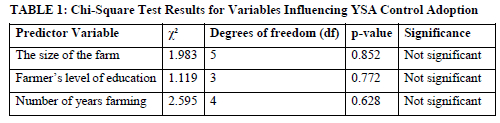
Table 1 presents a chi-square test of independence conducted to assess whether the farm size, farmer's education level, and number of years farming were significantly associated with the adoption of YSA control measures (Yes/No). The test results revealed no statistically significant associations for the predictors examined. Specifically, the association between the size of the farm and YSA control adoption was insignificant, χ2 (5, N = 41) = 1.983, p = 0.852. Similarly, the level of education and YSA control adoption was not significant χ2 (3, N = 40) = 1.119, p = 0.772. The number of years in farming and YSA control adoption showed no significant relationships with the likelihood of adopting YSA control practices χ2 (4, N = 41) = 2.595, p = 0.628. These findings suggest that, within this sample, demographic and farm characteristics such as size, educational level, and experience did not independently influence farmers' decisions to implement pest-control measures.
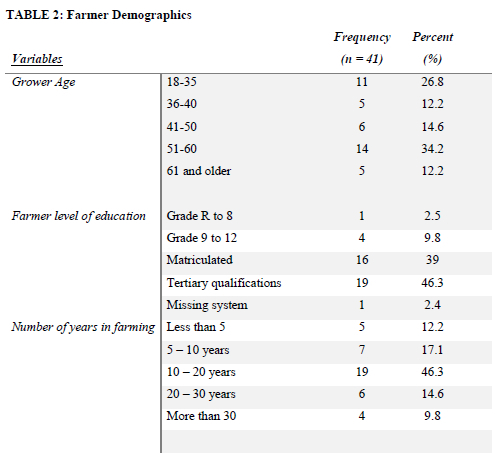
Despite the lack of statistically significant associations. Table 2 offers important insight into the descriptive findings. The majority (34.2%) of the respondents were 51 to 60, with youth constituting 26.8% of the sample. Younger farmers are more willing to take risks and experiment with new control measures. The possibility of increased yields and long-term sustainability is frequently their driving force. Older farmers tend to be risk-averse and favour tried-and-true techniques. Their desire to preserve stability and reduce possible losses often influences their choices. Younger farmers may have better access to digital tools and platforms that provide information on YSA management. They are also more likely to participate in training programmes and workshops. Older farmers may face challenges accessing modern resources and technologies (Baker & Luke, 2020) since youth are not afraid of taking risks but lack experience in sugarcane farming. In contrast, older farmers are risk-averse and have experience in the sector. The study recommends a more balanced approach to YSA management, which harnesses the strengths of youth and older farmers and encourages them to support one another.
Almost 10% of the farmers had achieved an education level between Grade 9 and matric, 39% had matriculated, and 46.3% had attained tertiary qualifications. Only 2.5% of farmers had an education level between Grade R and Grade 8. Compared to other studies, such as Mangoejane and Christian (2024), who found that while most cooperative farmers only had primary school education, the farmers in this study had much higher levels of education. This higher education level is relevant because literacy and language proficiency often facilitate access to and understanding of critical information about YSA such as pest scouting techniques, variety ratings, and chemical control guidelines (SASRI, 2019). Most respondents (46.3%) had between 10 and 20 years of farming experience, with 5 to 10 years being the second-largest group. Just 9.8% said they had been farmers for more than 30 years. This suggests that most farmers possess substantial experience in sugarcane production, which is likely beneficial for identifying and responding promptly to YSA outbreaks, even if statistical analysis did not reveal a direct link to YSA control adoption. Although the chi-square tests did not demonstrate statistically significant relationships, the farmers' relatively high levels of education and extensive experience remain important contextual factors. These qualities probably assist farmers in managing their farms better and responding to pest problems, even though they were not directly linked to using YSA control measures in this study.
3.2. Enterprise Management Before Acquisition and Land Under Sugarcane
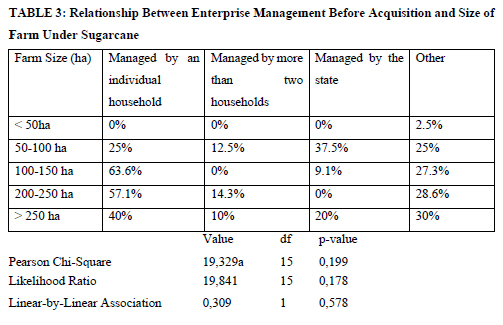
Table 3 presents the relationship between enterprise management before acquisition and the farm size under sugarcane cultivation was explored using a Pearson chi-square test of independence. The likelihood ratio test further supported the results, which showed no statistically significant relationship between these two variables, χ2 (15, N = 40) =19.33, p = 0.199, χ2 (15) =19.84, p = 0.178. Likewise, the results of linear-by-linear association test were non-significant χ2(1)=0.31, p = 0.578. Directional measures using Eta also indicated weak relationships, whether land under cane was treated as the dependent variable (η = 0.131) or enterprise management (η = 0.291). Although no strong statistical associations were found, the descriptive analysis provides valuable insights into the patterns of land management. Among farms with between 100 and 150 hectares under cane, a majority (63.6%) were previously managed by individual households.
Management histories became more mixed on farms larger than 250 hectares; 40% were previously managed by individual households, 30% by "other" entities, and 20% by the state. Notably, the only farm with less than 50 hectares was previously managed by an "other" entity, while farms between 50 and 100 hectares often had a history of state management (37.5%). These findings suggest that individual household management was more prevalent in mid-sized operations, while state or communal management forms were distributed across various farm sizes. The data show that farm size not only influences the scale of production but also plays a role in determining how land is held and managed among beneficiaries. Specifically, the distribution of farm sizes revealed a distinct tendency toward small group ownership structures. These results suggest that the possibility of involving multiple households to share the managerial, labour, and financial responsibilities increases with farm size. This trend shows that farm size influences how farmers must work together and manage farms in land reform projects.
3.3. Land Ownership or Rights and Land Under Sugarcane
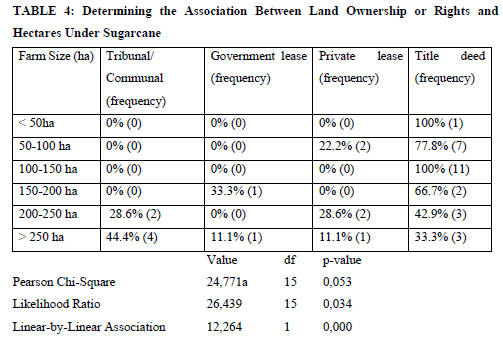
Table 4 presents a second Pearson chi-square test was performed to determine the association between land ownership or rights and the number of hectares under sugarcane. The Pearson chi-square result approached significance, χ2(15, N=40) =24.77, p=.053. The likelihood ratio was statistically significant, χ2(15) =26.44, p=.034, and the linear-by-linear association was highly significant, χ2(1) =12.26, p<.001, indicating a strong linear trend between these variables. Eta values indicated a moderate-to-strong relationship. When land under cane was the dependent variable, η=.561. When land ownership or rights were the dependent variable, η=.602. Descriptive results showed that all farms (100%) with more than 100 but less than 150 hectares under cane operated under title deed ownership.
Farms with more than 250 hectares were mostly held under tribal/communal (44.4%) and title deed (33.3%) arrangements. Farms between 50 and 100 hectares were predominantly under title deed ownership (77.8%), followed by private lease (22.2%). Farms with less than 50 hectares had title deeds (100%). Farms with title deeds were more likely to have substantial areas under cane, particularly in the 100-150 ha range. In contrast, tribal/communal ownership was more common in the largest farms (250+ ha). Owning title deeds is important because it assists farmers in investing for the future and taking good care of the farm, especially where there is little support from government or other institutions. (Robinson et al., 2022). These ownership patterns between tribal/communal and private lease reinforced the idea that secure land tenure is critical to successful farming enterprises within land reform initiatives.
3.4. The Effect of Land Ownership Rights and Training Attendance on YSA Control Adoption
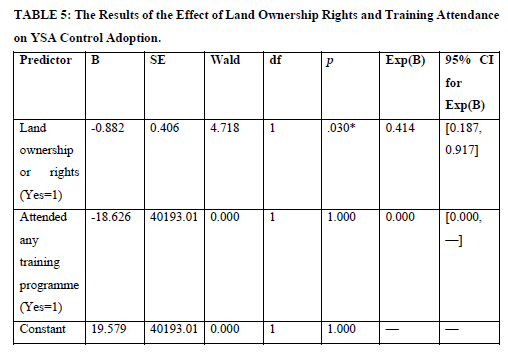
Table 5 presents the results of the effect of land ownership rights and training attendance on YSA control adoption. The Omnibus Test of Model Coefficients: χ2 (2) = 5.40, p = 0.067, Nagelkerke R2 = 0.268, Hosmer and Lemeshow Test: χ2 (3) = 1.51, p = 0.680 and Classification Accuracy, the model correctly classified 87.5% of cases. A binary logistic regression analysis was performed to assess the extent to which land ownership rights and training attendance predict YSA control adoption in farming. With χ2 (2, N = 32) = 5.40, p = 0.067, the whole model with both predictors was not statistically significant, suggesting that the model did not accurately differentiate between people who used and did not use modern technologies. The model appears to fit the data well, as indicated by the non-significant results of the Hosmer and Lemeshow goodness-of-fit test (χ2 (3) = 1.51, p = 0.680). The model accurately classified 87.5% of cases and explained roughly 26.8% of the variance in technology use (Nagelkerke R2 = 0.268). One of the predictors, land ownership rights, contributed significantly to the model, even though the model was not significant at the 5% level. With an odds ratio of 0.414 (95% CI [0.187, 0.917], p = 0.030), participants who stated that they owned or had land rights were significantly less likely to use modern farming technologies. This implies that a 58.6% decrease in the likelihood of implementing contemporary agricultural technologies was linked to land ownership.
3.5. Seasonal Pest, Symptoms, Infestation Rates, and Control Measures
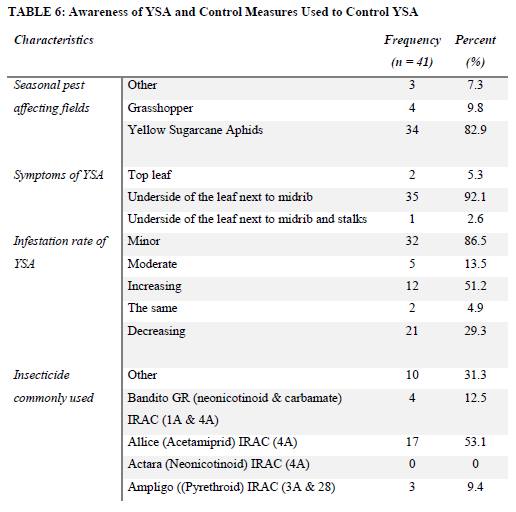
The results of this study (Table 6) show that the YSA was identified by most respondents (82.9%) as the primary seasonal pest affecting their sugarcane fields. The YSA outbreak causes infestation damage by feeding on plant sap, particularly on the underside of sugarcane leaves. This activity leads to chlorosis, stunted growth, and, in severe cases, stool mortality (SASRI, 2019). These physiological impacts directly reduce cane tonnage per hectare, negatively affecting overall yield and income, especially among land-reform farmers. Although limited data is quantifying the full economic impact of YSA in South Africa, local reports indicate that the 2018 and 2019 outbreak in KwaZulu-Natal, particularly in Gledhow and Darnall, led to substantial yield losses, threatening the sustainability of smallholder and land-reform sugarcane farms (Rutherford, 2023). The economic devastation of YSA has been historically documented internationally. For instance, during an outbreak in Puerto Rico in the 1960s, it was estimated that approximately US$1.2 million was lost due to the destruction of 1,600 to 2,020 hectares of young sugarcane, with a further 20,200 hectares infested (Madiope et al., 2021). These figures suggest that, if left unmanaged, YSA infestations can cause economic impacts, especially in resource-constrained farming environments.
In this study, 92.1% of participants observed YSA symptoms on the underside of the leaf next to the midrib, a finding consistent with observations by the South African Sugarcane Research Institute (SASRI, 2018), which describes YSA damage as causing leaf yellowing/reddening and the presence of brownish-red puncture marks. Most farmers (86.5%) reported minor infestation rates during winter, which aligns with the pest's known seasonal behaviour, with peak infestations typically occurring in spring and summer. The seasonal nature of YSA underscores the importance of timely scouting and preventative control measures. Regarding pest control, most farmers (53.1%) reported using Allice (Acetamiprid), a pesticide classified under IRAC group 4A, to manage YSA. This is consistent with the recommendations made by SASRI (2019), which, as a longer-term solution, has proposed management strategies that include using pesticides and developing varietal resistance.
However, these measures come with higher costs, such as those related to scouting, chemical inputs, and, in certain situations, replanting because of stool death. YSA infestations have an impact on sucrose content outside of farms, which lowers the quality of cane that is shipped to mills. The entire value chain is impacted by this quality decline, which also impacts community economic resilience, employment, and mill profitability. These issues negatively impact land-reform farmers since they usually lack the financial resources and technical assistance necessary to implement effective pest management plans. As a result, YSA's economic effects go beyond yield loss and endanger the long-term sustainability of land reform initiatives and rural development objectives in South Africa's sugarcane-growing regions.
4. CONCLUSION AND RECOMMENDATIONS
4.1. Conclusion
This study assessed land-reform farmers' understanding of YSA, the dissemination of YSA knowledge, and how farmers manage the pest in KwaZulu-Natal. The findings revealed that farmers had a relatively high awareness of YSA symptoms and its seasonal behaviour, with most participants correctly identifying infestation signs and employing chemical control methods. Demographic characteristics like education, farm size, and years of farming experience had no significant association with adopting YSA control measures, even with a high level of education and extensive farming experience. While older farmers favoured conventional techniques, younger farmers demonstrated a greater willingness to embrace new ones. Land ownership, primarily through title deeds, was found to be important for long-term farm management and investment, but it did not always indicate the adoption of pest control. Overall, despite farmers' awareness of YSA, financial limitations, experience gaps, and uneven support networks continue to hinder the successful implementation of control measures.
4.2. Recommendations
Continued farmer education should focus on practical pest management, including integrated pest management (IPM) approaches, to translate knowledge into effective practices. Special emphasis should be placed on building confidence among younger and older farmers. Encourage mentorship and collaboration between experienced older farmers and more risk-tolerant younger farmers to balance traditional knowledge with openness to innovation in pest control. Provide targeted subsidies or financial assistance to land-reform farmers to cover the costs of pesticides, scouting tools, and replanting efforts necessary for YSA management.
Strengthen land rights (particularly title deed ownership) to encourage farmers to invest more confidently in long-term pest management and sustainable farming practices. Use digital tools, workshops, and community demonstration plots to broaden the reach of up-to-date YSA control methods, especially to farmers in remote areas. Department of Agriculture and Rural Development in Kwa-Zulu Natal (DARD), South African Sugarcane Research Institute (SASRI), such as the Researchers and Biosecurity Teams, should develop specific YSA management guidelines tailored for smallholder and land-reform farmers, coupled with regular monitoring and technical support programmes. SASRI is still undergoing research, which will have management strategies that involve applying pesticides and the development of varietal resistance to YSA as a longer-term solution.
REFERENCES
- BAKER, C. & LUKE, H., 2020. The impact of age on farmer behaviours. Australia: Soil Cooperative Research Centre.
- FOOD AND AGRICULTURE ORGANISATION OF THE UNITED NATIONS (FAO)., 2018. Food Outlook: Biannual Report on Global Food Markets. FAO Trade and Markets Division.
-
GLEDHOW SUGAR COMPANY., 2020. Growers. Available from https://www.gledhowsugar.com/growers
» https://www.gledhowsugar.com/growers - MADIOPE, K.W., Fourie, D.V. & Keeping, M.G., 2021. Quantifying yield loss to yellow sugarcane aphid in potted sugarcane. Proc S Afr Sug Technol Ass., 93: 145-148.
- MANGOEJANE, T.P. & CHRISTIAN, M., 2024. An entrepreneurship framework for improved productivity and financial performance of primary agricultural cooperatives in North West Province. S. Afr. J. Agric. Ext., 51(3): 17-30.
- METISO, H. & TSVAKIRAI, C.Z., 2019. Factors affecting small-scale sugarcane production in Nkomazi Local Municipality in Mpumalanga Province, South Africa. S. Afr. J. Agric. Ext., 47(4): 1-8.
- NATIONAL PLANNING COMMISSION (NPC)., 2012. National Development Plan: Our Future - Make It Work. The Presidency of the Republic of South Africa.
- ORGANISATION FOR ECONOMIC CO-OPERATION AND DEVELOPMENT - FOOD AND AGRICULTURE ORGANIZATION OF THE UNITED NATIONS (OECD-FAO )., 2018. Agricultural Outlook 2018-2027: Sugar. OECD FAO.
- RUTHERFORD, S., 2023. Yellow Sugarcane Aphid (YSA), Information Sheet. SASRI.
- ROBINSON, B.E., DIOP, M., HOLLAND, M.B. & MASUDA, Y.J., 2022. Land tenure security and sustainable development. Cham: Palgrave Macmillan.
-
SOUTH AFRICAN SUGAR ASSOCIATION (SASA)., 2019. Transformation update to the Parliamentary Portfolio Committee for Trade and Industry. Available from https://www.thedtic.gov.za/wp-content/uploads/TRANSFORMATION.pdf
» https://www.thedtic.gov.za/wp-content/uploads/TRANSFORMATION.pdf -
SOUTH AFRICAN SUGARCANE RESEARCH INSTITUTE (SASRI)., 2019. Yellow Sugarcane Aphid. The Link, May 2019, 28(2). Available from https://sasri.org.za/wp-content/uploads/Sugarcane-Farming/Publications/The-Link-May-2019.pdf
» https://sasri.org.za/wp-content/uploads/Sugarcane-Farming/Publications/The-Link-May-2019.pdf - ZULU, N.S., SIBANDA, M. & TLALI, B. S., 2019. Factors affecting sugarcane production by small-scale growers in Ndwedwe Local Municipality, South Africa. Agric., 9(8): 170.