Enabling Small-Scale Grower Sugarcane Quality Management with Smartphone and Crop Spraying Drone Technologies
Abstract
In South Africa, ripeners are aerially applied to sugarcane in large-scale grower fields to improve cane quality. Small-scale growers (SSGs) generally have not experienced these benefits, mainly because of the small fields and their fragmented distribution. The recent commercial approval of crop-spraying drones creates ripening opportunities for SSGs because drones can operate effectively in these small fields. Furthermore, the PurEst® quality management smartphone application can assist these growers with ripening and harvest scheduling decisions. This paper describes the collaboration between researchers, extension specialists, growers, and other industry participants, enabling SSG cane quality management. Sixteen participatory drone ripening demonstration trials and 48 field days were conducted at 11 SSG locations. The first series of field days centred around the concepts of cane maturity assessment and ripening decision-making. Trial fields were then subdivided into unsprayed and ripener treatments and more field days were convened for SSGs to observe the drone spraying. The concluding field days before harvest are centred around ripener efficacy assessment and harvest scheduling. The demonstration trials elicited considerable interest in the available smartphone and drone spraying technologies but also revealed challenges that must be tackled to bridge the gap between demonstration and broader implementation.
Chemical Ripening; Crop Spraying Drones; Extension; Participatory Research; Small-Scale Growers; Sugarcane
1. INTRODUCTION
Ripeners improve low juice quality in sugarcane stalks caused by prolonged periods of vigorous crop growth (Legendre, 1974; Resende, Soares & Hudetz, 2000; van Heerden, Eggleston & Donaldson, 2014). Through manipulation of plant growth processes, these chemicals accelerate stalk ripening. Large-scale growers who adopt chemical ripening best practices unlock sucrose yield potential and associated economic benefits on their farms. An important component of chemical ripening best practice is the concept of informed ripening decision-making. The South African Sugarcane Research Institute (SASRI) developed a smartphone application (PurEst®) that, together with the use of a hand-held refractometer, enables growers to make informed decisions about ripening and harvesting (Mfeka, Ngxaliwe & van Heerden, 2015; van Antwerpen, van Heerden, Tweddle, Cheong & Riviere, 2018).
In contrast to large-scale growers, small-scale growers (SSGs) in South Africa have generally not experienced the benefits of chemical ripening. The small field sizes and the spatially fragmented distribution of fields make it nearly impossible for conventional aerial crop-spraying methods to accommodate SSGs' cane quality management needs.
The recent commercial approval of crop-spraying drones in South Africa creates chemical ripening opportunities for SSGs because of the ability of these drones to apply chemical ripeners in fragmented small-field environments effectively. Furthermore, the PurEst® smartphone application can assist these growers with decisions about ripening and harvest scheduling (Ngcobo et al., 2018).
This paper aims to describe the collaboration between researchers, extension specialists, growers and other industry participants that were used to introduce cane quality management principles, the PurEst® smartphone application, and crop-spraying drone technology to the SSG sector. This was done in different SSG communities through a network of participatory demonstration trials.
2. RESEARCH METHODOLOGY
2.1.
Participatory Demonstration Trial SelectionIn collaboration with regional SASRI small-scale grower extension specialists, Department of Agriculture and Rural Development (DARD) agricultural advisors (Kwa-Zulu Natal trials), and TsGro agricultural services staff (Mpumalanga trials), a selection process was followed to identify suitable drone ripening participatory demonstration trial sites. Willing growers, willing harvesting and cane transport contractors, and the agronomic suitability of fields were the main selection criteria.
2.2.
Stakeholder Engagement WorkshopsOnce drone ripening demonstration trial sites were identified, a stakeholder engagement workshop was convened at each trial location. These workshops aimed to establish a collaboration between all the local stakeholders required to fulfil the objectives of each demonstration trial. These workshops involved the local SSGs, their harvesting/transport contractors, SSG community leadership, DARD agricultural advisors, TsGro staff, representatives of the two cane grower associations, cane procurement and cane testing staff from the local sugar mill, and SASRI research/extension specialists. A key outcome of these workshops was the development of a field day schedule for each demonstration trial.
2.3.
Field Days2.3.1. Cane Maturity Assessment Field Days
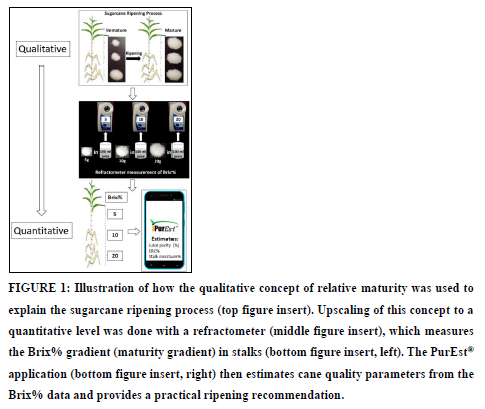
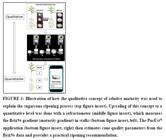
After the stakeholder engagement workshop, a field day was convened at each trial site to introduce the concepts of cane maturity assessment and chemical ripening decision-making. The well-understood qualitative concept of relative maturity, i.e., that not all parts of a sugarcane stalk are equally sweet, was used as the foundation to introduce the more complex concept of natural ripening in sugarcane. The qualitative concept of relative maturity was visualised using crystal sugar heaps of varying size, and the concept scaled up to a quantitative level through measurement of Brix% with a hand-held refractometer from cane juice squeezed out of sugarcane stalks at specific points along the length of the stalks (Figure 1). Demonstrations at the field day included input of the Brix% data into the PurEst® smartphone application, discussing the estimates of cane quality and linked chemical ripening recommendations provided by the application (Figure 1).
After the field day, the mapping of maturity and cane yield estimates across the demonstration trial field was done at GPS-referenced monitoring points. At each monitoring point, three randomly selected stalks were used for maturity testing with a refractometer and PurEst® [according to a standard method (SASRI, 2020)]. Stalk height measurements (from ground level to the natural breaking point) of 20 randomly selected stalks at each monitoring point were used to estimate cane yield according to a method commonly used by SASRI extension specialists (SASRI, 2019). The maturity and cane yield variability across the demonstration trial field were analysed and used to balance best the two treatment areas (the area left untreated as the control and the area for ripener spraying with a drone).
2.3.2. Drone Spraying Field Days
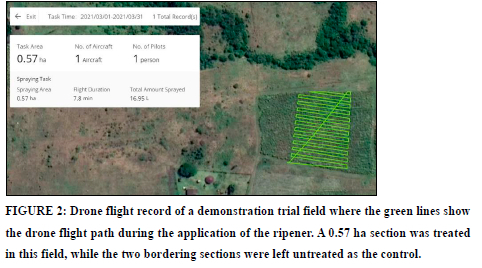
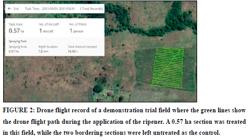
On the agreed spray date, a field day was convened so that the SSGs and other participants could observe the drone application of the ripener treatment. Comparisons across trials were made possible by applying the same product [Orca®, containing the active ingredient fluazifop-p-butyl (125 g/L active ingredient formulation)] at the same rate (0.33 L/ha in a water volume of 30 L/ha) in all trials. Depending on the harvest month, the ripener was applied 42-56 days before the planned harvest date. Agricultural drone specialist PACSys (PTY) Ltd was contracted to use ripener treatments. Each field was sprayed as closely as possible after sunrise with a DJI Agras T20 or T30 drone (Figure 2).
2.3.3. Ripener Efficacy Assessment Field Days
Shortly before the planned harvest date, another field day was convened for each demonstration trial to introduce the concepts of ripener efficacy assessment and harvest scheduling. Several stalks from the treated and untreated sections of the field were collected and used to demonstrate the visual effects of fluazifop-p-butyl application. Upscaling visual to quantitative assessment followed the same process illustrated in Figure 1. The observed changes in Brix% values and cane quality parameters between spraying and harvest were recorded on flipchart sheets and discussed with the SSGs.
2.4. Data Analysis
The PurEst® application provides in-field estimates of specific laboratory-determined cane quality parameters used in the South African sugarcane industry. One of these, the Estimated Recoverable Crystal Percent (ERC%), indicates the content of dissolved sucrose in the cane juice expected to be recovered during milling. The infield cane yield estimates (tons cane per hectare) and the PurEst® derived estimates of ERC%, measured at the monitoring points before spraying and shortly before harvest, were used to determine the crop response to ripening.
These data determined the relative change in the ERC% and cane yield between spraying and harvesting for both treatments. Each treatment's ERC yield (Eqn. 1) increase was estimated. An economic analysis was conducted, which considered the input costs of the ripening, harvesting and cane transport specific to each SSG that hosted a demonstration trial.

The results obtained in each trial were presented to the SSGs and other stakeholders at post-trial grower days and workshops with industry representatives.
3. RESULTS AND DISCUSSION
3.1. Participatory Demonstration Trial Network
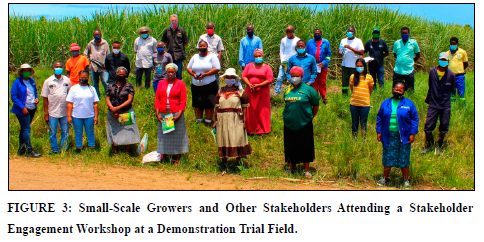
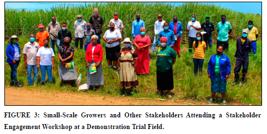
Through the selection process described in section 2.1, 16 demonstration trial sites were established at 11 diverse SSG locations in Kwa-Zulu Natal and Mpumalanga, covering both rainfed and irrigated production systems. A total of 16 stakeholder engagement workshops and three field days per trial (48 field days in total) were convened, which resulted in sustained interaction with many SSGs and other stakeholders (Figure 3).
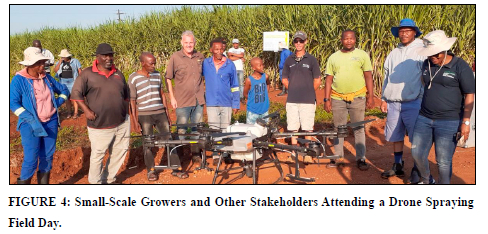
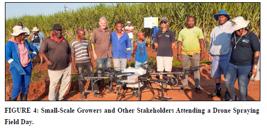
The ripener treatments were successfully sprayed with the drone in all the demonstration trials and attracted significant interest from the local communities (Figure 4).
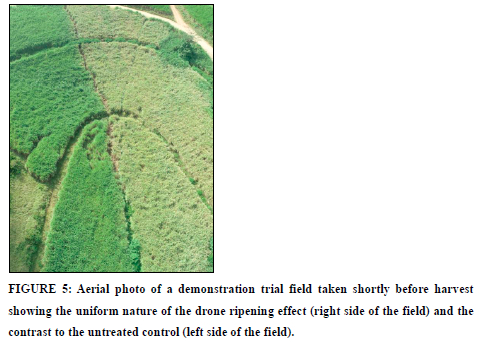
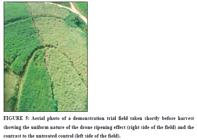
As harvest time approached, the ripener treatments caused the typical visual appearance of ripened cane that was in contrast with the appearance of the untreated parts of the fields. In many trials, these differences were clearly visible to the local communities from the ground. Aerial photos of the trials were also taken shortly before harvest to show the uniform treatment application achieved with the drone (Figure 5).
3.2. Ripener Efficacy Assessment
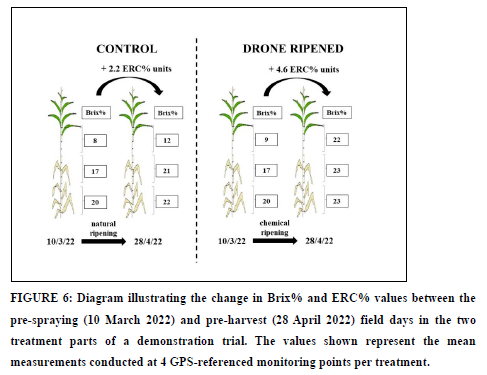
Measuring Brix% values with a refractometer in stalks collected from the treated and untreated parts of the demonstration trial fields was a very effective method of demonstrating ripener efficacy to the SSGs. For each trial, the results collected on the field day before drone spraying were compared to those gathered on the field day shortly before harvest and presented to growers as a diagram (Figure 6). This visualised the natural and chemical ripening processes that occurred simultaneously within the same field between the two field days. The PurEst® smartphone application was then used to estimate the increase in ERC% in the stalks between the two field days. In the case shown in Figure 6, the Brix% values of cane juice collected near the top of the stalks from the untreated control part of the field increased from 8% to only 12% during the two field days due to natural ripening. In contrast, the Brix% values increased from 9% to 22% in the ripened part of the field. The ERC% in the untreated control part of the field increased by 2.2 percentage units between the two field days, while the ERC% increase in the drone-ripened field was much greater, at 4.6 percentage units.
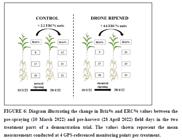
This method enabled a better understanding amongst SSGs of natural and chemical ripening processes and the added benefit of chemical ripening on cane quality in each demonstration trial.
3.3. Yield and Gross Margin Responses
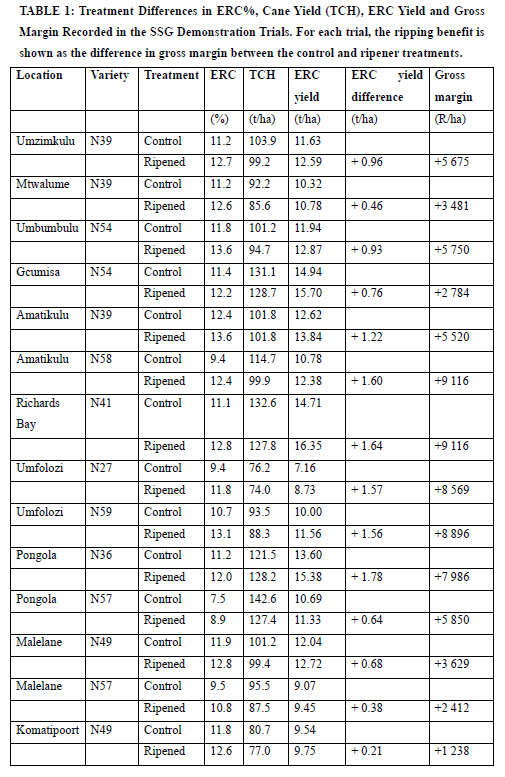
The ripener treatments increased ERC% in all trials (Table 1). In most trials, the ripener treatments achieved a lower cane yield than the control treatments because of the known growth restriction effect of fluazifop-p-butyl, which is required to trigger the accelerated ripening process. In all trials, the increases in ERC% overridden the restriction effect on cane yield, leading to ERC yield increases ranging between 0.21 - 1.78 tons per hectare (Table 1). These increases in ERC yields are well-aligned with results from previous research trials and participatory demonstration trials with large-scale growers (van Heerden et al., 2015; van Heerden, 2019; van Heerden & Ramusandiwa, 2021).
Considering the input costs of ripening, harvesting, and cane transport, specific to each SSG who hosted a demonstration trial, the calculation of gross margin gains brought about by drone ripening was allowed. Gross margin increases over the unsprayed control treatment ranged between R1 238 - R9 116/ha (Table 1). The influence of the growing conditions and sugarcane variety on the economic outcome achieved was explained. This elicited rich discussions with the growers on their variety choices and access to seed cane sources.
3.4. Challenges to Wider Implementation and Possible Solutions
These demonstration trials triggered interest in ripening opportunities and drone spraying technology among the SSGs. However, during the engagement with these growers, it became clear that challenges need to be solved before bridging the gap between demonstrations and wider implementation could be expected.
Because of the limited availability of drone spraying contractors, even sometimes within the large-scale grower sector, most SSGs will have difficulty accessing the drone-spraying technology. Other factors that will contribute to this difficulty are the remoteness and fragmentation of the SSG sector, as well as the general lack of coordinated harvest planning. Without a harvest plan for a particular SSG area, it will be difficult for a drone spraying contractor to assess the total treatment area available for spraying and the associated business merit of such a venture.
The mapping of small-scale grower fields at the mill supply level will be the foundation for efficient coordination of ripener spraying and harvest planning. Once in place, the current scarcity of drone spraying contractors could be ameliorated by establishing local spray contractors within the SSG communities through development programmes.
Another hurdle to cross is gaining the acceptance of harvest and transport contractors that treated crops, which require more precise harvest scheduling and quicker delivery to the mill to enable the SSGs to achieve the best return on their investment in ripening. Contractor roadshows that extension specialists from SASRI are presently driving could be leveraged to gain a better acceptance of this necessity.
Finally, despite conducting participatory demonstration trials in many SSG regions, reaching a relatively small number of the total SSG cohort in the South African sugarcane industry was possible. Further engagement, using a targeted knowledge exchange strategy, will be needed for their continuous education on and broader adoption of chemical ripening. A follow-on knowledge exchange project is being conceptualised to address these remaining challenges.
4. CONCLUSIONS
By applying the multi-stakeholder collaboration and participatory approach described in this paper, 16 drone ripening demonstration trials were successfully conducted at various locations in the SSG sugarcane sector. The measurement of Brix% gradients in stalks to quantify the maturity state of sugarcane and the use of the PurEst® smartphone application was a very effective method of engagement with the SSGs. Ripening benefits, regarding higher ERC yields, ranged between 0.21-1.78 t/ha. Although the demonstration trials triggered great interest in ripening opportunities and drone spraying technology, it also became clear that challenges need to be solved before bridging the gap between demonstrations and wider implementation could be expected.
5. ACKNOWLEDGEMENTS
Special thanks go to PACSys (PTY) Ltd. for applying the ripeners, to the various industry stakeholders for their support, and to the SSGs who allowed us to conduct these trials.
REFERENCES
- LEGENDRE, B.L., 1974. Testing chemical ripeners for sugarcane in Louisiana. Proc. Am. Soc. Sug. Technol., 3: 28-33.
- MFEKA, Y.T., NGXALIWE, S. & VAN HEERDEN, P.D.R., 2015. Development of a whole-stalk juice purity calculator to simplify chemical ripener decision-making: Preliminary findings. Proc. S. Afr. Sug. Technol. Ass., 88: 425-428.
- NGCOBO, P.M., GIDA, Q., MKHUNGO, L.H., MNYANDU, G.V., NZIMANDE, S.C., HLELA, S., VAN HEERDEN, P.D.R., GILLESPIE, W.A. & MDUNGE, G.M., 2018. The use of the PurEst® application to commercialise small scale sugarcane farmers through synergised extension. Proceedings of the 52nd Conference of the South African Society for Agricultural Extension., 42-44.
- RESENDE, P.A.P., SOARES, J.E. & HUDETZ, M., 2000. Moddus®, a plant growth regulator and management tool for sugarcane in Brazil. Sug. Cane Int., April 2000: 5-9.
- SASRI., 2019. Illustrative guide to sugarcane farming.
- SASRI., 2020. SASRI Information Sheet 4.7 - Determining crop maturity for purposes of cane quality management.
- VAN ANTWERPEN, R., VAN HEERDEN, P.D.R., TWEDDLE, P., CHEONG, R.N. & RIVIERE, V., 2018. Advances in harvesting and transport of sugarcane. In P. Rott (ed.), Achieving sustainable cultivation of sugarcane Volume 1: Cultivation techniques, quality andsustainability. Cambridge: Burleigh Dodds Science Publishing Limited, pp. 203-234.
- VAN HEERDEN, P.D.R., EGGLESTON, G. & DONALDSON, R.A., 2013. Ripening and post-harvest deterioration. In F.C. Botha & P.H. Moore (eds.), Sugarcane Physiology, Biochemistry and Functional Biology. USA: Wiley-Blackwell, pp. 55-84.
- VAN HEERDEN, P.D.R., ADENDORFF, M.W., LAGERWALL, G., BOTHA, P., CRONJÉ, C.P.R., VAN DER MERWE, J., NEL, N., SMITH, P., HÖLL, E., HYSLOP, G., SMITH, V., HARRIS, A., HARRIS, W., MHLONGO, J.B., HARRIS, D.M. & DHEOPURSAD, J., 2015. Grower-Extensionist-Researcher partnerships: On-farm demonstration trials to facilitate adoption of chemical ripening. Int. Sug. J., 117: 500-506.
- VAN HEERDEN, P.D.R., 2019. Response of selected South African coastal sugarcane varieties to chemical ripeners: Active ingredient effectiveness and associated impacts on grower and miller sustainability. Proc. S. Afr. Sug. Technol. Ass., 92: 18-21.
- VAN HEERDEN, P.D.R. & RAMUSANDIWA, T.D., 2021. Comparative efficacy and economics of the two hormonal mode-of-action ripeners Ethephon® and Moddus® in selected irrigated sugarcane varieties. Proc. S. Afr. Sug. Technol. Ass., 93: 158-161.