Resilience in Food Systems - Response and Adaptation to Shocks and Disruptions: The Case of the Phillipi Horticultural Area in Cape Town, South Africa
Abstract
This study explores the concept of food systems resilience. It studied the vulnerability to shocks and pressure of the Philippi Horticultural Area (PHA), a key urban food-producing region in Cape Town, South Africa. The PHA is critical for the city's food security but faces challenges such as rapid urbanisation, governance gaps, and socioeconomic pressures threatening its resilience and sustainability. Using a descriptive methods approach, the research collected data through surveys with stakeholders from the government, the private sector, NGOs, private individuals, and informal settlers. The study adopted the place-based approach emphasising the importance of community-led initiatives and local actors in managing food systems. The perspective highlights the significance of addressing challenges collaboratively within specific contexts. Key findings revealed insufficient governance commitment, a lack of multi-stakeholder collaboration, and the growing threat of urban development on agricultural land. The study also confirmed the importance of community-driven strategies to adapt to these challenges and build resilience. In conclusion, the research emphasises the need for integrated, community-centred, and multi-stakeholder approaches to safeguard the PHA's food system. To address these issues, the study recommends strengthening governance frameworks, promoting collaboration among diverse stakeholders, empowering community leadership, and protecting agricultural land from urban encroachment. These measures are crucial to maintaining the resilience and sustainability of this vital urban agricultural region.
Agricultural Crime; Food Security; Food System Drivers; Illegal Settlements; Urban Encroachment; Land Contestation
1. INTRODUCTION
Food systems are inherently complex and vulnerable to various shocks and pressures. The shocks and pressures include global change processes like population ageing, rapid urbanisation, and climate change; unexpected events such as natural disasters, pandemics, and financial or political crises; and unforeseen system responses to such disruptions (Tendall et al., 2015). These shocks impact food and land use systems and interact and amplify one another, growing in intensity and frequency, posing significant threats to food security (Elaydi, 2021). Building resilience within food systems is crucial in this increasing instability. Resilience encompasses the system's capacity to recover from disruptions, adapt to change, and draw lessons from past experiences, without compromising the agency of individuals to resist harmful external influences or promote equity, justice, and inclusivity (Elaydi, 2021).
South Africa's food systems are profoundly shaped by systemic challenges such as inequality, poverty, and environmental change. The country faces a dual burden of undernutrition and obesity, with climate change further exacerbating vulnerabilities by threatening agricultural productivity, particularly in rural areas dependent on subsistence farming. Economic disparities, limited access to arable land, and water scarcity also strain food production and distribution systems. Urbanisation and shifting dietary preferences reshape food demand, increasing reliance on processed and imported foods. Efforts to build resilience in South Africa's food systems focus on sustainable agriculture, improving food supply chains, enhancing local production, and fostering equitable access to nutritious food. Addressing systemic issues like land reform, poverty reduction, and environmental sustainability is essential for creating a more resilient and inclusive food system.
The Philippi Horticultural Area (PHA) in Cape Town exemplifies these challenges and opportunities. As an urban farming hub, the PHA supplies roughly one-third of Cape Town's fresh vegetables and employs thousands of farmworkers (Govender & Mammon, 2020). However, it faces significant threats, including rampant crime, informal land occupation, and contested urban development. These vulnerabilities stem from underlying issues such as poverty, limited economic development, and unequal power dynamics. Building resilience in the PHA requires addressing these root causes to ensure its sustainability. Resilience strategies should aim to help the PHA adapt to external pressures, recover from disruptions, and promote equitable and inclusive food practices. By focusing on these goals, the PHA can continue playing a vital role in Cape Town's food security while serving as a model for broader efforts to enhance food system resilience in South Africa and beyond.
This study has several key objectives. The first objective is to identify and analyse the critical threats and vulnerabilities affecting the PHA food systems. The second objective focuses on developing actionable solutions and countermeasures to address the PHA's identified challenges effectively. The third objective seeks to create a strategic roadmap to guide sustainable agricultural development in the PHA region. The fourth objective involves designing a structured resilience framework enabling the PHA to withstand and adapt to future challenges and stresses. This will provide clear indicators to measure the effectiveness of implemented strategic initiatives.
The key elements have been defined in this section. A food system refers to all the components and processes involved in producing, processing, distributing, preparing, and consuming food. This concept also includes the socioeconomic and environmental impacts of these processes (HLPE-FSN, 2014). Food systems emphasise the interconnectedness of various actors and activities that sustain global, national, and local food security (Ericksen, 2008). Food security is the condition where all individuals consistently have access to sufficient, safe, and nutritious food to maintain an active and healthy life. It is structured around six key pillars: availability, access, utilisation, stability, agency, and sustainability (HLPE-FSN, 2020). These pillars highlight the multidimensional nature of food security and its evolving relevance to development contexts. Resilience refers to the ability of a system to absorb, recover, and adapt to shocks and stressors while maintaining essential functions such as food security and sustainability. Resilience encompasses three key capacities: absorptive, adaptive, and transformative (Tendall et al., 2015; Barrett & Constas, 2014). Shocks are unexpected, acute events, such as natural disasters or pandemics, that disrupt food systems. Stressors, in contrast, are long-term trends like weak institutions or environmental degradation that increase the vulnerability of food systems to shocks. Shocks can be classified as covariate, affecting large populations, or idiosyncratic, impacting individuals or households (Hoddinott, 2023; Dercon et al., 2005). The place-based approach is a strategy that emphasises community-led responses to food system management. It recognises specific territories' unique physical, social, and economic characteristics and encourages localised solutions to enhance resilience, sustainability, and equity. This approach integrates local resources and collective action to address community-specific challenges (Losch & May, 2023).
2.1. Theoretical Review
Resilience has emerged as a crucial lens for understanding the relationship between food security and development. It provides a conceptual framework to examine how food systems withstand and recover from disruptions while maintaining their core functions. As interconnected networks of actors and activities, food systems require resilience to address complex challenges such as globalisation, climate change, and public health crises (Resilience Alliance, 2002; Tendall et al., 2015). Three dimensions characterise the concept of resilience. First, it involves the ability to absorb acute or chronic shocks. Second, it entails the capacity to recover, allowing food security or other indicators to return to pre-shock levels. Finally, resilience includes avoiding adverse outcomes or achieving desirable well-being when exposed to shocks and stressors (Béné, 2020; Barrett & Constas, 2014). These dimensions underscore the importance of stability in maintaining food security, as households unable to stabilise key pillars such as access, availability, and food quality are considered food insecure (Béné & Devereux, 2023). Effective resilience-building strategies include increasing biodiversity, adopting diverse farming practices, and fostering adaptive governance. Technological innovations, such as climate-resilient crops and blockchain-based supply chain transparency, also significantly strengthen food system resilience. By integrating these measures, food systems can better withstand disruptions and support sustainable development (Cabell & Oelofse, 2012; Challies et al., 2018; Vermeulen et al., 2012).
2.2. Empirical Review
Empirical evidence underscores the vulnerabilities of food systems to various shocks and stressors. Notable examples include the 2008 global food price crisis and the disruptions caused by the COVID-19 pandemic. These events exposed systemic fragilities, particularly in low-income regions such as Ethiopia and South Africa, where disruptions exacerbated food insecurity and inequality (Mittal, 2009; Upton et al., 2023).
Place-based approaches have demonstrated effectiveness in enhancing resilience. For instance, the Philippi Horticultural Area (PHA) in Cape Town illustrates the importance of meso-food systems in balancing urban pressures with food production. Community-led initiatives in the PHA foster inclusivity, stabilise food supply chains, and promote sustainability. These efforts highlight the potential of place-based solutions to address the unique challenges faced by specific territories (Blay-Palmer et al., 2018; Caron et al., 2017).
Research indicates that the impact of shocks on food systems depends less on their frequency or intensity and more on the responses implemented by system actors. Strengthening governance, fostering diversity, and integrating local knowledge are key to building food systems that are robust, adaptive, and transformative. Resilience thinking thus offers valuable insights into mitigating the long-term effects of disruptions and fostering sustainable food security (Béné & Devereux, 2023).
The above review suggests that incorporating resilience thinking will likely contribute to food security and sustainable food systems by helping people cope with the shocks, complexity and unpredictability affecting food systems (Tendall et al., 2015). The literature confirms how place-based problems and their solutions can better reflect the reality of spatial dynamics within territories, where the community-based actors can coordinate and compete, and local resources can be 'activated' through group action and used to address a common problem. In this context, the place-based strategy can help with sustainability, re-localise food supply chains and create inclusive food environments.
2.3. Conceptual Framework
The place-based food systems conceptual framework emphasises the importance of local contexts in shaping resilient and sustainable food systems. It focuses on leveraging territorial characteristics-such as ecological, social, and cultural-alongside key actors (producers, consumers, intermediaries) to address food security and sustainability challenges. The framework highlights local food production, short supply chains, and participatory governance as core processes, while ensuring inclusivity, equity, and sustainability in achieving desired outcomes. It emphasises continuous adaptation through feedback loops, capacity building, and innovation, supporting localised solutions like urban agriculture and community-based initiatives. This framework fosters more resilient food systems tailored to specific geographical and social contexts by aligning local priorities with broader policies and strengthening governance.
3. METHODOLOGY
This article follows a qualitative research design. Qualitative analysis enables the researcher to code, develop and relate themes from the collected data. Primary data was collected through survey instruments, focus group discussions and key informant interviews. The key interview questions were administered to two representatives of non-governmental organisations (NGOs), two government officials, three farmers, land developers, two activists and three illegal settlers within the PHA. The interviews sought to ascertain the challenges and possible mitigations impacting building resilience in the PHA.
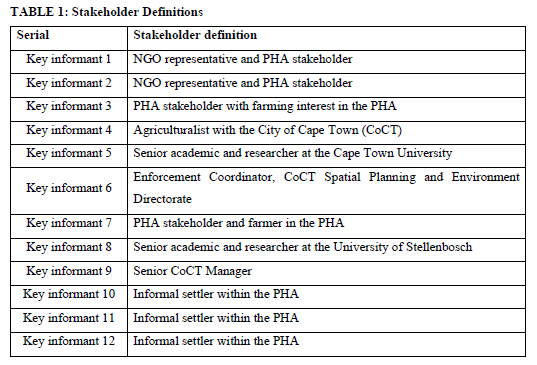
The interviews focused on ascertaining the main challenges that characterise the PHA, the ways and interventions to deal with the challenges, input into the development of a resilience plan for the PHA to adapt to future stresses, feedback whether the strategic plans for the PHA have failed along with possible reasons, the future outlook of agricultural production/activity in the PHA, suggestions on incorporating informal settlers into the resilience plan for the PHA and opinions on how the governance and management policy for the PHA should be constituted. The informants had the opportunity to recommend possible solutions to build resilience in the PHA. The study utilised interviews to collate responses from 12 stakeholders representing formal institutions in the government, private sector, NGOs, private individuals and informal settlers as indicated in Table 1.
Data analysis entailed transforming raw data, such as participants' responses and observational notes, into a coherent and appropriate representation of the research topic under study. The survey responses were analysed to generate descriptive statistics displayed as tables and graphs. Content and topic analysis were used to examine the qualitative responses and identify themes in the transcripts of participants' responses in the focus group discussions and key informant interviews. The researcher followed the six phases of conducting thematic analysis of Braun and Clarke (2006): Familiarisation of data, generating codes, combining codes into themes, reviewing themes, determining the significance of themes, and reporting findings. The study also employed the triangulation technique to bring out convergence, corroboration, and validation of the study results using the different methods.
4. FINDINGS
4.1. Shocks and Stressors to Food Systems - The Main Challenges Characterising the PHA
The PHA faces several interconnected challenges threatening its agricultural productivity and food security. These challenges include high crime rates, urban encroachment, population growth, inadequate municipal services, unemployment, and water pollution. The rapid population growth has driven increased housing demand, leading to urban development and the expansion of informal settlements within the area. According to a key informant, "We have to re-recognize a hard boundary around the PHA if it's going to be protected in perpetuity" (Key informant 8). The influx of people into the PHA has exacerbated land use competition between agricultural, residential, commercial, and industrial needs, with one respondent noting, "There is rapid urbanisation in the PHA driving competition for land use for agricultural or development-be it residential, commercial or industrial" (Key informant 9). Over time, the size of the PHA has shrunk due to these pressures, and municipalities face the challenge of responding to these growing urban demands sustainably.
The congestion within the PHA is another critical issue, with respondents highlighting that the area is increasingly overcrowded. One key informant stated, "The influx of people into the PHA [is] making the area very congested" (Key informant 4). At the same time, another commented on the inappropriate land use, saying, "Squatters are in the area which is not meant for housing" (Key informant 6). The expansion of informal settlements is compounded by a perceived lack of political will and government support, with some respondents expressing frustration at the inefficacy of housing delivery. One noted, "There is a lack of political will... [opportunities have been] squandered for basically short-term political gain" (Key informant 1), contributing to a worsening of the PHA's challenges.
The lack of basic municipal services, including electricity, water, and sanitation, has become a significant concern for the residents of informal settlements. Several respondents spoke about their dire living conditions: "There is no electricity, no water, and the roof is leaking" (Key informant 10), and another stated, "We have the same problems, bad toilets, no water, no electricity. We feel like children who have been thrown away" (Key informant 11). As respondents pointed out, these infrastructural deficits are compounded by the stressors caused by unemployment, which increases crime rates within the PHA. One key informant highlighted the link between informal settlements and crime: "Many of the people there [informal settlements] don't have jobs. So, they come and steal stuff (Key informant 2).
Crime, particularly theft of farm equipment and produce, was identified as a major threat to agricultural operations in the PHA. One respondent emphasised, "Farmers deal with a variety of problems daily, but the lack of security is the prominent dominating force. Criminality and theft of farm equipment... are a maj or threat to farming operations" (Key informant 5). Another informant stated, "Crime is our single biggest threat for the future existence of the PHA" (Key informant 6). Criminal activities, including the destruction of infrastructure, theft of crops, and vandalism of essential services such as borehole pumps, further strain the food system. As one informant recounted, "Crime is quite hectic. [Respondent] has to install cameras and get dogs. Hijacking and smash and grab is rife" (Key informant 2).
Additionally, the slow loss of agricultural land due to industrialisation and land sales by farmers has negatively impacted food production. External factors such as load shedding (power outages) and taxi strikes have disrupted the food system. The PHA is further threatened by water pollution, particularly affecting the Cape Flats aquifer, a primary water source for the region. The growing number of informal settlements and a lack of proper municipal services leave the area increasingly vulnerable to environmental and social stressors that undermine food security.
4.2. Possible Interventions to Deal with the Challenges in the PHA
Several potential interventions were suggested to address the numerous challenges facing the PHA. One of the primary interventions proposed was implementing the Municipal Spatial Framework (MSF), which was crucial for guiding development within the PHA and preventing harmful urban encroachment. A senior City of Cape Town (CoCT) official emphasised that the MSF could help restrict detrimental development, thereby preserving the agricultural land. Respondents expected the CoCT to lead in planning efforts, particularly regarding Environmental Impact Assessments (EIAs). A hybrid approach was suggested, where the CoCT could support or reject development applications that could undermine regional food security. As one key informant noted, "The intervention must basically have a sound and economic social purpose...the whole system has to be undergirded by a solid economic structure" (Key informant 1).
Proper land use planning was identified as another critical intervention. This includes acknowledging that urbanisation cannot be halted but ensuring that the State, through the CoCT, provides affordable housing opportunities on serviced land at the edges of the PHA, without encroaching on agricultural areas. Property owners should also be required to comply with zoning regulations, especially restricting construction on agricultural land. Respondents emphasised the importance of a "hard boundary" around the PHA to safeguard the farming area and maintain the integrity of agricultural land. A key informant suggested a "single farmer/agricultural voice" to represent the interests of farmers in land-use decisions.
To improve agricultural productivity, respondents recommended supporting farmers through training and encouraging the adoption of good business practices and a hybrid farming model to enhance output efficiencies. Additionally, promoting small-scale farming was seen as a way to create more job opportunities and provide valuable skills to the community. Building partnerships between farmers and the private sector was also highlighted as a potential strategy to strengthen the agricultural sector in the PHA.
A recurring theme in the responses was the need for improved safety and security in the PHA, with crime prevention being identified as a priority. Enhanced security services, including better police capacity, were deemed necessary to protect the area from criminal activities threatening farming operations and residents' livelihoods. One key stakeholder, a senior academic, argued, "If the management of the Cape Metropole realises the importance of the PHA, then a higher priority will be given to protecting it." These interventions suggest a multi-faceted approach to addressing the PHA's complex challenges, emphasising planning, security, and supporting agricultural productivity.
4.3. The Future of Agricultural Production/Activity in the PHA
When asked to consider different scenarios for the future of agricultural production in the PHA, respondents favoured the high agricultural production scenario, which was seen as achievable through the full utilisation of available knowledge and technology. They highlighted that the climate and soil conditions in the PHA were well-suited to support high production levels. Under this scenario, respondents believed the government would be motivated to implement legal protections for the area, ensuring policy certainty and attracting sufficient government attention to address existing challenges. However, they cautioned that without a spatial and legislative framework for land use, investor confidence would be diminished, increasing the likelihood of either low or medium production scenarios. One key informant stated, "If load-shedding continues, it will cause a low agricultural scenario, but if it stabilises, it will contribute towards a high output" (Key informant 9).
On the other hand, the low and medium agricultural production scenarios were seen as more probable if the current issues-such as poor safety and security, unreliable power supply, low crop yields, and ongoing challenges-persisted. A key informant emphasised that increasing agricultural production would require addressing several factors, including extending crop cycles, safeguarding agricultural land, improving security, and preventing land speculation: "To increase agricultural production entails increasing the crop cycles, protecting the available farming area, improving security and safety, ending speculation, and retaining farmers" (Key informant 1). Furthermore, some respondents expressed concern about the negative impact of policy uncertainty on the agricultural sector. As one respondent noted, "The low agricultural scenario is not one we would want to see or support. This would happen due to policy uncertainty about what the government would allow and won't allow" (Key informant 5).
While a high agricultural production scenario is seen as achievable with the proper policy framework and support, the future of agriculture in the PHA is highly dependent on addressing key challenges such as security, infrastructure reliability, and governmental support.
4.4. The Structure of the Resilience Plan for the PHA to Adapt to Future Stresses
A multi-stakeholder collaboration is essential for developing a resilience plan for the Philippi Horticultural Area (PHA), involving non-governmental organisations (NGOs), the public and private sectors, and the government, which must address the issues in the area. This resilience plan should co-create economic value with surrounding communities and could draw support from the Resilience and Climate departments within the city, which can offer feedback and assistance. The envisioned plan should include the following elements:
1. Promote Intensive and Labour-Intensive Farming: The resilience plan must focus on intensifying agricultural production while ensuring it remains labour-intensive to create economic opportunities for local communities. Political will and government efficiency are required to address the challenges in the PHA. One key informant emphasised, "Government can sometimes be too prescriptive, so it's important to get input from all stakeholders. The farmers and all PHA stakeholders must be involved" (Key informant 9).
2. Address the Loss of Farmland: The resilience plan must propose solutions to address the slow loss of agricultural land at the edges of the PHA, where land is being sold off for economic reasons. Respondents highlighted the pressure on available land for farming, as the demand for produce increases due to the growing number of wholesalers and the increasing population. One key informant noted, "The increase in wholesalers increases the need for more land. Better farming practices are required to optimise production systems and utilise inputs for better yields" (Key informant 3).
3. Combat Destructive Industrialisation: The plan should include strategies to curb the harmful industrialisation of the area, ensuring that the expansion of residential, commercial, and industrial zones does not compromise agricultural production. These proposals should also consider the impact of external factors such as load shedding and taxi strikes on the food system.
4. Preserve Underground Water Resources: Initiatives should be included to protect underground water from pollution, particularly from informal settlements upstream. The preservation of this vital resource is crucial for ensuring the continued sustainability of the agricultural operations in the PHA.
A significant concern raised by respondents was the lack of enforcement of existing land use regulations. Many respondents noted that agricultural land is often repurposed for residential and industrial use, undermining the agricultural potential of the PHA. One key informant pointed out, "The city allows people to build schools, factories, scrap yards, and houses on agricultural land" (Key informant 3). There was a consensus that the government must take more decisive action to regulate land use and prevent further encroachment into agricultural zones.
Suggestions for improving land use planning included allowing mixed-use developments and subdivision of land for small-scale farming. Respondents also emphasised the importance of involving farmers in land use planning discussions to address the agricultural community's needs. As one informant explained, "People are buying farmland but not farming it; they are building factories and scrap yards on it. We can't mix farms with residential land. We need to preserve agricultural land" (Key informant 2). A concerted effort by the government to enforce land use regulations and prevent the erosion of farming land is seen as crucial for the long-term resilience of the PHA.
4.5. Success Measurement of the Strategic Plans for the PHA and Drivers
When asked whether all the strategic plans for the Philippi Horticultural Area (PHA) had failed, opinions among respondents were varied. The consensus was that while the plans may have been well-conceived, their failure primarily occurred during implementation. Respondents identified several factors contributing to this failure, including missed opportunities, lack of resources, and insufficient stakeholder commitment. As one key informant put it, "The plans might have been very well conceived, but the execution of the plan is maybe the problem" (Key informant 1). Another informant noted, "The plan was not properly resourced, monitored and evaluated" (Key informant 2), highlighting a lack of effective management. There were also concerns about the operationalisation of the plans, with one informant asking, "Did it ever become an operational plan on the ground level and who was leading it?" (Key informant 3). Additionally, a key informant remarked that "there has been very limited success in the implementation of the strategic plans" (Key informant 8).
In contrast, city officials noted significant progress in implementing the strategic plans, particularly referencing the Indego report (Indego Consulting, 2018). One official explained, "We have adopted the Indego report, [we have] engaged with the PHA.. .and the farmers in the PHA, to see how we can help. Also, in the PHA, as part of our water security plans, we have our water augmentation strategy, where we are looking at tapping into the aquifer, extracting it and recharging it. So, we have engaged on those fronts with the PHA" (Key informant 9).
4.6. Future Prospects of Agricultural Production/Activity in the PHA
The future of agricultural production in the Philippi Horticultural Area (PHA) sparked mixed views among respondents. Some were optimistic, foreseeing significant potential for the area to remain productive and financially viable. One key informant remarked, "Future prospects for the area are very good, because people make money, and as long as people make money, they will continue to farm" (Key informant 6). Another noted the growth potential, emphasising the importance of collaboration: "I think it's got potential if we've got a proper partnership between traditional farmers, emerging farmers, government, the private sector, and NGOs" (Key informant 2).
However, almost all respondents acknowledged the threats to the area and emphasised the need for clear interventions to safeguard its agricultural future. As one respondent cautioned, "I think it's under threat if there's not some clear interventions there" (Key informant 1). At the same time, another warned that the PHA is particularly vulnerable if not properly managed, especially during election periods (Key informant 3). Several interventions were proposed, including safeguarding agricultural land from further encroachment, strategic planning for the area, improvements in safety and security, and fostering partnerships among stakeholders.
There were concerns about the irreversible consequences of inaction. One informant stated, "If we don't do it in 40-50 years' time, there won't be much PHA left. It will just be eroded by housing and industrial development, and it will be a great tragedy as we'll look back and we'll have a city that doesn't have a sustainable food supply and flies all its food in like everywhere else" (Key informant 2). This highlights the urgency of interventions to preserve the PHA for future generations.
Informal settlements within the PHA have contributed to the loss of agricultural land, with some farmers encouraging these settlements for economic reasons. City officials have also allowed multiple land uses, believing it supports landowners' incomes. However, this requires adaptive land use planning and zoning regulations that could accommodate a mix of uses while ensuring agricultural land is preserved (Key informant 5).
Several respondents stressed the need for food-sensitive planning to integrate agriculture into the city's ecosystem, with one key informant asserting, "The PHA should have the strongest protection available, and city and province should be on the same page on this" (Key informant 4). Additionally, farmers highlighted the importance of enhanced security to combat criminality and the influx of informal settlers, noting that these issues must be addressed for the agricultural future of the area (Key informants 1 and 6).
While some questioned the need to preserve the PHA for agriculture, given that food can be imported from other areas, others recognised the significant transportation costs and environmental impacts associated with sourcing food from distant locations. A CoCT Urban Agriculture department official explained, "The alternative areas can produce the required production, but transporting that same volume of production to the Cape from the alternative areas much further away will have an enormous carbon footprint." This highlights the longterm importance of preserving the PHA for local food production.
4.7. Suggestions On Incorporating Informal Settlers in the Resilience Plan for the PHA
Including informal settlers in the Philippi Horticultural Area (PHA) resilience plan generated polarised opinions. Most respondents supported their integration into the PHA's future, recognising the necessity of engaging with the settlers and addressing their needs. Those favouring integration argued that informal settlers were unlikely to leave the area and should therefore be included in any plans to ensure a more sustainable and harmonious future for the PHA.
4.7.1. Advocating for Integration
Several respondents emphasised the importance of incorporating informal settlers into the resilience plan, highlighting the potential for positive engagement and mutual benefit. One informant noted, "The informal settlers are not going anywhere, so they must be included in the resilience plan" (Key informant 6). Others supported the idea of involving settlers in the ongoing agricultural activities of the PHA, both as labour and for security purposes. One key informant suggested, "We need to make use of these people, instead of fighting w ith them, so that they can be utilised more effectively in the PHA... [they can] look after the farms and protect farming equipment" (Key informant 4). In this way, settlers could be integrated into the community, contributing to farm security while addressing issues like theft. Moreover, it was suggested that informal settlers, especially those officially recognised, should have a say in the sustainable future of the PHA. "The recognised informal communities should be involved in the sustainable future of the PHA" (Key informant 9). Many respondents believed that instead of evicting or marginalising the settlers, their integration into the agricultural economy could be beneficial, providing labour and acting as a buffer to external threats. There was also support for providing settlers with more stable housing arrangements and services, enabling them to contribute more effectively to the area's economy.
4.7.2. Challenges and Opposition to Integration
On the other hand, significant voices opposed integrating informal settlers into the PHA's plans. These individuals argued that informal settlers had no place in the area and should be relocated elsewhere. One informant vehemently stated, "The informal settlers have no right to be involved in the future of Philippi... the moment you tolerate or involve them, that gives them entitlement" (Key informant 6). This view was shared by others who expressed concerns over informal settlements encroaching on agricultural land and polluting resources like underground water. Another argument against integration suggested that informal settlers should be relocated to other residential areas, such as Mitchell's Plain or Gugulethu, to reduce the pressure on the PHA's agricultural land. "They must be in the residential area... not in the PHA, and the polluting of the underground water also" (Key informant 3). There were concerns that more informal settlements could emerge without proper controls, further compromising the area's agricultural viability. One respondent stated, "We don't have control over informal settlements, and they pop up all the time. We need a control mechanism in place" (Key informant 6).
4.7.3. The Need for a Balanced Approach
While the debate over integrating informal settlers was polarised, there was a general consensus on the need for a balanced and strategic approach. Several informants stressed that engaging with informal settlers and building trust through cooperation was key. Still, it must be done in a way that controls further expansion of informal settlements and ensures that agricultural land remains protected. As one respondent highlighted, "There must be trust building and listening from all sides. There must be agreement and control over further expansion" (Key informant 5).
4.7.4. Role of the City and Provincial Government
The respondents recognised the city and provincial government's central role in managing informal settlements. The city was urged to take a more active role in providing adequate housing in residential areas for informal settlers, including ensuring municipal services like water, electricity, and sanitation. It was suggested that the city should also provide services on invaded land it owns if the CoCT owns it. Moreover, the provincial government was seen as co-responsible for monitoring and addressing land grabs, focusing on providing proper housing solutions for informal settlers. Ultimately, while most respondents acknowledged the challenges posed by informal settlements in the PHA, they also acknowledged these communities' potential contributions as labour and consumers. The key to a successful resilience plan would be balancing accommodating informal settlers and safeguarding the area's agricultural future. This would require strategic land use planning, better control over settlement expansion, and active collaboration between all stakeholders involved.
4.8. Suggestions on Governance and Management Policy for the PHA
The respondents provided various policy suggestions for the governance and management of the Philippi Horticultural Area (PHA). These suggestions largely emphasised broad inclusion, multi-stakeholder collaboration, clear role definitions, and long-term commitment to sustainable management. Several key themes emerged from the responses.
4.8.1. Multi-Stakeholder Involvement and Coordination
A strong emphasis was placed on the need for multi-actor involvement in governance and management decisions. Key informants highlighted the importance of including diverse stakeholders in the decision-making process. For example, it was suggested that the governance structure must involve various stakeholders, such as the Department of Agriculture (DoA), spatial planning, resilience offices in the city, and local community representatives. One informant noted, "It must have a multi-actor platform, involving the Department of Agriculture (DoA), spatial planning and resilience office in the City" (Key informant 4). Additionally, the role of traditional farmers, emerging farmers, informal settlers, and market stakeholders was emphasised, ensuring that all key groups were represented in the decision-making processes. Another suggestion was the involvement of the "Eerste Nasie" foundation nation, the original inhabitants of the PHA, in governance. "There is need to involve the 'Eerste Nasie' foundation nation, the original inhabitants of the PHA" (Key informant 1). This inclusion would help ensure that the historical and cultural significance of the area is respected and that the governance plan incorporates the needs of those who have long been part of the region.
4.8.2. Clear Roles and Responsibilities
There was a strong call for clarity regarding the roles and responsibilities of various levels of government and other stakeholders in managing the PHA. Respondents noted that governance should be clearly defined, particularly concerning the management of the Green Strip-a critical area for agricultural activity in the PHA. Some respondents pointed out that the management of the Green Strip, whether by the City or the provincial Department of Agriculture, would influence the strategies and policies developed for the area. One informant mentioned, "If the City manages the Green Strip, the City must do the strategies and policies for the PHA" (Key informant 3). Further suggestions included a multidisciplinary approach, with the city taking charge of relevant aspects such as property management, resilience strategies, and economic growth, while also involving various departments such as water, law enforcement, and public safety. "There's a lot of departments that will come in within the strategy and policy... so, to draw up a strategy for the Green Strip, there's a lot of stakeholder engagement" (Key informant 4). This approach ensures that all sectors, from water management to economic development, are accounted for in the governance plan.
4.8.3. Devolved Responsibility and Local Involvement
Several informants emphasised the need for local ownership and responsibility within the governance structure. The idea was to encourage residents, organisations, and community leaders to take charge of their immediate surroundings and contribute to broader governance efforts. One respondent highlighted, "We need a self-management frame of mind and expertise to oversee the bigger picture but devolve the responsibility to your local occupants, church organisations, leadership structures" (Key informant 2). By empowering residents and leaders to take ownership of their communities, this approach aims to foster a deeper connection between governance structures and the daily realities of life in the PHA. In turn, this could lead to better long-term outcomes for the area as local stakeholders have a vested interest in maintaining the health and sustainability of the PHA.
4.8.4. Long- Term Vision and Leadership
Several respondents suggested that governance and management of the PHA would benefit from a long-term, visionary approach, guided by a leadership structure with a deep understanding of the area's needs. One suggestion was to create a dedicated department within the City of Cape Town (CoCT) that could focus specifically on the long-term requirements of the PHA. This department would be tasked with developing and overseeing policies, managing research, and coordinating stakeholders. The department would be led by someone with a long-term vision for the PHA's future, ensuring that policies were reactive and proactive. Additionally, this department could outsource research studies and collaborate with academics and policymakers to stay updated on best practices for agricultural, environmental, and community management in the region.
4.8.5. Coordination Between Provincial and Local Government
The governance and policy framework would also need to address the coordination between the local and provincial governments. The respondents expressed concern about a lack of coordination between the city and provincial government, particularly regarding agricultural policies. Some informants noted that the Western Cape Provincial Department of Agriculture should take the lead in managing agriculture-related policies in the PHA, with the City of Cape Town playing a role in enforcing by-laws, particularly those concerning water usage and conservation. "The policy should be managed by the WC provincial department responsible for agriculture; the City also has a role to play, but they get overruled by the WC government" (Key informant 6).
4.8.6. Importance of External Facilitation
Finally, there was a recurring suggestion to include external facilitation in the governance and policy-making process. The complexity of managing the PHA's various stakeholders and addressing the range of issues-from agriculture to land use-was seen as a challenge that would benefit from external facilitation to ensure that discussions remained open, transparent, and constructive. One respondent stressed, "The lack of consistent vision and contestations must be addressed with honesty, openness and willingness to listen to others - it must have external facilitation" (Key informant 8).
5. DISCUSSION
The findings of this study underscore the multiple and complex challenges that threaten the resilience of the Philippi Horticultural Area (PHA) as an essential urban food system. These challenges highlight the vulnerability of the PHA to external stressors, many of which are beyond the control of farmers and local stakeholders. While farmers can plan for certain contingencies, such as weather events, crop failure, or labour strikes, a broader set of stressors looms large. It increasingly undermines the PHA's ability to sustain itself as a productive agricultural hub. These stressors include high crime rates, encroachment by formal and informal urban developments, population growth, and inadequate governance and municipal support from the City of Cape Town (CoCT). The most significant concern among farmers revolves around the prevailing high levels of crime, driven by rising unemployment and the informal occupation of land. These factors have led some farmers to sell land and seek alternative livelihoods, thereby threatening the viability of farming operations in the area.
While perceived primarily as a threat by many respondents, urban encroachment also presents an opportunity for integrating the PHA more deeply into the surrounding urban fabric. While the area is increasingly surrounded by housing and industrial developments, the fact remains that much of the PHA remains minimally industrialised, with farming operations relying on relatively low-tech irrigation systems and manual labour. This allows sustainable agricultural practices to continue, particularly as the local market, consisting of approximately five million people within a 30km radius, is easily accessible. This proximity to the urban centre provides a unique advantage, enabling farmers to supply fresh produce to a local population with low transportation costs and minimal carbon emissions associated with food transport.
Despite this inherent environmental and economic advantage, the PHA's resilience has been eroded in recent years, primarily due to a lack of governance and foresight at all levels of government. Several respondents highlighted the inability of government entities to implement past development plans for the area, underscoring the fragmented and inconsistent approach to managing the region's agricultural potential. In particular, the failure to provide adequate housing elsewhere has exacerbated the issue of informal and formal urban encroachment on farmland, undermining the core agricultural activities of the PHA. This governance gap has hampered development and allowed stressors to accumulate unchecked, leaving the food system's resilience increasingly vulnerable.
The study's findings reveal strong support among respondents for a resilience plan that would help the PHA adapt to future stresses and shocks. Despite some concerns over the encroachment of informal settlements and the potential for land use conflicts with formal housing developments, there is a broad consensus around the idea of co-creating economic value with surrounding communities. This collaborative approach would not only help to address land use conflicts but also foster a shared responsibility for the future sustainability of the PHA. While acknowledging the challenges posed by urbanisation, many farmers expressed a willingness to work with surrounding communities, including informal settlers, to integrate them into the local economy. This highlights the potential for a more inclusive and integrated resilience strategy that recognises urbanisation as an inevitable force but also seeks to harness its potential benefits through strategic collaboration.
At the same time, it is clear that many of the stressors impacting the PHA's resilience can be mitigated through more effective governance and the proactive enforcement of existing laws and regulations. The CoCT has the power to manage land use, zoning, and pollution through its existing by-laws, yet these tools have not been sufficiently employed to address the mounting pressure on the PHA. Likewise, providing adequate housing in areas outside the PHA, improved infrastructure for food production and distribution, and better policing to reduce crime would go a long way in alleviating some of the most pressing concerns of local farmers. Creating a Management Association for the PHA, wherein property owners contribute to a fund dedicated to upgrading and improving the area, is a potential avenue for resource mobilisation, but is unlikely to resolve the fundamental issues that threaten the area's long-term resilience. Without broader governmental intervention and the effective enforcement of policies, this approach may only address superficial issues without tackling the root causes of the challenges faced by the PHA.
Ultimately, the resilience of the PHA food system hinges on coordinated, long-term efforts from government, private sector stakeholders, and local communities. Given the escalating risks posed by climate change, population growth, and urbanisation, there is an urgent need for a comprehensive resilience plan that not only preserves the agricultural viability of the PHA but also integrates it into the broader urban context sustainably and inclusively. A more proactive approach to governance, land-use management, and community engagement is essential for ensuring that the PHA can continue to serve as a vital food source for Cape Town's urban population while adapting to the inevitable future stresses.
6. CONCLUSION
The resilience of food systems is inherently fragile, particularly when exposed to many shocks and stressors that can interact and amplify one another, undermining the system's capacity to persist and thrive. This is evident in the Philippi Horticultural Area (PHA), where a combination of environmental, social, economic, and governance-related challenges has progressively threatened the viability of this crucial urban food system. While serving as a vital food source for Cape Town's rapidly growing population, the PHA faces considerable risks from urban encroachment, high crime rates, inadequate governance, and the increasing pressure of formal and informal housing developments. These stressors, compounded by limited municipal services and the socioeconomic impacts of high local unemployment, have exacerbated farmers' vulnerabilities and weakened the broader food system's resilience. Drawing insights from key stakeholders within a place-based approach, this study highlights the critical challenges and opportunities associated with sustainable land use and food security in the PHA. It confirms the urgency of addressing the root causes of these stressors, which are not merely external threats but reflections of deeper structural issues such as economic underdevelopment, governance failures, and a lack of foresight in urban planning. The resilience of the PHA food system, as demonstrated by over a century of sustainable farming, can be strengthened, but only through comprehensive, coordinated efforts across multiple levels of government and civil society. The findings from this study underscore the pressing need for more committed governance that actively enforces land-use regulations, enhances infrastructure, and takes a proactive approach to urbanisation. A collaborative, multi-stakeholder framework involving farmers, surrounding communities, government agencies, and the private sector must be prioritised to create a resilient and sustainable food system for the future. This approach should include clear responsibilities for managing land use, mitigating crime, securing essential resources such as water, and engaging marginalised communities in the economic life of the PHA. Ultimately, this study reinforces that resilience is not a passive characteristic of food systems but a dynamic quality that must be actively nurtured through targeted interventions, inclusive policies, and robust governance. As urbanisation continues to shape the future of the PHA, there is a unique opportunity to transform its challenges into a shared, sustainable solution for food security and community well-being. Through coordinated action, Cape Town's PHA can continue to thrive as a key urban farming area, maintaining its role as a sustainable food provider while adapting to the inevitable stresses of a rapidly changing world.
This study has several limitations, including its focus on a single geographic area, reliance on qualitative insights, and potential gaps in stakeholder representation, particularly among informal settlers and small-scale farmers. It provides a static view of challenges without capturing long-term trends or broader quantitative analysis. Future research should focus on quantitative assessments of resilience, longitudinal studies of governance and stressors, climate change impacts, and informal settlements' role. Comparative studies, innovative governance models, and technological interventions could further inform strategies to strengthen the resilience and sustainability of the PHA food system.
Funding was provided by the Food Systems Research Network for Africa (FSNet-Africa). FSNet-Africa is funded by the Global Challenges Research Fund (GCRF) as a Research Excellence project under the partnership between UK Research and Innovation (UKRI) and the African Research Universities Alliance (ARUA). FSNet-Africa is a flagship project in the ARUA Centre of Excellence in Sustainable Food Systems (ARUA-SFS), which is hosted by the University of Pretoria (South Africa) in collaboration with the University of Nairobi (Kenya) and the University of Ghana (Ghana). The authors report there are no competing interests to declare.
REFERENCES
2. LITERATURE REVIEW
-
BARRETT, C.B. & CONSTAS, M.A., 2014. Toward a theory of resilience for international development applications. In A.J. Bebbington, A.J. (ed.), Proceedings of the National Academy of Sciences. Available from https://www.pnas.org/doi/pdf/10.1073/pnas.1320880111
» https://www.pnas.org/doi/pdf/10.1073/pnas.1320880111 - BÉNÉ, C. & DEVEREUX, S., 2023. Resilience and food security in a food systems context. Cham, Switzerland: Palgrave Macmillan.
- BÉNÉ, C., 2020. Resilience of local food systems and links to food security - A review of some important concepts in the context of COVID-19 and other shocks. Food Secur., 12: 805-822.
- BIGGS, D., BIGGS, R., DAKOS, V., SCHOLES, R.J. & SCHOON, M., 2011. Are we entering an era of concatenated global crises? Ecol Soc., 16(2): 27.
- BLAY-PALMER, A., SANTINI, G., DUBBELING, M., RENTING, H., TAGUCHI, M. & GIORDANO, T., 2018. Validating the city region food system approach: Enacting inclusive, transformational city region food systems. Sustaina., 10(5): 1680.
- BRAUN, V. & CLARKE, V., 2006. Using thematic analysis in psychology. Qual Res Psychol., 3(2): 77-101.
- BURKART, S., DÍAZ, M.F., ENCIS O - VALENCIA, K., URREA-BENÍTEZ, J.L., CHARRY-CAMACHO, A. & TRIANA-ÁNGEL, N., 2020. COVID-19 and the bovine livestock sector in Colombia: Current and potential developments, impacts and mitigation options. Cali, Colombia: International Centre for Tropical Agriculture (CIAT).
- CARON, P., FERRERO Y DE LOMA-OSORIO, G., NABARRO, D., HAINZELIN, E., GUILLOU, M., ANDERSEN, I...VERBURG, G., 2018. Food systems for sustainable development: Proposals for a profound four-part transformation. Agron. Sustain. Dev., 38: 41.
- CARON, P., VALETTE, E., WASSENAAR, T., COPPENS D'EECKENBRUGGE, G. & PAPAZIAN, V., 2017. Living territories to transform the world. France: Editions Quae.
- CISSÉ, J. & BARRETT, C., 2018. Estimating development resilience: A conditional moments-based approach. J. Dev. Econ., 135: 272-284.
- CISTULLI, V., RODRÍGUEZ-POSE, A., ESCOBAR, G., MARTA, S. & SCHEJTMAN, A., 2014. Addressing food security and nutrition by means of a territorial approach. Food Secur., 6(6): 879-894.
- COLEY, D., HOWARD, M. & WINTER, M., 2009. Local food, food miles and carbon emissions: A comparison of farm shop and mass distribution approaches. Food Policy., 34: 150-155.
- CONSTAS, M., FRANKENBERGER, T., HODDINOTT, J., MOCK, N., ROMANO, D., BÉNÉ, C. & MAXWELL, D., 2014. A proposed common analytical modelfor resilience measurement: A general causal framework and some methodological options. Food and Agriculture Organisation and the World Food Program under the Food Security and Information Network.
- CONSTAS, M.A., 2023. Food security and resilience: The potential for coherence and the reality of fragmented applications in policy and research. In C. Béné & S. Devereaux (eds.), Resilience and food security in a food systems context. Cham, Switzerland: Palgrave Macmillan, pp. 147-184.
- CRESWELL, J.W., 2009. Research design: Qualitative, quantitative and mixed methods approach (3rd Edition). London: Sage Publishing.
- DAVIES, S., 1996. Adaptable livelihoods: Coping with food insecurity in the Malian Sahel. London: Macmillan.
- DAVIS, J.T.M., VERBÜRG, P.H. & MAY, J.D., 2023. Diverse actor perspectives on African urban food systems: Lessons from participatory food system modelling in Worcester, South Africa. EcolSoc., 28(4): 26.
- DERCON, S. & KRISHNAN, P., 2000. Vulnerability, poverty and seasonality in Ethiopia. J. Dev. Stud., 36(6): 25-53.
- DERCON, S., HODDINOTT, J. & WOLDEHANNA, T., 2005. Shocks and consumption in 15 Ethiopian villages, 1999-2004. J. Afr. Econ., 14(4): 559-585.
- EBATA, A., NISBETT, N. & GILLESPIE, S., 2020. Food systems and building back better. Institute of Development Studies, University of Sussex.
-
ELAYDI, H., 2021. Food system resilience and land restoration. ÜNCCD Global Land Outlook Working Paper, Bonn. Available from https://www.unccd.int/sites/default/files/2022-03/UNCCD%20GLO%20WP%20food.pdf
» https://www.unccd.int/sites/default/files/2022-03/UNCCD%20GLO%20WP%20food.pdf - ERICKSEN, P.J., 2008. Conceptualising food systems for global environmental change research. Glob. Environ. Change., 18: 234-245.
- FANZO, J., 2023. Achieving food security through a food systems lens. In C. Béné & S. Devereaux (eds.), Resilience and food security in a food systems context. Cham, Switzerland: Palgrave Macmillan, pp. 31 -52.
- FAO., 2016. RIMA II Resilience index measurement and analysis II. Rome: Food and Agriculture Organisation of the United Nations.
-
FINNEY RUTTEN, L., YAROCH, A.L., PATRICK, H. & STORY, M., 2012. Obesity prevention and national food security: A food systems approach. International Scholarly Research Notices. Available from https://onlinelibrary.wiley.com/doi/pdf/10.5402/2012/539764
» https://onlinelibrary.wiley.com/doi/pdf/10.5402/2012/539764 - FRESHWATER, D., 2015. Vulnerability and resilience: Two dimensions of rurality. Sociol. Rural., 55(4): 497-515.
- GOVENDER, T. & MAMMON, N., 2020. A clash of rights in the legal and spatial planning contexts: The case of the Philippi Horticultural Area. J. JuridicalSci., 45(2): 98-127.
- HARRIS-FRY, H., SHRESTHA, N., COSTELLO, A. & SAVILLE, N., 2017. Determinants of intra-household food allocation between adults in South Asia - A systematic review. Int. J. Equity Health., 16(1): 1-21.
-
HIRVONEN, K., MOHAMMED, K., MINTEN, B. & TAMRU, S., 2020. Food marketing margins during the COVID-19 pandemic-Evidence from vegetables in Ethiopia. Strategy Support Program Working Paper 150, International Food Policy Research Institute. Available from http://ebrary.ifpri.org/utils/getfile/collection/p15738coll2/id/133931/filename/134143.pdf
» http://ebrary.ifpri.org/utils/getfile/collection/p15738coll2/id/133931/filename/134143.pdf - HLPE., 2014. Food losses and waste in the context of sustainable food systems. A report by the High Level Panel of Experts on Food Security and Nutrition of the Committee on World Food Security. Rome: HLPE-FSN.
- HLPE-FSN., 2017. Nutrition andfood systems. A report by the High Level Panel of Experts on Food Security and Nutrition of the Committee on World Food Security. Report 12. Rome: HLPE-FSN.
- HLPE-FSN., 2020. Food security and nutrition: Building a global narrative towards 2030. A report by the High-Level Panel of Experts on Food Security and Nutrition of the Committee on World Food Security. Rome: HLPE-FSN.
-
HODDINOTT, J. & KNIPPENBERG, E., 2017. Shocks, social protection and resilience: Evidence from Ethiopia. ESSP-IFPRI Discussion paper 109, Addis Ababa. Available from https://gatesopenresearch.org/documents/3-702/pdf
» https://gatesopenresearch.org/documents/3-702/pdf - HODDINOTT, J. & QUISUMBING, A., 2010. Methods for microeconometric risk and vulnerability assessment. In R. Fuentes-Nieva & P.A. Seck (eds.), Risk, shocks, and human development. London: Palgrave Macmillan.
-
HODDINOTT, J., 2014. Understanding resilience for food and nutrition security. Paper prepared for the IFPRI 2020 conference "Building Resilience for Food and Nutrition Security" Addis Ababa, 15-17 May. Available from https://cgspace.cgiar.org/bitstreams/68f0d0a2-f41f-4db9-a4fa-688b83153311/download
» https://cgspace.cgiar.org/bitstreams/68f0d0a2-f41f-4db9-a4fa-688b83153311/download - HODDINOTT, J., 2023. Food systems, resilience, and their implications for public action. In C. Béné & S. Devereux (eds.), Resilience and food security in a food system context. Cham, Switzerland: Palgrave Macmillan, pp. 185-206.
- INDEGO CONSULTING., 2018. Building the City of Cape Town's resilience and adding to regional competitiveness: Philippi Horticultural Area: Socioeconomic agricultural plan. Somerset West: Indego Consulting.
- JOHNSON, R.B., ONWUEGBUZIE, A.J. & TURNER, L.A., 2007. Toward a definition of mixed methods research. J. Mix. Methods Res., 1(2): 112-133.
- LAPPING, M.B., 2004. Toward the recovery of the local in the globalizing food system: The role of alternative agricultural and food models in the US. Ethics, Place. Environ., 7(3): 141-150.
- LOSCH, B. & MAY, J., 2023. Place-based approaches to food system resilience: Emerging trends and lessons from South Africa. In C. Béné & S. Devereux (eds.), Resilience and food security in a food systems context. Cham, Switzerland: Palgrave Macmillan.
-
MITTAL, A., 2009. The 2008 food price crisis: Rethinking food security policies. G-24 Discussion Paper No. 56. Research papers for the Intergovernmental Group of Twenty-Four on International Monetary Affairs and Development, UNCTAD. Available from http://www.g24.org/wp-content/uploads/2016/01/FOOD-PRICE-CRISIS-RETHINKING-FOOD-SECURITY-POLICIES.pdf
» http://www.g24.org/wp-content/uploads/2016/01/FOOD-PRICE-CRISIS-RETHINKING-FOOD-SECURITY-POLICIES.pdf - MORDUCH, J., 1995. Income smoothing and consumption smoothing. J. Econ. Perspect., 9(3): 103-114.
- MORGAN, E.H., HAWKES, C., DANGOUR, A.D. & LOCK, K., 2019. Analyzing food value chains for nutrition goals. J. Hunger Environ. Nutr., 14(4): 447-465.
- MOSELEY, W.G. & BATTERSBY, J., 2020. The vulnerability and resilience of African food systems, food security, and nutrition in the context of the COVID-19 pandemic. Afr. Stud. Rev., 63(3): 449-461.
- REARDON, T. & SWINNEN, J., 2020. COVID-19 and resilience innovations in food supply chains. In J. Swinnen & J. McDermott (eds.), COVID-19 and global food security. Washington, DC: International Food Policy Research Institute (IFPRI).
- SCHOON, M.L., ROBARDS, M.D., MEEK, C.L. & GALAZ, V., 2015. Principle 7 - Promote polycentric governance systems. In R. Biggs, M. Schlüter & M.L. Schoon (eds.), Principles for building resilience: Sustaining ecosystem services in social-ecological systems. Cambridge: Cambridge University Press.
- TENDALL, D.M., JOERIN, J., KOPAINSKY, B., EDWARDS, P., SHRECK, A., LE, Q.B., KRUETLI, P., GRANT, M. & SIX, J., 2015. Food system resilience: Defining the concept. Glob. Food Secur., 6: 17-23.
-
TERMEER, E., BROUWER, I. & DE BOEF, W., 2020. Rapid country assessment: Bangladesh. The impact of COVID-19 on the food system. Wageningen University & Research, Global Alliance for Improved Nutrition and CGIAR Research Program on Agriculture for Nutrition and Health. Available from https://research.wur.nl/en/publications/rapid-country-assessment-bangladesh-the-impact-of-covid-19-on-the
» https://research.wur.nl/en/publications/rapid-country-assessment-bangladesh-the-impact-of-covid-19-on-the -
TOUNKARA, S., 2020. La COVID-19 et la Chaîne de Valeur Mangue au Sénégal: Effets, Stratégies d'adaptation et Recommandations. Initiative Prospective Agricole et Rurale. Available from https://media.africaportal.org/documents/le_covid_19_et_la_chaine_de_valeur_mangue_au_senegal.pdf
» https://media.africaportal.org/documents/le_covid_19_et_la_chaine_de_valeur_mangue_au_senegal.pdf - UPTON, J., TENNANT, E., FIORELLA, K.J. & BARRETT, C.B., 2023. COVID-19, Household resilience, and rural food systems: Evidence from Southern and Eastern Africa. In C. Béné & S. Devereux (eds.), Resilience and food security in a food systems context. Cham, Switzerland: Palgrave Macmillan.
- VARSHNEY, D., ROY, D. & MEENAKSHI, J.V., 2020. Impact of COVID-19 on agricultural markets: Assessing the roles of commodity characteristics, disease caseload and market reforms. IndianEcon. Rev., 55: 83-103.
- WESTBURY, S., GHOSH, I., JONES, H.M., MENSAH, D., SAMUEL, F., IRACHE, A., AZHAR, N., AL-KHUDAIRY, L., IQBAL, R. & OYEBODE, O., 2021. The influence of the urban food environment on diet, nutrition and health outcomes in low-income and middle-income countries: A systematic review. BMJ Global Health, 6(10): e006358.
- YAMANO, T., ALDERMAN, H. & CHRISTIANSEN, L., 2003. Child growth, shocks and food aid in rural Ethiopia. Policy Research Working Paper 3128. Washington, DC: World Bank.