Factors Affecting the Choice of Agricultural Households' Participation in Income Diversification Activities in Rural Parts of Mnquma Local Municipality, Eastern Cape Province, South Africa
Abstract
Rural areas remain an integral part of any economy, yet poverty persists, especially in developing countries. Given that agriculture remains the backbone of most rural economies, the sector is plagued by low incomes. The need to transform rural areas into innovation hubs in South Africa has become urgent. This study aims to analyse the factors influencing the participation of agricultural households in income diversification activities in rural areas of Mnquma, Eastern Cape Province. A cross-sectional research design and multi-stage random sampling technique were employed. Structured questionnaires were used to collect data from a sample of 398 households. Descriptive statistics were used to examine socioeconomic characteristics, including age, gender, marital status, employment status, education level, household size, and household income. The study revealed that the most commonly observed income-generating activities were a combination of both farming and non-farming activities, with a representation of 49%, followed by non-farming activities (33%), and farming activities (18%). Principal Component Analysis (PCA) was employed to create the rural constraints and access to infrastructure indices, which are crucial factors in determining the choice of income diversification activity. The Multinomial Logistic Regression was used to investigate the factors affecting the choice of participation in income diversification activities by rural households. The analysis results revealed that rural constraints and the number of years spent in school were significant at 1% probability level in determining the choice of farming activities. Extension services, employment status, and age were highly significant at 1% probability level in determining the choice of non-farm activities. A policy favouring diversified rural income portfolios would result in higher incomes and poverty alleviation.
Income Diversification; Rural Economy; Household; Principal Component Analysis; Multinomial Logistic Regression; Mnquma Local Municipality; South Africa
1. INTRODUCTION
In South Africa's rural communities, agriculture plays a crucial role in improving job opportunities, contributing to food security, alleviating poverty, and enhancing the country's gross domestic product (GDP) (Mdiya & Mdoda, 2021). Despite the importance of agriculture, traditional low-productivity technologies remain dominant, negatively impacting households' production and livelihoods (Mujuru & Obi, 2020). Low farm productivity jeopardises efforts to reduce poverty and ensure food security, and it limits rural households' capacity to take advantage of contemporary possibilities in both the national and global food systems. Hence, income diversification has been recognised as a crucial strategic element for ensuring the livelihood of rural households in developing countries (Nanda et al., 2019; Musumba et al., 2022). The ability of rural households in developing countries to derive their income from various sources is one of their most enduring characteristics. Due to the smooth capital flow, income diversification enables rural households to earn more money, thereby improving food security and agricultural output.
Khatiwada et al. (2017) explored a positive relationship between livelihood diversification and poverty reduction. Consequently, income diversification can be examined as a process by which households, to improve their standard of living and manage risks, broaden their sources of income and social support by adopting new socioeconomic activities (Adem, 2018; Nagler & Naude, 2017; Rantso, 2016).
Osarfo et al. (2016) argued that rural households diversify their livelihood activities when the agricultural sector cannot generate enough income because of unfavourable agro-climatic conditions. According to Senandza (2014), the ability and incentive to diversify determine whether rural households choose to participate in income diversification strategies beyond a strictly farm income strategy. Adem (2018) noted that the decision of smallholder farmers to rely on a single specific source of income is the exception, and engagement in various income diversification activities is the norm. Therefore, the participation of households in income diversification activities helps mitigate the problems associated with uncertainty and risk.
The literature has identified push or pull forces that trigger rural households' incentive to diversify in developing countries (Adem, 2018; Senandza, 2014). Khatiwada et al. (2018) argued that the choices of households' income diversification depend on differential access to and control over types of livelihood capital/assets. In addition, the significant influence of the location factor, including geographical location and distance to key facilities (such as roads and markets), on the choice of livelihood strategy is one of the motives for rural households' income diversification. According to Nanda et al. (2019) and Meaza (2014), pull factors include higher labour and/or capital returns and the less risky nature of investment in income diversification activities.
Pull factors for income diversification are based on the desire to increase income to become more food-secure, upgrade housing, educate children, accumulate assets, or otherwise improve the household's standard of living. On the other hand, push factors are the involuntary reasons for participating in income-generating activities, including income risk management, coping mechanisms, diminishing or time-varying returns on productive assets, long-term constraints, or smoothing household consumption (Nanda et al., 2019).
Income diversification has great potential to provide employment opportunities. Employment becomes an important variable in explaining diversification since it enables households to engage in other activities. In addition, diversification enhances food security and alleviates poverty, particularly in rural communities; however, certain factors influence participation in more lucrative income-generating activities (LambonQuayefio, 2017).
These factors include education, access to credit, infrastructure access, access/distance to the marketplace, government regulations, competition from other enterprises, access to assets, and job security. Nanda et al. (2019) discovered that each additional year of schooling increases rural households' participation in more rewarding income diversification activities by 1%. However, rural households with low levels of education may lack the skills and technical know-how necessary to participate in income diversification activities (Demissie & Legesse, 2013; Ntwalle, 2019).
The study's findings are crucial for rural development actors to design effective income diversification programs, encouraging diverse livelihood activities, increasing economic productivity, and promoting sustainable livelihood opportunities.
2. MATERIALS AND METHODS
2.1. Description of the Study Area
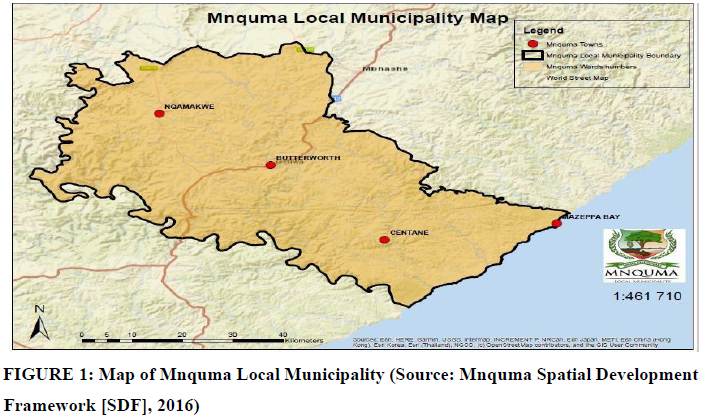
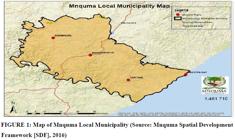
The study was conducted in the Mnquma Local Municipality of the Eastern Cape Province to collect data on the socioeconomic demographics and income diversification activities of rural households. Mnquma has a total population of 252.390 (Statistics South Africa. 2019) and comprises three towns: Butterworth. Centane. and Ngqamakwe. Butterworth is the major economic hub. contributing 75% to Mnquma's GDP. According to estimates. Mnquma is one of the municipalities with the highest levels of poverty. illiteracy and unemployment. with only 25% of the population in employment. while 11% are unemployed and 64% are deemed economically inactive (Mnquma Integrated Development Plan. 2020). Therefore. the municipality needs to prioritise service provision. skills. and social development. Mnquma Local Municipality's economy. like that of the Eastern Cape and the country. experienced negative growth. particularly between 2008 and 2010. This was a factor of a global recession characterised by business cycle contraction (Mnquma Integrated Development Plan. 2020). The main economic sectors of the area include community (government) services. wholesale and retail trade. manufacturing. agriculture. mining. and quarrying.
2.2. Sampling Procedure
A multi-stage random sampling technique was used to select rural households from the Mnquma Local Municipality for interviews. According to Etikan and Bala (2017) and Gattone et al. (2016), multi-stage sampling entails two or more stages of random sampling based on the hierarchical structure of clusters within the population. A different cluster type is randomly sampled at each stage, with the clusters nested within each other at successive stages. The final sampling stage involves selecting a random sample of people from the chosen clusters. This sampling technique is easy to implement and flexible, making data collection more practical for large populations (Etikan & Bala, 2017). The sampling process also requires fewer resources, as well as reduced administrative and travel expenses. As a result, a two-stage cluster sampling method was adopted, and the random sampling methodology was applied to the chosen clusters. The sampled households were then randomly selected for interviews.
The total sample size for the study was determined using the sample size determination formula as follows:

Where, N is the total number of households in Mnquma Local Municipality, n is the sample size, and a is the level of significance for the study, which is fixed at 5% (0.05). The total number of households in Mnquma is 69,732 (Mnquma Integrated Development Plan, 2020). Thus, the above formula gives the following sample size for the study:
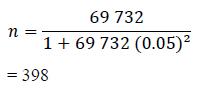
For the purposes of the study, a total of 398 rural households were selected.
2.3. Data Collection
The data was collected from a sample of 398 households using structured questionnaires in the IsiXhosa language to grasp their perception of participation in income diversification activities. The data collected include socioeconomic characteristics and factors affecting the choice of rural households participating in income diversification activities.
2.4. Data Analysis
The data collected from questionnaires were captured using STATA Version 15. The implied data was also captured using Microsoft Excel software to simplify the researcher's task of checking for unexpected errors before analysing the data in STATA. Descriptive statistics, including mean, standard deviation, percentages, and frequency of occurrence, were used to explore the socioeconomic and demographic characteristics of the households. Descriptive statistics are important to have a picture of the characteristics of the sample units. Principal Component Analysis (PCA) was used to construct the indices for access to infrastructure and rural constraints, which are important variables in explaining the choice of income-generating activity. Lastly, the study employed Multinomial Logistic Regression to examine the factors affecting rural households' participation in income diversification activities in Mnquma Local Municipality.
2.4.1. Model Specification
2.4.1.1. Principal Component Analysis (PCA)
According to Hasan and Abdulazeez, (2021) and Paul et al. (2013) the Principal Component Analysis (PCA) is a linear dimensionality reduction technique that converts a collection of correlated variables (p) into a smaller collection of uncorrelated variables (k) (k<p), known as principal components, while preserving as much variation in the original dataset as is possible. The primary purpose of employing principal component analysis was to transform the components of rural constraints and infrastructure accessibility into indices. Principal Component Analysis is suitable for this study because it is primarily an adaptive exploratory approach that can be easily applied to multiple forms of numerical data. Moreover, PCA is particularly well-suited due to its ability to condense the data set into smaller, non-correlated dimensions or components.
The first principal component often accounts for the greatest variability in the provided data (Todorov, Fournier & Gerber, 2018). To create a new collection of uncorrelated variables, PCA leverages any existing correlations between the input variables in the dataset. Principal Component Analysis (PCA) aims to optimise the variance of a linear combination of the variables by reducing the dimensionality of a data set with many connected variables into fewer "dimensions," with the least amount of information lost (Santos et al., 2019). It is essential to note that the Principal Component Analysis approach can be utilised to enhance the quality of findings obtained by employing various statistical techniques.
Dua and Graff (2019) suggested that since PCA components are sensitive to the relative ranges of the original features, feature scaling is necessary when there is a significant difference in scale between the features of the dataset. Otherwise, PCA will attempt to capture the variance due to relative ranges rather than the actual variance between the features. For the study, Principal Components Analysis was employed to reduce the complexity of high-dimensional data while preserving trends and patterns. Principal Component Analysis was used to create indices on the constraints to rural household participation in income-generating activities.
2.4.1.2. Multinomial Logistic Regression (MLR)
Multinomial Logistic Regression is an econometric model for categorically dependent variables with more than two levels (Mustafa et al., 2015; Senandza, 2014). According to Long (2014), this approach is suitable for explaining the selection of alternatives and effectively predicts income generation, as well as detecting differences in income-generating activities between households. Multinomial Logistic Regression also predicts binary logistic regression models for each indicator variable and is commonly used for nominal outcomes with multiple options (Aziz et al., 2016). Moreover, the model is an extension of binary logistic regression and deals with one nominal/ordinal response variable with more than two categories (Senyefia, Adams & Prah, 2019).
Considering the aforementioned facts, a multinomial logit model was employed in this study to determine the variables influencing rural household participation in income diversification activities. For the study, the model was chosen because it provides empirical estimates of how the probability of the dependent variable (farm, non-farm and the combination of both farm and non-farm income generating activities) is affected by variations in independent variables (socioeconomic and demographic variables, rural constraints and infrastructure accessibility as factors affecting the choice rural households' participation to income generating activities) (Best & Wolf, 2015). In this study, rural households participate in different income-generating activities to improve their food security status and livelihood. Therefore, rural households obtain a certain level of utility from each income-generating activity. The data collected also satisfies the condition of mutual exclusivity. There are three distinct activities: farm, non-farm, or a combination of both, and each household can only participate in one of them.
Whether or not to engage in income-generating activities by the household will be evaluated using the broad framework of utility or profit maximisation (Borges, Lansink & Emvalomatis, 2019). It is considered that households choose income-generating activities only when they believe the utility or net benefit of doing so exceeds that of the base category. However, the utility of households is not apparent in this situation, but the behaviour of economic agents can be evaluated by means of the decisions they make. According to Gecho (2014), the Multinomial Logistic Regression model is composed as follows:

Let Yi be a random parameter representing the income-generating activities chosen by any sample household in order to define the Multinomial Logistic Regression model.
Where j represents income-generating activities, X represents explanatory factors, and Bj represents estimated parameters. The Multinomial Logistic Regression model parameter estimates reflect only the trajectory of the influence of the explanatory factors on the dependent variable (income-generating activities), but not the actual quantity of change or probabilities. To articulate the impact of explanatory factors on probabilities, the marginal effects are stated as follows:

2.4.1.3. Description of the Variables Used in Multinomial Logistic Regression (MLR)
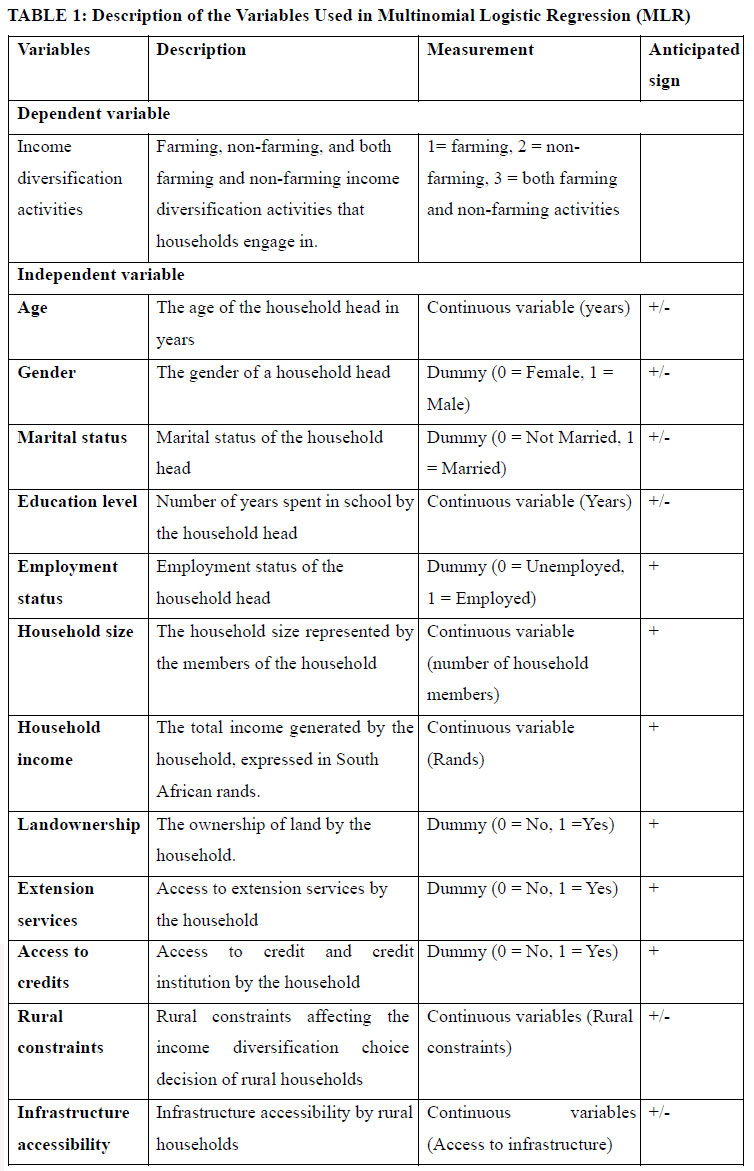
The dependent variable in the study is the choice of various income diversification activities by rural households; accordingly, it was identified by classifying the sample households according to their preferred income diversification activity. The following values were predicted for the multinomial model's dependent variable: 1 = farming activity, 2 = non-farming activity, and 3 = both farming and non-farming activities. The independent variables identified are age, gender, marital status, education level, employment status, household size, household income, land ownership, extension services, and access to credit. Table 1 below summarises the variables' description, measurements, and anticipated sign.
3. RESULTS AND DISCUSSION
This section presents the results and discussion of the analyses conducted on a sample of 398 households in the Mnquma Local Municipality. The households' socioeconomic characteristics were explored using descriptive statistics. The access to infrastructure and rural constraints indices were constructed using Principal Component Analysis (PCA). The factors affecting rural households' participation were examined using Multinomial Logistic Regression (MLR).
3.1. Socioeconomic Characteristics of the Households
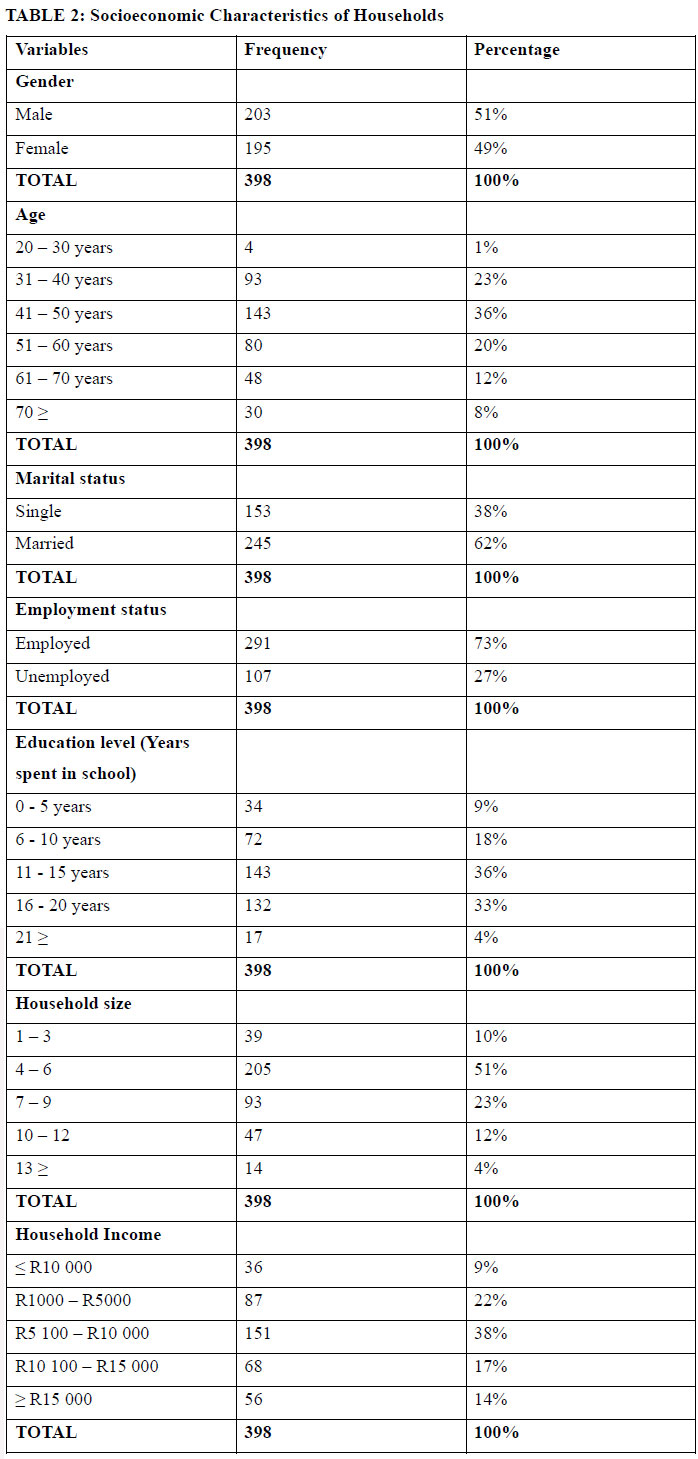
The socioeconomic characteristics analysed and further discussed are age, gender, marital status, number of years spent in school, household size, household income, and employment status of the household head. The results reveal that age plays a pivotal role in the participation of rural households in income diversification activities. According to the findings, most surveyed households are between 41 and 50 years old. Like Amurtiya's (2015) findings in Adamawa State, Nigeria, 73% of the respondents who participated in income-generating activities were under 50 years of age. This suggests that most households are more energetic and can engage in various income diversification activities, which help them improve their household livelihood and food security (Amurtiya, 2015).
The impact of development interventions and one's capacity to access income diversification activities are significantly influenced by gender. The results reveal that the representation is roughly equal, with 2% more men than women, as depicted by 51% men and 49% women. According to Adem (2018), males tend to provide for their families by diversifying their income more than their female counterparts. Consequently, most rural households are headed by males, except for those headed by single, divorced, widowed, and/or separated individuals, resulting in females being household heads (Mensah, 2014).
The level of participation of rural households in non-farm economic activity is influenced by marital status. The study illustrates that the majority (62%) of the respondents in the study area were married. Married household heads may have larger household sizes, which increase participation in income diversification activities and consumer spending, thus improving food security (Khatiwada et al., 2017). Therefore, this may encourage people to diversify their sources of income to meet their family's needs.
The employment status of households is more significant, as their income enables them to purchase farm and non-farm related inputs and equipment (Christian, 2017). The results reveal that 73% of the surveyed households were employed. Employment enables households to modernise their production by utilising suitable inputs and mitigating the risk of food shortages during droughts.
Education has been regarded as a key determinant and driver of employment and income, ensuring household well-being and establishing long-term livelihoods (Mensah, 2014; Amurtiya, 2015). The findings indicate that most household heads have completed between 11 and 15 years of formal education. Education can enhance the adoption of new technologies and income-generating activities, as well as improve farming practices for food security.
The study reveals that most respondents (51%) have a household size ranging from four to six members. However, the average family size was determined to be seven people. The household size may increase the amount of labour available for certain income diversification activities and provide a buffer against household demand emergencies. Moreover, family labour helps the household reduce the costs of hiring labour. According to Mensah (2014), households with bigger family sizes tend to have more family members who engage in various income diversification activities, thereby improving their food security.
Increased income enables households to overcome financial constraints and participate in multiple income diversification activities. Most households received a monthly income between R5,100 and R10,000. However, the average monthly income of all surveyed households was R8 872.88. According to the findings, households with higher-than-average incomes are more likely to diversify their sources of income. Households are encouraged to engage in various high-return income diversification activities when their income is higher.
Gecho et al. (2014) argued that low-income households are less likely to participate in income diversification activities because their income is essential to maintaining their household.
3.2. Household Income Diversification Activities
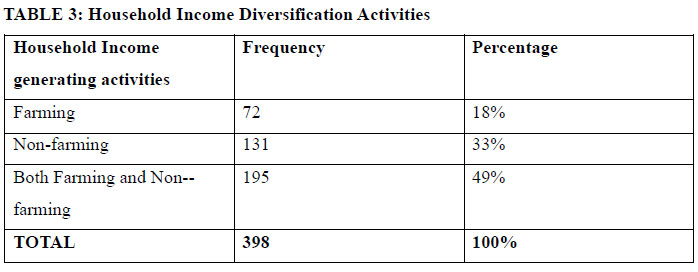
According to Mathebula et al. (2017), the profitability of smallholder farmers has declined, leading unskilled labour to seek job opportunities in various income diversification activities. Therefore, rural households are under pressure to participate in various income diversification activities due to the inability of farms to produce enough food to meet the market's demand and the shrinking size of farms. Due to this situation and the increasing land constraints brought on by rising population densities, rural households have formed and are now involved in a variety of income diversification activities to improve their food security situation. The obtained results are illustrated in Table 3 below.
The results reveal that the most frequently observed occupation was a combination of both nonfarm and agricultural income activities (49%), followed by non-farm activities (33%), and farming (18%). The combination of both income diversification activities (farming and non-farming) enables households to implement new technologies, enhance household productivity, and generate higher returns. According to Nagler and Naudé (2014), participation in farm and non-farm income-generating activities enables households to employ suitable modern technology and inputs, thus reducing the danger of food shortages during droughts.
3.3. Constructing Indices on Rural Constraints and Infrastructure Accessibility Using Principal Component Analysis (PCA)
3.3.1. Rural Constraints/Challenges Affecting the Choice of Participation of Households in Income Diversification Activities
This section presents the results of the Principal Components Analysis (PCA) for the rural constraints influencing the participation of households in income-generating activities. According to Alinovi, Mane, and Romano (2022), PCA is a method for constructing an index from a set of variables with similar information. This enables maximisation of the information retained without utilising variables that will lead to multicollinearity and without having to select one variable from a large number. Therefore, to produce indices on constraints hindering rural household engagement in income-generating activities, Principal Component Analysis was utilised. PCA is especially well-suited since it may break down the data set into more manageable, uncorrelated dimensions or components. To minimise the amount of information loss, Principal Component Analysis (PCA) reduces the dimensionality of a data set with many connected variables into a smaller number of "dimensions," to optimise the variance of a linear combination of the variables. In this study, rural households participate in various income-generating activities to enhance their food security status and improve their livelihoods. The results are represented by the analysis table below.
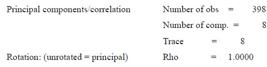
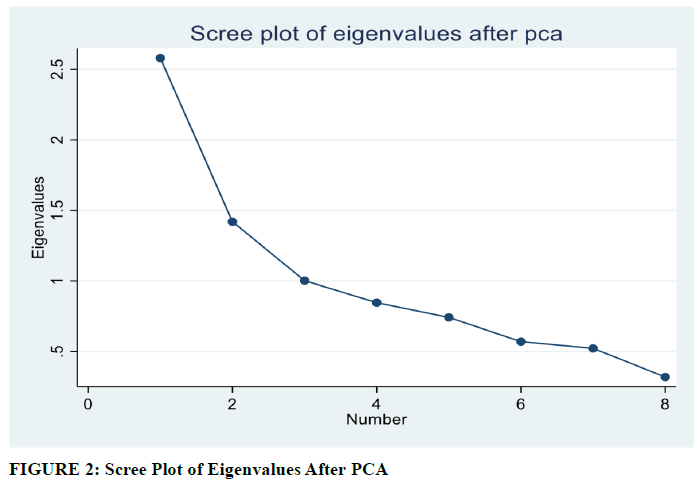
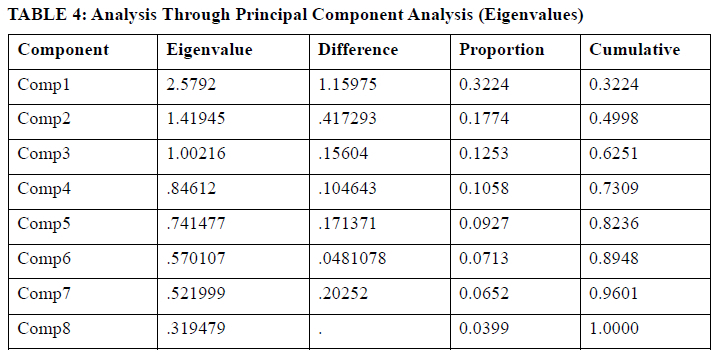
Table 4 illustrates the results of the eight eigenvalues from the PCA Analysis. Numerous correlated variables were broken down into smaller, crucial components using Principal Component Analysis. According to Schreiber (2021), the only requirement of Kaiser's rule is to keep factors whose eigenvalues are greater than 1. Therefore, the model maintained three (3) variables with Eigenvalues greater than one. The results indicate that the three (3) variables preserved in the model described 62.51% of the variance. Lack of infrastructure, with an Eigenvalue of 2.5792, was ranked first, followed by access to markets, with an Eigenvalue of 1.41945, and lack of productive assets, with an Eigenvalue of 1.00216. Furthermore, the lack of infrastructure expressed the most significant proportion, accounting for 32% of the cumulative percentage in the data, followed by access to markets at 49% and lack of productive assets at 62%. These are the cumulative percentages for the variables that were elucidated.
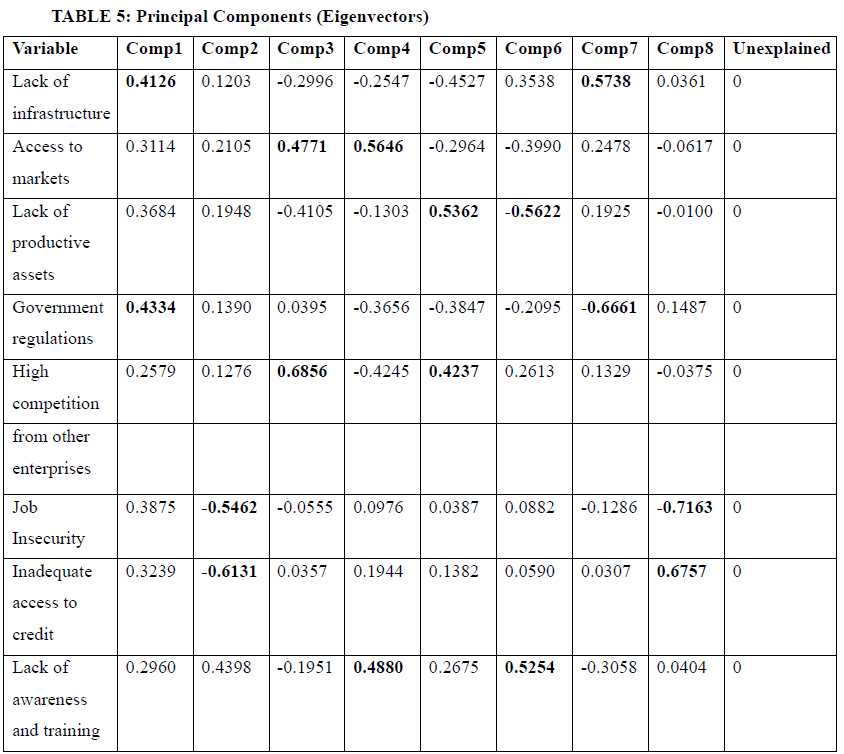
Table 5 presents the results of the principal components (Eigenvectors) and the variables that influence rural households' participation in income diversification activities. Principal Component 1 shows that government regulations (0.4334) have a greater influence on rural households' decision to participate in income diversification activities than the lack of infrastructure (0.4126). Principal Component 2 indicates that a lack of access to credit (-0.6131) has a more significant impact on households' decision to engage in income diversification activities than job insecurity (-0.5462). Moreover, Principal Component 3 demonstrates that households' decisions to engage in income diversification activities are most significantly influenced by high competition from other enterprises (0.6856) and, to a lesser extent, by market accessibility (0.4771). The findings enabled the definition of each of the eight components in terms of the variables with which each component is most closely associated.
When constructing the indices, the study began by selecting rural constraints variables, such as a lack of markets, productive assets, government regulations, high competition from other enterprises, job insecurity, inadequate access to credit, and a lack of awareness and training. Secondly, PCA was applied to generate eigenvalues and eigenvectors for the rural constraints variables and arrange the data to minimise dimensionality while preserving as much information as feasible in the overall fluctuation of these variables. Lastly, the interpretation of PCA eigenvalues and eigenvectors indicates that variables with eigenvalues greater than 1 signify that the Principal Components explain more variation than any of the original variables.
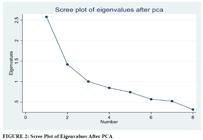
The Scree Plot of eigenvalues after PCA, shown in Figure 2, is generated by graphing the principal components in relation to their respective eigenvalues. As a result, it schematically represents the rate of variation in the magnitudes of the eigenvalues for the principal components. This method enhances the ability to identify a clear break in the slope of a plot showing the proportion of variance explained by each component. Figure 2 illustrates that it is unclear whether maintaining two or three primary components is preferable. However. if the study retains just two principal components. the original data set's overall variability is reduced from 62.51% to 49.98%. Since one of the objectives of PCA is to preserve as much of the variability of the original data set while reducing the dimensions. the study determines that the three principal components are the most effective way to characterise the data matrix.
3.3.2. Infrastructure Accessibility by Rural Households
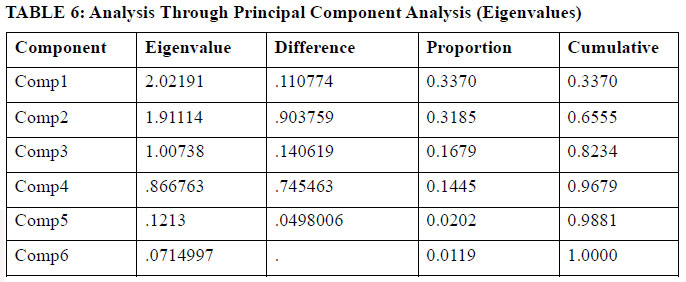
This section presents an in-depth analysis of infrastructure accessibility for rural households in the study area. utilising Principal Component Analysis. According to Adem et al. (2018). Alobo Loison and Bignebat (2017). and Asfaw et al. (2017). access to economic infrastructure influences the level of participation of rural households in various income-generating activities and. consequently. their food security status. Therefore. access to infrastructure for manufacturing/production and marketing is one of the key factors of income diversification. Households' access to markets. opportunities for employment. and amenities such as clean water. good health. education. transportation. and communication are all hindered by inadequate or substandard infrastructure. Nevertheless. having enough access to economic infrastructure creates opportunities for income diversification and employment possibilities during the development. operation. and maintenance phases. Table 6 below represents the results (Eigenvalues) of infrastructure accessibility by rural households.
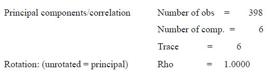
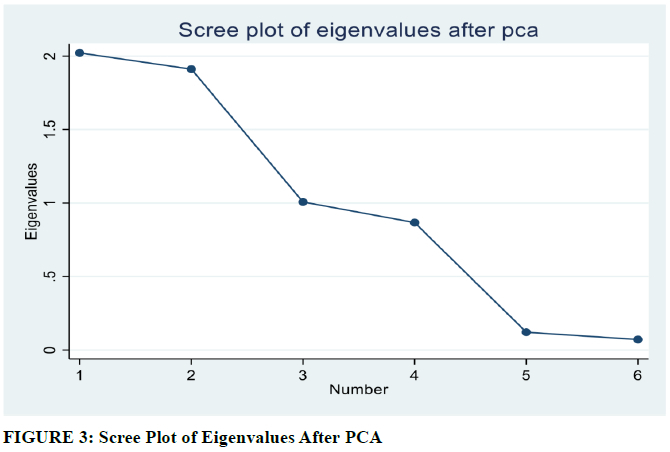
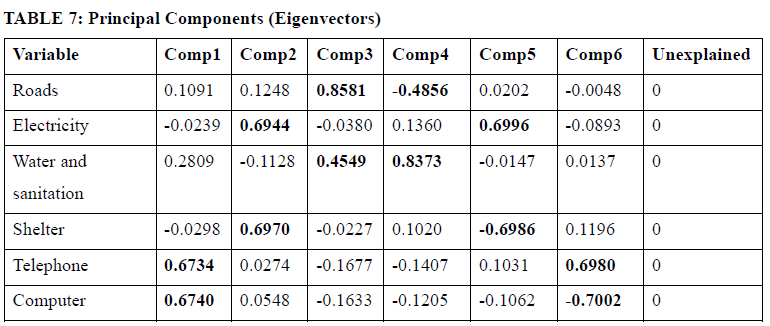
Table 6 shows the results of six eigenvalues from the PCA Analysis. Eigenvalues are a unique collection of scalar values that are probably connected to the matrix equations' linear equations (Olver et al, 2018). Furthermore, they assist in resolving equilibrium and stability issues, providing insights into system behaviour. The results indicate three (3) components that were preserved, which described 82.34% of the variance. Road infrastructure, with an Eigenvalue of 2.02191, was ranked first, followed by electricity, with an Eigenvalue of 1.91114, and water and sanitation, with an eigenvalue of 1.00738. Road infrastructure accounted for a cumulative percentage of 33%, electricity for 65%, and water and sanitation for 82%. These are the total percentages for the variables that were clarified. Below is Table 7, which illustrates the results of the eigenvectors.
Table 7 illustrates the results of the Eigenvectors of the infrastructure accessibility by rural households. The PCA's eigenvectors indicate a significant positive correlation between infrastructure accessibility and rural households' participation in income diversification activities. Thus, having access to physical infrastructure such as roads, electricity, as well as water and sanitation, enhances households' participation in various income diversification activities. Principal component 1 depicts that access to a computer (0.6740) is almost equal to access to a telephone (0.6734). Principal component 2 illustrates that access to shelter (0.6970) has a more positive impact on the household's choice to engage in income-generating activities than electricity (0.6944). Principal component 3 demonstrates that households' participation in income-generating activities is most significantly influenced by road infrastructure (0.8581) and less by water and sanitation (0.4549). The results enabled the definition of each of the six components in terms of the most strongly connected variables. Figure 3 below shows the scree plot produced when the principal components are plotted against their individual eigenvalues.
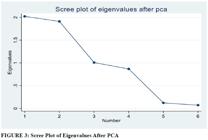
The Scree Plot of eigenvalues following PCA, represented by (Figure 3), shows that it is ambiguous whether keeping two or three principal components is desirable. However, if the study decides to retain only two principal components, the overall variability of the original data set decreases from 82.34% to 65.55%. The study identifies the three principal components as the most effective method for describing the data matrix, as PCA aims to maintain as much of the data variability while minimising dimensions.
PCA indices were generated for rural constraints and infrastructure accessibility to maximise information without choosing one variable over another or producing multicollinearity. The rural constraints indices indicated that a lack of infrastructure, market access, and productive assets positively influence the choice of rural households to participate in income diversification activities. On the other hand, indices on infrastructure accessibility indicate that roads, electricity, water, and sanitation have a positive impact on rural household participation in income diversification activities.
3.4. Factors Affecting the Choice of Household Participation in Income Diversification Activities
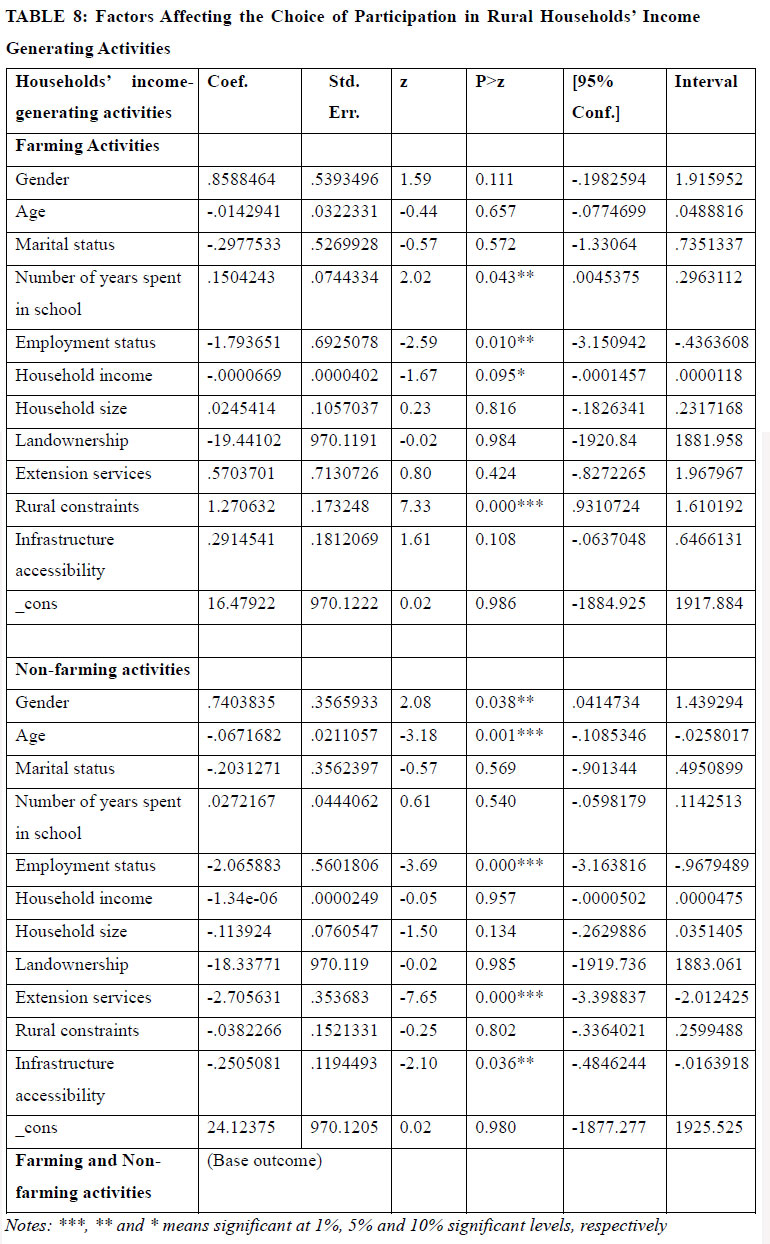
The decision of rural households to engage in income diversification activities is influenced by several variables, making it challenging to reduce poverty and further improve the standard of living. In this study, rural households engage in various income diversification activities to enhance their food security status and improve their livelihoods. The assumption is that household heads choose income diversification activities (such as farming, non-farming, or a combination of both) if the perceived utility or net benefit is significantly greater than without them. While utility is not instantly observed, households' behaviours are observed through their choices. Therefore, rural households obtain a certain level of utility from each income-generating activity. The results are presented in Table 8 below.
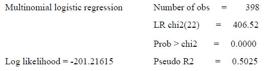
The above table illustrates the results from the multinomial logistic regression model estimation for the factors affecting rural households' participation in income diversification activities. If the P-value is less than alpha (0.05), the null hypothesis will be rejected, and the parameter estimate is considered significant at that alpha level. The Chi-square statistics show a highly significant likelihood ratio test statistic (p-value = 0.0000), indicating good explanatory power of the model. The results indicate a significant relationship between rural constraints (p = 0.000), employment status (p = 0.010), and the number of years spent in school (p = 0.043) and the choice of rural households' participation in farming activities. On the other hand, the results illustrate a significant relationship between extension services (p = 0.000), employment status (p = 0.000), age (p = 0.001), infrastructure accessibility (p = 0.036), and gender (p = 0.036) and the choice of rural households' participation in non-farm income activities.
Rural constraints were found to have a positive correlatio1%probability level. The significance of rural constraints implies that participation of rural households in farming activities is influenced by factors such as access to markets, government regulations, high competition from other enterprises, job insecurity, and lack of awareness and training. The constraints not only prevent diversification into profitable farming activities but also force diversification into low-wage, low-return farming enterprises. Similarly, the study by Ewebiyi and Meludu (2013) indicated that rural households faced significant obstacles to diversifying their sources of income, making it difficult for them to live sustainably in the countryside.
The number of years spent in school by the household head was positively correlated with the choice of participating in farming activities and was significant at a probability level of less than 5%. The likelihood of a household head engaging in high-reward farming activities increases with the number of years spent in school. Educational attainment is one of the most significant determinants of farm income (Weltin et al., 2017). Households with averagely well-educated members tend to live comparatively better lives by diversifying their sources of farm income.
The coefficient of the age of the household head implies that younger households were more likely than older households to engage in non-farming activities. As a result, younger households depend on various income-generating activities to maintain their household's livelihood, whereas older households are stuck with farming because they lack the skills to engage in other income-generating activities. This variable was found to have a negative correlation with household participation in non-farming activities and was significant at a 1% probability level. This aligns with the study by Zerai and Gebreegziabher (2011), who indicated that households headed by younger individuals tend to participate in non-farming activities.
The gender of the household head was found to have a positive correlation with the choice of household participation in non-farm income activities, and this correlation was significant at a probability level of less than 5%. The significance of the gender of the household head implies that male-headed households were keen to participate in a variety of non-farming income activities than female-headed households. This can be attributed to the fact that female-headed households are often single-parent households that may not have the resources to multitask, whereas male-headed households are typically nuclear families or their extended versions, which can do more. This suggests that households headed by men make a significant contribution to the growth of non-farm income activities by seeking alternative sources of income to support their families. The results are consistent with the observations of Alemu and Adesina (2017), who reported that male-headed households are more inclined to diversify their sources of income to improve households' livelihood.
Access to infrastructure, such as roads, electricity, water, sanitation, shelter, telephone, and computer, can be viewed as essential productive and non-productive resources for engaging in farm and non-farm activities, and their absence may act as a barrier to entry for income diversification (Alobo-Loison, 2015). A key component of rural households' engagement in non-farm income activities and reducing household poverty is better access to basic infrastructure. The household's choice to engage in non-farm income activities was found to be correlated with infrastructure accessibility, and this correlation was significant at a probability level of less than 5%. Infrastructure, such as better access and electrical supplies, is crucial, and investing in useful machinery can increase incomes (Alobo-Loison, 2015).
The results illustrated in the above table align with the study by Eshetu and Mekonnen (2016), whereby the participation of households in income diversification activities was affected by a variety of factors such as age, gender, number of years in school, household size, land size, livestock ownership, distance to the market, and access to credit.
4. CONCLUSION AND RECOMMENDATIONS
Since the objectives of eradicating poverty, generating employment, and guaranteeing food security for all people can never be fully achieved, new research fields and opportunities for policy and capacity improvement are continuously pursued through academic study. The study aimed to investigate the factors influencing rural households' participation in income diversification activities in the Mnquma Local Municipality of the Eastern Cape Province. Households in Mnquma Local Municipality engage themselves in a variety of income diversification activities to improve their livelihood and further achieve food security. Therefore, every household in the Mnquma Local Municipality engages in multiple sources of income, including farm, non-farm, and a combination of farm and non-farm income activities.
The findings of the study also indicated that the choice of participation of households in income diversification activities was influenced by a variety of factors, such as age, gender, number of years spent in school, employment status, household income, household size, extension services, land size, rural constraints, and infrastructure accessibility. The study further illustrated a significant relationship between the factors and participation in income diversification activities. Therefore, the study can conclude that the choice of rural household income diversification is affected by various factors in Mnquma Local Municipality.
Based on the obtained results and the reviewed literature, the following recommendations are made to enhance the level of participation of households in various income diversification activities, particularly in Mnquma Local Municipality.
> Construction of rural infrastructure, including markets, roads, electricity, telecommunications, and storage facilities, as well as institutional improvements to reduce entry costs and other barriers for underprivileged livelihood groups.
> Improvement of the youth's knowledge of fundamental farming practices through the creation of new and maintenance of current agricultural training centres. To increase youth awareness of agriculture, agricultural science should also be required for secondary school students.
> Promoting and encouraging primary, secondary, and tertiary cooperatives participation for easy access to funding, as municipalities and other sector departments prioritise cooperatives for funding purposes.
> Government regulations on business taxes, licences, and trading permits should be minimised for rural households to participate productively in income diversification activities.
REFERENCES
- ADEM, M., 2018. Determinants of income diversification and its effect on food security of small holder farmers in the case of Asayita Woreda, Afar Regional State. Doctoral dissertation, Bahir Dar University.
- ALEMU, A.E. & ADESINA, J.O., 2017. In search of rural entrepreneurship: Non-farm Household Enterprises (NFEs) as instruments of rural transformation in Ethiopia. Afr. Dev. Rev., 29(2): 259-271.
- ALINOVI, L., MANE, E. & ROMANO, D., 2022. Towards the measurement of household resilience to food insecurity: Applying a model to Palestinian household data. In R. Sibrian (ed.), Deriving Food Security Information from National Household Budget Surveys: Experiences, achievements, challenges. Rome: FAO, pp. 137-152.
- ALOBO, S. & BIGNEBAT, C., 2017. Patterns and determinants of household income diversification in rural Senegal and Kenya. J. Poverty Alleviation Int. Dev., 8(1): 93-126.
- AMURTIYA, M., 2015. Effect of livelihood income activities on food security status of rural farming households in Yola South Local Government Area of Adamawa State, Nigeria. Master's thesis, Yola: Modibbo Adama University of Technology.
- ASFAW, A., SIMANE, B., HASSEN, A. & BANTIDER, A., 2017. Determinants of non-farm livelihood diversification: Evidence from rainfed-dependent smallholder farmers in northcentral Ethiopia (Woleka sub-basin). Dev. Stud. Res., 4(1): 22-36.
- AZIZ, N.A.A., ALI, Z., NOR, N.M., BAHARUM, A. & OMAR, M., 2016. Modeling multinomial logistic regression on characteristics of smokers after the smoke-free campaign in the area of Melaka. AIP Conf. Proc, 1750(1): 060020.
- BEST, H. & WOLF, C., 2015. Logistic regression. In H. Best & C. Wolf (eds.), The Sage handbook ofregression analysis and causal inference. Sage Publications, pp. 153-172.
- BORGES, J.A.R., LANSINK, A.G.O. & EMVALOMATIS, G., 2019. Adoption of innovation in agriculture: A critical review of economic and psychological models. Int. J. Innov. Sustain. Dev., 13(1): 36-56.
- CHRISTIAN, M., 2017. Analysis of the impact of smallholder irrigation schemes on the choice of rural livelihood strategy and household food security in the Eastern Cape. Doctoral dissertation, University of Fort Hare.
- DEMISSIE, A. & LEGESSE, B., 2013. Determinants of income diversification among rural households: The case of smallholder farmers in Fedis district, Eastern Hararghe zone, Ethiopia. J. Dev. Agric. Econ., 5(3): 120-128.
- DUA, D. & GRAFF, C., 2019. UCI machine learning repository. Irvine, CA: University of California, School of Information and Computer Science.
- ESHETU, F. & MEKONNEN, E., 2016. Determinants of off-farm income diversification and its effect on rural household poverty in Gamo Gofa Zone, Southern Ethiopia. J. Dev. Agric. Econ., 8(10): 215-227.
- ETIKAN, I. & BALA, K., 2017. Sampling and sampling methods. Biom. Biostat. Int. J., 5(6): 00149.
- EWEBIYI, I.O. & MELUDU, N.T., 2013. Constraints to livelihood diversification among rural households in southwestern Nigeria. Int. J. Res. Inno. Soc. Sci., 9(1): 64-77.
- GATTONE, S.A., MOHAMED, E., DRYVER, A.L. & MÜNNICH, R.T., 2016. Adaptive cluster sampling for negatively correlated data. Environmetrics., 27(2): E103-E113.
- GECHO, Y., AYELE, G., LEMMA, T. & ALEMU, D., 2014. Rural household livelihood strategies: Options and determinants in the case of Wolaita Zone, Southern Ethiopia. J. Soc. Sci., 3(3): 92-104.
- HASAN, B.M.S. & ABDULAZEEZ, A.M., 2021. A review of principal component analysis algorithm for dimensionality reduction. J. Soft Comput. Data Min., 2(1): 20-30.
- LAMBON-QUAYYEFIO, M., 2017. Non-farm enterprises and the rural youth employment challenge in Ghana. In S. Ayele, S. Khan & J. Sumberg (eds.), Africa's Youth Employment Challenge: New Perspectives, IDS Bulletin, vol. 48, no. 3. Institute of Development Studies, p. 109.
- LONG, J.S., 2014. Regression models for nominal and ordinal outcomes. In H. Best & C. Wolf (eds.), The Sage handbook of regression analysis and causal inference. Sage Publications, pp.173-204.
- MEAZA, T.W., 2014. The role of non-farm activities in sustaining rural livelihood: The case of Enderta wereda. Doctoral dissertation, Mekelle University.
- MENSAH, C., 2014. The impact of livelihood diversification on food Security amongst farm households in northern Ghana: A case study of Bole district. Doctoral dissertation, University of the Western Cape.
- MDIYA, L. & MDODA, L., 2021. Socioeconomic factors affecting home gardens as a livelihood strategy in rural areas of the Eastern Cape Province, South Africa. S. Afr. J. Agric. Ext., 49(3): 1-15.
-
MNQUMA LOCAL MUNICIPALITY., 2020. Mnquma Integrated Development Plan. Available from https://www.cogta.gov.za/cgta_2016/wp-content/uploads/2020/11/Mnquma-Local_Municipality-2020-2021.pdf
» https://www.cogta.gov.za/cgta_2016/wp-content/uploads/2020/11/Mnquma-Local_Municipality-2020-2021.pdf -
MNQUMA LOCAL MUNICIPALITY., 2016. Mnquma Spatial Development Framework. Available from https://www.cogta.gov.za/cgta_2016/wp-content/uploads/2020/11/MNQUMA-LOCAL-M2020-2021.pdf
» https://www.cogta.gov.za/cgta_2016/wp-content/uploads/2020/11/MNQUMA-LOCAL-M2020-2021.pdf - MUJURU, N.M. & OBI, A., 2020. Effects of cultivated area on smallholder farm profits and food security in rural communities of the Eastern Cape Province of South Africa. Sustain., 12(8): 3272.
- MUSTAFA, A.M., COOLS, M., SAADI, I. & TELLER, J., 2015. Urban development as a continuum: A multinomial logistic regression approach. In O. Gervasi et al. (eds.), Computational Science and Its Applications -- ICCSA 2015. ICCSA 2015. Lecture Notes in Computer Science. Cham: Springer, pp. 729-744.
- MUSUMBA, M., PALM, C.A., KOMAREK, A.M., MUTUO, P.K. & KAYA, B., 2022. Household livelihood diversification in rural Africa. J. Agric. Econ.,53(2): 246-256.
- MRETIE, M.A., 2019. Determinants of income diversification and its implication on rural households food security in Gubalaf to Woreda, Northern Ethiopia. Master's thesis, Addis Ababa University College of Development Studies.
- NANDA, R., PESHIN, R., SINGH, A.K., SHARMA, L.K. & BAGAL, Y.S., 2019. Factors affecting non-farm diversification among farm households in Jammu and Kashmir. Agric. Econ. Res. Rev., 32(347-2019-3219): 125-132.
- NAGLER, P. & NAUDÉ, W., 2017. Non-farm entrepreneurship in rural sub-Saharan Africa: New empirical evidence. Food Policy., 67: 175-191.
- NTWALLE, J.A., 2019. Determinants of Tanzania rural households' income diversification and its impact on food security. Master's thesis, Swedish University of Agricultural Sciences.
- OLVER, P.J., SHAKIBAN, C., OLVER, P.J. & SHAKIBAN, C., 2018. Eigenvalues and singular values. In P.J. Olver & C. Shakiban (eds.), Applied Linear Algebra. Cham: Springer, pp. 403-474.
- OSARFO, D., SENADZA, B. & NKETIAH-AMPONSAH, E., 2016. The impact of non-farm activities on Rural farm household income and food security in the Upper East and Upper West Regions of Ghana. Theor. Econ. Lett, 6(3): 388-400.
- PAUDEL KHATIWADA, S., DENG, W., PAUDEL, B., KHATIWADA, J.R., ZHANG, J. & SU, Y., 2017. Household livelihood strategies and implication for poverty reduction in rural areas of central Nepal. Sustain., 9(4): 612.
- RANTSO, T.A., 2016. The role of the non-farm sector in rural development in Lesotho. J. Mod. Afr. Stud, 54(2): 317-338.
- SANTOS, R.D.O., GORGULHO, B.M., CASTRO, M.A.D., FISBERG, R.M., MARCHIONI, D.M. & BALTAR, V.T., 2019. Principal component analysis and factor analysis: Differences and similarities in nutritional epidemiology application. Rev Bras Epidemiol., 29(22): e190041.
- SENADZA, B., 2014. Income diversification strategies among rural households in developing countries: Evidence from Ghana. Afr. J. Econ. Mang. Sci., 5(1): 75-92.
- SENYEFIA, B.A., ADAMS, F.H. & PRAH, K.A., 2019. Survival and Multinomial Logistic Regression Analyses of Sekondi-Takoradi District Level National Health Insurance Data in Ghana. Am. J. Math. Stat., 9(2): 109-114.
- STATISTICS SOUTH AFRICA., 2019. Towards measuring the extent of food security in South Africa: An examination of hunger and food inadequacy.
- TODOROV, H., FOURNIER, D. & GERBER, S., 2018. Principal components analysis: theory and application to gene expression data analysis. Genomics and Computational Biology., 4(2): e100041.
- WELTIN, M., ZASADA, I., FRANKE, C., PIORR, A., RAGGI, M. & VIAGGI, D., 2017. Analysing behavioural differences of farm households: An example of income diversification strategies based on European farm survey data. Land Use Policy., 62: 172184.
- ZERAI, B. & GEBREEGZIABHER, Z., 2011. Effect of non-farm income on household food security in eastern Tigrai, Ethiopia: An entitlement approach. Food Sci Quality Manag., 1: 1-22.