Enhancing Sustainability Through Innovative Agricultural Extension for Climate Change Adaptation in Communal Farming Areas of the Eastern Cape Province
Abstract
This study explores the potential of innovative agricultural extension services to enhance sustainability and promote climate change adaptation among smallholder farmers and rural communities. The study adopted a cross-sectional research design and a snowball sampling technique. Semi-structured questionnaires and a 5-point Likert scale were used to collect data from 127 communal farmers. A chi-square test and descriptive statistics were employed for data analysis. The study revealed that communal farmers in the study areas primarily engage in livestock and crop production. However, they face significant challenges (low yields, animal deaths, and diseases) due to climate change-related disasters, particularly droughts and extreme temperatures. The results also showed that 87% of farmers employed multiple adaptation strategies to cope with climate change. The study revealed a significant association between access to resources and climate adaptation. The findings further indicated that although farmers had access to essential support services (<1.5), such as fodder and water tanks, access to climate-smart technologies was limited, hindering their ability to adapt effectively to climate change. The study concludes that by improving access to climate-smart technologies and essential support services, farmers can better navigate the challenges posed by climate change. Innovative extension methods can facilitate the dissemination of agricultural information and promote climate-resilient agriculture. The study further suggests a three-pronged approach to enhance communal farming. By providing communalfarmers with climate-resilient agricultural knowledge and skills, extension services can empower them to make informed decisions and take proactive steps to adapt to climate change.
Climate Change Adaptation; Innovative Strategies; Communal Farmers; Advisory Services
1. INTRODUCTION
The agricultural sector is highly susceptible to climate conditions, making it one of the most vulnerable sectors to the impacts of global climate change (Mdoda, 2014; Parker, Bourgoin, Martinez-Valle & Läderach, 2019). Globally, climate change is a major challenge facing farmers. This phenomenon threatens the sustainability of smallholder farmers in rural communities who depend solely on agriculture (Bontsa, Gwala, Mdiya & Mdoda, 2024). Farmers are known to take suitable steps to adapt when they observe change and adjust their farming practices to cope with climate change (Bontsa, Gwala, Mdiya, and Mdoda, 2024). Crop-livestock farming in South Africa is highly vulnerable to various challenges, including climate-related events, income instability, social disruptions, overgrazing, inadequate infrastructure, water shortages, reduced productivity, disease outbreaks, limited information access, and insufficient extension services, hindering farmers' ability to adapt (Debie & Ayele, 2023; Gwala, Yusuf & Monde, 2022). High levels of vulnerability and low adaptive capacity in the developing world have been linked to a range of factors that include a high reliance on natural resources (World Bank, 2000), a limited ability to adapt financially and institutionally (Lemos, Agrawal, Eakin, Nelson, Engle & Johns, 2013), low per capita GDP and high poverty, and a lack of safety nets (such as membership of organisations and social security) (Desanker & Magadza, 2001; IPCC, 2001). Hence, extension services are vital as they equip farmers with knowledge on improved farming techniques, enhance their understanding of challenges like climate change, and introduce sustainable management practices to ensure long-term agricultural productivity (Bontsa, Gwala, Ngarava, Mdiya & Zhou, 2023; Loki, Aliber, & Sikwela, 2021; Gwala, Monde, & Muchenje, 2016).
The rapidly evolving nature of agricultural innovation processes in low-income countries requires agricultural extension agencies to transform the classical roles that previously supported linear information dissemination and adoption of innovation. In the past, the extension agencies used a one-way flow of information from researchers to farmers, resulting in limited engagement and feedback from the farmers (Cook, Satizábal & Curnow, 2021; Antle et al., 2017). This approach has been useful in some cases; however, it cannot adequately address the complexities of modern agricultural challenges. Therefore, strengthening agricultural innovation calls for facilitation of interactive communication and a wide range of mediation tasks within (and between) stakeholders operating in different social spheres (Chowdhury, Hambly Odame & Leeuwis, 2013).
Interest in improving agricultural extension through digital media is high because established methods, such as Training-and-Visit or Farmer Field Schools, have not always achieved the desired outcomes in terms of innovation adoption or livelihood improvements (Faure, Desjeux & Gasselin, 2012; Taye, 2013). Many of the current limitations of agricultural advisory services stem from imperfect information flows among stakeholders in a complex knowledge system, including farmers, traders, processors, extension agents, and researchers (Faure et al., 2012). However, widespread access to mobile telephones has created new possibilities for supporting these information flows.
Innovative agricultural extension services play a vital role in enhancing sustainability and climate change adaptation in communal farming areas. By leveraging modern, technology-driven, and participatory approaches, these services empower farmers with knowledge, skills, and information to improve their livelihoods, productivity, and sustainability. This approach goes beyond traditional methods (face-to-face interactions, local extension services, and word-of-mouth communication), incorporating digital tools (Mobile Apps and Websites, Social Media Groups and Forums), data analytics (Precision Agriculture Tools, Yield Forecasting and Price Prediction Models), and collaborative platforms (Online Marketplaces, Farmer-to-Farmer Networks, Research-Extension-Farmer Partnerships) to connect farmers with researchers, markets, and financial institutions, ultimately fostering informed decision-making and the adoption of climate-resilient practices (Rajasri, 2025; Arulmanikandan & Vaishnavi, 2024).
Agricultural extension serves as the life force of sustainable farming, acting as the conduit linking wisdom to practical application, empowering farmers to flourish in a world marked by constant change (Anshuman & Mallick, 2024). Extension workers, often unsung heroes, play a pivotal role in connecting farmers with support systems and tools that foster heightened productivity, adaptability, and improved livelihoods, and in introducing cutting-edge innovations to cope with and minimise production challenges, such as those posed by climate change. The Eastern Cape Province is among the regions in South Africa most exposed to the risks of climate change. Communal farmers in this region face significant challenges in adapting to climate change due to limited access to information and technology. Innovative agricultural extension services play a crucial role in enhancing sustainability and promoting climate change adaptation among communal farmers. Hence, the study sought to identify innovative agricultural extension services that enhance sustainability and promote climate change adaptation among communal farmers, and to determine the adaptation strategies farmers employ to cope with the impacts of climate change.
1.1. Definition of the Problem
Climate variability has negatively impacted agricultural production, with farmers experiencing disasters such as floods and droughts that have damaged infrastructure, affected livestock and crop production, and resulted in poor yields. Research has shown that high-rainfall districts in the Eastern Cape are ecologically vulnerable to drought due to poor water supply management, grazing practices, and land management, which lead to serious land degradation (Bahta, Jordaan, & Phatudi-Mphahlele, 2019).
Furthermore, agricultural droughts in the Amahlathi Local Municipality have significantly affected socioeconomic activities, sustainable livelihoods, and ecosystem services, underscoring the need for greater resilience (Mbuqwa, Magagula, Kalumba, & Afuye, 2024). Despite the critical role of agricultural extension services in facilitating climate change adaptation, existing approaches often fail to address the specific needs and challenges of communal farmers. Most farmers in rural communities have limited access to climate change information, technology, and innovative practices that can assist in sustainability.
Therefore, this study aims to investigate how innovative agricultural extension strategies can enhance sustainability and support climate change adaptation in communal farming areas of the Eastern Cape Province. By leveraging technology, fostering partnerships, and adopting traditional approaches, this research seeks to improve the resilience and productivity of small-scale farmers and promote sustainability. Understanding the vulnerability of smallholder farmers to climate change and identifying effective adaptation strategies and innovative approaches can inform policy formulation and governance, ultimately contributing to improved resilience, food security, and sustainable livelihoods in rural communities.
2. RESEARCH METHODOLOGY
2.1. Study Site
The study was conducted in Amahlathi and Raymond Mhlaba local Municipalities. Two communities were selected in each of the local municipalities: KwaManana, Endulwini, Mqukwana, and Endlovini. The household head is the sampling unit in this study because they are solely responsible for most socioeconomic activities and significant decisions (Ahmad, 2023). The communities were selected because farming is their main source of livelihood, and because they are among the areas affected by climate change, with access to agricultural extension services essential for promoting sustainable farming practices (Gwala et al., 2022; Gwala et al., 2016). The Raymond Mhlaba is in a semi-arid environment, and Amahlathi is in a forest and a heavily wooded area dominated by trees (Eastern Cape Socioeconomic Consultative Council, 2017). Raymond Mhlaba is affected by climate change due to low rainfall and high temperatures (Raymond Mhlaba Local Municipality, 2017; Community Survey, 2016; ECSEC., 2012).
The ALM is characterised by warm average temperatures, typically ranging from 24 °C to 30 °C, and receives 600 mm of annual rainfall. It relies heavily on the Sandile Dam as its primary water source due to its semi-arid conditions. Consequently, the agricultural potential zones and land cover types have witnessed an increasing frequency, severity, duration, and spatial extent of long-term agricultural droughts in the Eastern Cape (Jaber, 2023; Amahlathi Local Municipality Integrated Development Plan, 2024), requiring urgent attention for sustainability. Drought episodes impact processes in the ALM (Mbuqwa, Magagula, Kalumba, & Afuye, 2024). The average rainfall in the Raymond Mhlaba municipality is less than 500 mm per year and was one of the municipalities declared drought areas in 2015 (Mahlalela, Blamey, Hart & Reason, 2020). Therefore, in recent years, local municipalities have been exposed to devastating droughts (Mahlalela, Blamey, Hart & Reason, 2020).
2.2. Research Approach
A cross-sectional, quantitative research design and a snowball sampling technique were used to collect data from 127 communal farmers in the Amahlathi and Raymond Mhlaba local municipalities. Semi-structured questionnaires were used to interview communal farmers. The questionnaire covered extension advisory services, communal farmers' practices, resources, climate change-related disasters, climate change adaptation, innovative agricultural extension strategies, and farming techniques. The study measured sustainability through a combination of indicators, including the adoption of climate-resilient agricultural practices, access to essential support services (such as fodder and water tanks), and the use of climate-smart technologies. Support was assessed based on the farmers' access to extension services, resources, and information that enable them to adapt to climate change. Specifically, the study used a 5-point Likert scale to gauge farmers' perceptions of the support services they received. A 5-point Likert scale was developed based on a review of the relevant literature on innovative agricultural extension approaches and the policy guidelines set out in the Eastern Cape Provincial Policy on Climate Change. It comprised 20 statements with which respondents had to agree or disagree. Statements covered the support material provided to farmers; relief materials for climate-change disasters; innovative agricultural extension services; and sustainability and climate-change adaptation. The statements allowed for the following responses: strongly disagree: 5, disagree: 4, don't know: 3, agree: 2 and strongly agree: 1. Total and mean perception scores were computed for each item, after which a cut-off mean score of 1.5 (1 = Strongly Agree, 5 = Strongly Disagree), a lower mean score indicates stronger agreement. The cutoff point: (1 + 2) / 2 = 1.5. A rating of >1.5 indicated ineffective climate change awareness, innovative adaptation strategies, and limited access to resources, while a rating of <1.5 indicated effective climate change awareness and good support.
2.3. Data Analysis
A chi-square test was used to assess the significance of the association between categorical variables measured on a Likert scale, and descriptive statistics were used for means and percentages.
3. RESULTS AND DISCUSSION
3.1. Crops Grown and Livestock Distribution in the Study Areas
3.1.1. Crops Grown
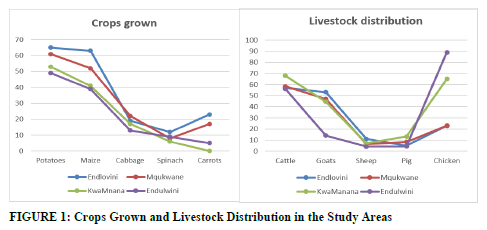
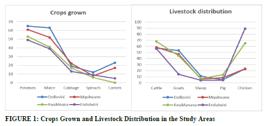
The study revealed that communal farmers in the study areas primarily engage in livestock (cattle, goats, pigs, and chickens) and crop (maize, potatoes, spinach, cabbage, and carrots) production. These findings agree with those of studies by Ngxetwane (2011), Gwala et al. (2016), and Katikati (2017). Potato and maize production are highest in Endlovini (65%; 63%) and Mqukwane (61%; 52%); spinach production (12%) is mainly practised in Endlovini. Mqukwane and KwaManana have lower yields (8% and 6%, respectively). In KwaManana, no farmer grows carrots. Endlovini has consistently high crop production across most crops. Mqukwane also shows promising yields, especially for potatoes, maize, and cabbage. Farmers in KwaManana and Endulwini reported water scarcity and high temperatures as contributing factors to the low crop yield.
3.1.2. Livestock Distribution
Findings of this research show that Endlovini is prominent in goat production (53%) and cattle production (56%). In contrast, KwaManana excels in cattle production (67.8%) and has a significant presence in chicken production (65%). Mqukwane demonstrates consistent performance across most livestock categories, with notable existence in cattle (58.4%) and goat production (47%). The results also reveal that Endulwini dominates chicken production (89%), while it has lower production levels for other livestock. Additionally, Endlovini and Mqukwane display relatively diversified livestock production profiles, while KwaManana and Endulwini appear to engage in specific livestock, namely cattle and chickens, respectively.
3.1.3. Challenges Faced by Communal Farmers
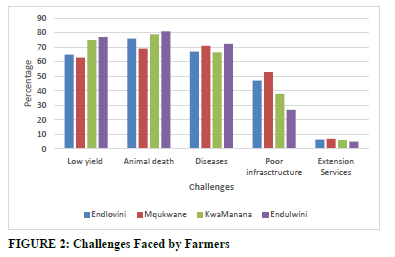
As shown in Figure 2, the study reveals that animal health is a significant challenge, particularly in Endulwini (81%) and KwaManana (79%), where a substantial proportion of farmers reported potential issues. Additionally, many farmers in these areas struggle with low crop yields (77% in Endulwini and 75% in KwaManana), which may be attributed to factors such as climate change and farming practices. Livestock diseases affect all study areas, with Endulwini and Mqukwane experiencing slightly higher rates. This suggests that disease management is a pressing concern across the region. Farmers in Endlovini (47%) and Mqukwane (53%) are also disproportionately affected by poor infrastructure (inadequate roads and dipping facilities).
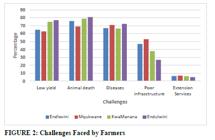
In contrast, KwaManana and Endulwini seem to have relatively better infrastructure, with ratings of 38% and 27%, respectively. Interestingly, farmers did not identify access to extension services as a major challenge, instead attributing animal death and disease to drought and high temperatures. This is reflected in research findings, with low ratings for extension services across all study areas. This finding contradicts a study by Gwala, Yusuf, Loki, Bontsa, Mdiya, and Rani (2024), which indicated that farmers have limited access to extension services, affecting production inputs.
3.2. Innovations Accessed by Communal Farmers
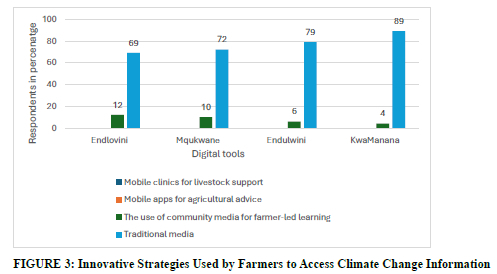
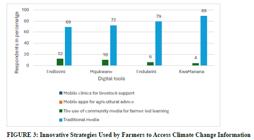
Research findings indicate that access to digital innovations (mobile clinics for livestock support and mobile apps for agricultural advice) is not available across all communities. There is limited use of community media for farmer-led learning, ranging from 4% (KwaManana) to 12% (Endlovini). Results further indicate a high reliance on traditional media (TV, radio) for access to agricultural and climate change information, ranging from 69% (Endlovini) to 89% (KwaManana). The results suggest that digital innovations, such as mobile clinics and mobile apps, are not being utilised in these communities. Bontsa, Mushunje, Ngarava, and Zhou (2023) found similar findings in a study conducted in rural areas of Port St Johns. The results in Figure 3 indicate that community media is not widely used for farmer-led learning and that traditional media remains a dominant source of information for farmers in the study areas. These findings indicate a need to invest in digital infrastructure and training to support the adoption of digital innovations, promote the use of community media for farmer-led learning and extension services and leverage traditional media channels to disseminate information and support farmers.
3.3. Climate Change Adaptation Strategies Employed by Communal Farmers in the Study Areas
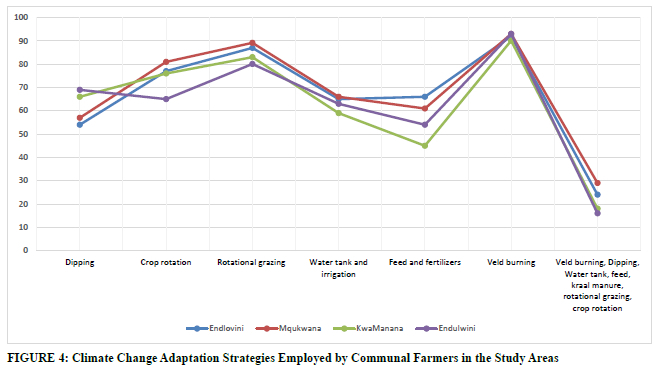
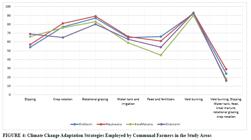
Veld burning is a widely used strategy across all communities, with adoption rates ranging from 90.1% (KwaManana) to 93% (Mqukwana and Endulwini). Rotational grazing is also a widely adopted strategy, with percentages ranging from 80.1% (Endulwini) to 89.2% (Mqukwana). Crop rotation is commonly used in Endlovini (77%) and Mqukwana (81%). Dipping is mostly practised in KwaManana (66%) and Endlulwini (69%). Around 59-66% of farmers across communities use water tanks for irrigation during drought periods. Farmers store maize and other crop residues to use as livestock feed during periods of limited grass and drought on grazing lands. As shown in Figure 4, fertiliser (kraal manure, as explained by farmers) is used for crop production; about 45% to 66% of farmers in KwaManana and Endlovini reported this adaptation strategy. About 87% of farmers in the study area employ multiple adaptation strategies and services (veld burning, dipping, water tanks, feed, kraal manure, rotational grazing, and crop rotation). These findings are similar to those of a study by Bontsa, Gwala, Ngarava, Mdiya and Zhou (2023). Research results further indicate that veld burning and rotational grazing are the most widely adopted adaptation strategies across all communities. This suggests their importance in managing the veld and livestock. The variation in the use of different adaptation strategies across communities may be influenced by factors such as climate variation, soil type, and farming practices. The relatively low adoption rates of integrated adaptation strategies may suggest opportunities to promote more holistic and innovative approaches to farming and natural resource management.
3.4. Access to Support Services and Climate Smart Farming Practices
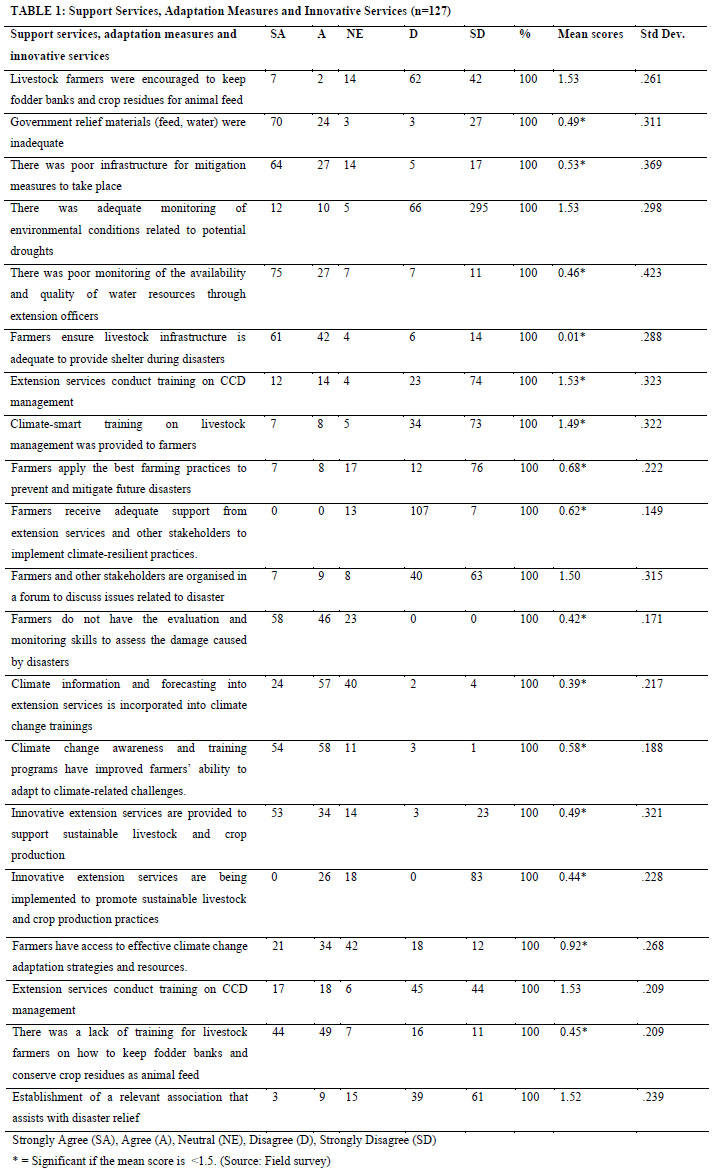
As shown in Table 1 various research results indicate significant findings as there are most strong agreements on the statements analysed; inadequate government relief materials (0.49) indicates significant results as there is strong agreement that government relief materials (feed, water) were inadequate; there was poor infrastructure for mitigation measures; there was poor monitoring of availability and quality of water resources (0.46); farmers do not have evaluation and monitoring skills to assess damages caused by disasters (0.42); Climate information and forecasting into extension services is incorporated on climate change trainings (0.39); Climate change awareness and training programs have improved farmers' ability to adapt to climate-related challenges (0.59). However, the results further show significance and strongly disagree with these statements; i). limited access to effective adaptation strategies (0.92), and ii) Innovative extension services are being implemented to promote sustainable livestock and crop production practices (0.49). The results suggest significant challenges in support and adaptation strategies, infrastructure, monitoring, and innovative extension services.
Additionally, farmers may lack evaluation and monitoring skills and access to effective adaptation strategies. However, extension services seem to be promoting sustainable practices, such as fodder banks and the use of crop residues, and conducting training on climate change and disaster management. These findings can inform policy and practice improvements to support sustainable livestock production and climate change adaptation.
4. CONCLUSIONS AND RECOMMENDATIONS
The study concludes that by improving access to climate-smart technologies and essential support services, farmers can better navigate the challenges posed by climate change. Innovative extension methods, such as leveraging digital platforms and community-driven initiatives, can facilitate the dissemination of agricultural information and promote climate-resilient agriculture. The study further suggests a three-pronged approach to enhance communal farming; i) capacity building-provide extension officers with training and capacity-building programs on climate-resilient agriculture, sustainable practices, and innovative extension methods, ii) farmer-led innovation-support farmers in experimenting with climate-resilient practices, ensuring access to resources, markets, and technology to improve their climate change adaptation and coping mechanisms, and iii) policy support- advocate for policies and incentives that promote climate change adaptation and sustainable agriculture in communal farming areas. By providing communal farmers with climate-resilient agricultural knowledge and skills, extension services can empower them to make informed decisions and take proactive steps to adapt to climate change.
5. ACKNOWLEDGEMENTS
The authors would like to humbly appreciate the farmers for providing enough information during data collection. Additionally, we are very grateful to the enumerators who assisted during data collection. The University of Fort Hare Office of Research and Innovation is funding this research.
REFERENCES
-
AMAHLATHI LOCAL MUNICIPALITY INTEGRATED DEVELOPMENT PLAN., 2024. Available from https://www.amahlathi.gov.za/wp-content/uploads/2023/06/Final-IDP-2023-2024.pdf
» https://www.amahlathi.gov.za/wp-content/uploads/2023/06/Final-IDP-2023-2024.pdf - ANSHUMAN, J. & MALLICK, B., 2024. Innovative agriculture strategies and concepts in extension. AkiNik Publications.
- ANTLE, J.M., BASSO, B., CONANT, R.T., GODFRAY, H.C.J., JONES, J.W., HERRERO, M., HOWITT, R.E., KEATING, B.A., MUNOZ-CARPENA, R., ROSENZWEIG, C. & TITTONELL, P., 2017. Towards a new generation of agricultural system data, models and knowledge products: Design and improvement. Agric. Syst., 155: 255-268.
- ARULMANIKANDAN, B. & VAISHNAVI, P., 2024. Transformative influence of innovative agricultural extension services on rural communities. In J. Jayasudha, P.N. Patel, K. Manobharathi, J.R. Aparna & K.L. Chaudhary (eds.), Innovative Agricultural Extension Approaches. AkiNik Publications, pp. 1-19.
- BAHTA, Y.T., JORDAAN, A. & PHATUDI-MPHAHLELE, B., 2019. Ecological vulnerability indicators to drought: Case of communal farmers in Eastern Cape, South Africa. Jamba: J. Disaster Risk Stud.., 11(1): 1-11.
- BEG, N., MORLOT, J. C., DAVIDSON, O., AFRANE-OKESSE, Y., TYANI, L., DENTON, F., SOKONA, Y., THOMAS, J.P., LA ROVERE, E.L., PARIKH, J.K., PARIKH, K. & RAHMAN, A.A., 2002. Linkages between climate change and sustainable development. Clim. Policy., 2(2-3): 129-144.
- BONTSA, N.V., GWALA, L., MDIYA, L. & MDODA, L., 2024. Determinants of livestock smallholder farmer's choice of adaptation strategies to climate change in Raymond Mhlaba Local Municipality, Eastern Cape, South Africa. S. Afr. J. Agric. Ext, 52(4): 128-147.
- BONTSA, N.V., GWALA, L., NGARAVA, S., MDIYA, L. & ZHOU, L., 2023. Quality of climate change extension services provided to smallholder farmers in Raymond Mhlaba Local Municipality, Eastern Cape Province, South Africa. S. Afr. J. Agric. Ext., 51(2): 114-127.
- BONTSA, N.V., MUSHUNJE, A., NGARAVA, S. & ZHOU, L., 2023. Utilisation of digital technologies by smallholder farmers in South Africa. S. Afr. J. Agric. Ext., 51(4): 104-146.
- CHOWDHURY, A.H., HAMBLY ODAME, H. & LEEUWIS, C., 2013. Transforming the roles of a public extension agency to strengthen innovation: Lessons from the national agricultural extension project in Bangladesh. J. Agric. Educ. Ext., 20(1): 7-25.
- COOK, B.R., SATIZÁBAL, P. & CURNOW, J., 2021. Humanising agricultural extension: A review. World Dev., 140: 10533
- DESANKER, P. & MAGADZA, C., 2001. Africa. In J.J. McCarthy, O.F. Canziani, N.A. Leary, D.J. Doken & K.S. White (eds.), Climate Change 2001: Impacts, adaptations and vulnerability. Cambridge: Cambridge University Press, pp. 489-531.
- DUNCOMBE, R., 2015. Mobile phones for agricultural and rural development: A literature review and suggestions for future research. Eur. J. Dev. Res., 28(2): 1-23.
-
EASTERN CAPE SOCIO ECONOMIC COUNCIL., 2017. Amathole District Municipality Socio-Economic Review and 0utlook. Available from https://www.ecsecc.org/documentrepository/informationcentre/amathole-district-municipality_74397.pdf.
» https://www.ecsecc.org/documentrepository/informationcentre/amathole-district-municipality_74397.pdf - FAURE, G., DESJEUX, Y. & GASSELIN, P., 2012. New challenges in agricultural advisory services from a research perspective: A literature review, synthesis and research agenda. J. Agric. Educ. Ext., 18(5): 461-492.
- GWALA, L., MONDE, N. & MUCHENJE, V., 2016. Qualitative data analysis of extension services for Nguni cattle project beneficiaries in Nkonkobe local municipality, South Africa. Int. J. Dev. Sustain., 5(11): 553-563.
- GWALA, L., YUSUF, F., LOKI, O., BONTSA, N., MDIYA, L. & RANI, Z., 2024. Perceptions of communal farmers on extension support services accessibility in the Port St Johns, Eastern Cape Province. S. Afr. J. Agric. Ext., 52(4): 83-96.
- GWALA, L., YUSUF, S.F.G. & MONDE N., 2022. Characteristics of livestock production systems in some communal areas of the Eastern Cape Province, South Africa. J. Crit. Rev., 9(2): 17-28.
- INTERGOVERNMENTAL PANEL ON CLIMATE CHANGE [IPCC]., 2001. Climate change 2001: Impacts, adaptation, and vulnerability. In Contribution of Working Group II to the Third Assessment Report of the Intergovernmental Panel on Climate Change. Cambridge: Cambridge University Press.
- JABER, S.M., 2023. Insights About the spatial and temporal characteristics of the relationships between land surface temperature and vegetation abundance and topographic elements in arid to semi-arid environments. Remote Sens. Earth Syst. Sci., 6: 254-274.
- KATIKATI, A., 2017. Assessment of production practices of emerging cattle farmers in the selected districts of the Eastern Cape Province, South Africa. Doctoral dissertation, Central University of Technology, Free State.
- LEMOS, M.C., AGRAWAL, A., EAKIN, H., NELSON, D.R., ENGLE, N.L. & JOHNS, O., 2013. Building adaptive capacity to climate change in less developed countries. In G.R. Asrar & J.W. Hurrell (eds.), Climate science for serving society: Research, modeling and prediction priorities. Dordrecht: Springer Netherlands, pp. 437-457.
- MAHLALELA, P.T., BLAMEY, R.C., HART, N.C.G. & REASON, C.J.C., 2020. Drought in the Eastern Cape region of South Africa and trends in rainfall characteristics. Clim. Dyn., 55: 2743-2759.
- MBUQWA, P., MAGAGULA, H.B., KALUMBA, A.M. & AFUYE, G.A., 2024. Interdecadal variations in agricultural drought monitoring using land surface temperature and vegetation indices: A Case of the Amahlathi Local Municipality in South Africa. Sustain., 16(18): 8125.
- MDIYA, L., ALIBER, M., NGARAVA, S., BONTSA, N.V. & ZHOU, L., 2023. Impact of extension services on the use of climate change coping strategies for smallholder ruminant livestock farmers in Raymond Local Municipality, Eastern Cape Province, South Africa. S. Afr. J. Agric. Ext., 51( 2).
- NAKASONE, E. & TORERO, M., 2016. A text message away: ICTs as a tool to improve food security. Agric. Econ., 47(S1): 49-59.
- NGXETWANE, V., 2011. Integrated crop-livestock farming system for sustainable economic empowerment of small-scale and emerging farmers in the former homeland of the Eastern Cape province of South Africa: A case study of Ciskei area in Nkonkobe municipality. Doctoral dissertation, University of Fort Hare.
- PARKER, L., BOURGOIN, C., MARTINEZ-VALLE, A. & LÄDERACH, P., 2019. Vulnerability of the agricultural sector to climate change: The development of a pan-tropical Climate Risk Vulnerability Assessment to inform sub-national decision making. PloS One., 14(3): e0213641.
- PARRY, M., ROSENZWEIG, C. AND LIVERMORE, M., 2005. Climate change, global food supply and risk of hunger. Philosophical Transactions of the Royal Society B: Biological Sciences, 360(1463), pp.2125-2138.
-
RAJASRI, S., 2025. Impact of innovative agricultural extension services on rural communities: A revolution. Available from http://www.agricosemagazine.com.
» http://www.agricosemagazine.com - RAYMOND MHLABA LOCAL MUNICIPALITY (RMLM)., 2017. Eastern Cape Province Government Gazette Extraordinary General Notice 3481.
-
STATISTICS SOUTH AFRICA (STATS SA)., 2016. Community survey 2016. Available from http://www.statssa.gov.za/?page_id=6283
» http://www.statssa.gov.za/?page_id=6283 - STEINKE, J., VAN ETTEN, J., MÜLLER, A., ORTIZ-CRESPO, B., VAN DE GEVEL, J., SILVESTRI, S. & PRIEBE, J., 2020. Tapping the full potential of the digital revolution for agricultural extension: an emerging innovation agenda. Int. J. Agric. Sustain., 19(5-6): 549-565.
- TAYE, H., 2013. Evaluating the impact of agricultural extension programmes in sub-Saharan Africa: Challenges and prospects. Afr. Eval. J., 1(1): 1-9.
- WORLD BANK., 2000. Poverty and climate change: Reducing the vulnerability of the poor. Discussion document for COP 8. New Delhi.