Agricultural Extension Practitioners' Use of Information Communication Tools in the Capricorn District, Limpopo, South Africa: A Perception Study
Abstract
Perception is a critical concept in innovation adoption. Reports from the Limpopo Department of Agriculture and Rural Development indicate that agricultural extension practitioners (AEPs) do not use the full complement of Information, Communication and Technologies (ICTs) made available for their extension work. This can compromise the effectiveness of extension service delivery to farmers. This study applied the Düvel adoption behaviour analysis framework to help understand the AEPs' perceptions and use of ICTs made available to them for their work. Using a self-administered questionnaire and adopting a census approach, data was collected from the AEPs in two local municipalities of the Capricorn district. Data was analysed by descriptive statistics. The findings indicate that most AEPs have a favourable perception of the ICTs made available to them for their work. Furthermore, the study found factors that are incompatible with the present situation of AEPs that constrain the use of all the ICTs. These findings have important implications for delivering effective extension services to farmers. The study results also show that the Düvel behaviour analysis framework consistently yields results congruent with theoretical expectations. This enriches the extension theory. To solve incompatibility challenges, recommendations are made based on the findings.
Agricultural Extension Practitioner; Communication; Information; Perception; Technology; Tools; Adoption Behaviour
1. INTRODUCTION
Communication is necessary in any human endeavour and sine qua non for effective agricultural extension work and agricultural development in general. Agricultural extension involves the conscious use of information communication to help people, such as farmers, form sound opinions and make good decisions towards achieving productive and successful farming businesses. It is said that the process of communicating about farm practices can be traced back to the early development of agrarian societies (Telg & Irani, 2012). It can be argued that traditionally, such communities looked for information on techniques and technologies to improve their agricultural production practices. Extension educators delivered much of this information to cater to their audience's needs by using traditional channels, such as face-to-face interaction, newsletters, magazines, pamphlets, and radio broadcasts (Telg & Irani, 2012). As the world moved towards an information-based economy, audiences for farm information, their needs, and the channels used to meet those needs have also changed.
Free government extension services to small-scale/smallholder and subsistence farmers have been and continue to be the dominant extension service model in many countries, especially developing ones (Sala, Ross & David, 2016). However, since the 1980s, budget constraints have plagued public extension services worldwide, which has resulted in fewer field-level public extension practitioners being employed and a lack of other resources, such as transport, being made available to deliver services (Gershon, Willett, & Zijp, 1999). These challenges have made it increasingly difficult for field-level extension workers worldwide to reach the thousands or even millions of small-scale/smallholder and subsistence farmers who often live in widely dispersed communities. Furthermore, the global population is expected to reach 9 billion by 2050, and all these people will need food (McNamara, Belden, Kelly, Pehu & Donovan, 2011). The increased demand for food due to the expected growth in the world population requires urgency from institutions such as agricultural extension organisations to find new ways to reach farmers with relevant and up-to-date agricultural information, technology, and advice that will empower them to be productive and successful. To meet these challenges, innovative extension approaches that have emerged in the last 15-20 years globally include information, communication and technology-based agricultural extension and advisory services (ICTs) (Davis & Asenso-Okyere, 2010).
Many papers have been written on ICTs, agricultural development, and extension service delivery. Most of these studies focus on areas such as the use of ICTs in the delivery of extension services to farmers (Rohila, Yadav & Ghanghas, 2017; Mabe & Oladele, 2012); the use and accessibility of mobile phones by farmers (Matto, 2018; Kante, Oboko & Chepke, 2016); and the awareness level of the use of ICT tools among agricultural extension practitioners (AEPs) (Mabe & Oladele, 2012). Other dominant research areas have examined ICT's importance and impact on agricultural development (Trendov, Varas & Zeng, 2019; Derso & Ejiro, 2015; Asenso-Okyere & Mekonnen, 2012).
Since 1994, agricultural extension in South Africa has become the vehicle to deliver government agricultural agenda in the face of food security concerns, concerns about low agricultural productivity among smallholder producers, the campaign for poverty alleviation, and the consideration of the devastating impacts of climate change on agricultural production, especially, on smallholder and subsistence agriculture. To navigate these challenges, the South African government has taken various policy initiatives to effectively and efficiently improve the extension delivery system to support smallholder and subsistence agriculture. These initiatives include, among others, the publication of the Norms and Standards in 2005 (Department of Agriculture, 2005) and the launch of the Extension Revitalization Plan(ERP) in 2008 (Department of Agriculture, Forestry and Fisheries [DAFF], 2011). Some of the objectives of the ERP initiatives include enhancing communication with farmers and farmer organisations through the use of new communication tools such as ICTs, adopting effective/efficient communication methods, and providing ICT infrastructure and other resources to extension practitioners.
Our study focuses on the field-level agricultural extension practitioners' (AEPs) perceptions of the ICT infrastructure provided to them by the Limpopo Department of Agriculture and Rural Development (LDARD) in the extension services delivery system under the Extension Revitalization Plan (ERP) (DAFF, 2011). Three ICT tools were introduced to be used with the personal computers which AEPs already had. Therefore, the four ICT tools investigated in this study are the smart pen technology (SPT), the smartphone, the laptop/desktop computer, and the Extension Suite Online (ESO) system.
The ESO version 1 is an internet-based (online) information system and an integrated agricultural production and extension support knowledge base developed to provide agricultural advisors with information on every possible aspect of agriculture. It was introduced into the extension service delivery system in South Africa in 2007 (De Villiers, 2012). As an agricultural knowledge centre, the information needs of farmers are translated into research activities, and the research results are translated into practical farming solutions. The system is available to the AEPs for their extension work anytime and anywhere, and it has internet connectivity to provide information to farmers. As an ICT tool, ESO embodies information that AEPs can access because it comprises soft- and hardware information and communication technology that facilitates communication between researchers and AEPs.
The smart pen technology (SPT), also called digital pen, was introduced to the LDARD in November 2010 (Lane, n.d). This followed a pilot study of the technology and its acceptance in the Western Cape Department of Agriculture in 2009, after which the DAFF embarked on a national roll-out of the technology in the other eight provinces of South Africa (Lane, n.d.). The smart pen is an efficient communication technology tool with GPS and a camera-enabled mobile phone. The solution allows the department's extension practitioners to register projects, do real-time monitoring, write and send reports, reduce paperwork, and provide support at regular site visits while also attaching GPS coordinates and photographs to reports. Extension managers can also use it to monitor information on agricultural projects and farm visits by AEPs.
A smartphone is an information and communication technology tool with enhanced applications and is generally used for information storage and communication purposes. The phone can connect to the personal computer to store the AEPs' field information for processing. The laptop is an information and communication technology tool used to store, retrieve, process, and communicate information related to extension work.
Even though the DAFF had adopted these ICTs for extension delivery work, their use depends on the AEPs' perceptions of these ICTs. The importance of perception as a powerful means of determining the psychological field forces in behaviour, and therefore, adoption or use of behaviour has been acknowledged long ago (Thomas & Znaniecki, 1927; Düvel, 1975). Studies on the perceptions of agricultural extension practitioners towards ICTs have been conducted by Oladele (2015) in South Africa, Ajayi, Alabi and Akinsola (2013) in Nigeria and Kopecky (2016) in Uganda. The Ajayi et al. (2013) and Oladele's (2015) studies were based on extension practitioners' perceptions of ICT in general. Kopecky (2016) investigated extension practitioners' perceptions of an ICT tool (smartphones) adopted by an extension organisation to be used by field-level extension practitioners for extension work. In this regard, our study comes close to this latter topic, but the difference is that our study investigated four ICTs. All the studies mentioned here analysed perception differently, either based on the use of a Likert scale (Oladele, 2015; Ajayi et al., 2013) or personal interviews to elicit extension workers' perceptions toward smartphones for their work (Kopecky, 2016). Furthermore, none of the studies previously mentioned used a widely tested conceptual framework to analyse the concept perception. This could have provided a basis for questionnaire construction to elicit respondents' perceptions, as we have done in our study.
Various definitions have been provided to explain the concept of 'perception' (McDonald, 2011; Hatfield, 2001). The operational definition of the perception of an innovation used in our study is based on Düvel's (1991) framework, which conceptualises perception in terms of the relative advantages of the innovation, the prominence of the innovation, and the compatibility of the innovation with the adopter's or user's situation. Düvel (1991) put forward the concept 'relative advantages' to replace Rogers' (1983) innovation attribute "relative advantage". The relative advantages relate to the attractiveness of the innovation; this is operationally defined as the advantages (or positive forces) and disadvantages (or negative forces) associated with the use or adoption of the innovation. The innovation attribute' prominence' is synonymous with the "relative advantage" of Rogers (1983). Düvel (1991) refers to the concept of 'prominence' as the overall comparison of the new idea (in this study, the four ICTs used together) with the old idea (use of laptop and smartphone together) about the achievement of one's goal.
The incompatibility of an innovation with an individual's present situation looks at whether the innovation is relevant in a respondent's specific, present situation. The situational incompatibility aspects represent the barriers to implementing an idea or one's goal achievement and are potentially negative. Therefore, these barriers become irrelevant once the new idea is implemented (Düvel, 1991). The incompatibility aspects relate to the social, physical, cultural, communication, and economic factors of the respondent's life that can prevent the use or adoption of an innovation. However, these factors can make the use or adoption of innovation possible when addressed rather than stimulated (Düvel, 1991). Most factors that make an individual unable or incapable of using or adopting an innovation, such as personal/environmental factors, fall into this category of variables and are more independent. Due to the wide variations in the literature concerning the influence of the independent variables on the use or adoption of innovations (Afful, 1995; Sulaiman & Sadamate, 2000; Israel & Wilson, 2006; Ajayi, 2006), the researchers in this present study carefully considered some independent variables to assess their incompatibility with the AEPs situation regarding their use of the ICTs provided to them by the LDARD for their work.
The Düvel (1991) framework for adoption behaviour analysis has been widely tested, and the mediating variables (needs, perception, and knowledge) have been found to consistently remain more important determinants of innovation use or adoption behaviour (Msuya, 2016; Annor-Frempong, 2013) than the independent variables. A meta-analysis of innovation characteristics and adoption (Tornatzky & Klein, 1982) found that the relative advantage of the innovation has a more substantial positive effect on adoption behaviour. Furthermore, Leeuwis and van den Ban (2004) also commented on the positive relationship between farmers' evaluation of the advantages and disadvantages of innovation and adoption. All these findings are consistent with the mediating variable categorisation of Düvel (1991) as a more important precursor of adoption or use behaviour than the independent variables. For this reason, the Düvel (1991) framework was adopted as a conceptual framework for a more focused analysis of AEPs' perceptions and use of the ICT tools provided to them for their extension work. The perception variables in the framework for ICT use analysis in our study were the prominence of the ICT tools in helping respondents to achieve their goals, the relative advantages of the ICT tools and the incompatibility of the ICT tools with the AEPs present social and economic situation. The Düvel (1991) framework guided the construction of the questionnaire for this study, and therefore, the validity and reliability of the data collection instrument were verified. Given the lack of extant literature based on empirical work on the use of the Düvel (1991) framework to address this topic, this study becomes even more necessary to inform extension managers and policymakers on AEPs perceptions of ICTs as well as relevant reasons for the non-use among AEPs of the four ICTs (smart pen, smartphone, laptop/desktop computer and the Extension Suite Online (ESO) system) provided to them for their work.
The purpose of the study was to investigate how field-level AEPs perceptions of the ICTs provided to them for their work can assist in gaining an understanding of the incompatibility of the ICTs with their situation and why they do not always use all four ICTs, how the relative advantages of the ICTs affect their use and how the prominence of the ICTs help AEPs to achieve their extension goals. The central research question for this study was as follows: How do AEPs' perceptions of the ICT tools provided to them for their work help to understand why AEPs do not always use all the ICTs for their Extension work? The specific research questions of the study were:
i. How incompatible are the ICTs with AEPs in the present situation? How many ICTs do AEPs use together? What is the frequency of ICT usage among AEPs? What are the AEPs' reasons for not using all the ICTs for their work?
ii. How aware or unaware are AEPs of the disadvantages and advantages of the ICTs provided to them for their work?
iii. What do AEPs think of the prominence of the ICTs provided for their work to achieve their extension goals?
2. METHODOLOGY
The data for this paper was based on a master's degree study conducted at the Tshebela and Mankweng Service Centres in the Capricorn district in the Limpopo Province in 2017. The Centres provide agricultural extension services to farmers. The population of this study comprised the agricultural extension practitioners (AEPs) at the Mankweng and Tshebela Service Centres. The study used a survey research design and a self-administered, semi-structured questionnaire. Data was collected in 2017 from 40 of the 45 AEPs available to participate in the study at the two service centres. This number of respondents is still adequate for statistical analysis based on the Central Limit theorem, which states that if sample sizes are large enough, n>30, the distribution of the mean will be approximately normal (Glen, 2013).
2.1. Generation of Index for Awareness of Disadvantages of ICTs
Respondents were asked to indicate whether they agree, coded as 1 or undecided or disagree, coded as 0, with statements on nine variables regarding awareness of disadvantages associated with using the four ICT tools. Individual respondent's mean scores on all nine variables were compared with the total mean score of all 40 respondents and the associated standard deviation. A respondent whose mean score was less than the total mean score was given a code 0; this means the respondent is unaware of the disadvantages of using ICTs for his or her work. The opposite was the case when the individual mean score was equal to or higher than the total mean score; such a respondent was given a code of 1; this means the respondent is aware of the disadvantages of using the ICTs in their work.
2.2.
Generation of Index for Unawareness of Advantages of ICTsA similar procedure as in the index generation for awareness of disadvantages was used to generate an index for a respondent's unawareness of the advantages of ICTs (based on 15 variables) for their work. An individual whose mean score was equal to, or more than, the total mean score was judged as unaware of the advantages of using the ICT tools for their work and coded 1; an individual was coded 0 in the opposite case.
2.3.
Assessment of ICT ProminenceThe prominence of the ICTs was assessed by requesting respondents to indicate their agreement with the study question that the use of the four ICT tools (laptop, smartphone, smart pen and ESO) together helps one to achieve one's career goal compared to the use of only the smartphone and laptop together. The responses were coded as 1 (helps to achieve one's goal) and 0 (does not help to achieve one's goal).
2.4.
Data AnalysisData analysis was conducted using the Statistical Package for Social Sciences (SPSS). Data was subjected to descriptive analysis, which included the use of means, percentages, and standard deviation of selected variables to provide information about the state of the situation regarding AEPs' perceptions and the use of the ICT tools provided for their extension work.
3. RESULTS AND DISCUSSION
3.1. Incompatibility of ICT with Respondents' Situation
AEPs' use of the ICT tools presupposes that they have been supplied with the tools or that these tools have been made available to them and have the necessary infrastructure to use them. This section summarises the results of the first research question related to the incompatibility of ICTs with the AEPs' present situation.
3.1.1. Sex of Respondents
The findings in this study show that an equal number of females and males (50%, N= 40) took part in the survey. However, other studies on AEPs, such as that of Ajayi et al. (2013) and Mustapha et al. (2022) in Nigeria, Antwi-Agyei and Stringer (2021) in Ghana and Mabe and Oladele (2012) in the North West province of South Africa, revealed that the majority of AEPs were males. Compared to the findings in other places such as Nigeria, our finding shows that the LDARD was doing well in achieving gender equity in its recruitment of workers in compliance with the Employment Equity Act, 55 of 1998 (South African Government, 1998). On the other hand, the difference in numbers between our study and that of Mabe and Oladele (2012) in the North West province of South Africa indicates that some provincial Departments of Agriculture are doing better in terms of improving female representation.
Regarding the potential of gender of the AEP being a constraint to the use of ICT, the findings reveal that generally, most males and females (75%, N= 40) used ICTs daily for their extension work. This finding is consistent with the finding by Maleka (2011) in five provinces of South Africa, including Limpopo, that gender differences do not exist in the adoption and usage of ICTs. Even though gender was not a constraint about the use of ICTs, our finding indicates that more males (60%) (N= 40) compared to females (40%) (N= 40) used all four ICT tools provided to them.
3.1.2. Age
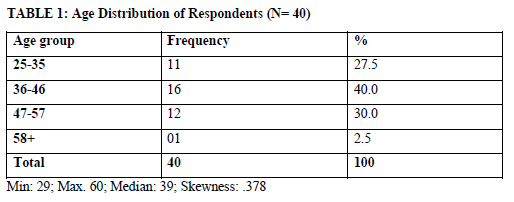
The findings in Table 1 indicate that 27.50% of the AEPs were youth, as defined by Statistics SA's (2016) age categories, whereby youth are grouped as people who fall in the age bracket 15 to 34 years. The majority of the AEPs (70%) were in the middle age group (36-57), and very few (2.5%) respondents were considered old (58 and over). Similar findings were made by Agwu et al. (2008) in a study in Nigeria where there was only a small percentage (5%) of AEPs in the older age group; the dominant group was the middle-aged group, and the remaining percentage was youth. Our finding on the age of AEPs, however, contradicts that of Samansiri and Wanigasundera (2014), who conducted research in Sri Lanka, where they found that the youth was less involved in the field of agricultural extension than the older age group.
The AEP's responses to the question about age and how often they used the ICTs indicated that 75% (N= 40) use their ICT tools daily compared to weekly or monthly. Ignoring the one individual (60 years of age) in the 58 years and over age group, most AEPs in all the other age categories used their ICT tools daily, but not all four ICT tools together. However, a closer look at the data indicates that mostly the age group 25-35 (73%, N= 11) used all four ICT tools daily. This finding concurs with the results of Maleka (2011), who indicated that age played a significant role in ICT adoption and usage and that younger individuals were more likely to adopt and use ICTs, irrespective of gender. The dominance of the youth and middle-aged group in agricultural extension is thus good because these groups are more familiar with new technologies and, therefore, more likely to embrace them for their work than the older respondents.
3.1.3. Income of Respondents
The rationale behind enquiring about the AEP's annual income was to indicate their ability to pay for smartphone airtime or data since the practice is that AEPs should buy the airtime or data when needed. They will be reimbursed later by the employer. According to the responses (N= 40), only a minority of the respondents (5%) earned less than R250, 000 per annum. The rest of the AEPs in the study earned R250,000-300,000 (55%) and over R300,000 (40%). Interestingly, the results on income and the use of all four ICT tools together (smart pen, smartphone, laptop/desktop computer and the Extension Suite online system) show that 41% of the AEPs who earned between R250,000 and R300,000 would make use of all four ICT tools compared to only 25% of those who earned more than R300,000. A possible explanation for this is that the middle-income earners are those aged 25-35, while those earning more than R300,000 belong to the older age group. Section 3.1.2 of this article has shown that most AEPs in the age group 25-35 use all four ICT tools compared to a smaller percentage in the older age group. Age, more than income earned, appears to be a deciding factor in using all ICT tools together. Ajayi et al. (2013) and Gilwald, Stork, and Milek (2010) found that income increases the probability of owning ICTs. However, these studies findings were based on a different context. The AEPs in our study must spend their own money on data to use an ICT tool (smartphone) to perform their job, though they will be reimbursed later. These differences in findings might also be because a minimum income threshold is needed. Once this is met, income is no longer a deciding factor in the use of ICT, which in our study appears to be the money AEPs must spend on data for their smartphones and the reimbursement they must apply for later.
3.1.4. Level of Education
The level of education of respondents (N= 40) indicates that slightly over half of the respondents (57.50%) had an honours degree, while some had a master's (17.50%) or bachelor's degree (15%) or a diploma (10%). This finding differs from that of Mugwisi (2013) in KwaZulu Natal, South Africa, which indicated that most AEPs had a bachelor's degree (46%) and a few had a master's degree (11%). Our finding that most AEPs had tertiary education (90%), however, concurs with the results of Abdullahi, Garforth, and Orward (2013), which indicated that the majority (50%) of extension agents in Nigeria had tertiary qualifications. The finding by Tata and McNamara (2016) that AEPs with advanced degrees faced fewer technical challenges when using internet-based systems than their less-educated colleagues bodes well for extension work in the LDARD since most AEPs in this office have tertiary education qualifications.
3.1.5. Respondents ' Training for ICT Usage
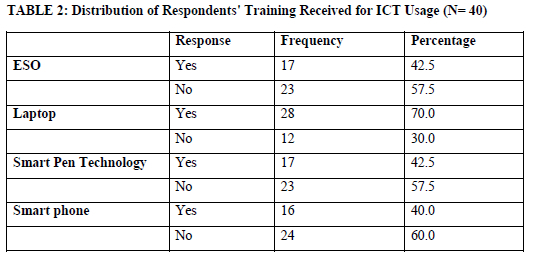
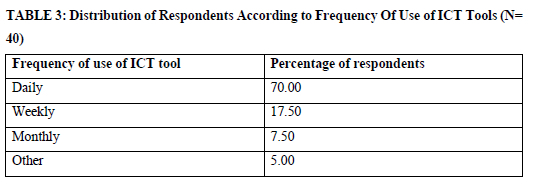
Table 2 provides a summary of responses to the question as to whether AEPs received training in the use of ICT tools. The findings in Table 2 indicate that between 57-60% said they did not receive training in three (ESO, SPT, smartphone) of the four ICT tools they are supposed to use. However, 70% of the respondents mentioned receiving laptop training. Looking at the training received (Table 2) and the frequency of ICT use (Table 3), we see that of the 75% of AEPs who used ICT tools daily, 90% received training on all four ICT tools, while 70% received some or no training at all. Furthermore, of the 35% (N= 40) who reported using all four ICT tools, 80% received training in using all four ICT tools, while only 20% received training on some or no training at all. These differences in ICT training and use may be due to the lack of knowledge of best practices in IT usage and IT-related skill deficiencies in the workforce, which constrain the benefits that can be gained from ICTs, as found by Kaushik and Singh (2004).
3.1.6. Use of ICTs: Number, Frequency, and Availability of Associated Infrastructure 3.1.6.1. Number of ICT Tools Used Together
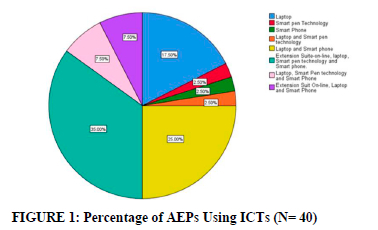
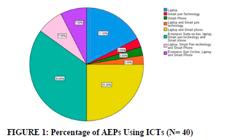
Figure 1 summarises the AEPs' responses to the question about the number of ICTs they use for their extension work. The results reveal that only 35% and 25% used all four and three ICT tools respectively together. Sadly, a good number of them, namely 40%, used only one or two tools.
A study by Sebeho (2016) in four municipalities in the Fezile Dabi District in the Free State, South Africa, based on farmers' perceptions of extension practitioners provided with ICT tools such as the smart pen technology, the Extension Suit Online system, smartphone and laptops, showed a poor picture of extension service delivery. For example, 96.5% of the farmers in the four municipalities said they did not experience any positive improvement in the delivery of extension services despite the extension practitioner being supplied with laptops, and only 4% of the farmers perceived improvement in service delivery even though extension practitioners had access to the ESO. Regarding the use of smart pen technology, it was reported in the study that only 3.5% of the farmers experienced the impact of this ICT on service delivery, while only 6.5% of farmers said the use of the cell phone improved the accessibility of extension practitioners. A lack of similar studies on the types of ICTs used together makes it difficult to compare our findings.
3.1.6.2. Frequency of Use of ICT Tools
AEPs were asked to indicate how often they used the ICT tools for their extension work. The results (Table 3) show that overall, most AEPs (70%) used their ICT tools daily compared to weekly or monthly.
3.1.6.3. Reasons For Not Using All Four ICT Tools
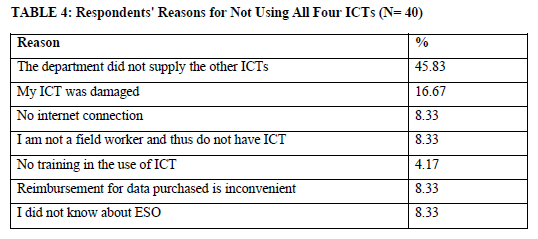
AEPs were further prompted to explain their reasons for not using all four ICT tools (laptop, smartphone, ESO, and smart pen). Their reasons relate to the associated infrastructure necessary to use the ICTs and are summarised in Table 4. The most common reason provided by most respondents (46%) was that the LDARD did not provide them with all of the four ICT tools. The second most popular reason the respondents gave (17%) was that their ICT tool got damaged and had not been replaced or repaired at the time of our survey. The other reasons were a lack of knowledge about the ESO, challenges associated with internet connectivity, the inconvenience of paying for data for the cell phones (to be reimbursed by the employer later), and lack of training in ICT tool usage. Some of these constraints concerning the use of the ICT tools are similar to those mentioned by the respondents in Sebeho's (2016) study, in the Free State in which 47% of the AEPs were dissatisfied with the use of the laptops because they could not access the internet as a result of their 3-G cards being disconnected; only 40% of AEPs were satisfied with using their cell phones while the majority of them were not. The Sebeho (2016) study did not provide reasons for their dissatisfaction. Still, one cannot rule out the problem of using one's own money to buy data for the phone and then apply for reimbursement from the department later. Again, only 40% of AEPs were satisfied with using the ESO system, and the majority were not. Sebeho (2016) believed this dissatisfaction was because their 3-G cards were disconnected, so they could not access the internet to use the ESO system. Training in ICTs is critical to its use, as previously indicated (see section 3.1.5) in our study, which found that most of the AEPs who used all ICT tools daily received training in using all four ICTs. The lack of training in the use of ICTs (Table 2) as a barrier to usage is corroborated by the findings of Kaushik and Singh (2004), who determined that a lack of knowledge of best practices in IT usage as well as IT-related skills deficiencies in the workforce constrain the benefits of ICT.
3.2. RELATIVE ADVANTAGES OF ICTs
The findings presented in this section relate to the second research question about the AEPs' awareness of the disadvantages and their unawareness of the advantages of the ICT tools provided for their work.
3.2.1. Respondents' Awareness of the Disadvantages of ICTs
The findings on respondents' awareness of the disadvantages of using ICTs for their work indicate that most AEPs, 60% (N= 40), disagreed with the research question that the ICTs provided to them have more disadvantages than advantages. In comparison, 40% agreed that they have more disadvantages than advantages. The findings, therefore, indicate that less than half of respondents agree there are disadvantages to using ICT tools for their extension work. These findings concur with that of Akuku, Makini, Wasilwa, Makelo, and Kamau (2014) in a study conducted in Kenya in which it was indicated that AEPs and farmers agree that the use of ICT tools brings a lot of positive change to agricultural extension work and have the potential of improving rural livelihoods and contributing to poverty eradication. Given the evidence in the literature of a negative relationship between awareness of the disadvantages of innovation and its use or adoption (Afful et al., 2013), the finding in our study bodes well for AEPs' continued use of ICTs for their extension work.
3.2.2. Respondents ' Unawareness of the Advantages of ICTs
The findings on respondents' unawareness of the advantages of the use of ICTs for their extension work indicate that 54% (N= 40) of AEPs agreed with the research question that the ICTs have more advantages than disadvantages; 46%, however, disagreed and said ICTs have more disadvantages than advantages. Put differently, less than half of the respondents agree that ICT tools have advantages for their extension work. This is good news because it means most respondents knew of the advantages of using ICTs for their work. A study by Samansiri and Wanigasundera (2014) in Sri Lanka indicated that most (68%) AEPs are familiar with the usefulness of ICT tools to access the information necessary for their extension activities. Again, given the evidence in the literature regarding the negative relationship between unawareness of the advantages of innovation and its use or adoption (Afful et al., 2013; Hudson & Hite, 2003), the finding in our study has positive implications for AEPs continued use of ICTs for their work.
3.3. PROMINENCE OF ICTS AND GOAL ACHIEVEMENT
This study's findings on the third research question, about the prominence of the ICTs provided to the AEPs in achieving their extension goals, indicate that most of them (70%; N= 40) think the use of all four of the ICTs is helping them to achieve their extension career goals compared to the use of only the smartphone and laptop. This finding is very important because it means practitioners will continue to use the four tools together to perform their extension work, provided the constraints to using these tools are addressed. The literature on the positive relationship between the prominence of an innovation and its adoption (Afful et al., 2013; Msuya, 2016) supports our finding.
4. CONCLUSIONS AND RECOMMENDATIONS
To understand why AEPs do not always use all four ICT tools provided to them for their work and to answer the study research questions, the study investigated AEPs perceptions of ICTs in this regard. The application of the Düvel (1991) framework helped the researchers to analyse the AEPs perceptions of ICTs and to gain an understanding of their incompatibility with AEPs' present situation, as well as to gauge their views on the advantages and disadvantages of using the ICT tools for their work and the prominence of the ICT tools for achieving their extension career goals.
The AEPs' use of the ICTs presupposes that they have been supplied with the ICTs, have the knowledge of how to use them, and have the necessary infrastructure to use them. A principal finding from this study is that the reasons for the AEPs not always using all the ICTs do not relate to the advantages and disadvantages of the ICTs or the prominence of the ICTs. This is because the minority of AEPs are unaware of the advantages or the disadvantages of ICTs. At the same time, most have a positive view of the prominence of ICTs in achieving their extension career goals. The findings on the incompatibility of the ICTs with the AEPs' present situation show that only a few AEPs use all four ICT tools together in their daily work. A minority of the AEPs are using all the ICT tools because of the following issues: the LDARD did not provide some of the ICT tools to the AEPs, such as 3-G cards which facilitate accessing the internet; damaged ICT tools have not been replaced or repaired by the LDARD; a lack of training in the use of the ESO hampers usage; there are challenges regarding internet connection in the workplace; and there is the inconvenience having to pay for data for cell phones and being reimbursed later by the LDARD. These challenges fall on the shoulders of the LDARD.
Furthermore, regarding the incompatibility issues, our findings show that the gender and age of AEPs and training in using ICTs are critical to using all four ICTs. All the preceding findings are consistent with the literature.
The study recommends that the LDARD focuses on the following to overcome the constraints in the AEPs' use of all the ICTs identified in this study and improve AEPs efficiency and effectiveness in the delivery of extension services: supply all the AEPs with the necessary ICTs; make AEPs aware of all four ICTs since some AEPs did not know about ESO and train all AEPs in the use of the ICTs; attend to internet connection challenges and speed up the reimbursement of AEPs for the cost incurred to purchase data to use their smartphones.
The implications of the findings of this study for field-level extension practice in the LDARD are that the positive perceptions of AEPs of ICTs for their work bode well for their continued use of modern and advanced technology for their work and reliance on scientific knowledge to guide farmers. The latter invariably leads to effective and efficient service delivery to farmers. For extension theory, our findings indicate that the Düvel (1991) framework has once again withstood the test of time regarding the use or adoption of innovations in that the perception variables continue to consistently yield the expected results corroborated by other findings in the literature.
Other developing countries can take a cue from this study by equipping their field-level extension practitioners with the necessary information and communication technologies. This will help them to keep pace with current, developing scientific knowledge in their field of work and the use of modern technology in their work. The latter will invariably lead to effective and efficient service delivery to farmers, ceteris paribus.
The authors do not have any conflict of interest.
5. ACKNOWLEDGEMENT
The authors express their sincere gratitude to the Limpopo Department of Agriculture and Rural Development for their support in the data collection. We are also grateful to the farmers of this study for their willingness to participate.
REFERENCES
-
ABDULLAHI, A., GARFORTH, C.J. & DORWARD, P.T., 2013. Enhancing extension roles through mobile phones in Nigeria: A case study. 21st European Seminar on Extension Education / Extension Education Worldwide, 2-6 September, ANTALYA. Available from: https://www.tandfonline.com/doi/abs/10.1080/1389224X.2013.768069
» https://www.tandfonline.com/doi/abs/10.1080/1389224X.2013.768069 - AFFUL, D.B., OBI, A. & LATEGAN, F.S., 2013. The relative attractiveness of payment for the delivery of public extension visits. J. Dev. Agric. Econ., 5(12): 490-498.
- AFFUL, D.B., 1995. Human constraints in stock reduction in a subsistence farming situation in South Africa. Master's dissertation. University of Pretoria, South Africa.
- AGWU, A.E., UCHE-MBA, U.C. & AKINNAGBE, O.M., 2008. Use of information communication technologies (ICTs) among researchers, extension workers and farmers in Abia and Enugu States: Implications for a national agricultural extension policy on ICTs. J. Agric. Ext., 12(1): 37-49.
- AJAYI, A.O., 2006. An assessment of farmers' willingness to pay for extension services using the contingent valuation method (CVM): The case of Oyo State, Nigeria. J. Agric. Educ. Ext., 12(2): 97-108.
- AJAYI, A.O., ALABI, O.S & AKINSOLA, T.O., 2013. Knowledge and perception of extension agents on information and communication technologies (ICTs) use in extension service delivery in Ondo State, Nigeria. Afr. J. Agric. Res., 8(48): 6226-6233.
-
AKUKU, B., MAKINI, F., WASILWA, L., MAKELO, M. & KAMAU, G., 2014. Application of innovative ICT tools for linking Agricultural research knowledge and extension services to farmers in Kenya. Kenya Agricultural Research Institute. Available from: https://repository.ubuntunet.net/bitstream/handle/10.20374/139/akukub2-presentation.pdf?sequence=2&isAllowed=y
» https://repository.ubuntunet.net/bitstream/handle/10.20374/139/akukub2-presentation.pdf?sequence=2&isAllowed=y - ANNOR-FREMPONG, C., 2013. The influence of intervening variables and subjective norms on the adoption behaviour of small-scale farmers in South Africa and Lesotho. Doctoral thesis. University of Pretoria, South Africa.
- ANTWI-AGYEI, P. & STRINGER, LC., 2021. Improving the effectiveness of agricultural extension services in supporting farmers to adapt to climate change: Insights from northeastern Ghana. Clim. Risk Manage., 32: 1-13.
-
ASENSO-OKYERE, K. & MEKONNEN, D.A., 2012. The Importance of ICTs in the provision of information for improving agricultural productivity and rural incomes in Africa. Available from: https//www.researchgate.net/publication/259256522_The_Importance_of_ICTs_in_the_Provision_of_Information_for_Improving_Agricultural_Productivity_and_Rural_Incomes_in_Africa
» https//www.researchgate.net/publication/259256522_The_Importance_of_ICTs_in_the_Provision_of_Information_for_Improving_Agricultural_Productivity_and_Rural_Incomes_in_Africa - DAVIS, K.E. & ASENSO-OKYERE, K., 2010. Innovative models of agricultural extension: Global perspectives and implications for Indian system. India: Naarmifpri.
-
De VILLIERS, R., 2012. The implementation of ICT in agriculture and rural development in South Africa. Available from: https://www.slideshare.net/Nawsheen_Hosenally/021-de-Villiers.
» https://www.slideshare.net/Nawsheen_Hosenally/021-de-Villiers - DEPARTMENT OF AGRICULTURE, FORESTRY AND FISHERIES., 2011. National Framework for Extension Recovery Plan. Pretoria: Government Printers.
- DEPARTMENT OF AGRICULTURE., 2005. Norms and Standards for Extension and Advisory Services in Agriculture, Scientific Research and Development Directorate. Pretoria: Government Printers.
- DERSO, D. & EJIRO, E., 2015. The contribution of information communication and technologies to the Ethiopian agricultural extension system: A review of literature on agricultural knowledge management. Afr. J. Agric. Sci. Technol., 3(9): 407-411.
- DÜVEL, G.H., 1991. Towards a model for the promotion of complex innovations through programmed extension. S. Afr. J. Agric. Ext., 20: 70-86.
- DÜVEL, G.H., 1975. The mediating function of perception in innovation-decision. S. Afr. J. Agric. Ext., 4: 31-37.
- GERSHON, F., WILLETT, A. & ZIJP, W., 1999. Agricultural extension: generic challenges and some ingredients for solutions. Washington, DC: The World Bank.
-
GILWALD, A., STORK, C. & MILEK, A., 2010. Gender assessment of ICT access and usage in Africa. Towards evidence-based ICT policy and regulation. Policy Paper 5. Available from: http://lirneasia.net/wp-content/uploads/2010/09//Gender_Paper_Sept_2010.pdf
» http://lirneasia.net/wp-content/uploads/2010/09//Gender_Paper_Sept_2010.pdf -
GLEN, S., 2013. Large enough sample condition. Available from: http://www.statisticshowto.com/large-enough-sample-condition/
» http://www.statisticshowto.com/large-enough-sample-condition/ -
HATFIELD, G., 2001. Perception: History of the Concept. Available from: https://doi.org/10.1016/B0-08-043076-7/00137-6
» https://doi.org/10.1016/B0-08-043076-7/00137-6 - HUDSON, D. & HITE, D., 2003. Producer willingness to pay for precision application technology: Implications for government and the technology industry. Can. J. Agr. Econ., 51: 39-53.
- ISRAEL, G.D. & WILSON, K.M., 2006. Sources and channels of information used by educational program clients. J. Appl. Commun., 90(4): 55-78.
- KANTE, M., OBOKO, R. & CHEPKEN, C., 2016. Factors affecting the use of ICTs on agricultural input information by farmers in developing countries, AIMS Agric. Food., 1(3): 315-329.
- KAUSHIK, P.D. & SINGH, N., 2004. Information technology and broad-based development: Preliminary lessons from North India. World Dev., 32: 591-607.
- KOPECKY, F., 2016. The introduction of smartphones as a tool for agricultural extension in rural Uganda: A three-phase study. Master's thesis. Iowa State University.
-
LANE, J., n.d. Presentation on digital pen project managed by South African Ministry of Agriculture in partnership with Xcallibre. Available from: https://slideplayer.com/slide/9235336/
» https://slideplayer.com/slide/9235336/ - LEEUWIS, C. & VAN DAN BAN, A., 2004. Communication for rural innovations: Rethinking agricultural extension. 3rd edn. Oxford: Blackwell Publishing.
- MABE, L.K. & OLADELE, O.I., 2012. Use of information communication technology tools among agricultural extension officers in the North-West province, South Africa. Life Sci., 9(4): 3275-3279.
- MALEKA, M.B.M., 2011. A gender-based analysis of ICT adoption and usage in South Africa. Master's dissertation. University of the Witwatersrand, South Africa.
- MATTO, G., 2018. Agricultural information access and the use of ICTs among smallholder farmers: A case of Bembeke EPA in Dedza District, Malawi. Research Report., 2(1): 59-72.
- MCDONALD, S.M., 2011. Perception: A concept analysis. Int J Nurs Knowl., 23(1): 2-9.
- MCNAMARA, K., BELDEN, C., KELLY, T., PEHU, E. & DONOVAN, K., 2011. Overview of ICT in agriculture: Opportunities, access, and cross-cutting themes. In ICT in Agriculture. Washington, D.C: The World Bank, InfoDev and ARD, pp 1-14.
- MSUYA, C.P., 2016. The comparative role of independent and intervening variables on influencing the adoption of nitrogen fertilization among maize growers in the Njombe District. S. Afr. J. Agric. Ext, 44(2): 1-18.
- MUGWISI, T., 2013. The information needs and challenges of agricultural researchers and extension workers in Zimbabwe. Doctoral thesis. University of Zululand, South Africa.
- MUSTAPHA, S., MAN, N., ARIF SHAH, J., HIRAWATY KAMARULZAMAN, N. & ABUBAKAR TAFIDA, A., 2022. Mediating role of motivation in the relationships between awareness, accessibility, perceived organizational support and adoption of ICT among extension agents in North-East, Nigeria. J. Agr. Sci. Tech., 24(6): 1313-1329.
- OLADELE, O.I., 2015. Effect of information communication technology (ICT) on agricultural information access among extension officers in North-West province South Africa. S. Afr. J. Agric. Ext., 43(2): 30-41.
- ROGERS, E.M., 1983. Diffusion of innovations. 3rd edn. New York: The Free Press.
- ROHILA, A.K., YADAV, K. & GHANGHAS, B.S., 2017. Role of information and communication technology (ICT) in agriculture and extension. J. Appl. Nat. Sci., 9(2): 1097-1100.
-
SALA, S., ROSS, F. & DAVID, S., 2016. Supporting agricultural extension towards climate-smart agriculture-an overview of existing tools: Compendium. Rome: FAO. Available from: http://www.fao.org/3Za-bl361e.pdf
» http://www.fao.org/3Za-bl361e.pdf - SAMANSIRI, B.A.D. & WANIGASUNDERA, W.A.D.P., 2014. Use of information and communication technology (ICT) by extension officers of the Tea Small Holdings Development Authority of Sri Lanka. Trop. Agric. Res., 25(4): 460-475.
- SEBEHO, M.H., 2016. Perceptions and attitudes of farmers and extensionists towards extension service delivery in the Free State province, South Africa. Master's dissertation. University of Pretoria, South Africa.
-
SOUTH AFRICAN GOVERNMENT., Employment Equity Act 55 of 1998. Available from: https://www.gov.za/documents/employment-equity-act
» https://www.gov.za/documents/employment-equity-act -
STATISTICS SOUTH AFRICA., 2016. Vulnerable groups Series I: The social profile of the youth, 2009-2014. Available from: http://www.statssa.gov.za/publications/Report-03-19-01/Report-03-19-012014.pdf
» http://www.statssa.gov.za/publications/Report-03-19-01/Report-03-19-012014.pdf - SULAIMAN, R. & SADAMATE, V.V., 2000. Privatizing agricultural extension in India Policy Paper 10. New Delhi: National Centre for Agricultural Economics and Policy Research (NCAP).
- TATA, J.S. & MCNAMARA, P.E., 2016. Social factors that influence the use of ICT in agricultural extension in Southern Africa. Agriculture., 6(15): 1-10.
- TELG, R. & IRANI, T., 2012. Agricultural communications in action: A hands-on approach. New York: Delmar Cengage Learning.
- THOMAS, W.I. & ZNANIECKI, F., 1927. The Polish peasant in Europe and America. New York: Knopf.
- TORNATZKY, L.G. & KLEIN, K.J., 1982. Innovation characteristics and adoption-implementation: A meta-analysis of findings. Ieee T Eng Manage., 29: 28-45.
-
TRENDOV, N.M., VARAS, S. & ZENG, M., 2019. Digital technologies in agriculture and rural areas. Status report. Rome. Available from: http://www.fao.org/3/ca4985en/ca4985en.pdf
» http://www.fao.org/3/ca4985en/ca4985en.pdf