Strengths, weaknesses, opportunities and threats (SWOT) analyses for multiple extension services in the high value crop programme: insight for pluralistic extension policy
Abstract
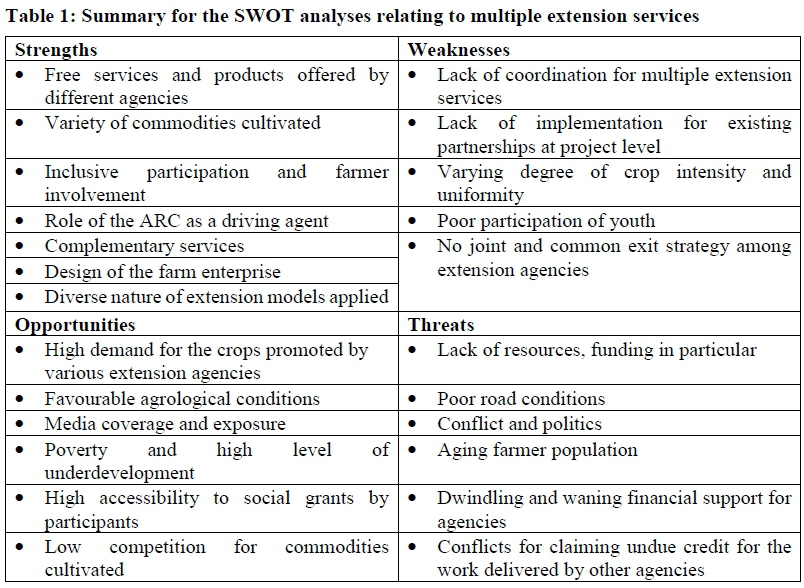
Following an extensive consultative process that looked into the challenges underpinning the public extension services in South Africa in 2016, the government introduced a new policy that advocates for a pluralistic approach when rendering extension services. Using the High Value Crop (HVC) Programme in OR Tambo as a case study, the objective of this paper is to carry out the Strength, Weaknesses, Opportunity and Threats (SWOT) analyses in order to generate insights into the important policy directives to be considered when implementing the new policy. Results show that participation of multiple extension agencies in the HVC served as a strength for the project. In terms of weaknesses, the issue offailure to implement partnership agreements at a project level and lack of coordination of services rendered were viewed as challenges. Furthermore, pluralistic extension services carry opportunities for smallholder farmers. For public extension officers to play a role of coordination in a pluralistic extension service, more resources (personnel numbers and funding) need to be mobilised. In order to ensure project sustainability, different extension agencies need to develop a common exit strategy.
High value crops; Opportunities; Pluralistic model; Strengths; Threats; Weaknesses