Coping Strategies Against Food Insecurity By Agricultural Food Security Pack Programme Beneficiaries: The Case of Mpulungu District, Zambia
Abstract
Climate variability, programming gaps and poor agricultural extension services hinder small-scale farmers' agricultural productivity in Southern Africa, Zambia inclusive. These agricultural challenges have not spared Zambia's food security pack programme beneficiaries. Using a mixed method design, this study investigated other economic activities that the 147 vulnerable farming households pursued, besides relying on the food security pack programme in the Mpulungu district. The study established that unpredictable rainfall, late delivery of farming inputs, and poor agriculture extension services were the major challenges that affected the productivity of the beneficiary households. To mitigate these challenges, the findings revealed that the beneficiaries grew crops other than those provided under the programme. Also, most respondents pursued other livelihood strategies such as receiving remittances from migrant relatives, petty trading, safety nets, and wage labour. The study concludes that the beneficiaries pursued other economic activities to enhance household food security apart from relying on what the programme provided. The study recommends investment intensification in agricultural research to produce pro-poor drought-resistant crop varieties, timeous distribution of farming inputs to beneficiaries, increasing extension staffing levels to bridge the staff-farmer ratio gap, and introducing in-service refresher training for agriculture extension staff.
Household Coping Strategies; Food Security; Small-Scale Farming
1. INTRODUCTION
Agriculture is the mainstay of many economies of Southern African countries, Zambia inclusive. Most governments prioritise agricultural food production in their national development plans to feed citizens. Small-scale farming is key to national development through its contribution to food security; hence, most governments craft sound policies that do not leave behind small-scale farmers in developing economies like Zambia. In Zambia, over 55% of the population dwells in rural areas, with about 90% dependent on agricultural food crop production through small-scale farming (Word Bank, 2021). In aggregate, small-scale agriculture provides most of the food produced in Zambia. With the potential of small-scale farming, the Zambian government implements agricultural food programmes designed to promote small-scale farming and enhance productivity. The notable agriculture-oriented food programmes are the Farmer Input Support Programme, the Food Security Pack Programme, and the Food Reserve Agency Crop Marketing Programme.
The farmer input support programme aims to improve the resource-impoverished small-scale farmers' access to improved agricultural inputs to enhance household and national food security and incomes through increased food and cash crop production (Kaoma & Mpundu, 2023). The programme targets individual small-scale farmers who can pay the prescribed farmer contribution of K400.00 and, at the same time, they should be members of registered farmer organisations in their localities (Kaoma & Mpundu, 2023). In contrast, the Food Security Pack programme empowers the poor and vulnerable small-scale farmers with free agricultural inputs and livelihood skills to improve their productivity to enhance their food, nutrition and income security (Kafula, 2017). On the other hand, the food reserve agency marketing programme aims to purchase agricultural food crops from farmers, especially small-scale farmers who are located in economically disadvantaged areas in Zambia, to provide income for them and maintain a sustainable strategic food reserve for the nation (Mulungu & Chilundika, 2016).
Notwithstanding the importance of all the programmes presented above in supporting small-scale farmers, the interest of this study was the food security pack programme because of its design to deal with the poor and vulnerable small-scale farmers. Under the popular rainfed cropping, the food security pack programme beneficiaries are provided with a farming inputs package through the Ministry of Community Development and Social Services, consisting of selected cereal seed, legume seed, potato vines (optional), cassava cuttings (optional), basal and top-dressing fertiliser, and lime for areas with acidic soils (Kafula, 2017). These inputs are meant to help the beneficiaries grow food crops such as cereals, including sorghum, maize, millet and rice; legumes, including beans, cowpeas, soya beans and groundnuts; and sweet potatoes and cassava crops.
Regrettably, despite the provision of accessible farming inputs by the Zambian government to vulnerable small-scale farmers in Mpulungu district, there have been reports of poor agricultural productivity among the beneficiaries that ultimately affect their household food security (Nkomoki, Bavorova & Banout, 2019). The poor agricultural productivity is attributed to several natural factors, such as floods, drought, heatwaves, and pest infestation. In contrast, other operational factors include poor road infrastructure and over-dependence on rainfed cropping. Others are institutional and include factors such as poor agriculture extension services and inadequate extension staff (Nkomoki et al., 2019). A study conducted to investigate the causes of seasonal household food insecurity in Mpulungu district revealed that 37% of the households were food secure throughout the year. In comparison, 25% were food insecure in critical periods. Also, 21% were temporarily food secure due to food crops that could not last until the next harvest period, while 17% were food insecure all year round (Goma, 2012).
There have been few or no attempts to establish how vulnerable small-scale farmers coping with poor agricultural productivity due to the abovementioned factors affecting household food security in Mpulungu district. This study, therefore, sought to establish other economic activities that the food security pack programme beneficiaries pursued, other than reliance on the programme, to enhance household food security in the Mpulungu district of Zambia. Specifically, the study focused on establishing the amount of maize and bean crops harvested by the respondents, challenges that the respondents encountered, whether the respondents grew food crops other than those prescribed under the programme or not; and other sources of income.
The study results supplement the existing knowledge that may assist policymakers, implementers, and planners, among other interest groups, in understanding the strengths and limitations of some poverty reduction programmes. The study's recommendations can help backstop and improve policy formulation for similar poverty reduction programmes. Also, the findings may present prospects for new research to address gaps that have not been covered in this study, considering present development policy debates.
2.1. The Concept of Food Security
Food security is "when all people, at all times, have physical and economic access to sufficient safe and nutritious food that meets their dietary needs and food preferences for an active and healthy life" (Wen & Berry, 2018:1). It is difficult to discuss the concept of 'food security' in isolation from the concept of 'food insecurity' which is said to be food shortage either at the global, continental, national, community or household level (Wen & Berry, 2018). The food shortage at any societal level is the gap between production and consumption (Graham, 2016). Graham (2016) found that, in many instances on a global scale, food production has increased, but food insecurity persists regionally and locally. For this reason, Wen and Berry (2018) point out one significant paradigm shift in the evolution of the 'food security' concept and the discussions surrounding it since the World Food Conference in 1974. According to Wen and Berry (2018), the fundamental shift in thinking about food security from the global and national to the household and individual levels is a breakthrough in efforts to combat food insecurity.
Many of the population could be living in hunger and starvation, even if the nation has plenty of food in the aggregate, all year round (Khaled, Cross & Gasim, 2018). Similarly, many people could be living in hunger during periods of crisis, even though the country has adequate food supplies (Khaled et al., 2018). For this reason, sufficiency in an aggregate does not automatically guarantee adequacy and capability at the household or individual level. What matters is to have access to the available food. Wen and Berry (2018) further explain that the world has ample food and the growth of global food production has been faster than the unprecedented population growth of the past forty years but many developing countries and hundreds of millions of poor people do not have a share in this abundance. They suffer from food insecurity, which is mainly caused by a lack of production, supply, and purchasing power (Graham, 2016).
The leading trigger of food insecurity is chronic poverty, which results from the absence of economic opportunities to produce adequate food or exchange labour for income to purchase adequate food (Graham, 2016). Eduardo (2017) explains that other factors affecting food security at the global, continental, national, community, household and individual levels include ethnic conflicts, civil war and armed conflicts among nations, such as the Russia-Ukraine and the Israel-Hamas wars. Such conflicts contribute to socio-political unrest and hinder human and economic development programmes, resulting in food insecurity among nations dependent on nations at war for food supplies. For example, Russia's war in Ukraine has disrupted global agricultural markets and worsened food insecurity among nations worldwide already dealing with the lingering shocks from COVID-19 (Priyanka & Pallavi, 2022).
2.2. Food Security Programmes
As a result of various factors discussed above, which affect agricultural productivity and food security at different societal levels, many nations worldwide implement food security programmes for the affected communities to counter food insecurity.
2.2.1. Food Security Programmes: Studies From Four Selected African Countries Four selected food security programmes from four countries, namely Malawi, Rwanda, Ethiopia, and Zambia, were implemented and evaluated by the International Federation of Red Cross, Red Crescent Societies and the local Red Cross Societies in collaboration with the governments of the respective countries were reviewed.
2.2.1.1. Malawi's Integrated Food Security Programme
Maize crop and citrus production in the Mwanza district of Malawi has been failing for over a decade due to droughts, thereby subjecting households to food insecurity (Malawi Red Cross Society, 2012). As a result, the Malawi Red Cross Society introduced the integrated food security programme in 2011 to lessen the food insecurity of vulnerable communities by implementing diversified food and cash crop production in the district (Malawi Red Cross Society, 2012). The programme targeted vulnerable households with few resources and required long-term support (Kassie, Hailemariam, Moti, Marenya & Erenstein, 2015). These households received start-up agricultural input packages namely crop seeds, beehives, goats and pigs, tools, irrigation equipment, fertilisers and chemicals (Malawi Red Cross Society, 2012).
After two years of implementation, the assessment of the programme, using participatory methods, revealed increased availability of food and access to it by the family members of the benefiting households (Kassie et al., 2015). Further, the income base for the beneficiary households increased because of the sale of their agricultural products, enabling them to take care of their household requirements (Kassie et al., 2015). However, despite the positive effects, the programme implementation was affected by high inflation coupled with fuel and foreign currency shortages, which negatively impacted the programme during its two years of execution (Kassie et al., 2015).
2.2.1.2. Rwanda's Livestock Rotation Programme
Most of Rwanda's rural population, which subsists on small-scale farming, is vulnerable to food insecurity due to environmental shocks (National Institute of Statistics of Rwanda, 2015). As a result, the Rwanda Red Cross Society initiated a livestock initiative in 2008 in some selected communities throughout the country to make communities resilient to sudden disasters by introducing a holistic recovery approach to address food insecurity and livelihood challenges (Rwanda Red Cross Society, 2012). The households in selected communities were given cattle, pigs, goats, rabbits and other livestock to raise for their livelihoods on a rotation basis.
An assessment of the programme, using community participatory approaches and household surveys to establish the programme's effect on the food security situation and livelihoods of the beneficiaries in Huye, Gisagara and Kayonza districts, revealed successes. Despite challenges experienced, such as land scarcity, shortage of extension services, high costs of constructing modern livestock sheds, and lack of livestock market information, the results revealed that the majority of beneficiary communities' livelihoods were made stronger in a sustainable manner. Some households were able to sell some livestock products to realise some income (World Food Programme, 2012). Also, beneficiaries could put aside money for other household requirements, such as payment of school fees and health insurance.
2.2.1.3. Ethiopia's Integrated Food Security Development Programme
The persistence of food insecurity in rural parts of Ethiopia, one of the poorest countries in Africa with a population of over 80 million people, led to the introduction of the integrated food security development programme by the Ethiopian Red Cross Society in the Tigray region in 2009 (Ethiopia Central Statistical Agency, 2013). The programme's objective was to improve alternative agricultural production and lessen vulnerability to enhance the income of 2,259 vulnerable households in the Dedba, Dergajen and Shibata sub-districts of Enderta (Belay & Dawit, 2017). The vulnerable households were given cash loans, crossbreed cows, beehives, chickens, citrus seedlings and vegetable seeds for alternative livelihoods. Though the programme experienced some challenges, such as limited resources, difficulties in identifying beneficiaries, and misapplication of cash loans, an assessment of the programme after four years of implementation, using a community participatory approach, revealed improvements in household food security and incomes of the beneficiaries (Ethiopian Red Cross Society, 2012).
2.2.1.4. Zambia's Zambezi River Basin Initiative Project
Along the coastal areas of the Zambezi River in Zambia, households are displaced by floods every rainy season (Zambia Red Cross Society, 2016). The displacement of households along the Zambezi basin each year affects their household food security (World Bank Group, 2021). Consequently, the Zambia Red Cross Society introduced the Zambezi River Basin Initiative project in 2012 to lessen the impact of disasters targeting 22,000 vulnerable households susceptible to floods in Sesheke and Kazungula districts of the western and southern provinces of Zambia (Zambia Red Cross Society, 2016). The target households were provided with seeds for maize, cowpeas, cabbages, tomatoes, and rape. Also, goats and chickens were given to beneficiary farmers as starter packs.
The assessment of the project using community participatory approaches and household surveys revealed that the project promoted the adoption of the best food livelihood practices among the beneficiaries in the Sesheke and Kazungula communities. The study showed that most beneficiaries adopted organic manure to improve their soil and enhance its fertility which made their crops grow well and ultimately increased their yields significantly (World Bank, 2021). As a result of the increased yields and harvests, families of the benefiting households could eat three meals a day. On the other hand, the lack of coherent partnership with the government stakeholders at district levels hindered the smooth implementation of some critical decisions during the implementation of the project (Zambia Red Cross Society, 2016).
3. METHODOLOGY
3.1. Research Design and Sampling Procedure
A mixed methods design employing both qualitative and quantitative approaches was used in this study. This design was used because it allowed the solicitation of descriptive and numerical data from the questionnaire respondents, interviews, and observations to realise objectivity and diverse views on the subject of study (Creswell, 2017). The study used non-probability sampling, utilising a purposive procedure to select the Mpulungu district as an area of study (Lury, 2018). This technique was also utilised in choosing the technocrats, the District Community Development Officer and District Agricultural Coordinator, as key informants for interviews. The study used probability sampling employing a simple random procedure to select the 147 vulnerable small-scale farming household heads aged eighteen (18) years and above as respondents. This sample size was determined using Slovin's formula (Glen, 2020).
3.2. Data Collection and Analysis
Researcher-administered questionnaires, interviews, and observations were used to collect data. Semi-structured questionnaires were used to collect respondents' biographic data, the amount of maize crop harvested, challenges of the food security pack programme, and other economic activities pursued by the respondents. Semi-structured interviews were used with the District Community Development Officer and District Agriculture Coordinator as key informants and technocrats in the study. The study used semi-structured observation to observe the homestead status physically and passively during visitations to questionnaire respondents (Flick, 2014). The combination of questionnaires, interviews, and observations was key in ensuring the validity and reliability of data (Creswell, 2017).
Descriptive statistics presenting frequency distributions and percentages were generated using the Statistical Package for Social Sciences (SPSS) to compare the variables of interest (Lury, 2018).
Qualitative data was analysed by developing a classification system that helped generate categorical variables/themes subjected to analysis using SPSS software (Flick, 2014).
4. RESULTS AND DISCUSSION
4.1. Sample Characteristics
4.1.1. Sex of the Respondents
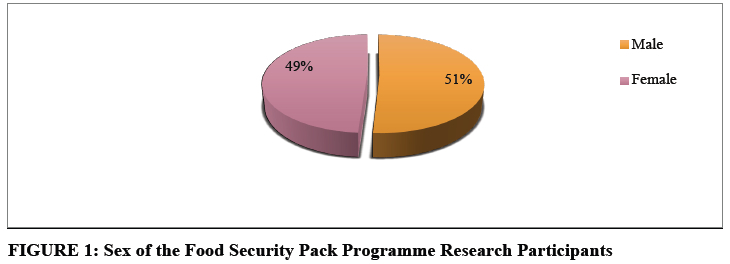
Of the 147 respondents, 51% were males, and 49%) were females. Thus, the study had almost equal representation, with males being slightly more than females, as shown in Figure 1 below. These findings were supported by the outcome of the interviews with key informants who said that male-headed households dominated the food security pack programme. Further, key informants explained that males were more than females on the programme because some were imposed by politicians due to their role in politics during campaign periods.
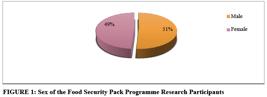
The results presented above contrasted with the backing for more female-headed households to be prioritised on poverty reduction programmes because they are classified among the most vulnerable groups (Yenilmez & Celik, 2019). The implication of these findings is that female-headed small-scale farming households in the Mpulungu district would continue to be classified among the most vulnerable groups to food insecurity.
4.1.2. Household Family Size of the Respondents
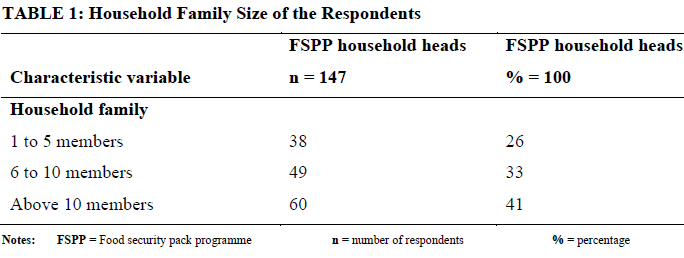
The majority (41%) of the participants had a family size of more than ten (10) members in a household, while the least (26%) had between one and five family members, as shown in Table 1 below.
A high number of family members is seen as an advantage among small-scale farmers in rural communities as a labour force that can help to achieve high agricultural productivity. The explanation above confirms an argument that small-scale farmers with a big family labour force realise greater yields per hectare because family labour has more incentives than hired labour (Palacios-Lopez, Christiaensen & Talip, 2017). The bigger the family size, the more comfortable the household heads are, as productivity is enhanced in rural areas. As such, to realise a significant family size, most men in rural areas resort to polygamy and embrace extended family ties (Palacios-Lopez et al., 2017). Therefore, it is implied that most of the respondents had large family sizes because of the assumption that the bigger the family size, the higher the productivity and comfort experienced by the families of the small-scale farmers.
4.2. Maize and Beans Crops Harvested by the Respondents
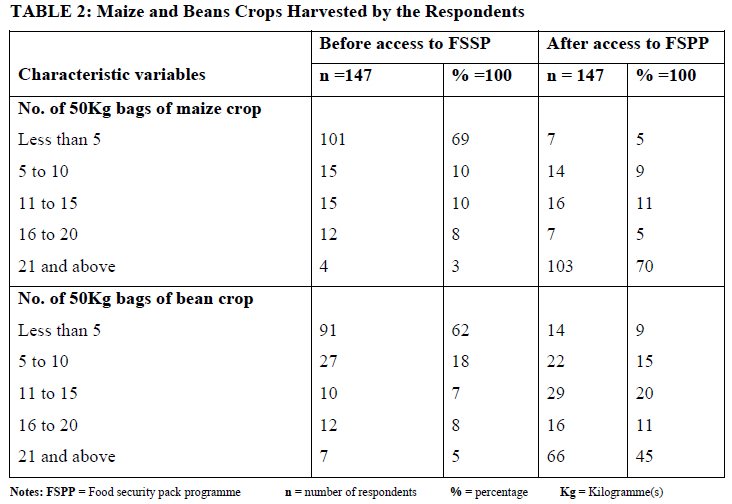
On maize harvests, 69% of the respondents harvested less than five 50kg bags of maize grain on average per 0.25 hectares of land before accessing the food security pack programme compared to 5% who harvested the same number of bags of maize grain on the same size of the land after accessing the programme. However, after accessing the programme, 70% of the respondents harvested more than 20 (50kg) bags of maize grain per 0.25 hectares of land compared to 3% that harvested the same amount of maize crop on the same size of a piece of land before accessing the food security pack programme as shown in Table 2 below. The results of the bean crop harvested were similar to those of the maize crop, as shown in Table 2 below. Like the maize crop harvested, 62% of the respondents harvested less than five 50kg bags of beans crop before accessing the food security pack programme compared to 9% who harvested the same number of bags of beans crop on the same land size after accessing the programme.
After accessing the programme, 45% harvested more than 20 (50kg) bags of bean crops compared to 5% that harvested the same amount of bean crop on the same size piece of land before accessing the programme, as shown in Table 2 above.
There was higher maize and bean crop productivity after respondents' access to the food security pack programme than before, implying that the programme contributed to increased productivity of both maize and bean crops among the beneficiaries. However, even with increased harvests due to the accessible farming inputs received under the programme, seasonal household food insecurity persisted among some beneficiaries in the Mpulungu district (Goma, 2012).
4.3. Challenges of Food Security Pack Programme: Beneficiaries' Perspectives
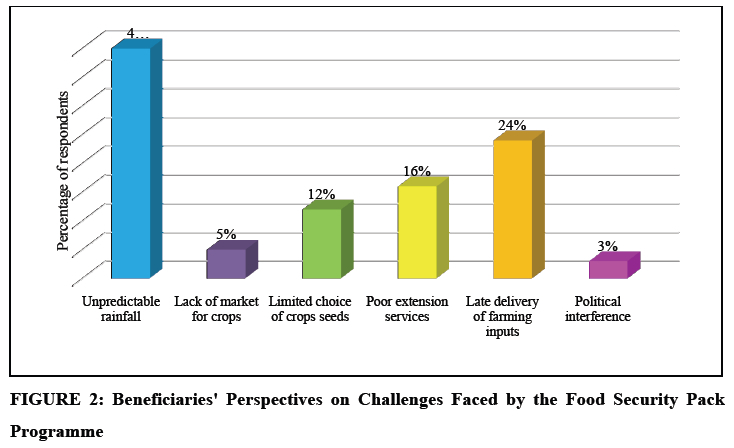
To understand the persistent seasonal household food insecurity among some food security pack beneficiaries in the Mpulungu district, the study solicited views from the respondents on the challenges they encountered with the food security pack programme. The majority, 40% of the 147 respondents, contended that unpredictable rainfall was the major challenge faced by the food security pack programme. In comparison, 24% and 16% mentioned the late delivery of farming inputs and poor agricultural extension services provided under the programme, respectively, as shown in Figure 2 below. Other challenges cited were the limited choice of crop seeds provided under the programme and political interference.
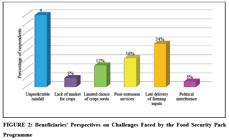
The unpredictable rainfall mentioned by most respondents as a major challenge resonates with an explanation that the possibility of rainy days in the Mpulungu district is unpredictable and varies during the year (Weatherspark, 2019). The district encounters intense seasonal variations in rainfall, with the period of rains yearly expected to last for seven months with a sliding 31-day rainfall of about 0.5 inches from October to May, though unreliable (Weatherspark, 2019). The unpredictable rain affects planting planning, which has a bearing on agricultural productivity.
The outcome of interviews with the Zambian government officials confirmed the respondents' response that the government's late delivery of farming inputs to the recipients was one of the major challenges. The interviews revealed that the beneficiaries of the food security pack often received farming inputs after the recommended period for planting, which is the first week of November. The Zambian government officials explained that the late distribution resulted from the failure of the Zambian government to release funds to suppliers in time to purchase farming inputs.
The submission by the respondents on poor extension services as a challenge agrees with an argument that agricultural field workers are either inadequate or lack essential technical training or field experience to provide the much-needed extension services to farmers (Qwabe, Swanepoel, Van Niekerk & Zwane, 2022). A lack of refresher training for agricultural extension employees compounds the problem because Zambia's current extension service delivery system does not embrace extension in-service refresher training (Somanje, Mohan & Saito, 2021). Lack of refresher in-service training can result in providing the farmers with outdated extension service information that may lead to a loss of trust in the public extension service delivery system and, ultimately, low acceptance and adaption to innovation that may affect production and productivity (Hlatshwayo & Worth, 2019). In Zambia, there is an increase in the farmer population with an increased demand for agricultural extension services without a corresponding increase in the number of extension workers, resulting in a poor extension officer-to-farmer ratio which stands around 1:1136 (Somanje et al., 2021).
4.4. Food Security Pack Beneficiaries' Engagement in Other Economic Activities
The study sought to establish whether the respondents grew crops other than those provided under the food security pack programme, along with other economic ventures they pursued to caution against household food insecurity in times of poor harvests.
4.4.1. Growing of Additional Crops by the Respondents
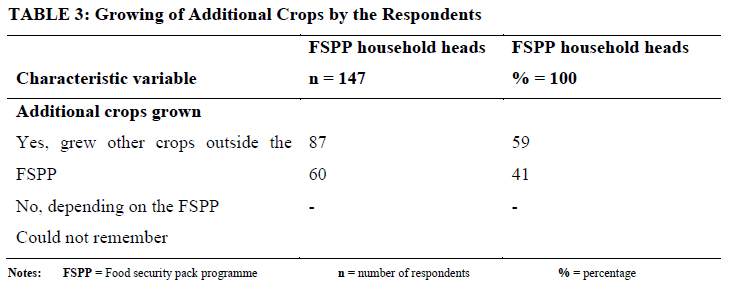
Fifty-nine (59%) of the respondents indicated that they grew other crops besides what was received under the programme. In comparison, 41% denied having grown crops other than what they were given under the programme, as shown in Table 3 below.
Most of the respondents grew other crops besides what was provided under the food security pack programme. Through observations, some fields with common additional crops, such as carrots, cabbages, onions, sugarcane, and bananas, could be seen in home backyards and fields closer to the respondents' homes during dispensing questionnaires. More crop varieties were said to have been grown to help curb household food insecurity in times of distress that may arise due to internal and external shocks such as late delivery of inputs and effects of climate change, respectively. Also, some respondents opted to grow additional food crops because of the programme's limited choice of crop seeds. This justifies an argument that the food security pack programme, in its current state, does not give small-scale farmers options on what to grow (Kafula, 2017). Currently, the Food Security Pack programme enhances maize cultivation with fertiliser use rather than encouraging crop diversification. This situation denies vulnerable small-scale farmers the choice of what to grow.
4.4.2. Income-Generating Activities Pursued by the Respondents
Apart from the agriculture-related activities, the study sought to establish the non-farm income-generating activities the respondents pursued before and after accessing the programme to mitigate the anticipated vulnerabilities, such as changes in seasonality and socio-economic shocks.
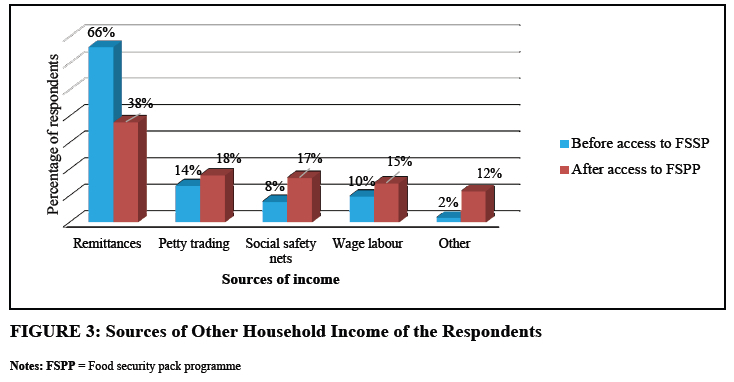
The majority, 38% of the 147 respondents, received support from remittances from their migrant relatives after accessing the food security pack programme, compared to the majority, 66%), got support from the same before accessing the programme. Eighteen (18%)) of the respondents did petty trading as a source of income after accessing the programme, compared to 14%) who pursued the same business venture before accessing the programme, as shown in Figure 3 below. Other sources of income mentioned were social safety nets and engagement in farm labour to earn a wage.
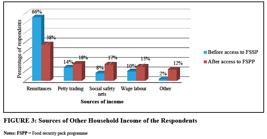
Fewer respondents received support from remittances after accessing the programme than before, and more respondents were in petty-trading business after accessing the programme. It can be argued that fewer respondents relied on support from remittances after accessing the programme, compared to the previous period, because most relied on the food security pack programme for their livelihood. On the other hand, it can be argued that before accessing the programme, they received more remittances than they did after accessing the programme, which was a cushion against household food insecurity.
More respondents were engaged in petty trading after accessing the Food Security Pack Programme than before because most remittances they received might have been channelled to petty trading as they were food-secure, whereas before they accessed the programme, most remittances received may have been channelled to food because of household food insecurity. Remittances as a source of livelihood were vital in supporting the respondents' households before and after they had access to the food security pack programme. This confirms that remittances play a significant role in helping small-scale farmers access other vital goods and services that require purchasing power (Generoso, 2015).
The findings on remittances agree with the study conducted in Mali on the effects of remittances on household food security in rural areas. They showed that households receiving remittances in Mali had an improved status of household food security in the Saharan zone compared to those without remittances, but the benefit was impermanent (Generoso, 2015). Similarly, a study conducted in Burundi with a focus on remittances and household wealth for post-conflict households revealed that in households that belong to the category of poor wealth, remittances improved their finances and household food security status (Fransen & Mazzucato, 2014). Remittances, petty trading, social safety nets, and wage labour presented in Figure 3 above are "sources of financial capital" under the livelihood assets component of the Sustainable Livelihood Framework (Generoso, 2015). Financial capital is key to cushioning household food insecurity of the vulnerable small-scale farmers, as it allows them to acquire goods and services, such as fertilisers, crop seeds, pesticides, transportation of surplus produce to markets, and foodstuffs.
5. CONCLUSIONS AND RECOMMENDATIONS
In most cases, agricultural poverty reduction programmes, like the food security pack in Zambia, are affected by an array of interconnected challenges that hinder the crop productivity of vulnerable small-scale farming households, resulting in household food insecurity. These challenges manifest as climate variability, programming gaps, and institutional lapses. The programme beneficiaries must devise mitigation measures to sustain their livelihood against such challenges. Unpredictable rainfall, late delivery of farming inputs, and poor extension services were the major challenges that the food security pack beneficiaries encountered in implementing the food security pack programme in the Mpulungu district of Zambia.
The food security pack beneficiaries pursued several coping mechanisms to mitigate the effects of poor crop productivity due to the challenges mentioned above. These coping strategies include growing indigenous drought-resistant crops outside what was provided under the programme, engaging in petty trading, which involves selling and purchasing goods and services on a small scale, engaging in farm labour to earn a wage, and receiving remittances from migrant relatives. Owing to the challenges mentioned above that the food security pack beneficiaries met and the corresponding initiatives they pursued to mitigate their effects, the study recommends an intensified robust investment in agricultural research and development to produce pro-poor drought-resistant crop varieties and timeous distribution of farming inputs to the beneficiaries. Also, increasing extension staffing levels to bridge the staff-farmer ratio gap and introducing in-service refresher training for agriculture extension staff would improve extension services.
REFERENCES
ACKNOWLEDGEMENTS
Acknowledgement goes to the University of South Africa through the Department of Development Studies, which financially supported this study during the Unisa postgraduate bursaries.
2. LITERATURE REVIEW
- BELAY, K. & DAWIT, A., 2017. Agricultural research and extension linkages: Challenges and intervention options. Ethiop. J. Agric. Sci., 27(1): 55-76.
- CRESWELL, J. & CRESSWELL, J.D., 2017. Research design: qualitative, quantitative, and mixed methods approach. Thousand Oaks CA: SAGE.
-
EDUARDO, A., 2017. Availability, access and utilization: Identifying the main fragilities for promoting food security in developing countries. WJSTSD., 14(4). http://dx.doi.org/10.1108/WJSTSD-05-2016-0033
» http://dx.doi.org/10.1108/WJSTSD-05-2016-0033 - ETHIOPIA CENTRAL STATISTICAL AGENCY., 2013. Population projection of Ethiopia for all regions at Wereda level from 2014 to 2017. Addis Ababa: Central Statistical Agency.
-
ETHIOPIAN RED CROSS SOCIETY., 2012. Integrated food security and livelihoods approach: Building capacity of vulnerable people in Tigray/Ethiopia. [Viewed 27 December 2021]. Available from https://www.ifrc.org/PageFiles/114719/Integrated%20approach%20Ethiopia%20CS%202011.PDF
» https://www.ifrc.org/PageFiles/114719/Integrated%20approach%20Ethiopia%20CS%202011.PDF - FLICK, U., 2014. An introduction to qualitative research. Thousand Oaks CA: SAGE.
- FRANSEN, S. & MAZZUCATO, V., 2014. Remittances and household wealth after conflict: A case study on urban Burundi. World Develop., 60: 57-68.
- GENEROSO, R., 2015. How do rainfall variability, food security and remittances interact? The case of rural Mali. Ecol. Econ., 114: 188-198.
-
GLEN, S., 2020. Elementary statistics for the rest of us. [Viewed 27 December 2021]. Available from https://www.statisticshowto.com/
» https://www.statisticshowto.com/ - GOMA, A., 2012. Seasonal household food insecurity: The case of the Lake Tanganyika basin community in Mpulungu district in Northern Province of Zambia. Masters Dissertation. Van Hall Larenstein University of Applied Sciences, The Netherlands.
- GRAHAM, S., 2016. Food production and consumption. Capital. Nat. Social., 27(4): 117-124.
- HLATSHWAYO, P. & WORTH, S., 2019. Agricultural extension: Criteria to determine its visibility and accountability in resource-poor communities. S. Afr. J. Agric. Ext., 47(2): 1320.
-
KAFULA, S.C., 2017. The food security pack programme and food security in Zambia: Views from female-headed households in Kabwe District. [Viewed 15 July 2022]. Available from https://www.multiresearch.net/cms/publications/CFP4012017.pdf
» https://www.multiresearch.net/cms/publications/CFP4012017.pdf - KAOMA, O.N. & MPUNDU, M., 2023. The farmer input support program and poverty alleviation in Zambia: The smallholder farmer's perspective using intervention and sustainability theories. Open Access Lib J., 10(8): 1-20.
- KASSIE, M., HAILEMARIAM, T., MOTI, J., MARENYA, P. & ERENSTEIN, O., 2015. Understanding the adoption of a portfolio of sustainable intensification practices in eastern and southern Africa. Land Use Policy., 42: 400-411.
-
KHALED, M., CROSS, J. & GASIM, S., 2018. Food and starvation: Is Earth able to feed its growing population? Int J Food Sci Nutr., 69(4). https://doi.org/10.1080/09637486.2017.1378625
» https://doi.org/10.1080/09637486.2017.1378625 - LURY, C., 2018. Routledge handbook of interdisciplinary research methods. London: Routledge.
-
MALAWI RED CROSS SOCIETY., 2012. A diversified approach to fighting food insecurity and rural poverty in Malawi. [Viewed 17 December 2023]. Available from https://www.ifrc.org/PageFiles/114719/1250700Malawi%20case%20studv_HR.PDF
» https://www.ifrc.org/PageFiles/114719/1250700Malawi%20case%20studv_HR.PDF -
MULUNGU, K. & CHILUNDIKA, N., 2016. Zambia food reserve agency pricing mechanisms and the impact on maize markets. Technical report: 1606. http://dx.doi.org/10.13140/RG.2.2.14129.58727
» http://dx.doi.org/10.13140/RG.2.2.14129.58727 -
NATIONAL INSTITUTE OF STATISTICS OF RWANDA., 2015. Rwanda poverty profile report-2013/14. [Viewed 18 October 2023]. Available from http://www.statistics.gov.rw/publication/rwanda-povertv-profile-report-results-eicv-4
» http://www.statistics.gov.rw/publication/rwanda-povertv-profile-report-results-eicv-4 -
NKOMOKI, W., BAVOROVA, M. & BANOUT, J., 2019. Factors associated with household food security in Zambia. Sustainability., 11(9): 2715. https://doi.org/10.3390/su11092715
» https://doi.org/10.3390/su11092715 - PALACIOS-LOPEZ, A., CHRISTIAENSEN, L. & TALIP, K.T., 2017. How much of labour in African agriculture is provided bv women? Food Policy., 67: 52-63.
-
PRIYANKA, S. & PALLAVI, G., 2022. Effects of Russia-Ukraine war. IJSREM., 6(3). http://dx.doi.org/10.55041/IJSREM11973
» http://dx.doi.org/10.55041/IJSREM11973 - QWABE, Q., SWANEPOEL, J., VAN NIEKERK, J. & ZWANE, E., 2022. Nexus between the invisibilitv of agricultural extension services and rural livelihoods development: Assertions from rural farming communities. S. Afr. J. Agric. Ext., 50(2): 26-41.
-
RWANDA RED CROSS SOCIETY., 2012. Cost-henefit analysis of the Rwanda Red Cross Livestock rotation programme. [Viewed 13 October 2023]. Available from https://www.ifrc.org/Global/Publications/disasters/livelihoods/1301800Rwanda%20CBA%20Studv-EN-02.pdf
» https://www.ifrc.org/Global/Publications/disasters/livelihoods/1301800Rwanda%20CBA%20Studv-EN-02.pdf -
SOMANJE, A.N., MOHAN, G. & SAITO, O., 2021. Evaluating farmers' perception toward the effectiveness of agricultural extension services in Ghana and Zambia. Agric & Food Sec., 10(53). https://agricultureandfoodsecuritv.biomedcentral.com/articles/10.1186/s40066-021-00325-6
» https://agricultureandfoodsecuritv.biomedcentral.com/articles/10.1186/s40066-021-00325-6 -
WEATHERSPARK., 2022. Average Weather in Mpulungu, Zambia. [Viewed 12 July 2022]. Available from https://weatherspark.com/v/96841/Average-Weather-in-Mpulungu-Zambia-Year-Round-Sections-Precipitation
» https://weatherspark.com/v/96841/Average-Weather-in-Mpulungu-Zambia-Year-Round-Sections-Precipitation -
WEN, P. & BERRY, E.M., 2018. The Concept of food security. Encyclopaedia of Food Security and Sustainability., 1 - 7. https://doi.org/10.1016/B978-0-08-100596-5.22314-7
» https://doi.org/10.1016/B978-0-08-100596-5.22314-7 -
WORLD BANK., 2021. World Bank staff estimates based on the United Nations Population Division's World Urbanization Prospects: 2018 Revision. [Viewed 30 October 2022]. Available from https://data.worldbank.org/indicator/SP.RUR.TOTL.ZS?end=2021&locations=ZM&most_recentvear_desc=false&start=2021&view=bar
» https://data.worldbank.org/indicator/SP.RUR.TOTL.ZS?end=2021&locations=ZM&most_recentvear_desc=false&start=2021&view=bar - WORLD FOOD PROGRAMME., 2014. Technical guidance for the World Food Programme's consolidated approach for reporting indicators of food security. Rome: CARI.
- YENILMEZ, M. & CELIK, O., 2019. A comparative perspective of women's economic empowerment. London: Routledge.
-
ZAMBIA RED CROSS SOCIETY., 2016. Cost-benefit analysis study: Zambezi region livelihoods preparedness intervention. [Viewed 26 October 2022]. Available from https://www.ifrc.org/Global/Publications/disasters/livelihoods/1301800-Zambezi%20Region%20CBA%20Study-02.pdf
» https://www.ifrc.org/Global/Publications/disasters/livelihoods/1301800-Zambezi%20Region%20CBA%20Study-02.pdf