An Exploration of Social Media as a Tool for Agricultural Information Dissemination Among Smallholder Farmers in Limpopo Province, South Africa
Abstract
Access to reliable and timely agricultural information remains essential for improving productivity among smallholder farmers. In South Africa's rural areas, such as Limpopo Province, traditional agricultural extension systems have limited reach, poor infrastructure, and resource constraints, resulting in a growing interest in social media as an alternative tool for information dissemination. This study explored how smallholder farmers in Limpopo Province use social media to access and share agricultural information. Quantitative in approach and following a cross-sectional survey design, data were collected from 420 randomly selected farmers across five districts in Limpopo Province and analysed using descriptive statistics in SPSS Version 31. The results show that 59.5% of farmers use social media for agricultural purposes. WhatsApp and Facebook were predominantly used platforms for their affordability, usability, and accessibility, even in rural settings for learning, sharing information, and marketing agricultural products. However, digital literacy gaps, language barriers, and limited connectivity remained major obstacles to broader adoption. Nevertheless, social media are valuable tools for agricultural communication; therefore, digital literacy training, local-language content, and improved ICT infrastructure must be prioritised to enhance the effective use of social media in agricultural extension.
Social Media; Digital Communication; Agricultural Extension
1. INTRODUCTION
Access to timely and relevant information is central to smallholder farmers' ability to adopt improved practices and increase productivity. Ongachi and Belinder (2025) proffer that agricultural extension has long played a central role in supporting smallholder farmers by facilitating knowledge transfer, improving farming practices, and enhancing rural livelihoods. Traditionally, extension services relied on face-to-face interactions, field demonstrations, and community meetings. However, the rise of digital technologies has transformed these methods by expanding the range of communication tools available to both farmers and extension officers.
According to Ntsoane, Ndoro and Ntombovuyo (2025), the increasing penetration of mobile phones and internet connectivity across rural South Africa has created new opportunities for information dissemination, especially in agriculture. Social media platforms such as WhatsApp, Facebook and YouTube have become interactive channels through which farmers can access timely agricultural information (Das, 2021). These platforms also enable networking with peers, extension officers, and agricultural institutions, thereby reducing social isolation and bridging the gap between rural farmers and broader agricultural value chains. Bonsta, Mushunje, Ngarava and Zhou (2023) show that there is increasing interest among South African smallholder farmers in using low-tech digital tools, although they still face challenges of access and readiness. Moreover, these farmers face challenges, including limited digital literacy, poor internet infrastructure, language barriers, and affordability constraints for data. Mulaudzi et al. (2024) conducted a study in the Limpopo Province that revealed that most farmers had a positive attitude towards using social media platforms for information dissemination. However, there was no documentation of how farmers in the Limpopo Province used social media. Therefore, this study explored the use of social media platforms for agricultural information dissemination among smallholder farmers in the Limpopo Province.
2. STUDY AIM AND OBJECTIVES
2.1. Aim
The main aim of this study was to explore how smallholder farmers in the Limpopo Province use social media platforms to access and share agricultural information, thereby improving communication and knowledge exchange.
2.2. Objectives
The specific objectives of this study were to: (i) Identify the social media platforms commonly used by smallholder farmers for agricultural information dissemination in the Limpopo Province; (ii) Examine the socio-economic factors that influence the use of social media for agricultural information dissemination among farmers in the Limpopo Province; (iii) Investigate the main purposes for which smallholder farmers use social media to disseminate agricultural information in the Limpopo Province, and (iv) Identify the challenges that farmers encounter when using social media for agricultural information dissemination.
Social media entail internet-based platforms that enable users to exchange ideas, information, and multimedia content through virtual networks. Within agriculture, these tools help farmers, for instance, to overcome geographic barriers, reduce social isolation and strengthen linkages among farmers, extension agents, and agribusinesses. According to Ahmed, Ekma, and Lind (2024), social media are increasingly valued not only for comfort or networking, but also for the perceived utility of accessing and sharing agricultural information. Beyond networking, their sustained use is linked not only to comfort or security but primarily to the perceived value and services they provide (Anderson, 2019). For extension services, social media provide opportunities to disseminate agricultural information, mobilise farmers for collective action, and stay updated on sectoral innovations. Social media also provides farmers with an opportunity to engage with extension officers in real time. Recent research in South Africa confirms that platforms such as WhatsApp and Facebook are among the most used for agricultural purposes (Gwelo, 2025; Olorunfemi, Mamiane & Matiwane, 2024). For example, in Mopani District, Limpopo Province, a 2024 study found that smallholder farmers widely use social media, with perceived ease of use and perceived benefits being strong predictors of utilisation (Imote, Wasike, Mageto & Mutunga, 2024). Similarly, Ramavhale, Zwane and Belete (2024) emphasised that WhatsApp and Facebook facilitate the timely sharing of market, pest and disease, and production practice information. WhatsApp has been highlighted as the dominant tool for direct peer-to-peer communication between farmers and extension officers due to its accessibility and low cost (Kimote et al., 2025). These platforms enable farmers not only to share daily activities and experiences but also to republish and adapt information for their specific needs.
Zondo and Ndoro (2023) investigated socio-economic factors affecting farmers' adoption of social media and found that education level, age, income, and cooperative membership significantly influence their adoption of social media tools. Likewise, Bontsa et al. (2023) mapped increasing awareness and uptake of digital technology, including social media, among South African farmers and reported that constraints remained in infrastructure, cost, and digital literacy. In Tanzania, similar barriers included the lack of communication tools, irrelevant content, illiteracy and the use of foreign languages in extension materials (Siyao & Sanga, 2024). Social media offers opportunities to overcome many of these barriers by providing affordable, user-friendly, and widely accessible communication channels (Sen et al., 2025). They complement formal extension systems by bridging the gap among farmers, knowledge institutions and markets. Mdoda et al. (2024) observed that WhatsApp is the most frequently used mobile app for accessing and sharing agricultural data, followed by Facebook. Farmers used these tools to exchange information about weather, pests, input availability, and to market produce. The reviewed literature demonstrates that social media have become an important component of modern agricultural information dissemination among smallholder farmers in developing contexts. WhatsApp and Facebook continue to dominate as preferred platforms for sharing agricultural information in real time due to their affordability, accessibility, and flexibility. Their growing integration into farming has improved access to extension services, market trends, and weather updates while reducing isolation among rural farmers. However, persistent challenges such as low digital literacy, poor infrastructure, high data costs, and limited localisation of content still constrain their full potential.
4. METHODOLOGY
4.1. Description of the Study Area
The study was conducted in the Limpopo Province of South Africa. Limpopo Province borders three countries: Mozambique, Botswana, and Zimbabwe and three South African provinces: Mpumalanga, Gauteng, and North-West. This province is the fruit basket of South Africa, although it also has other agricultural activities, including vegetable farming, wildlife, bushveld, and rain-fed crop farming. The province's population comprises rural black people who speak Sepedi, Xitsonga, Tshivenḓa, and other Bantu languages (Sibanda, 2019). Many people in this province earn a living through grants and small-scale and backyard farming. Limpopo accounts for up to 10.2% of the country's total land and produces main crops such as potatoes, tomatoes, citrus, avocados, and mangoes. About 700,000 tons of timber are made in this province annually. Most farmers in the province produce vegetables for household consumption and for sale. The province has five district municipalities: Capricorn, Vhembe, Mopani, Waterberg, and Sekhukhune. The study focused on all these district municipalities, which have varied agricultural land for production with different farming categories.
4.2. Study Approach and Sampling Technique
This study employed a quantitative research approach using a cross-sectional survey design to explore how farmers in the Limpopo Province use social media for agricultural information dissemination. Data were collected at a single point in time using structured questionnaires administered to selected farmers across the province. To ensure fair representation, the study used a multistage sampling technique combined with simple random sampling. In the first stage, the province was divided into five districts: Sekhukhune, Waterberg, Capricorn, Mopani, and Vhembe. All five districts were included to reflect the diversity of farmers across Limpopo. In the second stage, simple random sampling was used to select farmers from each district. Farmer lists were obtained from the Limpopo Department of Agriculture and Rural Development, and participants were selected randomly from these lists. This method ensured that each farmer had an equal chance of being included in the study.
The sample size was calculated using the Raosoft sample size calculator at a 95% confidence level, a 5% margin of error, and a population size estimated from district farmer records. This calculation yielded an initial minimum sample size of 373 farmers. To ensure adequate representation across all districts, particularly those with low expected participation, the researcher applied two adjustments: a minimum of 10 respondents per district was set to avoid under-representation of smaller districts in the study. Non-response adjustment was implemented, and a 12% buffer was added to the initial sample (373 × 0.12 = 44.8), bringing the adjusted total to approximately 418 respondents. This figure was rounded to 420 to maintain balance across districts. Accordingly, the final sample size was set at 420 farmers. This adjustment is consistent with recommended practices in survey sampling, where non-response and representativeness considerations are accounted for to improve reliability and validity of findings (Nuvey et al., 2022; Qange et al., 2025).
4.3. Data Analysis
Descriptive statistics were used to summarise and interpret data collected from smallholder farmers in the Limpopo Province. Frequencies and percentages were used to describe the social media platforms most used for agricultural information sharing, the socio-economic characteristics influencing use, the purposes of social media engagement, and the challenges farmers face. This approach allowed for a clear understanding of patterns and trends in farmers' digital communication practices, directly addressing the study's objectives. IBM Statistical Package for the Social Sciences (SPSS) version 31 was used to collect the data and perform the analysis.
5. RESULTS AND DISCUSSION
5.1. Descriptive Results: Socio-Economic Characteristics of Farmers
Understanding the socio-economic profile of respondents provides a foundation for analysing how smallholder farmers use social media to disseminate agricultural information. The researcher adopted this approach to bring together an understanding of these factors in the Limpopo Province (Adelakun & Olupitan, 2022).
5.1.1. Gender
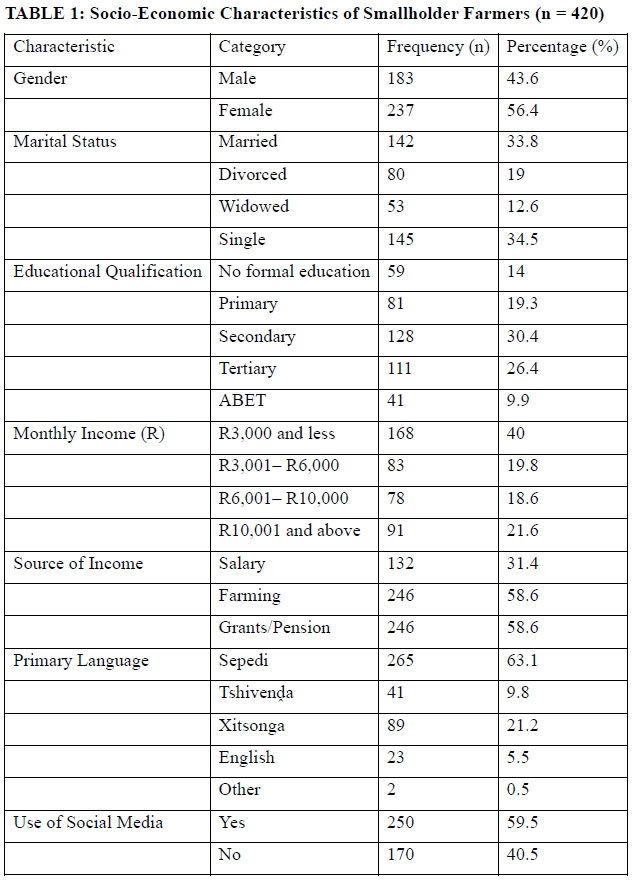
The results presented in Table 1 below show that a slightly higher proportion of respondents were female (56.4%) than male (43.6%), suggesting that women play an active role in agricultural communication within the study area. This finding aligned with reports by Shukla et al. (2022) and Nyagadza et al. (2022), who observed that female farmers increasingly use mobile and social platforms to seek agricultural advice and market information, particularly through WhatsApp and Facebook groups.
5.1.2. Marital Status
Regarding marital status, 34% were married, 35% were single, 19% were divorced, and 13% were widowed. Married farmers may have more household responsibilities and greater involvement in decision-making, which influences the type of agricultural information they seek and share (Amusa, Anugwo & Egwue, 2022). Similarly, single and often younger farmers may have greater flexibility to explore new information channels (Adelakun & Olupitan, 2022). This dynamic suggests that single farmers are more likely to use social media actively for learning and networking than their older or married counterparts.
5.1.3. Educational Qualification
Educational attainment was relatively high, with 66% of the respondents having at least secondary education, indicating substantial potential for digital participation. In accord with Ndimbwa, Mwantimwa, and Ndumbaro (2022) and another study by Adelakun and Olupitan (2022), which found that farmers with secondary and tertiary education demonstrated higher digital literacy in using WhatsApp and YouTube. They primarily used these platforms for interpersonal communication and for accessing agricultural information. Education thus appears to be a significant determinant of social media adoption for agricultural purposes.
5.1.4. Monthly Income Range
In terms of income levels, the largest group (40%) earned below R3,000 per month, reflecting limited financial resources. However, even lower-income farmers are increasingly using affordable digital tools, supported by data bundle promotions and community Wi-Fi hotspots. Similar patterns were reported by Zondo and Ndoro (2023), who found that affordability, rather than device access, was a key factor influencing rural farmers' online engagement. In addition, Bontsa et al. (2023) showed that monthly income is a determining factor for many farmers, and they perceive technologies as expensive.
5.1.5. Sources of Income
Sources of income were mainly farming (58.6%) and grants or pensions (58.6%), indicating that many respondents rely on multiple livelihood strategies. Muhammad et al. (2025) observed that even farmers with modest earnings use low-cost platforms such as WhatsApp and Facebook for agricultural purposes, given their affordability and practical value. This demonstrates that while income remains a limiting factor, perceived usefulness and low operating costs can motivate rural farmers to integrate social media into their farming activities.
5.1.6. Primary Language
Language remains a central factor influencing how farmers engage with digital technologies and social media platforms. In this study, most respondents spoke Sepedi (63.1%), followed by Xitsonga (21.2%) and Tshivenḓa (9.8%), reflecting the multilingual character of the Limpopo Province. This linguistic diversity highlighted the importance of developing agricultural information in local languages to improve accessibility and understanding. When social media content is presented in indigenous languages, farmers are more likely to participate actively and retain information effectively. Similar findings were reported by Maswanganyi (2023), who emphasised that using local languages in communicating public information enhances comprehension and encourages greater engagement among rural farmers.
5.2. Empirical Results of Farmers
5.2.1. Age
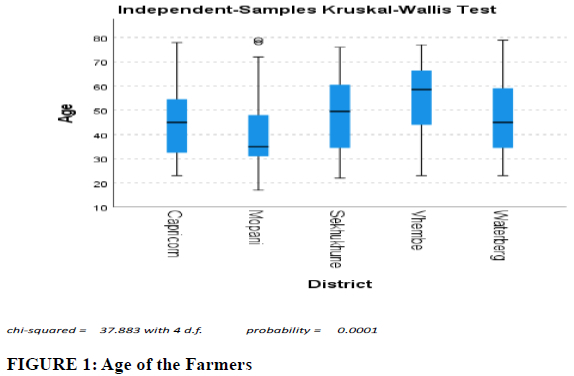
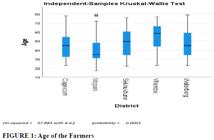
The results indicate that age plays a significant role in determining how farmers engage with social media platforms for agricultural purposes. The Kruskal-Wallis test was conducted to examine whether there were significant differences in median age across the five districts-Capricorn, Sekhukhune, Vhembe, Mopani, and Waterberg. The test produced a chi-squared value of 37.883 with 4 degrees of freedom and a p-value of 0.0001, indicating statistically significant differences in age distribution among the districts. This suggested that the age composition of farmers varied across regions, which may have influenced how they used social media for agricultural communication and information sharing. Similarly, Nxumalo and Chauke (2025) reported that younger farmers are generally more inclined to use digital tools such as WhatsApp, Facebook, and TikTok to seek agricultural information and engage in peer learning. Younger farmers often show greater confidence in adopting digital innovations than older farmers, who tend to rely more on traditional, face-to-face extension methods (Wayagi, 2024). This generational difference in digital engagement highlighted the need for agricultural extension programmes to adopt blended communication approaches that accommodate both younger and older farmers. Tailoring extension messages across age groups can promote inclusivity and ensure that all farmers benefit from digital information dissemination.
5.2.2. Household Members
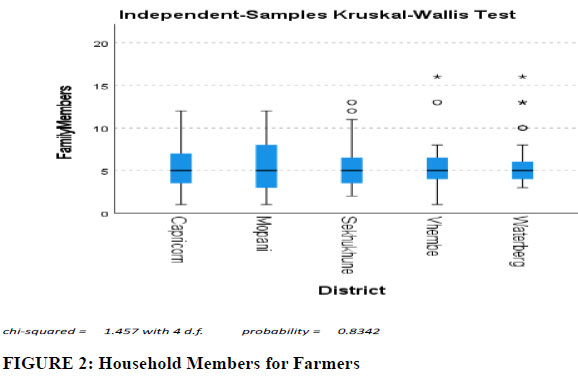
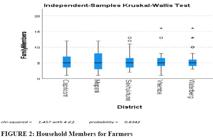
Household size is often linked to the sharing and transfer of agricultural information within families and communities. However, this study found no significant relationship between household size and the use of social media for agricultural communication. Results from the Kruskal-Wallis test showed no statistical difference in household size across the districts (chi-squared = 1.457, df = 4, p = 0.8342), with an overall mean household size of 5.33. This suggested that, in the study area, the number of household members did not meaningfully influence how farmers engage with social media.
5.3. Social Media Usage for Farmers
For this section, only respondents who reported using social media were included in the subsequent analysis. Out of the 420 farmers surveyed, 250 (59.5%) reported using social media platforms for agricultural purposes, while 170 (40.5%) indicated that they did not use any social media. The analysis that follows, therefore, focused on these 250 users to explore how social media facilitated access to and sharing of agricultural information among smallholder farmers in the Limpopo Province.
5.3.1. Social Media Platforms Used by Farmers
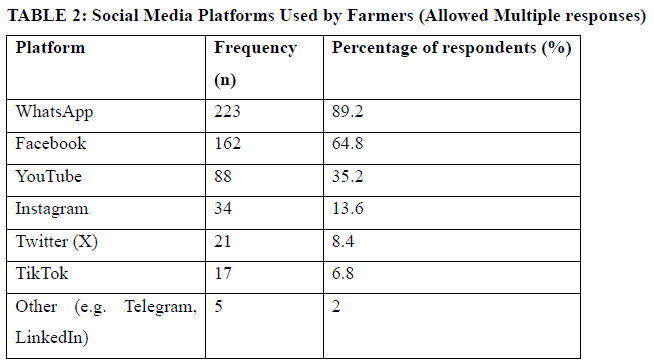
The results show that WhatsApp (89.2%) was the dominant platform among smallholder farmers in the Limpopo Province, followed by Facebook (64.8%) and YouTube (35.2%). The popularity of WhatsApp could be attributed to its low data cost, ease of group communication, and offline functionality, making it ideal for rural contexts with unstable connectivity. Likewise, Olorunfemi et al. (2024) reported that WhatsApp groups have become informal digital spaces for peer-to-peer knowledge exchange and quick access to agricultural information. Facebook is the second-most frequently used platform (64.8%). Its visual and community features allow farmers to follow agricultural pages, join interest groups, and share pictures or videos of crops, livestock, and market products. Kabir et al. (2023) concur that Facebook supports interaction among farmers, cooperatives, and extension support. YouTube (35.2%) was valued for its educational content, particularly video demonstrations of farming techniques, pest control, and equipment use. Rust et al. (2022) argue that video-based learning improves farmers' ability to apply new knowledge compared to text-based materials. Although less common, Instagram (13.6%), Twitter/X (8.4%), and TikTok (6.8%) gained traction, especially among younger farmers and women who used them to market produce or share agricultural innovations (Moreno-Ortiz et al., 2021). These emerging platforms reflected the gradual diversification of farmers' digital communication strategies and the blending of social networking with agribusiness promotion.
5.3.2. Times in the Day When Farmers Use Social Media Platforms
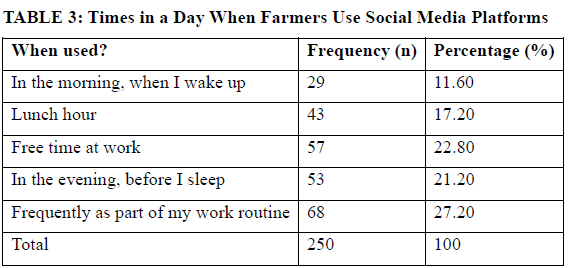
Understanding the times of day when farmers used social media offered valuable insights for the design and delivery of agricultural extension programmes. The findings are presented in Table 3 below. Among the 250 social media users, 27.2 % reported using social media as part of their work routine. Use was concentrated in natural breaks in the day, with 22.8% using social media during free time at work and 21.2% in the evening, while morning use was the lowest at 11.6%. These patterns showed that social media were embedded in farmers' working day and were used when farmers could momentarily pause field tasks. For extension practice, this means the timing of messages mattered to the farmers. Short, timely alerts and reminders sent during lunch breaks and early evening were more likely to reach farmers. The finding resonated with studies reporting that farmers use social media during rest periods and after completing farm tasks (Riley & Robertson, 2022).
5.3.3. Reasons for Farmers' Use of Social Media Platforms
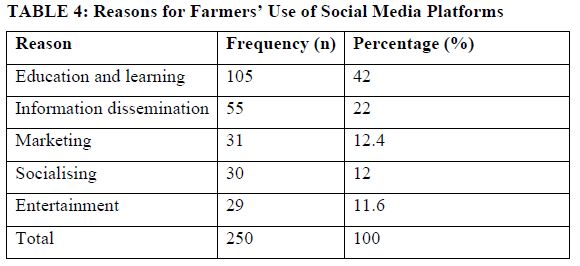
Understanding why farmers used social media was critical for designing agricultural extension programmes that aligned with their needs and preferences. The findings are presented in Table 4 below. Among the 250 users, education and learning were the main reasons for using social media, with 42% citing them. Information dissemination was next at 22%, showing that farmers used social media to access and share agricultural information. Marketing and socialising were smaller but notable uses. These results directly met the study's objective, which was to examine how social media is used to access and share agricultural information. The high share for education and learning suggested social media platforms were used for skills, technical advice and demonstration material. Extension providers should therefore develop short, practical learning content, formatted for WhatsApp and Facebook, and delivered at the times shown in Table 3 above. The pattern also supported earlier findings that farmers use social media for practical farming information and peer learning (Ramavhale et al., 2024).
5.3.4. Challenges of Social Media Use
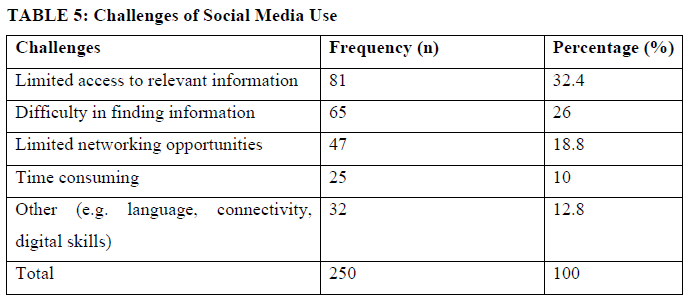
The survey findings highlighted several key challenges that farmers faced when using social media platforms for agricultural purposes. The findings are indicated in Table 5 below. The top challenge among users was limited access to relevant information (32.4%), followed by difficulty finding information (26%). Likewise, Ofori and El-Gayar (2021) proffered that while content exists, it is not always easy to locate contextually relevant content for local farming needs. Limited networking opportunities and time constraints were additional barriers. These issues pointed to three practical needs for extension: concise, well-labelled, and easily searchable content; moderated or curated farmer groups to strengthen useful networks; and quick, low-data formats such as text and short audio clips that respect farmers' time. The "Other" category likely includes language and connectivity constraints that require local-language content and infrastructure support.
6. CONCLUSION AND RECOMMENDATIONS
This study explored how smallholder farmers in the Limpopo Province used social media to access and share agricultural information. The results showed that social media has become an important part of agricultural communication. WhatsApp and Facebook were the most used platforms. Farmers valued WhatsApp for its affordability, ease of use, and ability to quickly share pictures, videos, and messages. Facebook helped farmers connect with wider agricultural communities and learn from others. Although YouTube, Instagram, TikTok, and Twitter were used less often, their growing use among younger farmers suggested future potential. Farmers' choice of social media platforms was influenced by cost, relevance to their farming needs, and ease of use.
The timing of social media use also mattered. Many farmers went online during lunch breaks, in their free time at work, or in the evening. This suggested that agricultural extension messages were more likely to reach farmers when shared during these periods. The main reasons for using social media were learning, sharing information, and social interaction. Farmers used these platforms to access new ideas, get advice on production, and exchange experiences with others. However, a significant number of farmers still did not use social media. They faced challenges such as limited access to relevant content, difficulty finding reliable information, limited networking opportunities, and a lack of time. These barriers revealed ongoing inequalities in access to digital tools and information. Improving these conditions is essential if all farmers are to benefit from digital communication.
Based on the study's findings, it is recommended that farmers receive regular digital skills training to help them use social media confidently and effectively for agricultural communication. Agricultural information should also be translated into local languages such as Sepedi, Xitsonga, and Tshivenḓa to make it easier for farmers to understand and apply. Improving access to technology is essential, and government and partners should expand internet coverage and reduce the cost of data and smart devices in rural areas. Strong collaboration among extension officers, ICT professionals, farmer organisations, and government departments is needed to ensure that online agricultural content is accurate, relevant, and timely. Extension programmes should also promote inclusivity by accounting for differences in gender, age, education, and income among farmers to ensure equal participation. Finally, communication strategies should be aligned with the times when farmers are most active online, such as midday and evening, to improve engagement. Together, these actions will make social media a more effective and inclusive tool for agricultural extension and rural development.
REFERENCES
3. LITERATURE REVIEW
- ADELAKUN, O.E. & OLUPITAN, O., 2022. Level of digital literacy among crop farmers in Oyo State. Int. J. Agric. Econ. Rural Dev., 12(1): 16-23.
- AHMED, H., EKMAN, L. & LIND, N., 2024. Planned behavior, social networks, and perceived risks: Understanding farmers' behavior toward precision dairy technologies. J. Dairy Sci., 107(5): 2968-2982.
- AMUSA, T.A., ANUGWO, S.C. & EGWUE, O.L., 2022. Comparative analysis of the contributions of men and women to farming decisions among rice producing households in Ebonyi State, Nigeria. J. Agric. Ext., 26(3): 86-97.
- ANDERSON, T., 2019. Challenges and opportunities for use of social media in higher education. J. Learn. Dev., 6(1).
- BONSTA, N.V., MUSHUNJE, A., NGARAVA, S. & ZHOU, L., 2023. Utilisation of digital technologies by smallholder farmers in South Africa. S. Afr. J. Agric. Ext., 51(4): 104-146.
- DAS, S., 2021. Influence of social media on agricultural advisory service: Analytical study on the agricultural extension specialists of Uttar Banga Krishi Vishwavidyalaya, West Bengal. Lib. Philos. Pract., 1-17.
- GWELO, F.A., 2025. Social media apps and the democratisation of agricultural knowledge. J. Knowl. Econ., 1-20.
- KABIR, K.H., RAHMAN, S., HASAN, M.M., CHOWDHURY, A. & GOW, G., 2023. Facebook for digital agricultural extension services: The case of rooftop gardeners in Bangladesh. Smart Agric. Technol., 6: 100338.
- KIMOTE, Z., WASIKE, J., MAGETO, V. & MUTUNGA, D., 2025. Impact of social network structures on knowledge sharing dynamics for community empowerment. Afr. J. Bus. Econ. Ind., 6(1): 107-119.
- MASWANGANYI, F.T., 2023. Leveraging indigenous languages for efficient local government: An analysis in a South African context. Int. J. Res. Bus. Soc. Sci., 12.
- MDODA, L., CHRISTIAN, M. & AGBUGBA, I., 2024. Use of information systems (mobile phone app) for enhancing smallholder farmers' productivity in Eastern Cape Province, South Africa: Implications on food security. J. Knowl. Econ., 15(1): 1993-2009.
- MORENO-ORTIZ, C.A., COLLART, A.J., DOWNEY, L., SEAL, S. & GALLARDO, R., 2021. Small farmers' use of social media and other channels for marketing their agricultural products. J. Ext., 59(4): 19.
- MUHAMMAD, A., ANGO, A.K. & BARAU, A.A., 2025. Impact of social media platforms on farmers' livelihood assets in North-Western Nigeria. Fudma J. Sci., 9(1): 333-345.
- MULAUDZI, A.I., OLORUNFEMI, O.D. & AGHOLOR, A.I., 2024. Social media utilization level among South African smallholder farmers: A case study of Mopani District, Limpopo Province. Cogent Soc. Sci., 10(1): 2356722.
- NDIMBWA, T., MWANTIMWA, K. & NDUMBARO, F., 2022. Smallholder farmers' satisfaction with agricultural information accessed in rural Tanzania. J. Agric. Ext. Rural Dev., 27(2).
- NTSOANE, M.M., NDORO, J.T. & NTOMBOVUYO, W., 2025. Multivariate probit model analysis of the factors influencing smallholder farmers' choice of ICT tools: A case study of Mpumalanga, South Africa. Agric., 15(17): 1817.
- NUVEY, F.S., NORTEY, P.A., ADDO, K.K., ADDO-LARTEY, A., KREPPEL, K., HOUNGBEDJI, C.A., DZANSI, G. & BONFOH, B., 2022. Farm-related determinants of food insecurity among livestock dependent households in two agrarian districts with varying rainfall patterns in Ghana. Front. Sustain. Food Syst., 6: 743600.
- NYAGADZA, B., MAZURUSE, G., RUKASHA, T., MUKARUMBWA, P., MUSWAKA, C. & SHUMBANHETE, B., 2022. Rural small-scale farmers' smart mobile phone usage acceptance prognosticators for agricultural marketing information access. SN Soc. Sci., 2(12): 256.
- OFORI, M. & EL-GAYAR, O., 2021. Drivers and challenges of precision agriculture: A social media perspective. Precis. Agric., 22(3): 1019-1044.
- OLORUNFEMI, O.D., MAMIANE, T.A. & MATIWANE, M.B., 2024. Investigating access and use of digital tools for agriculture among rural farmers: A case study of Nkomazi Municipality, South Africa. Open Agric., 9(1): 20220380.
- ONGACHI, W. & BELINDER, I., 2025. Agricultural extension as a pathway to livelihood diversification and sustainable development in rural communities: A systematic review. BMC Agric., 1(1).
- QANGE, S., MDODA, L., NONTU, Y., MABITSELA, M.M. & GIDI, L.S., 2025. Evaluating the impact of adopting conservation agriculture on farm returns of smallholder vegetable farmers in the Eastern Cape Province: Implications for extension services. Front. Sustain. Food Syst., 9: 1605561.
- RAMAVHALE, P.M., ZWANE, E.M. & BELETE, A., 2024. The benefits of social media platforms used in agriculture for information dissemination. S. Afr. J. Agric. Ext., 52(2): 77-90.
- RILEY, M. & ROBERTSON, B., 2022. The virtual good farmer: Farmers' use of social media and the (re)presentation of "good farming." Sociol. Rural., 62(3): 437-458.
- RUST, N.A., STANKOVICS, P., JARVIS, R.M., MORRIS-TRAINOR, Z., DE VRIES, J.R., INGRAM, J., MILLS, J., GLIKMAN, J.A., PARKINSON, J. & TOTH, Z., 2022. Have farmers had enough of experts? Environ. Manage., 69(1): 31-44.
- SEN, L.T.H., PHUONG, L.T.H., CHOU, P., DACUYAN, F.B., NYBERG, Y. & WETTERLIND, J., 2025. The opportunities and barriers in developing interactive digital extension services for smallholder farmers as a pathway to sustainable agriculture: A systematic review. Sustain., 17(7): 3007.
- SHUKLA, G., ANSARI, M.N., LAL, S.P. & BANDHAVYA, M., 2022. Information-seeking behaviour of farmers through mobile: An innovative ICT tool. Biol. Forum Int. J., 14(1): 586-590.
- SIYAO, P.O. & SANGA, E.E., 2024. Breaking barriers in accessing and uptaking climate change adaptation information by smallholder tomato farmers in Tanzania. Glob. Knowl. Mem. Commun., 74(6).
- ZONDO, W.N.S. & NDORO, J.T., 2023. Attributes of diffusion of innovation's influence on smallholder farmers' social media adoption in Mpumalanga Province, South Africa. Sustain., 15(5): 4017.