Determinants of the Use of Farmer Field Schools for Scaling Agroecology Practices Among Smallholder Farmers Across Ethiopia, Kenya and Madagascar
Abstract
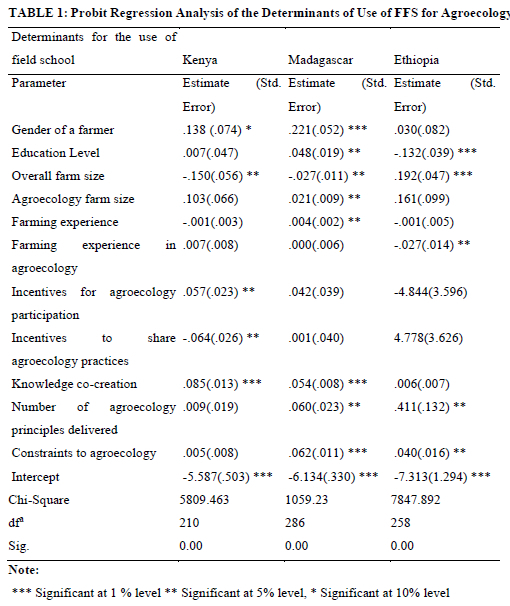
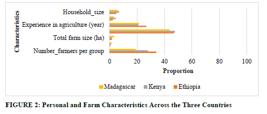
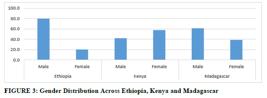
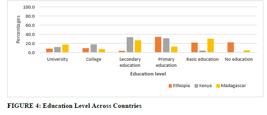
This study examined the determinants of the use of Farmer Field Schools (FFS) for scaling agroecology practices in Ethiopia, Kenya and Madagascar. This is predicated on the fact that a nexus exists among extension approaches, the principles and practices of agroecology. The specific objectives were to examine the influence of socio-demographic characteristics and the use of FFS for scaling agroecology practices. Data were collected from 993 farmers using a structured computer-assisted personal interview administered via the KoBoCollect mobile application. Data were analysed using descriptive statistics andprobit regression. The findings revealed that a majority offarmers in the FFS were male, 47 years of age, with middle-level education, had at least 20 years offarming experience, and had practised agroecology for at least 2 years on at least 25% of their land. There was a significant positive relationship between gender, knowledge co-creation, and scaling up the use of agroecological practices in Kenya and Madagascar. Farm size had a positive, significant correlation with scaling a farmer's use of agroecology in Ethiopia, but a negative, significant relationship with scaling the use of agroecology in Kenya and Madagascar. Incentives to share agroecology practices had a significant negative relationship with the scaling of a farmer's use of agroecology practices in Kenya. The number of agroecology principles used and constraints to agroecology had a significant negative relationship with the scaling up of agroecology among farmers. To scale agroecology practice in Africa, it is important to pay attention to contextual socio-demographics, the application of FFS, and the use of agroecology principles in each country as a basis for developing strategies for scaling agroecology practices.
Farmer Field Schools; Scaling; Agroecology Practices; Extension Services
 Thumbnail
 Thumbnail
 Thumbnail
 Thumbnail