Determinants of the Use of Farmer Field Schools for Scaling Agroecology Practices Among Smallholder Farmers Across Ethiopia, Kenya and Madagascar
Abstract
This study examined the determinants of the use of Farmer Field Schools (FFS) for scaling agroecology practices in Ethiopia, Kenya and Madagascar. This is predicated on the fact that a nexus exists among extension approaches, the principles and practices of agroecology. The specific objectives were to examine the influence of socio-demographic characteristics and the use of FFS for scaling agroecology practices. Data were collected from 993 farmers using a structured computer-assisted personal interview administered via the KoBoCollect mobile application. Data were analysed using descriptive statistics andprobit regression. The findings revealed that a majority offarmers in the FFS were male, 47 years of age, with middle-level education, had at least 20 years offarming experience, and had practised agroecology for at least 2 years on at least 25% of their land. There was a significant positive relationship between gender, knowledge co-creation, and scaling up the use of agroecological practices in Kenya and Madagascar. Farm size had a positive, significant correlation with scaling a farmer's use of agroecology in Ethiopia, but a negative, significant relationship with scaling the use of agroecology in Kenya and Madagascar. Incentives to share agroecology practices had a significant negative relationship with the scaling of a farmer's use of agroecology practices in Kenya. The number of agroecology principles used and constraints to agroecology had a significant negative relationship with the scaling up of agroecology among farmers. To scale agroecology practice in Africa, it is important to pay attention to contextual socio-demographics, the application of FFS, and the use of agroecology principles in each country as a basis for developing strategies for scaling agroecology practices.
Farmer Field Schools; Scaling; Agroecology Practices; Extension Services
1. INTRODUCTION
Globally, agricultural extension service delivery drives rural development for household and national economies (Abudu, Asante, & Mensah, 2023). Extension services, thus, provide the foundation for innovation, system change, and agricultural productivity to sustain household food security and agro-industries (Huang & Rozelle, 2014). The transformation of agriculture and rural households' incomes correlates with agricultural extension. However, there is a difference in the agricultural productivity of farmers who participate in agricultural extension programmes and those who do not (Biswas, Mallick, Kumar & Sultana, 2021). In Ghana, the delivery of extension programmes using participatory approaches improved yields, net revenue, and welfare of farming households (Mohammed & Abdulai, 2022). Thus, agricultural extension generally leads to economic gains through increased maize yields, farm income, household income, and income per capita among participants in agricultural extension programmes (Danso-Abbeam, Ehiakpor, & Aidoo, 2018; Jolex, 2022; Lampach & Nguyen-Van, 2018).
A major agricultural extension approach is the Farmer Field School (FFS), a participatory, hands-on learning approach for farmers, herders, and fisherfolk to develop skills in sustainable agricultural practices through experiments conducted in their own fields (van den Berg & Jiggins, 2020). Originally promoted by the Food and Agriculture Organisation (FAO) for Integrated Pest Management (IPM), FFS now address a wide range of topics, including soil and water management, crop variety testing, agroforestry, nutrition, and human capital development through empowerment. The "school without walls" is a "learning-by-doing" process in which local knowledge and scientific insights are integrated through regular meetings, group discussions, and hands-on experimentation within a local agro-ecosystem (Bello, 2011; FAO, 2023; van den Berg et al., 2020). The FFS approach serves as a strategic entry point for catalysing transformative change in agrifood systems by operationalising agroecological and systems-based principles at the grassroots level. Anchored in participatory, experiential learning, the FFS empowers small-scale producers to critically engage with the interconnected dimensions of agrifood systems, including sustainable production, input-use efficiency, value addition, market linkages, dietary diversity, and ecological sustainability (Olupot, 2025). Agriculture extension services act as the main pathway through which farmers access agroecological information, knowledge and practices (FAO, 2020; Kristin, 2020; Munishi, Mvena, & Wambura, 2021), with a shift to pluralistic mechanisms in most African countries (Muyanga & Jayne, 2008). Nevertheless, the agricultural extension landscape in sub-Saharan Africa still has several extension approaches and models that seem to jeopardise the intended aim of building the capacity of different actors in the form of a positive mindset, knowledge, and skills for agricultural transformation (Oladele, 2020).
The extension services in response to the advent of climate change necessitate the use of mitigation and adaptation strategies in agricultural production (Altieri & Nicholls, 2020), such that the innovative management of climate risks, especially through use of agroecological practices, offers win-win solutions for the improvement of agricultural practices and food security as well as enhancing the resilience of production systems (Assogba & Assogba, 2022). Extension services on agroecological practices in Ethiopia, Kenya and Madagascar have been provided by the Deutsche Gesellschaft für Internationale Zusammenarbeit (GIZ) and its partners. GIZ is the main development agency of Germany, through ProSoil/ProSilience interventions, where a suite of agroecological approaches focused on soil protection and rehabilitation, promoting food security and sustainable agriculture, has been scaled up among farmers. The key aspects of ProSoil/ProSilience Interventions are agroecological transitions, soil protection and rehabilitation, food security and livelihoods, climate change adaptation and mitigation, knowledge transfer and capacity building and evidence-based approach (GIZ, 2025). The ProSoil/ProSilience programmes are designed to be context-specific, adapting to the unique ecological, social, and economic conditions of each region and community. These programmes work closely with local partners to ensure that interventions are relevant, effective, and sustainable. They explored different extension approaches, methods and devices used to deliver services, among others.
2. THEORETICAL BACKGROUND
This study explored social learning theories, which are fundamental to Farmer Field Schools (FFS) and agroecology, as these approaches rely on farmers learning through observation, interaction, and shared experiences among groups and within a community, rather than just passive instruction. These theories underpin FFS and agroecology because farmers learn through observation, interaction, and shared experiences in groups and communities (Bandura, 2014; Wenger, 1998; Rogers, 2003; Pretty, 2002) Bandura's Social Cognitive Theory, states that farmers observe and imitate peers to acquire new farming practices, and to experience transformative learning, which emphasises community-driven dialogue and reflection to change worldviews and foster collective action towards sustainable practices (Bandura, 2014). The core social learning concepts in FFS are observation and imitation, experiential learning, discovery learning, and social interaction and knowledge sharing. Farmers are motivated to learn by observing other farmers' successful practices and the positive results of those practices, making the methods seem more accessible and credible. As participants learn by doing, actively engaging in experiments and observations in their local fields, knowledge is reinforced through a practical, hands-on process (Wang et al., 2024). The FFS environment encourages farmers to discover new ideas and co-create solutions through their own observations and analysis, rather than being given answers. The regular group meetings in FFS anchored on Agro-Ecosystem Analysis (AESA) enable farmers to carry out observations, recording, analysis, discuss challenges, co-create solutions and learn from the collective wisdom of the community, fostering trust in peer-derived information (Charatsari, Lioutas, Papadaki-Klavdianou, Koutsouris, & Michailidis, 2022).
The use of agroecological practices such as organic farming and sustainable land management leads to improved soil fertility, increased biodiversity, and enhanced crop yields, improved food security, increased incomes, reduced dependence on external inputs, as well as the resilience of farming systems (Dayou et al., 2020; Assogba et al., 2022; 24; Tapsoba, Aoudji,, Ouédraogo & Dassekpo, 2023). Similarly, farmers who receive training and technical assistance in agroecological practices are more likely to adopt and implement them effectively on their farms (Assogba, Hounzandji & Tossou, 2021). The approaches, such as farmer field schools, participatory research, and video-mediated learning (Karubanga, Godfrey, Rugare & Mubangizi, 2024), among others, have proven effective in empowering farmers and fostering the exchange of local knowledge (Egah et al., 2013; Zoundji et al., 2024). 26. Researchers such as Paracchini et al. (2020), Bendjebbar and Fouilleux (2022) found that institutional collaboration and stakeholder engagement are vital for integrating agroecology into national agricultural strategies and various programmes. Dassou et al. (2021) and Tapsoba et al. (2023) reported that innovative initiatives such as farmer cooperatives, direct marketing, and organic certification schemes have emerged to address the challenges of limited market infrastructure, price fluctuations, and certification requirements, and to create market opportunities for agroecological products. These agroecological practices, in line with farmer field school approaches, recognise and value indigenous knowledge systems and local co-creation and innovation, and are locally contextualised to address local production needs for sustainable agricultural productivity and food systems (Loconto, 2020; Tapsoba et al., 2020).
However, there is limited empirical evidence on the use of Farmer Field Schools to scale agroecological practices among farmers (Tapsoba et al., 2023). Therefore, the research questions that guided this study were: (i) Is there any relationship between the use of FFS and the scaling of agroecology practices? (ii) What factors influence the scaling of agroecology practices by farmers? The main objective of this paper was to identify the determinants of the use of Farmer Field Schools (FFS) for scaling agroecology practices among farmers across Ethiopia, Kenya, and Madagascar. The specific objectives were to examine the influence of socio-demographic characteristics and the use of FFS on scaling agroecology practices.
3. RESEARCH METHODOLOGY
This study covered Ethiopia, Kenya and Madagascar in Africa. In Kenya, the study covered the three counties of Bungoma, Kakamega and Siaya. In Bungoma, 62 villages were covered; in Kakamega, 44; and in Siaya, 20. In Ethiopia, the study covered four regions, namely Oromia (221 respondents), Sidama (37 respondents), Southern Region (36 respondents), and Central Region (38 respondents). In Madagascar, the study was conducted in five municipalities in the Boeny region (Ambato-Boeny, Mahajanga I, Mahajanga II, Marovoay, Mitsinjo) and two municipalities in the Androy region (Ambovombe and Bekily).

The study employed a descriptive research design to determine the characteristics of the farmers' population that enable agroecological transition. The study population consisted of smallholder farmers involved in the GIZ ProSoil/ProSilience interventions. The study used purposive criterion-based and random sampling to select 993 farmers. The countries, regions, districts, and counties were purposively selected based on their participation in the GIZ ProSoil/ProSilience interventions. In Kenya, there were 301 farmers from Bungoma county (121 farmers), Kakamega county (120 farmers), and Siaya county (60 farmers). In Ethiopia, there were 326 farmers; from the South region (37 farmers), the Central region (37 farmers), the Sidama region (36 farmers), and the Oromia region (216 farmers). In Madagascar, there were 366 farmers, from the Boeny region (274 farmers) and the Androy region (92 farmers). All respondents were randomly selected to ensure equal opportunity for each village and farmer to participate in the study and minimise selection error.
Data were collected from farmers using a structured questionnaire validated by agroecology, agricultural extension, and rural development experts across the countries. The questionnaire consisted of sections that elicited information on the respondents' demographic characteristics. The use and intensity of use of agroecology practices were interrogated through the use of a Computer-assisted personal interview. This comes from the KOBO Collect mobile application (https://www.kobotoolbox.org/), a data collection, management, and visualisation platform used globally to accelerate positive social change by facilitating efficient data collection. To ensure data quality, the location-capturing functionality was enabled in the data collection application. This uniform methodology ensured consistency and comparability of findings across the study areas. To ensure internal consistency of the items, the questionnaire was piloted in Illu District, Ethiopia, and in Murang'a County, Kenya. The reliability test generated a Cronbach's alpha of 0.85. The respondents signed an informed consent form after the enumerators had explained the objectives and purposes of the study, as well as the principles of anonymity, voluntary participation, confidentiality and beneficence. This was to rigorously uphold ethical considerations across all the participating countries during the survey process. Data were analysed using SPSS IBM version 27 to generate descriptive statistics and Probit regression. The probit model was applied to farmers, based on two alternatives: needs or no needs, as expressed by Nagler (1994). The model is appropriate for overcoming heteroscedasticity and satisfies the assumption of a cumulative normal probability distribution (Gujarati, 2004).
It is assumed that Y can be specified as follows:

Otherwise, Where X1, X2........................Xn represents a vector of random variables, β represents a vector of unknown parameters, and U represents random disturbance terms (Nagler, 1994).
4. FINDINGS AND DISCUSSION
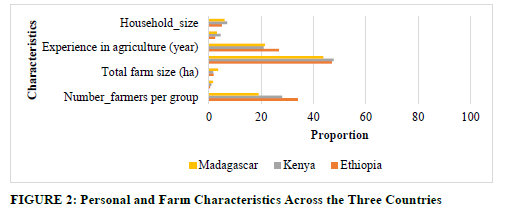
There is no single average size for a farmer group involved in agroecology across countries, because the size and structure of these groups vary significantly by region, context, and specific agroecological initiatives. However, studies show that smaller farms and diversified farming systems are more likely to adopt agroecological practices, suggesting that groups focused on these methods often comprise such farmers. The average size of farmer groups involved in agroecology practices varied across the countries, with 34 in Ethiopia, 28 in Kenya, and 28 in Madagascar. The average number of farmers in agroecology groups was 19. The average farm size per household designated for implementing agroecology in Ethiopia is 0.44ha; in Kenya, households allocate an average of 0.99ha to agroecology, while in Madagascar, the average land size allocated to agroecology is 1.64ha per household. The results imply that the farm size allocated to agroecology is not fixed; rather, it is determined by local conditions, farmers' needs, and the specific agroecological practices implemented. The results on personal and farm characteristics across Ethiopia, Kenya and Madagascar on the number of farmers per group, area allocated to agroecology, total farm size, age, years of experience in agriculture, years of experience in agroecology and household size are summarised in Figure 2.
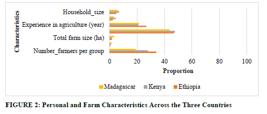
Total farm size, as a measure of overall landholding per farmer, including both agroecological and other farming activities, was, on average, less than 2 hectares across the countries. An understanding of the total farm size provides context for the scale of agricultural operations and the potential to integrate agroecology into existing farming systems. Generally, evaluating the proportion of land allocated to agroecology relative to total farm size showed 62% in Kenya, 47% in Madagascar, and 25% in Ethiopia. The average age of farmers engaged in agroecology ranged from 44 to 47 years across the countries. Age demographics are crucial, as they can influence the transition towards agroecology.
The farming experience, measured as the average number of years farmers have been engaged in agricultural activities, ranged from 21 to 26 years across the countries. Similarly, the experience in agroecology, measured as the average number of years farmers have been practising agroecology, ranged from 1 to 5 years across Ethiopia and Kenya, and 3 years in Madagascar. This metric indicates the degree of exposure and proficiency in sustainable agricultural practices among farmers. The average number of individuals in a farmer's household (household size) differed across countries, with 5 members in Ethiopia, 6 in Kenya, and 6 in Madagascar. Household size influences resource allocation, labour availability, and overall household resilience within agricultural communities.
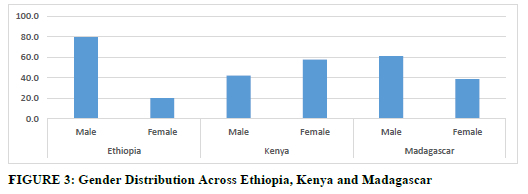
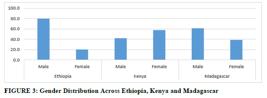
Gender differences significantly impact agroecology adoption rates, with men often having higher adoption rates for certain practices and technologies. At the same time, women tend to adopt low-risk, traditional methods but face substantial barriers such as lack of credit, land ownership, and access to information and extension services (Hailemariam, Kalsi & Mavisakalyan, 2024). Figure three showed gender distribution across Ethiopia, Kenya and Madagascar. In Ethiopia and Madagascar, male farmers were 80% and 61% respectively, while in Kenya, female farmers represented 58%.
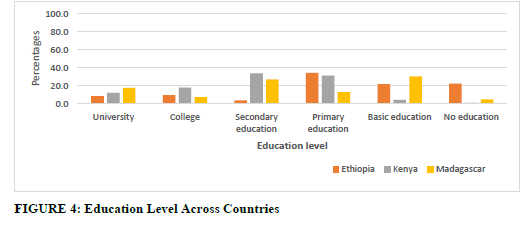
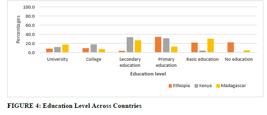
The educational attainment of agroecology adopters varies significantly by region and context, with some studies showing that a majority of adopters have completed secondary education or higher. In contrast, others indicate that many adopters, including those in formal education, embrace agroecological practices without formal education, particularly in developing regions. Figure 4 shows the distribution of respondents by education level across Ethiopia, Kenya, and Madagascar. During the analysis of educational attainment across Ethiopia, Kenya, and Madagascar, distinctive patterns emerged in the distribution of educational attainment. Madagascar had 18% of farmers with university education, 8% in Ethiopia, and 12% in Kenya. Higher education, combining university and college levels, indicated that 25% of respondents in Madagascar, 18% in Ethiopia, and 30% in Kenya had attained a college or university education. The proportion of farmers who had no formal education was 22% in Ethiopia, 1% in Kenya, and 5% in Madagascar.
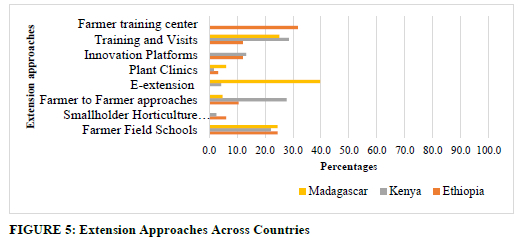
Extension approaches that promote agroecology emphasise participatory learning and the co-creation of knowledge between farmers, extension agents, and researchers. Figure 5 shows the different extension approaches used to promote agroecological practices across Ethiopia, Kenya, and Madagascar. Ethiopia used farmer training centres (32%), Kenya applied a farmer-to-farmer approach (29%), and Madagascar used an e-extension approach (40%) to deliver agroecological practices to farmers. Distinct patterns emerged in the utilisation of various agroecology extension approaches. Farmer training centres, which are driving the predominant adoption rate in Ethiopia, could indicate a structured approach to capacity building and skill development. In Kenya, the farmer-to-farmer approach took precedence as the primary method, facilitating hands-on learning and technical assistance for farmers through community social networks that could be strong and built on trust and reciprocity over a long period of time. In Madagascar, e-extension emerged as the leading approach, underscoring the importance of digital technologies in delivering agroecological knowledge and practices to farmers. The application of e-extension demands a relatively literate farmer population and access to the internet and smartphone handsets suitable for e-extension navigation. This is largely a limitation to the use of e-extension in Africa. These diverse agricultural extension patterns emphasise the importance of tailored approaches to promote agroecological development across countries.
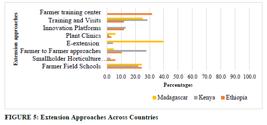
However, among the agricultural extension approaches considered in this study, hybrid approaches appear to be less widely used across Ethiopia, Kenya, and Madagascar, such as e-extension in Ethiopia, Plant Clinics in Kenya, and innovation platforms in Madagascar.
The overall percentages for the use of the FFS approach show 24% in Ethiopia, 22% in Kenya, and 25% in Madagascar. FFS emerged as the most widely used extension approach across Ethiopia, Kenya, and Madagascar. FFS play a central role in promoting participatory learning, knowledge exchange, and capacity building based on knowledge co-creation among farmers within their agroecological framework (Mdiya et al., 2024). These FFS provide platforms for farmers to collectively experiment with and learn about sustainable agricultural practices, enhancing their understanding of ecological principles and empowering them to implement environmentally friendly farming techniques (Mdiya et al., 2024). The widespread adoption of FFS underscores their effectiveness in fostering agroecological resilience and promoting sustainable food production systems across diverse agricultural landscapes.
The Smallholder Horticulture Empowerment Project emerged as the least-utilised extension approach in agroecology across Ethiopia, Kenya, and Madagascar. This approach reflects a minimal emphasis on promoting empowerment among smallholder horticultural farmers within the agroecological framework. Even in Ethiopia, the project approach accounted for a slightly high 6%, yet it still indicated limited engagement with initiatives to empower smallholder farmers to adopt horticultural practices aligned with agroecological principles. The low adoption of the Smallholder Horticulture Empowerment Project underscores the need for greater attention to initiatives that integrate agroecological principles into horticultural practices to promote sustainable livelihoods and agricultural development among smallholder farmers.
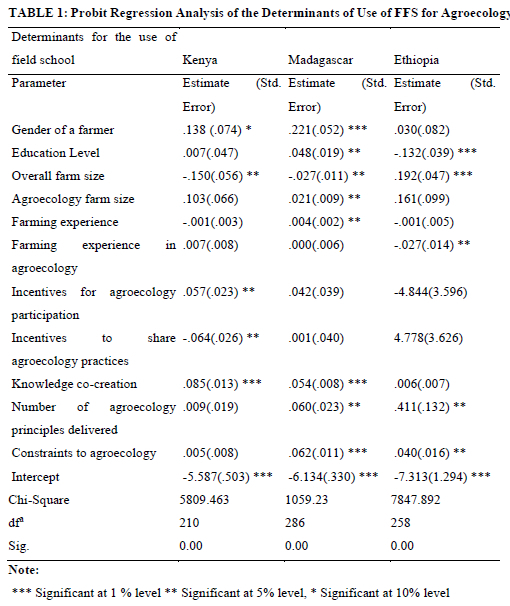
Gender and knowledge co-creation are more likely to scale up a farmer's ability to use agroecological practices in Kenya and Madagascar than in Ethiopia. Farm size is more likely to scale up a farmer's use of agroecology in Ethiopia but less likely to scale up its use in Kenya and Madagascar. Incentives to share agroecology practices were less likely to scale a farmer's use of agroecology practices in Kenya. Farming experience was more likely to scale up a farmer's use of agroecology in Madagascar, whereas it was less likely in Ethiopia. The number of agroecology principles used and the constraints to agroecology were more likely to scale up the use of agroecology among farmers (FAO, 2022).
The results in Table 1 indicate the Probit regression analysis of the use of FFS for scaling agroecology practices and principles in Kenya, Ethiopia and Madagascar. All the models are well-fitted, with Chi-Square values for Kenya (5809.463, 210, p < 0.001), Madagascar (1059.23, 286, p < 0.001), and Ethiopia (7847.892, 258, p < 0.001). In Kenya, gender (t = 1.86, p < 0.10), incentives for agroecology participation (t = 2.44, p < 0.05), knowledge co-creation (t = 6.44, p < 0.01), had positive significant association with the use of agroecology practice, while farm size (t = - 2.66, p < 0.05), incentives to share agroecology (t = - 2.44, p < 0.05), had a negative significant correlation with the use of agroecology practice. In Madagascar, gender (t = 4.22,p < 0.01), education level (t = 2.50,p < 0.05), agroecology farm size (t = 2.35,p < 0.05), farming experience (t = 2.19, p < 0.05), knowledge co-creation(t = 6.55, p < 0.01), number of agroecology principles (t = 2.66,p < 0.05), constraints to agroecology (t = 5.52, p < 0.01) had positive significant relationship with use of agroecology practice. In contrast, farm size (t = -2.47, p < 0.05) had a significant negative relationship with the use of agroecological practices. In Ethiopia, farm size (t = 4.10, p < 0.01), number of agroecology principles used (t = 3.11, p < 0.05), and constraints to agroecology (t = 2.57, p < 0.01) were positively and significantly associated with agroecology practice. In contrast, education level (t = -3.38, p < 0.01) and farming experience in agroecology (t = -1.93, p < 0.05) had a significant negative correlation with agroecology practice.
The results across Kenya, Ethiopia, and Madagascar showed that demographic characteristics are significantly related to the use of FFS for scaling agroecology practice. The level of participation in FFS is significantly associated with education, farm ownership, farm size, and the period of residency (Bello, 2020; Abudu et al., 2023). Land size affects both FFS decisions to attend and participate in agroecology practice (Cai, Zhang, & Liu, 2016). Farmers who participate in FFS tend to experience an impressive increase in self-assessed knowledge and skills in production, and in the consumption and marketing of vegetables (Apleni, Moyo & Dube, 2019). Farmer-to-farmer training was positively associated with the use of sustainable land management practices after accounting for demographic, agricultural and socioeconomic factors (Kansanga, Sanginga & Nyasimi, 2021). Farmer Field Schools tend to enhance critical thinking, innovation, confidence, the quality of life (human capital), mutual trust, bonding, collective action, networking and emancipation (social capital), improvements in field practices, food production, agricultural diversification, food security (natural capital) and income and profits, and savings and loans schemes (van den Berg et al., 2020).
Knowledge co-creation is significantly associated with the use of Farmer Field Schools (FFS) to scale agroecology across countries. FFS tend to foster knowledge co-creation and sharing (Vicente-Vicente et al., 2023). Farmers' co-production tends to enhance the adoption of adaptation practices (Wright et al., 2014), which increases income by 10-25% (Chiputwa et al., 2022). Similarly, agricultural innovations respond better to local challenges when co-created through participatory processes and knowledge sharing, which are crucial elements of agroecology (FAO, 2022). Knowledge co-creation among value chain actors, through the contribution of specific knowledge and skills and joint experimentation, enables the adoption of technologies, the optimisation of yields, and the maximisation of returns through climate-resilient practices (Mandaza et al., 2023). For example, layer poultry Farmer Field Schools in Ghana and Kenya are associated with self-reported reductions in antibiotic use, prevention and control practices, and enhanced engagement with animal health professionals (Caudell et al., 2022). FFSs create an easy way to build social capital through bonding and connecting, which greatly contributes to knowledge and innovation co-production (Chrysanthi et al., 2020).
The number of agroecological principles adopted has significantly influenced the use of Farmer Field Schools (FFS) to scale agroecological practices among farmers. Farmers participating in FFS had lower agroecological impacts from pesticide use, improved farming practices, strengthened agricultural extension services, and promoted sustainable agriculture (Bhuiyan & Maharjan, 2022). FFS programmes have diversified to include multiple crops and livestock, with farmers' involvement in the design and planning of interventions being critical (van den Berg et al., 2021). There was an increase in the skills of farmers participating in FFS regarding the production and use of compost and bio-pesticides, and the inclusion of legumes in the cropping system through intercropping or pure cropping, collective pest management, and crop rotations (Bakker et al., 2021). FFS training is an effective approach to extend the adoption of environmentally friendly irrigation and fertilisation technologies, significantly increasing their adoption rate. Bakker et al. (2022) stated that FFS is an effective approach that enhances family farming's response to climate change, food security, human health, and ecosystems (Cai et al., 2022). FFS has promoted integrated soil fertility management practices, the adoption of Zero Budget Natural Farming practices, and IPM practices among farmers (Kumar et al., 2023), and has enhanced participation in national agricultural programmes such as climate-smart agriculture, access to basic services, and conservation of natural resources (Arnés et al., 2018). The FFS approach remains relevant at the field level, despite different institutional arrangements that help farmers adapt their agricultural practices and livelihood situations, thus contributing to the achievement of the Sustainable Development Goals (van den Berg & Jiggins, 2020).
Incentives to participate in and share agroecology practices are significantly related to the use of Farmer Field Schools (FFS) to scale them. The Farmer Field School approach is effective as an agricultural innovation and dissemination platform, significantly improving farmers' knowledge and adoption of cultivation practices, thereby increasing productivity and profitability. There were marked differences between FFS-participating and non-participating farmers (Amarathunga, Perera & Wijesinghe, 2023). Farmers' FFS programmes must be implemented, along with a strong extension network, to enable wider dissemination of modern technology, given the effects of education on farm productivity (Paltasingh & Goyari, 2018). Farmer Field Schools are an innovative approach to agricultural advisory services, allowing farmers to independently identify solutions to their problems and acquire new skills (Adounkpe, Dossou & Houngbédji, 2022). For example, Haryanto et al. (2023) found that FFS increased the technical efficiency of maize farmers, demonstrating the importance of agricultural extension programmes. In addition, FFS households tend to harvest higher crop yields and achieve better household food security (Kithi, Mwangi & Kamau, 2023). Scaling agroecology requires specific pathways, local organisations, collective learning, experimentation, extension with or by farmers, and mobilised, participatory, multidisciplinary, and transdisciplinary approaches (Le Coq, Rakotobe & Ramanantsoa, 2019). Agroecology can mitigate negative impacts, but only if combined with smaller-scale agrifood systems and if livestock systems are better aligned with regional feed production capacities (Mayer, Smith & Müller, 2024).
5. CONCLUSION AND RECOMMENDATIONS
According to the results of this study, it can be established that the study achieved its objectives through the data analysis parameters and methodology applied.
5.1. Achievements of Study Objectives
We conclude that there is evidence regarding the determinants of the use of the Farmer Field School approach to scale agroecological practices in African countries. Farmers' personal characteristics influence the use and scaling of agroecology practices. There was a positive, significant relationship between gender, knowledge co-creation, and scaling up the use of agroecology practices in Kenya and Madagascar. Farm size had a positive, significant correlation with scaling a farmer's use of agroecology in Ethiopia, but a negative, significant relationship with scaling the use of agroecology in Kenya and Madagascar. Incentives to share agroecology practices had a significant negative relationship with the scaling of a farmer's use of agroecology practices in Kenya. There was a positive, significant relationship with the scaling of agroecology in Madagascar, but a negative, significant relationship with the scaling of agroecology practice in Ethiopia. The number of agroecology principles used and constraints to agroecology had a significant negative relationship with the scaling up of agroecology among farmers. The significant determinants of the use of the Farmer Field School approach to scale agroecology practices in African countries are gender, incentives for agroecology participation, knowledge co-creation, farm size, and incentives to share agroecology practices. Grounded in Bandura's Social Cognitive Theory, FFS enable farmers to acquire new skills through observation, imitation, and reflective group discussions, fostering transformative learning and context-specific adoption of sustainable agricultural practices.
5.2. Recommendations
Based on the findings of this study, the recommendations are that in order to scale agroecology practice in Africa, farmer field school extension service providers, extension workers, agencies promoting agroecology and farmer field schools must pay attention to the contextual socio-demographics, the application of FFS and the use of agroecology principles in each country as a basis to develop strategies for scaling agroecology practice.
REFERENCES
-
ABUDU, K., ASANTE, R. & MENSAH, J., 2023. Agricultural extension and rural development in Africa: Impacts on productivity and household livelihoods. S. Afr. J. Agric. Ext., 51(1): 45-58. https://doi.org/10.17159/2413-3221/2023/v51n1a4985
» https://doi.org/10.17159/2413-3221/2023/v51n1a4985 - ABUDU, S., KUMI, E. & MENSAH, J., 2023. Assessing the impact of farmer field schools on agricultural productivity in Sub-Saharan Africa: A case study from Ghana. African J. Agric. Res., 18(5): 123-130.
- ADOUNKPE, B., DOSSOU, J. & HOUNGBÉDJI, R., 2022. Farmer field schools as a participatory advisory service: Evidence from Benin. J. Rural Dev., 41(4): 567-583.
- ALTIERI, M.A. & NICHOLLS, C.I., 2020. Agroecology and the search for a truly sustainable agriculture. Boca Raton, FL: CRC Press.
- AMARATHUNGA, R., PERERA, B. & WIJESINGHE, C., 2023. Impact of farmer field schools on the adoption of sustainable agricultural practices and productivity in Sri Lanka. J. Agric. Educ. Ext., 31(2): 112-128.
- APLENI, T., MOYO, P. & DUBE, S., 2019. Impact of farmer field schools on vegetable production and marketing in Zimbabwe. Agric. Syst., 174: 1-9.
- ARNÉS, E., DÍAZ-AMBRONA, C.G. & MARÍN-GONZÁLEZ, O., 2018. Farmer Field Schools (FFSs): A tool empowering sustainability and food security in peasant farming systems in the Nicaraguan highlands. Sustain., 10(9): 3020.
-
ASSOGBA, G.M. & ASSOGBA, C.G., 2022. Agroecological practices support climate change resilience. Available from https://zerocarbon-analytics.org/nature/agroecological-practices-support-climate-change-resilience/
» https://zerocarbon-analytics.org/nature/agroecological-practices-support-climate-change-resilience/ - ASSOGBA, C.G., HOUNZANDJI, S. & TOSSOU, R., 2021. How communication's channels influence diffusion of eco-friendly technologies? A case study of sustainable land management technologies' diffusion in Benin, West Africa. Asian J. Agric. Ext. Econ. Sociol., 39(12): 193-203.
- BAKKER, T., DUGUÉ, P. & DE TOURDONNET, S., 2021. Assessing the effects of Farmer Field Schools on farmers' trajectories of change in practices. Agron. Sustain. Dev., 41(2): 17.
- BAKKER, T., DUGUÉ, P. & DE TOURDONNET, S., 2022. Discovering the impact of Farmer Field Schools on the adoption of environment-friendly technology. Environ. Sci. Policy., 126: 1-9.
- BANDURA, A., 2014. Social cognitive theory. In R. Vasta (ed.), Annals of Child Development, Vol. 6: Six Theories of Child Development. Greenwich, CT: JAI Press, p. 1-60.
- BANDURA, A., 2014. Social Learning Theory. Englewood Cliffs, NJ: Prentice-Hall.
- BELLO, F., 2020. Gender and Farmer Field Schools in agricultural production systems in West Africa. J. Agric. Ext. Rural Dev., 12(3): 35-42.
- BELLO-BRAVO, J.A. & DAVIS, K.E., 2011. Gender and Farmer Field Schools in agricultural production systems in West Africa. J. Agric. Educ. Ext., 17(3): 265-280.
- BHUIYAN, M.M.R. & MAHARJAN, K.L., 2022. Impact of Farmer Field School on crop income, agroecology, and farmer's behavior in farming: A case study on Cumilla District in Bangladesh. Sustain.,14(7): 4190.
- BISWAS, B., MALLICK, B., KUMAR, K. & SULTANA, Z., 2021. Impact of agriculture extension services on technical efficiency of rural paddy farmers in southwest Bangladesh. Environ. Chall., 4: 100261.
- CAI, J., ZHANG, Y. & LIU, H., 2016. Land size and its impact on agricultural practices: Evidence from rural China. Land Use Policy., 54: 1-8.
- CAI, J., ZHANG, Y. & ZHANG, X., 2022. Family farming in climate change: Strategies for resilient and sustainable food systems. Agric. Syst., 191: 103118.
- CAUDELL, M., MURIUKI, G. & OCHIENG, A., 2022. Evidence from poultry Farmer Field Schools in Ghana and Kenya: Impacts on antibiotic use and engagement with animal health professionals. Antibiotics., 11(5): 678.
- CHARATSARI, C., LIOUTAS, E.D., PAPADAKI-KLAVDIANOU, A., KOUTSOURIS, A. & MICHAILIDIS, A., 2022. Experiential, social, connectivist, or transformative learning? Farm advisors and the construction of agroecological knowledge. Sustain., 14(4): 2426.
- CHIPUTWA, B., BLUNDO-CANTO, G., STEWARD, P., ANDRIEU, N. & NDIAYE, O., 2022. Co-production, uptake of weather and climate services, and welfare impacts on farmers in Senegal: A panel data approach. Agric. Syst., 195: 103309.
-
CHRYSANTHI, A., LIOUTAS, E. & KOUTSOURIS, A., 2020. Farmer field schools and the co-creation of knowledge and innovation: The mediating role of social capital. Agric Hum Values., 37: 1139-1154. https://doi.org/10.1016/j.agsy.2019.102745
» https://doi.org/10.1016/j.agsy.2019.102745 - CAUDELL, M.A., KIAMBI, S., AFAKYE, K., KOKA, E., KABALI, E., KIMANI, T. & DORADO-GARCIA, A., 2022. Evidence from poultry Farmer Field Schools in Ghana and Kenya: Impacts on antibiotic use and engagement with animal health professionals. Antibiotics., 11(5): 678.
- DANSO-ABBEAM, G., EHIAKPOR, D.S. & AIDOO, R., 2018. Agricultural extension and its effects on farm productivity and income: Insight from Northern Ghana. Agric. Food Secur., 7(74).
- DAVIS, K.E., 2020. Comparison of national extension systems: Application of the best-fit framework. In K. Davis, S.C. Babu & C. Ragasa (eds.), Agricultural extension: Global status and performance in selected countries, Part 1: Global Assessment of Extension Characteristics, Chapter 3. Washington, DC: International Food Policy Research Institute (IFPRI).
- DAYOU, E.D., ZOKPODO, B.K.L., MONTCHO, M., AJAV, E.A., BAMGBOYE, I.A. & GLELEKAKA, R.L., 2020. Current agricultural and environmental policies in Benin Republic. Sustain. Agric. Res., 9(2): 64-73.
- FAO., 2022. Enabling extension and advisory services to promote agroecology. Food and Agriculture Organisation of the United Nations.
- FAO., 2023. Mid-term review of the project "KULIMA: Revitalising agricultural clusters and ulimi wa m'ndandanda through Farmer Field Schools in Malawi. Food and Agriculture Organisation of the United Nations. (in preparation).
-
FAO., 2022. Farmer Field Schools: Improving farmers' knowledge and practices for sustainable agriculture. Rome: Food and Agriculture Organisation of the United Nations. Available from https://www.fao.org/farmers-field-schools/en
» https://www.fao.org/farmers-field-schools/en - GIZ., 2025. Nurturing the Earth: Soil Protection and Rehabilitation for Food Security (ProSoil). Deutsche Gesellschaft für Internationale Zusammenarbeit (GIZ) GmbH.
-
HAILEMARIAM, A., KALSI, J. & MAVISAKALYAN, A., 2024. Gender gaps in the adoption of climate-smart agricultural practices: Evidence from sub-Saharan Africa. J. Agric. Econ., 75(2): 764-793. https://doi.org/10.1111/1477-9552.12583
» https://doi.org/10.1111/1477-9552.12583 - HARYANTO, S., NUGROHO, A. & SANTOSO, P., 2023. Technical efficiency of maize farmers under Farmer Field School programs in Indonesia. Agric. Syst., 207: 103616.
- HUANG, J. & ROZELLE, S., 2014. Agricultural research, development and extension. In S. Fan, R. Kanbur, S.J. Wei & X. Zhang (eds.), The Oxford Companion to the Economics of China. London: Oxford University Press, pp. 315-319.
- HUANG, J. & ROZELLE, S., 2014. Agricultural research, extension, and innovation systems in Asia: The investment, capacity, and impact of the World Bank and other donors. Report No. 88039-GLB.Washington, DC: World Bank.
- HUANG, J. & ROZELLE, S., 2014. Agriculture, rural development, and extension in global food security. Food Policy., 44: 1-8.
- JOLEX, A., 2022. Assessing the relationship between access to agricultural extension services and maize yield among smallholder farmers in Malawi. Agric. Food Econ., 10(1): 1-14.
- KANSANGA, S., SANGINGA, P. & NYASIMI, M., 2021. Farmer-to-farmer training and its influence on sustainable land management practices in East Africa. LandDegrad. Dev., 32(6): 1718-1727.
- KARUBANGA, G., GODFREY AGEA, J., RUGARE, J.T. & MUBANGIZI, N., 2024. Leveraging video integration for enhanced agricultural extension reforms in Uganda. CogentSoc. Sci., 10(1): 2399936.
- KITHI, A., MWANGI, W. & KAMAU, P., 2023. Farmer Field Schools and household food security in Kenya: Evidence from maize and horticultural farmers. Afr. J. Agric. Res., 18(6): 456-467.
- KUMAR, S. & SHARMA, S., 2023. Determinants and constraints for adoption of Zero Budget Natural Farming (ZBNF) practices. Indian J. Ext. Educ., 59(2): 1-7.
- LAMPACH, N. & NGUYEN-VAN, P., 2018. Measuring the effect of agricultural extension on technical efficiency in crop farming: Meta-regression analysis. Working Papers of BETA 2018-48. Bureau d'Economie Théorique et Appliquée.
- LE COQ, J.F., RAKOTOBE, Z. & RAMANANTSOA, J., 2019. Scaling agroecology in smallholder farming systems: Participatory and transdisciplinary approaches. Agric. Hum. Values., 36: 561-576.
- LOCONTO, A.M., FOUILLEUX, E., BENDJEBBAR, P., LEMEILLEUR, S. & ALPHA, A., 2021. Institutional innovations for organic agriculture in Africa. Science Forum: 6th ISOFAR Conference, Organic World Congress 2021.
- MANDAZA, J., SUZUKI, K. & ONISHI, S., 2023. A framework for analyzing co-creation value chain mechanisms in climate-resilient agriculture. Sustain., 16(7): 2919.
- MAYER, F., SMITH, J. & MÜLLER, K., 2024. Agroecology and food system resilience: Aligning livestock with regional feed capacities. Glob. Food Secur., 40: 101146.
- MDIYA, L., ALIBER, M., MDODA, L., VAN NIEKERK, J., SWANEPOEL, J. & NGARAVA, S., 2024. Empowering resilience: The impact of Farmer Field Schools on smallholder livestock farmers' climate change perceptions in Raymond Local Municipality. Sustain., 16(20): 8784.
- MUNISHI, L.K., MVENA, Z.S. & WAMBURA, R.M., 2021. Scaling up agroecological farming in Tanzania: The role of farmer training and extension services. Afr. J. Agric. Res., 16(4): 558-570.
- MUYANGA, M. & JAYNE, T.S., 2008. Private agricultural extension system in Kenya: Practice and policy lessons. J. Agric. Educ. Ext., 14(2): 111-124.
- NAGLER, J., 1994. Interpreting probit analysis. Polit. Anal., 5(3): 225-243.
- OLADELE, O.I., 2020. Agricultural extension systems in sub-Saharan Africa: Challenges and opportunities. J. Agric. Ext., 24(1): 1-15.
-
OLUPOT, M., 2017. The smart way to help African farmers tackle climate change. InnoDev. Available from https://innodev.org/content/smart-way-help-african-farmers-tackle-climate-change
» https://innodev.org/content/smart-way-help-african-farmers-tackle-climate-change - OLUPOT. M., 2025: Strengthening inter-regional cooperation for sustainable management of fall armyworm through south-south cooperation project (GCP/GLO/ 479/CPR). Training Farmer Field School Facilitators on FAO 's Farmer Field School Model.
- PALTASINGH, S. & GOYARI, P., 2018. Farmer education and productivity impacts of participatory extension programs in India. Agric. Econ. Res. Rev., 31(1): 23-35.
-
PARACCHINI, M.L., JUSTES, E., WEZEL, A., ZINGARI, P.C., KAHANE, R., MADSEN, S., SCOPEL, E., HÉRAULT, A., BHÉRER-BRETON, P., BUCKLEY, R., COLBERT, E., KAPALLA, D., SORGE, M., ADU ASIEDUWAA, G., BEZNER KERR, R., MAES, O. & NEGRE, T., 2020. Agroecological practices supporting food production and reducing food insecurity in developing countries. A study on scientific literature in 17 countries. JRC Technical Reports (European Commission). DOI: https://doi.org/10.2760/82475
» https://doi.org/10.2760/82475 - PRETTY, J., 2002. Agri-Culture: Reconnecting people, land and nature. London: Earthscan.
- ROGERS, E.M., 2003. Diffusion of innovations (5th edn). New York: Free Press.
- TAPSOBA, P.K., AOUDJI, A.K.N., OUÉDRAOGO, F. & DASSEKPO, S.I., 2023. Understanding the behavioral drivers of smallholder agroecological practice adoption in Benin and Burkina Faso. Farming Systems., 1(2): 100023.
- VAN DEN BERG, H. & JIGGINS, J., 2020. The Farmer Field School approach: Empowering farmers for sustainable agriculture and improved livelihoods. Sustain., 10(9): 3020.
- VAN DEN BERG, H. & JIGGINS, J., 2020. Is the Farmer Field School still relevant? Case studies from Malawi and Uganda. NJAS Wageningen J. Life Sci., 92: 100329.
- VAN DEN BERG, H. & JIGGINS, J., 2021. Leading issues in implementation of Farmer Field Schools: A global survey. NJAS Wageningen J. Life Sci., 100329.
- VAN DEN BERG, H., JIGGINS, J., VAN RIJN, F. & GROOT, J.C.J., 2020. Impacts of Farmer Field Schools on human, social, natural, and financial capital in smallholder farming systems. Agric. Syst., 178: 102745.
- VAN DEN BERG, H., PHILLIPS, S., DICKE, M. & FREDRIX, M., 2020. Impacts of Farmer Field Schools in the human, social, natural and financial domains: A qualitative review. Food Security, 12: 1443-1459.
- VICENTE-VICENTE, J., LAVANDERO, B. & RÍOS, D., 2023. Enhancing agroecological transitions: From locally-adapted protocols to a global transdisciplinary applied approach. Farming Systems., 11(1): 100154.
- WENGER, E., 1998. Communities of practice: Learning, meaning, and identity. Cambridge: Cambridge University Press.
- WRIGHT, H., VERMEULEN, S., LAGANDA, G., OLUPOT, M., AMPAIRE, E. & JAT, M.L., 2014. Farmers, food and climate change: Ensuring community-based adaptation is mainstreamed into agricultural programmes. Clim. Dev., 6(4): 318-328.