How Can We Use Farmer Field Schools to Complement the Training and Visit Approach in the Eastern Cape?
Abstract
An efficient agricultural extension system is crucialfor enhancing productivity, as farmers rely on accurate information to optimise resource utilisation. However, South Africa's public agricultural extension services have been criticised for inefficiency due to capacity constraints, among other challenges. While Farmer Field Schools have been successful in other countries and in one localised case study with smallholder vegetable farmers, their wider application has not been explored. Therefore, this article explores the potential of Farmer Field Schools (FFS) as a complementary approach to the conventional Training and Visit (T) system in the Eastern Cape. Drawing insights from a 15-month pilot study in Alice, involving 40 small-scale livestock farmers, this study highlights the effectiveness of FFS in enhancing farmers ' knowledge of climate change and its impact on livestock farming. Thus, a longitudinal research design was applied to a purposive sample of 40 livestock farmers, whereby descriptive and narrative impact assessments were employed to analyse the results. Findings indicate that farmers who participated in FFS-based study groups better understood climate change adaptation strategies than their prior knowledge. Integrating FFS with traditional extension approaches could strengthen knowledge transfer, peer learning, and resilience among smallholder farmers.
Farmer Field Schools; Peer Learning; Smallholder Farmers; Climate Change Adaptation; Eastern Cape
1. INTRODUCTION
Since the dawn of democracy, the South African government has been concerned with closing the wide gap in productivity between small-scale and large-scale commercial farmers. This wide gap originates from the apartheid government's exclusive support of white commercial agriculture and the corresponding suppression of smallholder farming in the former homelands (Karaan & Vink, 2014). Thirty (30) years into democracy, the wide gap between these two components of South African agriculture still exists in almost every aspect - resource endowment, human capital development, and productivity (Sihlobo, 2023). For example, in terms of productivity, the average yield of commercial maize production is about six tons per hectare compared to two tons per hectare on smallholder farms. Much of this yield gap is attributed to adopting technology, especially biotechnology, and genetically modified seeds. This implementation of technology is precisely the role of agricultural extension.
Agricultural extension refers to the list of activities and services designed to assist farmers in solving their problems and realising their potential through behavioural change (Aliber, 2019). It is assumed that the behavioural change will result in better farming decisions. One such example is adopting high-yielding technologies, which results in higher farm productivity, more farm income, and ultimately improved household livelihoods (Mwololo et al., 2019).
The private sector, commodity organisations, and not-for-profit organisations in South Africa offer agricultural extension. Private sector and outsourced extension tend to perform better than public agricultural extension. For instance, Conradie et al. (2022) studied the impact of private agricultural extension in the Eastern Cape club of dairy farms. They found that productivity rose at 0.91-1.06% p.a. over time and by 1.54-1.62% p.a. with each extra year of the extension support. In Mzimkhulu in KwaZulu-Natal, Lyne et al. (2018) reported impressive results on the impact of outsourced (Lima) agricultural extension on rural household welfare. After accounting for household and farm attributes, it was estimated that the extension service added R3326 per adult equivalent to crop revenue.
Public agricultural extension, which the government usually offers through its agricultural departments, is considered weak and less effective in South Africa by farmers and researchers, and even acknowledged by the government (Koch & Terblanche, 2013; Lukhalo, 2017; Aliber, 2019). There are numerous reasons for the inefficiency of public agricultural extension services.
Apleni et al. (2019) summarised those reasons: low number of extension officers, inadequate skills amongst extension officers, and insufficient coordination between government and private sector extension services. The other main challenge is the extension methodology, which is predominantly a training and visit approach. Chapter six of the National Development Plan also indirectly acknowledges the problem of weak public agricultural extension and strongly suggests improvement in the public agricultural extension to tap into the full potential of smallholder agriculture (NPC, 2012).
The government faces numerous constraints in improving agricultural extension, including insufficient budgets that result in high farmer extension ratios and the growing number of information needs of farmers (Lukhalo, 2017). Hence, considering other cheaper and efficient extension approaches, such as the Farmer Field Schools (FFS), seems worthwhile. A Farmer Field School is a group-based approach in which a facilitator meets with producers regularly and sets in motion a process by which the latter 'learn how to learn.'
However, they have not been tested in South African smallholder agriculture despite the known shortcomings of public agricultural extension. Anandajayasekeram et al. (2007) proposed the adoption of FFS in eastern and southern African countries where state agricultural extension is weak. They used findings from five countries in this region to show some impacts of the FFS. However, their analysis did not include South Africa, as the country had not experimented with FFS. Despite being an old approach, its use is still relevant, especially in developing countries like South Africa (van den Berg et al., 2020a).
Thus, few published studies have reported how FFS has been implemented and worked in South Africa. To our knowledge, only Apleni et al.'s (2019) study has described the implementation and performance of the FFS principled extension approach. However, this only focused on small-scale vegetable farmers. Yet, an effective agricultural extension service is lacking that cuts across all farming categories.
In this article, we revisit Anandajayasekeram et al's. (2007) argument that FFS could be a valuable approach to complement the training and visits (T&V) approach used in the current public agricultural extension model, making a case for South Africa from our pilot study of smallholder livestock farming households in Alice in the Eastern Cape. Our study is the second FFS pilot study based on FFS principles, following Apleni et al. (2019), which focused on vegetable gardens in Alice. The remainder of the paper unfolds as follows: Section 2 provides a brief literature review to contextualise the study. Section 3 describes our FFS study groups as implemented in Alice. In contrast, Section 4 discusses the prospects and the case for upscaling FFS to complement the current agricultural extension approach (T&V) in the Eastern Cape.
Farmer Field Schools (FFS) were established by the Food and Agriculture Organisation (FAO) in the 1980s in Indonesia (Braun et al., 2006). Since its advent, FFS has been implemented in more than 90 countries worldwide, reaching an estimated 10-15 million farmers (van den Berg et al., 2020b). In Sub-Saharan Africa, FFS had a large-scale launch in 1997 in Zimbabwe, after brief introductions in 1993 and 1995 in Sudan and Kenya, respectively (Friis-Hansen & Duveskog, 2012). FFS entails an innovative, interactive, and participatory learning method, technology adaptation, and dissemination based on adult learning principles such as experiential learning (Davis et al., 2012).
They comprise gatherings of individuals with a typical interest, who get together periodically every week or month, to discuss the ''how and why" of a specific subject. FFS emphasises strengthening farmers' skills to test, learn, adapt and seek more information. Farmer field schools (FFSs) are a popular education and extension approach that uses experiential learning and a group approach to facilitate farmers in making decisions, solving problems, and learning new techniques (Davis et al., 2012).
Although they were devised three decades ago, FFS are still a valuable and relevant approach. Van den Berg et al. (2020a) recently revisited FFS relevance in Indonesia and Malawi and found that FFS is still very relevant at the field level, regarding its position in the institutional environment and contribution to rural development. We show that the FFS remains relevant at the field level, helping farmers to adapt their agricultural practices and livelihood situation to changing circumstances.
Global survey of the use of FFS by Baun et al. (2006) shows that the FFS approach has been adapted for a wide range of crops (e.g., tree crops, vegetables and fruits, cotton, and cocoa), livestock sector (e.g., dairying, veterinary care, poultry and integrated rice-duck systems, goat husbandry, aquaculture and fishing), for land productivity issues (land and water management, soil fertility, and land degradation), for a range of social and health problems, such as food security, HIV/AIDS and vector-borne diseases, and environmental issues, such as water quality.
Literature suggests that FFS improve farmers' knowledge and adoption of beneficial practices that positively impact agricultural yields and income. A study by Davies et al. (2012), which used a longitudinal impact evaluation method, provides evidence on the economic and production impact of the FFS project in East Africa. Findings of the study show that FFSs were shown to positively impact production and income among women, low-literacy, and medium land size farmers - participation in FFS increased income by 61%. A further finding from this study showed that participation in FFS improved agricultural income and crop productivity overall. Authors concluded that FFS are a useful approach to increase production and income of small-scale farmers in East Africa, and that the approach can be used to target women and producers with limited literacy (Davis et al., 2012).
Van den Berg et al. (2020a) review of the impact of FFS on farmers livelihood through the lens of the Sustainable Livelihood Framework has shown that: FFS enhance rural communities' human, social, natural and financial capital. The study above found that human capital was built through critical thinking, innovation, confidence, and quality of life. Further, effects on social capital included mutual trust, bonding, collective action, networking, and emancipation. Natural capital was enhanced through improved field practices, food production, agricultural diversification, and food security. Financial capital was enhanced through increased income and profits, savings and loans schemes, with the potential to reduce poverty. However, van den Berg's (2020a) findings noted that the available body of evidence was unbalanced across the capital domains, providing high coverage of the natural domain but low coverage of the human, social and financial domains.
According to Waddington and White (2014), the full cost of FFS includes: fixed project management costs; start-up costs for facilitator training and curriculum development; recurrent costs of establishing and running FFS; field days and supervising for facilitators; and follow-up costs relating to community institutionalisation. Most FFS projects cost between $20-$40 per participant. Anandajayasekeram et al. (2007) indicate that the FFS approach is relatively cheaper than training and visits (T&V) in terms of cost per farmer, while Waddington and White (2014) raise concerns about sustainability.
3. METHODOLOGY
3.1. Study Area
The FFS were carried out in Alice under the Raymond Mhlaba Local Municipality, part of the Amathole District Municipality in the Eastern Cape Province. Specifically, the focus was on two villages in Msobomvu and Gaga. According to Stats SA's population census in 2011, Gaga had a total population of 588 residents, belonging to 170 households, while the population of Msobomvu was 1762 in 711 households (StatsSA, 2012).
As in many rural communities across the country, there are numerous farmer organisations in Alice. According to Bizikova et al. (2020), farmer organisations are formal or informal membership-based, collective action institutions that assemble and possess established organisational structures to support members in pursuing their individual and collective interests. There are several farmers' organisations in Alice, the largest being the umbrella body, Raymond Mhlaba Farmers Association. The association acts as a voice for farmers in the provincial department of agriculture and other non-governmental organisations that help smallholder farmers. Sometimes local farmers get training from the Department of Agriculture and Agrarian Reform and other agencies through this association. There is also the Msobomvu Farmer Organisation, which comprises all farmer members of the village and focuses on crop and livestock production.
Gaga also has a farmers' organisation focusing more on livestock production, especially woolled sheep production, and has a shearing shed.
3.2. Design of FFS Study Groups
According to Anandajayasekeram et al. (2007), the FFS agricultural extension approach is an interactive and practical training method; as such, it empowers farmers to be their own technical experts, because it assumes that farmers already have an indigenous knowledge. In the FFS approach, farmers are facilitated to conduct their own research, diagnose and test problems, and develop solutions. Thus, FFS assist farmers in developing their analytical skills, critical thinking, and creativity, which help them make better decisions (Anandajayasekeram et al., 2007). In the FFS approach, the trainer is more of a facilitator than an instructor.
With this background in mind, our approach to forming study groups, largely based on FFS principles, was to consult local farmer organisations (Raymond Mhlaba Farmers Association, Msobomvu and Gaga), where farmers have already grouped themselves with a common vision and objectives. We explained to the farmers the concept of FFS and its potential benefits and shortcomings, as well as our objective and asked them to initiate the FFS study groups in their monthly meetings that were already taking place before we came to them with the FFS idea. This helps to avoid scheduling conflicts between FFS study groups and other local activities as experienced elsewhere (Anandajayasekeram et al., 2007). Our study groups comprised 40 small-scale livestock farmers in each of the two villages that participated in our study.
3.3. Analytical Methods
Our study aimed to assess the impact of FFS study groups on the change in members' knowledge. Thus, our analysis is based on the theory of change (Rogers, 2012), which involves assessing long-term changes brought about through a development intervention or series of interventions. This implies firstly the descriptive analysis of the sample and its characteristics, and analysing change in knowledge from our participants before and after being part of our FFS study groups.
4. RESULTS
As is the case in most rural areas in South Africa, our participants were mostly men (70%), with an average age of 63 years. Most of our participants were married household heads living in a household with an average of six persons. We were shocked by the higher proportion of respondents with no formal education in Msobomvu (36%) and Gaga (18%). Most of our participants had primary and secondary education, 54% in Msobomvu and 70% in Gaga, and the remainder had tertiary education. In terms of income sources, there were stark differences between our study sites in Msobomvu, where more than 52% of the sources are from social grants and 26% earned from farming, and the remainder comes from remittances (12%) and salaried work (10%). While in Gaga, almost two-thirds (58%) came from farming and 18% from social grants, and the remainder came from salaried work (15%) and remittances (10%). This could be explained by the fact that more than half of the respondents in both study sites consider farming a business. Regarding livestock holding, in Msobomvu, participants on average kept 12 cattle, 58 sheep and eight goats, while in Gaga, participants kept seven herds of cattle and eight flocks of sheep on average. Only one participant kept eight goats.
4.1. Facilitating Farmer Field Schools and Survey Data
A questionnaire was utilised to collect the data from livestock farmers in the FFS. The data collection process was conducted in three different stages. The first was just before the livestock FFS was established (the baseline). The initial stages of the study utilised a cross-sectional survey of the newly formed FFS members in the study areas. This provided a baseline for exploring farmers' perceptions, understandings, and decisions on climate change and variability before joining the FFS. The subsequent stage involved the establishment of the FFS in conjunction with the Agricultural Rural Development Research Institute (ARDRI) and Risk and Vulnerability Centre (RAVAC) at the University of Fort Hare. The second stage was six months after establishing the study groups, and the third stage was six months after the second data collection. For this stage, two qualitative approaches, namely focus group discussion and observation, were used to assess the attitudes, perceptions, understanding, and decision-making on climate change and variability for livestock farmers.
The facilitator attended more than 10 meetings in the two FFS, which constituted the focus group discussions and observations. The meetings were held monthly; thus, 10 focus group discussions of the two FFS were attended over 15 months. In each case, 40 farmers from each of the two study sites were included. Livestock were limited to cattle, goats, sheep, and horses, and the expenditure amounted to R16000.
4.2. Topic For Discussion: Climate Change
The capacity of farmers to adapt to changing environments is crucial for sustainable, economically viable, and resilient rural development (van den Berg et al., 2020a). Climate change, the topic of our FFS group discussion, is one of the global threats of our lifetime. Creating awareness and building resilience and adaptation are inevitable measures and global priorities. Our response to climate change is dictated by our perception of change and our understanding of its causes, impacts, and future risks. It can be said, therefore, that people with knowledge of the human causes of climate change and who have experienced its impacts are more likely to perceive it as a serious threat. This understanding is important, especially for smallholders who may be less informed about new developments, particularly because uninformed and inappropriate responses to climate change can lead to maladaptation and exacerbate vulnerability. However, Africa's average national climate change literacy rate is only 39%, with significant variations within and between countries (African Union, 2022).
To test the knowledge and awareness of climate change of our participants, we discussed questions such as:
• Have you ever heard of climate change and variability (Y/N)? Ifyes, what do you understand about climate change?
• If yes, what can you say is the cause of climate change
• Have you noticed a prolonged drought?
• Have you noticed any changes in temperature?
• Have you noticed excessive floods?
• Do you have access to any climate change information?
In the study groups, farmers were interested in climate change, discussing their perceptions and engaging in interactive learning. Initially, the participants' knowledge seemed general, with no specific details, such as the factors associated with climate change and its causes. However, later during the programme, they mentioned that human activities mostly caused climate change. They also related it to their community and farming practices, indicating that they have experienced prolonged droughts, especially in 2016 and partly in 2020, which resulted in a shortage of grazing and led to a rise in livestock mortality. They also mentioned high tick infestation and diseases due to excessive heat. Most farmers indicated that thanks to the discussions in the study groups, they now pay more attention when the issue of climate change arises on television and have gained a better understanding of the topic. Subsequently, during the discussions, several questions were discussed with the respondents, including the following.
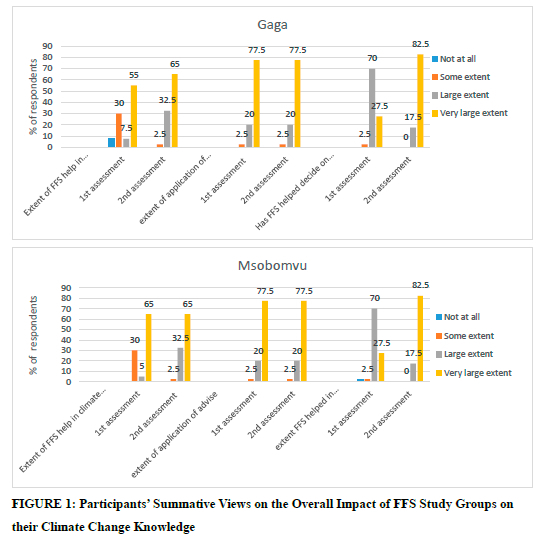
• To what extent has FFS helped you understand climate change ?
• To what extent have you used these activities?
• To what extent has FFS helped you decide on the best use of adaptation strategy in coping with climate change?
• Based on your previous answers, do you think FFS should be implemented by all smallholder livestock farmers?
Our participants' overall responses on the impact of FSS gathered from the first and second assessments suggest that they helped educate participants about climate change, whereby some of the participants subsequently applied the adaptation strategies discussed in study groups (Figure 1). Most participants affirmed that the study groups were helpful to a large extent (Figure 1).
5. DISCUSSION AND CONCLUSION
5.1. How Can We Use FFS to Complement the Current Extension Approach?
An efficient agricultural extension service is often expected to improve agricultural productivity as farmers utilise information and knowledge to optimise their limited resources (Kingiri, 2021). Conversely, an inefficient agricultural extension service may result in poor productivity among farmers. These observations underscore the importance of efficient and effective agricultural extension services, which South Africa seems to be lacking. While it is difficult to pinpoint one best extension approach, a combination of complementary agricultural extension approaches could be beneficial, especially in the South African context.
There are various impediments to the successful implementation of agricultural extension. On the one hand, there is a severe shortage of agricultural extension officers. For example, data show that the average extension officer in South Africa only interacts with 17 farmers annually, while in the Eastern Cape, an extension officer interacts with 46 farmers a year (Aliber, 2019; Lukhalo, 2017). On the other hand, there are budgetary constraints, according to the government. However, it appears that the Eastern Cape government has spent approximately R15 000 on extension per farmer per year, a much more expensive figure than the minimal support and contact time (Aliber, 2019). Compared to our FFS expenditure of R400 per farmer, this amount could support 37 more farmers than currently. This observation corroborates estimates from previous studies. For example, preliminary cost estimates from eastern and southern African countries by Anandajayasekeram et al. (2007) indicate that the FFS approach is relatively cheaper than T&V in terms of cost per farmer.
The FFS approach could also help establish farmer databases. Meaningful data and an updated working database for smallholders are a big challenge in South Africa (Zantsi, 2021). Apart from Statistics South Africa's General Household Survey, there is no detailed smallholder database yet. One key developmental programmes that the democratic government focuses on is smallholder agriculture. The FFS could also contribute to a skills audit and the monitoring and evaluation exercise of government programs, which have not been undertaken yet by the government's agricultural departments (Aliber et al., 2017; Ngarava et al., 2020).
While our pilot study shows some positive impact of FFS on the farmers' self-assessed knowledge, we recommend that the approach be upscaled and piloted in the context of other production systems, namely, field crop production, and other parts of the province, before being fully adopted. We aimed to stimulate a constructive discussion and share our initial work. Experimenting with the FFS approach is crucial because its potential seems great while its limitations must also be understood.
REFERENCES
2. LITERATURE REVIEW
- ALIBER, M., GWALA, L., YUSUF, F., RAHIM, A., MUSHUNJE, A., ARWARI, M., MAKHUNGA, Z. & SHILIGA, Z., 2017. Government and small-scale agriculture: Understanding the successes and failures in respect of learning, planning and implementation.
- ALIBER, M., 2019. Forms of agricultural support and the "culture of dependency and entitlement", Agrekon., 58(2): 141-153.
- ANANDAJAYASEKERAM, A., DAVIS, K.E. & WORKNEH, S., 2007. Farmer field schools: An alternative to existing extension systems? Experience from Eastern and Southern Africa. J. Int. Agric. Ext. Educ., 14(1): 81-93.
- APLENI, A., ALIBER, M., ZHOU, L. & ZANTSI, S., 2019. The impact of the Framer Field School approach on small-scale vegetable producers' knowledge and production in Alice, Eastern Cape, South Africa. S. Afr. J. Agric. Ext., 47(3): 70-82.
-
BIZIKOVA, L., NKONYA, E., MINAH, M., HANISCH, M., MOHANA, R., TURAGA, R., SPERANZA, C.I., KARTHIKEYAN, M., TANG, L., GHEZZI-KOPEL, K., KELLY, J., CELESTIN, A.C. & TIMMERS, B., 2020. A scoping review of the contributions of farmers' organizations to smallholder agriculture. Nat. Food., 1: 620-30. https://doi.org/10.1038/s43016-020-00164-x
» https://doi.org/10.1038/s43016-020-00164-x - BRAUN, A., JIGGINS, J., RÖLING, N., VAN DEN BERG, H. & SNIJDERS, P., 2006. A Global survey and review of farmer field school experiences. The Netherlands: International Livestock Research Institute (ILRI).
- CONRADIE, B., GALLOWAY, C. & RENNER, A., 2022. Private extension delivers productivity growth in pasture-based dairy farming in the Eastern Cape, 2012-2018. Agrekon., 61(2): 109-120.
- DAVIS, K., NKONYA, E., KATO, E., MEKONNEN, D.A., ODENDO, M., MIIRO, R. & NKUBA, J., 2012. Impact of farmer field schools on agricultural productivity and poverty in East Africa. World Dev., 40(2): 402-413.
- FRIIS-HANSEN, E. & DUVESKOG, D., 2012. The empowerment route to well-being: An analysis of farmer field schools in East Africa. World Dev., 40(2): 414-427.
- KARAAN, M. & VINK, N., 2014. Agriculture and rural development policies in the post-apartheid era. In: H. Bhorat, A. Hirsch, R. Kanbur & M. Ncube (eds.), The Oxford Companion to the Economics of South Africa. Oxford, UK: Oxford University Press, pp. 393-400.
- KOCH, B.H. & TERBLANCHE, S., 2013. An overview of agricultural extension in South Africa. South African. J. Agric. Ext., 41(1): 107-117.
- KINGIRI, A.N., 2021. Agricultural advisory and extension service approaches and inclusion in reaching out to Kenyan rural farmers. Afr. J. Sci. Technol. Innov. Dev., 13(7): 797-806.
- LYNE, M.C., JONAS, N. & ORTMANN, G.F., 2017. A quantitative assessment of an outsourced agricultural extension service in the Umzimkhulu District of KwaZulu-Natal, South Africa. J. Agric. Educ. Ext., 24(1): 51-64.
- LUKHALO, T., 2017. An expenditure review of agricultural extension system in South Africa. Masters dissertation, University of Pretoria.
- MWOLOLO, H., NZUMA, J. & RITHO, C., 2019. Do farmers' socio-economic characteristics influence their preference for agricultural extension methods? Dev. Pract., 29(7): 844-853.
-
NATIONAL PLANNING COMMISSION., 2012. The national development plan 2030: Our future - Make it work. Available from https://www.gov.za/sites/default/files/gcis_document/201409/ndp-2030-our-future-make-it-workr.pdf
» https://www.gov.za/sites/default/files/gcis_document/201409/ndp-2030-our-future-make-it-workr.pdf - NGARAVA, S., MUSHUNJE, A. & CHAMINUKA, P., 2020. Qualitative benefits of livestock development programmes. Evidence from the Kaonafatso ya Dikgomo (KyD) Scheme in South Africa. Eval. Program Plan., 78: 1-12.
-
ROGERS, P., 2012. Introduction to impact evaluation. Available from http://www.betterevaluation.org/en/node/1543
» http://www.betterevaluation.org/en/node/1543 -
STATISTICS SOUTH AFRICA (STATSSA)., 2012. Census 2011. Available from http://www.statssa.gov.za/?page_id=3839
» http://www.statssa.gov.za/?page_id=3839 - SIHLOBO, W., 2023. A country of two agricultures: The disparities, the challenges, the solutions. South Africa: Tracey McDonald, Bryanston.
- WADDINGTON, H. & WHITE, H., 2014. Farmer field schools: From agricultural extension to adult education. London: International Impact Initiative for Impact Evaluation report.
- VAN DEN BERG, H., PHILLIPS, S., DICKE, M. & FREDRIX, M., 2020A. Impacts of farmer field schools in the human, social, natural and financial domain: A qualitative review. Food Sec., 12: 1443-1459.
- VAN DEN BERG, H., KETELAAR, J.W., DICKE, M. & FREDRIX, M., 2020b. Is the farmer field school still relevant? Case studies from Malawi and Indonesia. NJAS Wageningen J. Life Sci., 92(1): 1-13.
- ZANTSI, S., 2021. Unlocking the potential of the emerging smallholder farming sector in South African agriculture: An agent-based approach. Doctoral dissertation, Stellenbosch University.