Institutional Arrangements and Support Systems for Independent Smallholder Irrigators in the Msinga Local Municipality, South Africa
Abstract
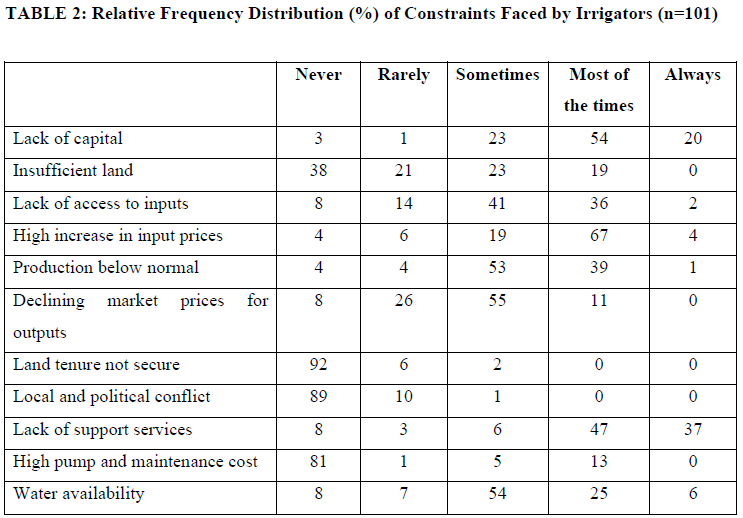
This article describes the present institutional arrangements for irrigators' resource access, agricultural support systems accessible to irrigators, and the various constraints irrigators experience. The survey acquired data from 101 snowballed respondents for the quantitative phase of the study. The qualitative phase gathered information from four purposively selected focus group discussions. According to the findings, irrigators commonly gained access to production land through traditional authority (81.2%). Gender was a barrier to land access, where male-headed families had larger land sizes than female-headed ones (t=4.993, p=0.028). Concerning irrigation water, irrigators abstract it wherever they find access, without any institutional arrangement or restriction. The main limitations to irrigators' water availability were competition and the drying out of the water source, particularly spring water. Government assistance was rare among independent irrigators. Smallholder support services tend to be distributed unevenly among South African smallholders, usually leaving independent irrigators unsupported. Lastly, irrigators experience constraints in their farming that government existing services have the potential to address. Therefore, this study proposes that the government recognize independent irrigators as possible drivers ofpoverty and food insecurities. The study recommends institutional inclusion and the extension of support systems to independent irrigators.
Independent irrigation; Agricultural extension; Irrigation development; Land access