Effects of Climate Change and Agricultural Productivity on Food Security in Africa: New Insights from Panel Data Analysis
Abstract
In recent times, economies in Africa have made intensive efforts to mitigate the worsening climatic conditions, boost agricultural output, and improve access to safe and nutritious food; however, this has not yielded much. This study investigates the effects of climate change and agricultural productivity on food security in Africa and the moderating role of institutional quality in these dynamic relationships. Using the System Generalised Method of Moments (SGMM) estimation technique andpanel data for 36 African economies covering a period of twenty years (2001-2020). The study found a significant positive relationship between climate change and food insecurity. Also, the study found that as agricultural productivity improves, food availability, access, and utilisation improve too, thereby improving food security in Africa. Furthermore, it also found a good causal relationship among the variables of interest. Interestingly, the study's findings indicate a mixed effect of institutional quality in moderating the effects of climate change and agricultural productivity on food security in Africa. This has been attributed to the prevalence of weak institutions in Africa and its inability to effectively exploit its infrastructure potentials to the fullest. The study recommends, among others, that African leaders and policymakers should develop and effectively implement sustainable climate change adaptation strategies aimed at mitigating the adverse effects of climate change on agriculture, food security, and poverty outcomes, while also strengthening their weak institutions.
Climate Change; Agricultural Productivity; Food Security; System GMM; Africa
1. INTRODUCTION
Food insecurity, low agricultural productivity, worsening climate change impacts on the environment, and weak institutions are among the critical issues facing most developing economies, particularly in Africa. In September 2015, world leaders, recognising how these problems affect contemporary economies, agreed to pursue a set of 17 goals to be achieved by 2030 (United Nations, 2015). These goals make up the Sustainable Development Goals (SDGs). The focus of SDGs 2, 13, and 16 is to achieve zero hunger, ensure concerted climate action, and build effective, accountable, and inclusive institutions, respectively (United Nations, 2015; World Bank, 2018; Abdi et al, 2024; Bedasa & Deksisa, 2024). In line with the SDGs, African economies have been making intensive efforts in recent times to mitigate worsening climatic conditions, boost agricultural output, and improve access to safe and nutritious food (Food and Agriculture Organisation [FAO], 2008; Apraku et al., 2021). However, little has been achieved, as the continent still hosts one of the world's most food-insecure populations (FAO, 2021).
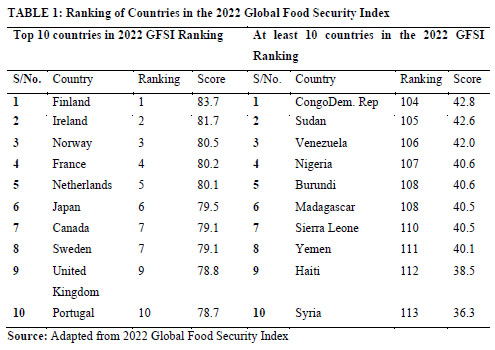
In the 2022 Global Food Security Index (GFSI) ranking, no African country ranked among the top 55 of 113 countries due to their poor Food Insecurity Multidimensional Index score. Seven of the ten least favourable food-secure economies are in Africa, and four of the ten most deteriorated food-insecure economies are in Africa (Global Food Security Index, 2022). Unfortunately, no African country was ranked among the top 10 most favourable food-secure economies in the world (Global Food Security Index, 2022), as shown in Table 1. According to the 2023 Global Hunger Index (GHI), 10 African economies ranked among the 13 most hunger-ravaged economies, and no African country ranked among the top 25 economies for low levels of hunger.
The problems of climate variability, poor agricultural output, lack of access to food, and weak institutions are dynamically interrelated, as each can be both the cause and the consequence of the others. Mbow et al. (2019) documented a framework illustrating the dynamic relationships among climate change, poor agricultural productivity, and food insecurity. This is because climate change, agricultural yields, food security, institutional quality, and poverty are all linked in a vicious circle (Mbow et al., 2019). The effects of climate change on agricultural output might disproportionately affect vulnerable populations, particularly those living in Africa. For example, climate change is considered a major cause of poor agricultural productivity and food insecurity (Mbow et al., 2019). On the other hand, food insecurity and low agricultural productivity can contribute to and worsen climate change. Climate change has the potential to have a considerable impact on yields from rising temperatures, altered precipitation patterns, spikes in the occurrence of severe weather (such as excess or insufficient rainfall), and shifts in growing seasons, and these can, in turn, alter food and agro systems. These climate-related changes can diminish crop performance, impact livestock output, and raise pest and disease burdens, resulting in lower agricultural productivity (Masson-Delmotte et al, 2021; FAO et al, 2021).
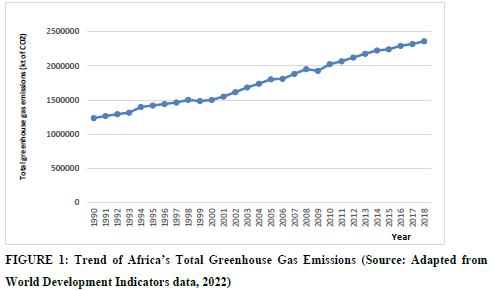
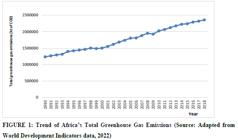
Climate change outcomes, such as temperature, across Africa have continued to rise by about 0.5 degrees Celsius over the last century, with the most affected being North Africa, followed closely by West and Southern Africa (Intergovernmental Panel on Climate Change (IPCC), 2007). This rising temperature across the continent has been shown to affect agricultural output and, by extension, food security (FAO et al., 2021). Figure 1 shows a rising trend in total greenhouse gas (GHG) emissions in Africa (Kiloton of CO2 equivalent).
While global projections have predicted an average rise in global temperature, Africa's temperature rise has been projected to exceed global estimates under the Representative Concentration Pathway (RCP) 4.5 scenario by 2069 and under the RCP8.5 scenario by 2047 (IPCC, 2007; Terence et al., 2021).
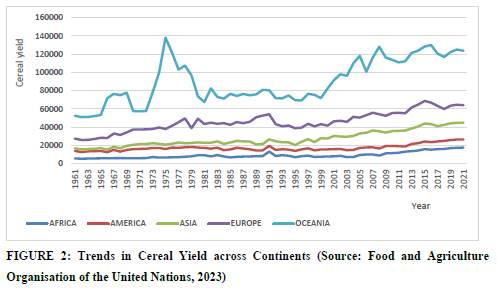
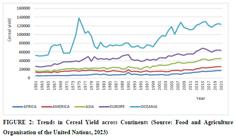
Agriculture remains a pivotal sector for economies in Sub-Saharan Africa, as it provides food, employment, foreign earnings, and income. The sector has the ability to end hunger, reduce poverty, and promote economic activity within and outside the continent. Studies have further shown that it can serve as a vehicle for economic diversification, industrialisation, the accumulation of foreign reserves, and the maintenance of a sustainable environment. Around two-thirds of Africa's population lives in rural areas and is heavily reliant on agriculture for a living (World Bank, 2017; Belikova et al., 2023). As a result, improving agricultural performance is critical in the fight against hunger and poverty. The level of cereal yield, a staple food in Africa, as shown in Figure 2, indicates that the continent is lagging, given its fast-growing population rate of approximately 2.5% over the last decade (World Development Indicators (WDI), 2023). In light of this, the continent has much to do to bridge the gap in meeting the food needs of its teeming population. As a result of the wide gap between the level of food production and population growth in Africa, the level of food-insecure people is highest in Africa compared to other regions of the world (FAO et al, 2021)
In 2023, the GHI forecast that 47 more countries could fall into severe hunger by 2030, with a sizeable number in Africa. The forecast was based on the exacerbating effects of climate change (Mbow et al., 2019; Masson-Delmotte et al., 2021; FAO et al., 2021), conflicts such as the Ukraine- Russia War and Sudan Crisis (Adelaja, 2019; Save the Children, 2020; ACLED 2021; FAO et al., 2021; Kadir et al., 2018), Covid-19 (Osendarp et al., 2021), among others. As a result of rising food insecurity in Africa, various food insecurity and nutritional outcomes seem to be worsening in the region in recent times. There has been a rise in the level of undernourishment and acute food insecurity in Africa in the last decade. Specifically, Africa's undernourishment rate rose sharply from 19.6 per cent in 2014-2016 to 21.8 per cent in 2018-2020 (FAO, 2021). Global Hunger Index 2021 further showed a rising incidence of the level of stunting in children under the age of five, wasting, and under-5 mortality rates. Africa presently has the highest rate of undernourished children and child mortality in comparison to other regions. (GHI, 2023).
The issue of institutional quality in Africa is a critical constraint on economic development, rooted in political-economy dynamics that shape state capacity and policy effectiveness. Weak institutions, typified by widespread corruption, a lack of bureaucratic expertise, and insufficient enforcement of property rights, distort market incentives and jeopardise the effective allocation of resources. For example, corruption is a systemic economic inefficiency that diverts public funds from beneficial investments in infrastructure, health care, and education to rent-seeking activities, rather than just being a moral failing (Kaufmann, 2010; Transparency International, 2020). These distortions limit the possibility of inclusive growth while sustaining poverty and inequality. Moreover, the lack of institutional responsibility often facilitates elite capture, erodes investor confidence, and creates an environment prone to political instability and social unrest. Thus, institutional weaknesses in many African economies should be viewed not simply as technical governance deficits, but as core structural impediments to long-term development and transformation.
Against this background, this study outlined three specific objectives, namely: (i) to examine the effect of climate change on food security in Africa; (ii) to determine the effect of agricultural productivity on food security in Africa; and (iii) to ascertain how institutional quality moderates the effects of climate change and agricultural productivity on food security in Africa. To achieve these objectives, the study used data from 2001 to 2020 for 36 African countries. The number of countries and the time period were determined by data availability. The system generalised method of moments (system GMM) estimator was adopted to address endogeneity, a problem often associated with the ordinary least squares (OLS) estimator. The remainder of this paper is organised as follows: Section 2 offers a comprehensive review of the extant literature, while Section 3 presents the methodology and data used. The research findings are presented and discussed in Section 4, and the study is concluded in Section 5 with relevant policy recommendations.
2. AN OVERVIEW OF LITERATURE
2.1. Climate Change, Agricultural Productivity, and Food Security in Africa
From the Rio Declaration of 1992 to the Paris Agreement of 2015, and more recently the IPCC Chapters and Agreements, the connection between global warming and food security has been a major concern for policymakers (IPCC, 2014, 2018). These concerns stem from research findings showing significant connections not only between climate change and food security but also between climate change and other socio-economic factors, such as poverty, workers' productivity, migration, and trade. Concerns about climate change and food security have led countries to strongly integrate food systems into their strategies for mitigating and adapting to climate change (IPCC, 2014; Richards et al., 2018; Rosenzweig et al., 2014, 2018). Having a deeper understanding of climate change and crop yield dynamics will help policymakers design better production plans, promote agricultural endeavours, and adapt to climate change (Mohammadi et al., 2023; Okeke & Amaechi, 2021).
Aragón et al. (2021), using household-level data from Peru, find that elevated temperatures reduce agricultural productivity. In response, farmers tend to expand cultivated areas and adjust their crop selection. These behavioural adjustments suggest that input reallocation serves as a short-term strategy to mitigate the adverse effects of extreme heat on agricultural output.
Yuegang et al. (2022), using the MetaFrontier-Malmquist model (MinDS) and data covering 18 years (2001-2019), examined the effects of severe weather conditions on green total factor agricultural productivity in China. Findings from the study indicate that when spatial and dynamic sustainability are present, extreme climate variability has a major impact on agricultural productivity through output, input, and structural effects.
Adhikari et al. (2015) extensively examined the effects of climate variation on various cash and staple crops (rice, wheat, maize, cassava, soybean, potato, millet, sorghum, cotton, tea, sugarcane, and banana) across eight Sub-Saharan African countries. The study found that output is significantly and negatively affected by warming temperatures across all crops; however, the severity of the impact on yield varies by crop. Wheat is considered the most susceptible, while millet and sorghum are considered the most resilient to climate change. The findings are consistent with the findings of other studies, such as Yuegang et al. (2022), Masson-Delmotte et al. (2021).
Mbow et al. (2019). Furthermore, the study projects declines of up to 72% for wheat, 45% for maize, rice, and soybean, 40% for tea and coffee, and less than 20% for millet and sorghum. The study further identified the susceptibility of cotton and sugarcane to precipitation variability.
2.2. Institutional Quality, Agricultural Productivity and Food Security in Africa
Sustainable Development Goals can be achieved with high-quality institutions. The role of institutional quality in climate change mitigation and in improving agricultural productivity, food security, and poverty outcomes remains a subject of great debate (Uddin et al., 2023). Robinson and Acemoglu (2013) highlight the moderating role of institutional quality across various spheres, referring to how the effectiveness or impact of a given factor is influenced by the quality of institutions within a given society. Institutions encompass the formal and informal rules, regulations, norms, and organisations that shape how a society functions. High institutional quality implies strong governance, well-defined property rights, efficient legal systems, low corruption, and effective public administration (Kaufmann, 2010). In a moderating role, institutional quality can enhance or diminish the effects of other variables. For example, in the context of economic growth, strong institutional quality can amplify the positive impact of factors such as foreign investment or technological advancements, whereas weak institutions can undermine these effects. In essence, institutional quality acts as a channel through which various socio-economic factors are filtered, either magnifying their positive impact or mitigating their negative consequences (Robinson & Acemoglu, 2013).
Soko et al. (2023) investigated the effect of government agricultural expenditures on nutritional well-being in Sub-Saharan Africa and Asia, examining whether institutional quality plays a role. The study used data from 25 countries (low-income and lower middle-income countries) in Sub-Saharan Africa and Asia from 1996 to 2017. The study found evidence that the impact of public agricultural spending on food security is strongly influenced by institutional quality. Overall, economies with higher-quality institutions experience a larger shift in cereal production in response to public agricultural spending than those with lower-quality institutions. While government support for agriculture increases food security, its effectiveness depends on the state's institutional capacity. High-quality state institutions safeguard the private sector's tangible and intellectual property while promoting the efficient use of public funds.
Overall, our review of the literature indicates a dearth of empirical evidence on the effects of climate change and agricultural productivity on food security in the African region, as well as on the moderating role of institutional quality in these relationships. This study addressed this gap in the literature. The study contributes to the limited available literature that evaluates the moderating role of institutional quality in the relationship between climate change, agricultural productivity, and food security in Africa. Previous studies used the food production index as a measure of food security, while a few others used the production levels of selected staple crops, such as cereals (Affoh et al., 2022; Pickson & Boateng, 2022). Although food production is a necessary condition for food security, it is insufficient because accessing and utilising available food are equally essential dimensions of food security. To address this shortcoming, we used the prevalence of undernourishment as a measure of food security in our baseline simulations, while the food production index is used for a robustness check. Prevalence of undernourishment was adopted because it strictly accounts for the proportion of the population that is food insecure and also captures all the essential dimensions of food security: availability of food, access to available food, utilisation of available food, and stability.
3. DATA AND METHODOLOGY
3.1. The Data
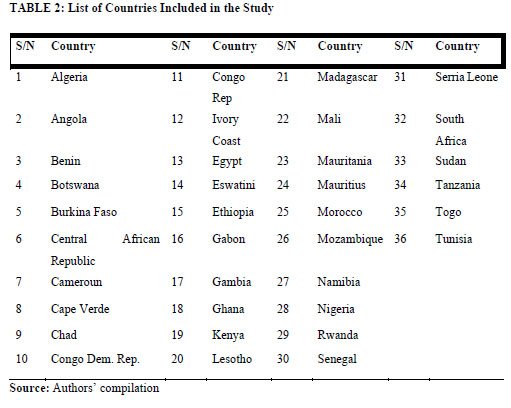
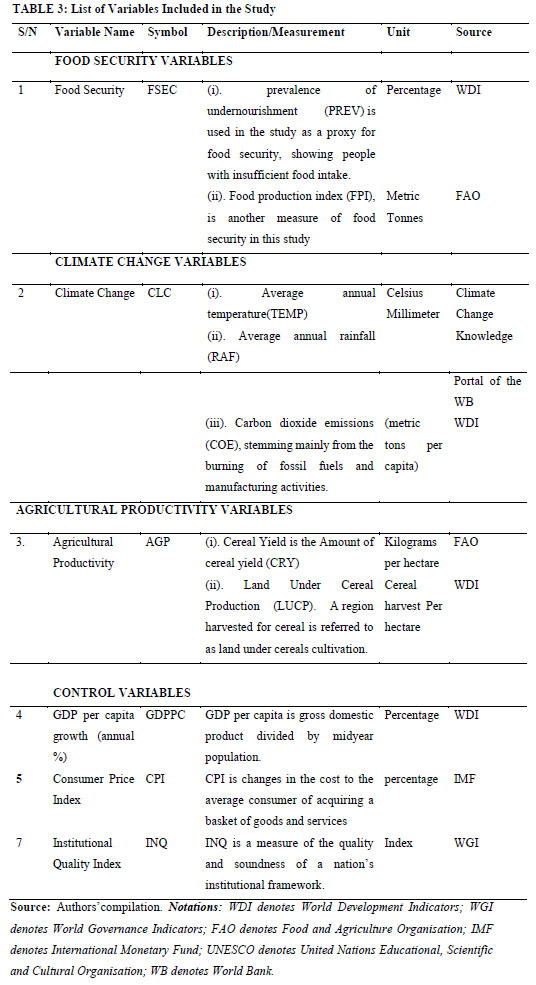
The thrust of this study is to understand the effects of climate change and agricultural productivity on food security in Africa, and the moderating role of institutional quality in this relationship, using a sample of 36 African economies over the period 2001-2020. Table 2 lists the countries in the sample, while Table 3 lists the variables of interest.
The dependent variable for this study is food security, which is measured using the prevalence of undernourishment and the food production index. Prevalence of undernourishment (which captures severe food insecurity in the total population) is used as the main proxy for food security because other proxies fall short of effectively capturing it. For example, food production index as a proxy for food security can only capture the availability dimension of food security. It must be emphasized that while availability is a necessary condition, it does not translate to access or utilization which are also key dimensions of food security. It is safe to say that food production is a necessary but insufficient condition for food security. However, the prevalence of severe food insecurity in the total population accounts for the number of people who are food insecure and captures all aspects of food security.
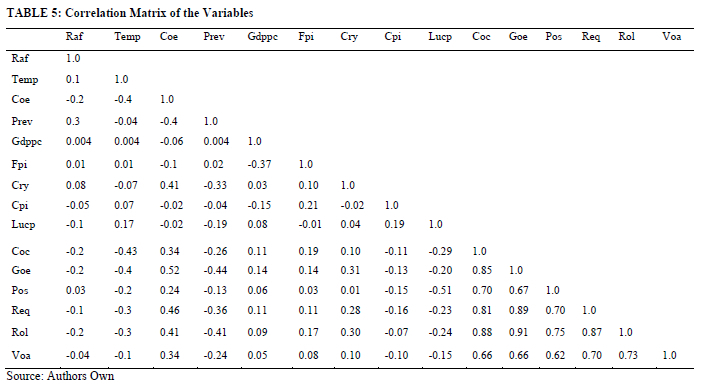
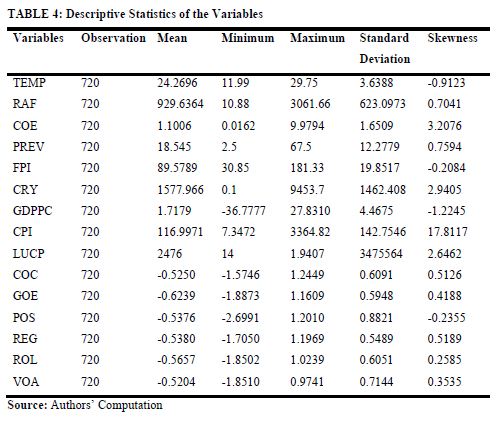
A core independent variable in this study is climate change, measured using average annual temperature, average annual rainfall, and CO2 emissions, following Dube and Nhamo (2020).Another core variable in this study is agricultural productivity, measured by cereal yield per hectare and land under cereal production. Cereal yield is considered a better measure of agricultural productivity in Africa because it accounts for the per-hectare yield of selected cereals. Following Affoh et al. (2022) and Adesete et al. (2022), the study used income (measured by GDP per capita), food prices (measured by the consumer price index), and institutional quality as control variables to achieve robust estimates. We measured institutional quality using the six conventional indicators, namely: control of corruption (COC), government effectiveness (GOE), political stability (POS), regulatory quality (REQ), rule of law (ROL), and voice and accountability (VOA) (World Governance Indicators (WGI, 2021). Table 4 presents the descriptive statistics of the variables, and Table 5 presents the correlation matrix. The standard deviation indicates that all the variables witnessed some variations as expected. The mean, maximum, and minimum values do not differ much from each other, indicating the absence of outliers in the data. The table further shows negative mean values for all the institutional quality variables, corroborating the long-standing assertion that African economies possess weak institutions. There is no collinearity problem since the institutional quality variables were included in separate regressions. This is further supported by our models' variance inflation factor (VIF) results. With the exception of the consumer price index, food production index, and institutional quality indicators, all other variables were logged prior to estimation.
3.2. Model Specification
This study estimated the effects of climate change and agricultural productivity on food security in Africa, as well as the moderating role of institutional quality in these relationships. Following Adesete et al. (2022), we specify the dynamic panel data model showing the effect of climate change on food security as follows:

We also followed Adesete et al. (2022) by specifying the dynamic panel data model showing the effect of agricultural productivity on food security as follows:

where:ϕ are parameters to be estimated;FSECi,t is a measure of food security for country i at time t; FSECi,t-1is the first lag of FSECi,t;CLC * INQ and AGP * INQ are interaction terms; Z represents other control variables; πi is the country-specific effect; ξt is the time-specific effect; and εi,t is the error term.
The study estimated the above models using the system Generalised Method of Moments (System GMM) estimator, which accounts for endogeneity, heteroscedasticity and autocorrelation within individual cross-sections.The estimates were tested for serial correlation using the Arellano-Bond second-order (AR2) test. They were also subjected to an over-identifying restriction test using the Hansen test. These validation tests are consistent with Arellano and Bond (1991) and Hansen (1982). Furthermore, the study accounted for identification, simultaneity, and exclusion restrictions within the framework of the system Generalised Method of Moments. Following Asongu and Odhiambo (2020), we treated all explanatory variables as endogenous in the underlying model, while only the time-invariant indicators were treated as strictly exogenous. We also evaluated the statistical validity of the exclusion restrictions using the Difference-in-Hansen Test (DHT), which tests for instrument exogeneity. Here, the exclusion restriction hypothesis is valid if the null hypothesis of the DHT is not rejected. The results of this study demonstrate that our exclusion restrictions are valid.
4. EMPIRICAL RESULTS
Recall that this study investigated the effects of climate change and agricultural productivity on food security in Africa, as well as the moderating role of institutional quality using the System Generalised Method of Moments (System GMM) estimator. To prevent inaccurate and/or inefficient estimates, we began the empirical work by conducting the Bonds (2002) test and cross-sectional dependence tests following Pesaran (2004), Friedman (1937), and Frees (1995). The results of the Bond (2002) test indicate that the system GMM estimator is preferred to the difference GMM estimator, and the cross-sectional dependence tests indicate that our panel is cross-sectionally independent. To conserve space, we do not report the results of these preliminary tests here; they are available upon request.
4.1. Modelling the Effect of Climate Change on Food Security in Africa
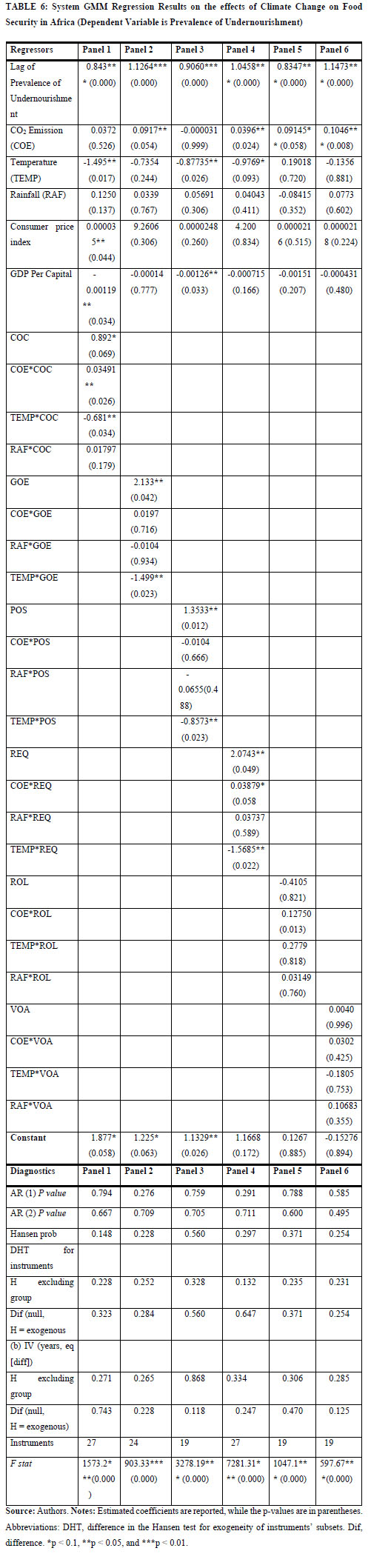
The first key objective of our study is to examine the effects of climate change on food security in Africa and how governance institutions in the region moderate these effects. To achieve this objective, we estimated the underlying model in Equation (1) and the results are presented in Table 6. This table has six Panels, since each measure of the governance institution is used in a separate regression to avoid collinearity. The results in Table 6 used the prevalence of undernourishment as the measure of food security. We summarise the findings in Table 6 as follows. First, the previous level of food security (i.e., the lag of the dependent variable) has a positive and significant effect on the current level in all models. This implies that the previous level of food security significantly influences the current level in Africa. This finding is consistent with those of Ugwa et al. (2024), Adesete et al. (2022), Mbow et al. (2019), and FAOSTAT (2018), which established that the initial level of food security is a major driver of the current level of food security.
The results also indicate that, in the absence of institutional quality, the effect of carbon dioxide emissions on food security is predominantly positive and statistically significant at the 5% level. This finding is consistent with Adesete et al. (2022), which found that increasing greenhouse gas emissions increase the prevalence of undernourishment, leading to a decline in food security in Sub-Saharan Africa. Thus, our results provide evidence that, when climate change is measured in terms of carbon dioxide emissions, it worsens the prevalence of undernourishment or food insecurity in Africa. However, while the effect of rainfall remained muted at the 5% level, an inverse relationship between temperature and undernourishment in Africa was observed, consistent with Subedi et al. (2023) and Oyelami et al. (2023), who found a negative relationship between food security and temperature.
Furthermore, the results in Table 6 show that food prices (measured using the consumer price index) have a positive effect on undernourishment in Africa, and this effect is significant in Panel 1. This means that, all else equal, rising food prices worsen food security in Africa. This finding is consistent with economic expectations and the findings of some previous studies (Akter & Basher, 2014; Amolegbe et al., 2021; Adesete et al., 2022). Economically, when food prices rise, consumers are unable to meet their nutritional requirements, which in turn leads to undernourishment. Interestingly, our results also indicate that income (measured by GDP per capita) negatively affects undernourishment, and this effect is significant in Panels 1 and 3. This means that, all else equal, rising income significantly reduces undernourishment and thus improves food security in Africa. This finding is in tandem with economic expectations and some previous studies (Adesete et al., 2022; Affoh et al., 2022).
Our results become more interesting when we consider the role of governance institutions. We find that the unconditional effects of governance indicators are mainly positive and significant. This means that governance institutions in Africa increase the prevalence of undernourishment, worsening food security in the region. Furthermore, the interaction between the governance indicators and the CO2 variable yielded mainly positive coefficients, which are statistically significant in Panels 1 and 4. This shows that, rather than moderating the worsening effect of CO2 emissions on food security in Africa, governance institutions in the region intensify this effect. In other words, governance institutions in Africa have not been effective in moderating the effects of climate change. This finding is consistent with the fact that weak governance institutions plague Africa. It is also consistent with the descriptive statistics in Table 4, which indicate that governance indicators generally reported negative mean values. However, while the interaction term remained largely muted when rainfall was used as the climatic variable, it showed a predominantly negative and significant effect for temperature, indicating that the interaction of governance variables with temperature significantly reduces undernourishment in Africa. This finding reflects the prevalence of favourable temperature conditions across most of Africa.
At this point, we summarise the results from Table 6 as follows. We find that: (i) climate change worsens the prevalence of food insecurity in Africa when it is measured in terms of carbon dioxide emission; (ii) instead of mitigating the undesirable effect of carbon dioxide emission on food security in Africa, governance institutions in the region intensifies this effect; and (iii) rising food prices worsens food security in Africa, while rising income significantly improves food security in the region. As shown in Appendix 1, we subjected these findings to a robustness check by using the food production index as a measure of food security rather than the prevalence of undernourishment, and the results remained consistent.
4.2. Modelling the Effect of Agricultural Productivity on Food Security in Africa
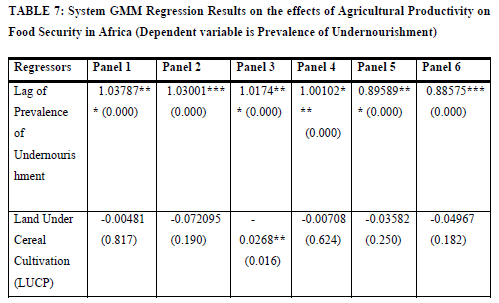
Another key objective of the study is to investigate the effect of agricultural productivity on food security in Africa and how regional governance institutions moderate this effect. To achieve this objective, we estimated the underlying model in Equation (2) using the system GMM estimator and the results are presented in Table 7. Following our established pattern, Table 7 has six Panels because the governance institution variables are estimated separately to avoid collinearity.
We find that, regardless of whether agricultural productivity is measured by cereal yield or by land under cereal cultivation, its unconditional effect on food security remains muted at the 5% level. This means that agricultural productivity in the region is not contributing significantly to achieving food security in Africa. This finding aptly captures the reality of many African countries, whose declining agricultural productivity and rising food imports have become recurring issues in recent times. For instance, Ugwu et al. (2022) explained that agricultural productivity in Nigeria, Africa's most populous country, had declined over the last two decades, with food import expenditure reaching $22 billion in 2018. Like many other countries in Africa, Nigeria has been a food-deficient nation and a net importer of food, and its food imports are growing at an unsustainable 11% per annum. Indeed, Rakotoarisoa et al. (2012) documented that, despite its agricultural potential, Africa is a net importer of food and agricultural products due to poor infrastructure, low and stagnating agricultural productivity, weak institutions, population growth, and policy distortions. However, the challenge of poor agricultural productivity in the region in recent years can also be attributed to the increasing wave of insecurity that has enveloped most African countries (Emeka et al., 2024).
The results in Table 7 also indicate that food prices (measured by the consumer price index) have a positive effect on undernourishment, and this effect is significant in Panels 4 and 5 at the 10% level. This means that rising food prices worsen food security in Africa. We also find that rising income (measured by GDP per capita) significantly reduces undernourishment, thereby enhancing food security in the region. Indeed, these findings are consistent with our established findings from Table 6.
We find that the unconditional effect of governance institutions is mainly positive but significant only in Panels 1 and 2, which control for corruption and government effectiveness. This means that governance institutions in the region increase the prevalence of undernourishment, worsening food security in Africa. This is consistent with studies that have highlighted the problem of weak governance institutions in Africa, such as Ouoba and Sawado (2019) and Soko et al. (2023). However, the interaction between governance indicators and agricultural productivity variables shows a clear pattern only when agricultural productivity is measured by cereal yield. We find that the interaction yields predominantly statistically insignificant coefficients at the 5% level. This means that governance institutions in the region failed to significantly moderate the effect of agricultural productivity on food security in Africa. This finding reiterates the existence of weak governance institutions in the region.
We summarise the results from Table 7 as follows. We find that: (i) agricultural productivity in the region is not contributing significantly towards the attainment of food security in Africa; (ii) governance institutions in Africa worsens its food security situation and does not significantly moderate the effect of agricultural productivity on food security; and (iii) rising food prices worsens food security in Africa, while rising income significantly improves food security in the region. As shown in Appendix 2, we also subjected these findings to a robustness check by using the food production index as a measure of food security rather than the prevalence of undernourishment, and the results remained consistent.
The Arellano-Bond tests for second-order serial correlation AR(2) indicate that all the models in Tables 6 and 7 are free from the problem of serial correlation. The Hansen (1982) tests of over-identifying restrictions show that the hypothesis of jointly valid instruments cannot be rejected in all cases, implying that the set of instruments employed in the estimations satisfied the exogeneity condition required for obtaining valid regression estimates. Hence, there are valid over-identifying restrictions in all cases, and our models are robust enough to inform policy. Furthermore, the results of the Difference in Hansen Tests (DHT) indicate that the prevalence of valid exclusion restrictions is high across all the models.
5. CONCLUSION AND SOME POLICY RECOMMENDATIONS
Following the exacerbating effect of climate change as well as the challenges of declining agricultural productivity, rising food insecurity and weak governance institutions in Africa, particularly in the last two decades, and the dearth of empirical evidence to support policies aimed at addressing these challenges, this study focused on the following three specific objectives: (i) to examine the effect of climate change on food security in Africa; (ii) to determine the effect of agricultural productivity on food security in Africa; and (iii) to ascertain how institutional quality is moderating the effects of climate change and agricultural productivity on food security in Africa. The study used data from 2001 to 2020 for 36 African countries and adopted the GMM system estimation framework. The findings indicate that climate change worsens food insecurity in Africa when measured in terms of carbon dioxide emissions, while agricultural productivity in the region does not contribute significantly to the attainment of food security. We also find that, rather than mitigating the undesirable effects of carbon dioxide emissions on food security in Africa, governance institutions in the region intensify these effects. In addition, governance institutions in Africa not only worsen the food security situation in the region but also fail to significantly moderate or enhance the effect of agricultural productivity on food security. Furthermore, our results indicate that rising food prices worsen food security in Africa, whereas rising income significantly improves it.
The foregoing findings have some policy implications. First, the adverse effects of climate change on food security require that policymakers and African leaders embrace and effectively implement climate change adaptation strategies, such as promoting drought-resistant crops and sustainable land management practices. The failure of governance institutions to mitigate the adverse effects of climate change or to significantly enhance agricultural productivity requires policymakers and African leaders to embrace and implement institutional reforms. Such reforms should prioritise establishing and strengthening governance structures and policy frameworks that promote sustainable agriculture, climate resilience, and food security. Additionally, African governments should enhance coordination among relevant ministries, agencies, and stakeholders to ensure coherence and effectiveness in policy implementation. Strengthening governance institutions responsible for regulating land use, water management, and environmental conservation is also crucial for promoting sustainable agricultural practices and mitigating the adverse impacts of climate change on food security.
It is expected that these policy recommendations will help reduce the adverse effects of climate change, increase agricultural productivity, address the challenge of rising food imports, and, in turn, reduce rising food prices. However, much work remains to gain a more thorough grasp of these linkages in Africa. For instance, by concentrating on the various sub-regions within Africa, future studies can investigate whether there are sub-regional variations in these linkages. Comparing these relationships and contrasting the dynamics in Africa with those in other regions, such as Asia, Europe, and the Americas, can also yield significant policy insights. Additionally, country-specific studies can be used to explore these relationships and help policymakers understand how conditions in each country vary from, or fit within, the general patterns observed across Africa as a whole.
REFERENCES
- ADELAJA, A. & GEORGE, J., 2019. Effects of conflict on agriculture: Evidence from the Boko Haram Insurgency. World Dev., 117: 184-195.
- ADESETE, A.A., OLANUBI, O. E. & DAUDA, R.O., 2023. Climate change and food security in selected Sub-Saharan African countries. Environ Dev Sustain., 25: 1-19.
- ADHIKARI, U., NEJADHASHEMI, A. & WOZNICKI, S., 2015. Climate change and Eastern Africa: A review of impact on major crops. Food Energy Secur., 4: 110-132.
- AFFOH, R., ZHENG, H., DANGUI, K. & DISSANI, B.M., 2022. The impact of climate variability and change on food security in Sub-Saharan Africa: Perspective from panel data analysis. Sustain., 14(2): 759.
- APRAKU, A., MORTON, J.F. & GYAMPOH, B.A. 2021. Climate change and small-scale agriculture in Africa: Does indigenous knowledge matter? Insights from Kenya and South Africa. Sci. Afr., 12: E00821
- ARAGÓN, F.M., OTEIZA, F. & RUD, J.P., 2021. Climate change and agriculture: Subsistence farmers' response to extreme heat. Am. Econ. J.: Econ. Policy., 13(1): 1-35.
- ARELLANO, M. & BOND, S. 1991. Some tests of specification for panel data: Monte Carlo evidence and an application to the employment equation. Rev. Econ. Stud., 58(2): 277-297.
-
ARMED CONFLICT LOCATION AND EVENT DATA PROJECT (ACLED)., 2021. ACLED 2020: The year in review. Available from Acleddata.Com/Acleddatanew/Wp-Content/Uploads/2021/03/Acledannualreport2020_ Webmar2021_Pubupd.Pdf.
» Acleddata.Com/Acleddatanew/Wp-Content/Uploads/2021/03/Acledannualreport2020_ Webmar2021_Pubupd.Pdf - ASHRAF, J. & JAVED, A., 2023. Food security and environmental degradation: Do institutional quality and human capital make a difference?. J. Environ. Manage., 331: 117330.
- ASONGU, S.A., LE ROUX, S. & BIEKPE, N., 2017. Environmental degradation, ICT and inclusive development in Sub-Saharan Africa. Energ Policy., 111: 353-361.
- BELIKOVA, S., IVANOVA, O. & SUKHININ, S., 2023. Sectoral features and problems of agricultural development in African Countries. In A. Beskopylny, M. Shamtsyan & V. Artiukh (eds.), XVInternational Scientific Conference "INTERAGROMASH 2022" Global Precision AgInnovation 2022, Volume 1. Cham: Springer International Publishing, pp. 489-499.
- CAULFIELD, M.E., HAMMOND, J., FONTE, S.J., FLORIDO, M.A., FUENTES, W., MEZA, K. & VAN WIJK, M., 2021. Unpicking the inter-relationships between off-farm livelihood diversification, household characteristics, and farm management in the rural Andes. Frontiers In Sustainable Food Systems., 5: 724492.
- CHUWAH, C., VAN NOIJE, T., VAN VUUREN, D.P., STEHFEST, E. & HAZELEGER, W., 2015. Global impacts of surface ozone changes on crop yields and land use. Atmos. Environ., 106: 11-23.
- DJOUMESSI, Y.F., 2021. What innovations impact agricultural productivity in Sub-Saharan Africa?. J. Agric. Food Res., 6: 100228.
- DUBE, K. & NHAMO, G., 2020. Evidence and impact of climate change on South African National Parks. Potential implications for tourism in the Kruger National Park. Environ. Dev., 33: 100485.
- EMBERSON, L.D., PLEIJEL, H., AINSWORTH, E.A., VAN DEN BERG, M., REN, W., OSBORNE, S., MILLS, G., PANDEY, D., DENTENER, F., BUKER, P., EWERT, F., KOEBLE, R. & VAN DINGENEN, R., 2018. Ozone effects on crops and consideration in crop models. Eur. J. Agron., 100: 19-34.
- EMEKA, E.T., OGBUABOR, J.E. & EKEOCHA, D.O., 2024. Terrorism and economic complexity in Africa: The unconditional impact of military expenditure. Afr. Dev. Rev., 36(1): 139-152.
- FAO, IFAD, UNICEF, WFP and WHO., 2021. The state of food security and nutrition in the world 2021: Transforming Food systems for food security, improved nutrition and affordable healthy diets for all. Rome: FAO.
-
FAO., 2008. Declaration of the world summit on food security. World Summit On Food Security. Available from ftp://Ftp.Fao.Org/Docrep/Fao/Meeting/018/K6050e.Pdf
» ftp://Ftp.Fao.Org/Docrep/Fao/Meeting/018/K6050e.Pdf - FAO., 2018. The Future of Food and Agriculture: Alternative Pathways to 2050. Rome: Food and Agriculture Organisation of the United Nations.
-
FAOSTAT., 2018. Food and Agriculture Organisation Corporate Statistical Database. Available from Www.Fao.Org/Faostat/En/#Home.
» Www.Fao.Org/Faostat/En/#Home - FREES, E.W., 1995. Assessing cross-sectional correlation in panel data. J. Econom., 69(2): 393-414.
- FRIEDMAN, M., 1937. The use of ranks to avoid the assumption of normality implicit in the analysis of variance. J. Am. Stat. Assoc., 32(200): 675-701.
- GELGO, B., GEMECHU, A. & BEDEMO, A., 2023. The effect of institutional quality on agricultural value added in East Africa. Heliyon., 9(10).
-
GLOBAL FOOD SECURITY INDEX., 2020. Economist impact. Available from Https://Impact.Economist.Com/Sustainability/Project/Food-Security-Index/About
» Https://Impact.Economist.Com/Sustainability/Project/Food-Security-Index/About -
GLOBAL HUNGER INDEX., 2023. Available from Https://Www.Globalhungerindex.Org/Download/All.Html
» Https://Www.Globalhungerindex.Org/Download/All.Html - HANSEN, L.P., 1982. Large sample properties of generalized method of moments estimators. Econometrica, 50(4): 1029-1054.
- INTERGOVERNMENTAL PANEL ON CLIMATE CHANGE (IPCC)., 2007: Climate Change 2007. Climate Change Impacts, Adaptation And Vulnerability, Working Group II, Summary For Policymakers. Geneva: Intergovernmental Panel On Climate Change.
- INTERGOVERNMENTAL PANEL ON CLIMATE CHANGE (IPCC)., 2014. Climate Change 2014 - Impacts, Adaptation and Vulnerability: Part A: Global and Sectoral Aspects: Working Group II Contribution to the IPCC Fifth Assessment Report. Cambridge University Press.
- INTERGOVERNMENTAL PANEL ON CLIMATE CHANGE (IPCC)., 2014. Climate Change 2014: Mitigation Of Climate Change: Working Group III Contribution To The IPCC Fifth Assessment Report. Cambridge, UK: Cambridge University Press.
- KADIR, A., SHENODA, S., GOLDHAGEN, J., PITTERMAN, S., SUCHDEV, P.S., CHAN, K. J.,... & ARNOLD, L.D., 2018. The effects of armed conflict on children. Pediatrics., 142(6).
- KAUFMANN, D., KRAAY, A. & MASTRUZZI, M., 2010. The worldwide governance indicators: methodology and analytical issues. World Bank Policy Research Working Paper, (5430).
- MBOW, C., ROSENZWEIG, C., BARIONI, L.G., BENTON, T.G., HERRERO, M., KRISHNAPILLAI, M., LIWENGA, E., PRADHAN, P., RIVERA-FERRE, M.G., SAPKOTA, T., TUBIELLO, F.N. & XU, Y., 2019. Food Security. In P.R. Shukla, J. Skea, E. Calvo Buendia, V. Masson-Delmotte, H.O. Pörtner, D.C. Roberts, P. Zhai, R. Slade, S. Connors, R. van Diemen, M. Ferrat, E. Haughey, S. Luz, S. Neogi, M. Pathak, J. Petzold, J. Portugal Pereira, P. Vyas, E. Huntley, K. Kissick, M. Belkacemi & J. Malley (eds.), Climate Change and Land: An IPCC special report on climate change, desertification, land degradation, sustainable land management, food security, and greenhouse gas fluxes in terrestrial ecosystems. Cambridge University Press.
- MOHAMMADI, S., RYDGREN, K., BAKKESTUEN, V. & GILLESPIE, M.A., 2023. Impacts of recent climate change on crop yield can depend on local conditions in climatically diverse regions of Norway. Sci. Rep., 13(1): 3633.
- NABUUMA, D., REIMERS, C., HOANG, K.T., STOMPH, T., SWAANS, K. & RANERI, J.E., 2022. Impact of seed system interventions on food and nutrition security in low-and middle-income countries: A scoping review. Glob. FoodSecur., 33: 100638.
- OGUNNIYI, A.I., MAVROTAS, G., OLAGUNJU, K.O., FADARE, O. & ADEDOYIN, R., 2020. Governance quality, remittances and their implications for food and nutrition security in Sub-Saharan Africa. World Dev., 127: 104752.
- OKEKE, G.C. & AMAECHI, O.C., 2021. Investigating the impact of agricultural development on food security in Nigeria: An econometric synthesis. UNJPE., 11(2).
- OSENDARP, S., AKUOKU, J.K., BLACK, R.E., HEADEY, D., RUEL, M., SCOTT, N., SHEKAR, M., WALKER, N., FLORY, A., HADDAD, L., LABORDE, D., STEGMULLER, A., THOMAS, M. & HEIDKAMP, R., 2021. The COVID-19 crisis will exacerbate maternal and child undernutrition and child mortality in low-and middle-income countries. Nat. Food., 2(7): 476-484.
- OUOBA, Y. & SAWADOGO, N., 2022. Food security, poverty and household resilience to COVID-19 in Burkina Faso: Evidence from urban small traders' households. World Dev. Perspect., 25: 100387.
- OYELAMI, L.O., EDEWOR, S.E., FOLORUNSO, J.O. & ABASILIM, U.D., 2023. Climate change, institutional quality and food security: Sub-Saharan African experiences. Sci. Afr., 20(759): e01727.
-
PESARAN, M.H., SHIN, Y. & SMITH, R.J., 2004. Bounds testing approaches to the analysis of long-run relationships. Available from https://www.repository.cam.ac.uk/items/ba8503f6-0b0c-4952-a38b-6311057b76d5
» https://www.repository.cam.ac.uk/items/ba8503f6-0b0c-4952-a38b-6311057b76d5 - RAKOTOARISOA, M.A., IAFRATE, M. & PASCHALI, M., 2012. Why has Africa become a net food importer? Rome, Italy: Food and Agriculture Organisation of the United Nations (FAO).
- RICHARDS, M.B., WOLLENBERG, E. & VAN VUUREN, D., 2018. National contributions to climate change mitigation from agriculture: Allocating a global target. Clim. Policy., 18(10): 1271-1285.
- ROODMAN, D., 2009. How to do xtabond2: An introduction to difference and system GMM in Stata. Stata Journal., 9(1): 86-136.
- ROSENZWEIG, C. & SOLECKI, W., 2018. Action pathways for transforming cities. Nat. Clim. Change., 8(9): 756-759.
- ROSENZWEIG, C., ELLIOTT, J., DERYNG, D. & RUANE, A.C., 2014. MÜLLER C, ARNETH A, BOOTE KJ, FOLBERTH C, GLOTTER M, KHABAROV N Et al.: Assessing Agricultural Risks Of Climate Change In The 21st Century In A Global Gridded Crop Model Intercomparison. Proc Natl Acad Sci USA, 111, 3268-3273.
- ROSENZWEIG, C., ELLIOTT, J., DERYNG, D., RUANE, A.C., MÜLLER, C., ARNETH, A., BOOTE, K.J., FOLBERTH, C., GLOTTER, M., KHABAROV, N., NEUMANN, K., PIONTEK, F., PUGH, T.A.M., SCHMID, E., STEHFEST, E., YANG, H. & JONES, J.W., 2014. Assessing agricultural risks of climate change in the 21st century in a global gridded crop model intercomparison. Proc. Natl. Acad. Sci., 111(9): 3268-3273.
- SOKO, N.N., KAITIBIE, S. & RATNA, N.N., 2023. Does Institutional quality affect the impact of public agricultural spending on food security in Sub-Saharan Africa and Asia?. Glob. FoodSecur., 36: 100668.
-
STATISTICAL ASSOCIATION., 32(200), 675-701. Available from Https://Doi.Org/10.1080/01621459.1937.10503522
» Https://Doi.Org/10.1080/01621459.1937.10503522 - SUBEDI, B., POUDEL, A. & ARYAL, S., 2023. The impact of climate change on insect pest biology and ecology: Implications for pest management strategies, crop production, and food security. J. Agric. Food Res., 14: 100733.
- UDDIN, I., AHMAD, M., ISMAILOV, D., BALBAA, M.E., AKHMEDOV, A., KHASANOV, S. & HAQ, M.U., 2023. Enhancing institutional quality to boost economic development in developing nations: New Insights from the CS-ARDL Approach. Res. Glob., 7(1): 100137.
- UGWA, M., CHIZOBA, G., OKEKE. & ANYALOR, M.C., 2024. Insecurity and poverty: Two sides of the food security coin in Nigeria. UBS J. Bus. Econ. Policy., 2(2): 132 - 145.
- UGWU, E., EFUNTADE, O. & EHINOMEN, C., 2022. Analysing the effects of food imports on food production and balance of payments in Nigeria. Folia Oeconomicastetinensia., 22(1): 302-324.
- UNITED NATIONS, & DEPARTMENT OF ECONOMIC AND SOCIAL AFFAIRS, POPULATION DIVISION., 2017. World Population Prospects: The 2017 Revision, Key Findings and Advance Tables. Working Paper No. ESA/P/WP/248 Ed.
- UNITED NATIONS., 2015. Transforming our world: The 2030 Agenda For Sustainable Development. New York: United Nations.
- USMAN, M.A. & HAILE, M.G., 2022. Market access, household dietary diversity and food security: Evidence from Eastern Africa. Food Policy, 113: 102374.
-
WORLD BANK., 2023. World Development Indicators. Available from Https://Databank.Worldbank.Org/Source/Worlddevelopment-Indicators#
» Https://Databank.Worldbank.Org/Source/Worlddevelopment-Indicators# -
WORLD BANK., 2023. World Governance Indicators. Available from Https://Www.Worldbank.Org/En/Publication/Worldwide-Governance-Indicators
» Https://Www.Worldbank.Org/En/Publication/Worldwide-Governance-Indicators - YULDASHEV, M., KHALIKOV, U., NASRIDDINOV, F., ISMAILOVA, N., KULDASHEVA, Z. & AHMAD, M., 2023. Impact of foreign direct investment on income inequality: Evidence from selected Asian economies. Plos One., 18(2): e0281870.