Co-Learning in a Constellation of Practice for Sustainable Agriculture in Times of Change
Abstract
Effective learning about climate change would enhance the adaptation and resilience of small-scale farmers who rely on rainfed agriculture and whose other socioeconomic activities are anchored on natural resources. This study adopted Lave and Wenger's (1991) communities of practice (CoP) to outline ways of learning and training for small-scale farmers in changing times, showing who is doing what, with whom, under what conditions and with what outcomes. Data was collected through individual interviews with seven small-scale farmers, two farmersupport organisations and three government extension officers in one of the most climate-vulnerable districts in South Africa, the Amathole District of the Eastern Cape province. Additional group interviews with ten farmers illuminated farmer-to-farmer learning relationships. Increased technological penetration and limited face-to-face interaction because of COVID-19 transformed a localised CoP of small-scale farmers into a broad group of practitioners of varying practices and interests. The change exposed members to more learning opportunities, knowledge, and skills for adaptation and resilience, but the gains did not always meet the realities of small-scale farmers. Effective climate change learning and practice in expanding CoP networks requires CoPs to remain committed to their domains, shared repertoire, and the practical realities of their members.
Adaptation; Climate Change; Communities of Practice; Resilience; Small-Scale Farmers; Sustainable Agriculture
1. INTRODUCTION
1.1.
Farmer Learning at the Intersection of Climate and Other Compounding FactorsClimate change presents an unprecedented, unpredictable catastrophe (World Meteorological Organization, 2019). The scientific community has alerted the world to the socio-ecological costs of increases in global temperatures (Chandra et al., 2018) and failure to limit global warming to below 2°C will have catastrophic effects, effectively compromising the well-being of rural communities, especially small-scale farmers whose livelihoods depend heavily on rainfed agriculture (Gebrehiwot & Van der Veen, 2013; Pereira, 2017; Volenzo & Odiyo, 2019; Wrigley-Asante & Dake, 2019).
Extension services and research sectors are responsible for supporting farmers in ways that align with their available resources and skills, understanding who needs what, where, how and when (Carter, 2022). Extension services have changed their learning approaches, recognising learning approaches that stimulate critical reflection on the causes and effects of climate change on agriculture and integrating scientific and community knowledge of climate change and adaptation measures into their practice (Ayers & Forsyth, 2009). However, the public extension has paid little attention to farmer priorities (Maake & Antwi, 2022). Farmers' awareness of climate change is crucial for understanding their vulnerability and making informed decisions about their adaptation options (Anabaraonye, Okafor, & Hope, 2020; Asare-Nuamah, Botchway & Onumah, 2019). This awareness creates more opportunities for communities beyond climate change preparedness, helping to avoid significant losses during and after disaster scenarios (Muttarak & Lutz, 2014).
Understanding how farmers learn and apply acquired knowledge and the resultant outcomes is necessary to develop well-targeted adaptation policies (Below et al., 2012). This will help understand the contextual dynamics determining climate vulnerability, learning and adaptation capacity. This article aims to further our understanding of the current aspects of the farmer-learning landscape in the Eastern Cape province of South Africa and suggest ideas for better learning and practice approaches.
1.2.
Theoretical FramingThe present study adopted Lave and Wenger's (1991) concept of Communities of Practice (CoP) because they link the individual and the collective through knowledge transfer and participation (Cox, 2005; Koliba & Gajda, 2009). The CoP approach differs from individualist and acquisitionist learning approaches that see learning as solely transmitting 'factual' information from an expert to a learner, to learning as is commonly practised in traditional extension services (Van den Ban & Mkwawa, 2007; Sennuga, Ope-oluwa, Sokoya & Olusegun, 2021). Members of a CoP develop a shared set of skills, knowledge, and experiences (a shared repertoire) by collaborating with others (mutual engagement) who share this same interest (domain) over an extended period (Davies, 2005; Kirschner & Lai, 2007).
Two core modes of CoP learning are situated learning and legitimate peripheral participation (Lave & Wenger, 1991). In the case of small-scale farmers, situated learning implies that a new farmer gains knowledge and skills through engaging with agricultural sites rather than acquiring abstract information through top-down agricultural extension training. Situated learning emphasises social and cultural contexts in the learning process, whereas cognitive learning focuses on abstract knowledge and skills that can be transferred across contexts (Ormrod, 2004). The situated learning process involves newcomers and established practitioners interacting regularly, exchanging knowledge and experience and coordinating actions to accomplish their objectives. Gradually, the newcomers join the ranks of the oldtimers (Wenger-Trayner & Wenger-Trayner, 2020).
Although there has been increased research on the functioning of CoPs, their community learning in building adaptive capacity in times of change remains uncertain (McNamara et al., 2020). This study investigates how CoPs shape the learning landscape for small-scale farmers, showing who is doing what, where, with whom, under what conditions and with what outcomes.
1.3. Context of the Study Area
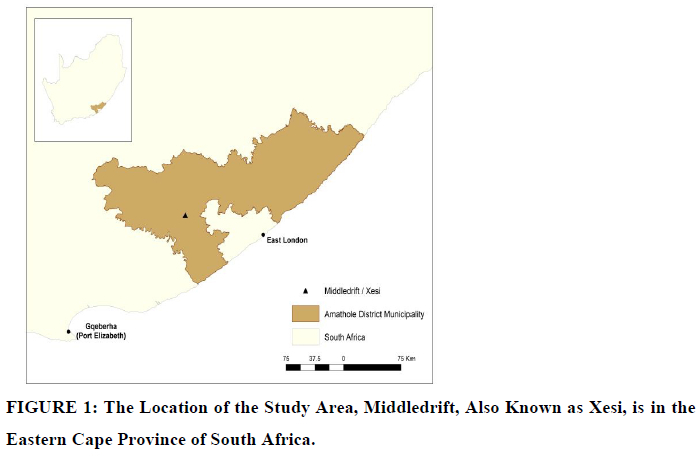
The case study area is on the outskirts of Middledrift town (also known as Xesi) in the Amathole District of the Eastern Cape province of South Africa (Figure 1). The district was selected for its high climate change vulnerability (Hove & Osunkunle, 2020). Since 2015, the district has experienced recurrent droughts that have worsened an already fractured socioeconomic structure dominated by small-scale farming (Mahlalela et al., 2020).
Subsistence farming across South Africa is shrinking, with commercial crop production heavily reliant on limited state subsidies (Connor & Mtwana, 2018). The Eastern Cape has neglected farmers' challenges compared to other provinces (Hosu et al., 2016; Mahlalela et al., 2020) and has few capacitated governmental and non-governmental agricultural extension services to provide advisory and educational support to farmers. The Eastern Cape also exhibits the lowest extension service to farmer ratio compared to the national standard (Ngaka, 2012).
Without clear policy statements and instruments to enhance institutional services (Hosu et al., 2016), small-scale farmers in this region face historical intersectional marginalisation, limited access to finance, insecure land tenure, weak bargaining power, and unequal access to water, worsened by climate variability (Chanyau & Rosenberg, 2023). To address these challenges, Chanyau and Rosenberg (2024) note that farmer support and community development organisations have established and supported farmer cooperatives, leading to expanded learning and resource-sharing networks with varied outcomes. Understanding the nature and significance of these outcomes in the Middledrift/Xesi area is a key contribution of this paper.
2. MATERIALS AND METHODS
The study adopted purposive sampling to select the case studies and participants, allowing the researcher to choose the most relevant sample with finer details of the climate change learning and practice landscape, attributes of what Malterud et al. (2016) referred to as high information power. Besides information power, availability and willingness to participate were also considered in participant selection, bearing in mind the busy farm schedules and distance between the farmers.
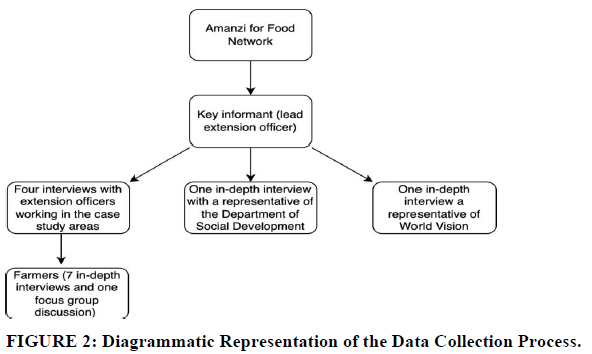
The lead author, Chanyau, first established contact with a member of Amanzi for Food (a learning network on water conservation and food production), who introduced him to the lead extension officer in the case study area, who then became a key informant who introduced Chanyau to four extension officers from the Department of Agriculture, Land Reform and Rural Development (DALRRD) who, in turn, organised interviews with seven small-scale farmers and one focus group discussion with ten farmers. The key informant also introduced Chanyau to one Department of Social Development (DSD) representative and one social development officer from World Vision-South Africa (Figure 2).
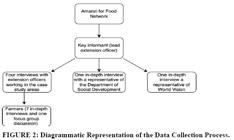
The focus group discussion explored farmer-to-farmer relationships in group learning settings. Interviews were conducted at participants' practice locations. Multiple data collection methods enhanced comprehensiveness and confidence in data quality. Data analysis followed a deductive approach, coding data into categories based on key features of Communities of Practice (CoP) and establishing relationships among the categories.
3. FINDINGS
3.1. Understanding the Climate Change Learning Landscape
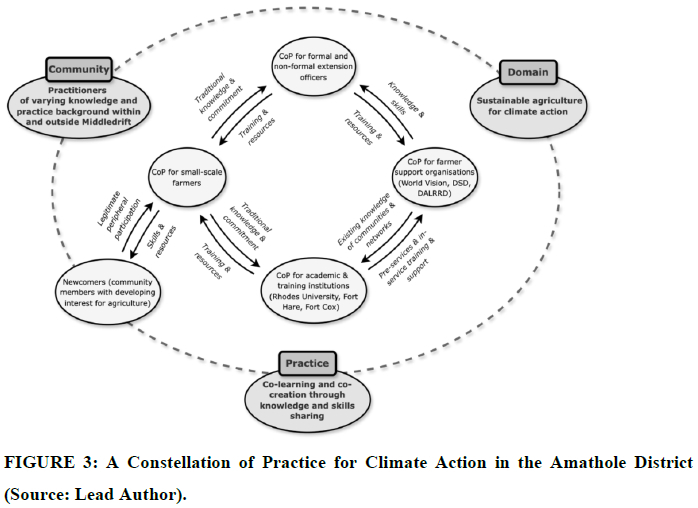
Fieldwork began by mapping the farmer learning and training landscape in Xesi with a DALRRD informant. The CoP for smallholder farmers encompassed individuals with diverse backgrounds in experience, gender, knowledge, expertise, age, personality, and authority. Further exploration revealed learning and practice connections between this CoP and other CoPs within the broader Amathole District Municipality, including academic institutions such as Rhodes and Fort Hare Universities and Fort Cox Agriculture and Forestry Training Institute (also known as Fort Cox). Connections were also identified with a community development CoP involving the Department of Social Development (DSD), DALRRD, and World Vision. This interconnected network, a "constellation of practice" (Lave & Wenger, 1998), extending spatially and facilitated by various boundary processes (Coe & Bunnell 2023), transcends CoP boundaries within the district to form the larger CoP and unit of analysis for this study (Figure 3).
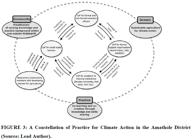
In the constellation of practice, academic and training institutions provide formal and non-formal training to pre-service and in-service extension officers and farmers. Community development organisations collaborate with extension officers to offer resources, further training, and monitor progress over time. Farmers bring in a rich contextual understanding of the historical and cultural context. Their commitment to practice further helps to secure community buy-in and promote the sustainability of the CoP.
3.2. Epistemic Pluralism and Knowledge and Practice Boundary Crossing
After establishing the constellation of CoPs, the study aimed to understand the types of knowledge and practices shaping interactions within and between these CoPs. Our findings revealed that the diversity within and between CoPs led to epistemic pluralism. A mixture of scientific, experiential, and traditional knowledge was rooted in the communities' history, cultures, and experiences dealing with extreme climatic conditions. For example, farmers shared their experiences of climate change's impact on their practices and communities, mentioning frequent tornadoes, high temperatures, droughts, and flash floods. They also highlighted the importance of traditional knowledge for preserving moisture during dry spells, avoiding frost damage, and treating emerging livestock diseases attributed to climate change. In the broader CoP, social exchanges of this locally embedded, socio-culturally rich knowledge drove situated learning. This learning fostered the development of sustainable climate change resilience and adaptation.
Unlike traditional learning processes, the individual CoPs and the constellation they form present different levels of expertise and authentic social interactions, all rooted in the philosophy of co-learning and co-creation. Each member can actively generate and share knowledge, thereby contributing to its implementation in shared spaces such as community gardens. No knowledge form is deemed superior to another, fostering a horizontal learning landscape. In this context, extension officers promote the need for mutual and collective learning to achieve success in addressing climate change:
We have not received training in climate change we get climate change information from news platforms, even social media ... I also know about climate change through my own experiences because I am a farmer, too. (Extension Officer 2).
Another extension officer emphasised that the co-learning approach requires extension officers to navigate between the boundaries of scientific knowledge, primarily acquired through their training, and traditional knowledge inherent in the communities they serve:
We are not trained to impose knowledge on the farmers; we are also open to learning from the farmers. As the extension officer, you listen to them and learn more. They are good at demonstrating traditional practices and will accommodate whatever they introduce to us that works. (Extension Officer 1)
This inclusive and participatory learning environment leverages farmers' knowledge and experiences, leading to more sustainable and effective outcomes that support farmers of different skill sets and specialities.
The exchange of knowledge across boundaries within and between the CoPs in the constellation extends to other CoPs; they engage in cross-boundary learning:
We also learn and share knowledge with other farmers practising in other communities. When we meet at the market in Qonce, we exchange ideas. (Farmer 1)
Extension Officer 3 noted that this emerging form of farmer-to-farmer social learning represents "a remnant of a wide network of learning that was fractured by over two years of the COVID-19 pandemic". Similarly, Extension Officer 2 highlighted how farmers bring new knowledge, allowing their networks to assess its relevance and applicability within the farmers' context.
3.3. Access to Online Tools, Learning Tools and Effective Participation
The individual CoPs and the broader constellation have seen the proliferation of various social media groups, which have grown significantly since their inception. This growth can be attributed to the farmers' evolving learning and communication patterns, transitioning gradually to virtual platforms in response to the COVID-19 pandemic. Social media integration has expanded the farmers' learning networks within the Eastern Cape and beyond, providing access to diverse knowledge and practices. However, the expansion of the CoPs through technology has not been uniformly beneficial across members of all age groups and skill levels:
For the elderly, WhatsApp has not been very beneficial, .... some do not have electronic gadgets supporting WhatsApp, and the costs of internet data (World Vision).
The challenges extend beyond digital access. Even those with access had difficulty in accessing information relevant to their contexts:
The shared information is not always relevant to our contexts and is sometimes too complicated to put into practice .... (Farmer 1)
Insights from extension officers and farmer support organisations shed light on effective learning facilitation methods. Age emerged as a critical factor influencing their choice of training methods:
For elderly farmers, the training must be more practical . farmer field schools and onsite trials. (Extension Officer 2)
The effectiveness of training methods depends on the content of the training and the preferred learning style of the farmers:
For training that involves chemicals, they must write down so that they will do exactly as they should. I prefer writing, most of them are aged . they may forget. A mix of theoretical and practical training was ideal for the youth as they are usually literate. (Extension Officer 3).
3.4. Gradual and Progressive Participation by New Farmers
The successes of established farmers have inspired a new generation of farmers, who gradually learn to improve their practice from established farmers within their communities through peripheral participation. One such established farmer described herself as 'the village's extension officer' taking on the role of mentoring young and new farmers, offering guidance on adaptive practices in the context of poor rainfall patterns and the lack of irrigation water supply:
I advise other people interested in farming, especially the ones in my community, for example, changes in rainy seasons and the need to grow potatoes because potatoes are becoming increasingly expensive ... we also exchange seeds and seedlings. (Farmer 2)
Newcomers in the CoP are active practitioners who contribute significantly to the collective knowledge and skill base, exemplifying the role of situated learning. The following extract from an established farmer shows that newcomers are not passive participants; they are equally responsible for shaping practice and the collective identity of CoP members:
The new farmers often infuse the insights they gained from our interactions with traditional knowledge and ingenuity in their practice. (Farmer 3)
Situated learning represents a departure from traditional, one-directional approaches to knowledge transfer; farmers engaging in legitimate peripheral participation retain the freedom to adopt new knowledge and join the CoP; hence, Figure 3 places them on the boundary. In these CoPs, knowledge exchange is bi-directional, fostering the co-creation of new knowledge and adaptive solutions through problem-solving and social learning. Most newcomers become successful, with many new practices eventually being adopted and shared by established farmers in the CoP. Although the domain of the CoP may initially be ambiguous, it is an open space for experimentation and learning, and the shared identity of the CoP is adapting and evolving.
3.5. Conflicts and Contradictions in the CoP
Although the CoP is a collaborative and rich learning environment, farmers acknowledged that conflicts arise during their interactions, particularly within cooperatives. The Department of Social Development (DSD) and World Vision attributed the poor performance of some supported projects to inadequate conflict management among farmers:
There is a need for training on conflict resolution because the conflicts are affecting our progress in many ways, especially in cooperatives. (Farmer 6)
The DSD offered a valuable perspective from their past experiences: "Conflicts are inherent in all communities and are not entirely bad; farmers and ourselves should learn from it" (DSD). The organisations mentioned a plan to learn from other communities and initiate conflict management training for farmers and practitioners.
The group interview also revealed a disconnect between the training provided through the CoP and its practical application. While participants appreciated the information on climate change adaptation (e.g. mulching, minimum tillage, and raised beds) acquired through agroecology training, these methods presented unforeseen challenges:
The methods were helpful in the early instances, but in the long run, our yields were going down because the methods took up a lot of space. We then decided to go back to our traditional way of farming because yields do matter most to us. (Farmer 4)
Another participant highlighted the need to reconsider government support approaches, suggesting they are often out of touch with farmers' realities:
Sometimes, the government come with take-it-or-leave-it approaches . sometimes, the things they give us don't work . we may not have the extra resources needed to implement the new practices. . They just bring things without even consulting us. (Farmer 8)
Farmers stressed the need for effective post-training to ensure the practical application of acquired knowledge and skills, ultimately enhancing their practices and aligning with community needs and identities.
4. DISCUSSION
Boundaries between CoPs in a constellation of practice are potential sources of misunderstanding, confusion, and uncertainty. However, they also serve as rich learning spaces (Wenger-Trayner et al., 2019). This study found that navigating the boundary between scientific and traditional knowledge stimulates collective reflection among practitioners on the impacts of climate change, mobilises collaborative efforts to address challenges, and facilitates the diffusion of practice elements, knowledge, and adaptive solutions throughout the constellation of practice. This broader, open learning system potentially fosters multiple shared practices that contribute to sustainable and far-reaching outcomes that benefit the CoP members, their communities and beyond (Wenger, 2008; Chanyau & Rosenberg, 2024).
The co-learning and co-creation approach in the Xesi CoPs represents a significant departure from traditional top-down approaches to farmer training, where only extension officers introduced innovations to passive farmer participants (Olayemi et al., 2021). The CoPs have cultivated a collaborative learning environment, resulting in a long-standing history of shared learning and innovative, contextually relevant practices. By offering a forum independent of external pressures, CoPs create a safe space for mutual learning, capacity building and collaboration (Thomson et al., 2022). The members develop a shared identity that transcends common boundaries in community learning; these include gender, knowledge, expertise, age, personality, and authority.
Small-scale farmers learn most effectively through interactions with peers, practical on-the-farm demonstrations within shared agriculture spaces, and ongoing theoretical training and support from extension officers. Continual interactions in a CoP are vital in developing an intact network of shared practice supported by a shared repertoire of resources, experiences, stories, tools, and activities (Wenger, 2011). Collaborative learning enables farmers with similar profiles and aspirations to learn from one another, reducing the gap between varying knowledge boundaries and minimising conflict.
Lave and Wenger (1991) showed how newcomers gradually become competent CoP members through legitimate peripheral participation. The present study extended further by finding that newcomers also have the decision-making power to fully join the CoP and embark on the inward journey through knowledge and competence building or not depending on varying factors, including resources.
This study highlights the importance of aligning farmer learning processes with their socio-cultural and ecological context, particularly for smallholder farmers with limited access to adaptation resources and skills. This alignment improves knowledge and skill uptake, leading to better adaptation outcomes. It also enhances the potential for knowledge and skills to effectively permeate into other CoPs, minimising end-user confusion (Wågsæther & Ziervogel, 2011). This fosters spatial dissemination of knowledge and co-learning across various CoPs and institutions, ultimately building societal capacity to deal with and adapt to environmental variability more effectively (Christoplos et al., 2009), building farmer resilience, making emergent environmental changes less surprising and more manageable (Chanyau & Rosenberg, 2023). Furthermore, active participation in climate change learning communities can bolster farmers' resilience, shape their adaptation patterns, and enhance their bargaining power in accessing essential, contextually relevant services and resources.
While not immune to conflict, CoPs are not necessarily a harmonious group. Disagreements, contradictions, tensions and conflict are inevitable as CoP members negotiate competence in the domain (Farnsworth et al., 2016); the key difference lies in how participants perceive and manage conflict. Farmers who view conflict as an opportunity for learning and reflection focus their efforts on the root causes of their challenges (Engeström, 2000). This learning-centred view of conflict is a crucial precondition and a powerful means of collectively re-imagining and adapting practice to overcome challenges.
Digital communication and learning tools have exposed farmers to a wide array of information, but not all of it is relevant to their actual circumstances. However, increasing globalisation and rapid technological advancements have led to a burgeoning of virtual CoPs (Kirschner & Lai, 2007). In virtual CoPs, members live in different realities than traditional CoPs, necessitating a tailored approach to understanding and supporting these distinct CoP types (Bourhis et al., 2005). This complexity makes it difficult for practitioners to identify and cultivate a common practice (Dubé et al., 2006).
5. CONCLUSIONS
Communities of practice for small-scale farmers are more likely to sustain and operate effectively if the members are co-located within the same geographical area and engage in face-to-face interactions. When characterised by co-learning and co-creation, these interactions are more conducive to effective situated learning than virtual interactions. Although the adoption of social media has broadened learning opportunities for the farmers, for effective situated learning, CoPs should remain primarily inward-looking. This inward focus helps to reduce the boundary gaps, facilitating better knowledge and skills uptake within and across CoPs. We recommend that extension services training prioritise facilitation and communication skills so that extension officers can effectively stimulate farmer participation in learning activities throughout the practice landscape since smallholder farmers learn better through grounded interactive processes.
Improving the ratio of extension officers to farmers, enhancing the quality of training, and increasing the resources available to extension officers are essential steps to facilitate the emergence and strengthening of effective Communities of Practice (CoPs) that address climate change and agriculture issues. These measures should also incorporate and embrace local knowledge, promoting social inclusion and cohesion. Lastly, the migration to virtual CoPs, while expanding the reach of these communities, also presents challenges that require a careful balance between expansion and relevance. This balance is key to fostering sustainable learning and practices supporting food systems, contributing to broader global development trajectories.
REFERENCES
- ANABARAONYE, B., OKAFOR, J.C. & HOPE, J., 2020. Educating farmers in rural areas on climate change adaptation for sustainability in Nigeria. In W. Leal Filho (ed.), Handbook of Climate Change Resilience. Switzerland: Springer Nature.
- ASARE-NUAMAH, P., BOTCHWAY, E. & ONUMAH, J.A., 2019. Helping the helpless: Contribution of rural extension services to smallholder farmers' climate change adaptive capacity and adaptation in rural Ghana. Int. J. Rural Manag., 15(2): 244-268.
- AYERS, J. & FORSYTH, T., 2009. Community-based adaptation to climate change. Environment SPSD., 51(4): 22-31.
- BELOW, T.B., MUTABAZI, K.D., KIRSCHKE, D., FRANKE, C., SIEBER, S., SIEBERT, R. & TSCHERNING, K., 2012. Can farmers' adaptation to climate change be explained by socioeconomic household-level variables? Glob. Environ. Change., 22(1): 223-235.
- BOURHIS, A., DUBÉ, L. & JACOB, R., 2005. The success of virtual communities of practice: The leadership factor. Electron. J. Knowl. Manag., 3(1): 23-34.
- WENGER-TRAYNER, E. & WENGER-TRAYNER, B., 2020. Learning to make a difference: Value creation in social learning spaces. Nord. J. Work. Life Stud., 11(1).
-
CARTER, S., 2022. Climate action and research must come together for better adaptation outcomes. Available from: https://gca.org/climate-action-and-research-must-come-together-for-better-adaptation-outcomes/
» https://gca.org/climate-action-and-research-must-come-together-for-better-adaptation-outcomes/ - CHANDRA, A., MCNAMARA, K.E. & DARGUSCH, P., 2018. Climate-smart agriculture: Perspectives and framings. Clim. Policy., 18(4): 526-541.
- CHANYAU, L. & ROSENBERG, E., 2023. Women farmers leading and co-learning in an agroecology movement at the intersections of gender and climate. Agenda., 37(3): 124140.
- CHANYAU, L. & ROSENBERG, E., 2024. Value created for small-scale farmers in an agroecology movement in the Eastern Cape region of South Africa: An application of the value creation framework. Agroecol. Sust. Food., 48(3): 382-409.
-
CHRISTOPLOS, I., ANDERSON, S., ARNOLD, M., GALAZ, V., HEDGER, M., KLEIN, R. J.T. & LE GOULVEN, K., 2009. The human dimension of climate adaptation: The importance of local and institutional issues. Commission on Climate Change and Development. Available from: https://www.preventionweb.net/files/9673_humandimensionofca1.pdf
» https://www.preventionweb.net/files/9673_humandimensionofca1.pdf - COE, N.M. & BUNNELL, T.G., 2023. 'Spatializing' knowledge communities: Towards a conceptualization of transnational innovation networks. Glob. Netw., 3(4): 437-456.
- CONNOR, T. & MTWANA, N., 2018. Vestige garden production and deagrarianization in three villages in the Eastern Cape, South Africa. S. Afr. Geogr. J., 100(1): 82-103.
- COX, A., 2005. What are communities of practice? A comparative review of four seminal works. J. Inf. Sci., 31(6): 527-540.
- DAVIES, B., 2005. Communities of practice: Legitimacy not choice. J. Socioling., 9(4): 557581.
- DUBÉ, L., BOURHIS, A. & JACOB, R., 2006. Towards a typology of virtual communities of practice. Int. J. Knowl. Manag., 69-92.
- ENGESTRÖM, Y., 2000. Activity theory as a framework for analyzing and redesigning work. Ergonomics., 43(7): 960-74.
- FARNSWORTH, V., KLEANTHOUS, I. & WENGER-TRAYNER, E., 2016. Communities of practice as a social theory of learning: A Conversation with Etienne Wenger. Br. J. Educ., 64(2): 139-160.
- GEBREHIWOT, T. & VAN DER VEEN, A., 2013. Farm level adaptation to climate change: The case of farmers in the Ethiopian highlands. J. Environ. Manage., 52(1): 29-44.
- HOSU, S.Y., CISHE, E.N. & LUSWAZI, P.N., 2016. Vulnerability to climate change in the Eastern Cape Province of South Africa: What does the future hold for smallholder crop farmers? Agrekon., 55(1-2): 133-167.
- HOVE, C. & OSUNKUNLE, O.O., 2020. Participatory water conservation education on social media in Amathole District local municipalities, Eastern Cape, South Africa. Inf. Dev., 36(2): 181-192.
- KIRSCHNER, P.A. & LAI, K., 2007. Online communities of practice in education. Technol. Pedagogy Educ., 16(2): 127-131.
- KOLIBA, C. & GAJDA, R., 2009. "Communities of Practice" as an Analytical Construct: Implications for Theory and Practice. Int. J. Public Admin., 32(2): 97-135.
- LAVE, J. & WENGER, E., 1991. Situated learning: Legitimate peripheral participation. Cambridge: Cambridge University Press.
- LAVE, J. & WENGER, E., 1998. Communities of practice: Learning, meaning, and identity. Cambridge: Cambridge University Press.
- MAAKE, M.M.S. & ANTWI, M.A., 2022. Farmers' perceptions of effectiveness of public agricultural extension services in South Africa: An exploratory analysis of associated factors. Agric. FoodSecur., 11(34): 3-15.
- MAHLALELA, P.T., BLAMEY, R.C., HART, N.C.G. & REASON, C.J.C., 2020. Drought in the Eastern Cape region of South Africa and trends in rainfall characteristics. Clim. Dyn., 55(9-10): 2743-2759.
- MALTERUD, K., SIERSMA, V.D. & GUASSORA, A.D., 2016. Sample size in qualitative interview studies: Guided by information power. Qual. Health Res., 26(13): 1753-1760.
- MCNAMARA, K.E., CLISSOLD, R., WESTOBY, R., PIGGOTT-MCKELLAR, A.E., KUMAR, R., CLARKE, T., NAMOUMOU, F., AREKI, F., JOSEPH, E., WARRICK, O. & NUNN, P.D., 2020. An assessment of community-based adaptation initiatives in the Pacific Islands. Nat. Clim. Chang., 10(7): 628-639.
- MUTTARAK, R. & LUTZ, W., 2014. Is education a key to reducing vulnerability to natural disasters and hence unavoidable climate change? Ecol. Soc., 19(1).
- NGAKA, M.J., 2012. Drought preparedness, impact, and response: A case of the Eastern Cape and Free State provinces of South Africa. J. Disaster Risk Stud., 4(1).
- OLAYEMI, S.S., OPE-OLUWA, A.A.A. & ANGBA, C.W., 2021. Evolution of agricultural extension models in sub-Saharan Africa: A critical review. Int. J. Agric. Ext. Rural Dev. Stud., 8(1): 29-51.
- ORMROD, J.E. & DAVIS, K.M., 2004. Human learning. London: Merrill.
- PEREIRA, L., 2017. Climate change impacts on agriculture across Africa. In L. Pereira (ed.), Oxford Research Encyclopaedia of Environmental Science. Oxford University Press.
- SENNUGA, O., ALO, A. & SOKOYA, O., 2021. Agricultural extension theories and practice in Sub-Saharan Africa: A critical review. J. Agric. Sci., 1: 20-028.
- THOMSON, A., PALMÉN, R., REIDL, S., BARNARD, S., BERANEK, S., DAINTY, A.R.J. & HASSAN, T.M. 2022. Fostering collaborative approaches to gender equality interventions in higher education and research: The case of transnational and multi-institutional communities of practice. J. Gend. Stud., 31(1): 36-54.
- VAN DEN BAN, A.W. & MKWAWA, D.S., 2007. Towards a participatory and demand-driven training and visit (T& V) agricultural extension system: A case of Tanzania. Agric. Educ. Ext., 5(2): 121-129.
-
VOLENZO, T.E. & ODIYO, J.O., 2019. Linking risk communication and sustainable climate change action: A conceptual framework. J. Disaster Risk Stud., 11(1). https://jamba.org.za/index.php/jamba/article/view/737
» https://jamba.org.za/index.php/jamba/article/view/737 -
WÅGSÆTHER, K. & ZIERVOGEL, G., 2011. Bridging the communication gap between climate science and society: A case study of disseminating climate information in the South-Western Cape, South Africa. J. Disaster Risk Stud., 4(1). https://jamba.org.za/index.php/jamba/article/view/49
» https://jamba.org.za/index.php/jamba/article/view/49 - WENGER, E., 2008. Communities of practice: Learning, meaning, and identity. Cambridge: Cambridge University Press.
-
WENGER, E., 2011. Communities of practice: A brief introduction. Available from: https://scholarsbank.uoregon.edu/xmlui/bitstream/handle/1794/11736/A%20brief%20introduction%20to%20CoP.pdf?sequence=1&isAllowed=y
» https://scholarsbank.uoregon.edu/xmlui/bitstream/handle/1794/11736/A%20brief%20introduction%20to%20CoP.pdf?sequence=1&isAllowed=y - WENGER-TRAYNER, B., WENGER-TRAYNER, E., CAMERON, J., ERYIGIT-MADZWAMUSE, S. & HART, A., 2019. Boundaries and boundary objects: An evaluation framework for mixed methods research. J. Mix. Methods Res., 13(3): 321338.
-
WORLD METEOROLOGICAL ORGANIZATION., 2019. The global climate in 2015-2019. World Meteorological Organisation. Available from: https://library.wmo.int/doc_num.php?explnum_id=9936
» https://library.wmo.int/doc_num.php?explnum_id=9936 - WRIGLEY-ASANTE, C. & DAKE, F., 2019. Climate change and gender in Ghana: An overview. In S.N.A. Codjoe & D.V.K. Dovie (eds.), Climate change in Ghana: The human dimension. Ghana: Afram Publications, pp. 56-76.