Farmers' Preferred Kenaf Dissemination Strategies for Knowledge and Attitude Changes in Southwestern Nigeria
Abstract
Kenaf is an important industrial crop with the potential to significantly contribute to Nigeria's economy, provided it is cultivated effectively and at scale. The study examined farmer-preferred dissemination strategies for Kenaf to promote knowledge and attitude change in Southwestern Nigeria. A multi-stage sampling procedure was used to select 80 respondents from the study area. Data were collected through a structured interview schedule and analysed using percentages, means, standard deviations, and correlation analysis. The results revealed that respondents were knowledgeable about seed planting by broadcasting (75.0%), sourcing seeds from the Institute of Agricultural Research and Training (70.8%), and the appropriate time for weeding (54.2%). Most respondents (58.3%) exhibited a favourable attitude towards Kenaf production. Agbe Asejere radio programme (x=1.71), peer-to-peer networks (x=1.50), and public extension agents (x=1.42) were the most preferred Kenaf dissemination strategies. The study found that the farmers' knowledge of Kenaf production was generally low. Respondents' knowledge of Kenafproduction was positively and significantly correlated with preferred Kenaf dissemination strategies (r=0.365). Aligning farmers' knowledge with their preferred dissemination strategies is therefore important for enhancing their knowledge and experience of Kenaf production practices, thereby promoting the uptake of Kenaf technologies in Nigeria.
Dissemination Strategies; Knowledge; Attitude; Kenaf
1. INTRODUCTION
The importance of agricultural research in Nigeria and across the World in generating technologies to enhance farmers' productivity, increase agricultural output, and ensure adequate food supply for an ever-growing population has long been recognised. The Food and Agriculture Organisation (FAO)'s 2024 report on the State of Food Security and Nutrition in the World noted that over 730 million people worldwide faced hunger in 2023, with more than 2.3 billion experiencing moderate or severe food insecurity (FAO, 2024). Given this, the drive to reduce food insecurity remains a major policy priority for governments in developing countries, and Nigeria is no exception. This fact informed the establishment and funding of various agricultural research institutes across different geopolitical zones of the country, each with varied mandates, one of which is the Institute of Agricultural Research and Training (IAR&T).
The primary goal of the IAR&T is to ensure self-sufficiency in food and industrial raw materials production. Since its establishment in 1969, the institute has served the needs of Nigerian farmers through its integrated agricultural resource development, and new technologies have been developed and transferred to farmers and other end users to sustain agricultural production and improve Nigeria's economy. The IAR&T conducts research and provides extension services on several crops, including Kenaf (Hibiscus cannabinus L.). Kenaf is a fibre crop originating in East-Central Africa (Xu et al., 2020). The crop is tolerant of semi-arid conditions, making it a warm-season crop. As an annual crop, it is easily adopted by the farmers and fits well into rotation systems with conventional food crops. The crop is widely adapted to diverse environments, climates, and soil types, and, relative to other fibre plants, it is characterised by a high cellulose content.
Kenaf is one of the major industrial crops cultivated in Nigeria. As an industrial crop famous for its fibrous stem, the fibres are used to produce various commercial products, including high-quality paper, biocomposites for car door trimmings, interior shelving, bioplastics, building materials such as medium-density fibreboard, textiles, and furniture. Aside from the fibrous stem, other parts of the Kenaf plant (flowers, seeds, and leaves) are often considered industrial by-products of low economic value. Kenaf is closely related to cotton. According to LINKS Nigeria (2022), this makes it a viable substitute and diversification option for farmers, especially given the persistent challenges confronting Nigeria's cotton industry over the past decades, owing to its higher yield potential and minimal environmental impact. It is also suggested as a fibre alternative for commercial returns.
Nigeria ranks 4th in Africa and 13th globally in Kenaf production, with a total national Kenaf fibre output of around 1,460 tonnes in 2020 (LINKS Nigeria, 2022). Countrywide figures show that Kenaf is mainly grown in the Southwestern states of Nigeria, with Ogun and Oyo accounting for about 60% of the national output; next are the Northcentral (16.4%) and Northwest (15.5%) (LINKS Nigeria, 2022). These statistics indicate that Kenaf can thrive across a wide range of agroecological zones. Several research efforts have thus been carried out to improve its production and utilisation, with institutional actors at the forefront, playing crucial roles in coordinating and expanding the Kenaf value chain in Nigeria.
In this regard, the IAR&T Kenaf serves as the primary research institute responsible for developing the Kenaf value chain. This is structured under the Kenaf and Jute Development Programme, which focuses on genetic enhancement, sustainable production practices, and processing technologies to boost the utilisation of Kenaf at both smallholder and industrial scales. The Institute's research team has generated and disseminated numerous Kenaf-related technologies, ranging from improved seeds (with higher fibre yield and quality) to Kenaf management of biotic and abiotic production factors, application of biotechnology, and cost-effective production. The IAR&T was commissioned in 2017 by the Raw Materials Research and Development Council (RMRDC) to produce five tonnes of foundation seeds for distribution to various Kenaf stakeholders (i.e., farmers, processors, and marketers) for planting (LINKS Nigeria, 2022). Aside from IAR&T, operating associations involved in the development of the Kenaf value chain in Nigeria are Kenaf Producers, Processors and Marketers of Nigeria (KEPPMAN) and Kenaf Development Association of Nigeria (KEDAN).
These efforts notwithstanding, there is limited uptake of Kenaf technologies among farmers in Nigeria, highlighting a communication gap between technology producers (i.e., research institutions) and end users (i.e., farmers). Meanwhile, for innovations to have impact, knowledge or information must be effectively disseminated through channels that align with individuals' contexts (Rogers, 2003). Accordingly, the successful development of Kenaf technology relies not only on innovation but also on effective dissemination and delivery strategies.
Due to its diverse applications, including inherent agricultural and industrial opportunities, and the increasing global interest in sustainable, environmentally friendly materials, the demand for Kenaf has been rising. However, Kenaf production and technology adoption in Nigeria remain low, as the crop is not known to most practising farmers. A major reason for this is low awareness among farmers of the crops' full potential and their economic benefits (Oyegbami & Ajijola, 2019). In other words, information on Kenaf production remains inadequate, and access to Kenaf best-practice information in the Kenaf value chain is considered a crucial enabler of technological advancement.
Therefore, there is limited understanding of how Kenaf technologies are communicated to farmers and of the dissemination strategies they prefer. Bridging this gap requires understanding farmers' preferred dissemination strategies, especially in contexts where the adoption of agricultural technologies is hindered by limited access to information. It is also essential to understand the influence of knowledge and attitude, which are precursors of any behaviour change. Though IAR&T and other associations have developed improved technologies, the impact of these technologies has not been fully realised, partly due to a misalignment between farmers' information needs and dissemination strategies.
The broad objective of this study was to investigate farmer-preferred Kenaf dissemination strategies for changing knowledge and attitudes in Southwestern Nigeria. Specifically, the study: (i.) assessed farmers' knowledge of Kenaf production practices; (ii) examined farmers' attitude towards Kenaf production; and (iii) identified farmers' preferred Kenaf dissemination strategies. The study hypothesis stated that knowledge and attitude do not correlate with Kenaffarmers' preferred Kenaf dissemination strategies.
Kenaf (Hibiscus cannabinus L.) is an annual, herbaceous, fast-growing plant with multiple uses. The long fibre that can be derived from the outer part/bark, otherwise known as bast, can serve as a raw material for making sacks, ropes, carpets, and cordage, and can serve as a biodegradable alternative for certain artificial materials utilised in the fabrication parts of cell phones and automobiles (Omar et al., 2020; Sabir et al., 2022). Additionally, cellulose and hemicellulose are present in the core or inner stem of Kenaf, making it useful for the production of pulp and paper, adsorbent materials, bioethanol, and as an alternative for bio-composites and timber (Patane & Sortino, 2010; Salih et al., 2022; Jasmani & Alnun, 2023). Though primarily cultivated for fibre production, it is also accepted as a food and non-food crop owing to its seeds, which contain about 22% oil and high levels of PUFAs (polyunsaturated fatty acids) (Cheng et al., 2016).
Kenaf is increasingly popular in Nigeria, especially for its economic potential. Apart from its economic importance, it has the potential to reduce deforestation and climate change and to improve Nigeria's foreign reserves. Its production is considered to have the potential to help the country overcome its economic crisis and, at the same time, reduce the yearly expenditure of 2.75 billion on the importation of jute (Ibirogba, 2020). Kenaf production, therefore, offers significant prospects for generating employment, substituting for imports, boosting local industries, and creating wealth. This strategically positions it among other agricultural value chains with enormous potential to diversify the country's economy away from crude oil, given that its by-products have several commercial and industrial applications (Adeniyan, 2018).
In Africa, Nigeria is among the foremost producers of Kenaf, and within Nigeria, the Southwestern region is historically known for its production and pilot schemes; yet uptake at scale in the Southwestern region and the country at large has been low and uneven. This review briefly synthesises evidence on three linked aspects: knowledge of Kenaf production, attitudes toward Kenaf production, and preferred dissemination strategies.
As regards knowledge, evidence from the Nigeria value-chain study reports indicates wide gaps in the Kenaf value chain, including awareness levels of Kenaf; production drudgery and processing activities; seed multiplication and scaling-up; and market linkage reliability (LINKS Nigeria, 2022). These collectively reflect existing limitations in the Kenaf value chain regarding knowledge and technical know-how. Improved varieties of Kenaf are available nationwide, but farmers' use of these seeds is limited by gaps in awareness and knowledge. The domestically produced hybrid seeds can ensure 2-3 production cycles annually (LINKS Nigeria, 2022). Ultimately, knowledge limitations hinder the wider uptake of Kenaf. Odumuyiwa et al. (2024) similarly identified poor access to improved, high-quality seed varieties as a major agronomic challenge for Kenaf production. These knowledge limitations create a barrier to wider adoption and reduce the perceived reliability of Kenaf as a cash crop.
Farmers' Attitudes Toward Kenaf Production Attitude is important considering it is the bridge between knowledge and change in behaviour, as theorised in Roger's (2003) Knowledge-Attitude-Practice (KAP) framework. The attitude of Kenaf farmers in Nigeria is influenced by factors such as knowledge and awareness, market experience, and perceived potential profit.
For instance, Oyegbami and Ajijola (2019) identified inadequate familiarity, poor information, and deficient knowledge of its utilisation as constraints hindering the cultivation of Kenaf. The authors further quipped that while Kenaf's potential as a cash crop is recognised by farmers, uncertainty in market demand and price instability dissuade its continued production. This finding mirrors broader evidence that perceptions of risk and economic considerations typically influence farmers' enthusiasm for technologies (Nyairoa et al., 2022). The positive evaluations of technologies by farmers do not necessarily translate into widespread uptake, underscoring the need to address limitations, including inadequate access to information and training, which can inhibit farmers' enthusiasm for adopting technologies or new crops (Nyairoa et al., 2022).
2.1. Farmers' Preferred Kenaf Dissemination Strategies.
The successful transfer of knowledge and positive attitude into practice requires operational dissemination strategies. This hinges on the fact that communication not only entails the transfer of information but also involves a combination of channels (Kadzamira et al., 2025), feedback loops, and experiential learning (Suvedi et al., 2023). Farmers most times prefer certain informal channels that blend various characteristics which they understand and consider credible. One of these findings is that the communication of Kenaf information should align with the dissemination strategies preferred by farmers. This is because individuals typically trust information sources that they use (Korshakova et al., 2022).
Considering the several uses of Kenaf, coupled with the policy interest in expanding the Kenaf value chain in Nigeria, a study such as this that provides an insight into the dissemination strategies for Kenaf preferred by farmers, as well as assessing their knowledge and attitude, in contexts where adoption or uptake of agricultural technologies is hindered by poor access to information, is vital for driving any change in behaviour.
3. METHODOLOGY
3.1. Study Area
The study was carried out in Southwestern Nigeria. Southwestern Nigeria comprises six states: Ekiti, Lagos, Ogun, Ondo, Osun, and Oyo. Yoruba is the predominantly spoken language and farming is a major occupation. Agriculture is a major occupation of people in the region, and agricultural activities in the region involves crop (grains e.g. maize, rice; root crops e.g. cassava, yam, cocoyam; vegetables e.g. tomato, pepper, okra; tree crops e.g. cocoa, oil palm, kolanut, rubber, oranges, mangoes, pawpaw) and livestock (poultry, ruminants, pigs) production. The cultivation of Kenaf is becoming an important fibre crop for economic and industrial uses. The study area has a functional agricultural extension system (i.e.Kenaf, under the Agricultural Development Programme) that facilitates the dissemination of technologies, making it necessary to ascertain the preferred dissemination strategies of Kenaf farmers, taking into account their knowledge and attitudes.
3.2. Research Design
The study employed a cross-sectional survey to collect quantitative data from Kenaf farmers to evaluate their knowledge, attitudes, and preferred dissemination strategies for Kenaf production in Southwestern Nigeria. This approach enabled field-based data collection from a representative sample of Kenaf farmers within a defined time frame, allowing analysis of key variables and the identification of patterns and relationships among them. Data collection was conducted using a Kenaf-structured interview schedule covering three aspects (i.e., knowledge, attitude, and preferred Kenaf dissemination strategies), thereby affording standardised responses appropriate for the interpretation of quantitative data.
3.3. Sampling Method and Size
A multi-stage random sampling technique was employed to select respondents for the study. First, two states with more functional agricultural extension organisations (i.e., the Agricultural Development Programme, ADP) - Lagos and Ekiti - were selected. Of the 4 ADP zones in each state, 2 were randomly selected, yielding 4 zones. Each selected zone consists of eight cells, which function as the units of operation for performing field activities. From these, 4 cells were randomly selected from each zone, for a total of 16 cells. Lastly, five farmers were randomly selected from each cell, yielding a total of 80 respondents. This small sample size reflects the limited number of farmers who cultivate Kenaf, which is just being popularised in the study area. The sampled farmers are also those who work with the extension agency. This sampling method ensured representativeness while also prioritising locations with dynamic extension support, which is crucial to achieving the research's focus.
3.4 Data Analysis
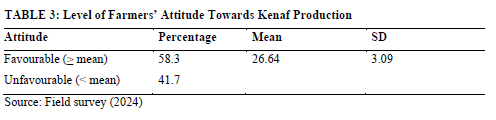
Data analysis used percentages, mean values, and standard deviations, while correlation analysis tested the formulated hypothesis. Version 21 of SPSS was used to perform all statistical analyses, with correlation significance set at p < 0.05. This method of analysis is consistent with acceptable research procedures and has provided salient insights into the relationships among the variables under consideration. The objectives were operationalised as follows: knowledge of Kenaf production was measured on a 2-point scale (correct response = 1, incorrect response = 0) across 12 items. Respondents' knowledge was rated as high (>50%) or low (<50%), based on percentage scores. Attitude towards Kenaf production was operationalised on a five-point Likert scale (strongly agree = 5, agree = 4, undecided = 3, disagree = 2, and strongly disagree = 1) across 9 items/statements. Scale points were reversed for negative items. The maximum obtainable score was 45, while the minimum obtainable score was 9. The mean score (26.64±3.09) was computed and used to group respondents into favourable (> mean) and unfavourable (< mean) attitudes towards Kenaf production, consistent with Thomas and Uwandu (2019). Also aligning with Thomas and Uwandu (2019), preferred dissemination strategies were measured on a three-point scale (not preferred = 0, preferred = 1, most preferred = 2) comprising 9 items. Mean values less than 1 depicted less preference, while values more than 1 depicted high preference.
4. RESULTS AND DISCUSSION
4.1. Knowledge of Kenaf Production
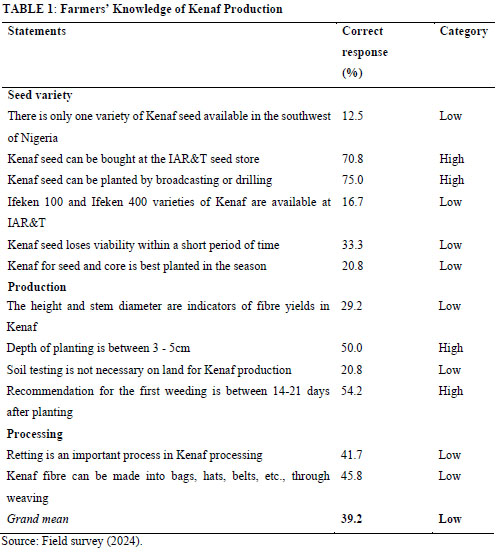
Requisite knowledge of Kenaf production can build farmers' capacity along the Kenaf value chain and, consequently, help them produce sufficient Kenaf as raw material for industrial take-off in the country. As indicated in Table 1, knowledge of Kenaf production was assessed across three aspects: seed variety, cultivation/production, and processing. The Kenaf farmers were quite knowledgeable regarding broadcasting Kenaf seeds (75.0 %); sourcing Kenaf seeds from IAR&T (70.8 %); weeding at 14-21 days after planting (54.2 %); and planting seeds at a depth of 3-5 cm (50.0 %).
With an overall mean percentage of 39.2%, the findings in Table 1 suggest that the respondents are neither entirely new to nor entirely unaware of the aspects of Kenaf production practices. It reflects the fact that, though an industrial crop with high economic potential, the crop has unfortunately not been well adapted, as only a few farmers cultivate it in the study area. However, they lack the requisite knowledge to thrive within the Kenaf value chain. This indicates that, though the farmers exhibit fundamental practical awareness of Kenaf cultivation (e.g., depth of seed, time of weeding), they may not have advanced agronomic knowledge of the Kenaf value chain (e.g., improvement of seed varieties, techniques of fibre processing). This echoes Oyegbami and Ajijola's (2019) finding that Kenaffarmers possess limited knowledge of Kenafs potential in Southwest Nigeria.
It can be said that the various aspects of Kenaf production practices are not well understood by farmers, underscoring the need for greater sensitisation and training. As described in Rogers's (2003) classical diffusion of innovation model, knowledge is the initial stage in the innovation-decision process. It implies that farmers would not be able to transition from awareness to persuasion, decision-making, and adoption without the requisite technical understanding and extension support. Training support for Kenaffor in disseminating knowledge about new technologies for Kenaf cultivation/production and processing, and educating farmers on modern farming techniques (LINKS Nigeria, 2022), can help boost farmers' knowledge. This underscores the need to build farmers' competence through extension approaches that are not merely focused on one-way transmission of information or knowledge. Given the current realities of climate change, complex food systems, and diverse needs of farmers, extension training that reinforces participatory methods, farmers' field schools, facilitated peer-to-peer learning, and experiential practical learning are recommended (Suvedi et al., 2023).
4.2. Attitude towards Kenaf Production
Farmers' attitudes are important in determining whether to adopt a practice, as a positive perception would encourage widespread adoption, whereas a negative perception would discourage it. Information in Table 3 indicates that most Kenaf farmers (58.3%) exhibited a favourable attitude towards Kenaf production, suggesting that the majority of respondents recognise Kenaf as a profitable and beneficial enterprise. This is in consonance with the persuasion phase of the innovation-decision process, the phase in which farmers begin to develop a favourable or unfavourable disposition towards a technology (Rogers, 2003).
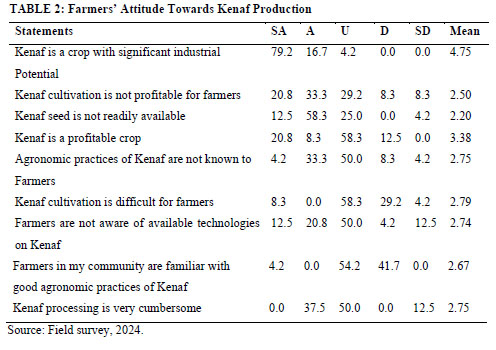
This positive disposition partly stems from statements in Table 2 in which respondents strongly agreed/agreed that Kenaf is a crop with significant industrial potential (95.9%), that it is a profitable crop (29.1%), and strongly disagreed/disagreed with the statement that Kenaf cultivation is difficult for farmers (33.4%). The strong agreement among Kenaf farmers regarding the industrial value of Kenaf reflects ample awareness of the growing industrial demand (e.g., paper and textile industries) for Kenaf fibre, highlighting their confidence in the economic viability of the crop. Attitude is pivotal in translating knowledge into practice (Xie et al., 2024). This is commonly referred to as the knowledge-attitude-practice (KAP) pathway.
In a scenario in which farmers' attitude towards a technology is positive but practice or adoption is low, this suggests that there are associated barriers, such as weak market linkage. Given that a comparatively low proportion (29.1%) strongly agreed/agreed that the crop is profitable to a large extent, there are uncertainties concerning its marketing. Indeed, uncertain market demand and underdeveloped value chains are among the known factors hindering farmers' adoption of underutilised and neglected crops (Mmbando, 2025). In general, a positive attitude towards Kenaf production would foster widespread adoption and large-scale cultivation, thereby increasing the availability of industrial raw materials.
On the other hand, the overall proportion of farmers with an unfavourable attitude towards Kenaf production (41.7%) could be attributed to a lack of requisite knowledge. This recognises that a farmer's attitude is influenced by knowledge about an agricultural technology or practice (Nyairoa et al., 2022). This is additionally given credence to by the respondents' strong disagreement/disagreement with the statement that farmers are familiar with good agronomic Kenaf practices (41.7%), combined with strong agreement/agreement with statements such as: agronomic practices of Kenaf are not known to farmers (37.5%), and farmers are not aware of available Kenaf technologies (33.3%). These collectively imply that, though Kenaf is considered to have potential by the farmers, self-assurance or confidence in production capability is low. The implication is that when farmers perceive they do not possess adequate knowledge or skills (or low behavioural control), a favourable attitude may not lead to adoption (Ajzen, 1991). Interventions aimed at bridging knowledge gaps and strengthening a favourable attitude (e.g., farmers' field schools, facilitated peer-to-peer learning, and experiential, practical learning) are therefore imperative.
4.3. Preferred Kenaf Technology Dissemination Strategies
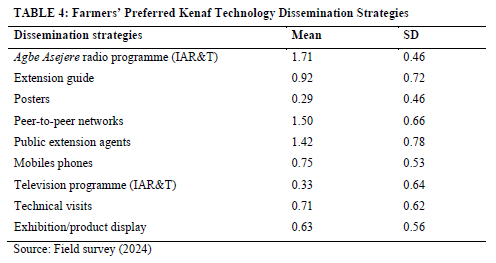
As reported in Table 4, IAR&T radio programme (Agbe Asejere) ( = 1.71), peer-to-peer networks (i.e., interpersonal communication with fellow farmers) (
 = 1.50), and public extension agents (
 = 1.42) were the most preferred Kenaf technology dissemination strategies among farmers. Farmers tend to prefer receiving information on Kenaf production through a mixture of sources, including mass media, interpersonal channels, and formal institutional channels, in that order.
Radio is widely considered an effective means of information delivery to farmers due to its ability to overcome barriers, ease of use, and relative affordability. Moreover, radio is particularly effective in disseminating both agricultural innovations and market information to farmers. Agbe Asejere is an in-house farm broadcast currently sponsored by IAR&T on five radio stations across the southwest geopolitical zone of the country. As a mass media channel, radio can simultaneously and efficiently connect multiple farmers, particularly in rural areas where most agricultural activities take place and where it is challenging for extension agents to have one-on-one contact with farmers. Research has shown a significant association between agricultural programmes broadcast on radio and changes in farmers' behaviour regarding agricultural practices (Adeyeye et al., 2023). Such radio programmes are usually delivered in local languages, just like the Agbe Asejere farm broadcast.
Preference for peer-to-peer networks stems from farmers' availability and the ability to receive immediate feedback, which facilitates the exchange of knowledge and experiences, thereby accelerating technology adoption. Fellow farmers also serve as a social capital network, which, according to Kehinde et al. (2024), can positively influence farmers' on-farm technical efficiency. Farmers usually belong to a farmers' association, which is a social group. They trust their peers, and these peers function as change agents, though informally, serving as channels for communicating farming innovations.
Similarly, as a dissemination strategy, extension services can contribute to the adoption of modern farming practices and technologies. Acting as bridges or intermediaries between research organisations and farmers, extension agents provide technical advice and follow up on the implementation of improved farming technologies, thereby improving farmers' incomes. Supporting this view, Shokati et al. (2023) observed that regular delivery of extension services to farmers increased their likelihood of higher yields and income following the adoption of modern farm practices.
The implication of these findings is that the communication of Kenaf information should align with farmers' preferred dissemination strategies. This is because individuals typically trust information sources that they use (Korshakova et al., 2022). As such, Kenaf programmes aimed at disseminating Kenaf information to farmers should deploy a multi-channel approach that combines radio, peer-to-peer networks, and extension agents. Such a combination enhances the reach and effectiveness of extension campaigns (Kadzamira et al., 2025). Ultimately, this is expected to translate into greater knowledge transfer, a change in attitude, and, consequently, better outcomes for Kenaf adoption and production.
4.4. Relationship between Knowledge, Attitude and Preferred Kenaf Technology Dissemination Strategies of Farmers
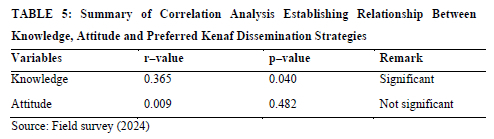
A positively significant relationship was observed between Kenaf farmers' existing knowledge and their preferred dissemination strategies (r = 0.365, p = 0.040) as presented in Table 5. This implies that the degree to which the respondents seek, interpret and use information from the available Kenaf dissemination strategies is influenced by their level of knowledge about Kenaf production. It also suggests that, for farmers to embrace or learn the latest practices, their knowledge directly influences their choice of information channels. In other words, the likelihood that farmers with greater knowledge will actively choose and effectively use information channels is higher than for those with lower knowledge. This echoes the perspective that different knowledge levels drive preferences for communication channels (Carroll et al., 2022).
Given that farmers acquire knowledge through firsthand experience and exposure to media sources, and that this knowledge significantly influences their intention to adopt new technologies (Zheng et al., 2019), it is important that dissemination strategies align with this knowledge. In other words, it is essential to disseminate technologies in ways that farmers can understand to engender adequate knowledge. Additionally, dissemination strategies should be tailored to respondents' characteristics (i.e., socio-economic backgrounds, levels of education, and geographic context), as their knowledge of Kenaf production shapes their preferences. This will help make the message more relevant and easier to understand, and increase farmers' trust in the dissemination strategy.
5. CONCLUSION AND RECOMMENDATIONS
The student evaluated farmer-preferred Kenaf dissemination strategies in relation to knowledge and attitude in Southwestern Nigeria. Findings revealed that farmers' overall knowledge of Kenaf production was low, although they were knowledgeable in some areas, including seed planting by broadcasting and sourcing seeds from IAR&T. The lack of knowledge reflects technical capacity deficiencies along the Kenaf value chain, especially in the improvement of seed varieties and fibre-processing techniques, which are essential for increasing productivity and improving fibre quality.
Most farmers displayed a favourable attitude towards Kenaf production, indicating a positive disposition towards the crop's profitability and industrial potential. However, this favourable attitude was constrained by knowledge deficiencies, making it imperative to bridge existing knowledge, attitude, and practice gaps. With respect to dissemination strategies, Kenafthe Agbe Asejere radio programme, peer-to-peer networks, and public extension agents were the most preferred Kenaf dissemination strategies among farmers, underscoring the importance of combining dissemination strategies such as mass media, interpersonal channels, and formal extension services to ensure effective knowledge transfer and reinforcement.
Knowledge of Kenaf production practices showed a positive and significant relationship with farmers' preferred dissemination strategies, indicating that farmers with greater knowledge have a better chance of selecting and utilising those they consider more effective. This ses that to engender higher uptake of technologies or innovations, it is important to tailor them to farmers' knowledge levels and preferred dissemination strategies.
Consequent on the findings, in order to reinforce the Kenaf value chain, increase the availability of raw materials for industries, and improve the economic benefits of farmers, the following recommendations are advanced:
■ Aligning farmers' knowledge with their preferred dissemination strategies, Kenaf, provided by stakeholders such as IAR&T, KEPPMAN, and KEDAN, in the Kenaf value chain to enhance farmers' knowledge and firsthand experience in Kenaf production practices, thereby promoting the uptake of Kenaf technologies by farmers in Nigeria.
■ Strengthening the linkage between research and farmers to facilitate the timely dissemination of improved varieties of Kenaf, agronomic practices, and methods of processing.
■ Use of a combination of channels in disseminating improved technologies or innovations in line with the knowledge and local context of farmers. Such channels include radio, peer-to-peer networks, and extension agents.
■ Use of participatory approaches, including farmers' field schools, facilitated peer-to-peer learning, and experiential practical learning. This is aimed at reinforcing a favourable attitude and promoting technical know-how in Kenaf production.
6. DISCLOSURE STATEMENT
The authors declare no conflicts of interest, financial or otherwise.
REFERENCES
2. LITERATURE REVIEW
- ADENIYAN, O.N., 2018. Adding value to Kenaf: Panacea for economic diversification II. J. Exp. Agric. Int., 27(6): 1-9.
- ADEYEYE, B., SALAWU, A. & ADESINA, E., 2023. Nexus among indigenous languages, agricultural radio programmes and behavioural change towards agricultural practices in Nigeria. Sustain., 15(7): 3929.
- AJZEN, I., 1991. The theory of planned behaviour. Organ. Behav. Hum. Decis. Process., 50(2): 179-211.
- CARROLL, A.A., LAMM, K.W. & BORRON, A., 2022. Finding the right channel: An analysis of communication channel preferences amongst potential extension clientele. J. Agric. Educ., 63(2): 131-149.
- CHENG, W.Y., AKANDA, J.M.H. & NYAM, K.L., 2016. Kenaf seed oil: A potential new source of edible oil. Trends Food Sci. Technol., 52: 57-65.
- FAO., 2024. G20 Global Alliance against Hunger and Poverty Task Force Ministerial Meeting Launch of the SOFI 2024 Report: Financing to end hunger, food insecurity and malnutrition in all its forms statement. Food and Agriculture Organisation of the United Nations.
- IBIROGBA, F., 2020. How Kenaf value chain development can save billions of naira. Nigeria: The Guardian.
- JASMANI, L. & ALNUN, Z.M.A., 2023. Pulping and paper making of Kenaf. In Z.M.A. Ainun, S.M. Sapuan & R.A. Ilyas (eds.), Pulping and paper making of non-wood plant fibers. London: Academic Press, pp. 143-155.
- KADZAMIRA, M.A.T.J., KANSIIME, M.K., POSTHUMUS, H., NJUNGE, R., SILVESTRI, S. & ROMNEY, D., 2025. Study reveals 'huge variability' in estimates of cost efficiency and effectiveness of agricultural extension communication channels. CABI.
- KEHINDE, A.D., OJO, T.O. & OGUNDEJI, A.A., 2024. Impact of participation in social capital networks on the technical efficiency of maize producers in Southwest Nigeria. Agric. FoodSecur., 13(12): 1-19.
- KORSHAKOVA, E., MARSH, J.K. & KLEINBERG, S., 2022. Health information sourcing and health knowledge quality: repeated cross-sectional survey. JMIR Form Res., 6(9): e39274.
-
LINKS NIGERIA., 2022. Market study and value chain analysis of Kenaf in Nigeria. Available from https://www.links-nigeria.com/wp-content/uploads/2022/10/Market-Study-and-Value-Chain-Analysis-of-Kenaf-in-Nigeria-1.pdf
» https://www.links-nigeria.com/wp-content/uploads/2022/10/Market-Study-and-Value-Chain-Analysis-of-Kenaf-in-Nigeria-1.pdf - MMBANDO, G.S., 2025. The current challenges and solutions on utilizing the potential of underutilized and neglected crops for Africa's food security. Discov. Plants., 2: 163.
- NYAIROA, N.M., PFEIFFERC, L., SPAULDINGB, A. & RUSSELL, M., 2022. Farmers' attitudes and perceptions of adoption of agricultural innovations in Kenya: A mixed methods analysis. J. Agric. Rural Dev. Trop. Subtrop., 123(1): 147-160.
- ODUMUYIWA, O.E., ADESUYI, A.A., ADEYEMI, I.A. & OGUNNIYAN, D.J., 2024. Prospects, production, and challenges of Kenaf in Sub-Saharan Africa: A review. In Proceedings of the 2024 International Conference on Kenaf, Jute and Allied Crops. Ibadan: Institute of Agricultural Research & Training.
- OMAR, M.F., JAYA, H. & ZULKEPLI, N.N., 2020. Kenaf fibre reinforced composite in the automobile industry. Mater. Sci. Eng., 5: 95-101.
- OYEGBAMI, A. & AJIJOLA, S., 2019. Knowledge of the potentials and constraints in Kenaf production among farmers in Southwest Nigeria. Moor J. Agric. Res., 20(2): 189-197.
- PATANE, C. & SORTINO, O., 2010. Seed yield in Kenaf (Hibiscus cannabinus L.) as affected by sowing time in South Italy. Ind. Crops Prod., 32: 381-388.
- ROGERS, E.M., 2003. Diffusion of Innovations (5th edn.). Free Press.
- SABIR, A., ALTAF, F. & JACOB, K.I., 2022. Green composites and their manufacturing. Green sustainable process for chemical and environmental engineering and sciences. London: Academic Press.
- SALIH, R.F., HAMAD, E.M. & ISMAIL, T.N., 2022. Commercial and field factors of selecting Kenaf fibers as alternative materials in industrial applications. J. Sustain. Agric., 6(2): 85-89.
- SHOKATI, A.M., MOJTAHEDI, M. & SAVARI, M., 2023. An economic effect assessment of extension services of Agricultural Extension Model Sites for the irrigated wheat production in Iran. Sci Rep., 13(1): 16947.
- SUVEDI, M., SASIDHAR, P.V.K., AGWU, A.E., CHANZA, C., DIMELU, M.U., LIVERPOOL-TASIE, L.S.O., ANUGWA, I.Q., TCHUWA, F., DAVIS, K., NAJJINGO MANGHENI, M., OYWAYA-NKURUMWA, A., VON MALITZ, L., IFEONU, C.F. & ELAPATA, M.S., 2023. Strengthening Agricultural Extension Training in Nigeria, Malawi, South Africa, Uganda, and Kenya. Partnerships for Innovative Research in Africa (PIRA) Research Report. Alliance for African Partnership, Michigan State University.
- THOMAS, K.A. & UWANDU, C.N., 2019. Utilization of information and communication technologies for nutrition education among community health workers in Imo State, Nigeria. J. Health Educ. Teach., 10(1): 44-57.
- XIE, X., LI, Y., CHEN, H., WANG, J. & ZHANG, L., 2024. Evaluation of a knowledge-attitude-practice model based narrative life education program for community-dwelling older adults: A mixed-methods feasibility study. BMC Geriatrics., 24: 153.
- ZHENG, S., WANG, Z. & WACHENHEIM, C.J., 2019. Technology adoption among farmers in Jilin Province, China: the case of aerial pesticide application. China Agric. Econ. Rev., 11(1): 206-216.
- XU, J., TAO, A., QI, J. & WANG, Y., 2020. Bast fibres: Kenaf handbook of natural fibres. Amsterdam: Elsevier.