An Integrated Development Pathway for Diverse Typologies: A Self-Help Tool to Develop Youth in Agriculture
Abstract
Supporting youth in actively participating in agriculture is crucial to ensuring food security and promoting economic growth. Yet, the active engagement of youth remains constrained by development frameworks that overlook their heterogeneity and by fragmented support initiatives. The article aims to develop an integrated development pathway consisting of a pool of strategies that empowers heterogeneous youth to actively participate in agriculture. Drawing on support strategies emerging from a literature review of stakeholder and typology-driven development pathways that aim to enhance participation in agriculture, an integrated development pathway is proposed, considering the six livelihood capitals (Natural, Financial, Physical, Human, Social, and Psychological) represented within the Modified Sustainable Livelihood Framework. The integrated pathway provides a bottom-up approach to development that empowers youth to choose their own specific strategies from a suggested pool, including diverse support strategies. Focusing on suggesting diverse strategies along a development pathway to enhance access to livelihood capitals provides a functional self-help tool that can effectively develop youth to engage in agriculture. The proposed reconceptualisation of youth development provides a facilitative rather than directive process that can serve as a roadmap for policy and other development partners in implementing effective youth development initiatives.
Youth Development; Agriculture; Self-Help Tool; Livelihood Capitals; Stakeholder-Driven Pathway; Typology-Driven Pathway; Support Initiatives
1. INTRODUCTION AND BACKGROUND
The agricultural sector remains a vital driver of economic development, particularly in developing countries. The sector creates employment, provides raw materials for agro-based industries, mitigates inequalities, generates foreign exchange earnings, enhances food security, alleviates poverty, and contributes to the gross domestic product (GDP) (Gina et al., 2023; Muzekenyi, Nyika & Hoque, 2023). Active youth engagement in agriculture as a livelihood strategy has been widely acknowledged in literature as pivotal to the sustainability and growth of the agricultural sector (Yami et al., 2019; Geza et al., 2021; Henning et al., 2022; Madende, Henning & Jordaan, 2023; Tikum & Ahmad, 2024). In developing regions such as Africa, characterised by youthful populations, high youth unemployment, and high rural-to-urban migration, agriculture can offer viable economic opportunities for youth (Geza et al., 2021).
Aligning youth development frameworks with the Sustainable Development Goals (SDGs) is increasingly important amid global efforts to promote sustainable agriculture, transform agrifood systems, and address challenges such as climate change and food insecurity (Rathava, Chaudhary & Rathwa, 2023). Young people, as pioneers of innovation, are essential for achieving food security and promoting environmental conservation and climate resilience through sustainable practices. Furthermore, the drive for technological advancements, such as the green economy and Agriculture 4.0, offers tech-savvy youth opportunities to transform agriculture through digital innovations (United Nations Women, 2021). Leveraging these unique characteristics of youth is integral to agricultural development (Kote et al., 2024), enabling them to drive transformative change in food systems and contribute to economic prosperity and the 2030 Agenda.
While literature underscores the vital role of agriculture as a catalyst for socio-economic transformation and inclusive economic participation, particularly in the global South, intentions and plans have not yet translated into the desired development outcomes. Decades of policy interventions and projects by governments and other stakeholders have aimed to improve access to productive resources, yet persistent barriers continue to hinder active youth engagement in agriculture (Kote et al., 2024; Songca, Henning & Madende, 2024; Boye et al., 2024). These barriers are particularly pronounced for marginalised groups such as youth and women, who typically have limited resource access (Kote et al., 2024). A combination of factors, including restricted access to land and credit, low self-confidence, limited aspirations, insufficient interest, inadequate access to technology, information, and training, lack of knowledge and skills, and negative perceptions, all contribute to these challenges (Geza et al., 2021; Henning et al., 2022; Kote et al., 2024; Boye et al., 2024; Mukwedeya & Mudhara, 2024). Therefore, effectively supporting youth to access essential livelihood resources such as land, credit, physical assets, and infrastructure is crucial for their active participation in agriculture (Adeyanju et al., 2023; Khan et al., 2024; Whitton & Carmichael, 2024). While the existing literature has proposed tailored support strategies to address these diverse challenges, their effectiveness in fostering active youth engagement remains limited due to inherent assumptions and limitations.
Traditional development pathways have often been stakeholder-driven, focusing on what support providers can offer rather than the diverse needs of farmers (Stads, 2016; Valdivia et al., 2017; Rusere et al., 2019; Anantha et al., 2021; Tui et al., 2022; Amadu, 2022). These approaches, while sometimes leading to increased productivity or improved livelihoods, often assume farmers have access to other necessary resources, overlook the participants' perception of future benefits, and don't adequately address the heterogeneity of support needs, especially for marginalised groups such as youth (Tui et al., 2022; Rathava et al., 2023). For instance, a stakeholder-driven pathway focused on providing technical training might assume access to land or financing, which is often not the case for many young farmers. This "one-size-fits-all", piece-meal or fragmented approach, often top-down (Mathivha, 2012; Stads, 2016; Gina et al., 2023), limits the effectiveness of support interventions.
In contrast, typology-driven development focuses on tailoring support to the specific characteristics and needs of different farmer groups or "typologies", recognising their inherent heterogeneity (Senison et al., 2016; Wale & Chipfupa, 2018; String et al., 2020; Turolla et al., 2022). This approach aims to provide targeted strategies to enhance access to scarce resources, rather than relying on blanket solutions. For instance, Madende et al. (2023) developed four tailor-made development pathways specifically for youth in agriculture, acknowledging their diverse endowments of livelihood capitals. While this typology-specific approach is more effective at coordinating support and providing targeted interventions, its functionality remains limited. The development pathway often benefits only individuals who perfectly align with a defined typology; those who partially relate may find themselves "stuck" before they can become actively engaged in agriculture, as some of their support needs are overlooked.
To develop an inclusive solution usable by any youth, the development framework should address the limitations of existing development pathways. Instead of focusing on predefined typologies, an integrated development pathway that prioritises suggesting diverse support strategies that address access to productive resources, inputs, knowledge, financial services, and markets to enhance active engagement in agriculture among youth is necessary. Providing a pool of diverse support strategies within a development pathway fosters a bottom-up approach to development, empowering youth to independently map their development rather than relying on external stakeholders to initiate it. An integrated pathway provides youth with a self-help tool that is functional and effectively assists both youth entering the agricultural sector and those who want to expand their activities, regardless of their specific characteristics.
Within the context of the above, the aim of this study is to develop an integrated development pathway that empowers youth to actively engage in agricultural activities through enhanced access to key livelihoods and supporting capitals. The integrated development pathway suggests a pool of diverse support strategies that can address the varied support needs of youth, in contrast to the blanket and fragmented support initiatives currently proposed along current development pathways. The self-help tool fosters a much-needed sense of responsibility and ownership among youth, which is key for the overall sustainability and resilience of agricultural systems.
The paper is structured as follows: The next section provides a review of currently available literature on development pathways to enhance active engagement in agricultural activities. The development of the integrated development pathway is then outlined in the following section. Thereafter, the new integrated development pathway is presented. Next, the new integrated pathway is discussed. The application of the integrated development pathway is then demonstrated in the section that follows. Finally, conclusions are made, and the findings' implications for youth and policy are emphasised. The conclusions section also includes areas of possible further research.
2. CONCEPTUALISING DEVELOPMENT PATHWAYS TO ENHANCE PARTICIPATION IN AGRICULTURE
To understand how to effectively support youth in agriculture, it's essential to examine existing approaches to development pathways. These pathways, broadly, are frameworks or strategies designed to guide farmers towards active and sustainable engagement in agricultural activities. Historically, two prominent models have emerged: stakeholder-driven development pathways and typology-driven development pathways. This section will define and contrast these approaches, highlighting their strengths and, crucially, their limitations in empowering diverse young farmers.
2.1. Stakeholder-Driven Development Pathways
Stakeholder-driven development pathways are support initiatives implemented in line with the development objectives and capabilities of the organisations or entities providing the support (Barbosa, 2024). The focus is on the support strategies the development stakeholder can provide, rather than a holistic assessment of the farmer's diverse needs. Development stakeholders include government agencies, Non-Governmental Organisations (NGOs) and private companies. Stakeholder-driven pathways often target the development of a specific livelihood capital (natural, social, human, financial or physical) through support strategies. In most cases, these initiatives operate seasonally, particularly those implemented by the government, which are often used to gain political standing during specific seasons (Mativha, 2012). For instance, pathways focused on natural capital aim to boost productivity and environmental sustainability. Examples include implementing natural resource management (NRM) interventions such as improved crop cultivators, soil health management, and resource-use efficiency strategies (Anantha et al., 2021). Similarly, developed pathways focused on breeding climate-resilient seed varieties for rice farmers (Arora et al., 2024), emphasising sustainable practices for long-term agricultural productivity, have been suggested. Other stakeholder-driven development pathways targeting different capitals that have been suggested include:
Social Capital: Improving farmer extension services has been highlighted as a common pathway to enhance active engagement of farmers in agriculture. Amadu (2022) found that effective extension positively influences the adoption of climate-smart agriculture. Similarly, Von Maltitz et al. (2023) highlight that providing quality extension, technical expertise, and training enhances farmers' knowledge and skills, thereby improving productivity.
Human Capital: Investing in agricultural research and technological innovation is another pathway, as highlighted by Stads (2016), Kimani and Ruigu (2017), and Tomich et al. (2019). By allocating resources towards research and development, farmers could adopt new technologies and practices that improve their productivity and profitability. The development pathways highlighted how developing human capital can significantly empower farmers with the knowledge and skills necessary to actively engage in agriculture.
Financial Capital: Strategies to enhance access to insurance and credit are also suggested as key to developing financial capital (Osabohien et al., 2022). Facilitating these financial services helps farmers manage risks and invest in productive agricultural activities, allowing them to expand operations and increase participation.
While stakeholder-driven pathways aim to address various challenges hindering active farming engagement and can contribute to sustainable development, they often provide support in "piecemeal" fashion, focusing on an individual's livelihood capital in isolation. This approach overlooks the heterogeneity of farmer support needs. For youth who often face multiple, simultaneous resource constraints, the effectiveness of such pathways is often limited. For example, a technology-focused pathway assumes young farmers already have access to other crucial resources, such as land, which is often not the case. This mismatch between the support offered and the actual farmer constraints can lead to intentions not translating into desired development outcomes. The top-down approach to development also fosters dependence on external support, which limits the effectiveness of support initiatives.
2.2. Typology-Driven Development Pathways
In response to the limitations of stakeholder-driven approaches, typology-driven development pathways emerged, emphasising the heterogeneity of farmers' characteristics and support needs. This approach involves first classifying farmers, including youth, into distinct typologies based on their specific characteristics such as their resource endowment, farming system and socio-economic factors (Valvidia et al., 2017; Wale & Chipfupa, 2018; Rusere et al., 2019; Stringer et al., 2020; Madende et al., 2023). For a given typology, support strategies within a development pathway are tailored to the specific needs of each group. The goal is to move beyond a "one-size-fits-all" model. For example, Valdivia et al. (2017) developed and evaluated typology-driven pathways for semi-subsistence crop-livestock systems, recommending strategies such as enhanced infrastructure and improved market linkages based on bio-physical characteristics and production system diversity. Wale and Chipfupa (2018) applied this approach to foster farm entrepreneurship, proposing strategies to develop financial, physical, human, and psychological capital based on specific farmer typologies. Rusere et al. (2019) also developed tailor-made pathways for smallholder farmers in Limpopo, South Africa, emphasising ecological intensification technologies suited to different farming systems and challenges. Stringer et al. (2020) further demonstrated this by developing pathways for diverse commercial, smallholder, and artisanal farmers based on their responses to economic, social, and environmental factors. More recently, Madende et al. (2023) extended the applicability of typology-driven pathways specifically to youth in agriculture, developing four tailor-made pathways: gender-oriented, livestock-oriented, business-oriented, and occupation-oriented. Each pathway suggested specific support strategies to enhance access to crucial livelihood capitals for its corresponding youth typology.
Typology-driven pathways offer significant advantages, such as facilitating access to essential livelihood capitals when lacking, and can guide third-party or external intervention organisations in developing specific support strategies with potentially lower transaction costs (Madende et al., 2023). However, their ability to guide individual development remains limited. They often assume an individual perfectly fits a given typology. Farmers, especially youth, whose traits don't entirely align with predefined typologies, may find it difficult to use these pathways effectively without external guidance. This is because the pathways are designed for specific groups, and individuals with characteristics that do not fully align with the typology that informed them might not find comprehensive support. Furthermore, the development process still relies on external classification and guidance.
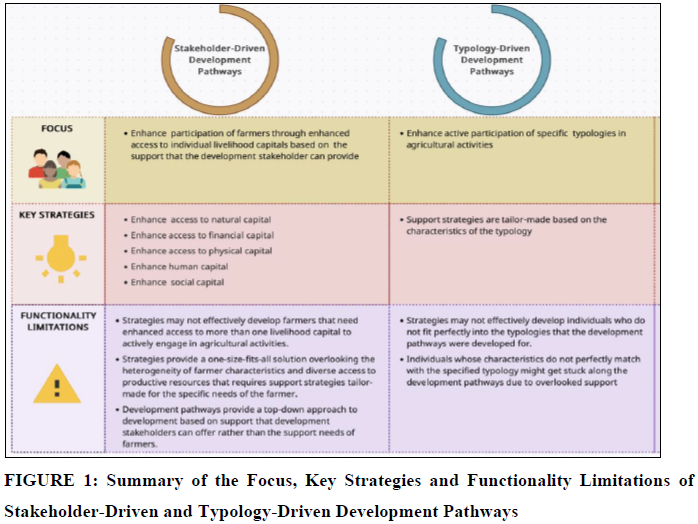
The limitations of both the stakeholder-driven and typology-driven pathways, as implicitly described above and summarised in Figure 1, highlight a critical gap. Focusing solely on individual livelihood capitals (stakeholder-driven) or strictly adhering to predefined farmer typologies (typology-driven) results in support strategies that often fail to effectively address the complex and diverse needs of farmers, particularly marginalised groups like youth.
Assumptions about a youth's existing resource endowment can severely limit the effectiveness of interventions. To address these shortcomings, there is a clear need for a holistic, functional solution to youth development in agriculture: an integrated development pathway. This pathway aims to empower youth directly by fostering a bottom-up approach, allowing them to identify their own specific support needs and choose strategies to enhance access to lacking resources. Instead of focusing on what can be provided or who fits a specific typology, an integrated pathway offers a comprehensive self-help tool comprising a pool of strategies that address diverse support needs, applicable regardless of a youth's specific characteristics or current resource endowment. This novel approach acknowledges that no assumptions should be made regarding a youth's initial support needs and that a flexible, self-guided process can be more effective.
3. DEVELOPMENT OF THE INTEGRATED DEVELOPMENT PATHWAY
The integrated development pathway is framed drawing from the diverse array of support strategies identified within both stakeholder-driven and typology-driven development pathways outlined in the previous section. While stakeholder-driven approaches provide strategies for developing individual livelihood capitals, and typology-driven pathways offer tailored strategies based on specific farmer characteristics, a more holistic approach is needed to effectively empower and develop diverse youth to actively engage in agriculture.
3.1. Theoretical foundation: The Modified Sustainable Livelihood Framework (MSLF)
Central to the conceptualisation of effective agricultural engagement is the principle that adequate access to various livelihood capitals is essential for individuals to participate actively and achieve positive livelihood outcomes (Zantsi, Pienaar & Greyling, 2021; He & Ahmed, 2022). The Sustainable Livelihood Framework (SLF) (DFID, 1999) offers a robust theoretical lens for understanding the interplay between an individual's capital base, their livelihood options, chosen strategies, desired outcomes, and vulnerability context (Timalsina, 2012). Recognising the crucial role of soft skills in livelihood strategies, the SLF has been modified to include Psychological Capital (PsyCap), forming the Modified Sustainable Livelihood Framework (MSLF) (Chipfupa, 2017). The MSLF provides a comprehensive framework by encompassing six key livelihood capitals:
Natural Capital: Includes resources such as land, water, and environmental resources.
Financial Capital: Includes resources such as credit and savings.
Physical Capital: Includes resources such as infrastructure, tools, equipment, and technology.
Human Capital: Includes skills, knowledge, health, and education.
Social Capital: Includes social networks, relationships, and group memberships.
Psychological Capital (PsyCap): Includes internal strengths such as hope, optimism, resilience, and self-efficacy.
Considering that youth's livelihood decisions and their engagement in agriculture are informed by their endowment across these capitals, the integrated development pathway is explicitly grounded in the MSLF. This framework provides a holistic lens for understanding the complex factors shaping livelihood strategies in agricultural contexts, ensuring a development pathway that addresses the comprehensive range of youth support needs.
3.2. Structure of the Integrated Development Pathway
The integrated development pathway structures its support strategies around the MSLF capitals, differentiating between key productive resources and supporting capitals. Key livelihood capitals include the natural, financial, and physical capitals, which are the directly productive resources youth need to engage actively and profitably in agriculture (Geza et al., 2021; Zulu, Djenontin & Grabowski, 2021; Madende et al., 2023; Roy, 2023; Giwu et al., 2024). Youth require access to land and water for production, financial capital for inputs and operational costs, and physical assets for efficiency and productivity. Supporting capitals include the human, social, and psychological capitals, which are crucial for leveraging and effectively utilising the key productive resources (Zulu, Djenontin & Grabowski, 2021; Boye et al., 2024; Baloyi et al., 2025). Youth can draw on their skills and knowledge (human capital) for farm management, social networks (social capital) for collective action and market access, and a positive mindset (PsyCap) as strategies to enhance access to key livelihood capitals, adapt and navigate challenges, and build resilience in the face of agricultural uncertainties. This comprehensive yet adaptable approach is central to empowering youth's self-directed development in agriculture.
The core contribution of this integrated pathway lies in its ability to address the inherent limitations of both the stakeholder-driven and typology-driven development pathways while leveraging their strengths. The criteria for harmonising these diverse strategies into a coherent, user-friendly self-help tool are rooted in the inclusivity, adaptability and self-help principles. By integrating diverse support strategies from the literature into this MSLF-aligned structure, the development pathway offers multiple options for acquiring and enhancing access to each capital. As such, youth are not limited to a single type of support but are empowered to explore diverse avenues to acquire the necessary resources. This flexibility acknowledges that a solution effective for one youth may not be for another, enabling individuals to select the most applicable strategies for their unique context and needs, often influenced by factors such as gender, geographical location, and current resource endowments, among many others. This approach to development not only addresses the fragmented nature of support initiatives offered along stakeholder-driven development pathways but also empowers youth to drive their own development process. The development pathway is thus inclusive and useful to all youth, regardless of their current resource endowment or specific typology, fostering a bottom-up, self-help development approach to enhance active engagement in agricultural activities. A discussion of the integrated development pathway is provided below.
4. THE INTEGRATED DEVELOPMENT PATHWAY
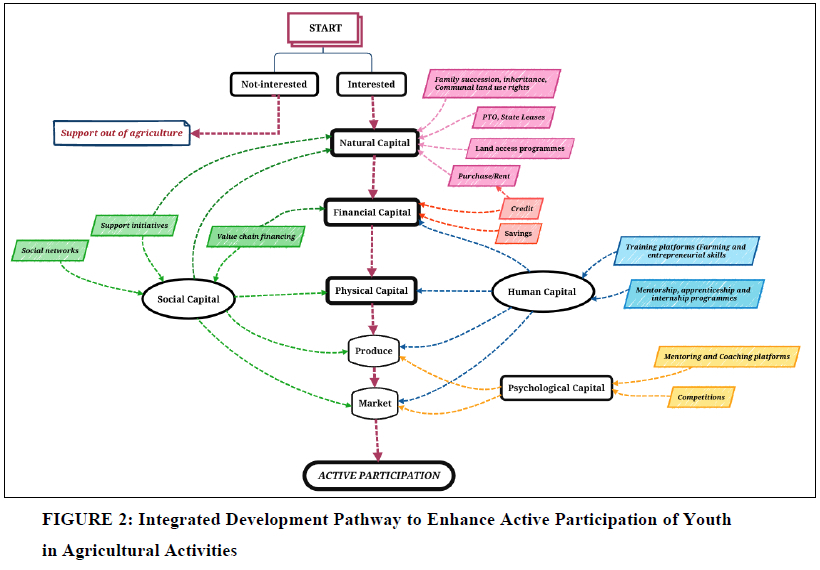
The integrated development pathway depicted in Figure 2 suggests a self-help tool for young people to map their unique development pathways towards active participation in agriculture. By consolidating a diverse pool of strategies to enhance access to essential livelihood capitals, the integrated pathways enable youth to produce and sell agricultural products profitably. The pathway posits that adequate access to key livelihood capital (natural, financial, and physical capitals) is key for production, while human, social, and psychological capitals (PsyCap) act as crucial supporting capitals that can be leveraged to access and effectively utilise key resources. As depicted in Figure 2, adequate access to key livelihood capitals will enable youth to produce products to sell. Successfully accessing markets and sufficient marketing expertise will then enable youth to sell their surplus produce at a profit and earn a livelihood from farming.
4.1. Natural capital
Access to natural capital, primarily land, is fundamental for youth to participate in agriculture (Kumeh & Omulo, 2019; Holden & Tilahum, 2021; Tilahum & Holden, 2023; Giwu et al., 2024). Figure 2 outlines a range of avenues for youth to acquire land or land-use rights, while critically acknowledging that solutions must be tailored to diverse socio-economic and institutional contexts across South Africa. This approach directly empowers youth by offering multiple entry points rather than a singular prescriptive path.
Youth can explore options such as:
Succession and inheritance: While often slow, youth can actively build trust with older generations by demonstrating interest, capability and trust (Ibrahim et al., 2024), potentially accelerating land transfer. This emphasises proactive engagement rather than passive waiting. Such a community-based approach can be adopted from models that have been successful in other countries (Wawuyu, 2022).
Communal and commonage land: Youth can directly engage local and traditional authorities to secure use rights. The pathway encourages initiatives to formalise these rights (e.g., PTO certificates), addressing the insecurity often associated with informal arrangements (Kidido & Bugri, 2017). This facilitates advocating for formal recognition and clarity of access to productive assets for youth in agriculture.
Purchasing and renting: For youth with financial capital, these options offer secure tenure. The pathway links this to financial capital development (Ricker-Gilbert & Chamberlin, 2018), highlighting that access is not just about availability but also financial readiness. This points to the interdependencies within the integrated model. Access to credit could allow youth to purchase land that they privately own, with rights that are more secure and documented. The credit granted by commercial lenders often requires the borrower to provide collateral, and, in the absence of such collateral, other available sources of credit to purchase land that youth could consider include the Agri-Industrial Fund and the Small Enterprise Finance Agency (SEFA).
Government support programmes: Youth can proactively apply for state leasing and land redistribution initiatives, many of which prioritise young people (Kepe & Hall, 2020; DALRRD, 2020). The South African land tenure reform programme considers the youth to be critical stakeholders who should benefit from its land redistribution programme and initiatives such as the state leasing programme. Young people and women have been considered priority groups for state-owned lease programmes for agricultural land to emerging farmers for 30 years (DALRRD, 2020). Youth need to be proactive in seeking information on different programmes, including eligibility criteria, application forms, deadlines, and required documentation, and be determined in pursuing such opportunities, which are often slow, complex, and unorganised.
Collective Action: Forming cooperatives or youth clubs enables collective land ownership (e.g., Communal Property Associations), reducing individual barriers to entry (van Huffel, 2024). This explicitly fosters peer-to-peer collaboration and leveraging group strength.
Social-based support programmes: Youth can benefit from initiatives such as Land Redistribution for Agricultural Development (LRAD), Ilima, Comprehensive Agricultural Support Programme (CASP), and the Youth Land Care programme, which facilitate land access often with specific youth considerations (Madende et al., 2023). Initiatives such as the Job Funds might also assist youth in accessing land through incubator farms that youth can use for their production activities.
By presenting these diverse, context-specific support strategies, the pathway moves beyond a generalised approach. It empowers youth to identify the most feasible land access strategy for their specific situation, whether through family ties, community engagement, market participation, government support, or collective action, thereby enhancing their agency across diverse regional and socio-economic landscapes.
4.2. Financial Capital
Access to financial capital (credit, savings) is a critical enabler for youth in agriculture, underpinning their ability to acquire land and other productive resources (Rogito et al., 2020). The integrated pathway directly addresses how to overcome common structural barriers, such as collateral requirements, risk perception, and financial literacy, by leveraging other forms of capital and offering diverse avenues for financing.
Youth can pursue financial capital through:
Commercial Credit: Commercial credit can be accessed through commercial banks such as ABSA Bank, Standard Bank, First National Bank and Nedbank (Western Cape Department of Agriculture, 2022). While access to commercial credit is often limited by collateral and perceived high risk for youth (Yami et al., 2019), the pathway emphasises the development of human capital (e.g., budgeting, record-keeping, business planning, understanding credit criteria) to improve creditworthiness (FAO, 2013; Rogito et al., 2020). Skills can be acquired through training offered by various organisations and associations, such as NYDA, Small Enterprise Development Agency (Seda), CASP and extension services (DAFF, 2019). This can equip youth to present themselves as more competent and reliable, with the skills to overcome perceived financial literacy gaps and to submit stronger applications, potentially through formal agreements for leased land.
Local support programmes and institutions: Numerous initiatives such as the Youth Fund (AYF), CASP, the Micro-Agricultural Financial Institution of South Africa (MAFISA), the AgriBEE Fund, the Critical Infrastructure Programme (CIP), the Jobs Fund Project, the Blended Finance Scheme (BFS), the Youth Challenge Fund (YCF), the Cooperatives Development Support Programme (CDSP), and the Localisation Programme, specifically target youth or agribusinesses with financial support. The youth can also approach agricultural companies that offer credit for farming businesses, such as KAAP Agri, Capital Harvest, Unigro Agricultural Finance, HortFin, AgriSeed Capital, and BKB AgriFin. Youth can also apply for credit from development finance institutions and agencies that support youth with funding to grow or diversify their agricultural businesses, such as the National Youth Development Agency (NYDA), the Small Enterprise Finance Agency (SEFA), the Masisizane Fund, SEDA, the Enablis Acceleration Fund, and the Anglo-American Zimele Fund (Green Agri, n.d). Youth need to proactively seek and apply for these tailored programs.
Social capital development: While traditional lenders often require collateral, such as land or property, as security for credit, young people, especially in developing contexts, lack these significant assets. Leveraging social capital through participation in cooperatives and youth savings groups significantly enhances access to financial resources and production credit (Smith, Scott & Shepherd, 2015; Issa & Kagbu, 2016). Collective bargaining power can reduce input costs and boost profits, enabling savings. Agencies such as SEFA, which target financing cooperatives, can also be approached. Furthermore, engaging in value chain financing, where risk is distributed, can provide access to credit from input suppliers or institutions such as the Land Bank, HortFin, the Masisizane Fund, and Kaap Agri (Green Agri, n.d.), which might otherwise be inaccessible to individual farmers with higher risk profiles. This approach directly addresses the collateral and risk-perception barriers by leveraging collective guarantees and diversified lending models, as the collective assets and members' shared responsibility serve as social collateral. Importantly, youth can gain financial knowledge through online resources from agricultural institutions, webinars, and through peer-to-peer learning within cooperatives or youth groups.
The integrated pathway recognises that access to financial capital is not solely about credit availability but also about developing financial literacy, leveraging social networks, and identifying alternative, less stringent funding models. By providing a range of strategies that engage human and social capital, the pathway offers effective ways for diverse youth to overcome the systemic financial barriers they often face.
4.3. Physical Capital
Access to physical capital ranging from basic tools (shovels, hoes, wheelbarrows) and physical resources (vehicles, computers, television, radio, smartphones) to advanced machinery (tractors, implements), farm infrastructure (farmhouses, fencing, storage facilities, handling facilities, boreholes), and productive assets (livestock) is crucial for agricultural engagement (Songca et al., 2024).
Youth can enhance access to physical capital through:
Financial capital development: The most direct route is through purchasing assets, which necessitates developed financial capital. Considering youth already have constrained access to commercial credit and savings, the pathway highlights organisations such as HortFin and Seda that offer infrastructure credit, linking financial readiness to physical asset acquisition.
Social capital development: Collective action through cooperatives or youth organisations enables shared acquisition, borrowing, or renting of expensive productive assets such as machinery and implements. This strategy directly addresses resource endowment disparities by making otherwise unaffordable assets accessible to groups, leveraging shared resources to overcome individual limitations.
Human capital development: Acquiring skills to operate, repair, and maintain technologically advanced assets is essential.
Support programmes: Government initiatives such as CASP, the Cooperatives Development Support Programme (CDSP), and the Critical Infrastructure Programme (CIP) can provide direct access to infrastructure and equipment (DAFF, 2019). The pathway encourages youth to proactively apply for these programs, which are vital for youth in marginalised geographic areas or with limited personal endowments.
The integrated pathway suggests multiple, interconnected avenues for physical capital access. By linking it to financial and social capital development and the proactive engagement with support programs, it implicitly addresses how youth with varied initial endowments or geographic locations can strategically acquire necessary assets. The pathway empowers youth to make their own decisions, tailoring support strategies to their specific resource limitations.
4.4. Produce
The previous sections highlighted the importance of access to natural, financial, and physical capital for agricultural engagement. By effectively utilising these key livelihood capitals and leveraging supporting capitals (human, social, and psychological), youth can achieve production and enhanced productivity, as indicated in Figure 2. As such, production and productivity are considered outcomes of the interplay and synergy among all livelihood capitals within the integrated development pathway, representing the successful transformation of resources into marketable agricultural goods.
To maximise production and productivity, youth can:
Develop human capital: This involves acquiring essential farming, entrepreneurial, and farm management skills through training, internships, mentorship, and apprenticeships (DSBD, 2021). Practical experience and shared success stories are vital for adopting effective production techniques and cultivating an entrepreneurial mindset (self-reliance, innovativeness, proactiveness). Organisations such as extension services, Seda, NYDA, Community Work Programme (CWP), National Rural Youth Service Corps (NARYSEC), and Sernick's Emerging Farmers' Programme offer platforms for skill development, including technologically advanced methods. The National Research Fund (NRF) also funds apprenticeships to develop the skills of unemployed youth in agriculture. Interested youth should take the initiative to apply to participate in such programmes.
Leverage social capital: Networks, youth clubs, cooperatives, and social media facilitate knowledge exchange on effective resource use and production techniques (Qui et al., 2021; Laitinen & Sivunen, 2021). Collective action can also improve access to inputs and credit, boosting productivity through bulk purchasing and negotiated prices (Yu & Gambrah, 2024). Furthermore, accessing information from institutions such as universities, the Agricultural Research Council (ARC), the Water Research Commission (WRC), the NRF and the National Agricultural Marketing Council (NAMC) through their websites, webinars, and workshops provides valuable knowledge (Kipkurgat, Onyiego & Chemwaina, 2016).
Cultivate PsyCap: A positive mindset (resilience, optimism, self-confidence, hope) directly influences efficiency and productivity in agriculture (Chipfupa & Wale, 2018). Mentorship, coaching from experienced farmers, and engagement in competitions (e.g., Youth in Agriculture, Forestry and Fisheries (YAFF) awards, Young Farmer and Female Farmer of the Year, Youth Innovation Competition (InnovatHER) and forums such as the Youth Forum Webinars) can foster positive PsyCap, transforming perceptions about agricultural livelihoods and inspiring success (South African Government, 2017). Attending exhibitions and shows such as the African Farmers' Association of South Africa (AFASA), the young farmers' roadshows, the Grain SA roadshows, and the NAMPO Agricultural shows also provides exposure to advanced production techniques.
Produce is the tangible outcome of effective capital accumulation and utilisation. It underscores that merely having access to physical land or credit isn't enough. Efficient production stems from a strategic combination of all livelihood capitals, enabling youth to generate the surplus needed for market engagement.
4.5. Market
While producing a surplus is necessary, successful market access and effective marketing activities are crucial for youth to earn a profitable livelihood from agriculture. Challenges such as inadequate infrastructure, limited financial resources, and a lack of market information commonly hinder small-scale farmers from selling their produce profitably (Yamanaka et al., 2019; Agholor, Ogujiuba, & Shongwe, 2023; Manganyi et al., 2024). The integrated pathway provides diversified strategies to help youth gain access to profitable markets, leveraging supporting capital.
Youth can improve market access through:
Social capital development: Collective action through cooperatives or youth clubs facilitates meeting the quality and quantity requirements of formal markets, reduces transaction costs (e.g., transport), and addresses information asymmetry (Figure 2). Cooperatives can also assist in obtaining product guarantees, such as quotas and certification. Programs such as the SAB Foundation Tholoana Enterprise Programme foster peer-to-peer networks to enhance entrepreneurial skills and market access (SAB, 2023).
Human capital development: Developing entrepreneurial skills, including technical business, marketing, leadership, financial management, pricing, selling, and value addition, is paramount (Manganyi et al., 2024). Training programs from Seda, AgriSeed Capital, CWP, and extension services are vital for equipping youth with these skills, enabling them to operate more effectively in the market and maximise profits.
Positive PsyCap: Self-confidence and hope are essential for negotiating prices, concluding sales, and securing contracts in competitive formal markets. Mentorship and coaching from established farmers can significantly build this confidence, helping youth navigate market dynamics. Engaging in youth forums and attending agricultural exhibitions also fosters a positive mindset and provides valuable market insights.
The integrated development pathway provides a comprehensive set of strategies, allowing youth to selectively leverage their endowment to support livelihood capitals (PsyCap, social, and human) and improve access to and effective utilisation of natural, financial, and physical capitals. This ultimately enables them to produce and sell surplus produce at a profit, ensuring a sustainable livelihood from farming. The pathway empowers youth to proactively map a specific strategy, recognising that each youth's journey will be unique yet guided by a shared framework for success.
5. DISCUSSION
The proposed integrated development pathway represents a significant conceptual shift, positioning itself as a self-help tool that empowers youth to actively drive their own agricultural development. Contrary to traditional stakeholder-driven or typology-driven approaches that foster development from the perspective of external support and development organisations or predefined categories (Tomich et al., 2019; Osabohien et al., 2022; Von Maltitz et al., 2023), the new pathway explicitly adopts a youth-centric, bottom-up perspective. Within this development approach, young farmers are not considered passive recipients; rather, active pioneers who can identify and select strategies best suited to enhance their access to crucial livelihood capitals. The integrated pathway presents a transition of government and other development organisations from being primary drivers to vital support enablers, fostering independence rather than dependence on external interventions such as extension services. This aligns with broader Sustainable Development Goals (SDGs) focused on youth empowerment, food security, and sustainable livelihoods by enhancing access to productive resources, knowledge, skills, and markets.
A key strength of this pathway is its inherent flexibility and adaptability. Complementing the currently available development pathways, the integrated pathway enables youth to tailor their development and choose strategies that align with their specific needs and contexts. This personalised approach is key to addressing the well-documented challenges youth face in accessing essential livelihood capitals. By empowering youth to choose strategies they believe in, the pathway fosters greater ownership and commitment, likely leading to more sustainable engagement compared to top-down interventions based on generalised assumptions. Furthermore, the pathway acknowledges that development is not necessarily a linear process; youth can utilise this tool at any stage of their agricultural journey, whether initiating, sustaining, or expanding activities, to enhance profitability and secure their agricultural-based livelihoods. The choice of strategy remains entirely dependent on their unique characteristics and aspirations.
To yield the desired outcome, the implementation of the integrated development pathway requires a significant transition in how existing development institutions, which include government departments (e.g., DALRRD), financial institutions, extension services, and NGOs, engage with youth for agricultural development. Complementing the integrated development pathway with capacity assessment tools, such as the FAO rapid capacity assessment tool (FAO, 2021), that aim to create an enabling environment to provide effective support initiatives, can enhance the alignment of youth support needs with the capacities of support stakeholders. The reconceptualisation of development, specifically for youth in agriculture, proposed by the integrated development pathway, provides a facilitative rather than directive process that can positively influence youth participation in agriculture. While the pathway fosters a self-help model, transitioning development stakeholders from being directive to becoming responsive facilitators of the development process is key. Furthermore, coordination between various support and development stakeholders is crucial to provide the diverse support strategies that youth may need to successfully produce for a profit (FAO, 2021). Rather than offering prescriptive support initiatives, it is crucial to enhance the capacity of development stakeholders to foster youth-led support.
6. CONCLUSIONS
Given the limited functionalities of stakeholder-driven and typology-driven development pathways, the main objective of the study was to develop an integrated development pathway to enhance youth participation in agriculture. Developing youth to engage in agriculture actively is a critical strategy for achieving several SDGs. Alignment with the Sustainable Development Goals in development initiatives underscores a commitment to global sustainability, particularly in the agricultural sector. To develop such a pathway, it is necessary to focus on the key productive capitals and strategies to enhance access to them. A pathway that provides a pool of strategies to enhance access to key livelihood capitals (natural, financial and physical) was developed (leveraging on social, human and psychological capitals). The integrated development pathway replaces the typical top-down approach to development with a bottom-up approach based on the needs of youth, rather than stakeholder- or typology-driven support strategies. The bottom-up approach focuses on empowering youth, addressing the well-documented dependency culture prevalent among smallholder farmers, including youth. The pathway fosters self-help strategies, allowing youth to choose the one that best suits their support needs, without depending on third-party development agents to lead the process. The focus of the integrated development pathway is on capacitating youth to map their own development and address their constrained access to livelihood capitals to actively participate in agriculture. Following the pathway, youth can choose the best strategies to produce surplus products and sell them at a profit, making a living from farming activities. The pathway also allows youth to use it, regardless of the typology they relate to or the stage they are at in their business cycle.
Based on this research, the conclusion is that a development pathway focused on strategies to enhance access to physical, financial, and natural capital can be successfully applied by interested youth to engage actively in agricultural activities. Concentrating on strategies rather than typologies can be more effective for developing youth, depending on their individual characteristics. Youth can use the integrated development pathway as a self-help tool to map their own personalised strategy to enhance access to key productive resources and facilitate their active participation in agriculture. Youth should be proactive in leveraging other livelihood capitals (human, social, and psychological) to enhance their access to key productive resources and become independent of third-party development agents and the government.
The integrated development pathway presents a solution-driven functional tool for policy. The tool provides more effective bottom-up support for youth than a top-down approach, addressing low youth participation in agricultural activities and tackling the youth unemployment crisis. Policy and other development partners could use the integrated pathway as a roadmap for implementing youth development initiatives, avoiding "double-dipping" into support initiatives that are often fragmented, created in silos, and primarily address short-term goals. By providing a pool of strategies, the integrated pathway facilitates the review and synchronisation of fragmented support initiatives, harmonising their objectives, strategies, management, and systems, ensuring that youth development programs are more coordinated and effective. Furthermore, the integrated pathway can aid the effectiveness of capacity assessment tools for supporting stakeholders. Complementing the integrated development pathway with capacity assessment tools can ensure effective synergy of the specific support needs of youth and the capacity of support stakeholders, creating an enabling environment for the sustainable development of the agricultural sector through youth empowerment and development.
It is noted that this development tool was specifically designed for youth in South Africa, with the strategies suggested along the pathway guided by available support initiatives in the country. The tool could be adapted to develop youth in other economies by replacing the South African programmes with those applicable to the specific country and supporting organisations. The focus is placed on youth being initiators and owners of their own development process, while using government and other development organisations only as support. Further research could adapt the development pathway to support other groups in agriculture beyond youth. Although the pathway provides a pool of support strategies implemented by different role players to support development along it, youth often lack knowledge and guidance on where to access support and funding. Further research could thus examine the role and development of a knowledge hub that connects youth to relevant, up-to-date support programmes by providing in-depth information on available support initiatives and how to access them. Further research could also develop a complementary self-assessment tool that empowers youth to effectively assess their own resource endowments. Such a tool could simplify the youth's understanding of the resources they have access to (haves) and those they have limited access to (have-nots), and effectively guide their choice of support strategies along the integrated development pathway.
REFERENCES
- ADEYANJU, D., MBURU, J., GITURO, W., CHUMO, C., MIGNOUNA, D., MULINGANYA, N. & ASHAGIDIGBI, W., 2023. Can young agripreneurs improve their skills through agripreneurship empowerment programmes? Evidence from Africa. Heliyon., 9(1): 1-12.
- AGHOLOR, A.I., OGUJIUBA, K.K. & SHONGWE, N.I., 2023. Determinants of small farmers' access to agricultural markets in South Africa. Agric. Sci. Technol., 15(1): 80-87.
- AMADU, F.O., 2022. Farmer extension facilitators as a pathway for climate smart agriculture: evidence from southern Malawi. Clim. Policy., 22(10): 1097-1112.
- ANANTHA, K.H., GARG, K.K., MOSES, D.S., PATIL, M.D., SAWARGAONKAR, G.L., KAMDI, P.J., MALVE, S., SUDI, R., RAJU, K.V. & WANI, S.P., 2021. Impact of natural resource management interventions on water resources and environmental services in different agroecological regions of India. Groundwater Sustain. Dev., 13: 100574.
- ANANTHA, K.H., GARG, K.K., PETRIE, C.A. & DIXIT, S., 2021. Seeking sustainable pathways for fostering agricultural transformation in peninsular India. Environ. Res. Lett., 16(4): 044032.
-
ARORA, S., NARAYANARAO, B., MITTAL, N. & VADEKKAL, R.S., 2024. Agricultural innovations for sustainability? Diverse pathways and plural perspectives on rice seeds in Odisha, India. Agric. Hum. Values., 1-18. https://doi.org/10.1007/s10460-024-10666-0.
» https://doi.org/10.1007/s10460-024-10666-0 - BALOYI, R., WALE, E., NINGI, T., NDABA, L. & TAMAKO, N., 2025. Understanding decisions of rural youth to participate in livestock farming: Some evidence from South Africa. Afr. J. Dev. Stud., 15(1): 351-368.
- BARBOSA, M.W., 2024. Government support mechanisms for sustainable agriculture: A systematic literature review and future research agenda. Sustainability., 16(5): 2185.
- BOYE, M., GHAFOOR, A., WUDIL, A.H., USMAN, M., PRUS, P., FEHÉR, A. & SASS, R., 2024. Youth engagement in agribusiness: Perception, constraints, and skill training interventions in Africa: A systematic review. Sustainability., 16(3): 1096.
- CHIPFUPA, U., 2017. Entrepreneurial development pathways for smallholder irrigation farming in KwaZulu-Natal: typologies, aspirations and preferences. Doctoral thesis, University of KwaZulu-Natal, South Africa.
- CHIPFUPA, U. & WALE, E., 2018. Farmer typology formulation accounting for psychological capital: Implications for on-farm entrepreneurial development. Dev. Pract., 28(5): 600-614.
-
DEPARTMENT OF AGRICULTURE, LAND REFORM AND RURAL DEVELOPMENT (DALRRD)., 2020. Government Gazette. Available from https://www.gov.za/sites/default/files/gcis_document/202001/42939gon2.pdf
» https://www.gov.za/sites/default/files/gcis_document/202001/42939gon2.pdf - DENISON, J., DUBE, S.V., MASIYA, T.C., MOYO, T., MURATA, C., MPYANA, J., VAN AVERBEKE, L.L. & VAN AVERBEKE, W., 2016. Smallholder irrigation entrepreneurial development pathways and livelihoods in two districts in Limpopo Province. WRC Report No. 2179/1/16. Water Research Commission.
-
DEPARTMENT FOR INTERNATIONAL DEVELOPMENT (DFID)., 1999. Sustainable livelihoods guidance sheets. Department for International Development. Available from http://www.livelihoodscentre.org/documents/20720/100145/Sustainable+livelihoods+guidance+sheets/8f35b59f-8207-43fc-8b99-df75d3000e86
» http://www.livelihoodscentre.org/documents/20720/100145/Sustainable+livelihoods+guidance+sheets/8f35b59f-8207-43fc-8b99-df75d3000e86 -
DEPARTMENT OF AGRICULTURE, FISHERIES AND FORESTRY (DAFF)., 2019. Comprehensive Agricultural Support Programme (CASP), and Ilima/Letsema Conditional Grants (Focus On 2019/20 Business Plan). Available from https://static.pmg.org.za/190903CASP_ILIMA.pdf
» https://static.pmg.org.za/190903CASP_ILIMA.pdf - DEPARTMENT OF AGRICULTURE, FISHERIES AND FORESTRY (DAFF)., 2015. Catalogue for producer support and development.
-
DEPARTMENT OF SMALL BUSINESS AND DEVELOPMENT (DSBD)., 2021. Youth Challenge Fund. Available from http://www.dsbd.gov.za/sites/default/files/publications/youth-challenge-fund-brochure.pdf
» http://www.dsbd.gov.za/sites/default/files/publications/youth-challenge-fund-brochure.pdf -
FOOD AND AGRICULTURE ORGANISATION (FAO)., 2013. FAO Statistical Yearbook: World Food and Agriculture. Available from https://doi.org/10.1787/agr_outlook-2013-sum-en
» https://doi.org/10.1787/agr_outlook-2013-sum-en -
FOOD AND AGRICULTURE ORGANISATION (FAO)., 2021. Rapid capacity assessment tool: Strengthening capacities to enhance responsible investment in agriculture and food systems. Available from https://openknowledge.fao.org/server/api/core/bitstreams/d2d84a5d-1637-4a56-b202-a79deed8d5db/content
» https://openknowledge.fao.org/server/api/core/bitstreams/d2d84a5d-1637-4a56-b202-a79deed8d5db/content -
GEZA, W., NGIDI, M., OJO, T., ADETORO, A.A., SLOTOW, R. & MABHAUDHI, T., 2021. Youth participation in agriculture: A scoping review. Sustainability., 13: 9120. https://doi.org/10.3390/su13169120.
» https://doi.org/10.3390/su13169120 - GINA, G.A., MARIYA, A., NATALIA, C., NISPUANA, S., WIJAYA, M.F. & PHALEPI, M.Y., 2023. The role of the agricultural sector on economic growth in Indonesia. Int. J. Multidiscip. Sci., 2(1): 167-179.
- GIRDZIUTE, L., BESUSPARIENE, E., NAUSEDIENE, A., NOVIKOVA, A., LEPPALA, J. & JAKOB, M., 2022. Youth's (Un) willingness to work in agriculture sector. Front. Public Health., 10: 937657.
- GIWU, O., MDODA, L., NTLANGA, S.S. & LOKI, O., 2024. Evaluating factors influencing youth participation in agricultural enterprises: Implications for food security and agribusiness. South. Afr. J. Entrepreneurship Small Bus. Manage., 16(1): 903.
-
GREEN AGRI., n.d. Funding opportunities. Available from https://www.greenagri.org.za/funding-and-incentives/government-and-developmental-institutes-financing/
» https://www.greenagri.org.za/funding-and-incentives/government-and-developmental-institutes-financing/ - HE, Y. & AHMED, T., 2022. Farmers' livelihood capital and its impact on sustainable livelihood strategies: Evidence from the poverty-stricken areas of Southwest China. Sustainability., 14(9): 4955.
-
HENNING, J.I.F., MATTHEWS, N., AUGUST, M. & MADENDE, P., 2022. Youths' perceptions and aspiration towards participating in the agricultural sector: A South African Case Study. Soc. Sci., 11: 215. https://doi.org/10.3390/socsci11050215.
» https://doi.org/10.3390/socsci11050215 - HOLDEN, S.T. & TILAHUN, M., 2021. Are land-poor youth accessing rented land? Evidence from northern Ethiopia. Land Use Policy., 108: 105516.
- IBRAHIM, S., SAMAILA, N. & GARBA, L., 2024. Factors associated with land accessibility among rural farm youth in Kebbi State, Nigeria. J. Agric. Sci. Pract., 9(3): 48-56.
- ISSA, F.O. & KAGBU, J.H., 2016. Institutional support for youth agribusiness cooperative development and management in Nigeria: The Oyo State Example. Asian J. Agric. Ext. Econ. Sociol., 10(1).
- KEPE, T. & HALL, R., 2020. Land redistribution in South Africa: Towards decolonisation or recolonisation?. In L. Piper (ed.), Decolonisation after Decolonisation after Democracy: Rethinking the research and teaching of political science in South Africa. Routledge, pp. 128-137,
-
KHAN, F. U., NOUMAN, M., NEGRUT, L., ABBAN, J., CISMAS, L. M., & SIDDIQI, M. F., 2024. Constraints to agricultural finance in underdeveloped and developing countries: A systematic literature review. Int. J. Agric. Sustain., 22(1). https://doi.org/10.1080/147359032024.2329388
» https://doi.org/10.1080/147359032024.2329388 -
KIDIDO, J.K.; BUGRI, J.T. & KASANGA, R.K., 2017. Dynamics of youth access to agricultural land under the customary tenure regime in the Techiman traditional area of Ghana. Land Use Policy., 60: 254-266. https://doi.org/10.1016/j.landusepol.2016.10.040.
» https://doi.org/10.1016/j.landusepol.2016.10.040 - KIMANI, J.G. & RUIGU, G.R., 2017. The impact of research and development investment on agricultural sector performance in Kenya. J. Agric. Policy., 2(1): 34-57.
- KIPKURGAT, T., ONYIEGO, M. & CHEMWAINA, S., 2016. Impact of social media on agricultural extension in Kenya: A case of Kesses District. Int. J. Agric. Ext. Rural Dev. Stud., 3(1): 30-36.
- KOTE, P., YALLAPA, M., JABEEN, A., SRINATHA, T.N., PRABHAVATHI, S.J., RAMASAMY, M., DHANALAKSHMI, K., CHITRA, K. & MALATHI, G., 2024. A scoping review on youth participation in agriculture: Sustainable development, food security, and economic growth. J. Sci. Res. Reports., 30(5): 947-58.
-
KUMEH, E.M. & OMULO, G., 2019. Youth's access to agricultural land in Sub-Saharan Africa: A missing link in the global land grabbing discourse. Land Use Policy., 89: 104210. https://doi.org/10.1016/j.landusepol.2019.104210.
» https://doi.org/10.1016/j.landusepol.2019.104210 - LAITINEN, K. & SIVUNEN, A., 2021. Enablers of and constraints on employees' information sharing on enterprise social media. Inf. Technol. People., 34(2): 642-665.
- MADENDE, P., HENNING, J.I. & JORDAAN, H., 2023. Accounting for heterogeneity among youth: A missing link in enhancing youth participation in agriculture-A South African case study. Sustainability., 15(6): 4981.
-
MADENDE, P., HENNING, J.I. & JORDAAN, H., 2023. Tailor-made development pathways: A framework to enhance active participation of youth in agriculture. Soc. Sci., 12: 630. https://doi.org/10.3390/socsci12110630.
» https://doi.org/10.3390/socsci12110630 -
MANGANYI, B., SOTSHA, K., RAMBAU, K. & CHILOANE D., 2024. Improving market access for smallholder farmers in SA. Available from https://www.namc.co.za/wp-content/uploads/2024/10/Policy-Brief-Improving-Market-Access-for-Smallholder-Farmers-in-South-Africa.pdf
» https://www.namc.co.za/wp-content/uploads/2024/10/Policy-Brief-Improving-Market-Access-for-Smallholder-Farmers-in-South-Africa.pdf -
MATHIVHA, O., 2012. Current and emerging youth policies and initiatives with a special focus on links to agriculture: South African case study report on youth participation in agriculture. Available from https://fanrpan.org/wp-content/uploads/2025/04/Country_Case_Study-South_African-April2012-2.pdf
» https://fanrpan.org/wp-content/uploads/2025/04/Country_Case_Study-South_African-April2012-2.pdf - MUKWEDEYA, B. & MUDHARA, M., 2024. Factors affecting rural youth participation in the smallholder farming sector. J. Agric. Food Syst. Community Dev., 13(4): 259-275.
- MUZEKENYI, M., NYIKA, F. & HOQUE, M., 2023. A small-scale farming intervention plan for inclusive economic development in rural South Africa. Int. J. Food Agric. Nat. Resour., 4(2): 46-52.
-
NAUDE, P. & SEKWATLAKWATLA, P., 2023. Sernick's Farmer Development Programme: A beacon of hope and progress. Available from https://agriorbit.com/sernicks-farmer-development-programme-a-beacon-of-hope-and-progress/
» https://agriorbit.com/sernicks-farmer-development-programme-a-beacon-of-hope-and-progress/ - NCUBE, A., 2017. The socio-economic coping and adaptation mechanisms employed by African migrant women in South Africa. Doctoral dissertation, University of the Free State, South Africa.
- NATIONAL YOUTH DEVELOPMENT AGENCY (NYDA)., 2021. Our Youth. Our future. NYDA Youth Development report 2020/2021. Pretoria, South Africa: NYDA.
- OSABOHIEN, R., MORDI, A. & OGUNDIPE, A., 2022. Access to credit and agricultural sector performance in Nigeria. Afr. J. Sci. Technol. Innov. Dev., 14(1): 247-255.
- QUI, N.H., GUNTORO, B., SYAHLANI, S.P. & LINH, N.T., 2021. Factor affecting the information Sources and communication channels toward pig farmer's perception of African swine fever in Tra Vinh province, Vietnam. Trop. Anim. Sci. J., 44(2): 248-254.
- RATHAVA, S., CHAUDHARY, K. & RATHWA, S., 2023. A review on opportunities and challenges of youth in agriculture. Madhav Res. Rev., 5(1): 72-77.
- RICKER-GILBERT, J. & CHAMBERLIN, J., 2018. Transaction costs, land rental markets, and their impact on youth access to agriculture in Tanzania. Land Econ., 94: 541-555.
- ROGITO, J.M., MAKHANU, E., MOMBINYA, B.K. & NYAMOTA, G., 2020. Relationship between access to financial services and youth involvement in agricultural value chains in Kakamega county, Kenya. Agric. Resour. Econ. Int. Sci. E-J., 6(2): 24-336.
- ROGITO, J.M., MAKHANU, E., ROGITO, J.M. & MAKHANU, E., 2024. Access to land and youth involvement in agricultural value chains in Kenya. Int. J. Sci. Res. Arch., 11: 2185-2193.
- ROY, S.K., 2023. Influencing factors for pursuing agriculture as a career for agriculture undergraduates: A two-stage approach. Entrepreneurship Educ., 6(2): 169-203.
- RUSERE, F., CRESPO, O., MKUHLANI, S. & DICKS, L.V., 2019. Developing pathways to improve smallholder agricultural productivity through ecological intensification technologies in semi-arid Limpopo, South Africa. Afr. J. Sci. Technol. Innov. Dev., 11(5): 543-553.
-
SAB FOUNDATION., 2023. Tholoana Enterprise Programme Information Brochure 2023. Available from https://innovationbridge.info/ibportal/sites/default/files/tholoanaenterpriseprogramme-digitalinformationbrochure2023.pdf
» https://innovationbridge.info/ibportal/sites/default/files/tholoanaenterpriseprogramme-digitalinformationbrochure2023.pdf -
SMITH, W., SCOTT, L. & SHEPHERD, A., 2015. Financial inclusion policy guide: Enhanced resilience through savings and insurance via linkages and digital technology. Policy Guide No. 6. London: Chronic Poverty Advisory Network. Available from https://dl.orangedox.com/FbQBiI2eyW6clPZA77
» https://dl.orangedox.com/FbQBiI2eyW6clPZA77 - SONGCA, S.S., HENNING, J.I.F. & MADENDE, P., 2024. Livelihood assets influence on rural youth participating in support initiatives to enhance agricultural participation. S. Afr. J. Agric. Ext., 52(4): 17-46.
-
SOUTH AFRICAN GOVERNMENT., 2017. Agriculture, Forestry and Fisheries hosts Youth in Agriculture, Forestry and Fisheries Awards. Available from https://www.gov.za/speeches/youth-agriculture-forestry-and-fisheries-honoured-excellence-19-jun-2017-0000
» https://www.gov.za/speeches/youth-agriculture-forestry-and-fisheries-honoured-excellence-19-jun-2017-0000 - STADS, G.J., 2016. Investment in agricultural research and development: An account of two-speed growth, underinvestment, and volatility. In J. Lynam, J. Roseboom, N.M. Beintema & O. Badiane (eds.), Agricultural research in Africa: Investing in future harvests. Washington, DC: IFPRI, pp. 85-108.
- STRINGER, L.C., FRASER, E.D., HARRIS, D., LYON, C., PEREIRA, L., WARD, C.F. & SIMELTON, E., 2020. Adaptation and development pathways for different types of farmers. Environ. Sci. Policy., 104: 174-189.
- TIKUM, K. & AHMAD, M. M., 2024. Challenges of making a new farmer: A case study of Thailand's Young Smart Farmer program. Dev. Stud. Res., 11(1).
- TILAHUN, M. & HOLDEN, S.T., 2023. Livelihood diversification and migration intentions among land-poor youth in Tigray, Northern Ethiopia: do they correlate with livestock assets, trust, and trustworthiness? Front. Sustain. Food Syst., 7: 1175572.
- TIMALSINA, K.P., 2012. Contextualizing livelihood of street vendors in the urban areas of Kathmandu metropolitan city, Nepal. Int. J. Polit. Good Gov., 3(3): 1-24.
- TOMICH, T.P., LIDDER, P., COLEY, M., GOLLIN, D., MEINZEN-DICK, R., WEBB, P. & CARBERRY, P., 2019. Food and agricultural innovation pathways for prosperity. Agric. Syst., 172: 1-15.
- TUI, S.H.K., SISITO, G., MOYO, E.N., DUBE, T., VALDIVIA, R.O., MADAJEWICZ, M., DESCHEEMAEKER, K. & RUANE, A.C., 2022. Developing pathways for sustainable agricultural development in Zimbabwe by 2030. In X. Poshiwa & G.R. Chary (eds.), Climate change adaptations in dryland agriculture in semi-arid areas. Singapore: Springer Nature, pp. 185-202.
-
TUROLLA, M., SWEDLUND, H.J., SCHUT, M. & MUCHUNGUZI, P., 2022. "Stop Calling Me a Youth!": Understanding and Analysing Heterogeneity Among Ugandan Youth Agripreneurs. Afr. Spectrum., 57: 178-203. https://doi.org/10.1177/00020397221105292.
» https://doi.org/10.1177/00020397221105292 -
UNITED NATIONS (UN) WOMEN., 2021. Opportunities for youth in rural business and entrepreneurship in agriculture. Available from https://africa.unwomen.org/sites/default/files/Field%20Office%20Africa/Attachments/Publications/2021/10/Report%20UN%20Women%20WEE%20YouthOpportunities%20in%20agriculture.pdf
» https://africa.unwomen.org/sites/default/files/Field%20Office%20Africa/Attachments/Publications/2021/10/Report%20UN%20Women%20WEE%20YouthOpportunities%20in%20agriculture.pdf - VALDIVIA, R.O., ANTLE, J.M. & STOORVOGEL, J.J., 2017. Designing and evaluating sustainable development pathways for semi‐subsistence crop-livestock systems: Lessons from Kenya. Agric. Econ., 48(S1): 11-26.
- VAN HUFFEL, A.L.S., 2024. State regulation and misconstructions of customary land tenure in South Africa. Afr. Hum. Rights Law J., 24(1): 58-76.
- VON MALTITZ, L., DAVIS, K., SUVEDI, M., CHANZA, C., AGWU, A.E., SASIDHAR, P.V.K., DIMELU, M.U., LIVERPOOL-TASIE, L.S.O., ANUGWA, I.Q., & TCHUWA, F., 2023. Strengthening agricultural extension training: Process skills and competency gaps in undergraduate agricultural extension curriculum in South Africa. Partnerships for Innovative Research in Africa (PIRA) Research Report. East Lansing, Michigan, USA: Alliance for African Partnership, Michigan State University.
- WALE, E. & CHIPFUPA, U., 2018. Appropriate entrepreneurial development paths for homestead food gardening and smallholder irrigation crop farming in KwaZulu-Natal Province. Report to the Water Research Commission No. 2278/1/18. Pretoria: Water Research Commission, Pretoria, South Africa.
- WALE, E. & CHIPFUPA, U., 2021. Entrepreneurship concepts/theories and smallholder agriculture: insights from the literature with empirical evidence from KwaZulu-Natal, South Africa. Trans. R. Soc. S. Afr., 76(1): 67-79.
- WAMUYU, H., 2022. Improving land access by the youth for agriculture: Whether legal incentives? KAS Afr. Law Study Libr., 9(1): 54-64.
-
WESTERN CAPE DEPARTMENT OF AGRICULTURE., 2022. Sources of finance for agricultural businesses. Programme: Agricultural Economics. Available from https://www.westerncape.gov.za/agriculture/files/wcg-blob-files?file=2024-10/financial-institutions_20220606.pdf&type=file
» https://www.westerncape.gov.za/agriculture/files/wcg-blob-files?file=2024-10/financial-institutions_20220606.pdf&type=file - WHITTON, J. & CARMICHAEL, A., 2024. Systemic barriers preventing farmer engagement in the agricultural climate transition: a qualitative study. Sustain. Sci., 1-14.
-
YAMANAKA, L. O, SEVERINO, M.R, TUNI A. & SOARES J.C.V., 2019. Smallholder farmers challenges to supply institutional markets: A case study. Available from https://strathprints.strath.ac.uk/69158/
» https://strathprints.strath.ac.uk/69158/ -
YAMI, M., FELEKE, S., ABDOULAYE, T., ALENE, A.D., BAMBA, Z. & MANYONG, V., 2019. African rural youth engagement in agribusiness: Achievements, limitations, and lessons. Sustainability., 11(1): 185. https://doi.org/10.3390/su11010185.
» https://doi.org/10.3390/su11010185 - YU, Q. & GAMBRAH, P.P., 2024. Information Network Among Farmers: A Case Study in Ghana. SAGE Open., 14(1): 21582440241228696.
- ZANTSI, S., PIENAAR, L.P. & GREYLING, J.C., 2021. A typology of emerging farmers in three rural provinces of South Africa: What are the implications for the land redistribution policy? Int. J. Soc. Econ., 48: 724-747.
-
ZULU, L.C., DJENONTIN, I.N. & GRABOWSKI, P., 2021. From diagnosis to action: Understanding youth strengths and hurdles and using decision-making tools to foster youth-inclusive sustainable agriculture intensification. J. Rural Stud., 82: 196-209. https://doi.org/10.1016/j.jrurstud.2021.01.023.
» https://doi.org/10.1016/j.jrurstud.2021.01.023