Quality of life and associated determinants of chronic pain among patients attending a primary healthcare clinic in Gqeberha: A cross-sectional study
Abstract
BACKGROUND: Chronic pain is a major global health challenge that impairs quality of life through physical disability, psychological distress, and socioeconomic burden. Despite its prevalence, limited research examines its multidimensional impact in South African primary healthcare. This study evaluated the quality of life and factors influencing chronic pain in patients attending a primary healthcare clinic in Gqeberha, South Africa METHODS: A cross-sectional study was conducted among 208 adults with chronic pain attending Walmer 14th Avenue Clinic. Data were collected using the Brief Pain Inventory, capturing demographics, pain severity, interference, relief, and management. Descriptive statistics, bivariate analysis, and multivariable logistic regression were performed using SPSS v29 RESULTS: Participants had a mean age of 50.2 years; most were female (71.6%). Back pain was most common (43.8%), while pelvic/groin pain was most severe. Pain relief was inadequate in 74% of participants, with 15.9% reporting none. Sleep was the most affected quality-of-life domain (72% interference). Predictors of higher pain interference included pain severity (p < 0.001), pain relief (p = 0.003), marital status (p = 0.004), and employment status (p = 0.005). Disease-specific treatments and adjuvant therapies provided better relief than paracetamol, nonsteroidal anti-inflammatory drugs, or opioids CONCLUSION: Severe pain and inadequate relief are prevalent in primary healthcare. Improving access to adjuvant and disease-specific therapies, as well as addressing socioeconomic factors, is thus essential for enhanced patient outcomes CONTRIBUTION: This study highlights the interplay between chronic pain, sociodemographic factors, and quality of life in South African primary care and underscores the need for tailored, multimodal, resource-sensitive pain management strategies to inform policy
chronic pain; quality of life; primary healthcare; pain management; South Africa
Introduction
Chronic pain is a highly prevalent and debilitating condition that profoundly affects physical functioning, psychological well-being, and social relationships, thereby reducing overall quality of life.1,2,34,5,67,8,9,104,5,6
Chronic pain interferes with multiple aspects of daily life, including sleep, mood, mobility, and interpersonal relationships.7,8,910,11,122,13,1414,15,16
In primary healthcare settings, where most patients with chronic pain seek treatment, chronic pain remains under-researched, poorly understood and undertreated.17,18,1920,21,2223,24
This study highlights the need for a holistic, patient-centred approach to chronic pain management in South African primary healthcare, with an emphasis on improving pain relief strategies to enhance patients' quality of life. The theoretical framework is grounded in the biopsychosocial model of chronic pain, which recognises pain as more than a physical symptom, but also as an experience shaped by psychological, social, and environmental factors.25,26,275,285,63,293,29
While chronic pain has been extensively studied in the context of specific diseases, a critical gap in understanding its broader effects on patients' quality of life within primary healthcare contexts still exists.22,30,3129,32,3334,3529,32,33
This study sought to bridge this gap by evaluating the quality of life of patients with chronic pain attending a primary healthcare clinic in Gqeberha, South Africa. We evaluated pain characteristics, including location, duration, severity, and self-reported management strategies, to assess how chronic pain interferes with multiple quality-of-life domains. In addition, we investigated key socio-demographic and clinical determinants of chronic pain and their contribution to pain-related disability within this primary healthcare population.
Research methods and design
Study design
This was a cross-sectional, quantitative study designed to evaluate the quality of life of patients with chronic pain attending a primary healthcare clinic in Gqeberha, South Africa.
Setting
The study was conducted at Walmer 14th Avenue Clinic, a government-funded primary healthcare facility located in Gqeberha, Eastern Cape, South Africa. Gqeberha, an urban centre within the Nelson Mandela Bay Metropolitan Municipality, has a population of approximately 1.2 million and is served by 44 primary care facilities, including clinics and community health centres.36,37
Study population and sampling strategy
The study population included adult patients (≥ 18 years) with chronic pain who attended the clinic for routine care during the study period. Chronic pain was defined, in line with the International Association for the Study of Pain, as persistent, unresolved, or recurrent pain lasting 3 months or longer.4,5
Sampling method
A systematic sampling method was used to recruit participants. Every third eligible patient in the clinic's waiting area during the data collection period was invited to participate. Initial screening involved chronicity questions and clinical history review; the researcher asked if the potential participants had experienced any pain lasting at least 3 months. Patients reporting pain for less than 3 months were excluded before completing the full questionnaire. If a patient declined participation, recruitment continued with the next patient until the predetermined sample size was achieved. The sample size was calculated using Cochran's formula for cross-sectional studies, based on a 95% confidence level, a 5% margin of error, and an estimated prevalence of chronic pain in the population based on recent studies.31,38
Data collection
Quantitative data were collected between February and April 2024 using a structured questionnaire incorporating the long-form Brief Pain Inventory (BPI). The instrument was used without modification for the pain severity, interference, and relief domains. The BPI has been validated in both South African and international settings, and it demonstrates high internal consistency (Cronbach's α > 0.85).9,1030,31
Pilot study
A pilot study was conducted on 20 participants at the Family Medicine Department outpatient clinic in Gqeberha to assess the clarity and suitability of the questionnaire used in this research on a comparable population. The questionnaires were presented in English, isiXhosa, and Afrikaans, based on the preferences. Feedback from the pilot confirmed that the instrument was unambiguous and appropriate for addressing the study objectives. Data from the pilot study were excluded from the final analysis.
Data analysis
Quantitative data were captured electronically using Google Sheets and subsequently exported to the IBM Statistical Package for Social Sciences software version 29.0 (IBM SPSS, Chicago, Illinois, United States) for analysis. The data were checked for accuracy, completeness, and consistency, and then cleaned and coded. To maintain anonymity, each participant was assigned a unique study identifier. The dataset was confirmed to be normally distributed.
For analysis, scores on the numerical rating scale were categorised as follows: pain severity into mild (1-3), moderate (4-6), and severe (7-10); pain relief into no relief (0% - 9%), poor relief (10% - 39%), moderate relief (40% - 69%), and good relief (70% - 100%); and pain interference into no interference (0), mild (1-3), moderate (4-6), and severe (7-10). Pain duration was grouped into < 1 year, 1-5 years, 5-10 years, and > 10 years. Anatomical pain sites were classified into nine categories: lower limbs, upper limbs, headache/facial pain, neck/shoulder, backache, abdomen, chest, pelvis, and generalised joint pain.
Self-reported pain management strategies were grouped into 12 categories: (1) no treatment; (2) paracetamol only; (3) nonsteroidal anti-inflammatory drugs (NSAIDs) only; (4) mild opioids only; (5) paracetamol and NSAIDs; (6) paracetamol and mild opioids; (7) NSAIDs and mild opioids; (8) paracetamol, NSAIDs, and mild opioids; (9) adjuvant medications (e.g. amitriptyline, orphenadrine, prednisone, pregabalin, carbamazepine, lidocaine patches, cannabis); (10) disease-specific modalities (e.g. antihypertensives, nitrates, disease-modifying antirheumatic drugs, asthma kits, gout kits, migraine kits); (11) physical therapies (e.g. massage, heat/cold rubs, gym, exercise, braces, orthotics); and (12) water only. These categories were created based on the responses given by the participants
Descriptive statistics were used to summarise data and were presented in tables and graphs. Numerical variables (e.g. age, pain severity, pain relief, pain interference, and domain-specific interference) were expressed as means with standard deviations (s.d.), while categorical variables (e.g. gender, population group, employment, and marital status) were presented as frequencies and percentages.
Inferential analyses examined associations between variables and identified predictors of pain severity, pain interference, and treatment outcomes. Bivariate associations were assessed using Chi-square tests and Pearson's correlation to determine significant associations and the direction and strength of such associations. Chi-square tests were used for categorical associations, Pearson's correlation for numerical variables, and significant variables were entered into multivariable logistic regression. Significant variables were included in multivariable logistic regression models to identify predictors of quality-of-life interference, and the corresponding odds ratios were reported. All reported p-values were two-tailed. Associations were considered statistically significant if the p-value was < 0.05 at a 95% confidence interval (CI).
Ethical considerations
Ethical approval for this study was obtained from the Walter Sisulu University Research Ethics & Biosafety Committee on 02 August 2023 with ethical clearance number 072/2022. Permission to conduct the research was also granted by the Eastern Cape Department of Health through the National Health Research Database (reference Number: EC_202311_017), the Office of Clinical Governance of the Nelson Mandela Bay Health District, and the facility manager of Walmer 14th Avenue Clinic. Written informed consent was obtained from all participants. Privacy and confidentiality were strictly maintained; data were anonymised using unique identifiers and stored securely in a password-protected database.
Results
Baseline characteristics
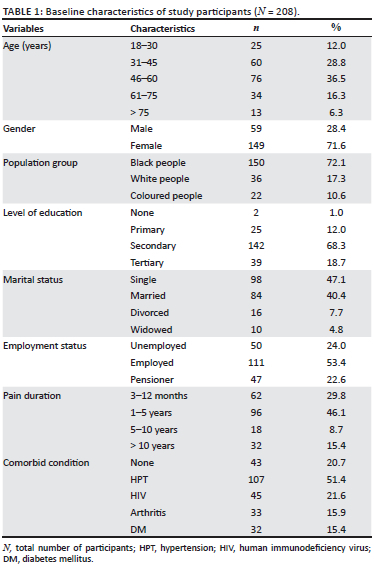
A total of 208 participants met the eligibility criteria and were included in the analysis. Their baseline characteristics are summarised in Table 1. The mean age was 50.2 (s.d. ± 14.99) years. The majority were female (71.6%) and of black African descent (72.1%). Most participants had completed high school (68.3%), and just over half were employed (53.4%). Hypertension was the most common comorbidity (51.4%), followed by HIV (21.6%) and arthritis (15.9%).
Chronic pain characteristics
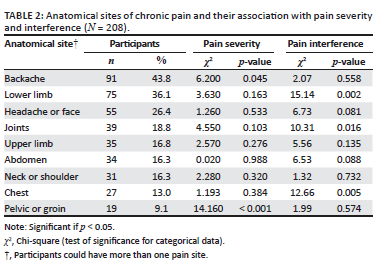
The mean duration of chronic pain was 5.8 years (s.d. ± 4.3), with 1-5 years being the most frequently reported duration (46.1%), and 15.4% of participants experiencing pain for more than 10 years (Table 1). Anatomical pain sites and their associations with pain severity and interference are presented in Table 2. The most reported site was the back (43.8%), followed by the lower limbs (36.1%) and headache/facial pain (26.4%). Although pelvic and groin pain accounted for only 9.1% of cases, it was reported as the most severe pain location (p < 0.001). Chest pain was 2.3 times more prevalent among females than males (p = 0.014). Back pain and pelvic pain showed significant associations with pain severity (p = 0.045 and p < 0.001, respectively), while lower limb, joint, and chest pain were most strongly associated with quality-of-life interference (p = 0.002, p = 0.016, and p = 0.005, respectively).
Chronic pain severity
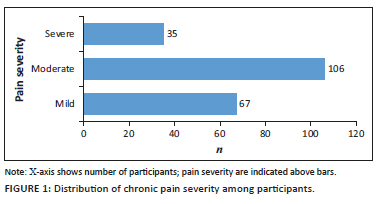
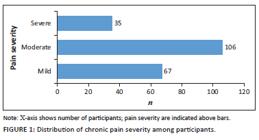
Pain severity, assessed on a 10-point scale, revealed that 51.0% of participants reported moderate pain (4-6/10), while 16.8% reported severe pain (≥ 7/10) (see Figure 1). The mean pain severity score was 4.67 (s.d. ± 1.94), reflecting moderate overall severity. Pain scores were higher among females than males, although this difference was not statistically significant (p = 0.119). The age distribution exhibited a bimodal peak in pain interference; pain was more severe in the younger participants (< 30 years) and older participants (> 75 years). In addition, most chronic pain patients also had medical comorbidities, with only one-fifth (20.7%) of participants reporting no medical comorbidities (Table 1). Despite the high rates of comorbidities, there was no significant relationship observed between chronic pain severity and the presence of chronic diseases (p = 0.091).
Pain management and relief
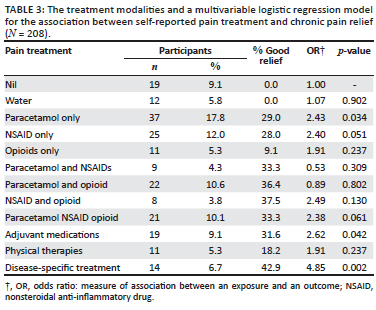
The participants reported a mean pain relief score of 39.86% (s.d. ± 29.37), indicating mild to moderate pain relief. About 74.0% of participants reported inadequate pain relief, with 15.9% experiencing no relief at all. Table 3 reveals the relationship between the treatment modalities and pain relief. Paracetamol was the most used analgesic, with 29.7% of users reporting good relief (p = 0.034). Disease-specific treatments such as antihypertensives, isosorbide dinitrate, metered dose inhalers, migraine kits, and disease-modifying antirheumatic drugs provided the highest reported pain relief (42.9%, p = 0.002). Likewise, adjuvant pain therapies, physiotherapy and cognitive behavioural therapy were used by a minority of participants but demonstrated statistically significant pain relief (31.6%, p = 0.042). Notably, opioid use did not show a significant association with pain relief (p = 0.095).
Interference with quality of life
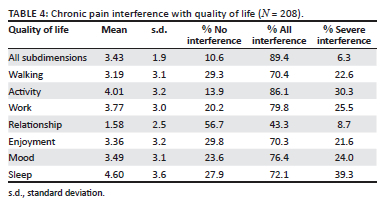
The mean overall pain interference score was 3.43/10 (s.d. ± 1.99), reflecting mild-to-moderate disruption in quality of life. Table 4 summarises the interference of chronic pain on the quality-of-life domains. General activity was substantially affected, with a mean score of 4.01 (s.d. ± 3.17) and 86% of participants reporting interference. Sleep emerged as the most affected domain with a mean score of 4.60 (s.d. ± 3.62); 72% of participants reported sleep disturbances, including 39.3% who experienced severe interference. Mood disturbances were also common, with one-quarter of participants reporting severe impairment. In contrast, interpersonal relationships were the least affected, with only 42% of participants reporting disruptions in social interactions. Overall, chronic pain interference with quality of life was statistically significant at p < 0.001.
Bivariate associations between predictor variables and pain interference subdimensions
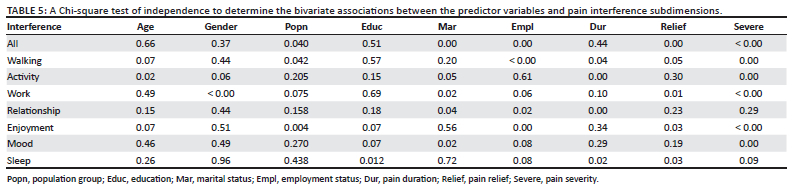
Bivariate analysis using the Chi-square Test of Independence (Table 5) revealed several significant associations (p < 0.05) between sociodemographic/clinical variables and pain interference subdimensions. Population group, marital status, employment status, duration of pain, relief from treatment, and pain severity showed multiple significant relationships with pain interference outcomes. Marital status was significantly associated with overall pain interference (p = 0.004), and employment status was linked to both overall interference (p = 0.005) and interference with walking (p < 0.001). Pain severity was significantly related to all subdimensions except relationship (p = 0.290), while duration of pain was significantly associated with interference in daily activities (p = 0.002) and interpersonal relationships (p = 0.004). These results indicate that both sociodemographic and clinical characteristics influence the extent to which chronic pain affects different areas of patients' lives.
Predictors of pain interference
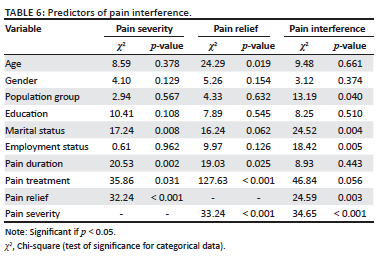
Multivariable logistic regression analyses were performed to identify the key predictors of chronic pain severity, pain relief, and pain interference, as presented in Table 6. Pain severity emerged as the most significant predictor of adverse quality-of-life outcomes (p < 0.001). Participants who reported insufficient pain relief also experienced significantly greater pain interference in daily activities (p = 0.003), thus underscoring the urgent need for more effective pain management strategies. The duration of pain, however, was not a significant predictor of pain interference (p = 0.087), suggesting that chronic pain-related disability may be more closely linked to severity and management rather than the length of time an individual has been in pain. Furthermore, sociodemographic and economic factors were also associated with pain outcomes. Unmarried individuals experienced significantly worse pain-related quality-of-life interference (p = 0.004), while unemployed participants also reported significantly higher pain interference scores (p = 0.005). Racial disparities were observed, with black African participants reporting higher pain interference than participants from other racial groups (p = 0.040).
Discussion
This study evaluated the quality of life of patients with chronic pain attending a primary healthcare clinic in Gqeberha, South Africa. We identified a high prevalence of moderate-to-severe pain, significant interference across multiple quality-of-life domains, and poor levels of pain relief. Multivariable analyses highlighted pain severity, inadequate pain relief, unemployment, and unmarried status as key predictors of pain interference, while racial disparities were also observed. These findings underscore the urgent need for more effective and contextually appropriate pain management strategies within primary healthcare.
This study assessed the multidimensional nature of chronic pain using the Brief Pain Inventory, an approach consistent with other research that has applied multidimensional tools to evaluate pain determinants.29,31,39,4027,31,38
Consistent with global and South African research, back pain emerged as the most common pain site and was strongly associated with disability (43.8%), followed by headaches (26.4%) and knee pain (23.1%). These findings align with Mills, Nicolson, and Smith,2829
Similarly, this study found that females had a 25% higher likelihood than males of experiencing chronic pain interference. This is consistent with previous research showing that women with chronic pain often report poorer quality of life compared to men.27,31,383131
Pain management in this population was suboptimal. Paracetamol (52.3%) and NSAIDs (47.8%) were the most used medications, yet both provided only modest relief, while opioids (41.5%) demonstrated limited effectiveness. This finding supports the work of Cohen, Vase, and Hooten,41411721
Chronic pain substantially interfered with multiple quality-of-life domains in this study, with 72% of participants reporting sleep disturbances, 22% experiencing severe mobility problems, 24% experiencing severe mood disturbances, and 25% facing severe work-related impairment. These findings are consistent with international evidence linking chronic pain to insomnia, depression, and reduced productivity.3,7,357353
Patients with chronic pain also experienced a substantial psychological burden, with 25% reporting symptoms of severe mood disorder. This finding is consistent with the findings of Pereira et al.,393940
A key component of this study was identifying factors associated with higher pain burden and reduced pain relief. Pain severity was the strongest predictor of pain interference (p < 0.001), with higher pain levels directly correlating with poorer quality-of-life outcomes. This supports the findings by Haraldstad et al.29p = 0.005), marital status (p = 0.008), and inadequate pain relief (p < 0.001). The association between employment status and increased pain burden further supports Pandelani et al.31312525
This study did not identify any significant gender-based differences in pain burden, which contradicts the findings of Mills, Nicolson, and Smith28p = 0.040) were weaker than those reported by Kamerman et al.38
Strengths and limitations
This study employed the Brief Pain Inventory, a validated multidimensional tool, to quantitatively assess quality of life among patients with chronic pain. The use of a 24 h recall method minimised recall bias and strengthened the validity of the findings. Furthermore, the inclusion of multivariable logistic regression enhanced the robustness of the analysis by identifying independent predictors of pain interference and pain-related disability. However, certain limitations must be acknowledged. Firstly, the study was conducted at a single primary healthcare clinic, which restricts the generalisability of the findings to other settings. Secondly, the cross-sectional design was utilised; hence, causality could not be inferred. Thirdly, reliance on self-reported measures introduces potential reporting bias, given the subjective nature of pain. Despite these limitations, the findings remain highly relevant for healthcare providers and policymakers working to improve pain management in resource-limited settings.
Implications of the study
The findings of this study demonstrate that pain severity, inadequate pain relief, and sociodemographic factors such as employment status and marital status are significant determinants of quality of life in individuals with chronic pain. These insights are essential to healthcare policy and practice and highlight the need for a patient-centred approach to pain management that goes beyond pharmacological interventions. Integrating mental health services, expanding access to multimodal therapies, and addressing social determinants of health are essential for improving outcomes in primary healthcare contexts, particularly in low-resource environments.
Future research
Future research should be conducted across multiple primary healthcare facilities to improve generalisability and inform broader policy development. Longitudinal studies are necessary to evaluate the progression of chronic pain and the efficacy of various treatment approaches. Incorporating standardised mental health assessment tools, such as PHQ-9 for depression (following screening with PHQ-2) and GAD-7 for anxiety, would provide a more comprehensive understanding of the psychological burden associated with chronic pain. Qualitative studies exploring patients' lived experiences within primary healthcare could also yield valuable insights into barriers and facilitators of effective management. Finally, given the bimodal peak of pain burden observed among individuals younger than 30 and older than 75, future research should further investigate chronic pain in younger populations.
Conclusion
This study highlights the substantial burden of chronic pain in primary healthcare settings, characterised by moderate-to-severe pain, impaired quality of life, and inadequate pain relief. These findings underscore the urgent need for more effective pain management strategies in primary healthcare clinics. Integrating pharmacological approaches, including disease-specific medications and adjuvant therapies, with non-pharmacological interventions such as physiotherapy and psychological support may enhance patient outcomes.
Primary healthcare providers should incorporate mental health support and pain education into routine care while advocating for policy reforms that expand access to multidisciplinary pain services. Policy interventions should prioritise adequate resource allocation, strengthen healthcare provider training in multimodal pain management, and promote the integration of mental health services into pain management strategies. Furthermore, addressing the key socioeconomic determinants, particularly employment status and social support, will be critical to reducing the impact of chronic pain on quality of life.
Competing interests
The authors, Kemi D. Dele-Ijagbulu, Febisola I. Ajudua and Busisiwe Cawe declare that they have no financial or personal relationships that may have inappropriately influenced them in writing this article.
CRediT authorship contribution
Kemi D. Dele-Ijagbulu: Conceptualisation, Data curation, Formal analysis, Investigation, Methodology, Resources, Software, Validation, Visualisation, Writing - original draft, Writing - review & editing. Febisola I. Ajudua: Conceptualisation, Project administration, Resources, Supervision. Busisiwe Cawe: Conceptualisation, Supervision. All authors reviewed the article, contributed to the discussion of results, approved the final version for submission and publication, and take responsibility for the integrity of its findings.
Funding information
This research received no specific grant from any funding agency in the public, commercial, or non-for-profit sectors.
Data availability
The data supporting the findings of this study are available from the corresponding author, Kemi D. Dele-Ijagbulu, upon reasonable request.
Disclaimer
The views and opinions expressed in this article are those of the authors and are the product of professional research. They do not necessarily reflect the official policy or position of any affiliated institution, funder, agency, or that of the publisher. The authors are responsible for this article's results, findings, and content.
Acknowledgements
This article is based on research originally conducted as part of Kemi Dorcas Dele-Ijagbulu's master's thesis titled 'Evaluation Of The Quality Of Life Of Patients With Chronic Pain Attending A Primary Healthcare Clinic In Gqeberha', submitted to the Department of Family Medicine and Rural Health, Faculty of Health Sciences, Walter Sisulu University, in 2025. The thesis is currently unpublished and not publicly available. The thesis was supervised by Febisola Ibilola Ajudua and Busisiwe Cawe. The manuscript has been revised and adapted for journal publication. The author confirms that the content has not been previously published or disseminated and complies with ethical standards for original publication.
References
-
1. Dahlhamer J, Lucas J, Zelaya A, et al. Prevalence of chronic pain and high-impact chronic pain among adults - United States, 2016. MMWR Morb Mortal Wkly Rep. 2018;67(36):1001-1006. https://doi.org/10.15585/mmwr.mm6736a2
» https://doi.org/10.15585/mmwr.mm6736a2 -
2. Dueñas M, Ojeda B, Salazar A, Mico JA, Failde I. A review of chronic pain impact on patients, their social environment and the health care system. J Pain Res. 2016;9:457-67. https://doi.org/10.2147/JPR.S105892
» https://doi.org/10.2147/JPR.S105892 -
3. Hadi MA, McHugh GA, Closs SJ. Impact of chronic pain on patients' quality of life: A comparative mixed-methods study. J Patient Exp. 2019;6(2):133-141. https://doi.org/10.1177/2374373518786013
» https://doi.org/10.1177/2374373518786013 -
4. Raja SN, Carr DB, Cohen M, et al. The revised international association for the study of pain definition of pain: Concepts, challenges, and compromises. Pain. 2020;161:1976-1982. https://doi.org/10.1097/j.pain.0000000000001939
» https://doi.org/10.1097/j.pain.0000000000001939 -
5. Treede RD, Rief W, Barke A, et al. Chronic pain as a symptom or a disease: The IASP classification of chronic pain for the International Classification of Diseases (ICD-11). Pain. 2019;160(1):19-27. https://doi.org/10.1097/j.pain.0000000000001384
» https://doi.org/10.1097/j.pain.0000000000001384 -
6. Raffaeli W, Tenti M, Corraro A, et al. Chronic pain: What does it mean? A review on the use of the term chronic pain in clinical practice. J Pain Res. 2021;14:827-835. https://doi.org/10.2147/JPR.S303186
» https://doi.org/10.2147/JPR.S303186 -
7. Sun Y, Laksono I, Selvanathan J, et al. Prevalence of sleep disturbances in patients with chronic non-cancer pain: A systematic review and meta-analysis. Sleep Med Rev. 2021;57:101467. https://doi.org/10.1016/j.smrv.2021.101467
» https://doi.org/10.1016/j.smrv.2021.101467 -
8. Duo L, Yu X, Hu R, Duan X, Zhou J, Wang K. Sleep disorders in chronic pain and its neurochemical mechanisms: A narrative review. Front Psychiatry. 2023;14:1157790. https://doi.org/10.3389/fpsyt.2023.1157790
» https://doi.org/10.3389/fpsyt.2023.1157790 -
9. Nijs J, Mairesse O, Neu D, et al. Sleep disturbances in chronic pain: Neurobiology, assessment, and treatment in physical therapist practice. Phys Ther. 2018;98(5):325-335. https://doi.org/10.1093/ptj/pzy020
» https://doi.org/10.1093/ptj/pzy020 -
10. Ataoǧlu E, Tiftik T, Kara M, Tunç H, Ersöz M, Akkuş S. Effects of chronic pain on quality of life and depression in patients with spinal cord injury. Spinal Cord. 2013;51(1):23-26. https://doi.org/10.1038/sc.2012.51
» https://doi.org/10.1038/sc.2012.51 -
11. Rapti E, Damigos D, Apostolara P, Roka V, Tzavara C, Lionis C. Patients with chronic pain: Evaluating depression and their quality of life in a single center study in Greece. BMC Psychol. 2019;7(1):86. https://doi.org/10.1186/s40359-019-0366-0
» https://doi.org/10.1186/s40359-019-0366-0 -
12. Tankha H, Caño A, Dillaway H. 'Now I have hope': Rebuilding relationships affected by chronic pain. Fam Syst Health. 2020;38(1):51-56. https://doi.org/10.1037/fsh0000472
» https://doi.org/10.1037/fsh0000472 -
13. Schaffer J, Fogelman N, Seo D, Sinha R. Chronic pain, chronic stress and substance use: Overlapping mechanisms and implications. Front Pain Res. 2023;4:1145934. https://doi.org/10.3389/fpain.2023.1145934
» https://doi.org/10.3389/fpain.2023.1145934 -
14. Stubhaug A, Hansen JL, Hallberg S, Gustavsson A, Eggen AE, Nielsen CS. The costs of chronic pain-long-term estimates. Eur J Pain. 2024;28(6):960-977. https://doi.org/10.1002/ejp.2234
» https://doi.org/10.1002/ejp.2234 -
15. Kahere M, Ngcamphalala C, Östensson E, Ginindza T. The economic burden of low back pain in KwaZulu-Natal, South Africa: A prevalence-based cost-of-illness analysis from the healthcare provider's perspective. PLoS One. 2022;17(10):e0263204. https://doi.org/10.1371/journal.pone.0263204
» https://doi.org/10.1371/journal.pone.0263204 -
16. Briggs AM, Woolf AD, Dreinhöfer K, et al. Reducing the global burden of musculoskeletal conditions. Bull World Health Organ 2018;96:366-368. https://doi.org/10.2471/BLT.17.204891
» https://doi.org/10.2471/BLT.17.204891 -
17. Borrelli KE, Bettinger JJ. Borelli 2023. Analgesic use in PHC [homepage on the Internet]. MedCentral: 2023 [cited 2024 Nov 21]. Available from: https://www.medcentral.com/pain/analgesic-use-in-primary-care
» https://www.medcentral.com/pain/analgesic-use-in-primary-care -
18. Bonnema R, Mcnamara M, Harsh J, Hopkins E. Primary care management of chronic pelvic pain in women. Cleve Clin J Med. 2018;85:215-223. https://doi.org/10.3949/ccjm.85a.16038
» https://doi.org/10.3949/ccjm.85a.16038 -
19. Yang J, Jung M, Picco L, et al. Pain in people seeking and receiving opioid agonist treatment: A systematic review and meta-analysis of prevalence and correlates. Addiction. 2024;119(11):1879-901. https://doi.org/10.1111/add.16574
» https://doi.org/10.1111/add.16574 -
20. Engelbrecht D, Thandar Y, Venketsamy Y. Analgesic self-medication among patients with chronic musculoskeletal pain in a South African chiropractic teaching clinic: A cross-sectional study. J Chiropr Med. 2024;23(1-2):1-12. https://doi.org/10.1016/j.jcm.2024.02.002
» https://doi.org/10.1016/j.jcm.2024.02.002 -
21. Gebke KB, McCarberg B, Shaw E, Turk DC, Wright WL, Semel D. A practical guide to recognize, assess, treat and evaluate (RATE) primary care patients with chronic pain. Postgrad Med. 2023;135(3):244-253. https://doi.org/10.1080/00325481.2021.2017201
» https://doi.org/10.1080/00325481.2021.2017201 -
22. Wahl AK, Rustøen T, Rokne B, et al. The complexity of the relationship between chronic pain and quality of life: A study of the general Norwegian population. Qual Life Res. 2019;18(8):971-980. https://doi.org/10.1007/s11136-009-9515-x
» https://doi.org/10.1007/s11136-009-9515-x -
23. Queremel Milani D, Davis D. Pain management medications [homepage on the Internet]. StatPearls: 2023 [cited 2024 Nov 21]. Available from: https://www.ncbi.nlm.nih.gov/books/NBK560692/
» https://www.ncbi.nlm.nih.gov/books/NBK560692/ -
24. Kummer I, Lüthi A, Klingler G, et al. Adjuvant analgesics in acute pain - Evaluation of efficacy. Curr Pain Headache Rep. 2024;28:843-852. https://doi.org/10.1007/s11916-024-01276-w
» https://doi.org/10.1007/s11916-024-01276-w -
25. Miaskowski C, Blyth F, Nicosia F, et al. A biopsychosocial model of chronic pain for older adults. Pain Med. 2020;21(9):1793-1805. https://doi.org/10.1093/pm/pnz329
» https://doi.org/10.1093/pm/pnz329 -
26. Lumley MA, Schubiner H. Emotional awareness and expression therapy for chronic pain: Rationale, principles and techniques, evidence, and critical review. Curr Rheumatol Rep. 2019;21:30. https://doi.org/10.1007/s11926-019-0829-6
» https://doi.org/10.1007/s11926-019-0829-6 -
27. Goyal AK, Mohanty SK. Association of pain and quality of life among middle-aged and older adults of India. BMC Geriatr. 2022;22(1):939. https://doi.org/10.1186/s12877-022-03480-y
» https://doi.org/10.1186/s12877-022-03480-y -
28. Mills SEE, Nicolson KP, Smith BH. Chronic pain: A review of its epidemiology and associated factors in population-based studies. Br J Anaesth. 2019;123(2):e273-e283. https://doi.org/10.1016/j.bja.2019.03.023
» https://doi.org/10.1016/j.bja.2019.03.023 -
29. Haraldstad K, Wahl A, Andenæs R, et al. A systematic review of quality of life research in medicine and health sciences. Qual Life Re. 2019;28:2641-2650. https://doi.org/10.1007/s11136-019-02214-9
» https://doi.org/10.1007/s11136-019-02214-9 -
30. Rauf W N, Meyer HP, Marcus TS, Becker PJ. The impact of chronic pain on the quality of life of patients. S Afr J Anaesth Analg [serial online]. 2014 [cited 2024 Nov 23];20(2):122-126. Available from: https://journals.co.za/doi/pdf/10.10520/EJC153114
» https://journals.co.za/doi/pdf/10.10520/EJC153114 -
31. Pandelani FF, Nyalunga SLN, Mogotsi MM, Mkhatshwa VB. Chronic pain: Its impact on the quality of life and gender. Front Pain Res. 2023;4:1253460. https://doi.org/10.3389/fpain.2023.1253460
» https://doi.org/10.3389/fpain.2023.1253460 -
32. Paul-Savoie E, Bourgault P, Potvin S, Gosselin E, Lafrenaye S. The impact of pain invisibility on patient-centered care and empathetic attitude in chronic pain management. Pain Res Manag. 2018;2018:6375713. https://doi.org/10.1155/2018/6375713
» https://doi.org/10.1155/2018/6375713 -
33. Pequeno NPF, Cabral NLDA, Marchioni DM, Lima SCVC, Lyra CDO. Quality of life assessment instruments for adults: A systematic review of population-based studies. Health Qual Life Outcomes. 2020;18(1):208. https://doi.org/10.1186/s12955-020-01347-7
» https://doi.org/10.1186/s12955-020-01347-7 -
34. Mallon T, Eisele M, König HH, et al. Lifestyle aspects as a predictor of pain among oldest-old primary care patients - A longitudinal cohort study. Clin Interv Aging. 2019;14:1881-1888. https://doi.org/10.2147/CIA.S217431
» https://doi.org/10.2147/CIA.S217431 -
35. Philpot LM, Schumann ME, Ebbert JO. Social relationship quality among patients with chronic pain: A population-based sample. J Patient Exp. 2020;7(3):316-323. https://doi.org/10.1177/2374373519862934
» https://doi.org/10.1177/2374373519862934 -
36. Ajudua FI, Mash RJ. Implementing active surveillance for TB: A descriptive survey of healthcare workers in the Eastern Cape, South Africa. Afr J Prim Health Care Fam Med. 2024;16(1):a4217. https://doi.org/10.4102/phcfm.v16i1.4217
» https://doi.org/10.4102/phcfm.v16i1.4217 -
37. Population Stat. Port Elizabeth, South Africa population (2025) [homepage on the Internet]. 2025 [cited 2025 Aug 16]. Available from: https://populationstat.com/south-africa/port-elizabeth
» https://populationstat.com/south-africa/port-elizabeth -
38. Kamerman PR, Bradshaw D, Laubscher R, et al. Almost 1 in 5 South African adults have chronic pain: A prevalence study conducted in a large nationally representative sample. Pain. 2020;161(7):1629-1635. https://doi.org/10.1097/j.pain.0000000000001844
» https://doi.org/10.1097/j.pain.0000000000001844 -
39. Pereira MG, Carvalho C, Costa ECV, Leite Â, Almeida V. Quality of life in chronic pain patients: Illness- and wellness-focused coping as moderators. Psych J. 2021;10(2):283-294. https://doi.org/10.1002/pchj.410
» https://doi.org/10.1002/pchj.410 -
40. Van Vreede JJ, Parker R, Van Nugteren J. A history of depression in patients attending a chronic pain management clinic in South Africa: A retrospective chart review. S Afr J Psychiatry. 2022;28:a1673. https://doi.org/10.4102/sajpsychiatry.v28i0.1673
» https://doi.org/10.4102/sajpsychiatry.v28i0.1673 -
41. Cohen SP, Vase L, Hooten WM. Chronic pain: An update on burden, best practices, and new advances. Lancet. 2021;397(10289):2082-2097. https://doi.org/10.1016/S0140-6736(21)00393-7
» https://doi.org/10.1016/S0140-6736(21)00393-7

Accepted: 12 Nov. 2025
Published: 12 Feb. 2026