
 Clinical leadership development: Current practices and future directions for Southern African primary healthcare
Abstract
Family physicians are uniquely positioned to lead efforts to tackle Southern Africa's persistent primary healthcare challenges, yet such leadership is often perceived as a top-down process rather than a tangible presence. Drawing on insights from the 2025 South African Academy of Family Physicians (SAAFP) conference workshop, we synthesised leadership behaviours, innovative curricula, and workplace learning approaches, aligning with Entrustable Professional Activities and national unit standards. We outline a 5-year roadmap for clinical trainers, programme leaders, and the SAAFP, including: creating psychologically safe learning environments; embedding 360° feedback; normalising mindfulness and reflective practice; and leveraging mentorship for early-career family physicians. CONTRIBUTION: This Open Forum contributes to the South African Family Practice journal's 45-year special collection by reflecting on significant milestones and proposing future directions for clinical leadership and governance. Practical strategies are offered to embed leadership presence, mentorship, and a culture of feedback into training programmes and health system strengthening activities
clinical leadership development; primary healthcare; family medicine; entrustable professional activities; work-based assessment; mentorship and coaching; health system strengthening
Introduction
Leadership presence as a catalyst for change in Southern African primary healthcare
Primary healthcare systems in Southern Africa continue to grapple with persistent challenges, including skilled workforce shortages, entrenched hierarchies and inequities exacerbated by social determinants of health. Against a backdrop characterised by volatility, uncertainty, complexity and ambiguity (VUCA) - and increasingly by brittleness, anxiety, non-linearity, and incomprehensibility (BANI) - the role of adaptive, self-aware leadership is more critical than ever.1,234
Building on insights from the 2025 National Family Medicine Conference workshop hosted by the South African Academy of Family Physicians (SAAFP) and the growing scholarship on distributed and relational leadership,56,7,8,910,11,12,13
Workshop objectives and process
We synthesised insights from a 90-min interactive workshop at the 27th annual SAAFP national conference held on 06 September 2025 in Midrand, Gauteng, South Africa. The workshop targeted newly qualified and early-career FPs, as well as those involved in workplace-based supervision and mentoring of registrars and early-career FPs. Objectives included exploring links between leadership and CG, developing CG leaders within health systems, and showcasing practical examples such as antimicrobial stewardship rounds, multidisciplinary palliative care rounds, clinical audits, staff management, and the establishment of a safe learning environment.
The workshop process consisted of three phases: (1) scene-setting presentations covering leadership as a way of being, its developmental nature, and the connection between CG and leadership presence, framed by EPA 21 and national unit standards; (2) small-group discussions focusing on self-awareness, additional leadership qualities, barriers and facilitators, and identifying one to two priority steps for clinical trainers and supervisors, academic programmes, and the SAAFP Education and Training Committee; and (3) plenary synthesis to consolidate themes and develop recommendations.
Current challenges: From process to presence
Clinical governance structures - such as audits, antimicrobial stewardship rounds and pharmaceutical therapeutic committees - are essential but insufficient to drive leadership development on their own. Practice improves most when leaders communicate with clarity, invite diverse perspectives, and foster trust, psychological safety and compassion within their teams. As one presenter at the National Family Medicine Conference observed, 'Leadership is the presence and soft skills we bring to our roles. It is a way of being rather than simply what we do'.
Experiential entrustment for EPA 21 often plateaus by registrar training in the second or third year, leaving registrars without the necessary exposure to leading meetings, coordinating rosters, managing conflicts and cultivating team culture. Feedback cultures are frequently underdeveloped; teams benefit greatly from scheduled, constructive 360-degree feedback and 'brave spaces' for debriefing. A South African study on leadership values found that most participants perceived the healthcare environment as one of relational disconnect and constraining silos and hierarchies. Healthcare professionals found it difficult to share their personal emotions and grapple with sharing their values and feelings in the workplace. This blocking of emotional expression seemed to be institutionalised by the professional training of healthcare practitioners in hierarchies and functional silos.1415
Becoming an entrusted leader is a developmental journey marked by psychological growth. Training programmes must incorporate integrated opportunities to build a strong foundation of personal self-awareness, which in turn, supports the cultivation of professional leadership presence and effective practice. Leadership development opportunities within existing training programmes are both feasible and valuable, enhancing the purpose and impact of the CG role that FPs fulfil.
Efforts to transform healthcare must focus on shifting mindsets, embracing diverse perspectives and building teams that trust one another and hold each other accountable. This calls on leaders to question their assumptions, challenge their own views and reflect on the prevailing culture of the health system. Self-awareness and presence allow leaders to navigate this role with greater ease and efficacy. A complex, adaptive health system needs leaders who take a whole-society view of patients and families in communities - seeing communities not as broken or weak, but as whole, with assets that can be utilised. Only when we recognise our communities as true partners can FPs meaningfully empower those they lead and genuinely serve the people in their care; otherwise, we risk disempowering them.
Insights on current educational approaches and innovations to scale now
Embed leadership presence within clinical governance
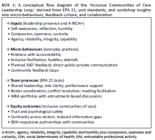
The visible enactment of key microbehaviours needs to be complemented by also fostering a deeper, intentional inquiry into the internal motivations and meta-awareness that underpin them. Micro-level leadership behaviour refers to the observable verbal and non-verbal actions and interactions of leaders with their team members, which have the potential to influence the attitudes and behaviours of those they lead.1617
A competent clinical leader cultivates insight into the drivers of their decisions and behaviours, regularly reflecting on how these are landing with the team.181919
We define effective clinical leadership as the intentional practice of the A-RICH framework, linked to professional behaviour that builds trust by cultivating Agency, Reliability, Integrity, Capability and Humility.20
Build mentorship, coaching, and supervisor capability with Next5
District mentorship networks should provide protected time, peer learning and foundational role assessments. The SAAFP Next5 initiative offers a structured approach to support early-career FPs through mentorship and role clarification during their first 5 years.21
Normalise 360-degree feedback and reflective practice in work-based assessment portfolios
Integrate multi-source feedback and entrustment-based discussions into portfolios (EPA 21). Plan feedback sessions deliberately and foster psychological safety. Additionally, as educators, it is imperative for clinical and educational supervisors to critically reflect on and align their own understanding of leadership. Entrusting the development of clinical leaders to faculty presupposes a shared language and collective understanding of what leadership entails. This theme emerged prominently in our workshop planning and group discussions, highlighting the need for ongoing dialogue and self-examination among educators to ensure consistency and clarity in teaching, mentoring and role-modelling leadership presence.
Create communities of practice and spiral experiential learning
Establishing communities of practice (CoPs) and adopting spiral models of experiential learning create a scaffolded environment for authentic leadership development. Regular opportunities for role-model exposure, learning-by-doing and guided navigation of complex systems are essential, with gradual entrustment aligned to national outcomes.
The experience of revising the Leadership and Governance (L&G) module at the University of Cape Town (UCT) highlights the importance of moving beyond hierarchical structures and recognising that leadership maturity is not synonymous with title or expertise.8
The 2022 revision of the UCT module expanded the curriculum from 7-12 sessions, integrating leadership development through group coaching and a five-lens Enneagram profile to deepen self-awareness. Reflective sessions, enhanced by inviting learners from outside the core programme, create greater diversity, enrich communal learning and build leadership capacity. These are paired with practical application: following a guest expert's theory session (e.g. on running a pharmaceutical and therapeutics committee), participants engage in reflective practice to explore their personal leadership style and impact. This approach disrupts rigid procedural focus and supports discernment, collaboration and authentic team processes.
By integrating new perspectives and creating intentional spaces for self-reflection, the module aims to build a solid foundation of personal leadership. Leadership is nurtured as a presence and 'way of being', not merely a set of competencies tied to hierarchy. These CoPs and spiral learning cycles foster environments where leaders continuously revisit and grow into professional roles, anchored by authentic self-awareness. Over time, this empowers clinicians to move from technical expertise towards collaborative, adaptive practice - enabling more effective, equity-focused CG in complex, rapidly changing health systems.
EPA 21 entrustment thresholds
What 'ready' looks like
While registrars and junior consultants are often adept at the technical and cognitive aspects of CG, authentic leadership is about more than following processes - it is rooted in presence, self-awareness and influence. Leadership presence is revealed in everyday actions: how we communicate, listen, facilitate meetings, write emails or respond in moments of uncertainty. Team members and patients experience it through leaders' use of body language, tone of voice and empathetic listening during patient care.222324
Entrustable Professional Activity 21 articulates a comprehensive approach to leading clinical teams, encompassing not only task delegation and management functions - such as recruitment, line management and performance oversight - but also softer, relational elements.10
Crucially, leadership is not confined to formal roles or hierarchical positions. It is a developmental journey, shaped by intentional opportunities for personal growth, feedback and collective learning - whether through spiral learning in training programmes, group coaching or intentional reflection. Both the structure of EPAs and the South African family medicine national unit standards emphasise ethical practice, collaboration and the capacity to care for oneself and others, including managers. As FPs and clinical leaders, making space for self-reflection and personal development is not selfish; it underpins our ability to support and inspire others and to build resilient, effective healthcare teams capable of meeting the complex demands of the district health system.25,26
Box 1 illustrates the conceptual connections among the elements of the leadership development loop.
Recommendations: Directions for the next five years
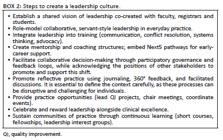
A pragmatic roadmap links training and service realities. Based on the workshop discussion, we suggest steps to cultivate a leadership culture (see Box 2), tailored to three key stakeholder groups: clinical trainers and supervisors, university programmes and the SAAFP Education and Training Committee.
Clinical trainers and supervisors
Collecting feedback from early-career FPs and trainers about their mentorship experiences (and explicitly valuing both formal and informal approaches) can inform improvements and ensure that mentorship structures effectively support leadership development. The following steps were generated from the discussions:
• Schedule regular brave-space debriefs to foster open communication and psychological safety.
• Conduct baseline role assessments to clarify expectations and responsibilities.
• Embed deliberately planned 360-degree feedback cycles to support ongoing professional growth.
• Ensure intentional exposure to EPA 21 (leading a clinical team) in training the second or third year, track engagement and identify opportunities for further development.
• Strengthen supervisor capability through targeted training in human relations, conflict resolution and cultural competence.
• Normalise mindfulness and reflective practice in daily routines.
• Partner with the Next5 initiative to support early-career FPs locally, recognising that while formal mentorship is available, uptake may not be as enthusiastic as anticipated. There is a need to understand better whether mentorship and peer support are occurring more informally and, if so, to adapt pairing and support strategies to meet clinicians where they are.
• Partner with the private sector and various provincial departments of health to align leadership development in clinical service with academic programmes.
University programmes
The following steps position university programmes to move beyond formal competency checklists, nurturing a new generation of clinical leaders uniquely equipped for the evolving realities of Southern African primary care:
• Adopt spiral leadership curricula that offer repeated, developmentally scaffolded opportunities for leadership practice, ideally incorporating structured group coaching to foster reflection, peer learning and ongoing growth.
• Integrate personality frameworks or lenses (such as the Enneagram) responsibly to promote self-insight among registrars - ensuring these tools enhance, rather than define, individual and team development.
• Expand registrar and faculty portfolios to include multi-source evidence of leadership progress, such as feedback from supervisors, peers and self-reflection, as well as illustrative case experiences and project outcomes.
• Build and sustain multiprofessional communities of practice that connect registrars across faculties, professions and disciplines, offering richer perspectives and modelling collaborative leadership.
• Prepare registrars to navigate workplace uncertainty and constant change, and to engage with EPA 21, as expected from clinical competency committee processes, using practical simulations and real-world scenarios core to the curriculum.
South African Academy of Family Physicians Education and Training Committee
The SAAFP Education and Training Committee (ETC) can set a clear standard for high-quality, relational, and contextually relevant leadership development for FPs across Southern Africa through these expanded efforts:
• Intentionally endorse the personal developmental pathways: Explore what tools and training are available to cultivate self-awareness, self-acceptance, emotion regulation and relational competence that contribute to the psychological maturation of leaders. Facilitation of this personal growth will help ensure that the A-RICH+ qualities and behaviours can more naturally and authentically manifest in future clinical leaders.
• Develop and publish national guidance for EPA 21: Provide clear, practical resources outlining micro-behaviours, feedback cultures and creation of brave spaces. This could include best-practice toolkits, sample feedback forms, video guides and implementation checklists to assist clinical trainers and supervisors across all training sites.
• Endorse and standardise A-RICH+ relational qualities: Explicitly incorporate relational qualities (openness, curiosity, compassion) into the expanded A-RICH framework within assessment rubrics and curriculum content. This highlights the importance of fostering authentic and relational leadership inspired by ubuntu. Include these qualities directly in EPA assessment rubrics, faculty development sessions and registrar induction materials to promote a value-based approach to leadership.
• Institutionalise Next5 mentorship within district activities: Move beyond ad hoc mentorship by formalising regular mentor-mentee pairings, protected time for mentorship conversations and periodic group or peer meetings. Establish clear outcome metrics for evaluating the reach and impact of mentorship, ensuring consistent support for early-career FPs and a seamless transition from training to clinical practice.
• Monitor and evaluate implementation: Collect regular feedback from trainers, registrars and stakeholders on the effectiveness and uptake of these initiatives. Use surveys, workshops and programmatic data to identify gaps and areas for ongoing improvement, ensuring that guidance remains relevant and practice-focused.
• Facilitate continuous faculty and leadership development: Offer short courses, webinars and leadership interest groups to help faculty and supervisors stay up-to-date with emerging best practices, maintain engagement and build a cohesive leadership pipeline across the profession. These activities could complement current efforts, including the 5-day Training of Clinical Trainers course and the accreditation of clinical trainers.
Conclusion
As the South African Family Practice journal celebrates 45 years of advancing family medicine, this Open Forum highlights the important truth that leadership is about presence, not just position. Our workshop revealed that authentic clinical leadership stems from self-awareness, kindness and everyday behaviours that foster trust and psychological safety. We can transform CG from a procedural duty into a catalyst for equity and resilience by embedding these principles into EPA 21, mentorship networks like Next5 and spiral learning curricula.
In the context of this Open Forum, workshop participants humbly recognised that leadership behaviours were the main focus of the discussion. Although the importance of FPs gaining insight and self-awareness to become effective leaders was acknowledged, it was only briefly mentioned, suggesting that further efforts are needed. Importantly, we must ensure that, as we promote the outcomes of mature clinical leadership, we do not set the cart before the horse by neglecting the foundational developmental processes linked to psychological maturation such as self-insight, self-regulation, and unconditional self-acceptance that are prerequisites for authentic engagement with others and for the genuine emergence of the A-RICH+ qualities.
The next five years offer a crucial opportunity to create inclusive care communities, normalise feedback cultures and invest in faculty development that embodies collaborative leadership. These steps align with the SAAFP and its journal's legacy of promoting responsive, patient-centred systems, as well as their commitment to enhancing primary healthcare in Southern Africa. By embracing leadership as a way of being, FPs can navigate complexity and champion health equity, ensuring that CG reflects the values of trust, compassion and shared purpose.
Competing interests
The authors declare that they have no financial or personal relationships that may have inappropriately influenced them in writing this article. The authors, Louis S. Jenkins, Ramprakash Kaswa, and Klaus B. von Pressentin, serve as editorial board members of this journal. The peer review process for this submission was handled independently, and the authors had no involvement in the editorial decision-making process for this article. The authors have no other competing interests to declare.
CRediT authorship contribution
Richard Cooke: Conceptualisation, Writing - review & editing. Angela de Sá: Conceptualisation, Writing - review & editing. Louis S. Jenkins: Conceptualisation, Writing - review & editing. Ramprakash Kaswa: Conceptualisation, Writing - review & editing. Klaus B. von Pressentin: Conceptualisation, Project administration, Writing - original draft, Writing - review & editing. All authors reviewed the article, contributed to the discussion of results, approved the final version for submission and publication, and take responsibility for the integrity of its findings.
Ethical considerations
This article followed all ethical standards for research without direct contact with human or animal subjects.
Funding information
This research received no specific grant from any funding agency in the public, commercial or not-for-profit sectors.
Data availability
The authors confirm that the data supporting this Open Forum are available in its listed references.
Disclaimer
The views and opinions expressed in this article are those of the authors and are the product of professional research. They do not necessarily reflect the official policy or position of any affiliated institution, funder, agency or that of the publisher. The authors are responsible for this article's results, findings and content.
Acknowledgements
We acknowledge the workshop facilitators and participants who contributed insights during the workshop. We recognise Next5 for its ongoing support of early-career family physicians and for the SAAFP ETC's role in shaping national family medicine learning activities. We acknowledge Dr Jana Weenink for her role in capturing the workshop outcome, as well as Dr Madeleine Muller for conceptualising the inclusions in the expanded A-RICH+ framework. While their contribution was important, it did not meet the criteria for authorship.
References
-
1. Cernega A, Nicolescu DN, Meleșcanu Imre M, et al. Volatility, Uncertainty, Complexity, and Ambiguity (VUCA) in healthcare. Healthcare (Basel). 2024;12(7):773. https://doi.org/10.3390/healthcare12070773
» https://doi.org/10.3390/healthcare12070773 -
2. Menaria, N. Comparative analysis of VUCA and BANI frameworks. Int J Multidiscip Res. 2024;6(2):1-4. https://doi.org/10.36948/ijfmr.2024.v06i02.15715
» https://doi.org/10.36948/ijfmr.2024.v06i02.15715 -
3. South African Academy of Family Physicians. The contribution of family physicians to district health services in South Africa: A national position paper. S Afr Fam Pract. 2022;64(1):a5473. https://doi.org/10.4102/safp.v64i1.5473
» https://doi.org/10.4102/safp.v64i1.5473 -
4. Moosa S. Strengthening universal health coverage through the NHI: A response to recent critique. S Afr Med J. 2025;115(10):e4149. https://doi.org/10.7196/SAMJ.2025.v115i10.4149
» https://doi.org/10.7196/SAMJ.2025.v115i10.4149 -
5. Motshweneng O, Gilson L. Responsibility without autonomy: Exploring the emergence of distributed leadership in a district hospital of the Western Cape province, South Africa. Health Policy Plan. 2025:czaf094. https://doi.org/10.1093/heapol/czaf094
» https://doi.org/10.1093/heapol/czaf094 -
6. Von Pressentin KB, Mash RJ, Baldwin-Ragaven L, et al. The bird's-eye perspective: How do district health managers experience the impact of family physicians within the South African district health system? S Afr Fam Pract. 2018;60(1):13-20. https://doi.org/10.1080/20786190.2017.1348047
» https://doi.org/10.1080/20786190.2017.1348047 -
7. Dladla S, Von Pressentin KB, Ras T. The perceived impact of family medicine leadership training on practice: A qualitative study. Afr J Prim Health Care Fam Med. 2025;17(1):a4954. https://doi.org/10.4102/phcfm.v17i1.4954
» https://doi.org/10.4102/phcfm.v17i1.4954 -
8. Von Pressentin KB, De Sá A, Pampallis P, Ras T. Cultivating leaders for primary health care: A revised approach for transformative development. Afr J Prim Health Care Fam Med. 2024;16(1):a4410. https://doi.org/10.4102/phcfm.v16i1.4410
» https://doi.org/10.4102/phcfm.v16i1.4410 -
9. Von Pressentin KB, Mash RJ, Baldwin-Ragaven L, et al. The influence of family physicians within the South African district health system: A cross-sectional study. Ann Fam Med. 2018;16(1):28-36. https://doi.org/10.1370/afm.2133
» https://doi.org/10.1370/afm.2133 -
10. Mash R, Steinberg H, Naidoo M. Updated programmatic learning outcomes for the training of family physicians in South Africa. S Afr Fam Pract. 2021;63(1):a5342. https://doi.org/10.4102/safp.v63i1.5342
» https://doi.org/10.4102/safp.v63i1.5342 -
11. Colleges of Medicine of South Africa (CMSA). Preamble to EPAs and EPAs (Family Medicine) [homepage on the Internet]. 2024 [cited 2025 December 9]. Available from: https://www.cmsa.co.za/wp-content/uploads/2024/02/Preamble_to_EPAs_and_EPAs_16_2_2024.pdf
» https://www.cmsa.co.za/wp-content/uploads/2024/02/Preamble_to_EPAs_and_EPAs_16_2_2024.pdf -
12. Jenkins LS, Mash R, Motsohi T, et al. Developing entrustable professional activities for family medicine training in South Africa. S Afr Fam Pract. 2023;65(1):a5690. https://doi.org/10.4102/safp.v65i1.5690
» https://doi.org/10.4102/safp.v65i1.5690 -
13. Mash R, Jenkins L, Naidoo M. Development of entrustable professional activities for family medicine in South Africa. Afr J Prim Health Care Fam Med. 2024;16(1):a4483. https://doi.org/10.4102/phcfm.v16i1.4483
» https://doi.org/10.4102/phcfm.v16i1.4483 -
14. Vivier E, Robinson B, Jenkins L, Smit A. Institutional logics and relational shifts: Permeating hierarchies and silos in the healthcare sector. Public Manag Rev. 2024;26(10):2943-2965. https://doi.org/10.1080/14719037.2023.2299929
» https://doi.org/10.1080/14719037.2023.2299929 -
15. National Health Insurance Act, 20 of 2023. Government Gazette No. 50664 [statute on the Internet]. 2024 [cited 2025 December 9]. Available from: https://www.gov.za/documents/acts/national-health-insurance-act-20-2023-english-afrikaans-16-may-2024
» https://www.gov.za/documents/acts/national-health-insurance-act-20-2023-english-afrikaans-16-may-2024 -
16. Meyer B, Burtscher MJ, Jonas K, et al. What good leaders actually do: Micro-level leadership behaviour, leader evaluations, and team decision quality. Eur J Work Organ Psychol. 2016;25(6):773-789. https://doi.org/10.1080/1359432X.2016.1189903
» https://doi.org/10.1080/1359432X.2016.1189903 -
17. Klaber R, Mountford J, Allwood D. Kindness in healthcare: Why it matters and why BMJ leader will focus on it. BMJ Lead. 2024;8:1-2. https://doi.org/10.1136/leader-2024-000991
» https://doi.org/10.1136/leader-2024-000991 -
18. Louiset M, Allwood D, Bailey S, et al. Let's reconnect healthcare with its mission and purpose by bringing humanity to the point of care. BMJ Lead. 2023;7:291-293. https://doi.org/10.1136/leader-2023-000747
» https://doi.org/10.1136/leader-2023-000747 -
19. Berry LL, Danaher TS, Chapman RA, et al. Role of kindness in cancer care. J Oncol Pract. 2017;13:744-750. https://doi.org/10.1200/JOP.2017.026195
» https://doi.org/10.1200/JOP.2017.026195 -
20. Ten Cate O, Chen HC. The ingredients of a rich entrustment decision. Med Teach. 2020;42(12):1413-1420. https://doi.org/10.1080/0142159X.2020.1817348
» https://doi.org/10.1080/0142159X.2020.1817348 -
21. South African Academy of Family Physicians. Next5 initiative (mentorship for newly qualified family physicians) [homepage on the Internet]. 2025 [cited 2025 December 9]. Available from: https://saafp.org/next5/
» https://saafp.org/next5/ -
22. Hake AB, Post SG. Kindness: Definitions and a pilot study for the development of a kindness scale in healthcare. PLoS One. 2023;18(7):e0288766. https://doi.org/10.1371/journal.pone.0288766
» https://doi.org/10.1371/journal.pone.0288766 -
23. Edmondson AC. Psychological safety and learning behavior in work teams. Adm Sci Q. 1999;44(2):350-383. https://doi.org/10.2307/2666999
» https://doi.org/10.2307/2666999 -
24. Greco A, González-Ortiz LG, Gabutti L, Lumera D. What's the role of kindness in the healthcare context? A scoping review. BMC Health Serv Res. 2025;25(1):207. https://doi.org/10.1186/s12913-025-12328-1
» https://doi.org/10.1186/s12913-025-12328-1 -
25. Van der Bijl CC, Nair A, Von Pressentin KB. Transition tips: How can we be better leaders as family physicians? S Afr Fam Pract. 2025;67(1):a6055. https://doi.org/10.4102/safp.v67i1.6055
» https://doi.org/10.4102/safp.v67i1.6055 -
26. World Health Organization. Operational framework for primary health care: Transforming vision into action [homepage on the Internet]. Geneva: WHO; 2020 [cited 2025 December 9]. Available from: https://www.who.int/publications/i/item/9789240017832
» https://www.who.int/publications/i/item/9789240017832
Accepted: 18 Jan. 2026
Published: 27 Feb. 2026
