Beyond magnesium sulphate - Rethinking magnesium's impact on maternal and foetal health in low to middle-income countries: A scoping review
Abstract
BACKGROUND: Hypertensive disorders of pregnancy (HDP), contribute greatly to maternal and perinatal morbidity and mortality, particularly in low-and middle-income countries (LMICs), undermining progress towards reducing maternal mortality. While magnesium sulphate is established for seizure prophylaxis, magnesium's physiological and epidemiological significance in HDPs is underexplored. This scoping review mapped current evidence on maternal magnesium homeostasis and HDP association. METHODS: Electronic databases were searched for studies reporting maternal magnesium levels, magnesium physiology in pregnancy or, magnesium supplementation in HDP. Eleven studies met the eligibility inclusion criteria. Data was charted for study design, magnesium biomarkers, outcomes and contextual factors. RESULTS: Observational evidence demonstrated lower magnesium levels among women with HDP against normotensive controls and linked low magnesium with adverse foetal outcomes. Mechanistic studies supported this, highlighting magnesium's role in endothelial function, vascular tone regulation and oxidative stress. Randomised trials evaluating magnesium supplementation showed inconsistent findings and were influenced by variations in formulation, dosage, timing and, underlying nutritional status. Contextual factors, such as HIV, obesity, renal function, and socioeconomic disadvantage, impacted magnesium homeostasis and HDP risk, particularly in LMICs. CONCLUSION: Magnesium insufficiency may contribute to HDP and adverse perinatal outcomes in LMICs, though causal pathways remain unconfirmed. Improved biomarker standardisation, mechanistic studies, and targeted supplementation trials in high-risk or deficient populations are needed. CONTRIBUTION: This review highlights key inconsistencies in magnesium measurement, identifies contextual modifiers relevant to LMICs, and outlines priority areas for future research.
hypertensive disorders of pregnancy; pre-eclampsia; magnesium; HIV; obesity; scoping review
Introduction
The United Nations' Sustainable Development Goal (SDG) 3 sets a target of reducing the global maternal mortality ratio to under 70 per 100 000 live births by 2030 (target 3.1).12,34) for seizure prophylaxis but also a deeper understanding of magnesium's (Mg) broader physiological role in blood-vessel health and placental function.
Magnesium is an essential cofactor in over 300 enzymatic reactions, including those governing vascular tone, endothelial integrity, and oxidative-stress regulation.4,5,675
The available literature on magnesium and HDP spans diverse study designs, including biochemical, epidemiological, and interventional work conducted across heterogeneous populations. However, findings are often inconsistent. Some studies report strong associations between low magnesium levels and HDP, while others find no relationship.8,9,10
Given this fragmented evidence base, a scoping review was warranted to comprehensively map existing research, identify consistencies and gaps, and clarify methodological and contextual limitations in the study of magnesium's role in maternal health.
The purpose of this scoping review is therefore to synthesise and characterise current evidence on magnesium homeostasis during pregnancy and its relationship with hypertensive disorders and adverse perinatal outcomes, with a particular focus on LMIC settings.
Objectives
This scoping review aimed to:
• Describe mechanisms of Mg absorption, distribution, renal handling, and placental transfer during pregnancy.
• Synthesise existing evidence linking maternal Mg insufficiency to HDP and adverse perinatal outcomes.
• Examine evidence from interventional studies of magnesium supplementation. Explore the influence of comorbidities such as HIV, obesity, and socioeconomic status, on magnesium metabolism and HDP risk. Identify knowledge gaps and methodological limitations to guide future research in LMICs.
Research methods and design
Framework and reporting
This review followed the Arksey and O'Malley111213
Research questions
The following research questions had been addressed:
• What is known about magnesium homeostasis during pregnancy?
• How is magnesium insufficiency associated with HDP and perinatal outcomes?
• How do HIV, obesity, and socioeconomic status modify these relationships?
Eligibility criteria
Included studies were peer-reviewed, English-language, human studies (1988-2025) addressing:
• Magnesium homeostasis and metabolism during pregnancy.
• Associations between magnesium status and HDP, preterm birth, or foetal growth restriction.
•Magnesium supplementation during pregnancy.
• Interactions between magnesium and comorbidities (HIV, obesity, socioeconomic status).
Exclusion criteria: non-human studies (unless mechanistic), editorials, conference abstracts, case reports, and studies without measurable magnesium data.
Information sources and search strategy
Searches were conducted in PubMed, Scopus, Web of Science, the Cochrane Library, and Google Scholar from February 1988 to September 2025. Keywords included 'magnesium homeostasis', 'magnesium supplementation', 'preeclampsia', 'gestational hypertension', 'fetal growth restriction', 'HIV', 'obesity', and 'socioeconomic status'.
Reference lists of eligible articles were hand-searched for additional studies.
Selection process
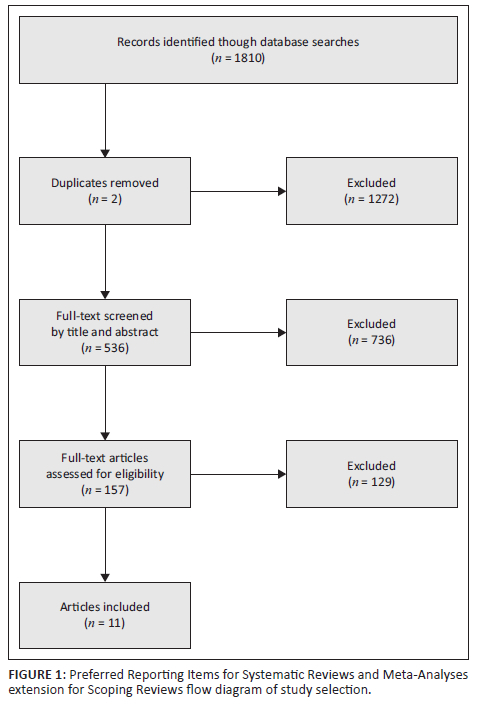
Citations were screened by title and abstract for relevance, followed by full-text review. The selection process is summarised in Figure 1.
Data charting
Data were extracted into a table capturing:
• author and year
• study design and location
• sample characteristics
• magnesium measure (serum, erythrocyte, dietary intake)
• outcomes assessed (HDP, preterm birth, foetal growth restriction)
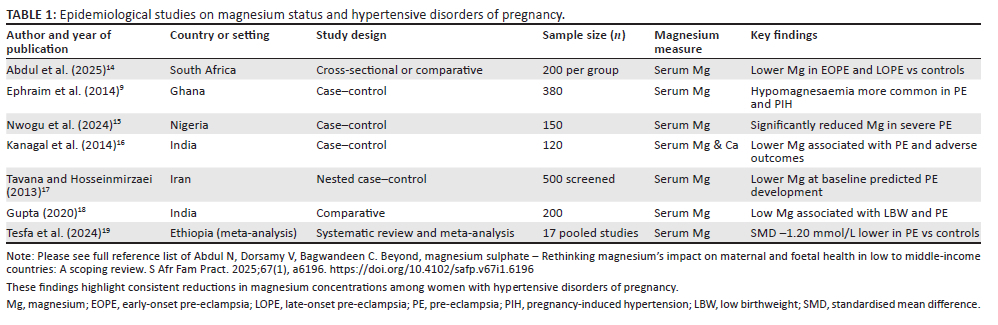
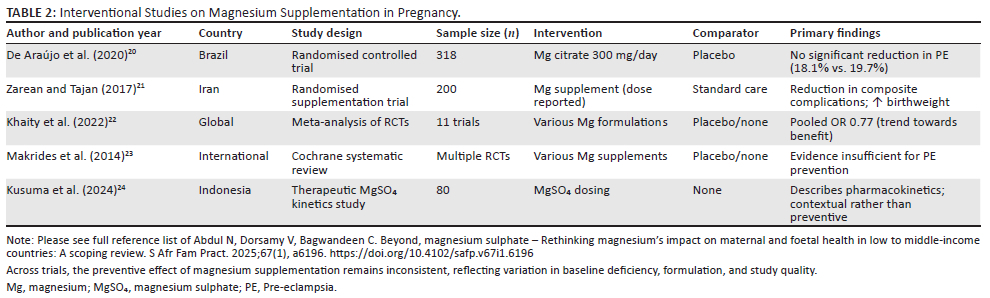
• key findings: Two tables summarise epidemiological associations (Table 1) and interventional evidence (Table 2).
Synthesis of results
Findings were synthesised narratively and thematically. No quantitative meta-analysis was attempted because of heterogeneity in study design, magnesium measures, and populations.
Ethical considerations
Ethical clearance to conduct this study was obtained from the Biomedical Research Ethics Committee of the University of KwaZulu-Natal (No. BREC/00007005/2024). All samples were obtained with explicit informed consent. The purpose of the samples and tests were explained to all participants. All their data were kept private.
Results
Study selection and characteristics
A total of 11 studies met the inclusion criteria and were included in the final synthesis (Figure 1). These comprised observational studies evaluating the association between maternal magnesium status and HDP, as well as interventional trials assessing magnesium supplementation during pregnancy. The included studies were conducted across diverse global regions - with substantial representation from LMICs - and varied in design, sample size, magnesium measurement methods, and gestational timing of assessment.
Epidemiological evidence of magnesium status and hypertensive disorders of pregnancy
Across observational and comparative studies, women who developed HDP consistently demonstrated lower circulating magnesium levels than normotensive controls. Studies from South Africa, Ghana, Nigeria, India, and Iran reported higher prevalence of hypomagnesaemia among women with PE and, in some cases, gestational hypertension. For example, Abdul et al.149151617181919Table 1.
Despite the overall consistency in direction of association, some variation exists between studies. Differences in laboratory assays, trimester of sampling, and cut-off thresholds for hypomagnesaemia contributed to inter-study variability.20,21,22,23,2425,26,27,28,29
Interventional evidence: Magnesium supplementation studies
Evidence from intervention trials assessing magnesium supplementation for prevention of HDP remains mixed. In the largest Randomised Control Trial (RCT), De Araújo et al.2021
Meta-analytic evidence suggests a possible trend towards reduced risk of HDP with supplementation, although the authors emphasised low certainty because of methodological limitations across trials.2223Table 2.
Summary of findings
Overall, the evidence suggests that low magnesium status is frequently observed among women with HDP, particularly in LMIC settings where dietary magnesium intake may be inadequate. Observational findings demonstrate a consistent association between reduced magnesium levels and HDP, whereas interventional evidence is inconclusive and varies according to dosage, formulation, baseline deficiency, and study quality.
Discussion
This scoping review synthesised evidence relating Mg status to HDP, integrating observational data, mechanistic studies, and interventional trials. Across diverse global settings, particularly within LMICs, a consistent pattern emerges linking lower maternal magnesium concentrations with PE and gestational hypertension. While the biological plausibility of this association is strong, limitations in measurement, heterogeneity of study designs, and inconsistent interventional evidence highlight the need for more focused, context-specific research.
Magnesium homeostasis and physiological adaptations during pregnancy
Pregnancy induces major physiological shifts that influence magnesium distribution and metabolism. Several longitudinal studies report a progressive decline in serum magnesium from the second trimester onwards, driven by haemodilution, increased glomerular filtration, and foetal mineral requirements.30,31,32,3332
Intracellular magnesium, reflected in erythrocyte levels, tends to remain more stable despite serum declines. However, in settings characterised by chronic dietary magnesium insufficiency - such as rural India, parts of sub-Saharan Africa, and other mineral-depleted regions - both serum and intracellular magnesium levels are consistently low.16,18,32
Pathophysiological mechanisms linking magnesium to hypertensive disorders of pregnancy
There is compelling mechanistic evidence connecting low magnesium to the vascular and endothelial abnormalities characteristic of HDP. Magnesium plays a critical role in vascular smooth muscle relaxation, calcium homeostasis, nitric oxide synthesis, and modulation of oxidative stress4,5,610,34,35,36
Experimental data further demonstrates that impaired TRPM6-mediated magnesium transport results in placental and foetal defects resembling hypertensive pregnancy phenotypes.3731
Epidemiological associations and magnitude of effect
Epidemiological evidence consistently supports an association between lower magnesium levels and HDP. A meta-analysis focusing on African studies reported a pooled standardised mean difference of -1.20 mmol/L between women with PE and normotensive controls.19171514
Inconsistencies and heterogeneity across studies
Despite general consistency in the direction of association, notable heterogeneity limits cross-study comparability. Variability arises from several sources:
•Magnesium biomarkers: Studies measure total, ionised, or intracellular magnesium, each reflecting different physiological pools.
•Assay methods and reference thresholds: A lack of standardisation hinders comparison across populations.
•Gestational age at sampling: Measurements taken in different trimesters capture varying physiological states.
•Dietary intake, renal function, and comorbidities: Few studies adjust for these important modifiers.
Some studies measuring only total magnesium reported no significant differences, suggesting that serum magnesium may not fully capture biologically relevant magnesium status.38,39
Perinatal outcomes beyond blood pressure
Magnesium insufficiency has implications beyond maternal hypertensive disorders. Several cohort studies demonstrate associations between low maternal magnesium and adverse foetal outcomes, including small-for-gestational-age (SGA) infants, intrauterine growth restriction (IUGR), preterm birth, and low birthweight.18,20,23,40 Evidence from Brazil and India highlights a two-fold increased risk of low birthweight among women in the lowest magnesium tertiles.18,20 These findings are consistent with magnesium's role in placental vasodilation, angiogenesis, and oxidative balance, suggesting that insufficiency may impair placental perfusion and foetal growth.4,5,6,10,34,36
Interventional evidence: Magnesium supplementation studies
Interventional evidence is less clear than observational findings. Twelve randomised or quasi-randomised trials have assessed magnesium supplementation during pregnancy, but results vary widely. The largest trial, the BRAzilian MAGnesium Trial, reported no reduction in PE incidence with 300 mg/day magnesium citrate.20212223
Effectiveness appears influenced by contextual factors, including baseline magnesium deficiency, dietary patterns, supplement formulation, adherence, and gestational timing of initiation. Collectively, evidence indicates that targeted supplementation in deficient or high-risk populations may hold promise, whereas universal prophylaxis lacks sufficient support.
Contextual modifiers: Human immunodeficiency virus (HIV), obesity, and socioeconomic status
Human immunodeficiency virus (HIV) infection and antiretroviral therapy
Human immunodeficiency virus infection may depress magnesium levels through chronic inflammation and altered renal handling, while antiretroviral therapy (ART), particularly protease inhibitors, may exacerbate endothelial dysfunction.25,26,4114
Obesity and metabolic risk
Obesity is associated with reduced intracellular magnesium because of chronic inflammation and insulin resistance.4228,29
Socioeconomic and nutritional factors
The LMICs often face widespread dietary magnesium insufficiency linked to cereal-based diets, mineral-depleted soils, and limited dietary diversity.434, and limited provider training - may further heighten the risk of HDP and maternal morbidity.
Knowledge gaps identified
This article highlights several key gaps:
• Measurement variability: A lack of consensus on the most accurate magnesium biomarker.
• Inadequate deficiency thresholds: No pregnancy-specific cut-offs exist.
• Limited adjustment for confounders: Few studies account for HIV, obesity, diet, renal function, or socioeconomic status.
• Uncertain supplementation strategies: Optimal dosage, formulation, and timing remain unclear.
• Limited mechanistic integration: Few studies include endothelial, angiogenic, or oxidative biomarkers.
• Low- and middle-income countries evidence gap: Despite bearing the highest burden, LMIC-focused trials remain scarce.
Limitations
This scoping review did not include formal quality appraisal of included studies, consistent with PRISMA-ScR guidelines. As a result, heterogeneity in study design, methodology, and measurement techniques limits direct comparisons. Most studies were observational and cross-sectional, restricting temporal inference. Confounding variables were inconsistently reported, and publication bias cannot be excluded. Despite these limitations, this review offers a comprehensive mapping of the available evidence and highlights priority areas for future research.
Recommendations
Future research should prioritise standardisation of magnesium assessment, development of pregnancy-specific reference ranges, and use of more sensitive biomarkers such as ionised or intracellular magnesium. Longitudinal cohort studies are needed to clarify temporal relationships and better account for contextual modifiers, including HIV and obesity.
Large, well-powered randomised trials focused on women with documented magnesium deficiency are required to determine optimal dosage, formulation, and timing of supplementation. Trials should integrate mechanistic endpoints to clarify physiological effects.
In LMIC settings, strengthening antenatal nutritional assessment, promoting dietary diversification or fortification, and improving health system readiness, particularly reliable access to MgSO4, may enhance maternal outcomes.
Conclusion
Taken together, the evidence reveals a biologically plausible and epidemiologically consistent association between magnesium insufficiency and HDP. While supplementation demonstrates potential benefit in deficient or high-risk populations, its preventive efficacy remains uncertain because of heterogeneity in trial design and population characteristics. Harmonised biomarker approaches, context-specific interventional research, and integration of mechanistic markers are essential to determine whether magnesium optimisation can contribute meaningfully to reducing the burden of HDP - particularly within LMICs, where both magnesium deficiency and HDP prevalence are high. This scoping review revealed a lack of magnesium reporting and investigation in RCTs, with comorbidities in LMIC-based studies being ignored and a scarcity of treatment protocols; thereby emphasising the importance of reinforcing treatment protocols and emphasising the importance of magnesium and how co-morbidities can affect it.
This article is based on data from a larger study. A related article focusing on the association between serum magnesium levels and hypertensive disorders of pregnancy has been published in South African Family Practice, 67(1), article 6140. The present article addresses a distinct research question, focusing on rethinking magnesium's impact on maternal and foetal health in low to middle-income countries.
Competing interests
The authors reported that they received funding from the National Research Foundation Thuthuka Grant in collaboration with the University of KwaZulu-Natal and Medical Research Council of South Africa, which may be affected by the research reported in the enclosed publication. The authors have disclosed those interests fully and have implemented an approved plan for managing any potential conflicts arising from their involvement. The terms of these funding arrangements have been reviewed and approved by the affiliated university in accordance with its policy on objectivity in research.
Authorship contribution
Naeera Abdul: Conceptualisation, investigation, methodology, visualisation, writing - original draft, review & editing. Vinogrin Dorsamy: Conceptualisation, data curation, formal analysis, funding acquisition, investigation, methodology, supervision, validation, writing - review & editing. Chauntelle Bagwandeen: Conceptualisation, project administration, resources, supervision, validation. All authors reviewed the article, contributed to the discussion of results, approved the final version for submission and publication, and take responsibility for the integrity of its findings.
Funding information
This study was funded by the National Research Foundation Thuthuka Grant (TTK170508230162) in collaboration with the University of KwaZulu-Natal and Medical Research Council of South Africa (SIR Grant UNS14197). The institutions listed have no vested interest in the study. Furthermore, there was no input from these organisations in the interpretation of the result.
Data availability
Data used in this study will be made available from the corresponding author, Naeera Abdul, upon reasonable request.
Disclaimer
The views and opinions expressed in this article are those of the authors and are the product of professional research. It does not necessarily reflect the official policy or position of any affiliated institution, funder, agency, or that of the publisher. The authors are responsible for this article's findings and content.
Acknowledgements
This article is based on research originally conducted as part of Naeera Abdul's Master's thesis titled 'The interplay between magnesium and hypertensive disorders of pregnancy in a pregnant, black South African population', submitted to the School of Laboratory Medicine and Medical Sciences, University of KwaZulu-Natal in 2025. The thesis was supervised by Dr Vinogrin Dorsamy and Dr Chauntelle Bagwandeen. The manuscript has since been revised and adapted for journal publication. The original thesis is currently under review.
References
-
1.United Nations. Transforming our world: The 2030 agenda for sustainable development [homepage on the Internet]. United Nations; 2015 [cited 2025 Nov 12]. Available from: https://sdgs.un.org/sites/default/files/publications/21252030%20Age nda%20for%20Sustainable%20Development%20web.pdf
» https://sdgs.un.org/sites/default/files/publications/21252030%20Age nda%20for%20Sustainable%20Development%20web.pdf -
2.Murray CJL, Lopez AD. Measuring the global burden of disease. N Engl J Med. 2013;369(5):448-457. https://doi.org/10.1056/NEJMra1201534
» https://doi.org/10.1056/NEJMra1201534 -
3.Dimitriadis E, Rolnik DL, Zhou W, et al. Pre-eclampsia. Nat Rev Dis Primers. 2023;9(1):1-22. https://doi.org/10.1038/s41572-023-00417-6
» https://doi.org/10.1038/s41572-023-00417-6 -
4.Schwalfenberg GK, Genuis SJ. The importance of magnesium in clinical healthcare. Scientifica. 2017;2017(1):1-14. https://doi.org/10.1155/2017/4179326
» https://doi.org/10.1155/2017/4179326 -
5.Dalton LM, Ní Fhloinn DM, Gaydadzhieva GT, Mazurkiewicz OM, Leeson H, Wright CP. Magnesium in pregnancy. Nutr Rev. 2016;74(9):549-557. https://doi.org/10.1093/nutrit/nuw018
» https://doi.org/10.1093/nutrit/nuw018 -
6.Sontia B, Touyz RM. Role of magnesium in hypertension. Arch Biochem Biophys. 2007;458(1):33-39. https://doi.org/10.1016/j.abb.2006.05.005
» https://doi.org/10.1016/j.abb.2006.05.005 -
7.Konukoglu D, Uzun H. Endothelial dysfunction and hypertension. Adv Exp Med Biol. 2016;956:511-540. https://doi.org/10.1007/5584_2016_90
» https://doi.org/10.1007/5584_2016_90 -
8.Eslamzadeh A, Amin M, Asadi N, et al. Serum calcium and magnesium levels in women presenting with pre-eclampsia: A systematic review and meta-analysis based on observational studies. Galen Med J. 2023;12:e3151. https://doi.org/10.31661/gmj.v12i.3151
» https://doi.org/10.31661/gmj.v12i.3151 -
9.Ephraim RKD, Osakunor DNM, Denkyira SW, Eshun H, Amoah S, Anto EO. Serum calcium and magnesium levels in women presenting with pre-eclampsia and pregnancy-induced hypertension: A case-control study in the Cape Coast Metropolis, Ghana. BMC Pregnancy Childbirth. 2014;14(1):390. https://doi.org/10.1186/s12884-014-0390-2
» https://doi.org/10.1186/s12884-014-0390-2 -
10.Owusu Darkwa E, Antwi-Boasiako C, Djagbletey R, Owoo C, Obed S, Sottie D. Serum magnesium and calcium in preeclampsia: A comparative study at the Korle-Bu Teaching Hospital, Ghana. Integr Blood Press Control. 2017;10:9-15. https://doi.org/10.2147/IBPC.S129106
» https://doi.org/10.2147/IBPC.S129106 -
11.Arksey H, O'malley L. Scoping studies: Towards a methodological framework. Int J Soc Res Methodol. 2005;8(1):19-32. https://doi.org/10.1080/1364557032000119616
» https://doi.org/10.1080/1364557032000119616 -
12.Levac D, Colquhoun H, O'brien KK. Scoping studies: Advancing the methodology. Implement Sci. 2010;5(1):69. https://doi.org/10.1186/1748-5908-5-69
» https://doi.org/10.1186/1748-5908-5-69 -
13.Tricco AC, Lillie E, Zarin W, et al. PRISMA extension for scoping reviews (PRISMA-ScR): Checklist and explanation. Ann Intern Med. 2018;169(7):467-473. https://doi.org/10.7326/M18-0850
» https://doi.org/10.7326/M18-0850 -
14.Abdul N, Dorsamy V, Bagwandeen C. The association between serum magnesium levels and hypertensive disorders of pregnancy. S Afr Fam Pract. 2025;67(1): 6140. https://doi.org/10.4102/safp.v67i1.6140
» https://doi.org/10.4102/safp.v67i1.6140 - 15.Nwogu HC, Fyneface-Ogan S, Imasuen SO. A comparative study of serum magnesium between normal healthy pregnant women and pre-eclamptics in a Nigerian teaching hospital. Port Harcourt Med J. 2024;18(2):86-93.
-
16.Kanagal DV, Rajesh A, Rao K, et al. Levels of serum calcium and magnesium in pre-eclamptic and normal pregnancy: A study from Coastal India. J Clin Diagn Res. 2014;8(7):OC01. https://doi.org/10.7860/JCDR/2014/8872.4537
» https://doi.org/10.7860/JCDR/2014/8872.4537 -
17.Tavana Z, Hosseinmirzaei S. Comparison of maternal serum magnesium level in pre-eclampsia and normal pregnant women. Iran Red Crescent Med J. 2013;15(12):e10394. https://doi.org/10.5812/ircmj.10394
» https://doi.org/10.5812/ircmj.10394 -
18.Gupta P. A study of maternal serum calcium and serum magnesium levels in pre-eclamptic and normotensive pregnancies. Int J Reprod Contracept Obstet Gynecol. 2020;9(8): 3129. https://doi.org/10.18203/2320-1770.ijrcog20203291
» https://doi.org/10.18203/2320-1770.ijrcog20203291 -
19.Tesfa E, Munshea A, Nibret E, Gizaw ST. Association of maternal serum magnesium with pre-eclampsia in African pregnant women: A systematic review and meta-analysis. Int Health. 2024;16(1):14-22. https://doi.org/10.1093/inthealth/ihad026
» https://doi.org/10.1093/inthealth/ihad026 -
20.De Araújo CA, De Sousa Oliveira L, De Gusmão IM, Guimarães A, Ribeiro M, Alves JG. Magnesium supplementation and preeclampsia in low-income pregnant women - A randomized double-blind clinical trial. BMC Pregnancy Childbirth. 2020;20(1):208. https://doi.org/10.1186/s12884-020-02877-0
» https://doi.org/10.1186/s12884-020-02877-0 -
21.Zarean E, Tarjan A. Effect of magnesium supplement on pregnancy outcomes: A randomized control trial. Adv Biomed Res. 2017;6(1):109. https://doi.org/10.4103/2277-9175.213879
» https://doi.org/10.4103/2277-9175.213879 -
22.Khaity A, Albakri K, Alabdallat Y, Saleh O, Ghaith HS. The effect of oral magnesium supplement on pre-eclampsia and perinatal outcomes in pregnancy: A meta-analysis of randomized controlled trials. Int J Med Stud. 2022;10:S225. https://doi.org/10.5195/ijms.2022.1808
» https://doi.org/10.5195/ijms.2022.1808 -
23.Makrides M, Crosby DD, Shepherd E, Crowther CA. Magnesium supplementation in pregnancy. Cochrane Database Syst Rev. 2014;2014(4):CD000937. https://doi.org/10.1002/14651858.CD000937.pub2
» https://doi.org/10.1002/14651858.CD000937.pub2 -
24.Kusuma AA, Widiyanti ES, Putra I, Widayana KA, Setiawan WA. Serum magnesium levels in preeclampsia and eclampsia patients during magnesium sulfate therapy. J Obstet Gynecol Cancer Res. 2024;10(1):40-50. https://doi.org/10.30699/jogcr.10.1.40
» https://doi.org/10.30699/jogcr.10.1.40 -
25.Suy A, Martínez E, Coll O, et al. Increased risk of pre-eclampsia and fetal death in HIV-infected pregnant women receiving highly active antiretroviral therapy. AIDS. 2006;20(1):59-66. https://doi.org/10.1097/01.aids.0000198090.70325.bd
» https://doi.org/10.1097/01.aids.0000198090.70325.bd -
26.Machado ES, Krauss MR, Megazzini K, et al. Hypertension, preeclampsia and eclampsia among HIV-infected pregnant women from Latin America and Caribbean countries. J Infect. 2014;68(6):572-580. https://doi.org/10.1016/j.jinf.2013.12.018
» https://doi.org/10.1016/j.jinf.2013.12.018 -
27.Kassu A, Yabutani T, Mulu A, Tessema B, Ota F. Serum zinc, copper, selenium, calcium, and magnesium levels in pregnant and non-pregnant women in Gondar, Northwest Ethiopia. Biol Trace Elem Res. 2008;122(2):97-106. https://doi.org/10.1007/s12011-007-8067-6
» https://doi.org/10.1007/s12011-007-8067-6 -
28.Olson KN, Redman LM, Sones JL. Obesity 'complements' preeclampsia. Physiol Genom. 2019;51(3):73-76. https://doi.org/10.1152/physiolgenomics.00102.2018
» https://doi.org/10.1152/physiolgenomics.00102.2018 -
29.Piuri G, Zocchi M, Della Porta M, et al. Magnesium in obesity, metabolic syndrome, and type 2 diabetes. Nutrients. 2021;13(2):320. https://doi.org/10.3390/nu13020320
» https://doi.org/10.3390/nu13020320 -
30.Rylander R. Magnesium in pregnancy blood pressure and pre-eclampsia - A review. Pregnancy Hypertens. 2014;4(2):146-149. https://doi.org/10.1016/j.preghy.2014.01.002
» https://doi.org/10.1016/j.preghy.2014.01.002 -
31.Fanni D, Gerosa C, Nurchi VM, et al. The role of magnesium in pregnancy and in fetal programming of adult diseases. Biol Trace Elem Res. 2021;199(10):3647-3657. https://doi.org/10.1007/s12011-020-02513-0
» https://doi.org/10.1007/s12011-020-02513-0 -
32.Lee C, Kim YH, Choi MG, Kim JW, Park CY. Placental magnesium transport-related mRNA expression is not associated with serum magnesium in singletons and twins. Placenta. 2025;165:73-75. https://doi.org/10.1016/j.placenta.2025.04.007
» https://doi.org/10.1016/j.placenta.2025.04.007 -
33.Blaine J, Chonchol M, Levi M. Renal control of calcium, phosphate, and magnesium homeostasis. Clin J Am Soc Nephrol. 2015;10(7):1257-1272. https://doi.org/10.2215/CJN.09750913
» https://doi.org/10.2215/CJN.09750913 -
34.Poston L, Igosheva N, Mistry HD, et al. Role of oxidative stress and antioxidant supplementation in pregnancy disorders. Am J Clin Nutr. 2011;94(Suppl. 6):1980S1985S. https://doi.org/10.3945/ajcn.110.001156
» https://doi.org/10.3945/ajcn.110.001156 -
35.Nielsen FH. Magnesium deficiency and increased inflammation: Current perspectives. J Inflamm Res. 2018;11:25-34. https://doi.org/10.2147/jir.s136742
» https://doi.org/10.2147/jir.s136742 -
36.Zheltova AA, Kharitonova MV, Iezhitsa IN, Spasov AA. Magnesium deficiency and oxidative stress: An update. BioMedicine. 2016;6(4):20. https://doi.org/10.7603/s40681-016-0020-6
» https://doi.org/10.7603/s40681-016-0020-6 -
37.Kisters K, Barenbrock M, Louwen F, Hausberg M, Rahn KH, Kosch M. Membrane, intracellular, and plasma magnesium and calcium concentrations in preeclampsia. Am J Hypertens. 2000;13(7):765-769. https://doi.org/10.1016/S0895-7061(00)00240-5
» https://doi.org/10.1016/S0895-7061(00)00240-5 -
38.Aali BS, Khazaeli P, Ghasemi F. Ionized and total magnesium concentration in patients with severe preeclampsia-eclampsia undergoing magnesium sulfate therapy. J Obstet Gynaecol Res. 2007;33(2):138-143. https://doi.org/10.1111/j.1447-0756.2007.00508.x
» https://doi.org/10.1111/j.1447-0756.2007.00508.x -
39.Taber EB, Tan L, Chao CR, Beall MH, Ross MG. Pharmacokinetics of ionized versus total magnesium in subjects with preterm labor and preeclampsia. Am J Obstet Gynecol. 2002;186(5):1017-1021. https://doi.org/10.1067/mob.2002.122421
» https://doi.org/10.1067/mob.2002.122421 -
40.Spätling L, Spätling G. Magnesium supplementation in pregnancy. A double-blind study. Br J Obstet Gynaecol. 1988;95(2):120-125. https://doi.org/10.1111/j.1471-0528.1988.tb06839.x
» https://doi.org/10.1111/j.1471-0528.1988.tb06839.x - 41.Bharath DS, Rakshith SC, Shilpa TA. A study of serum magnesium levels in people living with HIV on anti-retroviral therapy. Eur J Cardiovasc Med. 2025;15:305-307.
-
42.Suliburska J, Cholik R, Kocyłowski R, Bakinowska E. Relationship between prepregnancy BMI and the concentrations of iron, calcium, and magnesium in serum and hair during the first trimester of pregnancy in women. J Trace Elem Med Biol. 2024;83:127388. https://doi.org/10.1016/j.jtemb.2024.127388
» https://doi.org/10.1016/j.jtemb.2024.127388 -
43.Cazzola R, Della Porta M, Manoni M, Iotti S, Pinotti L, Maier JA. Going to the roots of reduced magnesium dietary intake: A tradeoff between climate changes and sources. Heliyon. 2020;6(11):e05390. https://doi.org/10.1016/j.heliyon.2020.e05390
» https://doi.org/10.1016/j.heliyon.2020.e05390

Accepted: 19 Nov. 2025
Published: 13 Jan. 2026