Breast cancer survivorship in South Africa: A holistic primary care approach
Abstract
As breast cancer incidence increases and survival improves, an increasing number of breast cancer survivors (BCS) require long-term follow-up and support. Primary care providers play a central role in maintaining continuity of care, promoting endocrine therapy adherence, managing complications such as lymphoedema and supporting psychosocial well-being. This article aims to provide a structured approach to breast cancer survivorship care, aligned with national cancer care policies and guidelines and international best practices, focused on primary care integration. A case vignette aims to bridge theory and practice, contextualise decision-making and encourage patient-centred care as it relates to breast cancer survivorship in the South African context.
breast cancer survivorship; primary care; hormone therapy; psychosocial support
Introduction
South Africa's (SA) breast cancer burden continues to rise, and although advancements in early detection and treatment have improved survival, the country still has a high breast cancer mortality rate, likely because of factors such as low screening rates, lower access to health care and a higher incidence of triple-negative breast cancer in patients of African ancestry.12344,55
Breast cancer survivorship refers to the phase of care that begins at the time of diagnosis and continues through the remainder of a person's life, regardless of whether one is still living with cancer or in remission. It encompasses not only the physical recovery from cancer and its treatment, but also the emotional, psychological, social and financial impacts that persist long after active treatment may have ended.6,7
Survivorship care spans more than disease surveillance; it includes managing late complications, improving quality of life and coordinating health maintenance. With specialist services stretched, PCPs are uniquely placed to provide accessible, long-term follow-up.
Case vignette
Ms. R is 65 years old. She presents to her local clinic for a consultation and script renewal of her anti-hypertensive treatment. She reports having undergone left-sided breast cancer treatment for a hormone receptor positive (HR+) 3 cm lesion without lymph node involvement at a tertiary centre 8 years ago. Her treatment consisted of:
• Neo-adjuvant chemotherapy.
• Breast conserving surgery and sentinel lymph node biopsy.
• Radiation therapy.
• Aromatase inhibitor (AI): letrozole, which she is currently still taking.
She requests further breast cancer follow up at her local clinic as she finds attending appointments at the tertiary centre cumbersome. Given that she feels well, she questions the need for frequent visits to the tertiary care centre. In approaching her care, it is essential to adopt a comprehensive and patient-centred strategy, considering the pertinent clinical and psychosocial issues that may influence ongoing management.
The breast cancer survivorship journey: Initial care
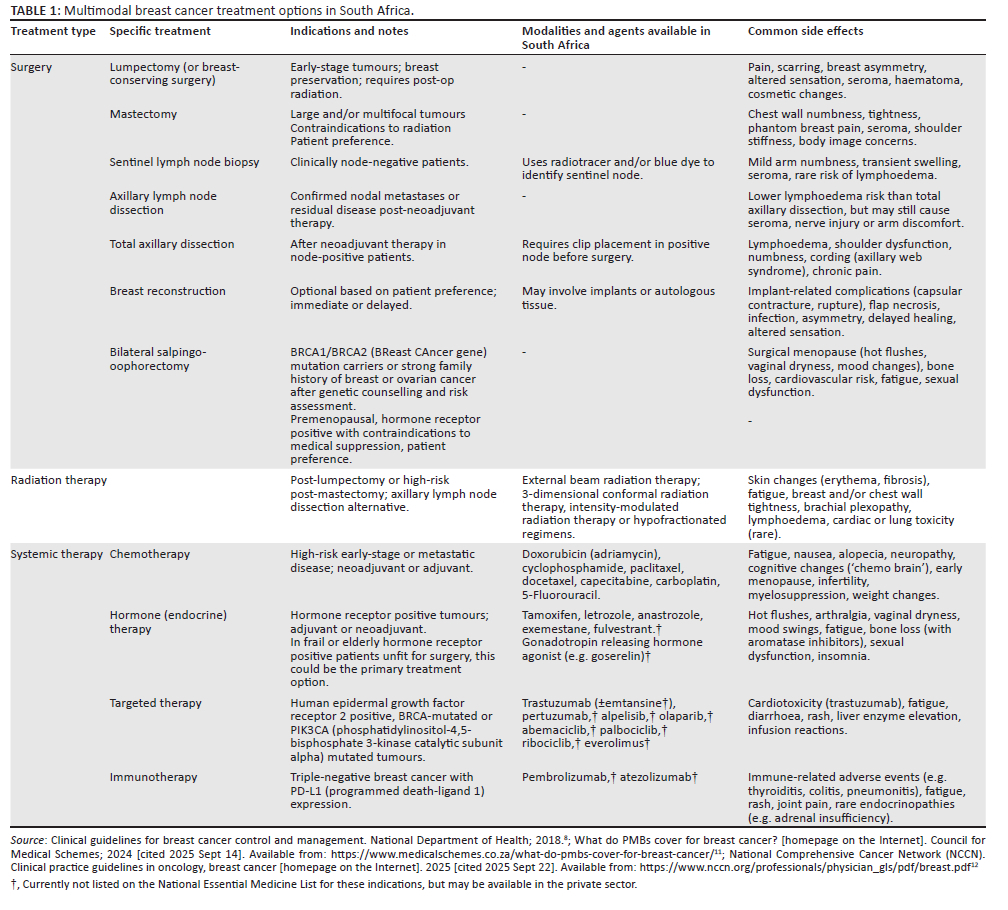
Many BCS have undergone multimodal treatments provided by multidisciplinary teams (surgeons, medical and radiation oncologists, radiologists, pathologists and allied health professionals). Table 1 outlines these treatments. Understanding the treatment history allows PCPs to anticipate complications and individualise care. These services are generally provided in dedicated regional and/or specialist breast units in the public sector.8,9 In the private sector, modes to access these services are not uniform, but treatment for breast cancer is a prescribed minimum benefit for patients who have medical insurance coverage.10
Follow-up and when to refer
Annual mammography with or without ultrasound is recommended for patients with early and locally advanced breast cancer following treatment, especially after breast-conserving treatment.88not routinely required in asymptomatic patients.
Echocardiography is advised for those treated with anthracyclines or trastuzumab, typically every 3 months during treatment and every 6-12 months after treatment if there is any decline in cardiac function. Bone mineral density measurement with Dual-Energy X-ray Absorptiometry (DEXA) testing is recommended every 2-3 years for BCS on AIs.
Primary care providers should vigilantly screen and examine for:
• New masses (breast, chest wall, axilla).
• Persistent bone pain or neurological symptoms.
• Weight loss or fatigue without another cause.
• Shortness of breath or a new cough.
• Abnormal blood tests (if ordered based on symptoms).
Urgent referral or imaging is warranted should any of these arise.
Other relevant cancer screening (e.g. cervical and colon cancer) should be conducted as for the general public.
Endocrine therapy
Approximately 60% - 70% of BCS have HR+ cancer.14,1588
Tamoxifen, a selective oestrogen receptor modulator, is approved for use in HR+ breast cancer in SA. In breast cells, it acts as an oestrogen antagonist, preventing oestrogen from binding to its receptor. This blockade inhibits tumour growth, as oestrogen normally promotes proliferation in hormone-sensitive breast cancer cells.168
In postmenopausal women, the ovaries no longer produce significant oestrogen. Instead, oestrogen is synthesised via aromatase-mediated conversion of androgens. Aromatase inhibitors inhibit this enzyme, leading to a dramatic reduction in circulating oestrogen levels. This oestrogen deprivation starves HR+ breast cancer cells, slowing or halting their growth.178811
Extended endocrine therapy is typically considered for patients with a higher risk of late recurrence as determined by the specialist treating team. A recent meta-analysis18
Paracetamol, non-steroidal anti-inflammatories (NSAIDs) and exercise may be effective treatments for vasomotor and musculoskeletal side effects of AIs.198
Trastuzumab (Herceptin)
Trastuzumab binds to the extracellular domain of the human epidermal growth factor receptor 2 (HER2) on breast cancer cells, preventing dimerisation and downstream signalling through multiple pathways. It also activates immune-mediated cell destruction via antibody-dependent cellular cytotoxicity, reducing tumour growth and HER2 surface expression.20212223
Bone health
Breast cancer survivors at increased risk of osteopenia and osteoporosis include those who are on AIs, undergoing ovarian suppression, have a low body mass index (BMI), smoke, or use corticosteroids.248,24
Cardiovascular health
Breast cancer survivors at increased risk of cardiovascular complications include those with pre-existing risk factors such as smoking, high alcohol intake, obesity, and a sedentary lifestyle, as well as those of advanced age or with a family history of heart disease. Additional risk factors include hypertension, diabetes mellitus, hypercholesterolaemia, and existing cardiac conditions (e.g., heart failure, asymptomatic left ventricular systolic dysfunction, cardiomyopathy, or coronary artery disease). Survivors treated with potentially cardiotoxic therapies such as anthracyclines (e.g., doxorubicin), trastuzumab, or chest wall radiotherapy, are also at elevated risk.8,24
Lymphoedema
Lymphoedema occurs in up to 30% of women after axillary surgery or radiotherapy,2526827
Psychosocial support and health promotion
Long-term effects of cancer and its treatment can be emotionally and socially complex. Common issues include anxiety about recurrence, depression or post-treatment adjustment, cognitive difficulties and employment and financial stress.24828
Sexual and reproductive health
Disruption of body image, sexual dysfunction and intimacy concerns are often neglected aspects of cancer care survivorship. Addressing sexual health proactively is a crucial aspect of providing breast cancer survivorship care. Assessing for reversible contributing factors and treating these when appropriate are indicated. Non-hormonal, water-based lubricants can be prescribed for vaginal dryness.1929248
Coordinated survivorship care
Survivorship care plans summarising the diagnosis, treatment, and follow-up schedule may facilitate shared care between the oncology team at the tertiary level and PCPs.30
Case vignette continued
After a comprehensive clinical consultation with Ms. R, you establish that her hypertension is well-controlled and she has no symptoms or signs of cardiovascular compromise, breast cancer recurrence, anxiety or depression. Her only complaint is joint pains in the knees and wrists in the mornings which improves during the day. She reports good adherence to letrozole. She has no signs or symptoms of lymphoedema. You establish that she is a non-smoker who attends a community exercise class 4 or 5 times per week, with an acceptable BMI. She does not currently have a sexual partner and reports no genito-urinary discomfort. You liaise with her oncologist at the tertiary centre who agrees that Ms. R is eligible for primary care follow up. The oncologist advises that Ms. R could discontinue the letrozole, having received 8 years of adjuvant endocrine treatment and considering her acceptable clinical response. Ms. R agrees to this. The oncologist advises that Ms. R continue calcium and vitamin D supplementation and undergoes a repeat mammogram and DEXA in 1 year (after reviewing reassuring recent examinations). Ms. R, reassured and fully informed of her stable clinical status, treatment history and ongoing health needs, agrees to the proposed plan through shared decision making. She is willing to undergo her repeat special investigations at the tertiary centre and understands the need for possible referral back to the tertiary centre should breast cancer recur.
Conclusion
Breast cancer survivorship care is a growing component of the PCP's workload. Equipped with clear guidance and practical tools, PCPs can offer high-value follow-up that not only detects breast cancer recurrence but also improves overall patient well-being. With the shift towards integrated chronic disease management in SA, breast cancer survivorship deserves structured support across the continuum of care.
Competing interests
The authors declare that they have no financial or personal relationships that may have inappropriately influenced them in writing this article. The author, Mareike Rabe, serves as an editorial board member of this journal. The peer review process for this submission was handled independently, and the author had no involvement in the editorial decision-making process for this manuscript. The authors have no other competing interests to declare.
CRediT authorship contribution
Mareike Rabe: Conceptualisation, Writing - orginal draft, Writing - review & editing. Nita M. Robinson: Writing - orginal draft, Writing - review & editing. All authors reviewed the article, contributed to the discussion of results, approved the final version for submission and publication, and take responsibility for the integrity of its findings.
Ethical considerations
This article followed all ethical standards for research without direct contact with human or animal subjects.
Funding information
This research received no specific grant from any funding agency in the public, commercial or not-for-profit sectors.
Data availability
The authors confirm that the data supporting this study and its findings are available within the article and its listed references.
Disclaimer
The views and opinions expressed in this article are those of the authors and are the product of professional research. The article does not necessarily reflect the official policy or position of any affiliated institution, funder, agency or the publisher. The authors are responsible for this article's results, findings and content.
Acknowledgements
The authors would like to thank Dr Francois Malherbe, Department of Surgery, Faculty of Health Sciences, University of Cape Town for his valuable contributions to this article. While their contribution was important, it did not meet the criteria for authorship.
References
-
1.Dlamini Z, Molefi T, Khanyile R, et al. From incidence to intervention: A comprehensive look at breast cancer in South Africa. Oncol Ther. 2024;12(1):1-11. https://doi.org/10.1007/s40487-023-00248-1
» https://doi.org/10.1007/s40487-023-00248-1 -
2.Debbie @CANSA. Breast cancer [homepage on the Internet]. CANSA - The Cancer Association of South Africa; 2022 [cited 2025 Jun 30]. Available from: https://cansa.org.za/breast-cancer/
» https://cansa.org.za/breast-cancer/ -
3.Cancer in South Africa (2008-2019) [homepage on the Internet]. Statistics South Africa; 2023 [cited 2025 Jun 30]. Available from: https://www.statssa.gov.za/publications/03-08-00/03-08-002023.pdf
» https://www.statssa.gov.za/publications/03-08-00/03-08-002023.pdf -
4.Herbst M. CANSA fact sheet on breast cancer in men [homepage on the Internet]. CANSA; 2024 [cited 2025 Jul 20]. Available from: https://cansa.org.za/files/2024/10/CANSA-Fact-Sheet-on-Breast-Cancer-in-Men-NCR-2022-web-October-2024.pdf
» https://cansa.org.za/files/2024/10/CANSA-Fact-Sheet-on-Breast-Cancer-in-Men-NCR-2022-web-October-2024.pdf -
5.Abboah-Offei M, Bayuo J, Salifu Y, Afolabi O, Akudjedu TN. Experiences and perceptions of men following breast cancer diagnosis: A mixed method systematic review. BMC Cancer. 2024;24(1):179. https://doi.org/10.1186/s12885-024-11911-9
» https://doi.org/10.1186/s12885-024-11911-9 -
6.Definition of survivorship - NCI dictionary of cancer terms [homepage on the Internet]. NCI; 2011 [cited 2025 Jun 30]. Available from: https://www.cancer.gov/publications/dictionaries/cancer-terms/def/survivorship
» https://www.cancer.gov/publications/dictionaries/cancer-terms/def/survivorship -
7.Mollica MA, Doose M, Reed C, Tonorezos E. Defining concepts in cancer survivorship. Cancer. 2025;131(16):e70039. https://doi.org/10.1002/cncr.70039
» https://doi.org/10.1002/cncr.70039 - 8.National Department of Health. Clinical guidelines for breast cancer control and management. Pretoria: National Department of Health; 2018.
-
9.National cancer strategic framework 2017-2022 [homepage on the Internet]. National Department of Health; 2017 [cited 2025 Sept 14]. Available from: https://knowledgehub.health.gov.za/system/files/elibdownloads/2023-04/national-cancer-strategic-framework-2017-2022-min.pdf
» https://knowledgehub.health.gov.za/system/files/elibdownloads/2023-04/national-cancer-strategic-framework-2017-2022-min.pdf -
10.What do PMBs cover for breast cancer? [homepage on the Internet]. Council for Medical Schemes; 2024 [cited 2025 Sept 14]. Available from: https://www.medicalschemes.co.za/what-do-pmbs-cover-for-breast-cancer/
» https://www.medicalschemes.co.za/what-do-pmbs-cover-for-breast-cancer/ -
11.National Comprehensive Cancer Network (NCCN). Clinical practice guidelines in oncology, breast cancer [homepage on the Internet]. 2025 [cited 2025 Sept 22]. Available from: https://www.nccn.org/professionals/physician_gls/pdf/breast.pdf
» https://www.nccn.org/professionals/physician_gls/pdf/breast.pdf -
12.Icon medicine formulary [homepage on the Internet]. 2025 [cited 2025 Aug 30]. Available from: https://iconsa.co.za/wp-content/uploads/2025/07/Icon-Medicine-Formulary-July-2025.pdf
» https://iconsa.co.za/wp-content/uploads/2025/07/Icon-Medicine-Formulary-July-2025.pdf -
13.Khatcheressian JL, Hurley P, Bantug E, et al. Breast cancer follow-up and management after primary treatment: American Society of Clinical Oncology clinical practice guideline update. J Clin Oncol. 2013;31(7):961-965. https://doi.org/10.1200/JCO.2012.45.9859
» https://doi.org/10.1200/JCO.2012.45.9859 -
14.Dix-Peek T, Dickens C, Augustine T, et al. FGFR2 genetic variants in women with breast cancer. Mol Med Rep. 2023;28(6):226. https://doi.org/10.3892/mmr.2023.13113
» https://doi.org/10.3892/mmr.2023.13113 -
15.De Lima H, Ramos S, Rajkumar L, Cubasch H. Female breast cancer trends: A South African perspective. S Afr J Radiol. 2025;29(1):a3117. https://doi.org/10.4102/sajr.v29i1.3117
» https://doi.org/10.4102/sajr.v29i1.3117 -
16.Tamoxifen [homepage on the Internet]. [cited 2025 Jul 20]. Available from: https://go.drugbank.com/drugs/DB00675
» https://go.drugbank.com/drugs/DB00675 -
17.Breast cancer prevention: Aromatase inhibitors [homepage on the Internet]. [cited 2025 Jul 20]. Available from: https://www.cancer.org/cancer/types/breast-cancer/risk-and-prevention/aromatase-inhibitors-for-lowering-breast-cancer-risk.html
» https://www.cancer.org/cancer/types/breast-cancer/risk-and-prevention/aromatase-inhibitors-for-lowering-breast-cancer-risk.html -
18.Ying Z, Linxun L, Kechang Z, Xiaowu W, Huazhen G, Zhijun M. Optimal extension time after initial endocrine therapy for postmenopausal hormone receptor-positive early-stage breast cancer: A systematic review and meta-analysis. BMC Womens Health. 2025;25(1):156. https://doi.org/10.1186/s12905-025-03610-9
» https://doi.org/10.1186/s12905-025-03610-9 - 19.Sisler J, Chaput G, Sussman J, Ozokwelu E. Follow-up after treatment for breast cancer practical guide to survivorship care for family physicians. Can Fam Physician. 2016;62:805-811.
-
20.Trastuzumab [homepage on the Internet]. [cited 2025 Jul 20]. Available from: https://go.drugbank.com/drugs/DB00072
» https://go.drugbank.com/drugs/DB00072 -
21.Dickens C, Duarte R, Zietsman A, et al. Racial comparison of receptor-defined breast cancer in Southern African women: Subtype prevalence and age-incidence analysis of nationwide cancer registry data. Cancer Epidemiol Biomarkers Prev Publ. 2014;23(11):2311-2321. https://doi.org/10.1158/1055-9965.EPI-14-0603
» https://doi.org/10.1158/1055-9965.EPI-14-0603 -
22.Wiseman RJ, Riddin J, Jugathpal J, Parrish AJ, Ruff P, Blockman M. Adjuvant trastuzumab in early HER2-positive breast cancer: Journeying towards the optimal duration of therapy in South Africa. S Afr Med J. 2020;110(4):271. https://doi.org/10.7196/SAMJ.2020.v110i4.14621
» https://doi.org/10.7196/SAMJ.2020.v110i4.14621 -
23.Earl HM, Hiller L, Vallier AL, et al. 6 versus 12 months of adjuvant trastuzumab for HER2-positive early breast cancer (PERSEPHONE): 4-year disease-free survival results of a randomised phase 3 non-inferiority trial. Lancet. 2019;393(10191):2599-2612. https://doi.org/10.1016/S0140-6736(19)30650-6
» https://doi.org/10.1016/S0140-6736(19)30650-6 -
24.Nardin S, Mora E, Varughese FM, et al. Breast cancer survivorship, quality of life, and late toxicities. Front Oncol. 2020;10:864. https://doi.org/10.3389/fonc.2020.00864
» https://doi.org/10.3389/fonc.2020.00864 -
25.DiSipio T, Rye S, Newman B, Hayes S. Incidence of unilateral arm lymphoedema after breast cancer: A systematic review and meta-analysis. Lancet Oncol. 2013;14(6):500-515. https://doi.org/10.1016/S1470-2045(13)70076-7
» https://doi.org/10.1016/S1470-2045(13)70076-7 -
26.Marco CM, Pillay R, Schoonheim C. The management of breast cancer-related lymphoedema. S Afr Med J. 2014;104(5):382. https://doi.org/10.7196/SAMJ.8251
» https://doi.org/10.7196/SAMJ.8251 -
27.Find a therapist [homepage on the Internet]. Lymphoedema Association of South Africa; 2024 [cited 2025 Sept 22]. Available from: https://www.laosa.co.za/find-a-therapist/
» https://www.laosa.co.za/find-a-therapist/ -
28.Silver JK, Baima J, Mayer RS. Impairment-driven cancer rehabilitation: An essential component of quality care and survivorship. CA Cancer J Clin. 2013;63(5):295-317. https://doi.org/10.3322/caac.21186
» https://doi.org/10.3322/caac.21186 -
29.Beste ME, Kaunitz AM, McKinney JA, Sanchez-Ramos L. Vaginal estrogen use in breast cancer survivors: A systematic review and meta-analysis of recurrence and mortality risks. Am J Obstet Gynecol. 2025;232(3):262-270.e1. https://doi.org/10.1016/j.ajog.2024.10.054
» https://doi.org/10.1016/j.ajog.2024.10.054 -
30.Miller R. Implementing a survivorship care plan for patients with breast cancer. Clin J Oncol Nurs. 2008;12(3):479-487. https://doi.org/10.1188/08.CJON.479-487
» https://doi.org/10.1188/08.CJON.479-487

Accepted: 28 Sept. 2025
Published: 07 Jan. 2026