
 A brief overview of managing prepubertal children who have experienced sexual abuse
Abstract
In South Africa, undergraduate medical teaching does not prepare medical and nursing practitioners adequately for the clinical forensic management of patients who have experienced child sexual abuse. Clinicians might be apprehensive when confronted with children who may have experienced sexual abuse. Their insecurities arise from a perceived lack of knowledge and the time-consuming nature of the legal procedures. The high prevalence of the sexual abuse of children demands the involvement of the medical profession. This article aims to allay uncertainty and address the unnecessary barriers to the provision of service and support to vulnerable pre-pubertal children who are victims of abuse.
children; sexual abuse; examination; forensic; position
Introduction
Child sexual abuse (CSA) is a complex public health challenge.1234
Nature of child sexual abuse
Child sexual abuse is the involvement of a child in sexual activity in circumstances where there is an imbalance in power, which includes monetary, physical strength, emotional, age and intellectual power.55,6789,10,1112
Consent for the medical examination
Children 12 years and older give consent for their medical examinations when they are of sufficient maturity to understand the nature of the consent.2,1111Criminal Procedure Act, if a magistrate's consent cannot be obtained, the investigating officer must declare this under oath, the medical practitioner must confirm under oath that the examination is urgent, and only then may the commissioned police officer or the person in charge of the local police station, grant written consent.1314
Timing of the examination
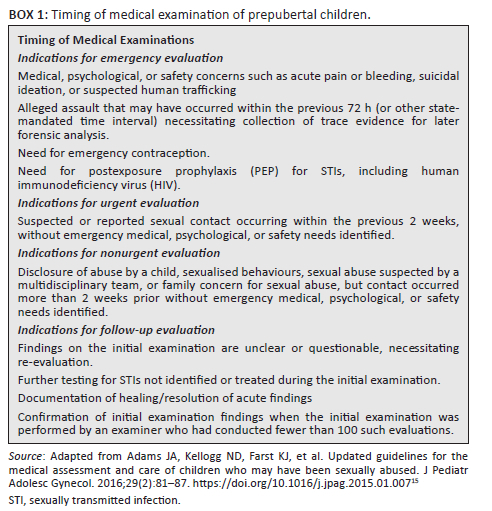
The conduct of the examination depends on medical, safety, emotional and forensic urgency. Emergency examinations must be carried out without delay, while urgent or 'as soon as possible' examinations should be completed within 1-7 days.15,1617Box 1 and Box 2).
Holistic care of child victims of sexual abuse
The care of sexually abused children extends beyond forensic needs, prioritising the child's best interests. Avoiding secondary trauma is of paramount importance.18
History and preparation for the physical examination
Medical history taking in CSA cases involves symptom-focused questions aimed at identifying injuries, infections and immediate health and safeguarding needs to guide clinical care. Forensic interviewing, in contrast, uses open-ended, non-leading questioning to obtain a detailed and legally reliable account of events for investigative and judicial purposes. The HCP must balance the two purposes.
Children's disclosure of CSA is generally delayed and incremental.1819,2021,22,23
All questions posed to the child and their verbatim responses must be carefully documented, and examiners should avoid making assumptions about the child's meaning. Where appropriate, interviews may be audio- or video-recorded to enhance accuracy.24,2526
General examination
When conducting a medical examination for a child with suspected sexual abuse, it is essential to ensure that the physical environment is safe, private and child-centred, that a chaperone is present to protect the child's dignity and support the process and that the timing of the examination is determined by clinical need and the urgency of forensic evidence collection.27
A thorough, non-threatening general examination is crucial to building trust and easing children into the anogenital examination. By integrating anogenital and extragenital assessments, the examination normalises all body areas and avoids placing undue emphasis on the anogenital region. The general examination helps identify necessary medical interventions. It establishes a differential diagnosis, guiding decisions on the anogenital exam, further investigations and forensic evidence collection based on the child's history and findings. Clinicians should ensure that medical forensic examinations are clearly indicated and minimally intrusive, balancing clinical benefit with the need to prevent additional distress and secondary trauma in the child.10
Anogenital examination
Children's right to refuse an examination should be honoured if no urgent medical need exists. Proper preparation and clear explanations generally help children feel comfortable. Examiners should guide children through each step and avoid unexpected touch. If children remain tense, the examination becomes technically challenging, and the findings are unreliable.
Positions of the anogenital examination of prepubertal children
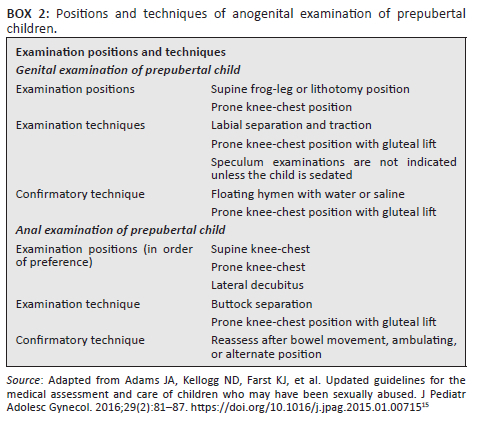
It is recommended to utilise multiple examination positions to distinguish structural abnormalities from normal anatomical variants (Box 2).28,29
Frog-leg position
The frog-leg position involves placing a child in a supine position with hip flexion and abduction. The outer aspects of the thighs rest on the surface of the examination couch. In this position, the external genitalia are visible.
Prone knee-chest position
To guide a child into a prone knee-chest (PKC) position, they kneel with knees slightly apart, bending forward to rest their ear flat on the examination couch, facing the support person. Arms lie flat beside the head (not resting on the elbows), and the chest is lowered onto the couch to relax the spine. Proper alignment (head on the ear, arms flat, hips at a 90° angle). In this position, the vagina opens under gravity. The posterior rim of the hymen smooths out, allowing for a more accurate diagnosis of anatomical variation and previous trauma of the anus and female genitalia. The anus is visible without touching, and testing for dynamic anal dilatation can be performed.
Supine knee-chest position
In the supine knee-chest (SKC) position, they lie on their backs, knees approaching the chest as comfortably as possible. The SKC position is an excellent examination position for the anal examination of boys since their genitalia are examined in other positions.
Techniques for the anogenital examination of prepubertal children
Labial separation
In the frog-leg position, the labia are gently separated with the touch of the labia majora and lateral movement.The posterior commissure, fossa navicularis, vestibule and hymen become visible, but the margins of the hymen cannot be adequately visualised.14,28
Labial traction
The labia majora is held bilaterally between the thumbs and forefingers and pulled in the examiner's direction. Gentle manipulation of the labia allows visualisation of the hymen. The hymenal opening may be better visualised, but the vagina is a potential space, and the edge of the hymen is still relaxed.14,28
Floating of the hymen with water or saline
The labia minora may adhere, making visualisation difficult. Dropping water at body temperature onto the genitalia breaks the adhesion and allows the structures to float.14,28
Gluteal separation
Gluteal separation can be done in the frog leg, PKC or SKC and lateral recumbent positions. The best visualisation of the anus is achieved in the PKC and SKC positions. The technique is mainly utilised to test for dynamic anal dilatation.14,28
Gluteal lift
In the PKC position, the examiner places his hands laterally to the superior aspects of the labia majora and gently pulls upward and outward. The vagina opens under gravitational force. The posterior hymenal rim, the location where structural abnormalities of the hymen occur, is smoothed out, the margins of the hymen can be visualised, and the differentiation between abnormalities and normal anatomical variation can be assessed. The anus is visualised excellently with this position and technique.14,28
Collection of evidence
Forensic evidence collection is ideally performed within 24 h for prepubertal children and within 72 h for adolescents. In some young children, evidence collection beyond 24 h may still be considered when appropriate.1522,30,31,32,33
Screening for sexually transmitted infections
Physicians should consider sexually transmitted infection (STI) screening in cases involving oral and anogenital penetration, abuse by a stranger, a person known or suspected to have an STI or high infection risk or when a household member has an STI.3031,3233
Examining under sedation or anaesthesia
Sedation or anaesthesia for examinations should be limited to cases with specific medical indications, such as acute bleeding, lower abdominal tenderness, severe injuries or foreign object use, and not solely for forensic purposes, as anaesthesia carries rare but serious risks.34,3522,30,3136
Interpretation of assessment
History
A clear history with details of time, place, sound, smell, touch and sensation and an imbalance of power is suggestive of CSA.5,22,37
Physical findings
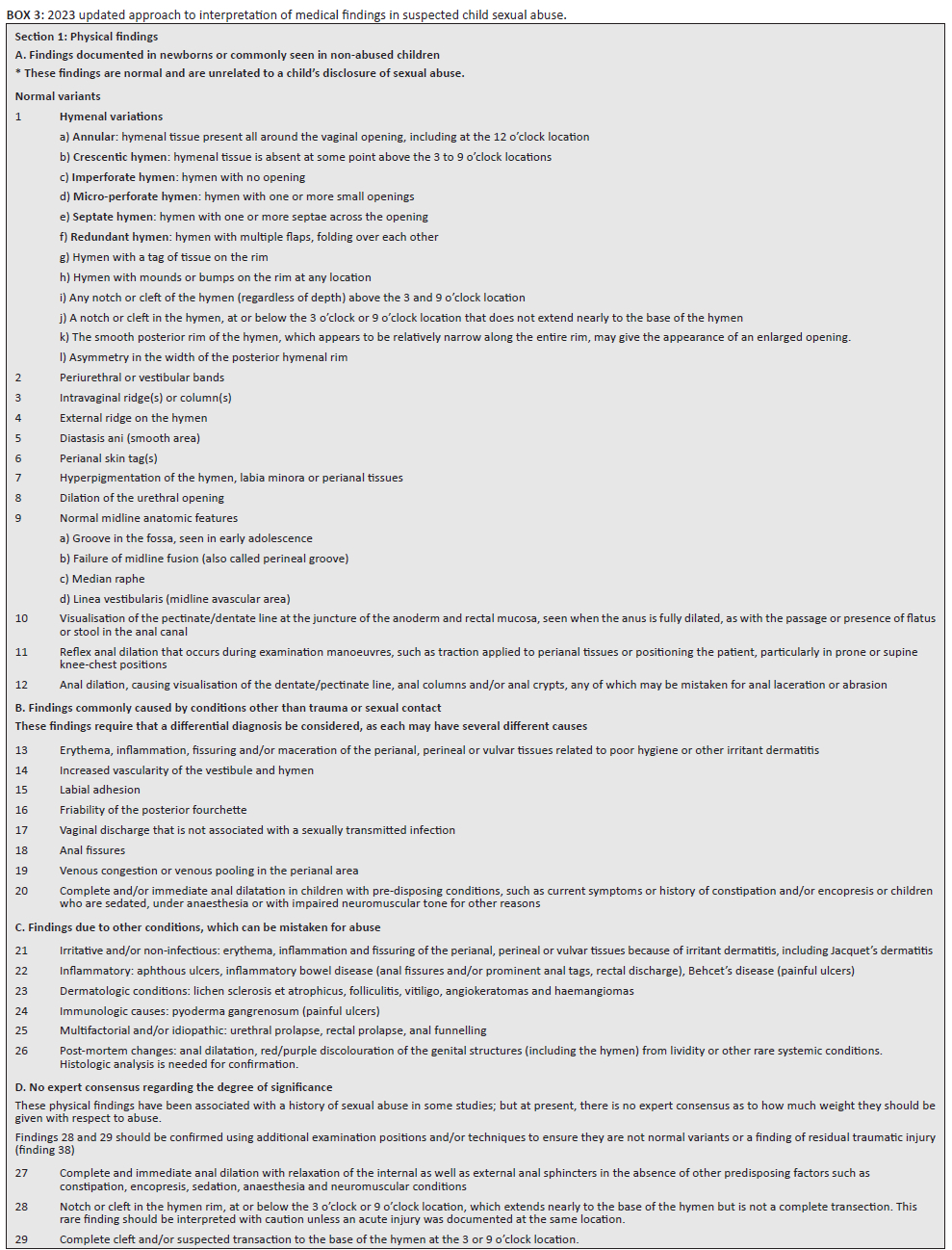
Congenital absence of the hymen does not occur as an isolated anomaly in otherwise normally developed genitalia.38Box 3 for more information.
Conclusion
Child sexual abuse among prepubertal children represents a widespread public health crisis. Inadequate awareness, training and specialised skills among healthcare professionals at the primary care level undermine both effective child protection and judicial outcomes. Deficiencies in undergraduate and postgraduate training further contribute to poor quality documentation and testimony. Healthcare professionals should recognise that they are examining children who have experienced sexual abuse, not the abuse itself; the assessment therefore carries a therapeutic responsibility that prioritises the child's wellbeing while also fulfilling medico-legal obligations.
Competing interests
The authors declare that they have no financial or personal relationships that may have inappropriately influenced them in writing this article.
CRediT authorship contribution
Marianne Kotzé: Conceptualisation, Project administration, Resources, Writing - original draft, Writing - review & editing. Chika K. Egenasi: Conceptualisation, Project administration, Resources, Writing - review & editing. Mathew O. Benedict: Conceptualisation, Project administration, Resources, Writing - review & editing. All authors reviewed the article, contributed to the discussion of results, approved the final version for submission and publication, and take responsibility for the integrity of its findings.
Ethical considerations
This article followed all ethical standards for research without direct contact with human or animal subjects.
Funding information
The authors received no financial support for the research, authorship and/or publication of this article.
Data availability
All information concerning the review findings is available from the corresponding author, Chika K. Egenasi, upon reasonable request.
Disclaimer
The views and opinions expressed in this article are those of the authors and are the product of professional research. They do not necessarily reflect the official policy or position of any affiliated institution, funder, agency or the publisher. The authors are responsible for this article's results, findings and content.
Acknowledgements
References
-
1.Singh R, Koushal V, Bharti B. A descriptive study on child sexual abuse act in India. J Family Med Prim Care. 2022;11(6):2923-2932. https://doi.org/10.4103/jfmpc.jfmpc_1071_21
» https://doi.org/10.4103/jfmpc.jfmpc_1071_21 -
2.Children's Act No. 38 of 2005 [homepage on the Internet]. Republic of South Africa; 2005. [cited 2026 Apr 10]. Available from: https://www.gov.za/documents/childrens-act
» https://www.gov.za/documents/childrens-act -
3.Artz L, Burton P, Ward CL, et al. Sexual victimisation of children in South Africa: Final report of the Optimus Foundation Study [homepage on the Internet]. Cape Town: UBS Optimus Foundation; 2016 [cited 2026 Jan 26]. Available from: https://ci.uct.ac.za/sexual-victimisation-children-south-africa-final-report-optimus-foundation-study-south-africa-2016
» https://ci.uct.ac.za/sexual-victimisation-children-south-africa-final-report-optimus-foundation-study-south-africa-2016 -
4.McQuoid-Mason D. May doctors refuse to treat rape survivors in order to avoid having to give evidence in court? S Afr J Bioeth Law. 2016;9(1):4-6. https://doi.org/10.7196/SAJBL.2016.v9i1.461
» https://doi.org/10.7196/SAJBL.2016.v9i1.461 -
5.Faller KC. The role relationship between victims and perpetrators as a predictor characteristics of intrafamilial sexual abuse. Child Adolesc Soc Work J. 1989;6(3):217-229. https://doi.org/10.1007/BF00755849
» https://doi.org/10.1007/BF00755849 -
6.Summit R. The child sexual abuse accommodation syndrome. Child Abuse Negl. 1983;7:177-193. https://doi.org/10.1016/0145-2134(83)90070-4
» https://doi.org/10.1016/0145-2134(83)90070-4 -
7.Faller KC. Women who sexually abuse children. Violence Vict. 1987;2(4):263-276. https://doi.org/10.1891/0886-6708.2.4.263
» https://doi.org/10.1891/0886-6708.2.4.263 -
8.Radford L, Allnock D, Hynes P. Preventing and responding to child sexual abuse and exploitation: Evidence review. New York, NY: United Nations Children's Fund (UNICEF); 2015 [cited 2026 Apr 10]. Available from: https://www.unicef.org/media/84081/file/Preventing-Responding-to-Child-Sexual-Abuse-Exploitation-Evidence-Review.pdf
» https://www.unicef.org/media/84081/file/Preventing-Responding-to-Child-Sexual-Abuse-Exploitation-Evidence-Review.pdf -
9.World Health Organization. Guidelines for medico-legal care for victims of sexual violence [homepage on the Internet]. 2003 [cited 2026 Apr 10]. Available from: https://www.who.int/violence_injury_prevention/publications/violence/med_leg_guidelines/en/
» https://www.who.int/violence_injury_prevention/publications/violence/med_leg_guidelines/en/ -
10.World Health Organization. Responding to children and adolescents who have been sexually abused: WHO clinical guidelines. Geneva: World Health Organization; 2017 [cited 2026 Feb 02]. Available from: https://cdn.icmec.org/wp-content/uploads/2020/04/WHO-guidelines-on-CSA-and-sexual-assault-2017.pdf
» https://cdn.icmec.org/wp-content/uploads/2020/04/WHO-guidelines-on-CSA-and-sexual-assault-2017.pdf -
11.South African Government. Criminal Law (Sexual Offences and Related Matters) Amendment Act 32 of 2007 [homepage on the Internet]. 2007 [cited 2021 Jun 23]. Available from: https://www.gov.za/documents/criminal-law-sexual-offences-and-related-matters-amendment-act
» https://www.gov.za/documents/criminal-law-sexual-offences-and-related-matters-amendment-act -
12.De Roos MS, Oliver C, Carré JR, Jones DN. Mimicry deception theory applied to sexual abuse of children. Child Abuse Negl. 2023;143:106339. https://doi.org/10.1016/j.chiabu.2023.106339
» https://doi.org/10.1016/j.chiabu.2023.106339 -
13.Criminal Procedure Act No. 51 of 1977 [homepage on the Internet]. Republic of South Africa; 1977 [cited 2026 Apr 10]. Available from: https://www.gov.za/documents/criminal-procedure-act-1977-26-mar-2015-1224
» https://www.gov.za/documents/criminal-procedure-act-1977-26-mar-2015-1224 -
14.Child abuse medical textbook: Physical examination: The perineum and genital examinations [homepage on the Internet]. [cited 2026 Jan 26]. Available from: https://childabusemd.org/textbook/3/13/
» https://childabusemd.org/textbook/3/13/ -
15.Adams JA, Kellogg ND, Farst KJ, et al. Updated guidelines for the medical assessment and care of children who may have been sexually abused. J Pediatr Adolesc Gynecol. 2016;29(2):81-87. https://doi.org/10.1016/j.jpag.2015.01.007
» https://doi.org/10.1016/j.jpag.2015.01.007 -
16.Christian CW. Timing of the medical examination. J Child Sex Abus. 2011;20(5): 505-520. https://doi.org/10.1080/10538712.2011.607424
» https://doi.org/10.1080/10538712.2011.607424 -
17.McPherson L, Gatwiri K, Vosz M, MacNamara N, Mitchell J, Tucci J. Approaches to assessment and intervention with children and young people who have experienced child sexual abuse: A review of reviews. J Child Adolesc Trauma. 2025;18(2):279-291. https://doi.org/10.1007/s40653-025-00702-4
» https://doi.org/10.1007/s40653-025-00702-4 -
18.Schnabel DJ, Font S, Miyamoto S. Putting kids first: Reaffirming universal strategies for accurate detection of child sexual abuse in child protection investigations. Child Protect Practice. 2025;5:100151. https://doi.org/10.1016/j.chipro.2025.100151
» https://doi.org/10.1016/j.chipro.2025.100151 -
19.Finkel MA. Putting it all together. J Child Sex Abus. 2011;20(6):643-656. https://doi.org/10.1080/10538712.2011.622252
» https://doi.org/10.1080/10538712.2011.622252 -
20.Finkel MA. I can tell you because you're a doctor. Pediatrics. 2008;122(2):442. https://doi.org/10.1542/peds.2008-1416
» https://doi.org/10.1542/peds.2008-1416 - 21.World Health Organization. Guidelines for medico-legal care for victims of sexual violence. Geneva: World Health Organization; 2017.
-
22.Kotzé JM, Brits H. Child sexual abuse: The significance of the history and testifying on non-confirmatory findings. Afr J Prim Health Care Fam Med. 2019;11(1):e1-e7. https://doi.org/10.4102/phcfm.v11i1.1954
» https://doi.org/10.4102/phcfm.v11i1.1954 -
23.Daley SF, Gutovitz S. Child sexual abuse [homepage on the Internet]. Treasure Island, FL: StatPearls Publishing; 2025 [cited 2026 Jan 26]. Available from: https://www.ncbi.nlm.nih.gov/books/NBK470563/
» https://www.ncbi.nlm.nih.gov/books/NBK470563/ -
24.Faller KC. Forty years of forensic interviewing of children suspected of sexual abuse, 1974-2014: Historical benchmarks. Soc Sci. 2015;4(1):34-65. https://doi.org/10.3390/socsci4010034
» https://doi.org/10.3390/socsci4010034 -
25.Lamb ME, Orbach Y, Sternberg KJ, Hershkowitz I, Horowitz D. Accuracy of investigators' verbatim notes of their forensic interviews with alleged child abuse victims. Law Hum Behav. 2000;24(6):699-708. https://doi.org/10.1023/A:1005556404636
» https://doi.org/10.1023/A:1005556404636 -
26.Danby M, Sharman S. Can child forensic interviewers accurately review their own adherence to best-practice techniques? J Police Crim Psych. 2025 [cited 2026 Apr 10]. Available from: https://link.springer.com/content/pdf/10.1007/s11896-025-09765-3.pdf
» https://link.springer.com/content/pdf/10.1007/s11896-025-09765-3.pdf -
27.SAFEta. KIDSta Protocol Section B7: Children's forensic medical examination chaperones and room policy [homepage on the Internet]. SAFEta; 2021 [cited 2026 Jan 1]. Available from: https://safeta.org/page/KIDSSectionB7
» https://safeta.org/page/KIDSSectionB7 -
28.Oregon medical guidelines for evaluation of sexual abuse in children and adolescents [homepage on the Internet]. [cited 2026 Jan 26]. Available from: https://1library.net/article/examination-techniques-the-female-genital-examination.yndg89pz
» https://1library.net/article/examination-techniques-the-female-genital-examination.yndg89pz -
29.Evaluating pediatric sexual abuse in the emergency department [homepage on the Internet]. [cited 2026 Jan 26]. Available from: https://www.clinician.com/articles/75689-evaluating-pediatric-sexual-abuse-in-the-emergency-department
» https://www.clinician.com/articles/75689-evaluating-pediatric-sexual-abuse-in-the-emergency-department -
30.Girardet RG, Lahoti S, Howard LA, et al. Epidemiology of sexually transmitted infections in suspected child victims of sexual assault. Pediatrics. 2009;124(1):79-86. https://doi.org/10.1542/peds.2008-2947
» https://doi.org/10.1542/peds.2008-2947 -
31.Greenbaum J, Crawford-Jakubiak JE, Christian CW, et al. Child sex trafficking and commercial sexual exploitation: Health care needs of victims. Pediatrics. 2015;135(3):566-574. https://doi.org/10.1542/peds.2014-4138
» https://doi.org/10.1542/peds.2014-4138 -
32.Jenny C, Crawford-Jakubiak JE. The evaluation of children in the primary care setting when sexual abuse is suspected. Pediatrics. 2013;132(2):e558-e567. https://doi.org/10.1542/peds.2013-1741
» https://doi.org/10.1542/peds.2013-1741 - 33.Royal College of Paediatrics and Child Health. The physical signs of child sexual abuse: An evidence-based review and guidance for best practice. London: Royal College of Paediatrics and Child Health; 2015.
-
34.SAFEta. KIDSta protocol - Section B7: Examination guidance. SAFEta. [cited 2026 Jan 26]. Available from: https://www.safeta.org/page/kidssectionb7
» https://www.safeta.org/page/kidssectionb7 -
35.Smith T, Chauvin-Kimoff L, Baird B, Ornstein A. The medical evaluation of prepubertal children with suspected sexual abuse. Paediatr Child Health. 2020;25(3):180-186. https://doi.org/10.1093/pch/pxaa019
» https://doi.org/10.1093/pch/pxaa019 -
36.Medical Protection. MPS statement - Professor Peter Beale murder trial [homepage on the Internet]. Medical Protection News and Updates. 2024 [cited 2024 Nov 12]. Available from: https://www.medicalprotection.org/southafrica/casebook-and-resources/news/news-article/2024/01/30/mps-statement-professor-peter-beale-murder-trial
» https://www.medicalprotection.org/southafrica/casebook-and-resources/news/news-article/2024/01/30/mps-statement-professor-peter-beale-murder-trial - 37.Finkel MA. The evaluation. In: Finkel MA, Giardino AP, editors. Medical evaluation of child sexual abuse: A practical guide. 3rd ed. Elk Grove Village, IL: American Academy of Pediatrics, 2009; p. 19-52.
-
38.Cabinum-Foeller E, Perkin RM. Pediatric trauma: Recognizing and managing child sexual abuse. Clinician.com. 2006 [cited 2026 Feb 02]. Available from: https://www.clinician.com/articles/127455-pediatric-trauma-recognizing-and-managing-child-sexual-abuse
» https://www.clinician.com/articles/127455-pediatric-trauma-recognizing-and-managing-child-sexual-abuse -
39.Adams JA, Farst KJ, Kellogg ND. Interpretation of medical findings in suspected child sexual abuse: An update for 2018. J Pediatr Adolesc Gynecol. 2018;31(3):225-231. https://doi.org/10.1016/j.jpag.2017.12.011
» https://doi.org/10.1016/j.jpag.2017.12.011 -
40.Kellogg ND, Farst KJ, Adams JA. Interpretation of medical findings in suspected child sexual abuse: An update for 2023. Child Abuse Negl. 2023;145:106283. https://doi.org/10.1016/j.chiabu.2023.106283
» https://doi.org/10.1016/j.chiabu.2023.106283

Accepted: 22 Mar. 2026
Published: 08 June 2026
