Mastering your fellowship: Part 2, 2026
Background
Diagnosed with asthma at the age of 4 years, only on PRN salbutamol, not on regular inhaled corticosteroid.
Allergic rhinitis and eczema.
Immunisations up to date.
No TB contacts. No HIV in family.
Social context
Lives in a shack with mother, grandmother and two siblings.
Mother smokes cigarettes inside the house (defensive if challenged).
Has a pet cat (sleeps in the same bed as the child).
Mother is unemployed, on social grant.
The school has complained of frequent absenteeism.
Mother's attitude (to role-play)
Very anxious: 'Doctor, is he going to stop breathing?'
Asks if the child has pneumonia or TB.
Doesn't understand why the inhaler sometimes works and sometimes doesn't.
Wants to know if asthma can be cured.
Guilty but defensive about smoking.
Opens up about financial struggles if the doctor shows empathy.
General role-playing notes:
You are the mother of Mfundo, a 6-year-old boy, 20 kg, Grade 1, admitted this morning with severe asthma.
You are on a Zoom call with the candidate (doctor).
The child is not on camera - you are speaking on his behalf.
Your goal is to test the candidate's ability to communicate, counsel and manage an inpatient case via a parent.
Adjust your emotional tone depending on how well the candidate engages with you.
Emotional baseline
Start anxious and fearful: you are worried your child might die.
If the candidate is empathetic → you relax, become cooperative and open.
If the candidate is cold, dismissive or judgemental → you become defensive and withdrawn.
Opening line (when doctor greets you)
'Doctor, thank you for seeing me. Mfundo is really struggling to breathe… is he going to stop breathing?'
Information to provide (if candidate asks)
Presenting illness - only if asked:
'He started coughing and wheezing last night'.
'I gave him his blue pump (inhaler), but it didn't help this time'.
'This morning he was worse, so I rushed him to the hospital'.
Medical history - only if asked:
'He has had chest problems since he was 3-years-old'.
'He's been admitted three times in the last year - once he was even in ICU'.
'The clinic told me it's asthma'.
'He only uses the blue pump when he's bad. I don't know about the other pumps they mentioned'.
'Has allergic rhinitis and eczema' sometimes
Immunisations up to date
No TB exposure, no HIV in the family
Social and/or family context - only if asked:
Lives with mother, grandmother and siblings in a shack.
'I smoke, but only at night, in the house. It doesn't affect him, does it?' (say this defensively).
'We have a cat, he loves it and sleeps with it'.
'I don't always have money to go to the clinic for pumps'.
'His school keeps complaining about him missing days'.
'I am unemployed and rely on a social grant only'
'School often complains of absenteeism'
Caregiver concerns - only if asked:
'Doctor, is this TB or pneumonia?'
'Why doesn't the inhaler always work?'
'Will my child grow out of this? Can it be cured?'
'Will he need to go to Johannesburg hospital again?'
Emotional cues
If the candidate explains clearly and shows empathy: Say: 'That makes sense, doctor. I didn't know asthma could be controlled. I just thought it happened randomly'. Become calmer and more cooperative.
If the candidate judges you about smoking: Respond defensively: 'I can't just stop, doctor. I'm already stressed, and he sleeps fine most nights'.
If the candidate addresses smoking sensitively: Respond thoughtfully: 'I didn't realise it could make things worse. Maybe I can try smoking outside instead'.
If the candidate reassures you that the hospital has a plan: Say: 'Thank you, doctor, I feel a bit better knowing he won't die tonight'.
Specific questions to ask the candidate
(Use at different points if the candidate hasn't addressed them)
'Why does this keep happening?'
'Can asthma be cured?'
'Why does the pump sometimes not work?'
'What can I do at home to stop this from happening again?'
'When should I bring him back if he gets sick again?'
Key 'triggers' for candidate competence
If they ask about social history → provide information about smoking, cat and poor finances.
If they ask about adherence/medication → mention only using the blue pump, no steroid pump.
If they ask about clinic follow-up → mention difficulty with transport and running out of pumps.
If they acknowledge your fear → you calm down.
If they explain clearly what asthma is → you express relief and interest.
Closing line
If the candidate has explained well:
'Thank you, doctor. I understand better now and I'll try to do what you say. I just want Mfundo to get better'.
If the candidate was unclear or rushed:
'I still don't really understand what's wrong with him. I'm very worried'.
Examination findings and investigations
Current vital signs
Temperature 37.2°C
HR 150 bpm
RR 48/min
O2 sat 89% on room air → 93% with facemask O2
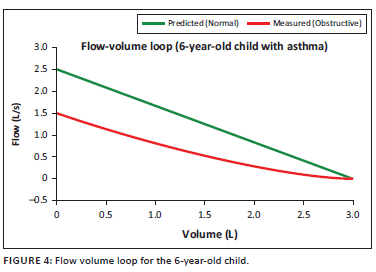
PEFR 90 L/min (expected ~180)
Exam
Sitting upright, speaking in short phrases, with subcostal recession.
Widespread expiratory wheeze, poor air entry.
No cyanosis, no focal chest signs.
Capillary refill < 2 s.
CXR report
Hyperinflated lungs, peribronchial thickening, no consolidation.
Full blood count
Mild eosinophilia.
PEFR
Competing interests
The authors, R.W. and K.v.P., serve as editors of this journal. J.M.M., S.R. and M.N. have no other competing interests to declare.
Authors' contributions
M.N., K.v.P., J.M.M., S.R. and R.K. contributed equally to the conceptualisation, writing and editing of the manuscript and share first authorship. All authors contributed to the article, discussed the results and approved the final version for submission and publication.
Funding information
This research received no specific grant from any funding agency in the public, commercial or not-for-profit sectors.
Data availability
Data sharing is not applicable to this article as no new data were created or analysed in this study.
Disclaimer
The views and opinions expressed in this article are those of the authors and are the product of professional research. They do not necessarily reflect the official policy or position of any affiliated institution, funder, agency or that of the publisher. The authors are responsible for this article's results, findings and content.
Correspondence:
Mergan Naidoo

Received: 10 Oct. 2025
Accepted: 13 Oct. 2025
Published: 31 Mar. 2026
Acknowledgements
The authors would like to thank Dr Michele Torlutter for reviewing this article. While their contribution was important, it did not meet the criteria for authorship.