Burnout in healthcare professionals
Abstract
Burnout is a work-related syndrome recognised by the World Health Organization and included in the International Classification of Diseases 11th revision (ICD-11) as resulting from chronic workplace stress that has not been successfully managed. Characterised by emotional exhaustion, depersonalisation, and a reduced sense of professional accomplishment, it predominantly affects healthcare professionals exposed to sustained emotional and organisational demands at the workplace. Global evidence indicates that nearly half of practising clinicians experience burnout, with higher prevalence in emergency medicine, anaesthesiology, surgical subspecialities, radiology, internal medicine, family medicine and primary healthcare, as well as among registrars and students. Burnout is a syndrome that is closely associated with other mental health conditions, such as depression, anxiety, substance use, and increased suicide risk, while compromising patient safety through elevated rates of diagnostic and medication errors. Contributing factors include excessive workloads, administrative burden, limited autonomy, poor work-life balance, and misalignment of personal and institutional values. Effective management requires a dual focus: individual strategies such as mindfulness, exercise, and stress-management programmes, and organisational reforms including workload optimisation, streamlining electronic documentation, leadership development, and value alignment. When recognised early and addressed comprehensively, burnout is reversible with improved clinician well-being and enhanced patient outcomes. A coordinated response from healthcare institutions, professional councils, and policymakers is essential to safeguard the workforce and sustain high-quality health services. This article aims to provide readers with evidence-based strategies to help themselves or to support a colleague who may be experiencing burnout.
burnout; depression; anxiety; suicide risk; substance use
Introduction
Burnout is recognised by the World Health Organization in the International Classification of Diseases 11th revision (ICD-11) as a 'syndrome conceptualised as resulting from chronic workplace stress that has not been successfully managed'.1,2,3,4,51,2,3,52
Epidemiology impact
Global research interest in burnout has grown markedly, with PubMed indexing over 33 000 studies, of which more than half were published between 2020 and 2025. National data indicate that nearly half of healthcare providers experience burnout, with higher prevalence noted among urology, emergency medicine, anaesthesiology, surgical subspecialities, radiology, and internal medicine.1,2,3,4,6778,9
Some studies suggest women may be slightly more affected, although large systematic reviews show no definitive gender difference.2,7,10
Comparisons between care settings indicate that outpatient providers report more emotional exhaustion than their inpatient counterparts, although depersonalisation and reduced professional accomplishment rates do not differ significantly.2,3,5,112,5,6
The impact of burnout extends beyond individual clinicians to patient safety and health system performance. Burnout is linked to depression, anxiety, substance use, and increased suicide risk, particularly when compounded by underlying mental health disorders.2,12,13
Clinical consequences include higher rates of errors in medication and diagnosis, inadequate physician-patient rapport, and poorer patient outcomes.23,14
Contributing factors
The current stressed healthcare system
In South Africa, the healthcare sector is currently facing severe challenges because of the combined impact of fiscal austerity, societal instability, and a shortage of healthcare personnel.151515
Healthcare professionals often work in environments where workplace violence, such as verbal or physical aggression from patients or their relatives, is increasingly reported.16,1716,17
Furthermore, factors such as xenophobia not only threaten foreign healthcare workers by creating a hostile and divisive work environment for the entire healthcare workforce but also induce or increase burnout.18,1918,1919
Key risk factors of burnout include long working hours, heavy bureaucratic or administrative tasks, excessive electronic health record use, poor work-life balance, pressure for productivity, and inadequate leadership support.2,4,13,202,4,6,20,13
Understanding these factors not only helps identify at-risk individuals but also informs the design of robust, evidence-based interventions at personal, organisational and policy levels. Addressing these issues comprehensively can disrupt the vicious cycle of stress and burnout and restore professional satisfaction.
Relationship with depression
Burnout and depression share overlapping features such as fatigue, low energy, and increased negativity, as well as functional impairment. This overlap has led some researchers to view burnout as part of a depression spectrum or as a form of work-related depression.2,11,122,11,12,21
Recognising these nuances is essential for clinicians and policymakers when designing screening tools and interventions to ensure that both conditions are appropriately addressed rather than conflated.11,12
Clinical presentation and assessment
Burnout typically manifests as emotional exhaustion, depersonalisation, and a diminished sense of personal achievement. Signs include declining work quality, increased clinical errors, and disengagement from professional responsibilities, leading to reduced patient satisfaction and early retirement.2,4,212,4,5,62,4,5,6,21
Preventative strategies
Primary, secondary and tertiary burnout prevention
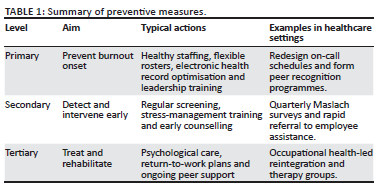
Organisations can implement primary (preventive), secondary (early intervention), and tertiary (treatment) strategies (Table 1). Primary prevention addresses workplace and system-level causes of chronic stress so that burnout never develops. It will minimise the root causes of burnout by creating a healthy, sustainable working environment. Secondary prevention aims to identify early signs of stress and intervene promptly to prevent progression to full burnout. Tertiary prevention focuses on the management and rehabilitation of healthcare workers already experiencing burnout, to reduce complications and help them return to meaningful work.2,13,21
The ABC approach to burnout prevention
An additional framework that complements individual and organisational interventions is the ABC approach, a concept grounded in emotional intelligence. This model encourages clinicians to integrate three reinforcing dimensions into their daily practice:
• A - Awareness: Recognising personal abilities, performance limits, and stress signals while remaining empathetic towards colleagues and patients.20,22
• B - Balance: Maintaining equilibrium across family, social, spiritual, and leisure domains, closely linked to sustainable work-life balance.23
• C - Commitment: Cultivating healthy routines, consistency, and lifestyle choices that support long-term performance and reduce stress.20,24
Applying the ABC approach can help clinicians transform insight into actionable habits.
Management
Enhancing provider wellness and resilience is key to reducing burnout. Resilience, the ability to cope with stress, can be strengthened through practices such as mindfulness, which has been shown to improve stress management.2,20,25Individual interventions include mindfulness, meditation, gratitude journaling, regular exercise, self-care practices, and stress-management programmes, which strengthen resilience and coping capacity.2,3,4,6,20,25organisational interventions (contextual) include aligning institutional and individual values, ensuring fair compensation, streamlining electronic documentation, delegating non-clinical tasks, and offering flexible work arrangements such as part-time schedules or remote consultations.2,3,4,5,26
The complexities of the work environment are such that it is usually never ideal, and it is easy to become overwhelmed because of deficiencies and limited resources, leading to burnout and emotional exhaustion.27,2829,30,31
Practical, evidence-informed strategies include:
• Seeking support: Burnout thrives in isolation. Intentionally maintaining connections with peers, friends, and family provides a buffer against its effects.29,30,31
• Finding value in work: Reconnecting with professional purpose and meaning has been shown to improve engagement and resilience.20,27
• Mentorship at work: Access to an experienced colleague or supervisor for debriefing and guidance strengthens coping skills and mental health.5,26,29,30,31
• Setting boundaries: Learning to say no and avoiding chronic overload are essential to protect personal energy and prevent burnout.24
• Spreading out leave: Taking shorter, regular breaks throughout the year supports sustained performance and well-being more effectively than infrequent extended leave.32
• Taking a technology break: Periodically disconnecting from constant digital demands fosters mindfulness and reduces emotional exhaustion.20,23
The South African Depression and Anxiety Group (SADAG) can play a vital supplementary role. The SADAG provides 24 h toll-free crisis helplines, including the Suicide Crisis Helpline (0800 567 567) and the Department of Social Development Substance Abuse Helpline (0800 12 13 14), offering immediate emotional assistance.3333
Prognosis and call to action
When recognised early and managed through both personal resilience and systemic reforms, provider burnout carries a favourable prognosis, with measurable improvements in clinician well-being and patient care. Conversely, if left unaddressed, burnout may escalate to depression, substance misuse and, in severe cases, suicide.222262626
Conclusion
Burnout is a significant occupational health concern that arises from chronic workplace stress and insufficient coping mechanisms. Healthcare professionals - particularly physicians and nurses - are disproportionately affected. Enhancing awareness and adopting robust preventive strategies are key to reducing its incidence. Early recognition through validated assessment tools, followed by timely intervention, can mitigate complications and improve outcomes. Establishing supportive and adequately resourced workplaces that promote resilience and professional satisfaction is vital for protecting clinicians' well-being and maintaining safe, high-quality patient care.
Competing interests
The authors, Klaus B. von Pressentin, Arun Nair and Mmaphefo M. Maluleka, serve as editorial board members of this journal.
CRediT authorship contribution
Mmaphefo M. Maluleka: Conceptualisation, Project administration, Resources, Visualisation, Writing - original draft. Felicity N. Bulo: Writing - original draft. Arun Nair: Conceptualisation, Resources, Supervision, Visualisation, Writing - original draft, Writing - review & editing. Klaus B. von Pressentin: Conceptualisation, Supervision, Writing - review & editing. All authors reviewed the article, contributed to the discussion of results, approved the final version for submission and publication, and take responsibility for the integrity of its findings.
Ethical considerations
This article followed all ethical standards for research without direct contact with human or animal subjects.
Funding information
This research received no specific grant from any funding agency in the public, commercial, or not-for-profit sectors.
Data availability
The authors confirm that the data supporting this study and its findings are available within the article and its listed references.
Disclaimer
The views and opinions expressed in this article are those of the authors and are the product of professional research. It does not necessarily reflect the official policy or position of any affiliated institution, funder, agency, or that of the publisher. The authors are responsible for this article's results, findings, and content.
Acknowledgements
References
-
1. World Health Organization. Burn-out an 'occupational phenomenon': International classification of diseases [homepage on the Internet]. Geneva: WHO; 2019 [2025 Jul 18]. Available from: https://www.who.int/news/item/28-05-2019-burn-out-an-occupational-phenomenon-international-classification-of-diseases
» https://www.who.int/news/item/28-05-2019-burn-out-an-occupational-phenomenon-international-classification-of-diseases -
2. Singh R, Volner K, Marlowe D. Provider burnout [homepage on the Internet]. Treasure Island (FL): StatPearls Publishing; 2025 [Updated 2023 Jun 12; cited 2025 Aug 01]. Available from: https://www.ncbi.nlm.nih.gov/sites/books/NBK538330/
» https://www.ncbi.nlm.nih.gov/sites/books/NBK538330/ -
3. Liebenberg AR, Coetzee JF, Conradie HH, Coetzee JF. Burnout among rural hospital doctors in the Western Cape: Comparison with previous South African studies. Afr J Prim Health Care Fam Med. 2018;10(1):e1-e7. https://doi.org/10.4102/phcfm.v10i1.1568
» https://doi.org/10.4102/phcfm.v10i1.1568 -
4. West CP, Dyrbye LN, Shanafelt TD. Physician burnout: Contributors, consequences and solutions. J Intern Med. 2018;286(6):516-529. https://doi.org/10.1111/joim.12752
» https://doi.org/10.1111/joim.12752 -
5. Khan S, Ntatamala I, Adams S. A review of burnout among doctors in South Africa: Pre-, during and post-COVID-19 pandemic. S Afr Fam Pract. 2024;66(1):a6002. https://doi.org/10.4102/safp.v66i1.6002
» https://doi.org/10.4102/safp.v66i1.6002 - 6. Christino MA, Talwalkar VR, Goldberg MJ, Weiss JM. Physician and clinician well-being. In: Samora JB, Shea KG, editors. Quality improvement and patient safety in orthopaedic surgery. Cham: Springer, 2022; p. 245-258.
-
7. Morcos G, Awan OA. Burnout in medical school: A medical student's perspective. Acad Radiol. 2023;30(6):1223-1225. https://doi.org/10.1016/j.acra.2022.11.023
» https://doi.org/10.1016/j.acra.2022.11.023 -
8. Muteshi C, Ochola E, Kamya D. Burnout among medical residents, coping mechanisms and the perceived impact on patient care in a low/ middle income country. BMC Med Educ. 2024;24(1):828. https://doi.org/10.1186/s12909-024-05832-1
» https://doi.org/10.1186/s12909-024-05832-1 -
9. Van der Merwe LJ, Motlapema N, Matsepe T, et al. Medical registrars at the University of the Free State: Burnout, resilience and coping strategies. S Afr Fam Pract. 2023;65(1):e1-e7. https://doi.org/10.4102/safp.v65i1.5788
» https://doi.org/10.4102/safp.v65i1.5788 -
10. Zeijlemaker C, Moosa S. The prevalence of burnout among registrars in the School of Clinical Medicine at the University of the Witwatersrand, Johannesburg, South Africa. S Afr Med J. 2019;109(9):668-672. https://doi.org/10.7196/SAMJ.2019.v109i9.13667
» https://doi.org/10.7196/SAMJ.2019.v109i9.13667 - 11. Bianchi R, Schonfeld IS, Laurent E. Burnout syndrome and depression. In: Kim YK, editor. Understanding depression. Singpore: Springer, 2018; p. 187-200.
-
12. Makilim NB, Nelson HF, Hugo FC. The overlap between burnout and depression through a different lens: A multi-method study. J Affect Disord Rep. 2022;10:100437. https://doi.org/10.1016/j.jadr.2022.100437
» https://doi.org/10.1016/j.jadr.2022.100437 -
13. Cohen C, Pignata S, Bezak E, Tie M, Childs J. Workplace interventions to improve well-being and reduce burnout for nurses, physicians and allied healthcare professionals: A systematic review. BMJ Open. 2023;13(6):e071203. https://doi.org/10.1136/bmjopen-2022-071203
» https://doi.org/10.1136/bmjopen-2022-071203 -
14. World Health Organization (WHO). Targets of Sustainable Development Goal 3 [homepage on the Internet]. Copenhagen: WHO Regional Office for Europe; 2025 [cited 2025 Sep 13]. Available from: https://www.who.int/europe/about-us/our-work/sustainable-development-goals/targets-of-sustainable-development-goal-3
» https://www.who.int/europe/about-us/our-work/sustainable-development-goals/targets-of-sustainable-development-goal-3 - 15. Parliamentary Budget Office. Pre-budget brief: The impacts of austerity, expenditure and tax revenue. Cape Town: Parliament of the Republic of South Africa; 2025.
- 16. Nkadimeng M, Engelbrecht A, Rajan S. Workplace violence in three public sector emergency departments, Gauteng, South Africa: A cross-sectional survey. Afr J Emerg Med. 2024;14:252-257.
- 17. Mabhele S. Violence and harassment at the workplace: Implications on occupational health and safety (OHS) [presentation]. National Occupational Health and Safety Conference; 2025 Feb 26-28; Klerksdorp, South Africa. Geneva: International Labour Organization; 2025.
- 18. Ngcamu BS. Understanding xenophobic attacks in South Africa: A systematic literature review. Mod Afr Polit Hist Soc. 2024;12(2):83-117.
-
19. Crush J, Tawodzera G. Medical xenophobia and the response to migrants in South African health facilities. J Ethn Migr Stud. 2021;47(20):4503-4519. https://doi.org/10.1080/1369183X.2020.1739372
» https://doi.org/10.1080/1369183X.2020.1739372 -
20. Kirby JM, Milligan PD, Conradie HH, McIntosh BM. A mindful approach to physician self-care. S Afr Fam Pract. 2024;66(1):a5836. https://doi.org/10.4102/safp.v66i1.5836
» https://doi.org/10.4102/safp.v66i1.5836 - 21. Kinman G, Dovey A, Teoh K, Doyle N, Greenberg N, Harriss A. Burnout in healthcare: Risk factors and solutions. London: Society of Occupational Medicine; 2023.
- 22. Coronado-Maldonado I, Bermúdez M, Ruiz-Olivares R, et al. Emotional intelligence, leadership, and work teams: The moderating role of emotional exhaustion. Int J Environ Res Public Health. 2023;20(12):7310-7324.
- 23. Ullah S, Ghevira J, Trinanda L. The influence of emotional intelligence and work-life balance on burnout among civil servants in East Kalimantan Province. Am J Hum Soc Sci Res. 2024;4(6):200-215.
- 24. Parker SK, Knight C. Design work to prevent burnout: A new model for improving work design supports change that increases employee engagement and reduces stress. MIT Sloan Manag. Rev. 2025;66(2):29-34.
-
25. Whitesman S. A rationale and framework for sharing mindfulness in trauma-dense communities in South Africa. S Afr Fam Pract. 2025;67(1):a6114. https://doi.org/10.4102/safp.v67i1.6114
» https://doi.org/10.4102/safp.v67i1.6114 -
26. Flegg KM, Martinez-Bianchi V. Caring for the caregivers: A global imperative for family doctors' wellbeing. Lancet Prim Care. 2025;1:100030. https://doi.org/10.1016/j.lanprc.2025.100030
» https://doi.org/10.1016/j.lanprc.2025.100030 -
27. Yang N. The causes, effects, and interventions of workplace emotional exhaustion. Lecture Notes Education Psychology Public Media. 2023;6(1):516-520. https://doi.org/10.54254/2753-7048/6/20220459
» https://doi.org/10.54254/2753-7048/6/20220459 - 28. Edú-Valsania S, Díaz E, Martín J, Estévez E, Tomás I. Burnout: A review of theory and measurement. Front Psychol. 2022;12:742914.
-
29. Gotian R, Pfund C, Cook C, Bard Johnson W. Don't let mentoring burn you out. Harv. Bus. Rev. 2022. [cited 2025 Sep 14]. Available from: https://hbr.org/2022/07/dont-let-mentoring-burn-you-out
» https://hbr.org/2022/07/dont-let-mentoring-burn-you-out - 30. Ohue T, Hamaguchi K, Yokoi K, et al. Effectiveness of mentorship using Cognitive Behavior (CB) approaches for reducing burnout and supporting mental health. Int J Environ Res Public Health. 2024;21(3): 1234.
-
31. Forgus ST. Recovering from burnout: Doing a home visit and finding an old friend and an entire community. S Afr Fam Pract. 2023;65(1):a5750. https://doi.org/10.4102/safp.v65i1.5750
» https://doi.org/10.4102/safp.v65i1.5750 -
32. Lyubykh Z, Gulseren D, Premji Z, et al. Role of work breaks in well-being and performance: A systematic review and future research agenda. J Occup Health Psychol. 2022;27(5):470-487. https://doi.org/10.1037/ocp0000337
» https://doi.org/10.1037/ocp0000337 -
33. SADAG. South African depression and anxiety group [homepage on the Internet]. n.d. [cited 2025 Sep 18]. Available from: https://www.sadag.org/index.php?Itemid=114&id=11&option=com_content&view=article
» https://www.sadag.org/index.php?Itemid=114&id=11&option=com_content&view=article

Accepted: 14 Nov. 2025
Published: 02 Mar. 2026