Female Figurines In Sudan From The Neolithic To Meroitic Period (4600 Bc To 350 Ad): A Review Of Their Chronological And Typological Development
Abstract
Clay female figurines recovered from central and northern Sudan suggest there are cultural similarities between the Neolithic (5000-2800 BC) and Meroitic periods (400 BC-AD 350). Female figurines were recovered from several Meroitic sites, including from the elite cemeteries in el-Bagrawwaya west, the domestic strata in the royal city of Meroe, the Meroitic settlement in Karanog at lower Nubia, and at el-Muweis south of the Meroitic Town. Here, I argue that female forms in the Meroitic period, like some of the Neolithic samples, and their continuation in the archaeological record, show the social importance of females across the cultural history of ancient Sudan. The paper describes the figurines and uses a comparative method to study and reassess the Meroitic female figurines according to their similarities with other samples from the Neolithic and prehistoric periods.
Meroe; Neolithic; female figurines; central Sudan; cultural similarities
1. Introduction
The female form has been a subject of figurative sculpture, using naturalistic or stylistic representations, since the Paleolithic period (Abramova 1967; Conkey 1987; Bahn & Vertut 1988). These figurines are found across Europe, Asia, and Africa, and are central to our understanding of the perceptions of women in ancient periods (Hamilton 1996). Unsurprisingly, they have been the subject of broad academic debate in archaeology and other fields. Of course, not all figurines are female - many represent men and animals - but this paper will focus solely on the portrayals of female bodies, henceforth referred to as female figurines.
It is uncertain why representations of the human body were first made and what function they may have served in early societies (Conkey 1983). It is also unclear why there was a preference for female forms, and numerous hypotheses have been put forward. For example, the prominence of the hips and breasts has led scholars to suggest these items portrayed the aesthetic ideal of larger-bodied women, promoted fertility, or served magic-religious functions (e.g., Guthrie 1984; Hutton 1997). Some argue that their artistic expression seems to suggest their link with an early type of spirituality (Maringer 1966); however, there is little consensus among scholars regarding what this may have been in practice (Hamilton 1996).
Female forms became a popular feature across the ancient Near East during the Neolithic period (120006500 BC). The earliest appearance of these figurines in the Middle Nile Region dates to the early Khartoum culture, the Mesolithic period that was characterised by bone working, a microlithic industry, and use of pottery. However, these early examples were fragmented, making it difficult to confirm whether they were females or males. In the Neolithic period, female figurines became common with examples found across north and central Sudan (e.g., at Kadruka, Shaheinab, Kadero, Geili, Kadada, and el-Sour) where the Neolithic dates to between the 6th and 3rd millennium BC (Arkell 1953; Geus 1984; Caneva 1988; Reinold 2001; Sadig 2005). Their popularity continued with examples known from A-group cultural contexts, which refers to sites from the first powerful culture in Northern Sudan at Lower Nubia that developed during the Copper Age, between the 4th and 3rd millennium BC. They occur mostly in its cemeteries, at Khor Risqalla, Dakka, Sayala, Halfa Degheim, Serra East, and possibly at Faras (Reisner 1910; Firth 1915, 1927; Säve-Söderbergh 1968; Nordstrom 1972). At the end of the A-group period, female figurines disappeared from the archaeological record for approximately 1000 years before reappearing again with C-group cultural sites. These arose during the Bronze Age, after the A-group sites, between the 3rd and 2nd millennium BC over the same area (e.g., at Dakka, Koshtamna, Kubban, Wadi Alaqi, and Aniba) (Woolley & Randal Maclver 1910; Firth 1915, 1927; Hofmann 1977). No evidence, however, was found of female figurines dating to Kerma sites (from upper Nubia, in parts of present-day northern and central Sudan; 2800-1480 BC), but they were present during the Egyptian occupation of Nubia, which began with the collapse of the Kerma kingdom in 1480 BC and continued approximately until the decline of the New Egyptian Kingdom. In addition, there was no evidence of female figurines in the early Napatan phases of the Kingdom of Kush (950 BC). After this long hiatus, female figurines are again found in excavations of sites dating to the Meroitic period (350 BC-AD 350).
Of course, this reappearance does not mean a continuation in figurine style or symbolism as associated with the earlier forms, even if other Neolithic features reappeared during the Meroitic period, despite a gap of nearly 3000 years. These included a continued presence of pastoralists and agro-pastoralist cultures in the same region, as well as similar patterns in burial practices. The handmade ceramic industry in both periods also showed remarkable similarities, including the use of coiling techniques, deoxidisation of vessels, and decoration styles including comb and punctate impressions and cross-hatching (cf. Clark 1973). Body decorations and accessories, including ostrich eggshell and stone beads, and lip plugs (which occur in all periods), are common across both eras.
In this paper, I assess similarities between the female figurines of the Neolithic, Copper Age, Bronze Age, and Meroitic, and consequently argue that they indicate periods when special meanings were accorded to women in the Middle Nile Region. The paper describes and compares examples of female forms from these three contexts before comparing them to analogous material found in other contemporary contexts to reassess their potential meaning/s.
2. A review of figurines, site contexts, and chronologies of the study region
The start of the Neolithic in the Near East was associated with the revival of cultural symbolism, not unlike the cultural revival that marked the start of the Upper Paleolithic in Europe. Early Neolithic sites such as Göbekli Tepe, Çayonü, Nevali Çori, and Ain Ghazal in modern Turkey, for example, have features that led Cauvin et al. (2001) to assume the birth of both agriculture and divinity.
Cauvin (1972) highlighted the importance of contemporary socio-cultural changes behind the Neolithic Revolution. He concluded that the emergence of symbolic material in the 10th millennium BC preceded the development of the agricultural economy in the Near East in the 9th millennium BC, suggesting that cognitive changes preceded economic transformation (Cauvin 1972). Cauvin et al. (2001; and see Hodder 2001) have since agreed with this premise, noting that the cultural, symbolic, and psychological aspects of the Neolithic Revolution were an integral part of it. However, they must be understood as practical parts of lived reality, not just abstract ideas.
Placing the development of the female figurines alongside these aspects of the Neolithic Revolution can be informative about their potential symbolism. In later Neolithic contexts, pregnant women were linked with the fertility of the land (Otto 1924; Al-Sawwah 1994), which may have originated in the socio-economic changes we see during the Neolithic Revolution.
In terms of the characteristics of the figurines themselves, in examples from the European Palaeolithic, and Neolithic of the Near and Middle East (cf. Fig. 1a & b), their typical size and shape is: 1) a palm-sized, nude, full-figured woman with a faceless and usually down-turned head, and thin arms that commonly end or disappear under the breasts but occasionally cross over them; 2) an abnormally thin upper torso carrying voluminous and pendulous breasts; 3) exaggeratedly large or elevated buttocks often splayed laterally but sometimes distended rearward; 4) a prominent, possibly pregnant or adipose abdomen with a large elliptical navel; and 5) what often appears to be oddly bent, unnaturally short tapering legs, which end in either a rounded point or disproportionately tiny feet (cf. McDermott 1996).
Two subtypes of female figurines are known. The first has a conical and tapered lower half that would allow it to be set into the ground, which suggests their possible use in open-air rituals. The second is pyramidal, with a flat end, meaning they could place it on a flat surface with the figure sitting on their buttocks. The purpose of these latter figurines may go back to blessing or protection in a domestic setting, where they were placed in a prominent position (Al-Sawwah 1994). Figurines are often small and carved from stone, bone, and ivory, with a few early examples modelled in fired clay (Vandiver et al. 1989; Soffer et al. 1993).
Archaeological contexts of the Nile Valley
Similar figurines are also present throughout the Nile Valley. Within this group, the most common subjects are either humans or animals, although some animal features occur. These may suggest the development of similar symbolism across the region as the reliance on agriculture increased (Arkell 1953; Nordstrom 1972).
Egypt's female figurines
Data about female figurines from early archaeological sites in Egypt are scarce. However, their presence increased in the Neolithic and Chalcolithic (Stevenson 2017). These again come from communities where we see at least a partial reliance on agriculture. For example, several female figurines painted in red and dated to ca. 4800 BC come from the site of Merimde Beni Salama, whose contemporaneous population was sedentary, practised agriculture, and kept livestock while also hunting and fishing. In Mata's (2014) unique study about the possible parallels between Egyptian and Sudanese Neolithic figurines and other contemporaneous examples coming from the Near Eastern Area, she suggested that these figurines seem to have been associated with magical rites, likely relating to fertility magic or initiation practices (Mata 2014).
However, such figurines were neither ubiquitous nor integral to ritual practice in pre-dynastic Egypt, or those periods before recorded history from the Palaeolithic and Neolithic Age, or those leading to the rise of the first Pharaonic dynasty. They were restricted to particular spaces and activities, occurring in both settlements and rich burial contexts. In both cases, they were likely used in emotionally engaging gatherings designed to solidify social relationships through rituals and practices focused on the body (Stevenson 2017), suggesting these figurines held similar symbolism. Figurines of nude females are known from most periods of Pharaonic Egyptian history and occurred in various contexts. These were fashioned from clay, faience, ivory, stone, and wood (cf. Waraksa 2018).
Sudan's female figurines
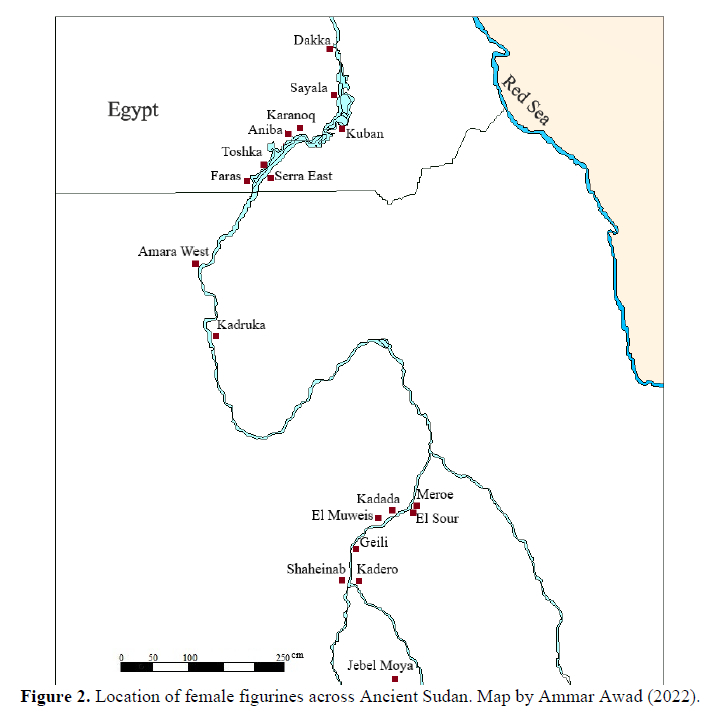
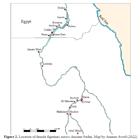
Female figurines in the Middle Nile region date from the late Mesolithic or early Neolithic periods. Their distribution is concentrated in the northern and central parts of the area (Fig. 2). The use of these figurines continued until the Meroitic period, suggesting their ongoing relevance within deep-seated traditions in the region.
Neolithic figurines
The earliest dated figurines come from the early Khartoum Mesolithic (Khartoum Hospital site), dated to ca. 5000 BC, and were found by Arkell in 1949. These samples were, unfortunately, very fragmentary, including 11 simply made figurines comprising legs or arms and eight fragments of heads and faces in clay (Arkell 1949: pl. 56, figs 2-4), and so their relevance here is tentative. These figurines were associated with over 200 small objects comprising animal heads, including hippopotamus or crocodiles, and Arkell (1949) suggested they were used as magic for hunting.
Two samples come from Kadruka, just south of Kerma, a site that spans over a thousand years (46003200 BC) (Reinold 2001). The first figurines were found in a burial dating to the first half of the 5th millennium BC, in Cemetery KDK1. It was carved in Nubian sandstone and was deposited in the burial equipment of a ca. 40-year-old adult male, along with a pair of bucrania bracelets, a diorite palette, and calceiform vases, evidence indicating to Reinold (2000) that this man could have been a tribal chief. The second figurines came from Cemetery KDK 21, and are also made of Nubian sandstone. These stylised figurines did not emphasise any specific part/s except for a pair of lines marked on the abdomen, thus making it difficult to determine its female nature (Reinold 2000). Both examples had a finely polished surface and a conical, pointed base, likely to fix them in the ground to perform open-air rituals (e.g., Fig. 3a).
In contrast to those made on Nubian sandstone, most figurines are made using fired clay. In the Neolithic site of Shaheinab, dating ca. 4440 BC, a complete female clay figurine was recovered from a burial associated with proto-dynastic material at the site (Arkell 1953: pl. 41: 7). Arkell (1953) suggested that the potters who had made the vessels in the proto-dynastic burials at Shaheinab had also made this (Fig. 3b).
Three examples of figurines were found in the Neolithic site of Kadero, dating from ca. 4200 BC, and again they were made using fired clay. Three figurines were decorated with incised lines on the torso, which could suggest tattoo designs. Another example showed dotted marks on the front and back, again perhaps representing tattoos (Reinold 2000). The severed head of another figurine has rough, prominent facial features marking the eyes, nose, mouth, and hair or a cap made from vegetal material or fabric, such as linen. Another torso showed frontal and back tattoos made through dotted marks, so many of the marks on these figurines could be understood to represent tattoos (Rampersad 1999).
In the early and classic Neolithic levels at Geili, north of Khartoum, two fragmentary female figurines and several other unidentifiable fragments, including a head, body fragments with marked breasts, and clay phalli, were recovered (Caneva 1988: figs 17 & 18) (Fig. 3c).
Additional female figurines were found at the Neolithic site of el-Kadada, dating from ca. 4015 BC. Here, the figurines vary in form, some highly stylised with noticeable breasts, stomachs, and buttocks. One rich grave with a substantial amount of goods contained fragments of six heads of female figurines with elaborate hairstyles (Geus 1984). Another figurine found in a child's grave was also made using fired clay, possibly representing a pregnant woman and serving as a symbol of fertility (Fig. 4a). A dozen similar figurines from different cemeteries at el-Kadada (Fig. 4b & c), and two more figurines from Shaheinab and Geili, further suggest the importance of this symbolism in the area (Reinold 2000).
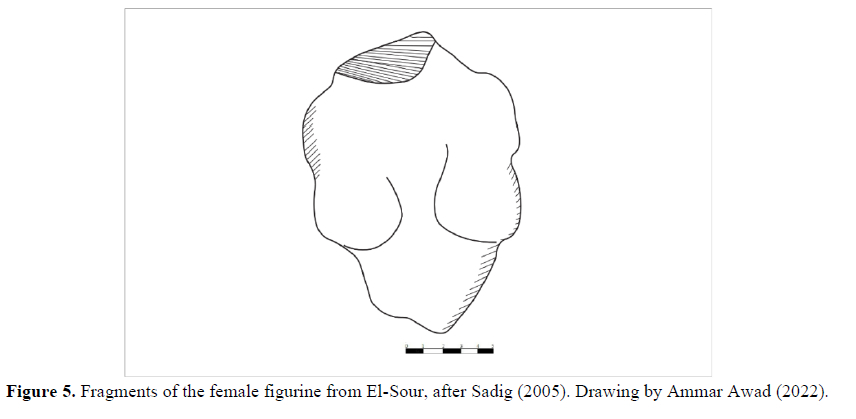
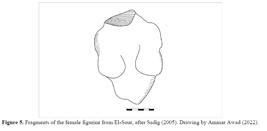
Two further fragments found at el-Sour were again linked to a child's grave (Sadig 2005). The first one is a human head, with no prominent features, but is similar to examples found at el-Kadada (Geus 1984). The hair of the figurine is decorated with a hard, rippled decoration. The second is an incomplete human figurine comprising the torso of a female. Unfortunately, the upper and lower parts of the figurine were lost (Fig. 5), and there was no other decoration on the body. Sadig (2005) has suggested that these forms had a religious purpose.
About 496 human and animal figurines were recovered during the excavations at Jebel Moya (Addison 1949). Of these, the human figurines are both male and female and highly stylised, and are made of unfired clay. Such figurines became more common in the later periods at the site (1st millennium BC-1st millennium AD). The prevalence of many simple, almost phallic types, looking like rough cones of clay, may point to different symbolisms around figurines at this site. Addison (1949) suggested that the animal figurines represent children's toys, while the human figurines seem to differ in character from the animal types. The latter are model animals with legs, horns, tails, etc., all realistically reproduced, or at least reproduced as well as their makers knew how, but no attempt was made to model a human. Sexual characteristics are often indicated, and sometimes there is a suggestion of arms, but in no single case is there any effort to show separate legs, and only occasionally are features suggested by a mere pinching of the clay.
The earliest evidence of female forms in the A-group in lower Nubia began with the first archaeological survey of Nubia (1907-1911). Several female figurines were discovered in the first stage of the survey (1907-1908) in Cemetery 30 at Khor Risqalla. They were made of fired clay; almost all were headless, without hands or legs (Reisner 1910: fig. 291). The second stage of the survey (1908-1909) located a group of female forms from Cemetery 102 at Dakka, characterised by a seated posture and outstretched legs, and at least one of them was associated with a female child's grave (Firth 1915: pl. 11) (Fig. 6a). The last stage of the first survey (1910-1911) located an additional female figurine in Cemetery 130, Grave 311 at Sayala, which belonged to a young girl. The figurine is made of clay, nearly straight in its upper body, and has a head like a bird but no thighs or breasts (Fig. 6b).
Two samples of female figurines belonging to the Α-group cemetery were found associated with the burials of an adult woman and a child in Tomb 16b at Site 277, between Halfa Degheim and Khor Musa (Fig. 6c). The accompanying figurines mirror the human remains, with one figurine being a mature woman and the other a young girl with a short, slender body and small breasts (Säve-Söderbergh 1968: pl. XLIII). The modelled incisive ripples from the lower abdomen to above the knees seem to depict a garment, perhaps a loincloth (Nordstrom 1972). Säve-Söderbergh (1968) suggested that these were intended to restore the vitality of the deceased individuals rather than being related to fertility.
In the settlement complex of Α-group at Serra-East, Site 303, Area 2, was a sample of a female figurine, approximately 6 cm high, with a long, thin neck and attached head, and with short arms. The nipples and navels were indicated by indented points, and the eyes and eyebrows were indicated by indented lines (Säve-Söderbergh 1968) (Fig. 6d).
Bronze Age
Cemetery 87 of Koshtamna contained the skeleton of a female child in Grave 66. There were a series of clay female figurines, seated and with unarticulated legs, and the upper body more or less bent back. (Fig. 7a). Numerous female figurines belong to C-group cemeteries found at Dakka, and all of the figurines were in seated positions (Firth 1912: pl. 39). An additional group of female figurines was discovered at the Kubban cemetery (Graves 1, 2, 7, 43, 46, 82, & 244) (Firth 1927).
A group of female figurines was recovered from the site of Aniba, where the largest consternation graves occur for the C-group. Across five graves (677, 390, 249, 133, & 99), nine samples of female figurines were recovered, and they were made of fired clay in the seated position with short arms. The absence of breasts also distinguished all the figurines, except for one that seemed unique; it had a long and distinctive conical breast and a set of sunken scars that might show a tattoo (Fig. 7b). The other figurines are also females because they have the same female features in their bodies, e.g., their seated position, tapering legs, buttocks, and short arms.
Three samples were collected from C-group cemeteries at Toshka. Two of them were in a seated position, marked with dotted and other motifs representing human tattoos (Fig. 7c). The third stands upright, is headless with a long, thin neck, and has short arms. The upper body is narrow and the chest has two horizontal cuts, while the abdomen protrudes and is covered with tattoos. It also has thick legs, separated from each other at the bottom, so that it stands on two flat feet. (Fig. 7d).
During the Egypt Exploration Society (EES) excavations at the site from 1938 to 1939 and 1948 to 1950, sixteen female figurines were recovered from in and around the walled town of Amara West (Spencer 1997). Further fragments of 21 examples were found again in the same area during the 20082014 seasons of the British Museum, recovered within the walled Ramesside Period town and adjacent extramural settlement, which continued in the New Egyptian Kingdom.
Most of the recovered figurines are flat, plaque-shaped, hand-modelled in clay, with a small number that have been rounded. The figurines are naked, often with the pubic triangle, breasts, or navel marked, while those rounded figurines tend to have very prominent buttocks. Tattoos or scarifications occur on figurines of both shapes (Stevenson 2017).
The re-emergence of female figurines in the Kushite kingdom
The Kushite kingdom saw the re-emergence of female figurines as an important artefact category. In particular, four sites were found: two in the Meroe area, the third in el-Muweis to the south, and the fourth in Karanog in lower Nubia.
Reisner (1910) recovered three samples of clay female figurines in Meroe during the excavations in el Bagrawwaya West, all of which were made of clay. The first was a crude mud steatopygous female figurine with no head or arms, with a height of 16.5 cm (Fig. 8a); the second and third were crude mud male figurines ca. 100 AD (Dunham 1963).
During excavations in the city of Meroe in the 1980s, a female figurine with no arms or head, measuring 165 mm in height and comprising an uneven surface texture, was found in Grave W. 323, accompanied by three crude male figurines. All were made of fired clay. The head of the complete male figurine was attached with a wooden dowel so that the missing female head may have been similarly attached (Dunham 1963) (Fig. 8b).
Several fragments of an unknown number of human figurines were also found during the Meroe city excavations, including pieces of legs, torsos, buttocks, heads, and a complete female torso. The faces often show the three vertical cuts on the cheek known from other Meroitic representations of the human face, which are still common amongst the modern Jaaliyin population of the area. All these fragments were made of fired clay (Shinnie & Bradly 1980: figs 70-72), and many cattle figurines were also found (Fig. 9a-c). Visible perforations on the figurine shoulders were perhaps used to hang them within houses for protection, or blessings. However, this may have been confined to members of the royal class only, and access to similarly important roles for non-royal women remains unknown.
In a Meroitic site at Mouweis south of the capital, this pottery workshop dumpsite contains an unfired clay female figurine with punctuated decoration on the abdomen, including a triangle. It dates to the 1st-4th century AD (Fig. 9d).
North of the kingdom in lower Nubia, at the cemetery of Karanog, a low-rank male grave (G 300) contains a clay female figurine with a plant-shaped motif punctuated in axial position on the abdomen, ca. 3rd century AD (Woolley & Randall Maclver 1910: pl. 96, no. 7662).
3. Discussion
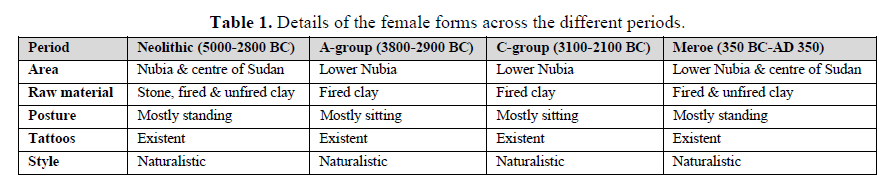
Archaeologically, female figurines in Sudan first appear in the Neolithic period and then they began to occur in the archaeological record from time to time in specific contexts: the A-group, C-group, and Meroitic periods (4500 BC-AD 350) (see Table 1). It appears that their most prominent and common characteristic is their naturalistic dimension, which characterise the samples throughout the different stages of cultural development. It gives the impression that the human body had embedded meaning. The focus in Neolithic samples in central Sudan on a specific area of the body such as the breasts, which may have been more important, further attests to the importance of the body.
Neolithic sites in the Sudan, where female figurines were found, demonstrate variation in socioeconomic structures across the Nile Valley, showing different ways of exploiting natural resources (cf. Arkell 1953; Haaland 1987; Caneva 1988; Magid 1989; Reinold 2001; Jesse 2008; Sadig 2010). These differences are reflected in the diversity of material culture found across this period. Some Neolithic groups were focused on hunting and fishing subsistence. In contrast, others were more sedentary and may have practised agriculture and domestication (Mohammed-Ali 1973). The burials at Kadruka, for example, point to a homogenous population in which social hierarchies are clear (Reinold 2001), perhaps suggesting the development of chiefdoms. The dominance of cattle bones and bucrania shows that pastoralism was important (Haaland & Haaland 2017). We see social differentiation and differences in wealth in the burials of men, women, and children at Kadero (Sadig 2009). In contrast, the Neolithic community at Geili represented a group of hunter-gatherers and pastoralists who used large semipermanent camps near the Nile (Caneva 1988). Despite the similarities in style and raw materials among the Neolithic samples of figurines, we do not see significant standardisation in the female forms. This may go back to differentiation in space and time between the Neolithic cultures in Sudan.
The Neolithic female figurines in Sudan also differ from those observed in other contemporary sites across the Near East in that we see little concern for sexual details, e.g., no voluminous, pendulous breasts or exaggeratedly large or elevated buttocks. The prominent abdomen is also missing, a key aspect of other female figurines. The Sudanese Neolithic samples seem more representative of actual human female characters, even though they rarely have a head or legs. Their main aim appears to have been to reflect specific functional aspects, as seen in the discussion below. According to the distribution of these forms across time and space in Sudan, we can see that quantities of female figurines were highest in the Neolithic period and C-Group. However, the Neolithic period witnessed the birth of this phenomenon in Sudan. In the Bronze Age, small communities of farmers and pastoralists were scattered in Lower Nubia along the banks of the Nile during the C-Group culture, and they were in constant contact with neighbouring Egypt. Their level of political stratification, however, was much lower (Renaut 2020).
The female figurines in Sudan are characterised by several features, including a diversity of raw materials used in their production, ranging between fired and unfired clay and stone. In most cases, they are also characterised by their standing position and an absence of peripheral parts (appendages), such as arms and legs (except for the example from el-Kadada, shown in Figure 4a, and C-group examples).
Decoration typically features horizontal and vertical lines around the thigh and leg areas, which may symbolise clothing, or strings made of leather that almost cover the part between the waist and the upper thigh; in some cases, comprising ostrich eggshell. This clothing style continued in the Meroitic period among the non-elite class, and it looked very similar to contemporary styles of dress among the Rahat, where young girls would wear a kind of leather skirt (a tradition that continued until the beginning of the previous century). Habitually, this covered the lower part of the body while leaving the upper parts, including the breasts, naked (Fig. 10a & b).
Archaeologically, the Neolithic female figurines in the Sudan seem to have been included in elite funerary rites since they are found in the burials of wealthy men, women, and children. However, their meaning is still unclear. Their presence in burials may point to their use relating to spiritual beliefs around the afterlife, fertility, childbearing, and medical aspects. Some of their details may suggest that they were representations of primitive deities, or at least symbolic embodiments of them (El-Atta 2000).
Haaland and Haaland (2017) have suggested these female figurines are a way to understand the role of women in pre-state communities. Such figurines portray the importance of a mother-child relationship, which is a useful anchor to forge solidarity within a given society. Furthermore, this emphasises the important role of women in the stabilisation of communities as they transition from a mobile to a more sedentary lifestyle (Haaland 1997).
We see, for example, similarities between A-Group figurines and those found at Late Halaf sites in north-eastern Syria dating to ca. 6th millennium BC, as well as with slightly later Naqadan figurines in southern Egypt dating to ca. 4th millennium BC. The A-Group examples are very similar to the late Halaf examples, especially in how the hands and arms cradle the ample breasts, and in the use of regular stripes for decoration (Graham 2020). The Nubian A-Group was contemporaneous with the Naqada civilisation (45 km to the north) in Upper Egypt. This tells us that there was an exchange of goods and ideas at this time along the Nile and into the Levant (Hofmann 1977).
The long gap between the disappearance of female figurines in the late A-group period and their reappearance in the C-group period, and the continued use of female forms during the Bronze Age, reflects the persistence of the imagined symbolism of women from earlier traditions. Stylistically, the type of seated position of figurines, the short arms, the long necks, the inarticulate legs, and tattoos, were common features on figurines in the graves of both periods. A new introduction was the standing position, which appears to have been preferred in the settlements of the C-group. This may relate to a change in the location of rituals around the objects, with no need for them to be pushed into the ground. However, the body decoration has been constant. Furthermore, the breasts are rarely shaped in the C-group, depicted instead by holes or lines.
The examples from the Aniba C-group may have been used in ritual practice. Hafsaas (2006) suggested they were used in a female puberty rite, and she assumed a correlation between the adult (with scarification) and immature (blank) female body, reflecting this transition to womanhood perhaps in preparation for marriage, pregnancy, and childbirth.
Also, the parallels between some aspects of the C-group and the New Egyptian settlement in Amara West and Aaskut are notable (cf. Smith 2003; Stevenson 2017). The female figurines in the Pharaonic period were considered components of magico-medical rites to protect and heal. However, recent research suggests a broader and more active function for these figurines, including evidence for their deliberate destruction in various healing and apotropaic rites. This uniformity, together with their decoration in various media, suggests mass production at a state-supplied workshop.
Female figurines have been found in the full range of excavated sites in Egypt, from houses, temples, and tombs in the Nile Valley, to cemeteries in the western oases, mining sites in the Eastern Desert and Sinai Peninsula, and Nubian forts (cf. Waraksa 2018). Their breakage is sometimes indicative of deliberate destruction, which most likely occurred at the conclusion of a rite before the figurine was discarded. Combined with the frequent occurrence of the figurines in refuse zones, this breakage highlights their temporary utility (Kemp 1995; Waraksa 2007).
However, in Kushite contexts, we see the frequency of female figurines rise again. These occur in both the elite cemetery and domestic strata in the royal city at Meroe, as well as in a low-ranking burial of a male at Karanog and in a pottery workshop at Muweis (the latter unlikely to be the intended final position). Some significant parallels can thus be identified between the Neolithic and C-group site figurines.
First, the style of the figurines has reverted back to that seen in Neolithic contexts, particularly as seen at el-Kadada and C-group (Fig. 10b). Figurines are again armless and headless in a standing position. Furthermore, markings denoting tattoos appear on the Meroitic examples across the thighs, abdomen, and neck. These are similar to those figurines from Neolithic sites such as Geili and el-Kadada.
The Meroitic female figurines were found in an elite context in the Meroe area. Furthermore, they were shown in lower-ranking classes outside Meroe (Karanog and Mouweis). However, no female figurines have been found in a royal tomb. This may indicate differences in the cultural traditions between the royal, elite, and other low ranks in Meroitic society. The differences in cultural traditions are noticeable across the Meroitic cemeteries in the north and south (Adams 1977; Edward 1989; Kuckertz & Lohwasser 2019).
What can the use of female figurines tell us about the role of women in the Middle Nile Valley? The women of the Sudan Neolithic period played an important role in managing the number of group members through their reproductive control. This was effectively connected with the female function as the productive member in society, with their ability to increase group numbers. The completed figurines of females, which were collected from numerous Neolithic sites in central Sudan and which were characterised by standing body positions and erected breasts (e.g., in el-Geili, Kadero, Shaheinab, and Kadada), were almost exclusively associated with pastoral contexts and domesticated animals. The focus on the chest area, without the rest of the body, refers to the concern for its functional importance as a milk producer. This symbolism is close to the mobile agro-pastoralist cultures in these areas, where animals play a central role in people's socio-economic lives. This is also notable among the figurines of Jebel Moya, the most significant agro-pastoral community on these plains.
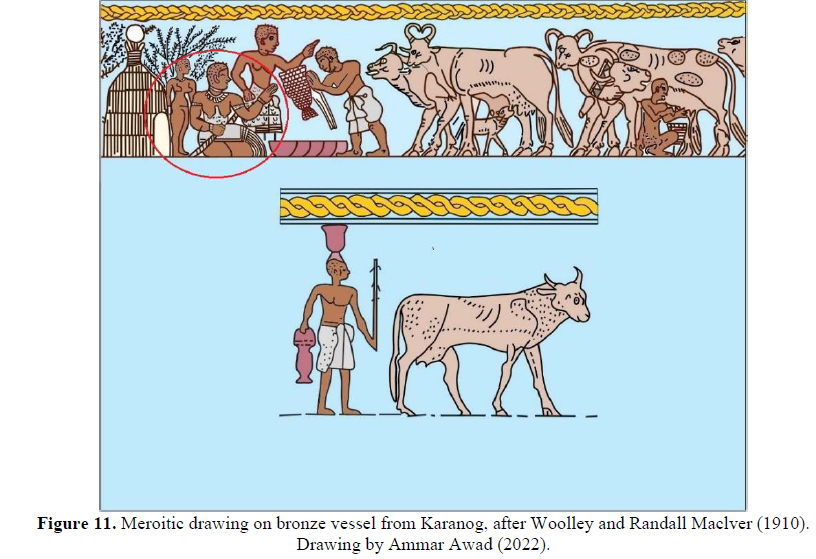
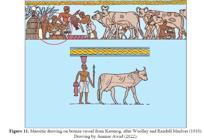
In the Meroitic period, similar such symbolism can be observed in the drawing on a copper vessel at the Karanog cemetery, preserved now in the Cairo Museum (item number JE 41017), which presents the pastoral process in Meroitic Nubia. The representation consists of two women appearing in front of the entrance of a local Sudanese hut called a Qotteia. Both of them are naked in the upper part of their chest while facing a group of cattle being milked (Kendall 1984). One woman is sitting on the ground, but the other is younger, standing behind her back. Both women have been drawn with erect nipples (Fig. 11).
The Meroitic period appears to comprise a riverine environment because many urban centres were established across the Nile River for more than 1000 km. However, settlements spread more into the plains than in the riverine areas, where pastoral communities dominated in the areas of Butana, Gizera, and the White Nile area to the south of Khartoum. The pastoralists appear more archaeologically in the burials than in the settlements; however, this is likely related to problems of excavation and site identification. According to the classical writer Strabo (see Eide et al. 1998), the island of Meroe was populated partly by nomads, partly by hunters, and partly by farmers.
We know that women occupied important positions in the Kingdom of Kush. The role of the priestess was extremely important in Meroitic religion, and the positions of Queen and Queen Mother were politically significant. Execration texts suggest this importance was of very long duration and point to this being a cultural norm for the area. Royal women who held cultic roles wielded considerable power as King's Mothers, King's Sisters, and King's Daughters (Lohwasser 2001; Phillips 2016).
For the elite women, these roles were not isolated from the general socio-economic contexts for the non-elite women in Meroitic life, which had not been evident archaeologically. Although the figurines fit standard body styles in Meroitic art, they do not look like the women in the reliefs. However, the emphasis on rounded hips and breasts and the interest in full-figured women occur in both, which is considered a beauty standard among the Sudanese. The continuing use of female figurines in this period refers to the constant importance of females in some symbolic aspects.
4. Conclusion
This article reviewed some of the common cultural aspects reflected by female figurines across the different cultural contexts in ancient Sudan, focusing on the Neolithic and Meroitic periods. Previous literature has focused on addressing these objects within the cultural contexts to which they belong without looking for potential similarities regarding continuity and change. The ongoing appearance of female figurines points to the important position afforded to women across history in the Middle Nile region. However, their prominence during the Neolithic and Meroitic periods points to the continued importance of female roles during these specific periods. Female figurines in ancient African contexts have been created and used as devices to help ensure married couples are able to procreate (NOMA 2021). In addition, they are presently linked with ancestral values and traditions, where carved figurines are used in ceremonial functions. For example, during the filling of storage grains (Siwiba) in the Nuba Mountains region of Sudan, where the Sippr is one of the festivals of Nuba and is associated with agriculture and its religious rites. The Sippr of el-Siwiba represents one important rite in Damik. It occurs when the farmer intends to fill the Siwiba with grain. The farmer then notifies the Kugur, who blesses this work with special prayers. The process occurs after decorating the el-Siwiba building on its external side and painting it in black, red and white. Some sticks are also tied around the body of the Siwiba to prevent it from cracking after being filled with grain. Human and animal figurines are then installed on the front side of the el-Siwiba building (Gandul 2015). The discovery of more female figurines in future investigations will shed more light on the continuity and change surrounding the role of women across history in this area.
Acknowledgements
I would like to thank the reviewers for their valuable comments and for providing additional references that strengthened the paper. I am also deeply thankful for the assistance and patience of the Editors at Southern African Field Archaeology.
References
- Abramova, I. 1967. Palaeolithic art. U.S.S.R. Arctic Anthropology, 17: 1-179.
- Adams, W. 1977. Nubia: Corridor to Africa. London: Allen Lane.
- Addison, F. 1949. Wellcome Excavations in the Sudan: I, Jebel Moya 1910-1914. London: Oxford University Press.
- Al-Sawwah, F. 1994. The Religion of Man. Damascus: Aladdin Publications (in Arabic).
- Arkell, A. 1949. Early Khartoum. London: Oxford University Press.
- Arkell, A. 1953. Shaheinab. London: Oxford University Press.
- Bahn, P. & Vertut, J. 1988. Images of the Ice Age. New York: Facts on File.
- Caneva, I. 1988. El-Geili: The History of a Middle Nile Environment 7000 BC-AD 1500. BAR International Series 424. Cambridge Monographs in African Archaeology 29. Oxford: Oxford University Press.
- Cauvin, J. 1972. Religion Neolithgues. Paris: Centre de Recherches d Ecologie et de Prehistoire.
- Cauvin, J., Hodder, I., Rollefson, G. et al. 2001. The birth of the Gods and the origins of agriculture: "Review Feature". Cambridge Archaeological Journal, 11(1): 105-121.
- Clark, D. 1973. Preliminary Report: Archaeological and Geomorphological Survey in the Central Sudan, January-March 1973. Berkeley: Mimeographed.
- Conkey, M. 1983. On the origin of Paleolithic art: A review and some critical thoughts. In: Trinkaus, E. (ed.) The Mousterian Legacy: Human Biocultural Change in the Upper Pleistocene: 201-227. Oxford: BAR Publishing.
- Conkey, M. 1987. New approaches in the search for meaning: A review of research in Palaeolithic art. Journal of Field Archaeology, 14 (4): 13-30.
- Dunham, D. 1963. The Royal Cemetery of Kush 5 (the West and South Cemeteries at Meroe). The west and south cemeteries at Meroë: Excavated by the late George Andrew Reisner. Boston: Museum of Fine Arts.
- Edward, D. 1989. Archaeology and Settlement in Upper Nubia in the First Millennium AD. Cambridge Monographs in African Archaeology, BAR International Series 537. Cambridge: Cambridge University Press.
- Eide, T., Hägg, T., Pierce, R. H., et al. (eds) 1998. Fontes Historiae Nubiorum: Textual Sources for the History of the Middle Nile Region Between the Eighth Century BC and the Sixth Century AD. Volume 3: From the First to the Sixth Century AD. Bergen: Bergen University, Institute for klassisk filologi.
- El-Atta, H. 2000. The Neolithic and Bronze Age female figurines of Sudan 4th-1st millennium BC. Analyzing the data through Agency. Masters Dissertation. Cambridge: University of Cambridge.
- Firth, C. 1912. The Archaeological Survey of Nubia, Report for 1908-1909. Cairo: Government Press.
- Firth. C. 1915. The Archaeological Survey of Nubia, Report for 1909-1910. Cairo: Government Press.
- Firth. C. 1927. The Archaeological Survey of Nubia, Report for 1910-1911. Cairo: Government Press.
- Gandul, G. 2015. Approach to Study the Rophic Tribe: The Socio-cultural and Religious Life in Nuba Mountains, Sudan. London: MBJ (INT).
- Geus, F. 1984. Excavations at El Kadada and the Neolithic of the Central Nile. In: Krzyzaniak, L. & Kobusiewicz, M. (eds) Origin and Early Development of Food-producing Cultures in North-eastern Africa: 361-372. Poznan: Archaeological Commission of the Polish Academy of Sciences.
- Graham, L. 2020. Similarities among North Mesopotamian (late Halaf), Egyptian (Naqada), and Nubian (A- Group) female figurines of the 6-4th Millennia BCE. Journal of Ancient Egyptian Interconnections, 27: 24-37.
- Guthrie, R. 1984. Ethological observations from Palaeolithic art. In: Bandi, H.G., Huber, W., Sauter, M.R., et al. (eds) La Contribution de la Zoologie et de 1'Ethologie al'Interpretation de l'Art des Peuples ChasseursPrehistoriques "3e Colloque de la Societe Suisse des Sciences Humaines": 35-73. Fribourg: Editions Universitaires.
- Haaland, R. 1987. Socio-economic Differentiation in the Neolithic Sudan. British Archaeological Reports International Series 350. Oxford: Archaeopress.
- Haaland, R. 1997. Emergence of sedentism: New ways of living, new ways of symbolizing. Antiquity, 71 (374): 385.
- Haaland, R. & Haaland, G. 2017. Prehistoric figurines in Sudan. In: Insoll, T. (ed.) Oxford Handbook of Prehistoric Figurines: 85-104. Oxford: Oxford University Press.
- Hafsaas, H. 2006. Cattle Pastoralists in a Multicultural Setting. The C-Group People of Lower Nubia 2500-1500 BCE. The Lower Jordan River Basin Programme Publications 10. Ramallah: University of Bergen & Bir Zeit University.
- Hamilton, N. 1996. Can we interpret figurines? Cambridge Archaeological Journal, 6 (2): 281-307.
- Hodder, I. 2001. Symbolism and the origins of agriculture in the Near East "Review feature". Cambridge Archaeological Journal, 11(1): 105-121.
- Hofmann, I. 1977. Die Grosse Gottin des Ostmittelmeerraumes im Meroitischen Reich. Studien zur Altägyptischen Kultur, 5: 79-121.
- Hutton, R. 1997. The Neolithic great goddess: A study in modern tradition. Antiquity, 71: 91-99.
- Jesse, F. 2008. Time of experimentation? The fourth & third millennia BC in Lower Wadi Howar, Northwestern Sudan. In: Godlewski, W. & Lajtar, A. (eds) Between the Cataracts. Proceedings of the 11th Conference for Nubian Studies: 49-74. Warsaw: Warsaw University.
- Kemp, B. 1995. How religious were the ancient Egyptians? Cambridge Archaeological Journal, 5(1): 25-54.
- Kendall, T. 1984. Ethnoarchaeology in Meroitic Studies. Fifth International Conference for Meroitic Studies. Berlin: Akademie-Verlag.
- Kuckertz, J. & Lohwasser, A. 2019. Introduction to the Religion of Kush. Dettelbach: Verlag J.H. Röll.
- Lohwasser, A. 2001. Queenship in Kush: States, Role, and Ideology of Royal Women. Journal of American Research Center in Egypt, 38: 61-78.
- Maringer, J. 1966. The Gods of Prehistoric Man. London: Weidenfeld Nicolson.
- Magid, A. 1989. Plant Domestication in the Middle Nile Basin: An Archaeo-ethnobotanical Case Study. British Archaeological Reports International Series 523. Oxford: Archaeopress.
- Mata, P. 2014. Possible parallels between Egyptian and Sudanese Neolithic figurines and other contemporaneous ones coming from the Near Eastern Area. Boletín de la Asociación Espanola de Orientalistas, XL: 135-147.
- McDermott, L. 1996. Self-representation in Upper Palaeolithic female figurines. Current Anthropology, 37(2): 227-275.
- Mohammed-Ali, A. 1973. A re-assessment of the Neolithic Period in the Sudan. Masters Dissertation. Alberta: University of Calgary.
-
New Orleans Museum of Arts (NOMA) 2021. Maternity figures in African Arts. Available from: https://noma.org/maternity-figures-in-african-art/ (Accessed: 2023).
» https://noma.org/maternity-figures-in-african-art/ - Nordstrom, H. 1972. Neolithic and A-Group Sites: Scandinavian Joint Expedition to Sudanese Nubia. Oslo: Norwegian University Press.
-
Otto, R. 1924. The idea of the Holy. Translated by John W. Harvey. Available from: http://mod.oprsees.ru/main.php?q=rudolf-otto-the-idea-of-the-holy-pdf (Accessed: 2023).
» http://mod.oprsees.ru/main.php?q=rudolf-otto-the-idea-of-the-holy-pdf - Phillips, J. 2016. Women in ancient Nubia. In: Budin, S.L. & Turfa, J.M. (eds) Women in Antiquity: Real Women from Across the Ancient World: 280-298. Oxfordshire: Routledge.
- Rampersad, S. 1999. The origin and relationships of the Nubian A-Group. Doctoral Thesis. Toronto: University of Toronto.
- Reinold, J. 2000. Archéologie au Soudan. Les Civilisations de Nubie. Paris: Editions Errance.
- Reinold, J. 2001. Kadruka and the Neolithic in the Northern Dongola Reach. Sudan & Nubia, 5: 2-10.
- Reisner, G. 1910. The Archaeological Survey of Nubia, Report for 1907-1908. Cairo: Government Press.
- Renaut, L. 2020. Tattooed women from Nubia and Egypt: Flesh and bones. In: Alice, M. & Turnhout, B. (eds) The Individual and His Body in the Ancient Mediterranean Basin: 67-87. Belgium: Brepols Press.
- Sadig, A. 2005. Es-Sour: A Late Neolithic site near Meroe. Sudan & Nubia, 9: 26-40.
- Sadig, A. 2009. Neolithic Adaptations and Subsistence Economy in the Middle Nile Region, Sudan. Bergen: Nile Basin Research Program.
- Sadig, A. 2010. The Neolithic of the Middle Nile Region. An Archaeology of Central Sudan and Nubia. Kampala: Fountain Publishers.
- Säve-Söderbergh, T. 1968. Preliminary report of the Scandinavian joint expedition. Archaeological investigations between Faras and Gemai: November 1963 to March 1964. Kush, 15: 211-250.
- Shinnie, P. & Bradley, R. 1980. The Capital of Kush 1 (Meroe excavations 1965-1972), Meroitica. Berlin: Akademic-verlag.
- Smith, S.T. 2003. Wretched Kush: Ethnic Identities and Boundaries in Egypt's Nubian Empire. London: Routledge.
- Soffer, O., Vandiver, P., Klima, B., et al. 1993. The pyrotechnology of performance art: Moravian Venusesand wolverines. In: Knecht, H., Pike-Tay, A. & White, R. (eds) Before Lascaux: The Complex Record of the Early Upper Paleolithic: 259-275. Boca Raton: CRC Press.
- Spencer, P. 1997. Amara West I. The Architectural Report. London: Egypt Exploration Society.
- Stevenson, A. 2017. Predynastic Egyptian figurines. In: Insoll, T. (ed.) The Oxford Handbook of Prehistoric Figurines: 1-24. Oxford: Oxford University Press.
- Vandiver, P., Soffer, R., Klima, B., et al. 1989. The origins of ceramic technology at Dolni Vestonice, Czechoslovakia. Science, 246 (4933): 1002-1008.
- Waraksa, E. 2007. Female figurines from the Mut Precinct: Context and ritual function. Doctoral Thesis. Baltimore: Johns Hopkins University.
- Waraksa, E. 2018. Female figurines (Pharaonic Period). In: Wendrich, W. (ed) UCLA Encyclopedia ofEgyptology: 1-6. Los Angeles: UEE.
- Woolley, C. & Randall Maclver, D. 1910. Karanog: The Romano-Nubian Cemetery. Philadelphia: University Museum Press.
Revised April 2024
Published May 2024