Grave Via at Oakhurst Shelter: Reporting on a 5000-year-old mistaken identity and associated grave-goods
Abstract
Almost a century ago, Goodwin excavated Grave VIa at Oakhurst Shelter that later became known as one of the most intriguing Later Stone Age burials in southern Africa. At the time, and in subsequent discussions, it was thought that a man was buried with a bored stone and a grindstone - objects usually seen as women's things. We now know that the person was buried ~5000 years ago during the mid -Holocene, and that recent genetic work revealed their biological identity as that of a woman. This report reconciles the woman's bioarchaeological information with a photographic record of her grave goods, most of which have never been published before. It highlights how throughout its long curational history, originally well-contextualised items are now scattered, with some no longer traceable. Alongside the items I was able to record over a three-year period, I provide a list of 'still missing' items in the hope that it will lead to their re-location. Brief interpretations of some aspects of the grave goods (such as the bored stone with fish vertebrae, the quartz artefacts, and the ochre and paint paraphernalia) serve to highlight the uniqueness of this grave, and its potential to inform on the woman and the possible worldview of the people who lived at Oakhurst Shelter during the mid-Holocene.
Stone Age burials; ancient-DNA; bored stone; pigment-making; quartz crystals
1. Introduction
When studied archaeologically, ancient grave goods have an extraordinary potential to inform on past peoples and their worldviews (e.g., Alekshin et al. 1983; Cooper et al. 2022). In South Africa, many Stone Age graves were excavated during the first half of the 20th century amidst quests for 'missing links' and racial traits (Morris 2022), generally with little archaeological interpretation of the accompanying grave goods. The long and mostly poorly documented curatorial histories furthermore resulted in the splitting or comingling of grave contents - both human and material remains (e.g., Lazarides 2015; Steyn et al. 2024). It is therefore rare to find fully reconciled and well-documented records of individual sets of Stone Age grave goods although certain aspects are highlighted in overviews or comparative studies (Inskeep 1986; Hall & Binneman 1987; Wadley 1997; Pearce 2008; Lazarides 2015; Loftus & Pfeiffer 2024). The aim of this contribution is to report on the status of arguably one of the most interesting and complex sets of mid-Holocene, Later Stone Age grave goods in South Africa, and the recent genetically confirmed sex of the person buried with them at Oakhurst in Grave VIa.
2. Oakhurst Shelter and Grave VIa
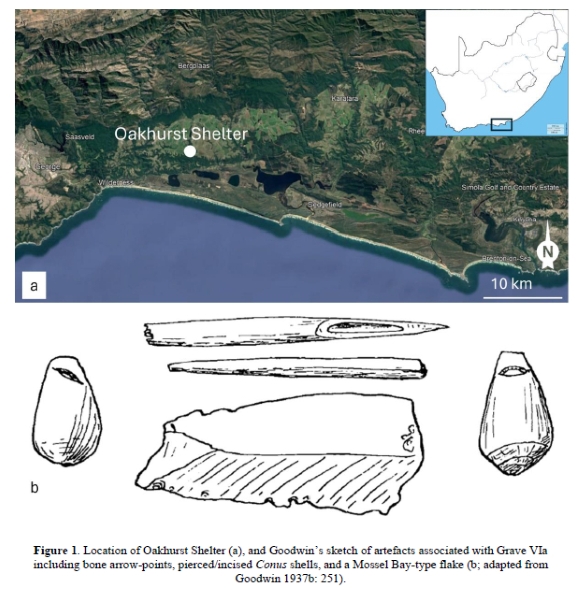
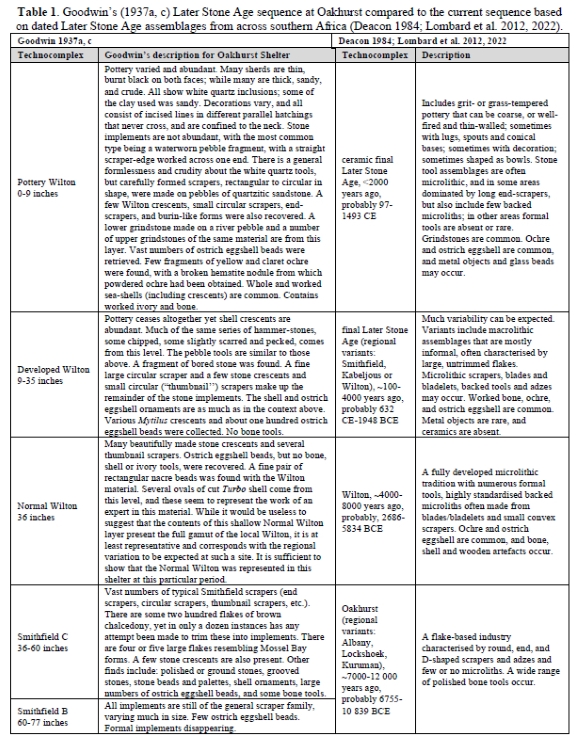
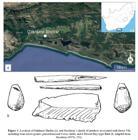
Oakhurst Shelter is an overhang of ~15 m long in an east-facing sandstone cliff, located in the forest along the Klein Keurbooms River about 6.5 km from the ocean just north of the coastal lakes between George and Knysna (Fig. 1a). Between 1932 and 1935, Goodwin (1937a) excavated the southern end of the shelter to bedrock. He interpreted the Later Stone Age sequence from top to bottom as follows: late Wilton with pottery, developed Wilton with no pottery, normal Wilton, Smithfield 'C', and Smithfield 'B' (Goodwin 1937a). In Table 1 I present Goodwin's chrono-stratigraphy for Oakhurst Shelter, compared to our current understanding of the southern African Later Stone Age sequence (Deacon 1984; Lombard et al. 2012, 2022; for detailed historical discussion of Oakhurst Shelter see Pearce 2008: 186-192).
Researchers who subsequently attempted to study the Oakhurst assemblages revealed difficulties with context and curational control (e.g., Fagan 1960; Schrire 1962; Sampson 1974; Wadley 1997; Pearce 2008). It seems that initially the material was housed at the University of Cape Town African Studies Museum, where it was studied by Fagan (1960) and Schrire (1962), and that Schrire reorganised and relabelled the assemblage. According to her (Schrire 1962: 183):
[I]t is unlikely that the horizontal limits of the terraces should coincide with the interfaces of the cultural deposits. These discrepancies prevent a full understanding of the excavation. Moreover, since Goodwin provides no key for identifying the labels on the material, they can only be deduced from the report. The inconsistencies found in this report have made this task even more difficult. The unlabelled material from Oakhurst cannot be incorporated in an analysis since its stratigraphical position is unknown. It is only when an unmistakable object, which has been described and illustrated in the report, is found that we can allot it a place in the sequence of finds. For example, an ivory point bearing no label is ascribed to grave six.
Goodwin (1937b) reported Grave VIa as one of a palimpsest of six individual burials (VI and VIa-e), describing Grave VIa as (Goodwin 1937b: 250-252):
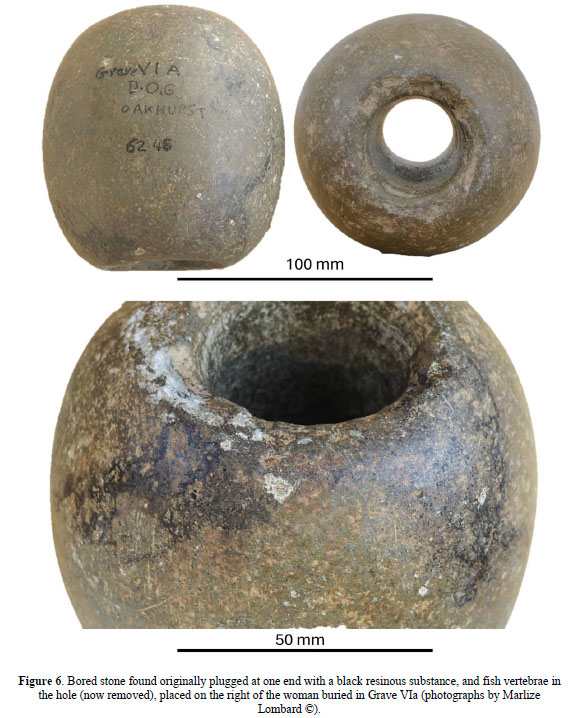
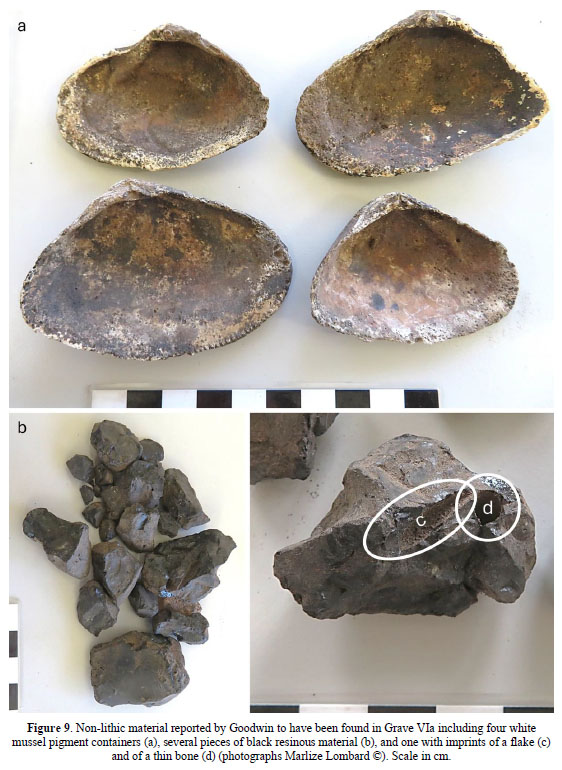
An earlier interment underlying VI. It had its own gravestones, three of which bore signs of red ochre, but no paint. The skull was that of an adult, very much rotted, apparently through contact with Skeleton VI, and through having been crushed by the gravestones. The skeleton lay on its right side, facing east, head to south. Four or five Wilton crescents of stone serve to date the burial as Early Wilton, buried from 36-inch layer. On the right thigh, with marked signs of red ochre in the surrounding earth, lay an oval bored stone pierced down its major axis. One end contained broken fragments of a mass of black resinous substance; the other end contained an unbroken series of fish vertebrae. A red-ochre powder coloured the area between this bored stone and an upper grindstone. Near the bored stone lay four pierced Conus shells and three pieces of ironstone (probably from the surface of the 300-foot peneplain above), which had apparently formed part of a girdle about the waist. On the right wrist, which had been forced against the sternum, was found a bracelet, consisting of an intricate band of ostrich eggshell beads, 1.5 inches wide, with beads in position. The wristlet was photographed, and fixed in wax for future development. Behind the pelvis, under a large stone with red paint on it, were three river pebbles about 3 inches [in] diameter with red ochre on them. With these was a mass of powdered ochre mixed with soil, also two water-worn flakes of Mossel Bay type, half a broken palette, a large crystal worked as a circular scraper, a few Donax shells filled with red ochre, and a crushed ostrich eggshell bored at one end. The whole grave was lined with sea-grass. Near the skeleton, and apparently belonging to it, were found two more slate palettes, two bone arrow-points, and a mass of black resinous-material. This latter bears the imprint of a flake, and of a thin bone about 3/16-inch in diameter. The superficial similarity of the resinous mass to that found in the bored stone suggests that they belong to the same grave. [...] Whether the water-tortoise is a part of the disturbed burial [VIe] or of that of VIa is uncertain. It is more probably related to VIa.
Goodwin (1937b) ascribed Grave VIa as belonging to the Wilton phase at Oakhurst Shelter (Table 1), and based on stature, Drennan (1937a) interpreted the post-cranial bones and skull of Oakhurst 6A as that of an adult male.
3. More about the person buried at Oakhurst in Grave VIa
Wadley (1997) found that in Goodwin's fieldnotes he described the grave goods for 6A as those later published for Grave VIa (Goodwin 1937b) - so that the simultaneously published 6A skeleton (Drennan 1937a) belonged to Grave VIa. She writes (Wadley 1997: 133 note 5):
Drennan (1938) identified skeleton 6A as male but Patrick (1989) identified skeleton 6a number 1 (UCT 204), which she claims comes from Grave 6a, as female. This skeleton was dated 4530+70 bp (Pta-4449). There is some doubt that these descriptions are of the same skeleton, and Pfeiffer (personal communication 1995) reported that UCT 204 comprises only the commingled feet of more than one adult. Given this apparent recent confusion over the identity of UCT 204, I am retaining Drennan's original identification. When I examined the Oakhurst Shelter grave goods at the South African Museum [now IZIKO South African Museum] and at the University of Cape Town Medical School [now University of Cape Town Department of Human Biology], the Grave 6A grave goods were missing. It is possible that Skeleton 6A is also missing.
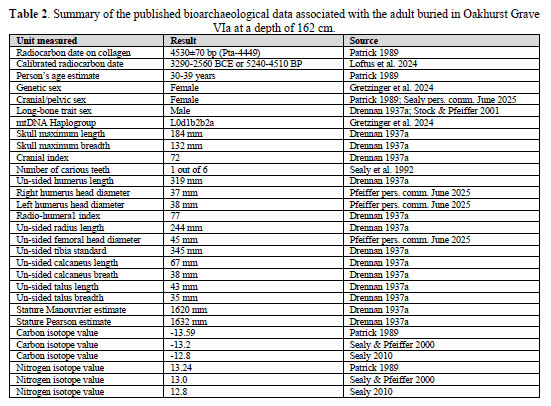
In 1992 Morris (1992: 47), however, described UCT 204 as comprising "most of [the] skeleton of [an] adult". Sealy et al. (1992) reported on the health of six teeth for an adult woman accessioned as UCT 204 (radiocarbon lab. no. Pta-4449). According to Sealy (Judith Sealy pers. comm. June 2025), her sex interpretation would probably have been based on at least a partial pelvis, and Patrick (1989) indicated that she used pelvic and cranial traits for sexing. The presence of at least partial pelvic bones seems plausible based on Goodwin's (1937b) observation about artefacts found behind the pelvis in Grave Via. By contrast, Drennan's (1937a) sexing was based on stature, and Stock and Pfeiffer (2001: 339) also interpreted the UCT 204 adult as male "based on non-pelvic indicators". It seems that after the 1995 communication between Wadley and Pfeiffer, Pfeiffer had another look at UCT 204, making the following note: "July 1996: This is Drennan's Grave Via [note however that Drennan used '6A' and Goodwin 'Via']: Wadley requested that I check the sex: Right humerus head: 37 [mm]; left humerus head: 38 [mm]; scrappy, partial un-sided femoral head: 45 mm. Can't see any pelvic material. General large size of long bones. Tentative-probable male". Thus, based on the size of the femur head, the person was not small, and may have had the stature of a typical man within the community (Susan Pfeiffer pers. comm. June 2025).
Sealy (2010) further conducted isotope analysis on UCT 204 bone samples at the University of Cape Town Department of Archaeology, and samples for DNA analysis were recently extracted from two teeth belonging to UCT 204 (radiocarbon lab. no. Pta-4449) (Gretzinger et al. 2024: s1). The crowns of the teeth have since been returned to the Department of Human Biology (Judith Sealy pers. comm. June 2025). The ancient DNA of UCT 204 revealed the genetic sex as that of a woman (Gretzinger et al. 2024), corresponding with Patrick's (1989) and Sealy et al.'s (1992) interpretations. Cumulatively, the various studies demonstrate that UCT 204 does not consist of foot bones only, instead it seems likely that at the time of Wadley's visit to IZIKO and the Department of Human Biology, some of the UCT 204 bones were elsewhere for research purposes and that subsequently Pfeiffer also found other bones. Currently, UCT 204 as curated by the University of Cape Town Department of Human Biology consists of a full skeletal box including a skull cap, teeth, and well-preserved distal and proximal portions of tibia and femora, and there are many more fragmented bones with well-preserved portions (Victoria Gibbon pers. comm. June 2025; see Table 2 for elements with previously published measurements).
Pearce (2008) thought that some of the confusion may stem from the various numbering systems used for the Oakhurst material, but from two catalogue notes at the Department of Human Biology he confirmed that the UCT 204 adult remains were those reported by Drennan (1937a) as '6A' - thus the adult from Goodwin's Grave VIa (Goodwin 1937b). Patrick (1989) identified the UCT 204 adult (labelled by her as both '6a' and 'no1') as a woman of 30-39 years upon death, buried at 162 cm, and dated to 4530±70 bp (Pta-4449). In Goodwin's (1937b) report, Grave VIa is the only adult burial found at a depth of 64 inches (162.56 cm). Patrick (1989) noted three more individuals associated with UCT 204 (unlabelled) for whom age and sex estimates were impossible. Sealy et al. (1992) also reported on one adult (radiocarbon lab. no. Pta-4449), one juvenile of 4-5 years and three intermediate sets of remains for UCT 204. These remains may relate to Goodwin's (1937b) Graves VIb-e mainly consisting of fragmented child bones (also see Morris 1992). Patrick (1989) goes on to report on the teeth associated with UCT 204. Here, UCT 204 (unlabelled) is a tooth specimen with caries and a C13 value of -14.46, but UCT 204 (grave 11) is a tooth without caries and a C13 value of -13.59. Patrick's (1989) carbon-nitrogen data show that UCT 204 (grave 11) with its -13.59 C13 value has a nitrogen value of 13.24, and that it is the 30-39-year-old woman whom she previously labelled 'UCT 204 no1' and 'UCT 204 6a'. The UCT 204 (unlabelled, C13=-14.46) entry has a nitrogen value of 10.09 and is a child of 45 years old. Patrick's (1989) labelling system creates further muddle when she also uses 'grave 11' and 'GRAVE 11' with UCT 209/186 buried at 177 cm. On page 192, Patrick (1989), however, links her 'Grave 6a' and UCT 204 buried at a depth of 162 cm, as associated with the grave goods described by Goodwin (1937b) for Grave VIa buried at the same depth.
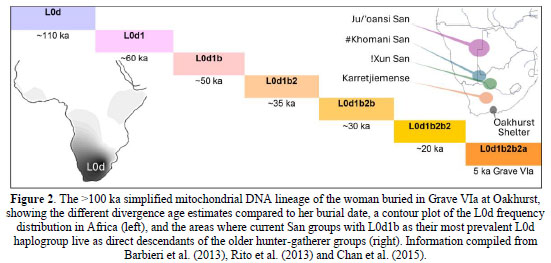
As for the grave goods, I found that some objects marked with 'O. 6a' (O.=Oakhurst) correspond to objects found in Grave VIa by Goodwin (1937b), so that the '6a' tag may have been introduced during Schrire's (1962) relabelling of the Oakhurst assemblage. By carefully following all available data (i.e., Goodwin's original descriptions [for his photographic record see below], burial depths, UCT accession numbers, radiocarbon laboratory numbers and research histories), it now seems most likely that the sexing of 6A/UCT 204 based on stature suggests a relatively tall person (162-163.2 cm; Drennan 1937a). Here it is important to note that according to Pfeiffer (2021), femoral length measures (where available) suggest that there was not much difference in stature amongst southern African hunter-gatherer adults. Ultimately, based on cranial and/or pelvic bones, as well as on DNA, the sex of the adult buried in Oakhurst Grave VIa was revealed as female. We recently recalibrated the burial date of this rather tall woman to 3290-2560 BCE or 5240-4510 BP (Pta-4449) (Loftus et al. 2024), and we now also know that she carries the L0d1b2b2a mitochondrial subclade in her DNA (Gretzinger et al. 2024; Fig. 2 orange label). Based on the published range of isotope data (Patrick 1989; Sealy & Pfeiffer 2000; Sealy 2010), it seems that her diet was most consistent with those of South African inland hunter-gatherers, relatively high in meat intake, perhaps supplemented with fresh-water foods, but generally low in plant-food intake (see fig. 12 in Steyn et al. 2023). Table 2 provides a summary of the currently available bioarchaeological data for the woman found at Oakhurst in Grave VIa.
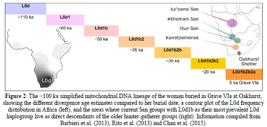
Gretzinger et al.'s (2024) ancient-DNA study included nine individuals from the Oakhurst Shelter dated to between 9120 and 710 BP, and a study by Jakobsson et al. (2026) included 28 individuals dating to 10 200 and 150 BP. Both these studies demonstrate that different from most other regions across the globe, the genomes of ancient southern Africans show little spatiotemporal stratification, consistent with a large, stable Holocene population. Southern Africa seems to have been a long-standing geographic refugium since ~200 000 years ago (Rito et al. 2019), with fragmented gene outflow between ~100 000 and 8000 years ago and gene inflow only manifesting after ~1400 years ago from eastern and western Africa, and later from Europe (Jakobsson et al. 2026). The genetic signature of the Oakhurst hunter-gatherers provides evidence of their ancestry to current #Khomani San and Karretjiemense from South Africa, and all the successfully reconstructed mtDNA (mitochondrial DNA) libraries from Oakhurst belong to the L0d haplogroup (Gretzinger et al. 2024). This haplogroup is shared with individuals from KwaZulu-Natal who lived there about 2000 years ago (Schlebusch et al. 2017, 2020) and is one of the most ancient mitochondrial lineages globally that coalesced sometime between 133 000 and 90 000 years ago (Chan et al. 2015). Figure 2 is a simplified representation of the >100 ka mtDNA lineage of the woman buried in Grave VIa.
The L0d haplotypes found in the southern San today are clearly distinguishable from northern groups (Schlebusch et al. 2013). The L0d1b branch, only detected in southern Africa, has higher frequencies in the south of the region, declining towards the north (Fig. 2 map on the left). The Ju/'hoansi and Cape Coloured groups in the Schlebusch et al. (2013) study had L0d1b as their most prevalent L0d haplogroup, occurring at lower frequencies in the !Xun (Fig. 2). Chan et al. (2015) found relatively elevated L0d1b frequencies in #Khomani San. This ancestral lineage appears to have been highly dispersed throughout southern Africa, showing expansion dates during MIS 2 at ~15 000 years ago, and again at ~3000 years ago during the late Holocene (Schlebusch et al. 2013). Its subsequent variant, L0d1b2 predominates within the San population today, and the woman from Grave VIa carries the L0d1b2b2a subclade (Gretzinger et al. 2024), which is most closely related to current San-predominant subclades such as L0d1b2a2, L0d1b2b1a and L0d1b2b2c (Chan et al. 2015). She, together with other individuals dating to at least the last 10 000 years (e.g., Schlebusch et al. 2017, 2020; Gretzinger et al. 2024; Jakobsson et al. 2026), is therefore a direct ancestor of people who currently self-identify as San or Bushman (also see D'Amato et al. 2025).
4. Current status of the Oakhurst Grave VIa grave goods
Goodwin's photographic record of Grave Via
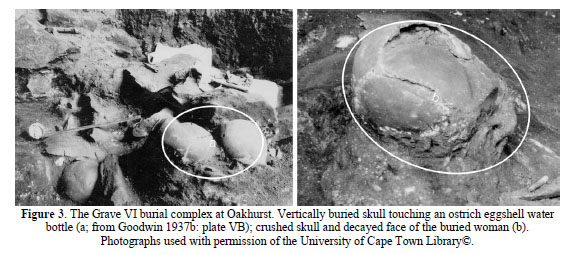
During July-August 2024, Clive Kirkwood, the archivist at the University of Cape Town Libraries, located some of Goodwin's original photographs associated with Grave VIa. Goodwin (1937b: plate VB) published the photograph in Figure 3 (left) as that of the Grave VI complex. He (Goodwin 1937b: 249-250) found that the skull of Grave VI "was almost vertical" and "behind the skull, and touching it, was an ostrich eggshell, pierced with a 1/4-inch hole at one end [Fig. 3a], it overlayed the burial stones and skull of Grave VIa, with the VIa skull crushed by the stones and a decayed face [Fig 3b]" (Goodwin 1937b: 220).
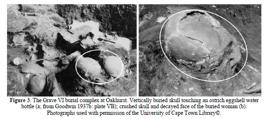
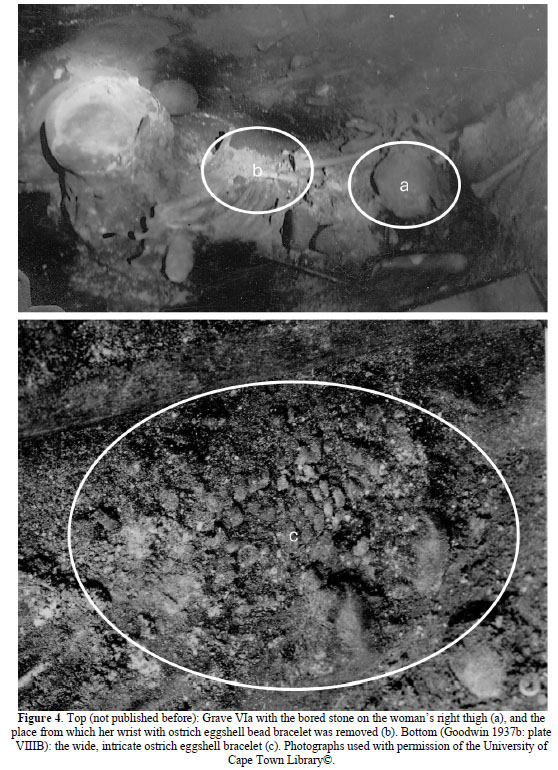
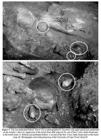
Figure 4a shows the location of the bored stone on the woman's thigh, and the place against her sternum (Fig. 4b) where the right wrist with ostrich eggshell bead bracelet was fixed in wax by Goodwin and removed. Figure 4c shows the image published by Goodwin (1937b: plate VIIIB) which shows the ostrich eggshell bracelet.
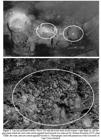
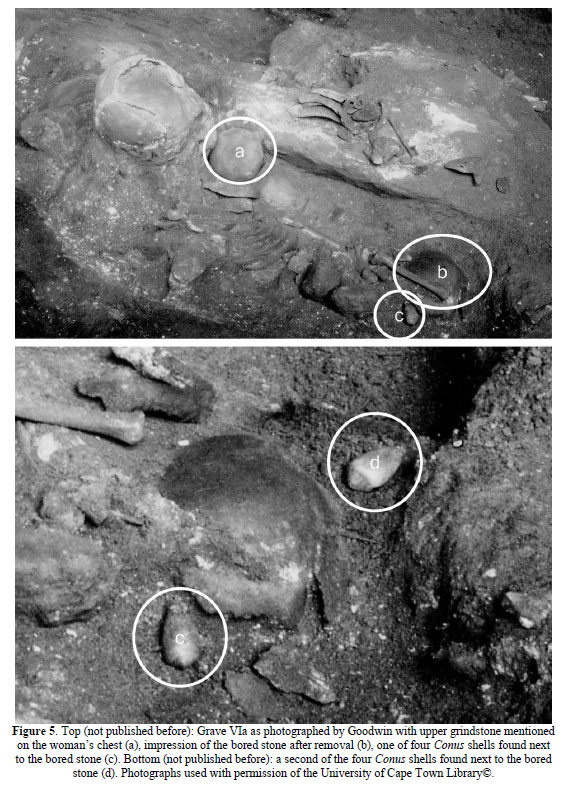
The photograph in Figure 5 reveals how the upper grindstone mentioned by Goodwin was placed on the woman's chest (Fig. 5a), how the bored stone on her thigh left an impression in the soil after removal (Fig. 5b), and the location of one of the four Conus shells found next to it (Fig. 5c). The detail of a different photograph (Fig. 5d) shows another of the Conus shells next to the bored stone impression.
Traceable grave goods associated with Grave VIa
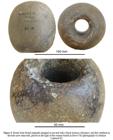
In November 2023 the curators of the University of Cape Town Archaeology Department (Louisa Hutten) and ! Khwa ttu Heritage Centre (Magdalena Lukas), helped to locate the Grave VIa bored stone as the one currently on display in the First People's Museum at !Khwa ttu (on loan from the Archaeology Department). The stone is marked as that of Grave VIa at Oakhurst, and traces of a black residue are still present at one end of the perforation (Fig. 6). It is taller than wide, and perforated down its longer axis, exactly as Goodwin described. We may therefore accept that it is the plugged stone found with fish vertebrae at Oakhurst placed on the woman's right thigh. Modern damage to the rim of the perforation (Fig. 6, bottom), suggests that the black resinous substance and the fish vertebrae were removed somewhat forcefully sometime during the stone's curational history.
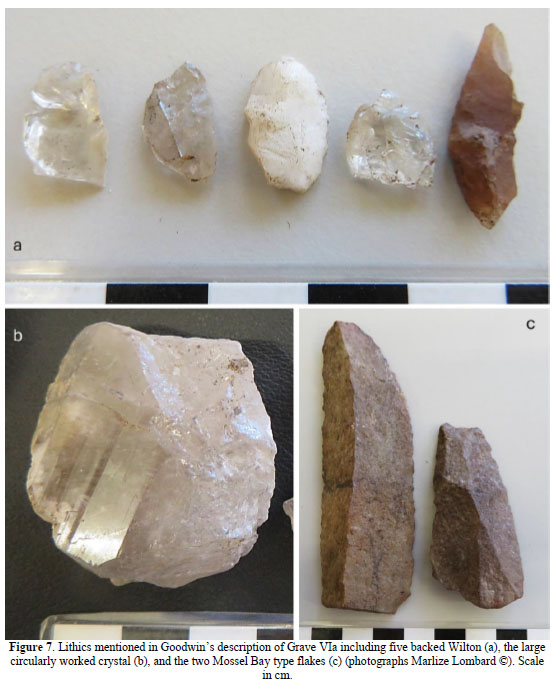
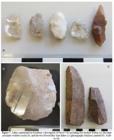
During November 2024 I visited the IZIKO South African Museum in Cape Town to record material from Grave VIa now under their curation. Goodwin (1937b) mentioned four or five Wilton segments or crescents, and in a separate Grave VIa sample bag I found five backed microliths, two produced on crystal quartz, and one each on smoky quartz, milky quartz and chert (Fig. 7a). Other lithics mentioned by Goodwin, and curated as part of Grave VIa at IZIKO, include the large circularly worked crystal (Fig. 7b), and the two Mossel Bay type flakes (Fig. 7c).
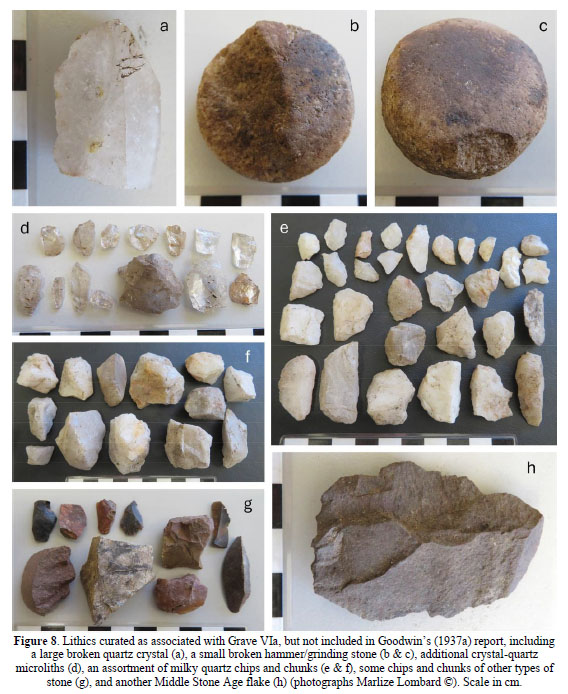
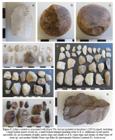
There are more sample bags with lithics marked as belonging to Grave VIa in the IZIKO collection. These include a large broken quartz crystal (Fig. 8a), a small broken hammer/grinding stone (Fig. 8b & c) - too small to be the upper grindstone on the woman's chest (Fig. 5a) - more crystal quartz microliths (Fig. 8d), an assortment of milky quartz chips and chunks (Fig. 8e & f), some chips and chunks of other rock types (Fig. 8g), as well as another Middle Stone Age flake (Fig. 8h).
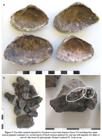
As described by Goodwin (1937b), there are several (I found four) white mussel (Donax serra) shells with traces of them having been filled with a liquid or semi-liquid pigment mixture containing red ochre and black pigments (Fig. 9a), and the pieces of black resinous material (Fig. 9b), one of which shows what Goodwin saw as the imprints of a flake and of a thin bone (Fig. 9c & d).
VIa grave goods recorded by others or that may be material described by Goodwin
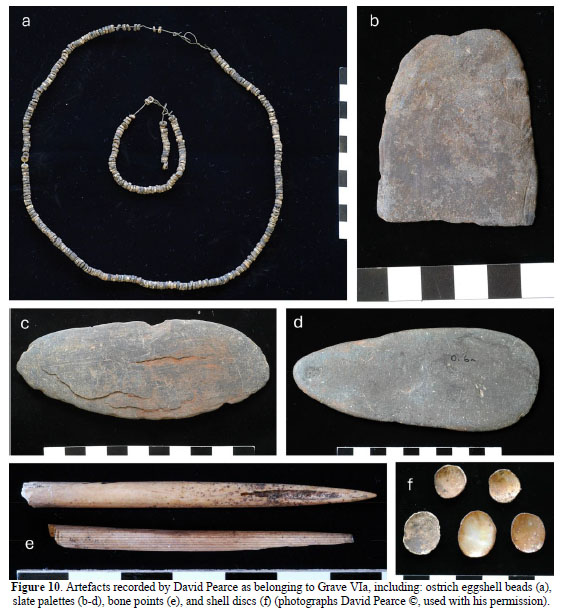
In 2005 David Pearce also tried to reconcile the material buried in Grave VIa as part of his doctoral research (Pearce 2008). At the time, he located several items distributed between IZIKO and a display case in the foyer of the University of Cape Town Archaeology Department. Apart from the bored stone in Pearce's (2008) record, I could not confidently locate any of the artefacts he recorded. For example, he found some ostrich eggshell beads (Fig. 10a), of which it is not clear whether they comprised the bracelet that Goodwin preserved in wax (Fig. 4c). When I was at IZIKO all I found was an empty 'ostrich eggshell bead' sample bag for Grave VIa, so it seems that subsequent to Pearce's record the beads were removed for research or display purposes with no note of its whereabouts left in the bag.
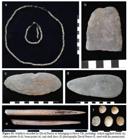
Pearce photographed the broken half of a palette (Fig. 10b), which Goodwin found with a large ochre-painted stone, three river pebbles and the circularly worked quartz crystal behind the woman's pelvis, and recorded the two complete palettes that were buried near her (Fig. 10c & d), as well as the two bone 'arrow' points illustrated by Goodwin (1937b; Fig 10e), currently on display at !Khwa ttu (Louisa Hutten pers. comm. June 2025). Pearce also found five shell discs indicated as belonging to Grave VIa (Fig. 10f), not included in Goodwin's description of the grave.
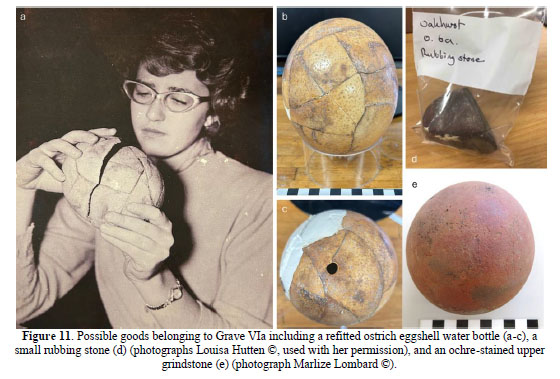
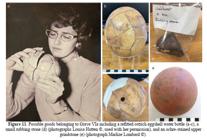
Three more artefacts from the Oakhurst assemblage may be part of the VIa grave goods as described by Goodwin, but are not unambiguously provenanced as such. First, Carmel Schrire refitted an ostrich eggshell water container labelled 'Graves VI & VIa Oakhurst, George' (Fig. 11a-c), currently curated at the University of Cape Town Archaeology Department (Louisa Hutten pers. comm. June 2025). At IZIKO I found sample bags with ostrich eggshell fragments marked 'Grave VI', but not for Grave VIa. It is therefore possible that this is the crushed ostrich eggshell, bored at one end, that Goodwin found behind the pelvis of the woman buried in Grave VIa. A rubbing stone marked with 'O. 6a', in the same way as other artefacts from Grave VIa, is also currently on display at !Khwa ttu (Louisa Hutten pers. comm. June 2025) (Fig 11d). Lastly, the IZIKO Oakhurst assemblage contains a large, ochre-stained upper grindstone marked as 'D.O.G. 6990' (Fig. 11e). Based on its size, shape, and staining it could be the stone found on the chest of the woman buried in Grave VIa (Fig. 5a).
Currently untraceable items described by Goodwin for Grave VIa
After three years of investigating all possible avenues, and contacting all possible repositories and curators (only the University of Cape Town Department of Human Biology declined to communicate whether they were curating any relevant grave goods), I was unable to locate the following items listed by Goodwin (1937b) as part of Grave VIa:
• The gravestones, three with red ochre traces, but no paint. It is unclear whether any of the gravestones from Oakhurst were brought from the site or left there.
• The unbroken series of fish vertebrae found in the bored stone. At IZIKO I found a sample bag marked 'bone' from Grave VIa, and whilst it contained a human tooth and four distal human phalanges, amongst a few animal bones, there were no fish remains.
• The four pierced Conus shells and three pieces of ironstone that Goodwin (1937b) interpreted as forming part of a waist girdle. During my visit to IZIKO in November 2023 there were several pierced Conus shells on display, which the curator thought could come from Oakhurst. Before my visit in November 2024 the display was dismantled, and the location of the shells was uncertain. An unmarked piece of ironstone from Oakhurst is currently at the University of Cape Town Archaeology Department (Louisa Hutten pers. comm. June 2025).
• The right wrist with a ~4 cm wide bracelet consisting of an intricate band of ostrich eggshell beads, photographed and fixed in wax for future development by Goodwin (1937a, b). The only photograph is of poor quality (Fig. 4c), and it is unclear whether these may be the beads recorded by Pearce in 2005 (Fig. 10a).
• The large stone with red paint found behind the woman's pelvis.
• The three river pebbles ~7 cm in diameter with red ochre on them.
• Remains of the seagrass grave lining, which Goodwin may not have brought from the site.
• The 'water-tortoise' remains mentioned by Goodwin in the context of Grave VIe, but which he thought probably belonged to Grave VIa.
5. Discussion
Previous interpretations of the Oakhurst Via grave goods
Wadley (1997), though unable to locate any of the grave goods, was the first to revisit Grave VIa. She used Goodwin's fieldnotes and Drennan's (1937a) male identification to critique the notion that the gender of deceased people is generally reflected in the associated burial practices. In her analysis, the fact that 'women's artefacts' such as grindstones and bored stones are also found in men's graves suggested that the materiality and gender association of the artefacts became less important in their symbolic context as grave goods. She further argued that burial practices do not always reflect "the lifetime role and status of the deceased, instead grave goods could be about their roles after death" (Wadley 1997: 109). Based on ethnographic accounts of San women beating the ground with bored stones and/or round grindstones to call out to the dead (Bleek 1935), Wadley (1997) hypothesised that the inclusion of grindstones and bored stones in Later Stone Age graves may be a forerunner to the subsequent San practice of using such artefacts to communicate with the dead. She cautions, however, that although continuities in beliefs about the spirit world may be represented through some grave goods, their mere presence in the Stone Age does not automatically vouch for symbolic continuity; such hypotheses are best used only if they represent a best-fit explanation for the data (Wadley 1987).
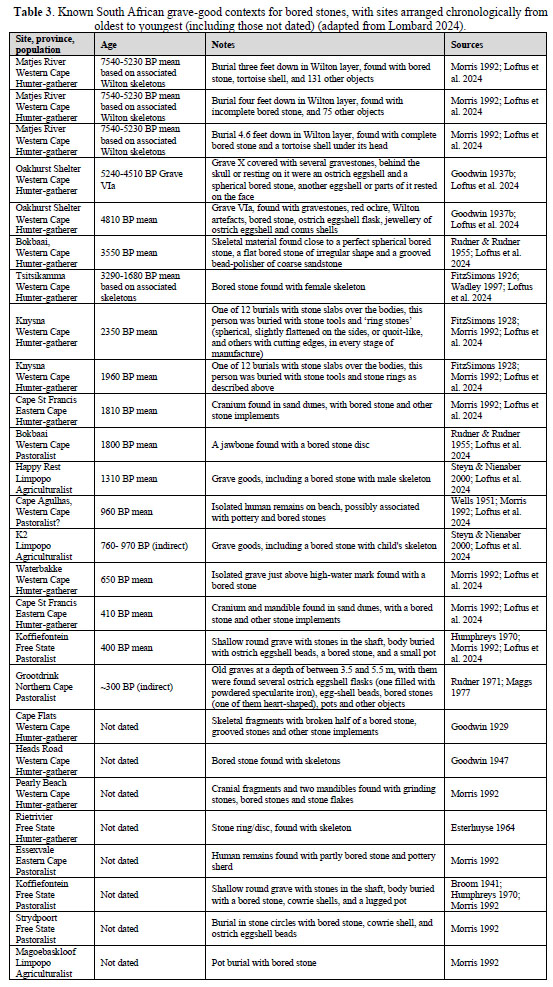
Wadley (1997) interpreted the fish placed within the hole of the bored stone as metaphor for an altered state of consciousness and the ability to travel underwater during a trance experience. Lewis-Williams and Pearce (2004) highlighted that whilst bored stones occur relatively frequently in graves (see Table 2, adapted from Lombard 2024), the fish vertebrae sealed inside the stone make it unusual. They further suggested that bored stones may have been placed in Stone Age graves to facilitate contact with the dead, invoking ethnographic accounts of San women beating such stones to communicate with the spirit world (Lewis-Williams & Pearce 2004: 62). Lewis-Williams and Pearce (2004) concurred with Wadley's (1997) suggestion that the bored-stone-fish combination may be a trance metaphor for underwater travel, and also agreed that the concept of passing through holes or swimming through passageways to reach the spirit world may be implied (Lombard 2002).
Pearce (2008) subsequently suggested that even if not related to underwater travel, the fish vertebrae in the stone can be positively linked to the 'underwater theme' identified in several other Later Stone Age burials from the southern Cape, highlighting that (Pearce 2008: 212):
In Later Stone Age rock art, fish and other aquatic creatures were often associated with religious specialists and underwater travel (e.g., Lewis-Williams & Dowson 1999; Lewis-Williams & Pearce 2004a, b). The fish vertebrae may therefore be a representation of the common ethnographic underwater metaphor. Why the vertebrae were placed inside the perforation of the bored stone, however, remains unclear. I suggest, though, that the notion of passing through a hole may be significant (see Lombard 2002 on concepts related to passage through the holes of bored stones), and may well relate to the symbolism inherent in grave holes themselves.
The three river pebbles and seashells, found with the woman in Grave VIa, may also be linked with symbolism relating to the underwater spirit world (Pearce 2008).
Pearce (2008) suggested that the Middle Stone Age flakes in the woman's grave may reflect Wadley's (1987) interpretation of such tools as objects 'of great antiquity', found alongside other unusual items - including quartz crystals, uncommon stones (including bored stones), and divining die - as part of a shaman's or sorcerer's cache. Quartz is widely associated with hunter-gatherer views of the spirit world (Lewis-Williams & Pearce 2004), which Wadley (1997) suggested may be a reason for its inclusion in some Later Stone Age burials. Pearce (2008: 206) further suggests that the sea grass lining of Grave Via and other Wilton graves at Oakhurst may reflect "ideas of the sea and transitions between underwater and land", as well as "metaphorical concepts of sleep". The latter interpretation was prompted by Goodwin's (1937a: 237) observation of "compressed and wadded bundles of sea-grass" between the fireplaces of the uppermost layer at Oakhurst Shelter and the rear wall, which were used as bedding "both for the living and the dead".
Some additional thoughts about Grave Via
Whilst this report does not aim to offer a comprehensive new interpretation of the full assemblage of grave goods and their possible meaning/s - a task reserved for a future, theoretically informed study -I present a few additional thoughts on some themes represented in the burial. The first theme relates to the plugged bored stone within which a series of fish vertebrae had been inserted. Bored stones are ubiquitous in South Africa and are found across sub-Saharan Africa (Lombard 2024), with the oldest examples coming from Border Cave in South Africa dating to ~45-41 ka (Beaumont 1978; d'Errico et al. 2012). Their ritual use in the form of grave goods is documented in 26 burials across South Africa that date to between ~7500 BP and 300 BP (Table 3; for discussion see Lombard 2024). The oldest evidence of such use comes from the mid-Holocene context at Matjes River, ~70 km west of Oakhurst Shelter, where the timing of the practice may have overlapped with that of Oakhurst Grave VIa (Table 3).
Bored stones such as the one from Grave VIa, which are taller than they are wide, are rare. Out of the 1429 stones from across South Africa for which I have measurements (all those reported by Goodwin [1947] plus >50 stones personally measured at McGregor Museum in April 2023), only nine (0.6%) from different regions in South Africa show this morphology, and the one from Oakhurst is the only one known to be associated with a grave. The sporadic manufacturing or use of such stones therefore does not seem to be linked to either regional traditions or their use as grave goods.
The Grave VIa bored stone could have functioned as a weight for a digging stick when the woman was still alive. Such gendered, mundane use is the fall-back interpretation (Goodwin 1947), regardless of shape, size, context or age (but see Ouzman 1997 for other uses). Green (2020: 3), for example states that: "Sticks depicted with bored stones are only painted with figures with breasts and indeterminate figures with large buttocks", and Parkington and Paterson (2021) reiterate that throughout the Western Cape, naked males are never painted with weighted digging sticks. However, in a spirit-world context recorded by Stow (1905; Stow & Bleek 1930), near Witsieshoek in the Free State, therianthropes with penises are depicted with bored stones on sticks (see Hollmann & Lombard 2024 for discussion). Also, in KwaZulu-Natal at Bushpig Shelter men are depicted wielding objects interpreted as bored stones (Ouzman 1997), and Ouzman (1997) found less excavation-centric, empirical and contextual support for the digging-stick-weight hypothesis than for the spiritual-symbolic use of bored stones.
Knowledge about the beating of stones to communicate with the spirit world came from the /Xam records (University of Cape Town's The Digital Bleek and Lloyd n.d.), which contain three references to women using bored stones for communication with spirit people who used to be game sorcerers, and Rains' things in the form of a chameleon (see discussion in Lombard 2024). Bleek and Lloyd (1911: 429) wrote that they were told that "a man does not beat a stone upon the ground - a woman beats a stone upon the ground". Subsequently, data collected by Hoff (2017) in the Nama Karoo from informants of /Xam descent reveal that they believe in an underworld wherein graves and the act of grave digging or digging for water, certain foods and medicinal roots or bulbs (with weighted or unweighted digging sticks), were connected to the spirit world, and that bored stones had a particular link with that world. Similar to the /Xam who shared information with Bleek and Lloyd more than a century ago, Hoff s informants indicated that spirits could be called by hitting the ground with a round stone (bored or unbored), and that bored stones may have been placed in graves to end the death connection (Hoff 1990, 2017). Hollman (2022) sees the beating of stones as representing a worldview wherein ancestral sorcerers of both sexes can be approached by the living for help.
As suggested above, the fish in the stone's perforation may represent the concept of passing through holes or swimming through passageways when travelling to and from the spirit world (Lombard 2002, 2024). Lewis-Williams and Pearce (2004) see fish as underwater metaphors or spirit-world creatures encountered by shamans when they experience altered states of consciousness as being immersed in water. Similar to the chameleon, fish are counted amongst Rain's things (Bleek & Lloyd 1911; Bleek 1933), as well as snakes, turtles, tadpoles and frogs. Fish are, however, the only exclusively aquatic beings of Rain that never leave the water, or they die if they do. As such, they signify a full, and perhaps irreversible, immersion into the place that spirits enter when people die (Guenther 2020). One possibility is therefore that a fish or a series of fish vertebrae in a terrestrial context, such as the bored stone buried with the woman in Oakhurst Grave VIa, may represent a link to Rain's things and/or that once deceased, she was seen by those who buried her as permanently immersed into the spirit world -the resinous cap at one end of the hole metaphorically obstructing her ability to come back to life. Regardless of the range of possibilities or constraints, the fish in the bored stone capped at one end, buried with the woman at Oakhurst is an indisputable example of a bored stone used in a ritualised, symbolic context 5000 years ago. The recent accounts of bored stones, used by some San individuals as a link with the spirit world (Bleek & Lloyd 1911; Hoff 2017), demonstrate a measure of continuity in the spiritual and/or ritualised use of bored stones stretching over several millennia - in tandem with southern African genetic continuity throughout the Holocene (e.g., D'Amato et al. 2025; Gretzinger et al. 2024; Jakobsson et al. 2026).
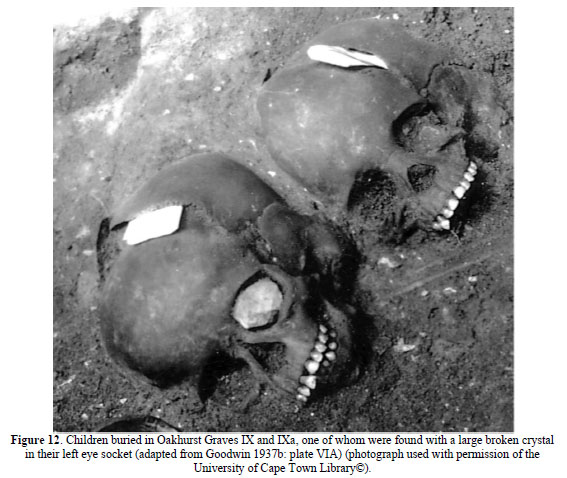
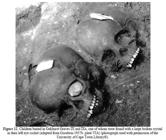
The second theme concerns the crystal quartz and quartz lithics. Goodwin (1937b) mentioned the large quartz crystal shaped into a 'round scraper' found in Grave VIa, and I found another piece of unworked quartz crystal with the quartz lithics associated with the grave. A large broken crystal was also found lodged in the left eye socket of a four-year-old child buried in Grave IX at Oakhurst (Goodwin 1937b; Drennan 1937b), dated to 4995±215 bp (PAA-2117) (Patrick 1989). According to Goodwin (1937b) the child was lying on its side and behind its back was a second child (Grave IXa) with its arm across the shoulder of the first. He further observed that although the crystal's presence may be coincidental, it's eye-sized 'diamond facet' was placed to accurately represent an eye (Fig. 12), and that no other crystals were found in the grave (Goodwin 1937b). Lewis-Williams and Pearce (2004) suggested that even if the placing was accidental, the crystal must have been brought into the cave deliberately, and that if its positioning in/on the child's eye was intentional it may be linked to a "spiritual way of seeing" (Lewis-Williams & Pearce 2004: 65). A possible interpretation of the quartz lithics and small hammerstone is that the woman from Grave VIa was the one shaping such stones for either mundane or spiritual 'seeing' purposes.
Lastly, I want to underscore the use of ochre and pigment-making paraphernalia in Grave VIa. Similar to other mid-Holocene burials, for example those at Klasies River Mouth Cave 5 and Welgeluk Shelter (Hall & Binneman 1987), ochre was an important aspect of the burial of the woman in Grave VIa. First, Goodwin (1937b) recorded that three of the gravestones covering the grave were ochre stained, but not painted. At Welgeluk a burial cairn also contained three stone slabs with red-ochre stains on their upper surfaces. Hall and Binneman (1987: 144) pointed out that: "While this ochre may have been deliberately applied it may also have resulted from contact with ochre nodules from the overlying deposits". FitzSimons (1926: 814-815), however, reported that most burials at Witcher's Cave were found with large, flat stones "smeared with red ochre" and that a few showed traces of crude paintings. At Tierkloof the larger one of two painted stones, capping a human grave, was painted with representational imagery (Pearce 2005). Ochre-stained or painted stones may thus form deliberate gravestones, even though this may not have been their exclusive purpose (Pearce 2005).
Less ambiguous is the fact that the bored stone on the woman's right thigh was surrounded by red ochre in the earth, and that red ochre powder was strewn between it and the upper grindstone on her chest (Fig. 5a). Her torso was therefore covered in red ochre powder, linking the two large spherical stones placed on her body. Of specific interest is the large stone with red paint behind her pelvis, found covering a mass of powdered ochre soil (Goodwin 1937b). This is similar to the burial of a young woman at Klasies River Mouth Cave 5, perhaps 16-18 years old, also found with a thick layer of red ochre below her pelvis as well as red ochre-stained ostrich eggshell beads around her pelvis, probably attached to two alikreukel (Turbo sarmaticus) pendants worn around the hips (Hall & Binneman 1987). In more recent times, San women from southern Africa often use/d red ochre body paint for puberty initiation rites associated with a girl's first menses, and upon her wedding, signalling ovulation and fertility (e.g., Marshall 1959, 1999; Shostak 1981; Watts 2002). Although we may never know exactly how the large stone with red paint and powdered ochre behind the pelvis of the woman in Grave VIa relates to the ethno-historical accounts, Watts (2024) argues that the metaphoric relationship between women's reproduction and ochre could date back to the Middle Stone Age.
Within the powdered-ochre soil behind her pelvis, Goodwin (1937b) recorded a cache of additional grave goods including not only the large circularly worked crystal, two Mossel Bay-type flakes, and a crushed ostrich eggshell water bottle, but also pigment-making paraphernalia. The latter is represented by the four white mussel shells with residues demonstrating that they were once filled with liquid pigment containing red ochre and black pigments, half a broken palette, and three ochre-stained river pebbles that could have been used as small grinding stones. A similar pigment-making set consisting of an abalone (Haliotis midae) shell, once filled with a liquefied ochre-rich mixture, an ochre-stained grindstone and a seal scapula palette was found at Blombos Cave dating to ~100 ka (Henshilwood et al. 2011), testifying to the antiquity of such paraphernalia. Solomon (2000) highlights ethno-historical records suggesting that from the mining of pigments to women grinding pigments during full moon, the process of painting had 'magical' significance linked to the world of sorcerers (mythological 'First Bushmen', 'First People' or spirits of dead San).
In addition to the shell pigment containers, grindstones and palettes buried with the woman in Oakhurst Grave VIa, there was also a hollow bone point with black residues on its tip (Fig. 10e) similar to hollow bone tips used as tattooing needles elsewhere (Deter-Wolf et al. 2021). Whereas black residues on bone points from South Africa may represent poison (e.g., Bradfield et al. 2020), I am not aware of diagonally cut hollow points being used as arrow tips, and Bradfield (2010) mostly interpreted them as awls. In the case of the hollow point from Grave VIa, future residue analysis may shed light on the use of the artefact. In San communities, tattooing was/is widely practiced in association with initiation, marriage and hunting rituals (see Mitchell & Plug 1997 for an overview). Special black medicine made from a burnt and powdered medicinal root is, for example, applied to incisions in the skin of a hunter so that "the arrow may fly straight at the springbok" (Hollmann 2004: 301), or is applied by a woman healer to cuts in a newly pair-bonded man and woman to "strengthen the uniting influence of the mixed bloods and [to] also help.. .ensure the couple's prosperity and happiness [or to] ward off want and disaster" (Silberbauer 1963: 20). I am unaware of other pigment-making tool sets, or potential pigment application tools, in the Stone Age record so directly associated with a single person - woman or man - as with the woman in Oakhurst Grave VIa. These artefacts suggest that some of her activities may have included the preparation of pigments during her lifetime, perhaps for the painting of stones or the colouring of other items such as beads, but potentially also for body decoration, menarcheal rites or other symbolic/ritual performances. In the case of the hollow point from Grave VIa, future residue analysis may shed light on the use of the artefact as a potential tattoo instrument.
6. Conclusion
The purpose of this report is to draw together all published bioarchaeological knowledge about the person buried in Oakhurst Grave VIa (Table 2), and for the first time to visually present as much of the grave goods as possible. Although Goodwin's controlled excavation procedures and recording methods were exemplary for its time, post-excavation control, and curatorial practices throughout the last century - namely, the splitting up of the grave goods, inter-institutional loans, and not keeping track of artefacts used for research or display purposes - have compromised the full presentation of the grave goods. It seems that Schrire removed some of the cultural material from the assemblage to display in the University of Cape Town Archaeology Department (Judith Sealy pers. comm. June 2025), and that the rest of the assemblage was ultimately transferred to the IZIKO South African Museum in Cape Town. Some artefacts associated with unknown Oakhurst burials may, however, also be curated with skeletal material at the University of Cape Town Department of Human Biology (Victoria Gibbon pers. comm. September 2024). The curator, however, declined to communicate whether any of the Grave VIa burial goods were present, so that I could not write an informed application to record material from that repository.
Wadley (1997: 126) saw Oakhurst Grave Via as unusual or even "bizarre to the Western eye", because of the fish bones inserted into the bored stone and the presence of the Middle Stone Age flakes. Lewis-Williams and Pearce (2004: 62) saw the bored stone with fish vertebrae as "the most complex of all grave goods". Pearce (2008) suggested a clear connection between Oakhurst Grave Via and the underwater spirit world, evoking the possibility of a shaman's or sorcerer's cache, and above i suggest links to pigment production, womanhood and fertility ritual. These hypotheses remain speculative, wherein archaeology, ethnography and rock art each capture only already biased fragments of the possible human experience (e.g., McGranaghan 2017). None the less, we may learn more about the woman buried ~5000 years ago at Oakhurst Shelter and the worldview of those who buried her by revisiting the complete set of grave goods in greater detail and from well-considered theoretical angles.
Acknowledgements
Sincere thanks go to Clive Kirkwood (University of Cape Town Libraries), Louisa Hutten (University of Cape Town Archaeology Department), Magdalena Lukas (!Khwa ttu Heritage Centre), Wilhelmina Seconna (IZIKO Museums, Archaeology Repository), and David Pearce (University of the Witwatersrand Archaeology Division) for access to photographic records and curated materials. Judith Sealy (University of Cape Town Archaeology Department), Victoria Gibbon (University of Cape Town Department of Human Biology), and Susan Pfeiffer (University of Toronto) kindly provided information about the skeletal remains and institutional knowledge. Lyn Wadley and an anonymous reviewer offered their time to provide valuable feedback resulting in an improved manuscript.
References
- Alekshin, V.A., Bartel, B., Dolitsky, A.B., et al. 1983. Burial customs as an archaeological source [and comments]. Current Anthropology, 24(2): 137-149.
- Barbieri, C., Vicente, M., Rocha, J., et al. 2013. Ancient substructure in early mtDNA lineages of southern Africa. The American Journal of Human Genetics, 92(2): 285-292.
- Beaumont, P.B. 1978. Border Cave. Masters Dissertation. Cape Town: University of Cape Town.
- Bleek, D.F. 1933. Beliefs and customs of the /Xam Bushmen part VI. Rain making. Bantu Studies, 7: 375-392.
- Bleek, D.F. 1935. Beliefs and customs of the /Xam Bushmen part VII. Sorcerors [sic]. Bantu Studies, 9: 1-47.
- Bleek, W.H.I. & Lloyd, L. 1911. Specimens of Bushman Folklore. London: G. Allen Limited.
- Bradfield, J.S. 2010. The evolution of bone points as hunting weapons in South Africa. Masters Dissertation. Johannesburg: University of the Witwatersrand.
- Bradfield, J., Lombard, M., Reynard, J. & Wurz, S. 2020. Further evidence for bow hunting and its implications more than 60 000 years ago: Results of a use-trace analysis of the bone point from Klasies River Main site, South Africa. Quaternary Science Reviews, 236: e106295.
- Broom, R. 1941. Bushmen, Koranas and Hottentots. Annals of the Transvaal Museum, 20: 217-249.
- Chan, E.K., Hardie, R.A., Petersen, D.C., et al. 2015. Revised timeline and distribution of the earliest diverged human maternal lineages in southern Africa. PloS One, 10(3): e0121223.
- Cooper, A., Garrow, D., Gibson, C., et al. 2022. Grave Goods: Objects and Death in Later Prehistoric Britain. London: Oxbow Books.
- D'Amato, M.E., Ristow, P., Livesey, M., et al. 2025. Persistence of ancestral KhoeSan mitochondrial patterns in contemporary South African Populations. Annals of Human Genetics, 89: 195-207.
- Deacon, J. 1984. The Later Stone Age of Southernmost Africa. BAR International Series, 213. Oxford: Archaeopress.
- d'Errico, F., Backwell, L., Villa, P., et al. 2012. Early evidence of San material culture represented by organic artifacts from Border Cave, South Africa. Proceedings of the National Academy of Sciences, 109(33): 13214-13219.
- Deter-Wolf, A., Peres, T.M. & Karacic, S. 2021. Ancient Native American bone tattooing tools and pigments: Evidence from central Tennessee. Journal of Archaeological Science Reports, 37: e103002.
- Drennan, M.R. 1937a. Archaeology of the Oakhurst Shelter, George: Part III. The cave-dwellers. Transactions of the Royal Society of South Africa, 25(3): 259-280.
- Drennan, M.R. 1937b. Archaeology of the Oakhurst Shelter, George: Part IV. The children of the cave-dwellers. Transactions of the Royal Society of South Africa, 25(3): 281-293.
- Esterhuyse, D.J. 1964. Fallisisme in die Voorgeskiedenis van Suidelike Afrika. Doctoral Thesis. Bloemfontein: University of the Free State.
- Fagan, B.M. 1960. The Glentyre shelter and Oakhurst re-examined. The South African Archaeological Bulletin, 15(59): 80-94.
- FitzSimons, F.W. 1926. Cliff dwellers of Zitzikama: Results of recent excavations. South African Journal of Science, 23(12): 813-817.
- FitzSimons, F.W. 1928. Results of recent Strandloper excavations at Knysna. South African Journal of Science, 25: 448-450.
- Goodwin, A.J.H. 1929. Report on the stone implements found with the Cape Flats skull. The Journal of the Royal Anthropological Institute of Great Britain and Ireland, 59: 429-438.
- Goodwin, A.J.H. 1937a. Archaeology of the Oakhurst Shelter, George: Part I. Course of the excavation. Transactions of the Royal Society of South Africa, 25(3): 229-245.
- Goodwin, A.J.H. 1937b. Archaeology of the Oakhurst Shelter, George: Part II. Disposition of the skeletal remains. Transactions of the Royal Society of South Africa, 25(3): 247-257.
- Goodwin, A.J.H. 1937c. Archaeology of the Oakhurst Shelter, George: Part VI. Stratified deposits and contents. Transactions of the Royal Society of South Africa, 25(3): 303-320.
- Goodwin, A.J.H. 1947. The bored stones of South Africa. Annals of the South African Museum, 37: 1-210.
- Green, D. 2020. Engendering the rock art archaeology of the north Eastern Cape: Ritual specialists, novices, and social conditioning. Masters Dissertation. Pretoria: University of South Africa.
- Gretzinger, J., Gibbon, V.E., Penske, S.E., et al. 2024. 9,000 years of genetic continuity in southernmost Africa demonstrated at Oakhurst rockshelter. Nature Ecology & Evolution, 8(11): 2121-2134.
- Guenther, M. 2020. Human-animal relationships in San and hunter-gatherer cosmology: Volume I. London: Palgrave Macmillan.
- Hall, S. & Binneman, J. 1987. Later Stone Age burial variability in the Cape: A social interpretation. The South African Archaeological Bulletin, 42: 140-152.
- Henshilwood, C.S., d'Errico, F., Van Niekerk, K.L., et al. 2011. A 100,000-year-old ochre-processing workshop at Blombos Cave, South Africa. Science, 334(6053): 219-222.
- Hoff, A. 1990. Die tradisionele wêreldbeskouing van die Khoekhoen. Doctoral Thesis. Pretoria: University of Pretoria.
- Hoff, A. 2017. Bored stones and a stone ring. The Digging Stick, 34(2): 9-13.
- Hollmann, J.C. 2004. Customs and Beliefs of the |Xam. Johannesburg: Wits University Press.
- Hollmann, J.C. 2022. Customs and Beliefs of the |Xam. Second Edition. Johannesburg: Wits University Press.
- Hollmann, J.C. & Lombard, M. 2024. Notes on George Stow's copy of the Mo'koma (dance of blood) depictions copied from Namahali Shelter, Maloti-Drakensberg. Southern African Humanities, 37(1): 33-56.
- Humphreys, A.J.B. 1970. The remains from Koffiefontein burials excavated by W. Fowler and preserved in the McGregor Museum, Kimberley. The South African Archaeological Bulletin, 25(99/100): 104-115.
- Inskeep, R.R. 1986. A preliminary survey of burial practices in the Later Stone Age, from the Orange River to the Cape coast. In: Singer, R. & Lundy, J.K. (eds) Variation, Culture and Evolution in African Populations: 221-239. Johannesburg: Witwatersrand University Press.
- Jakobsson, M., Bernhardsson, C., McKenna, J. et al. In press. Sapiens-specific evolution unveiled by ancient southern African genomes. Nature.
- Lazarides, M. 2015. Temporal, spatial and structural analysis of LSA burials in the Western Cape province, South Africa. Masters Dissertation. Johannesburg: University of the Witwatersrand.
- Lewis-Williams, J.D. & Pearce, D.G. 2004. San Spirituality: Roots, Expression, and Social Consequences. Cape Town: Double Storey.
- Loftus, E., Lombard, M. & Steyn, M. 2024. Dated Holocene human remains from South Africa: Recalibration and broad contextualization. Radiocarbon, 66(1): 118-133.
- Loftus, E. & Pfeiffer, S. 2023. Cultural disruption suggested by dates of late Holocene burials, southwestern Cape, South Africa. Current Anthropology, 64(4): 454-463.
- Lombard, M. 2002. Bored stones, lithic rings and the concept of holes in San shamanism. Anthropology Southern Africa, 25(1): 17-27.
- Lombard, M. 2024. Bored stones - star stones - ancestral stones: A sub-Saharan perspective of the ritualised relationship between humans and perforated stones. Archaeologies, 20(1): 239-276.
- Lombard, M., Bradfield, J., Caruana, M.V., et al. 2022. The Southern African Stone Age sequence updated (II). The South African Archaeological Bulletin, 77(217): 172-212.
- Lombard, M., Wadley, L., Deacon, J., et al. 2012. South African and Lesotho stone Age sequence updated (I). South African Archaeological Bulletin 67(195): 123-144.
- Maggs, T. 1977. Some recent radiocarbon dates from eastern and southern Africa. The Journal of African History, 18(2): 161-191.
- Marshall, L. 1959. Marriage among the !Kung Bushmen. Africa, 29: 335-365.
- Marshall, L. 1999. Nyae Nyae !Kung Beliefs and Rites. Cambridge (MA): Harvard University Press.
- McGranaghan, M. 2017. Ethnographic analogy in archaeology: Methodological insights from southern Africa. In: Spear, T. (ed.) Oxford Research Encyclopaedia of African History: 1-27. Oxford: Oxford University Press.
- Mitchell, P. J. & Plug, I. 1997. Ritual mutilation in southern Africa. In: Wadley, L. (ed.) Our Gendered Past: Archaeological Studies of Gender in Southern Africa: 135-166. Johannesburg: Witwatersrand University Press.
- Morris, A.G. 1992. A Master Catalogue: Holocene Human Skeletons from South Africa. Johannesburg: Witwatersrand University Press.
- Morris, A.G. 2022. Bones and Bodies: How South African Scientists Studied Race. New York: NYU Press.
- Ouzman, S. 1997. Between margin and centre: The archaeology of southern African bored stones. In: Wadley, L. (ed.) Our Gendered Past: Archaeological Studies of Gender in Southern Africa: 71-106. Johannesburg: Witwatersrand University Press.
- Parkington, J. & Paterson, A. 2021. Cloaks and torsos: Image recognition, ethnography and male initiation events in the rock art of the Western Cape. Azania: Archaeological Research in Africa, 56(4): 463 -481.
- Patrick, M.K. 1989. An archaeological, anthropological study of the human skeletal remains from the Oakhurst Rockshelter, George, Cape Province, Southern Africa. Masters Dissertation. Cape Town: University of Cape Town.
- Pearce, D.G. 2005. Iconography and interpretation of the Tierkloof painted stone. South African Archaeological Society Goodwin Series, 9: 45-53.
- Pearce, D.G. 2008. Later Stone Age burial practice in the Eastern Cape Province, South Africa. Doctoral Dissertation. Johannesburg: University of the Witwatersrand.
- Pfeiffer, S. 2021. Osteobiographies: The Discovery, Interpretation and Repatriation of Human Remains. Cambridge (MA): Academic Press.
- Rito, T., Richards, M.B., Fernandes, V., et al. 2013. The first modern human dispersals across Africa. PloS One, 8(11): e80031.
- Rito, T., Vieira, D., Silva, M., et al. 2019 A dispersal of Homo sapiens from southern to eastern Africa immediately preceded the out-of-Africa migration. Scientific Reports, 9(1): e4728.
- Rudner, J. 1971. Ostrich egg-shell flasks and soapstone objects from the Gordonia District, northwestern Cape. The South African Archaeological Bulletin, 26(103/104): 139-142.
- Rudner, I. & Rudner, J. 1955. Geomorphology, archaeology and anthropology from Bok Baai, Darling District, Cape Province. The South African Archaeological Bulletin, 10(39): 85-93.
- Sampson, C.G. 1974. The Stone Age Archaeology of Southern Africa. New York: Academic Press.
- Schlebusch, C.M., Lombard, M. & Soodyall, H. 2013. MtDNA control region variation affirms diversity and deep sub-structure in populations from southern Africa. BMC Evolutionary Biology, 13: 1-21.
- Schlebusch, C.M., Malmström, H., Günther, T., et al. 2017. Southern African ancient genomes estimate modern human divergence to 350,000 to 260,000 years ago. Science, 358(6363): 652-655.
- Schlebusch, C.M., Sjödin, P., Breton, G., et al. 2020. Khoe-San genomes reveal unique variation and confirm the deepest population divergence in Homo sapiens. Molecular Biology and Evolution, 37(10): 2944-2954.
- Schrire, C. 1962. Oakhurst: A re-examination and vindication. The South African Archaeological Bulletin, 17(67): 181-195.
- Sealy, J. 2010. Isotopic evidence for the antiquity of cattle-based pastoralism in southernmost Africa. Journal of African Archaeology, 8(1): 65-81.
- Sealy, J.C., Patrick, M.K., Morris, A.G., et al. 1992. Diet and dental caries among Later Stone Age inhabitants of the Cape Province, South Africa. American Journal of Physical Anthropology, 88(2): 123-134.
- Sealy, J. & Pfeiffer, S. 2000. Diet, body size, and landscape use among Holocene people in the Southern Cape, South Africa. Current Anthropology, 41(4): 642-655.
- Shostak, M. 1981. Nisa: The Life and Words of a !Kung Woman. London: Routledge.
- Silberbauer, G.B. 1963. Marriage and the girl's puberty ceremony of the G|wi Bushmen. Africa, 33: 12-24.
- Solomon, A. 2000. Pigment and paint analyses and their potential in San rock art research. Pictogram, 11(2): 12-15.
- Steyn, M., Meyer, A. & Lombard, M. 2024. Revisiting the people of Whitcher's Cave, Eastern Cape, South Africa: An osteobiographic analysis. The South African Archaeological Bulletin, 79(221): 63-74.
- Steyn, M., Meyer, A., Peyroteo-Stjerna, R., et al. 2023. African farmers, not Stone Age foragers: Reassessment of human remains from the Mumbwa Caves, Zambia. African Archaeological Review, 40(1): 53-72.
- Steyn, M., & Nienaber, W.C. 2000. Iron Age human skeletal remains from the Limpopo Valley and Soutpansberg area. African Archaeological Society Goodwin Series, 8: 112-116.
- Stock, J. & Pfeiffer, S. 2001. Linking structural variability in long bone diaphyses to habitual behaviors: Foragers from the southern African Later Stone Age and the Andaman Islands. American Journal of Physical Anthropology, 115(4): 337-348.
- Stow, G.W. 1905. The Native Races of South Africa. London: Swan Sonnenschein & Co.
- Stow, G.W. & Bleek, D.F. 1930. Rock-paintings in South Africa from Parts of the Eastern Province and the
- Orange Free State Copied by George William Stow with an Introduction and Descriptive Notes by Dorothea Bleek. London: Methuen & Co. Ltd.
-
University of Cape Town. n.d. The Digital Bleek and Lloyd. Available from: https://digitalbleeklloyd.uct.ac.za (Accessed: 2024).
» https://digitalbleeklloyd.uct.ac.za - Wadley, L. 1987. Later Stone Age Hunters and Gatherers of the Southern Transvaal: Social and Ecological Interpretation. Cambridge: BAR International Series 380.
- Wadley, L. 1997. Where have all the dead men gone? Stone Age burial practices in South Africa. In: Wadley, L. (ed.) Our Gendered Past: Archaeological Studies of Gender in Southern Africa: 107-133. Johannesburg: Witwatersrand University Press.
- Watts, I. 2002. Ochre in the Middle Stone Age of southern Africa: Ritualised display or hide preservative? TheSouth African Archaeological Bulletin, 57(175): 1-14.
- Watts, I. 2024. Blood symbolism at the root of symbolic culture? African hunter-gatherer perspectives. Journal of Anthropological Archaeology, 76: e101627.
- Wells, L.H. 1951. South African stone implements from the 'Challenger' Expedition in the Edinburgh University Anatomical Museum. The South African Archaeological Bulletin, 6(23): 91-92.
Revised October 2025
Published March 2026