The points from Primrose Ridge: A possible Still Bay workshop on the Gauteng Grassland of South Africa
With this contribution we re-introduce a Middle Stone Age point assemblage from the Gauteng Grassland. Whilst the open-air site can no longer be excavated or dated, an updated interpretation of the Primrose Ridge points has the potential to shed new light on the Middle Stone Age occupation of the Witwatersrand. We apply a fine-grained approach, developed for compiling intra- and inter-assemblage comparative data, to assess how the Primrose Ridge points compare to some other Middle Stone Age point assemblages. We demonstrate that most of the points from Primrose Ridge conform to what can be expected from Still Bay point assemblages in terms of invasive bifacial retouch, lenticular cross sections and semi-circular or pointed butts as originally defined. In situ anvil boulders surrounded by fresh quartz chips recorded in the 1940s, and knapping mistakes provide reasons to think of Primrose Ridge as a workshop or production site for Still Bay-like quartz points. If our interpretation is correct, Primrose Ridge could have been used during the Still Bay phase - in terms of relative chronology -representing the first tentative record of this technocomplex on the Grassland Biome of interior South Africa.
point production; Pietersburg Industry; Levallois; bifacial retouch
RESEARCH REPORT (PEER-REVIEWED)
The points from Primrose Ridge: A possible Still Bay workshop on the Gauteng Grassland of South Africa
Marlize LombardI, ; Matthew V. CaruanaI; Anders HögbergI, II
IPalaeo-Research Institute, University of Johannesburg, P.O. Box 524, Auckland Park 2006, Johannesburg, South Africa
IISchool of Cultural Studies, Archaeology, Linnaeus University, SE-391 82 Kalmar, Sweden
With this contribution we re-introduce a Middle Stone Age point assemblage from the Gauteng Grassland. Whilst the open-air site can no longer be excavated or dated, an updated interpretation of the Primrose Ridge points has the potential to shed new light on the Middle Stone Age occupation of the Witwatersrand. We apply a fine-grained approach, developed for compiling intra- and inter-assemblage comparative data, to assess how the Primrose Ridge points compare to some other Middle Stone Age point assemblages. We demonstrate that most of the points from Primrose Ridge conform to what can be expected from Still Bay point assemblages in terms of invasive bifacial retouch, lenticular cross sections and semi-circular or pointed butts as originally defined. In situ anvil boulders surrounded by fresh quartz chips recorded in the 1940s, and knapping mistakes provide reasons to think of Primrose Ridge as a workshop or production site for Still Bay-like quartz points. If our interpretation is correct, Primrose Ridge could have been used during the Still Bay phase - in terms of relative chronology -representing the first tentative record of this technocomplex on the Grassland Biome of interior South Africa.
Keywords: point production, Pietersburg Industry, Levallois, bifacial retouch
1. Reintroducing the Primrose Ridge assemblage
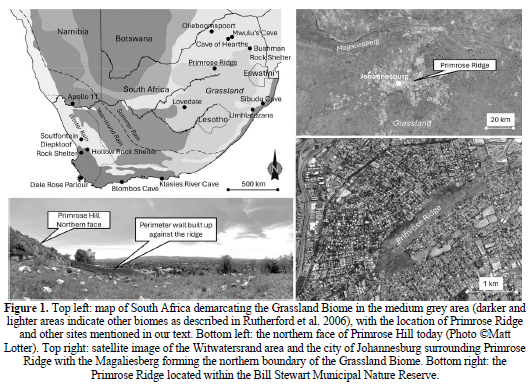
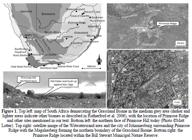
Harcus (1945) reported on A Middle Stone Age Industry from Primrose Ridge District, Germiston, Transvaal, which he excavated during 1943-1944, and selected specimens that he thought were worthy of display from the thousands found during the dig. On 14 December 2023, Matt Lotter (then of the Palaeo-Research Institute, University of Johannesburg), visited the Bill Stewart Municipal Nature Reserve in the Gauteng Province adjacent to Plot 170, where the Primrose Ridge deposit was excavated, finding that the site was destroyed by urban development (Fig. 1). Harcus' report and curated assemblage are the only records of the people who once used the site located on an outcrop in the Grassland Biome of South Africa. We suggest that the assemblage is worth revisiting and rethinking with our current understanding of the Middle Stone Age sequence in southern Africa (Lombard et al. 2022).
Harcus' attention was drawn to the archaeology of Primrose Ridge when he found yellowish brown quartzite Stone Age artefacts in the flat plain (the floodplain of the Jukskei River) north of and below the ridge (Harcus 1943). A cleaver and two handaxes all exceeding ~15 cm in length seemed to represent the Acheulean (see Lotter et al. 2022). Smaller (<8 cm in length), completely retouched pointed artefacts amongst the tools (Harcus 1943), however, alluded to the Middle Stone Age. Subsequently, house-foundation trenches erroneously dug on Plot 170 (Primrose Hill Township) inadvertently exposed a ~45 cm deep, stratified anthropogenic deposit on underlying red and yellow shale located on the sunny north-facing, wind-protected slope of Primrose Ridge, just below a six-foot high rocky outcrop (Harcus 1945). From the foundation trench Harcus collected a white quartz ovoid bifacial point that he interpreted as being pressure-flaked and in excellent condition except for its missing tip, and chips suggesting a factory site. He went on to excavate the site of ~15x5.5 m in ~12 cm spits to bedrock -selecting artefacts from the sieving station as the digging progressed.
Harcus' (1945) interpretation of Primrose Ridge being a factory site was confirmed when the excavation revealed boulders with scars that seem to have served as in situ anvils surrounded by fresh chips (i.e., flakes and debitage). He described the excavated assemblage as being predominated by carinated points shaped like up-turned boats (which he dubbed Navis points - navis being Latin for ship), averaging ~90 mm in length, 28 mm wide and 25 mm thick. Another type was represented by delicately pressure trimmed, bifacial pointed ovoid "blades or spearheads" (Harcus 1945: 460). These measured about 95x44x13 mm, and sometimes were produced on dark quartzites. He observed no dark quartzite chips in the sieve, suggesting that these artefacts were not knapped on site, and reported only six so-called typical Pietersburg points, and two "equilateral triangular points with transversely concave flake undersides, carefully trimmed on the upper or convex face" (Harcus 1945: 460). He concluded that the Primrose Ridge assemblage does not represent the Pietersburg Industry, but that it represents a new type-centre, with novel ideals and a more extensive use of materials such as chert, climaxing in the use of white vein quartz - the "Primrose Ridge Culture" (Harcus 1945: 462).
Mason (1957) included the Primrose Ridge assemblage in his statistical analysis of the Transvaal Middle Stone Age, based on the six-bed Middle Stone Age sequence at the Cave of Hearths. He (Mason 1959: 120) reported 1570 "primary class specimens with statistical significance", including what he termed quadrilateral and rectangular flakes, backed end-struck flakes, hemi-lemniscates (bifacial points), opposed arcs (double pointed tools), ellipticals, ogives (probably unifacial points), and outils écaillés. In general, he found the Primrose Ridge assemblage to be smaller compared to what he thought of as the Pietersburg Standard Series range, with a less extensive use of the Levallois technique, a more extensive use of plain platforms, a tendency to remove the platform altogether and more frequent bifacial production strategies (Mason 1957). Like Harcus, Mason therefore excluded the Primrose Ridge assemblage from the Pietersburg, instead lumping it with that of the neighbouring Linksfield Ridge into a Transvaal variant of the later Sangoan. The Sangoan is used commonly, but vaguely, further north in sub-Saharan Africa for industries that are later than the final Acheulean and that contain rather massive picks in addition to other large tool types. According to Taylor (2022), an age of ~300-250 ka may be an underestimation, but the paucity of well-stratified Sangoan assemblages prohibits the understanding of its technological characteristics and variability.
In southern Africa, Davies (1952) initially thought that the so-called Tugela Industry of KwaZulu-Natal (see Cramb 1937) had an affinity with the Sangoan of central Africa. He later self-corrected -concluding that the term was misapplied to industries that were too widely separated in age and distribution and too poorly defined to allow for its use in South Africa (Davies 1976). However, he described how at several sites the Tugela Industry or Natal Sangoan was overlain stratigraphically by Middle Stone Age layers, some of which contained Still Bay points, that have now been described from stratified contexts at Sibudu Cave (Wadley 2007) and Umhlatuzana Rock Shelter (Högberg & Lombard 2016a, b), generally dating to >70 ka (Jacobs et al. 2008; Lombard et al. 2010). The Primrose Ridge assemblage lacks the large picks and other large tools associated with the Sangoan but does have a relatively large non-Levallois retouched point assemblage.
Clark (1959) likened what Harcus (1945) described as tea cosy fabricators and high-backed boat-shaped tools worked on the dorsal side only, to the proto-Still Bay or Lupemban Industry of the Upper Zambezi Savannah and Grassland regions. The type-fossil of the Lupemban is the elongated bifacial lanceolate point that may exceed 30 cm in length (Taylor 2022); core-axes, points of different shapes and dimensions, blades, and other small tools are all also attributed to the Lupemban (Taylor 2021). Similar to the Sangoan, the Lupemban remains poorly dated, and where dates exist, they are disputed (Herries 2011) and range from >200 ka (Barham 2012), to as young as MIS 3 (57-29 ka) at some sites (Basell 2013). Thus, the Lupemban remains poorly defined and understood (Taylor 2021), and the Primrose Ridge assemblage lacks its elongated bifacial lanceolate type-fossil and core axes.
The Pietersburg, defined as containing bifacial points shaped like "wide almonds" with "perfectly round" butts measuring between ~50 and 64 mm and thought to represent a "step towards" making Still Bay points (Goodwin and van Riet Lowe 1929: 110, 119), too remains poorly defined although generally dated from stratified Middle Stone Age contexts (see de la Peña et al. 2019 for full historical discussion of the Pietersburg). Mason speculatively placed the Pietersburg of the Transvaal earlier than the Mossel Bay and Still Bay (at the time thought to be only present in the Cape) in his Middle Stone Age sequence, concluding that: "most important is the need for additional dynamic, evolutionary evidence that can come only from the excavation of more long-sequence sites such as the Cave of Hearths" (Mason 1957: 136). Such long-sequence Middle Stone Age sites have been excavated, and some contexts dated. For example, age estimates for so-called Pietersburg assemblages included in Mason's (1959) analysis are that of Olieboomspoort now dated to ~150±14 ka (Val et al. 2021) and Mwulu's Cave dated to ~90 ka (Feathers et al. 2020). At Olieboomspoort Val et al. (2021) found that it does not represent a clear chrono-cultural unit, and for Mwulu's Cave, Feathers et al. (2020: 15) do not assume that Pietersburg is a proper label for its stone tools, seeing it as more of a "catch-all category" rather than a useful archaeological entity.
Whilst their point descriptions remain unreported, at Border Cave in KwaZulu-Natal, the Pietersburg phase has been dated to MIS 5 (130-80 ka) (Grün & Beaumont 2001; Grün et al. 2003), and Porraz et al. (2018) dated it at Bushman Rock Shelter, Mpumalanga, to 73±6 ka and 75±6 ka on quartz and to 91±10 ka and 97±10 ka on feldspar. The numerical age estimates suggest a probable duration of ~132-73 ka with a median age of ~91 ka. Age estimates for the Mossel Bay at Blombos Cave, Hollow Rock Shelter, and Klasies River in the Western Cape have a median value of 88.2 ka with the most probable duration of the technocomplex currently seen as 98.4-77.4 ka (Lombard et al. 2022). Based on 117 dating data points, from sites such as Klasies River, Blombos Cave, Sibudu Cave, Umhlatuzana Rock Shelter, Diepkloof Rock Shelter and Apollo 11, the probable duration of the Still Bay technocomplex lies at 88.8-67.4 ka with a median age of 75.2 ka (Lombard et al. 2022). These dating outcomes would place the Pietersburg generally earlier than the Still Bay technocomplex, should it become clearly defined as a southern African technocomplex.
For the invasively retouched Navis points from Primrose Ridge, Harcus (1945: 461) reported pointed, semi-circular as well as straight butts, expressing the sentiment that: "it will be interesting to know if there are any specimens of this type, the Navis, in other collections". He further acknowledges that he has not done justice to the smaller (~50x19x10 mm), very fine and delicate bifacial points in white quartz with rounded butts, "bespeaking highly skilled technique in this difficult material" (Harcus 1945: 461-462). Working on the Grassland interior, it perhaps did not cross his mind to look at Goodwin and van Riet Lowe's (1929) definition of the Still Bay type fossil as a thin (<10 mm), invasively retouched, bifacial, foliate or lanceolate point with semi-circular or wide-angled pointed butt, and lenticular cross-section.
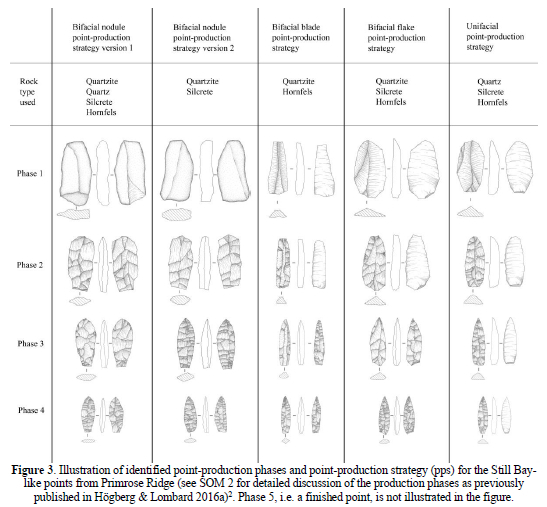
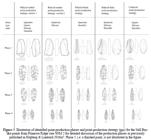
Our work on the complete Still Bay point assemblages from Hollow Rock Shelter, Umhlatuzana Rock Shelter, Apollo 11 and Sibudu Cave, as well as some points from Blombos Cave, revealed at least five point-production strategies with four phases each, resulting in a range of cross-sections (e.g., lenticular, rhombic, wedge-shaped, semi-circular and triangular), and pointed, semi-circular as well as straight butts (Högberg & Lombard 2016a; Lombard & Högberg 2018), configurations of which may vary through time and across space throughout the Still Bay phase (Lombard et al. 2019). Although at the KwaZulu-Natal sites of Sibudu and Umhlatuzana bifacial point production occurs intermittently throughout their sequences (e.g., Kaplan 1990; Wadley 2012; de la Peña et al. 2013; Mohapi 2013), points from non-Still Bay contexts mostly lack the typical semi-circular or pointed butts and slender shape, so that Still Bay point assemblages remain relatively distinct. At first glance, Harcus' descriptions and illustrations are reminiscent of Still Bay point assemblages (see plates Y and Z in Harcus 1945: 463-464). This observation provided the impetus for the study we present below where we apply our approach for comparative analysis of retouched point-production strategies and morphometric attributes to assess to which extent the Primrose Ridge point assemblage is similar or different from other Still Bay point assemblages or point assemblages pre- or post-dating the Still Bay phase, and whether it could represent a point-manufacturing workshop on the Gauteng Grassland.
2. Sample and approach
The Primrose Ridge assemblage is curated by the Archaeology Division of the University of the Witwatersrand without field notes, and artefacts are in boxes without any stratigraphic context. We were thus unable to reconstruct a possible artefact sequence from Harcus' layered excavation. Our purpose with this study is to assess whether the Primrose Ridge assemblage contains a point assemblage consistent with what can be expected for the Still Bay technocomplex, and if so, how it compares to other Still Bay point assemblages. To achieve this, we follow the approach outlined in Högberg and Lombard (2016a), and Lombard and Högberg (2018) wherein qualitative data for each point are presented in supporting online material (SOM) 1, with analyses conducted in a replicable quantitative manner conducive of directly comparing large samples - not possible with more traditional and subjectively descriptive chaîne opératoire approaches. We found 112 points and point fragments from Primrose Ridge in different phases of production, that could be analysed in the same manner we used for Still Bay point production, which we therefore refer to below as Still Bay-like. We found six more points (5% of the point assemblage) that could not be analysed in the same way, because they were made with a Levallois knapping strategy. We provide their description following the method published for Levallois point production described in Högberg and Lombard (2022)1.
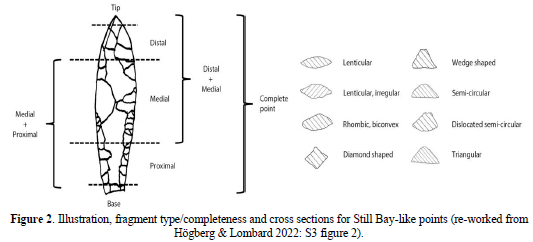
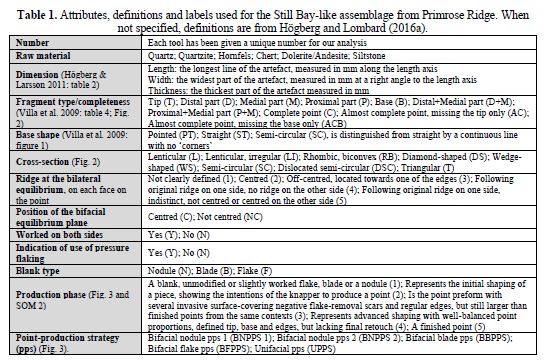
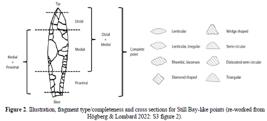
We gave each point a unique study number, and recorded its basic morphometric attributes (maximum length, width and thickness). Alongside details such as raw material and dimensions, we documented qualitatively fragment type/completeness, base shape, cross-section, the alignment of the dorsal ridge at bilateral equilibrium, the position of the bilateral equilibrium plane, whether the point was worked on one or both sides, indication of pressure flaking, and the type of blank used for producing the point (Table 1; Fig. 2; SOM 1). Based on these criteria, we interpret the production phase and point-production strategy for each Still Bay-like piece according to Högberg and Lombard (2016a; Fig. 3; and see Table 1 in SOM 2 for previously published phase definitions). Note that, because both whole and fragmented points are included in our study, the total number of points for the analysis of each attribute varies.
To assess similarities or differences with known Still Bay assemblages, we compare the results of the Primrose Ridge point assemblage with those of other sites for which we have appropriate comparative data. At Sibudu we found that the points of the pre-Still Bay phase dated to >77.3±2.7 ka were relatively distinct from the Still Bay phases dated to ~73-65 ka (Lombard et al. 2019), we therefore present these two phases separately in our comparative trait analysis, because they may reveal temporal trends in point-production strategies and morphologies. We also compare the Primrose Ridge points with those excavated at Hollow Rock Shelter dated to ~85-68 ka (Högberg & Lombard 2022), Umhlatuzana dated to >71±5 ka (Lombard et al. 2010), and Apollo 11 dated to 71±3 ka (Vogelsang et al. 2010). We do not have point-production or cross-section and base-shape data for the following point assemblages: Blombos Cave Still Bay dated to ~78-68 ka (Jacobs et al. 2020), Diepkloof Rock Shelter Still Bay ~88-65 ka (Jacobs & Roberts 2017), Bushman Rock Shelter Pietersburg dated to ~ 97-73 ka (Porraz et al. 2018), Olieboomspoort Pietersburg dated to ~164-134 ka (Val et al. 2021), as well as White Painting Shelter and ≠Gi Pan in Botswana dated, respectively, to >66 ka (Robbins et al. 2000) and ~77 ka (Brooks et al. 1990), but we do have morphometric data which we include in our analysis. We also include the undated Still Bay assemblages from Clanwilliam Dam, Dale Rose Parlour and Soutfontein, as well as the Pietersburg points from Cave of Hearths in our morphometric analysis. Our purpose for including all these Middle Stone Age point assemblages is to assess as best as possible where the Primrose Ridge point assemblage may fit in the sequence.
3. Results
Description of the Primrose Ridge point assemblage
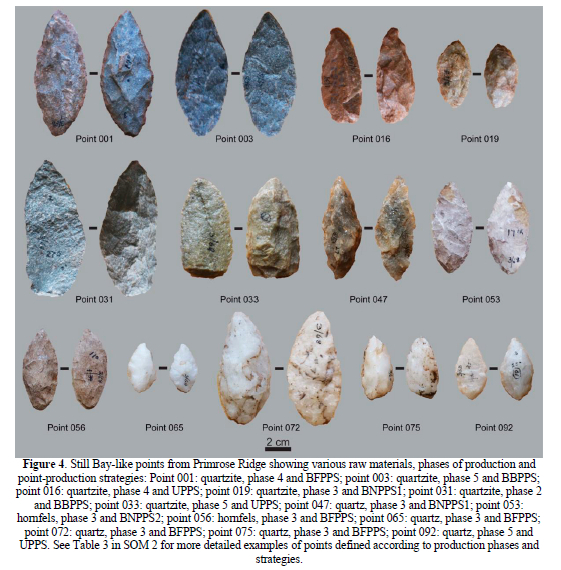
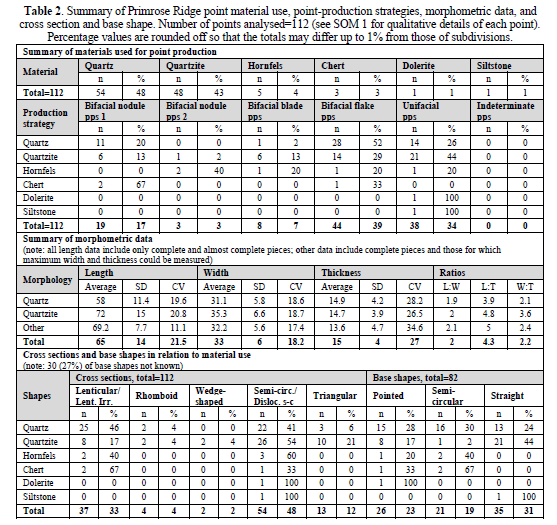
We identified six raw materials used for Still Bay-like point production at Primrose Ridge with most points made on quartz (n=54, 48%), followed by quartzite (n=48, 43%), five (4%) on hornfels, three (3%) on chert and one each (1%) on dolerite and siltstone (Table 2; Fig. 4). Most of the quartz points were made with the bifacial flake point-production strategy (n=28, 52%), followed by the unifacial point-production strategy (n=14, 26%), the bifacial nodule point-production 1 strategy (n=11, 20%), and one (2%) quartz point was made using the bifacial blade point-production strategy. For making the quartzite points, the Primrose Ridge knappers preferred the unifacial point-production strategy (n=21; 44%), followed by the bifacial flake point-production strategy (n=14, 29%), and the bifacial nodule 1 and bifacial blade point-production strategies were each used for making six (13%) points, whereas only one (2%) was made with the bifacial nodule point-production strategy 2. The numbers of points made on the other raw materials are too small for interpreting preferred point-production strategies, but their data are presented in Table 2. Cumulatively, it would seem that most of the Primrose Ridge points were made with the bifacial flake (n=44, 39%), and unifacial (n=38, 34%) point-production strategies. The bifacial nodule 1 (n=19, 17%), bifacial blade (n=8, 7%), and bifacial nodule 2 (n=3, 3%) point-production strategies are all less represented.
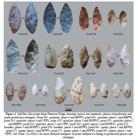
Most of the Still Bay-like quartz points from Primrose Ridge have lenticular cross sections (n=25, 46%), followed by points with semi-circular cross sections (n=22, 41%) (Table 2). Three quartz points (6%) have triangular, and two (4%) have rhomboid cross sections. The base shapes are relatively equally distributed across the quartz points with 16 (30%) having semi-circular, 15 (28%) having pointed and 13 (24%) having straight bases. By contrast, the predominant cross section amongst the quartzite points is semi-circular (n=26, 54%), followed by triangular (n=10, 21%), lenticular (n=8, 17%), with two points each (4%) having either rhomboid or wedge-shaped cross sections. Also different from their quartz counterparts, the quartzite points from Primrose Ridge mostly have straight bases (n=21, 44%), eight (17%) have pointed bases, and only a single quartzite point has a semi-circular base (Table 2). Again, the number of points for the other materials is too small for comparative purposes, but as a whole, most of the points (n=54, 48%) have semi-circular cross sections, followed by lenticular (n=37, 33%) and triangular (n=13, 12%) ones, with only a few having rhomboid or wedge-shaped cross sections. The predominant base shape is straight (n=35, 31%), followed by pointed (n=26, 23%), and semi-circular (n=21, 19%) (Table 2). Morphometrically, there are no significant differences between the quartz and quartzite points from Primrose Ridge (p=0.4525; SOM 3), so that for the inter-site comparisons we do not separate between the two main raw material groups from the site.
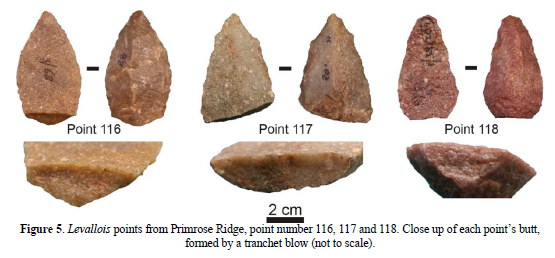
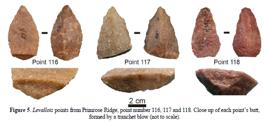
Six additional points were produced with a Levallois knapping strategy (SOM 1). These points were all made on quartzite, and three of them have plain butts formed by having the original flake-blank platform removed with a tranchet blow, resulting in a flat un-modified surface (Fig. 5). Two have faceted butts, and one was retouched so that the platform is no longer distinguishable. All six points were worked on their dorsal sides only, and four have extensive dorsal surface-covering flaking resulting in the same shape as a classic Levallois point. The remaining two points were retouched on both their left and right lateral sides of their tips covering the whole point (SOM 1).
The points from Primrose Ridge compared to Still Bay and other relevant assemblages
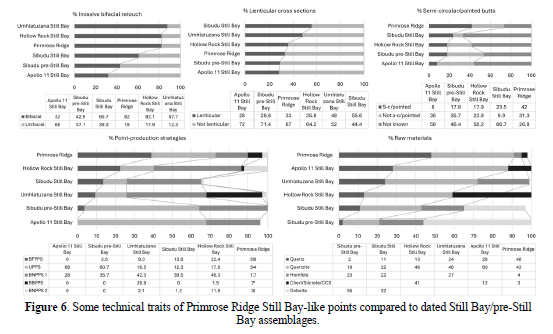
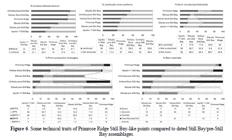
First, we present an inter-assemblage comparison of criteria originally used to define the Still Bay technocomplex, i.e., bifacial retouch, semi-circular or pointed butts, and lenticular cross-sections (e.g., Goodwin & van Riet Lowe 1929). In terms of invasive bifacial retouch, the frequency of the Primrose Ridge Still Bay-like points (82%) is most similar to that of other Still Bay assemblages with relatively high proportions of points with such retouch, e.g., the Hollow Rock (82.1%) and Umhlatuzana Still Bay assemblages (87.7%) (Fig. 6). Proportions of points with lenticular cross sections are relatively high for the Still Bay point assemblages of Sibudu (55.6%) and Umhlatuzana (48%), but the Still Bay-like points from Primrose Ridge with 33% are most similar to those from the Hollow Rock Still Bay (35.8%) and the Sibudu pre-Still Bay (28.6%) assemblages (Fig. 6). The Umhlatuzana Still Bay point assemblage has the highest frequency (61%) of points with semi-circular and pointed butts, followed by the Primrose Ridge Still Bay-like points (42%) and the Sibudu Still Bay assemblage (23.5%) (Fig. 6). Similar to the Still Bay knappers from Hollow Rock and Umhlatuzana, those at Primrose Ridge used the full suite of point-production strategies thus far recorded for Still Bay assemblages, and raw material use for point knapping varies between the sites (Fig. 6).
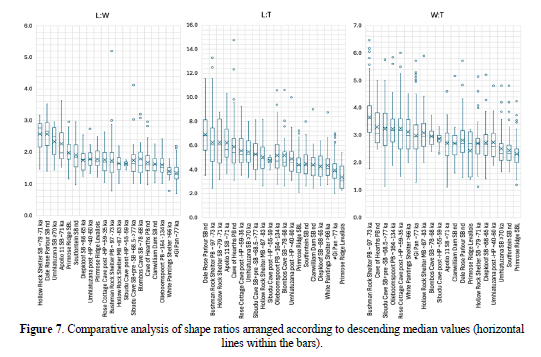
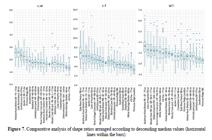
Box and whisker plots demonstrate that in terms of shape ratios, the Primrose Ridge Still Bay-like assemblage clusters most closely with some other Still Bay assemblages, whilst the six Levallois points cluster with post-Howiesons Poort points in terms of their length:width (L:W) ratios, the points from ≠Gi Pan and White Paintings in Botswana in terms of length:thickness (L:T), and some Still Bay assemblages in terms of width:thickness (W :T) (Fig. 7). Statistically (Mann-Whitney U-tests; SOM 3), there are no significant (p<0.05) differences between: a) The L:W ratios of the Primrose Ridge Still Bay-like points and those from the Apollo 11 (p=0.3502) and Soutfontein (p=0.1158) Still Bay assemblages; b) the L:T ratios of the Primrose Ridge Still Bay-like points and those from the Soutfontein (p=0.9473), Clanwilliam Dam (p=0.6881), and Diepkloof (p=0.5918) Still Bay assemblages; and c) the W:T ratios of the Primrose Ridge Still Bay-like points and those from the Umhlatuzana (p=0.36) and Soutfontein (p=0.3348) Still Bay assemblages (Fig. 7). All other shape-ratio comparisons, apart from the Primrose Ridge Levallois points, show significant or highly significant (p<0.001) differences (SOM 3).
4. Concluding discussion
Less than two decades ago, it was still thought that the Still Bay technocomplex was restricted to the Cape coastal regions of South Africa, and the so-called Pietersburg to the Savanna-Grassland Biomes north of the Vaal River. Both Harcus (1945) and Mason (1957) separated the Primrose Ridge point assemblage from what they perceived to be the Pietersburg Industry. Harcus, however thought that six pieces - probably those we identified as made with the Levallois technique - may represent the Pietersburg. The Pietersburg on the Gauteng Grassland, as well as at Cave of Hearths further northwest on the Savanna is Levallois based, but the six Primrose Ridge Levallois points do not group morphometrically with those from the purported Cave of Hearths and Olieboomspoort Pietersburg point assemblages. Instead, they group either with the younger post-Howiesons Poort assemblages dating to <60 ka (also Levallois based, e.g., Dusseldorp 2014; Timbrell et al. 2022), or with the non-Still Bay assemblages from Botswana with age estimates contemporaneous with the Still Bay. At Hollow Rock Shelter, we found a Mossel Bay Levallois point-making tradition that may have started there at ~87 ka, and after ~83 ka the knappers started to also make Still Bay points even though some Levallois-type points remained in use throughout the site's Still Bay sequence until ~71 ka (Högberg & Lombard 2022). Thus, the six Levallois points from Primrose Ridge may be seen as: a) contemporaneous with the Still Bay-like points from the site; b) part of an earlier Mossel Bay-like technocomplex; or c) a younger intrusion into the Still Bay-like assemblage. Because they are so few and because the site itself cannot be re-excavated or dated, we may never know which is the more likely.
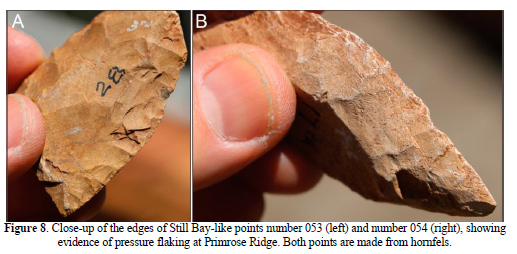
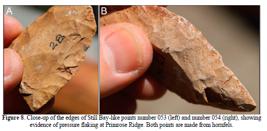
We demonstrated, however, that the Still Bay-like points from Primrose Ridge conform to what can be expected from Still Bay point assemblages in terms of invasive bifacial retouch, lenticular cross sections and semi-circular or pointed butts as originally defined by Goodwin and van Riet Lowe (1929), and subsequently recorded for points from dated Still Bay contexts (e.g., Wadley 2007; Porraz et al. 2008; Villa et al. 2009; Lombard et al. 2010; Högberg & Larsson 2011; Lombard & Högberg 2018). To our knowledge no other technocomplexes in southern Africa display this trait combination, even when they contain bifacially retouched points such as the final Middle Stone Age hollow-based points from Sibudu and Umhlatuzana in KwaZulu-Natal (Wadley 2005; Mohapi 2013). Pressure flaking has been confirmed for Still Bay assemblages from Blombos and Umhlatuzana (Mourre et al. 2010; Högberg & Lombard 2016b), but contrary to Harcus' (1945) interpretation of quartz pressure flaking at Primrose Ridge, we only found evidence of this knapping technique on two hornfels points (Fig. 8). Thus far, pressure flaking has not been consistently reported for any southern African Middle Stone Age technocomplexes other than the Still Bay. However, the bifacial and unifacial points from Sibebe in eSwatini dated to ~43 ka (Bader et al. 2022), require closer scrutiny with comparative work.
In terms of their shape ratios, the Primrose Ridge Still Bay-like points are almost indistinguishable from the undated points reported from Soutfontein, and show similarities with those from the Still Bay contexts of Apollo 11 (~71 ka), Diepkloof (~88-65 ka), Umhlatuzana (>70 ka) and Clanwilliam Dam (undated). The Soutfontein points were recorded from an open-air site in the winter rainfall zone of the Western Cape (Mackay et al. 2010). Similar to the Primrose Ridge Still Bay-like points, they were mostly (66%) produced on local white vein quartz, show invasive bifacial retouch with a few unifacial points, and both semi-circular and pointed butts (Mackay et al. 2010, 2018). Hallinan and Parkington (2017) place the Soutfontein and Clanwilliam Dam assemblages within the Still Bay of the Olifants River Valley landscape, and Dewar and Stewart (2017: 17) see the Soutfontein assemblage as containing "tool forms diagnostic of the Still Bay". The Soutfontein quartz pieces show breakage patterns consistent with knapping errors, suggesting that the points were produced onsite (Mackay et al. 2010). Because of the collection and curation history of the Primrose Ridge assemblage, we were unable to conduct a technological flake analysis (e.g., Högberg & Lombard 2016b), yet we found similar knapping errors on some of the quartz pieces from Primrose Ridge. Together with Harcus' (1945) observation about in situ anvil boulders surrounded by fresh quartz chips, it is reasonable to suggest that Primrose Ridge too served as a workshop or knapping site for quartz points (for discussion about earlier workshop sites on the Gauteng Grassland-Savanna ecotone see Lotter et al. 2024).
Mackay et al.'s (2022) reconstruction of Still Bay mobility patterns shows that Still Bay point knappers selected their raw materials in response to geological resources within river catchments. Along these catchments, open-air Still Bay point knapping sites show low raw material diversity, with local rocks dominating the assemblages. Primrose Ridge is located <2 km south of the Jukskei River on one of several ridges with quartz veins and pebble conglomerates in the Witwatersrand Basin (Tucker et al. 2016). Just north of the Jukskei River, a white quartzite ridge (Linksfield Ridge) with Orange Grove Quartzite, represents the lowermost stratigraphic layer of the basin. The 'dark' quartzite artefacts, that Harcus (1945) saw as having been knapped elsewhere, may come from the iron rich quartzites of the West Rand Group ~40 km west of Primrose Ridge (Tucker et al. 2016). This would be consistent with Mackay et al.'s (2022) suggestion that Still Bay points were transported regularly over distances of 30-60 km, and the possibility that patterns in raw material selection and artefact transport were part of socially mediated choices and territory boundaries (also see Hallinan 2019).
Understood as a technocomplex - not a culture-historical unit (see discussion in Lombard et al. 2022) - Still Bay assemblages will share a place in the Stone Age sequence of southern Africa (i.e., above/younger than Mossel Bay-like Levallois horizons) and artefact classes (i.e., relatively slender, invasively retouched bifacial and unifacial points with rounded or pointed butts). Not all properties will, however, be identical through time (phases) or across space (local/regional knapping traditions). Each Still Bay assemblage is thus expected to include variations of the same family of artefacts as a response to socio-economic and/or environmental factors (e.g., Clarke 1968). A technocomplex, such as the Still Bay, can therefore be widespread, with subtle shifts in regional tool frequencies or design, whilst retaining broad similarities (e.g., Deacon 1980). Sackett (1982, 1986) discuss artefact shape as linked to shared traditions, but we see the fact that the Primrose Ridge Still Bay-like points so closely resemble the shape of those from far-away (>1000 km) Soutfontein as a result of raw material use within a spatiotemporally variable Still Bay technocomplex as mentioned above (also see Mackay et al. 2014; Högberg & Lombard 2016a).
Seen in this context, the technical traits (i.e., invasive bifacial retouch, lenticular cross sections and semi-circular or pointed butts) remained the shared stylistic tradition, but Still Bay shape ratios varied based on the quality and size restrictions of the different raw materials and perhaps on regional or intra-site shifts in point-making and maintenance traditions and phases (also see Archer et al. 2016, 2018; Lombard et al. 2019; Way & Hiscock 2021). We have previously demonstrated how ideas and/or artefacts can spread throughout the South African landscape within less than 15 years through social networks with travelling radii of up to 100 km operating along the coastline and river systems (Högberg & Lombard 2020) - with travelling radii of up to 60 km it will take ~25 years to spread across the landscape, i.e., within a single human generation. We now also know that, different from most other regions in the world, the southern African hunter-gatherer population show genetic continuity and similarity from the Cape to KwaZulu-Natal throughout the Holocene (Gretzinger et al. 2024). This implies social networks and the exchange of genes across the landscape for at least the last 12 000 years, perhaps reaching back into the Pleistocene - especially when considering the widespread appearance of technocomplexes such as the Howiesons Poort and Still Bay (Wadley 2015; Wurz 2021).
Primrose Ridge is forever lost as an archaeological site - only the Harcus (1945) report and the artefacts he collected remain. Two developments over the last decade, however, made it possible to revisit the assemblage and present its artefacts in a new light. First, we now have a much better understanding of the distribution and dating of Stone Age technocomplexes across southern Africa (summarised in Lombard et al. 2012, 2022) - including the Still Bay that was previously discarded by Sampson (1974) and Volman (1984) - allowing for interpreting undated open-air sites in the broader chronological framework. Secondly, we developed and implemented the approach used here, specifically designed for comparative techno-morphometric analysis of non-Levallois bifacial and unifacial points from various sites and contexts. Different from exclusively morphometric studies (e.g., Archer et al. 2016, 2018; Way & Hiscock 2021), or traditionally descriptive chaîne opératoire approaches (e.g., Villa et al. 2009; Porraz et al. 2018; de la Peña et al. 2019) our approach is also able to describe and quantify variation and similarities in point-production strategies and the resulting technical traits.
When Harcus (1945) reported on the three butt varieties of the Primrose Ridge Navis points, he wondered whether there were any other point assemblages with similar traits, and he understood that he did not do justice to the smaller, finely made white quartz bifacial points with rounded butts. Here we demonstrated that, yes, there are assemblages with similar traits and some of them, such as the points from Soutfontein, Apollo 11, and Umhlatuzana also have relatively small points made on quartz with rounded butts - all of which have been identified as Still Bay point assemblages. We therefore conclude that the best-fit interpretation of the Primrose Ridge point assemblage is that it is consistent with what can be expected for Still Bay point assemblages, and that they do not signal the "novel ideals" of a "Primrose Ridge Culture" proposed by Harcus (1945: 462). If our interpretation is correct, Primrose Ridge could have been used as a knapping site for quartz Still Bay points, perhaps sometime between ~89 ka and 67 ka, representing a provisional record of the Still Bay technocomplex on the Grassland interior of South Africa. The only other possible Grassland Still Bay site could be Lovedale in the Free State dated to ~70 ka (Wroth et al. 2022), but its point assemblage awaits formal description. Today, Gauteng is the most densely populated and built-up province of South Africa, but our hope is that this paper will stimulate new open-air Grassland research in areas still available for surveys, and that it may lead to research that could provide more robust evidence of a Grassland Still Bay.
Lombard et al. Supporting Online Material File 1
Lombard et al. Supporting Online Material File 2
Lombard et al. Supporting Online Material File 3
Acknowledgements
We thank Faye Lander for providing access to the Primrose Ridge assemblage, and Matt Lotter for visiting the location of the site, confirming its destruction (both from the University of the Witwatersrand). Emily Hallinan together with an anonymous reviewer and the Editor provided useful feedback that helped us to improve on our reporting, and we appreciate the time they spent with reading and commenting on our work. No funding was received for this study.
References
- Archer, W., Pop, C.M., Gunz, P., et al. 2016. What is Still Bay? Human biogeography and bifacial point variability. Journal of Human Evolution, 97: 58-72.
- Archer, W., Pop, C.M., Rezek, Z., et al. 2018. A geometric morphometric relationship predicts stone flake shape and size variability. Archaeological and Anthropological Sciences, 10(8): 1991-2003.
- Bader, G.D., Mabuza, A., Williams, D.P., et al. 2022. Rethinking the Middle to Later Stone Age transition in southern Africa: A perspective from the highveld of Eswatini. Quaternary Science Reviews, 286: 107540.
- Barham, L. 2012. Clarifying some fundamental errors in Herries' "A chronological perspective on the Acheulian and its transition to the Middle Stone Age in southern Africa: The question of the Fauresmith". International Journal of Evolutionary Biology, 2012(1): 230156.
- Basell, L. 2013. The Middle Stone Age of eastern Africa. In: Mitchell, P. & Lane, P. (eds) The Oxford Handbook of African Archaeology: 387-410. Oxford: Oxford University Press.
- Brooks, A.S., Hare, P.E., Kokis, J.E., et al. 1990. Dating Pleistocene archeological sites by protein diagenesis in ostrich eggshell. Science, 248(4951): 60-64.
- Clark, J.D. 1959. Equatorial influences in the Prehistoric cultures of southern Africa. Trabalhos de Antropologia e Etnologia, 17(1-4): 257-265.
- Clarke, D.L. 1968. Analytical Archaeology. London: Methuen.
- Cramb, J.G. 1937. Further notes on the Tugela industry. South African Journal of Science, 33(3): 950-959.
- Davies, O. 1952. The Natal Sangoan Culture. South African Journal of Science, 48(7): 212-214.
- Davies, O. 1976. The 'Sangoan' Industries. Annals of the Natal Museum, 22(3): 885-911.
- Deacon, J. 1980. Comments on Parkington: Time and place: Some observations on spatial and temporal patterning in the Later Stone Age sequence in South Africa. South African Archaeological Bulletin, 35: 89-93.
- de la Peña, P., Val, A., Stratford, D.J., et al. 2019. Revisiting Mwulu's Cave: New insights into the Middle Stone Age in the southern African Savanna Biome. Archaeological and Anthropological Sciences, 11: 3239-3266.
- de la Peña, P., Wadley, L. & Lombard, M. 2013. Quartz bifacial points in the Howiesons Poort of Sibudu. South African Archaeological Bulletin, 68(198): 119-136.
- Dewar, G. & Stewart, B.A. 2017. Early maritime desert dwellers in Namaqualand, South Africa: A Holocene perspective on Pleistocene peopling. The Journal of Island and Coastal Archaeology, 12(1): 44-64.
- Dusseldorp, G.L. 2014. Explaining the Howiesons Poort to post-Howiesons Poort transition: A review of demographic and foraging adaptation models. Azania, 49: 317-353.
- Feathers, J.K., Evans, M., Stratford, D.J., et al. 2020. Exploring complexity in luminescence dating of quartz and feldspars at the Middle Stone Age site of Mwulu's Cave (Limpopo, South Africa). Quaternary Geochronology, 59: 101092.
- Goodwin, A.J.H. & van Riet Lowe, C. 1929. The Stone Age cultures of South Africa. Annals of the South African Museum, 27: 1-289.
- Gretzinger, J., Gibbon, V.E., Penske, S.E., et al. 2024. 9,000 years of genetic continuity in southernmost Africa demonstrated at Oakhurst Rockshelter. Nature Ecology & Evolution, 8(11): 2121-2134.
- Grün, R. & Beaumont, P. 2001. Border Cave revisited: A revised ESR chronology. Journal of Human Evolution, 40(6): 467-482.
- Grün, R., Beaumont, P., Tobias, P.V., et al. 2003. On the age of Border Cave 5 human mandible. Journal of Human Evolution, 45(2): 155-167.
- Hallinan, E. 2019. Variation and modernity in Middle Stone Age landscape use in the Western and Northern Cape, South Africa. Doctoral Thesis. Cape Town: University of Cape Town.
- Hallinan, E. & Parkington, J. 2017. Stone Age landscape use in the Olifants River Valley, Clanwilliam, Western Cape, South Africa. Azania: Archaeological Research in Africa, 52(3): 324-372.
- Harcus, J. 1943. Middle Stone Age types from Bedfordview. South African Journal of Science, 40(11): 330-331.
- Harcus, J. 1945. A Middle Stone Age industry from Primrose Ridge district, Germiston, Transvaal. South African Journal of Science, 41(07): 459-464.
- Herries, A.I. 2011. A chronological perspective on the Acheulian and its transition to the Middle Stone Age in southern Africa: The question of the Fauresmith. International Journal of Evolutionary Biology, 2011(1): 961401.
- Högberg, A. & Larsson, L. 2011. Lithic technology and behavioural modernity: New results from the Still Bay site, Hollow Rock Shelter, Western Cape Province, South Africa. Journal of Human Evolution, 61(2): 133-155.
- Högberg, A. & Lombard, M. 2016a. Still Bay point-production strategies at Hollow Rock Shelter and Umhlatuzana Rock Shelter and knowledge-transfer systems in southern Africa at about 80-70 thousand years ago. PLoS ONE, 11(12): e0168012.
- Högberg, A. & Lombard, M. 2016b. Indications of pressure flaking more than 70 thousand years ago at Umhlatuzana Rock Shelter. South African Archaeological Bulletin, 71(203): 53-59.
- Högberg, A. & Lombard, M. 2020. 'I can do it' becomes 'we do it': Kimberley (Australia) and Still Bay (South Africa) points through a socio-technical framework lens. Journal of Paleolithic Archaeology, 3(4): 633-663.
- Högberg, A. & Lombard, M. 2022. Was there a shift from Levallois to Still Bay point knapping at Hollow Rock Shelter, South Africa? Azania: Archaeological Research in Africa, 57(1): 5-36.
- Jacobs, Z., Jones, B.G., Cawthra, H.C., et al. 2020. The chronological, sedimentary and environmental context for the archaeological deposits at Blombos Cave, South Africa. Quaternary Science Reviews, 235: 105850.
- Jacobs, Z. & Roberts, R.G. 2017. Single-grain OSL chronologies for the Still Bay and Howiesons Poort industries and the transition between them: Further analyses and statistical modelling. Journal of Human Evolution, 107: 1-13.
- Jacobs, Z., Roberts, R.G., Galbraith, R.F., et al. 2008. Ages for the Middle Stone Age of southern Africa: Implications for human behavior and dispersal. Science, 322(5902): 733-735.
- Kaplan, J. 1990. The Umhlatuzana rock shelter sequence: 100 000 years of Stone Age history. Southern African Humanities, 2(11): 1-94.
- Lombard, M., Bradfield, J., Caruana, M.V., et al. 2022. The southern African Stone Age sequence updated (II). South African Archaeological Bulletin, 77(217): 172-212.
- Lombard, M. & Högberg, A. 2018. The Still Bay points of Apollo 11 rock shelter, Namibia: An inter-regional perspective. Azania: Archaeological Research in Africa, 53(3): 312-340.
- Lombard, M., Högberg, A. & Wadley, L. 2019. Temporal perspectives on Still Bay point production at Sibudu Cave, KwaZulu-Natal, in the context of southern Africa. Azania: Archaeological Research in Africa, 54(2): 141-176.
- Lombard, M., Wadley, L., Deacon, J., et al. 2012. South African and Lesotho stone Age sequence updated (I). South African Archaeological Bulletin, 67(195): 123-144.
- Lombard, M., Wadley, L., Jacobs, Z., et al. 2010. Still Bay and serrated points from Umhlatuzana rock shelter, Kwazulu-Natal, South Africa. Journal of Archaeological Science, 37(7): 1773-1784.
- Lotter, M.G., Caruana, M.V. & Lombard, M. 2022. The large cutting tools from Wonderboom, South Africa. Lithic Technology, 47(2): 117-132.
- Lotter, M.G., Lombard, M. & Caruana, M.V. 2024. Wonderboom, South Africa: An Acheulean workshop with evidence of flake harvesting. Archaeological and Anthropological Sciences, 16(11): 1-22.
- Mackay, A., Ames, C.J., McNeil, J.L., et al. 2022. Reconstructing Middle Stone Age mobility patterns from raw material transfers in South Africa's Still Bay (77-70 ka) technocomplex. Archaeological and Anthropological Sciences, 14(1): 14.
- Mackay, A., Hallinan, E. & Steele, T.E. 2018. Provisioning responses to environmental change in South Africa's winter rainfall zone: MIS 5-2. In: Robinson, E. & Sellet, F. (eds) Lithic Technological Organization and Paleoenvironmental Change: Global and Diachronic Perspectives: 13-36. Cham: Springer International Publishing.
- Mackay, A., Orton, J., Schwortz, S., et al. 2010. Soutfontein (SFT)-001: Preliminary report on an open-air site rich in bifacial points, southern Namaqualand, South Africa. South African Archaeological Bulletin, 65(191): 84-95.
- Mackay, A., Stewart, B.A. & Chase, B.M. 2014. Coalescence and fragmentation in the late Pleistocene archaeology of southernmost Africa. Journal of Human Evolution, 72: 26-51.
- Mason, R.J. 1957. The Transvaal Middle Stone Age and statistical analysis. South African Archaeological Bulletin, 12(48): 119-137.
- Mason, R.J. 1959. Later Pleistocene stratigraphy in the Transvaal and its relation to the East African sequence. South African Archaeological Bulletin, 14(53): 3-8.
- Mohapi, M. 2013. The Middle Stone Age point assemblage from Umhlatuzana rock shelter: A morphometric study. Southern African Humanities, 25(1): 25-51.
- Mourre, V., Villa, P. & Henshilwood, C.S. 2010. Early use of pressure flaking on lithic artifacts at Blombos Cave, South Africa. Science, 330(6004): 659-662.
- Rutherford, M.C., Mucina, L. & Powrie, L.W. 2006. Biomes and bioregions of southern Africa. The vegetation of South Africa, Lesotho and Swaziland. Strelitzia, 19: 30-51.
- Porraz, G., Texier, P.J., Rigaud, J.P., et al. 2008. Preliminary characterization of a Middle Stone Age lithic assemblage preceding the 'classic' Howieson's Poort complex at Diepkloof rock shelter, Western Cape Province, South Africa. Goodwin Series, 10: 105-121.
- Porraz, G., Val, A., Tribolo, C., et al. 2018. The MIS 5 Pietersburg at Bushman Rock Shelter, Limpopo Province, South Africa. PLoS ONE, 13(10): e0202853.
- Robbins, L.H., Murphy, M.L., Brook, G.A., et al. 2000. Archaeology, palaeoenvironment, and chronology of the Tsodilo Hills White Paintings rock shelter, northwest Kalahari Desert, Botswana. Journal of Archaeological Science, 27(11): 1085-1113.
- Sackett, J.R. 1982. Approaches to style in lithic archaeology. Journal of Anthropological Archaeology, 1(1): 59-112.
- Sackett, J.R. 1986. Style, function, and assemblage variability: A reply to Binford. American Antiquity, 51(3): 628-634.
- Sampson, C.G. 1974. The Stone Age Archaeology of Southern Africa. New York: Academic Press.
-
Taylor, N. 2021. Lupemban. Oxford Research Encyclopaedia of Anthropology. Available from: https://doi.org/10.1093/acrefore/9780190854584.013.36 (Accessed 2025).
» https://doi.org/10.1093/acrefore/9780190854584.013.36 - Taylor, N. 2022. Riddles wrapped inside an enigma. Lupemban MSA technology as a rainforest adaptation: Revisiting the lanceolate point. Philosophical Transactions of the Royal Society B, 377(1849): 20200484.
- Timbrell, L., de la Peña, P., Way, A., et al. 2022. Technological and geometric morphometric analysis of 'post -Howiesons Poort points' from Border Cave, KwaZulu-Natal, South Africa. Quaternary Science Reviews, 297: 107813.
- Tucker, R.F., Viljoen, R.P. & Viljoen, M.J. 2016. A Review of the Witwatersrand Basin: The world's greatest goldfield. Episodes, 39(2): 105-133.
- Val, A., de la Peña, P., Duval, M., et al. 2021. The place beyond the trees: Renewed excavations of the Middle Stone Age deposits at Olieboomspoort in the Waterberg Mountains of the South African Savanna Biome. Archaeological and Anthropological Sciences, 13(7): 116.
- Villa, P., Soressi, M., Henshilwood, C.S., et al. 2009. The still bay points of Blombos Cave (South Africa). Journal of Archaeological Science, 36(2): 441-460.
- Vogelsang, R., Richter, J., Jacobs, Z., et al. 2010. New excavations of Middle Stone Age deposits at Apollo 11 Rockshelter, Namibia: Stratigraphy, archaeology, chronology and past environments. Journal of African Archaeology, 8(2): 185-218.
- Volman, T. 1984. The early prehistory of southern Africa. In: Klein, R.G. (ed.) Southern African Prehistory and Palaeoenvironments: 361-395. Boston: AA Balkema.
- Wadley, L. 2005. A typological study of the final Middle Stone Age stone tools from Sibudu Cave, KwaZulu-Natal. South African Archaeological Bulletin, 60(182): 51-63.
- Wadley, L. 2007. Announcing a Still Bay industry at Sibudu Cave, South Africa. Journal of Human Evolution, 52(6): 681-689.
- Wadley, L. 2012. Two 'moments in time' during Middle Stone Age occupations of Sibudu, South Africa. Southern African Humanities, 24(1): 79-97.
- Wadley, L. 2015. Those marvellous millennia: The Middle Stone Age of southern Africa. Azania: Archaeological Research in Africa, 50(2): 155-226.
- Way, A.M. & Hiscock, P. 2021. The evolution of Still Bay points at Sibudu. Archaeological and Anthropological Sciences, 13(7): 122.
- Wroth, K., Tribolo, C., Bousman, C.B., et al. 2022. Human occupation of the semi-arid grasslands of South Africa during MIS 4: New archaeological and paleoecological evidence from Lovedale, Free State. Quaternary Science Reviews, 283: 107455.
- Wurz, S. 2021. Technocomplexes and chronostratigraphy for MIS 6-1 in southern Africa. South African Journal of Geology, 124(4): 1083-1092.
Revised July 2025
Published September 2025
1 We did not find all the 'prime' artefacts depicted by Harcus (1943: plate B, 1945: plates Y & Z), some of which may have been used for displays or other purposes throughout the years and not reintegrated into the assemblage.
2 Wedge/triangular/semi-circular/dislocated semi-circular=keeled or double keeled=carinated points shaped like 'up-turned boats'.