Middle Stone Age fauna from the RS sub-member (MSA I) at Cave 1B, Klasies River Main site, South Africa
Abstract
Klasies River is an important site for the study of the evolution of Homo sapiens, understanding modern behaviour and human interaction with the environment during the Middle Stone Age. The faunal sample from the RS sub-member in Cave 1B (MSA I), dating to ca. 115 000 years ago and older, was recently analysed. The results indicate that humans were hunting a variety of prey. The most common taxa in the sample are indeterminate medium birds, indeterminate small mammals, rock hyraxes, and indeterminate medium mammals. Based on multiple lines of evidence including the presence of: cultural artefacts, shellfish, tortoises, large mammals, butchery marks, and burnt specimens; and, a lack of carnivore taxa compared to ungulates (as reflected in the low carnivore-ungulate ratio), hyena coprolites and beak damage, coupled with infrequent baboons and the absence of leopards (as reflected in the low leopard index), it is apparent that humans were the main agent of accumulation of the fauna. However, other agents of accumulation such as brown hyenas, leopards and raptors likely contributed some faunal remains, especially of smaller taxa.
zooarchaeology; taphonomy; marine isotope stage 5d-e; Klasies Pattern; butchery marks
1. Introduction
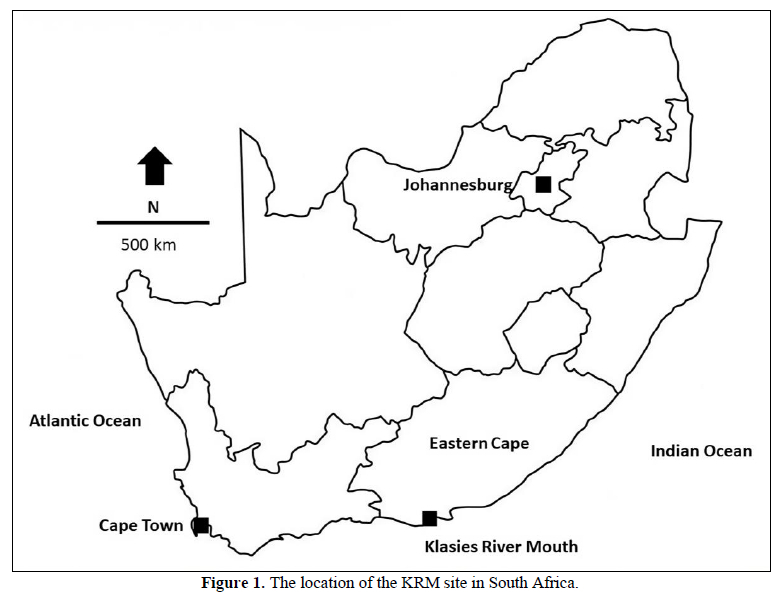
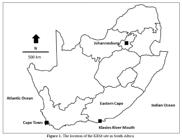
The Middle Stone Age (MSA) is an important period for understanding the origins of innovation and complex cognition of Homo sapiens. In southern Africa, the MSA dates to between about 300 000 and 40 000 years ago (e.g., Vogel 2001; Wadley 2015; Lombard et al. 2022; Wurz 2024 and references therein). One of the most significant MSA sites in South Africa is the Klasies River Main site (KRM). KRM (34.06° S, 24.24° E; Fig. 1) is located on the Tsitsikamma coast in the Eastern Cape province of South Africa (Singer & Wymer 1982) and situated towards the far south-eastern end of the Greater Cape Floristic Region (GCFR). This region is characterised by non-seasonal rainfall (Van Wijk et al. 2017). KRM has a long sequence of Late Pleistocene deposits and has yielded some of the oldest fossil evidence for anatomically modern humans in South Africa (Singer & Wymer 1982; Deacon & Geleijnse 1988; Grine et al. 2017, 2020). The Main site consists of Caves 1, 1A, 1B and 2. The MSA layers at KRM are dated to between ca. 115 and 48 ka (Wurz et al. 2018, 2022). The MSA at KRM is subdivided into the MSA I, MSA II/Mossel Bay, Howiesons Poort (HP), MSA III and MSA IV industries, occurring within several stratigraphic members (Deacon & Geleijnse 1988). The MSA I layers, related to the fauna investigated here, are associated with the production of regular and relatively long quartzite blades and elongated points, some of which have distinctive platform preparation in the form of thinning and rubbing (Wurz 2023).
John Wymer conducted the first excavations at KRM in 1967 and 1968 in Caves 1, 1A, 1B and 2 (Singer & Wymer 1982). The layers from Cave 1B (layers 1-15) were originally placed in the MSA I, but subsequently some of these layers have been found to be associated with the MSA II (Morrissey et al. 2023). A mesh size of 1x0.5 inches (25x13 mm) was used, and smaller specimens and those considered unidentifiable were discarded at the time (Klein 1976). Later, Hilary Deacon excavated Cave 1B starting in 1984 (Deacon 1989), using stacked sieves with mesh sizes of 3 and 2 mm, and retained all faunal specimens.
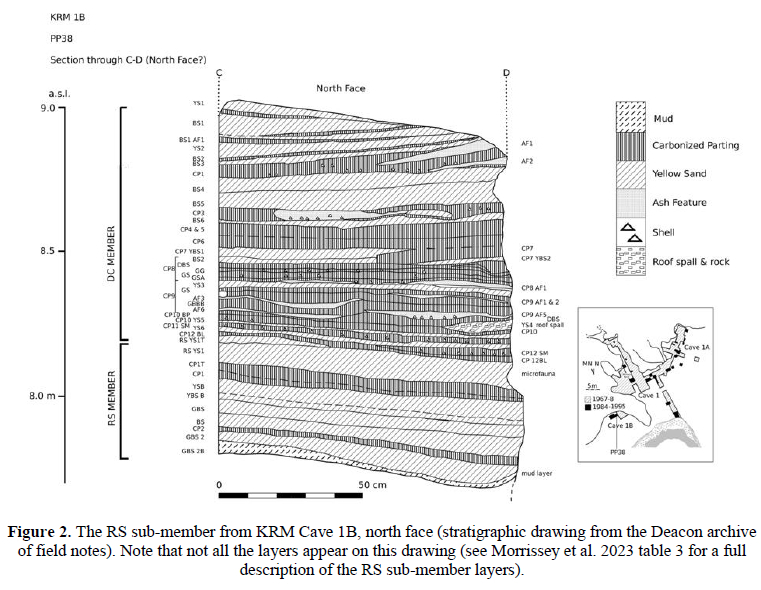
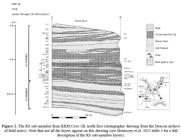
The LBS (Light Brown Sand) member associated with the MSA I industry has been dated to 108.6±3.4 ka (Vogel 2001) in Cave 1, and 106.8±12.6 ka in Cave 1/1A (the area where Caves 1 and 1A intersect) (Feathers 2002). The overlying SAS (Sand and Shell) stratigraphic member with sub-members associated with the MSA II technocomplex is the thickest depositional unit; it dates to between 100.8±2.1 and 85±2.1 ka in Cave 1 (Vogel 2001). The base of the SASL sub-member in Cave 1 has recently been dated to older than 110 ka (Wurz et al. 2022); therefore, the MSA I in Cave 1 and 1B must be older than ca. 115 ka. The faunal sample analysed here comes from the RS (Rubble Sand) sub-member in Cave 1B and is equivalent to the LBS member in Cave 1 (Fig. 2; Morrissey et al. 2023), and thus dates to older than ca. 115 ka. The RS sub-member contains relatively less anthropogenic material compared to the DC (Dark Carbonised) member, although lithics, pebbles, shellfish and animal bones are present (Morrissey et al. 2023). This overlying DC sub-member, equivalent to parts of the SAS member, is dated to ca. 110 ka and corresponds to the MSA II/Mossel Bay technocomplex (Figs 2-3; Wurz 2002).
The animal remains from KRM have been influential in several debates in MSA archaeology, notably focusing on the proficiency of early hunters (e.g., Binford 1984; Thackeray 1990; Milo 1998; Outram 2001; Faith 2008; Dusseldorp 2012; Clark & Kandel 2013) and the Klasies Pattern. Klein (1976; Klein & Cruz-Uribe 1996) argued, based on evidence such as the lack of flying birds, fish, and the presence of docile prey like eland (Taurotragus oryx), that MSA humans were less successful hunters when compared with hunters during the Later Stone Age. Today, however, it is widely accepted that MSA humans were successfully hunting large, dangerous prey (e.g., Faith 2008; Dusseldorp 2010, 2012; also see Weaver et al. 2011). The Klasies Pattern refers to the underrepresentation of proximal limb elements like femora and humeri of large bovids relative to more anatomically complete small bovids, a trend first identified by Klein (1976) at KRM. The Klasies Pattern sparked debates as to the cause of the pattern, including scavenging versus hunting (Binford 1984), the schlepp effect (Klein 1976), excavator's bias (Turner 1989), and a combination of post-depositional damage, marrow extraction, or agent of accumulation (Bartram & Marean 1999). In this study, the fauna from the RS sub-member excavated by Deacon from Cave 1B was analysed. The aim of the study is to contribute to an understanding of the agent(s) responsible for accumulating the fauna, to assess the prey selection behaviours of humans during the MSA I, to infer aspects of the palaeoenvironment, and to establish if the Klasies Pattern is present in the sample.
2. MSA I fauna and palaeoenvironment
There are very few sites in the southern Cape that relate to the period older than 110 ka. An exception is Pinnacle Point Cave 13B, where small assemblages date to this period (Brenner et al. 2022). Fauna from sites and samples dating from the later MSA II show variability, especially in the Eastern and Western Cape provinces of South Africa. At some sites, such as Blombos Cave (M3 phase) and Diepkloof (lower MSA), humans focused on smaller game, notably rock hyraxes (Procavia capensis; Badenhorst et al. 2016) and Cape dune molerats (Bathyergus suillus; Steele & Klein 2013), whereas at others, the focus was on small ungulates, such as at Diepkloof (Early HP, Pre-SB Lynn units; Steele & Klein 2013). Common species at coastal sites during the MSA II include hares (Leporidae), Cape dune molerats, rock hyraxes, Cape fur seals (Arctocephalus pusillus) and Cape grysbok/steenbok (Raphicerus sp.), with a diversity of small, medium and large ungulates (Steele & Klein 2013; Badenhorst et al. 2016).
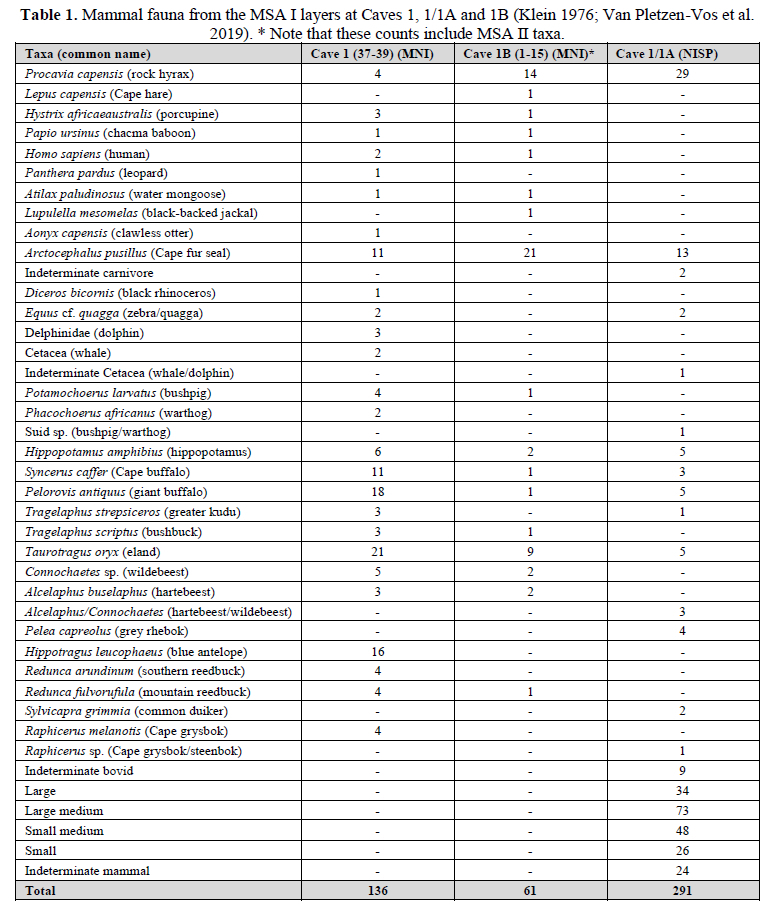
Previous faunal analyses from the MSA I layers at KRM (Table 1) show that rock hyraxes, Cape fur seals and a variety of ungulates are present (Klein 1976; Van Pletzen-Vos et al. 2019; Reynard & Wurz 2020), in addition to shellfish (Klein 1976; Thackeray 1988; Langejans et al. 2017), fish (von den Driesch 2004; Van Niekerk 2011), micromammals (Nel et al. 2018) and birds (Klein 1976; Avery 1987). Cape dune molerats are absent from the MSA I at KRM. The birds present in the MSA I sample from Cave 1 include great cormorants (Phalacrocorax carbo), Cape cormorants (Phalacrocorax capensis), gannet (Morus capensis), African barn owl (Tyto capensis), spotted eagle owl (Bubo africanus) and penguins (Spheniscus demersus; Klein 1976). There are 82 species of fish from 47 different genera/family. The fish families present in the MSA I LBS from the Cave 1/1A layers are Clinidae, Sparidae, Gobiesocidae with the inclusion of Mugilidae, Carangidae, Teraponidae and Engraulidae (von den Driesch 2004).
At KRM, the MSA I is broadly associated with the Last Interglacial, MIS 5e (Deacon & Geleijnse 1988), although re-dating studies might expand this temporal association (Wurz et al. 2022). This climatic phase, dated to between 130 and 115 ka, was characterised by high sea levels and relatively warm temperatures. The world-wide temperatures during this period were drier and warmer than at present (Langejans et al. 2017; Loftus et al. 2019). The abundance of grazers during the MSA I at KRM suggests grassland environments (Reynard & Wurz 2020; Reynard 2021).
3. Agents of accumulation
Determining the agent(s) of faunal accumulation at cave sites requires multiple lines of evidence and numerous methods have been proposed. Raptors often feed on smaller species, including rock hyraxes, Cape dune molerats and Cape grysbok/steenbok. Raptors often roost in caves and shelters (Klein & Cruz-Uribe 2000). Raptors such as the Cape eagle owls (Bubo capensis) feed on the Cape dune molerat, and large quantities of these small mammals may indicate raptor activity. In addition, the predominance of maxillae detached from brain cases, mandibles, and complete long bones as well as digested remains, may further suggest eagle owls (Klein & Cruz-Uribe 2000). Similar patterns for rock hyraxes and hares also suggest raptors as agents of accumulation (Henshilwood et al. 2001; Steele & Klein 2013).
Anthropogenic accumulations are usually inferred by the presence of lithics, hearths, ornamentation, butchery marks, burnt bone, a high fragmentation of long bones, spiral fractures, and a general faunal composition that includes large ungulates and shellfish (Brain 1981; Thompson & Henshilwood 2011). For smaller taxa such as rock hyrax, forelimbs outnumbering hind-limbs, post-crania outnumbering crania (Cruz-Uribe & Klein 1998), and the high fragmentation of long bones (Badenhorst et al. 2014), all indicate human consumption. While the diet niches of hominins overlapped with those of carnivores, the former were able to regularly bring down large and potentially dangerous prey (e.g., Klein & Cruz-Uribe 2000; Van Pletzen 2000; Avery et al. 2008; Rector & Reed 2010; Steele & Klein 2013; Reynard et al. 2016a, b; Van Pletzen-Vos et al. 2019; Reynard & Wurz 2020).
It is conceivable that carnivores, in particular brown hyenas (Hyeana brunnea), as well as leopards (Panthera pardus) made use of shelters as lairs (Brain 1981; Skinner & Chimimba 2005; Reynard & Henshilwood 2019) when humans were not occupying them. Carnivores could have left remains of their prey in these caves, and such remains would have eventually become incorporated with anthropogenic accumulations. In fact, some MSA samples from the Eastern and Western Cape do show some ephemeral carnivore activity, especially in accumulating some small ungulate remains (e.g., Marean et al. 2000; Thompson 2010; Thompson & Henshilwood 2011; Faith 2013; Reynard & Henshilwood 2017, 2019). Bone deposits from caves and shelters that have been accumulated by brown hyenas often have certain characteristics, such as chew marks (Blumenschine 1988), the presence of juvenile hyena remains (Kuhn et al. 2010), hyena coprolites (Cruz-Uribe 1991) and a lack of cultural artefacts (Scott & Klein 1981). Moreover, a high ratio of carnivore versus ungulate remains (based on either the Number of Identified Specimens [NISP] or the Minimum Number of Individuals [MNI]) is also indicative of hyena activity, since brown hyenas frequently prey on other carnivores (Scott & Klein 1981; Kuhn et al. 2010). Samples accumulated by brown hyenas also often show a great diversity of carnivore remains (e.g., Scott & Klein 1981; Pickering 2002). For example, Kuhn et al. (2010) suggested that a high MNI value of 30% or more carnivores, compared to ungulates, indicate brown hyena assemblages. Hominins consumed and interacted less frequently with carnivores (Scott & Klein 1981; also see Val et al. 2020). Transverse breakage on long bones and bone showing digestive damage also indicate carnivore activity (Brain 1981). Leopards often prey on medium-sized ungulates, baboons (Papio ursinus) and rock hyraxes (Procavia capensis) (Brain 1981; Thackeray 1990; Badenhorst et al. 2014), and the presence of these animals, especially baboons, may be an indicator of leopard activity.
As discussed previously (e.g., Badenhorst & Kimambo 2020; Badenhorst et al. 2021, 2022b, and references therein), these criteria often have several limitations. Considering the frequency of butchery marks, various ethno-archaeological and actualistic studies have found that smaller animals were usually brought back to sites intact, where they were roasted whole over fires leaving little or no butchering evidence on carcasses (e.g., Lee 1979; Harako 1981; Bartram et al. 1991; Jones 1993; Badenhorst et al. 2014; Clark 2019). In fact, even specimens of larger mammals may show little evidence of butchery despite slaughtering (Parsons & Badenhorst 2004). Moreover, the frequencies of butchery marks are influenced by the size, species, sex and preparation of the animal butchered, the type and characteristic of the tools used, and the skill and experience of the butcher (see summary in Badenhorst & Kimambo 2020).
Detailed taphonomic studies using magnification have been able to increase the observed frequencies of butchery and carnivore marks on specimens (e.g., Reynard et al. 2014; Armstrong 2016), although such studies have their limitations. This is because the meaning of higher observed frequencies (or relative abundance of a modification compared to another abundance of a modification; Thompson et al. 2017), is complicated by various factors, especially when applied to small mammals. Differential preservation of skeletal elements and other taphonomic factors (Brain 1967) further complicates any frequency study of taphonomic modifications. While digested bones of small mammals are usually considered to be the result of carnivore or raptor activity, humans would also often swallow skeletal remains (Clary 1987; Dewar & Jerardino 2007; Reinhard et al. 2007; Badenhorst et al. 2016; Clark 2019). Similar factors affect the frequency of carnivore marks. While the frequency of chew marks is high in bone collections of modern dens of brown hyenas (often 50% or more; Kuhn et al. 2010), for fossil samples however, this frequency is often quite low. The frequency of chew marks left by brown hyenas is influenced by various factors, including the size of the prey, bone density, length of fragment, the size of clans and the time spent to access a carcass (Faith 2007; Fourvel et al. 2015). For example, at Deelpan in the Free State province of South Africa, a Late Holocene sample occurs that lacks cultural artefacts but contains hyena coprolites, and only 2% of the fauna showed chew marks (Scott & Klein 1981). Humans consuming meat can also leave tooth marks on bones (Brain 1967; Romero et al. 2016). The size of the hyena tooth marks (Pobiner 2008) on bones overlaps with other carnivores such as lions (Panthera leo; Delaney-Rivera et al. 2009).
While the carnivore-ungulate ratio is useful for samples that were quantified using the same method, such as NISP or MNI, comparing results quantified using different methods is more problematic (i.e., NISP vs. MNI; see Badenhorst et al. 2021). Often, like in the case of many MSA sites from the Eastern and Western Cape in South Africa, the Cape fur seal makes up a substantial proportion of the fauna (e.g., Klein 1976; Grine & Klein 1993; Klein & Cruz-Uribe 2000; Van Pletzen 2000; Avery et al. 2008; Rector & Reed 2010; Badenhorst et al. 2016; Reynard & Wurz 2020), thus potentially masking the role of other agents of accumulation (for this reason, Badenhorst et al. 2021 excluded seals from their carnivore-ungulate calculations). All these factors highlight the notion that different approaches have unique strengths and limitations, and multiple lines of evidence are often the best approach to infer the role of various potential agents of accumulation.
4. Materials and methods
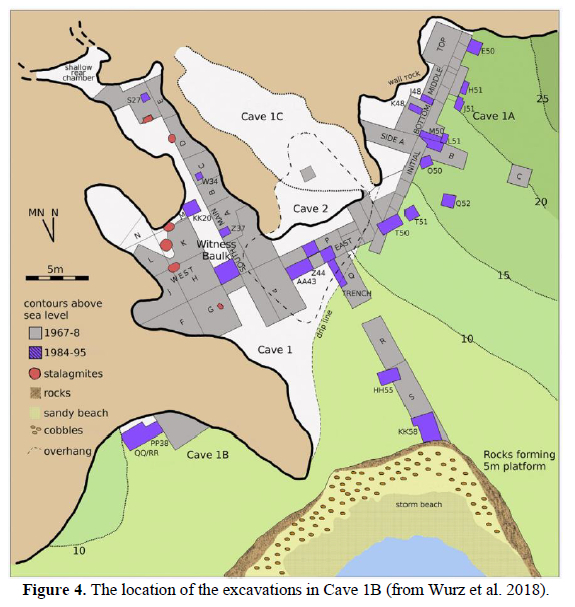
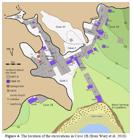
Deacon (1989) excavated the fauna from square PP38 in Cave 1B (Fig. 4) as part of the RS sub-member. The excavation area was 1x1 m in size, although the lowermost section was not fully excavated (Morrissey et al. 2023). The faunal identification method suggested by Driver (2005) was used for this study. According to this method, all specimens are considered identifiable when the element can be determined. The remaining specimens are considered unidentified. The identifications were done using the collections housed at the Evolutionary Studies Institute of the University of the Witwatersrand, and the Ditsong National Museum of Natural History in Tshwane. The layers are treated as a single unit in this paper but were originally analysed separately (see Ezeimo 2022 for fauna per layer). The indeterminate bovid size classes follow Brain (1974), and specimens identified to an indeterminate size class were counted separately from specimens identified to species or genera (e.g., Badenhorst & Plug 2012; also see Klein 1976). Teeth of rock hyraxes were aged using criteria established by Steyn and Hanks (1983). The NISP is the most commonly used method of quantification used by zooarchaeologists (e.g., Grayson 1984; Plug & Plug 1990; Lyman 2008) and it is used in this study. Teeth embedded in mandibles and maxillae are considered as separate elements in NISP calculations. The MNI is a highly problematic method of quantification (e.g., Plug & Plug 1990; O'Connor 2000), which also applies to the derivatives of this method - the Minimum Number of Elements (MNE) and the Minimum Animal Units (MAU, %MAU; Binford 1984; Lyman 2008); none were used in this study. However, we used a normed NISP for bovid skeletal part representation. This was calculated by using the NISP of an element, and dividing this by the number of times the particular element occurs in a bovid skeleton (Reynard & Henshilwood 2017).
Taking the caveats of determining the agent(s) of faunal accumulation into consideration (as discussed above), we used the following approaches: first, we recorded all visible taphonomy using naked-eye observations. Second, we subjected a random sample of 100 unidentified specimens to microscopic analyses using an Olympuz SZ51 microscope with 40x magnification. Third, we used the carnivore-ungulate and leopard ratios to infer the role of hyenas and leopards (Klein 1975; Brain 1981; Thackeray 1979, 1990; Badenhorst et al. 2022a). The carnivore-ungulate ratio is calculated by using the carnivore NISP (without Cape fur seals, following Badenhorst et al. 2021) divided by the total ungulates, and multiplied by 100. The leopard index is calculated by adding leopard and baboon NISPs, and dividing it by the total ungulate NISP, multiplied by 100 (Thackeray 1990). Fourth, we used the skeletal part representation of rock hyraxes to infer the role of humans, leopards and raptors as potential agents of accumulation (Klein & Cruz-Uribe 2000).
5. Results
Sample size
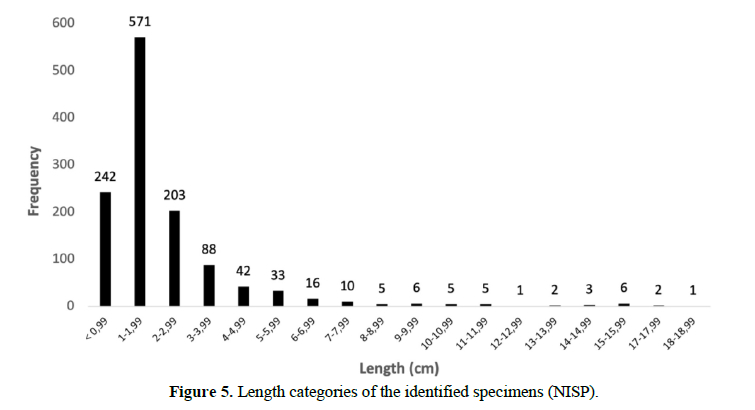
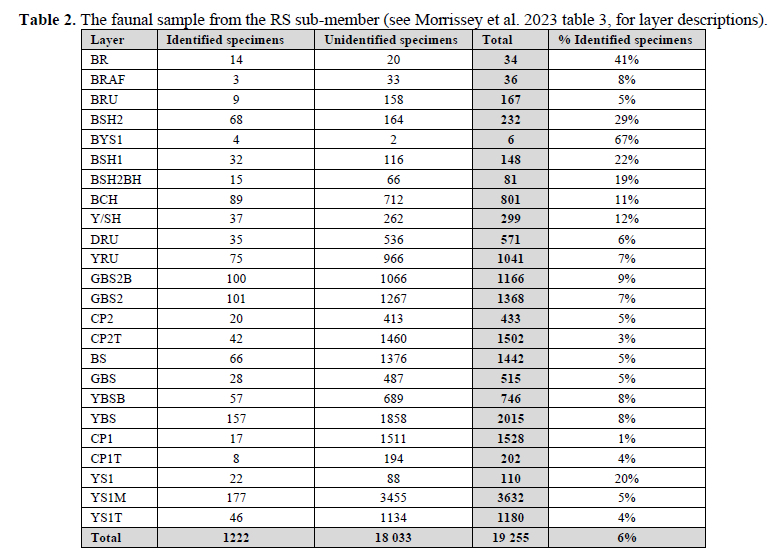
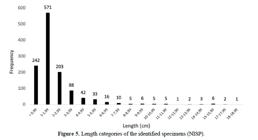
The total faunal sample consists of 19 255 specimens from the different layers of the RS sub-member, of which 1219 (6%) were identified (Table 2). Most of the identified specimens (n=1016, or 82%) are between 0.1 and 3 cm in length, indicating a highly fragmented sample (Fig. 5).
Taxa present
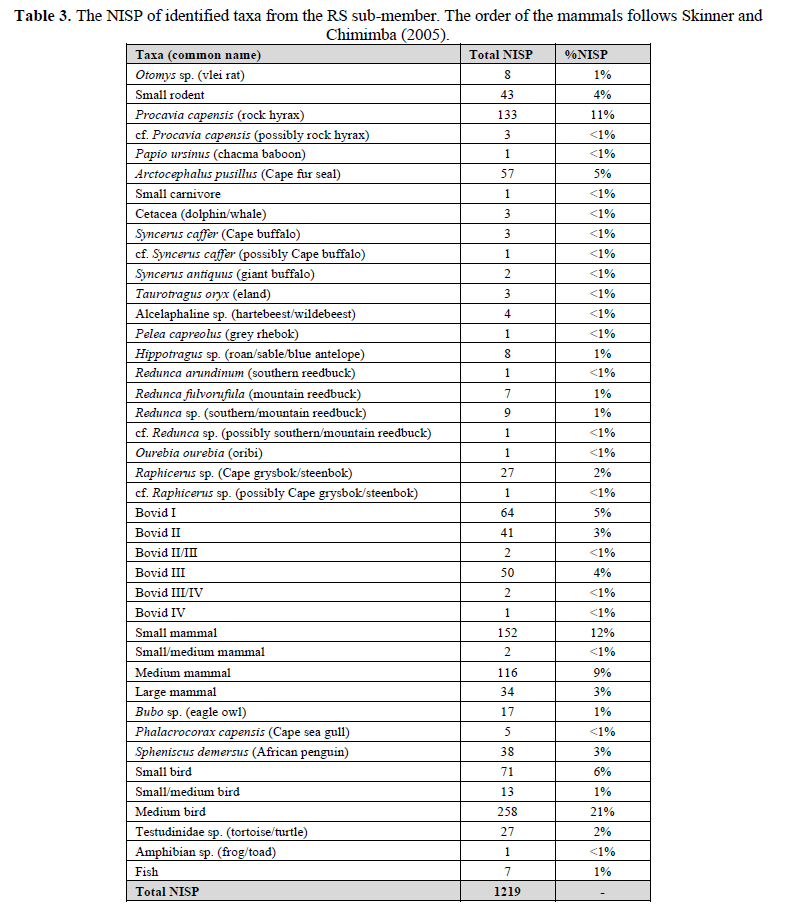
The sample contains mammals, birds, reptiles, amphibians, and fish (Table 3). The most common taxa are indeterminate medium birds (21%), indeterminate small mammals (12%), rock hyraxes (11%) and indeterminate medium mammals (9%). Bovids include Cape grysbok/steenbok, which are present in most layers (Ezeimo 2022), as well as mountain (Reduncafulvorufula) and southern reedbuck (Redunca arundinum), oribi (Ourebia ourebia), grey rhebok (Pelea capreolus), roan/sable/blue antelope (Hippotragus sp.), wildebeest/hartebeest (Alcelaphaline sp.), eland, Cape buffalo (Syncerus caffer) and giant buffalo (Syncerus antiquus). The indeterminate Bovid I specimens are likely Cape grysbok/steenbok. Many of the indeterminate small mammals are likely rock hyrax. The single baboon specimen is a first phalanx. The only rodent taxa identified is the vlei rat (Otomys sp.). There are three vertebrae that are potentially from dolphins or whales. Bird remains consist of penguin, the Cape cormorant and the eagle owl (Bubo sp.). Many of the indeterminate medium birds are most likely penguins. Other taxa include tortoise/turtle (Testudinidae sp.), toad or frog, and only seven fish vertebrae specimens.
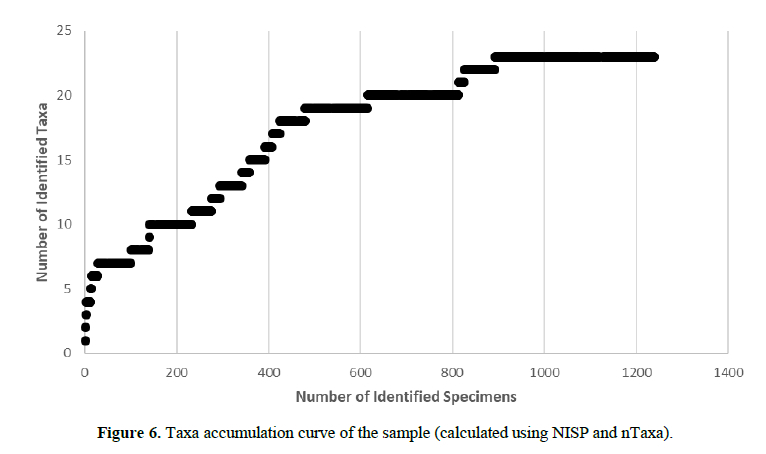
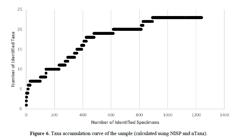
The identified sample is sufficiently large to be representative of the original animal population (Fig. 6; Badenhorst et al. 2022b). The carnivore-ungulate ratio, using the entire sample, is very low (0.43), which is much lower than the average anthropogenic carnivore-ungulate ratio for MSA sites in the Eastern and Western Cape of South Africa (3.10). Moreover, this ratio is also well below hyena samples from the same region, which averages 18.58 (Badenhorst et al. 2021). The leopard index is equally very low (0.43) for the RS sub-member, and similar to other MSA anthropogenic accumulations in the Eastern and Western Cape (average of 0.25), and well below the average for leopard samples (10.47; Badenhorst et al. 2021). The low carnivore-ungulate and leopard ratios suggest that the RS sub-member has very low probabilities of hyena or leopard activity.
Taphonomy
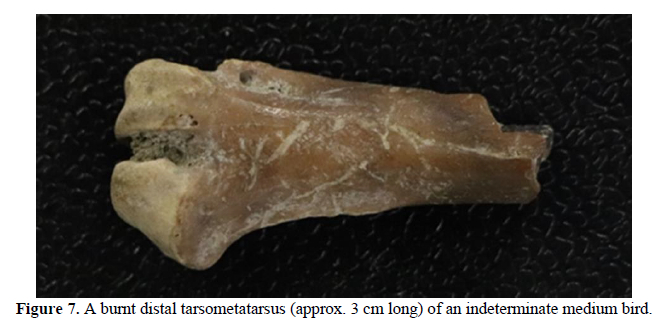
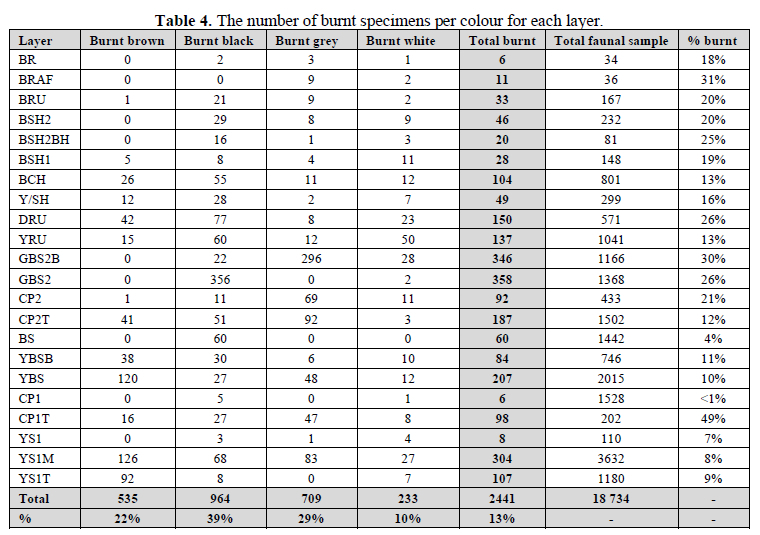
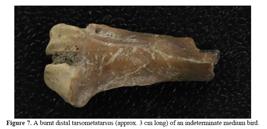
Burnt specimens are indicative of hominin involvement in accumulating the fauna. Most of the layers contain burnt specimens (Table 4), and 13% of the total sample is burnt. A variety of colours were observed, including brown (Fig. 7), black, grey and white, of which black, grey and brown colouring are most common; white colouring is not common. One shell fragment of a tortoise/turtle from layer GBS2B had localised, black burning on it.
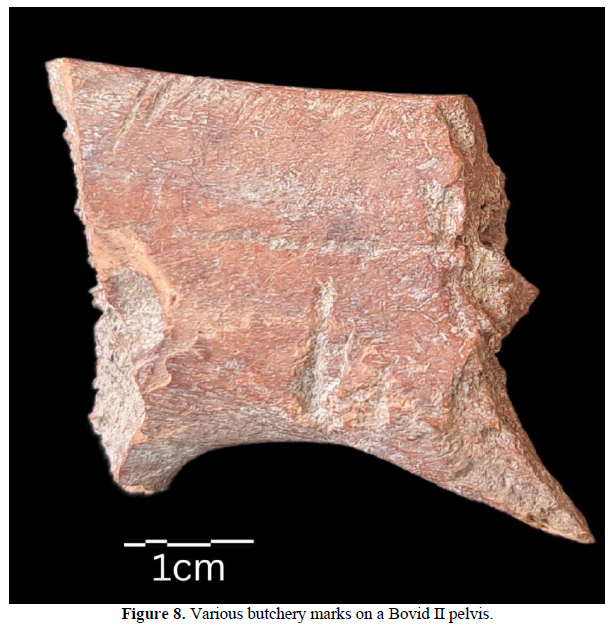
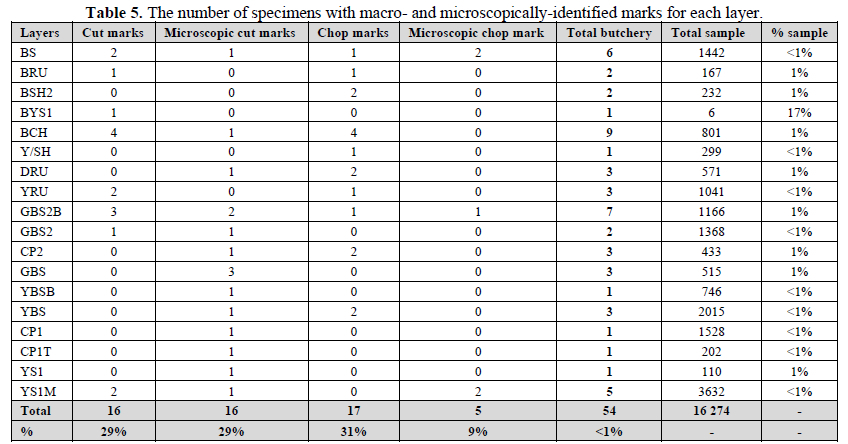
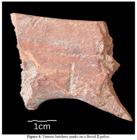
Most layers contain evidence for butchery (Table 5; Fig. 8) indicating hominin involvement in accumulating the fauna. While the microscopic analysis of the unidentified specimens was able to increase the frequency of butchery marks, overall, only less than 1% of the total sample contains such evidence. The taxa with butchery evidence include Cape fur seal (n=1), medium carnivore (n=1), Bovid I (n=3), Bovid II (n=5), Bovid III (n=2), large mammal (n=1), as well as unidentified specimens (n=41).
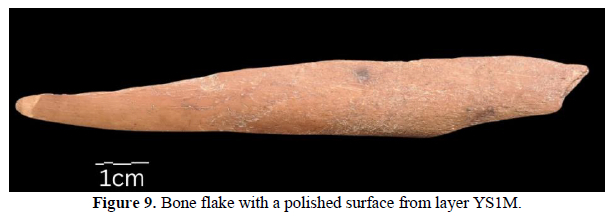
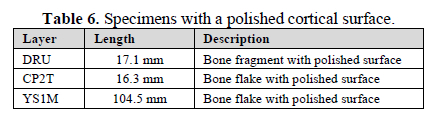
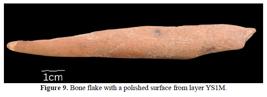
The bone surface of three specimens has a polished appearance (Table 6; Fig. 9), possibly caused by use-wear or trampling.
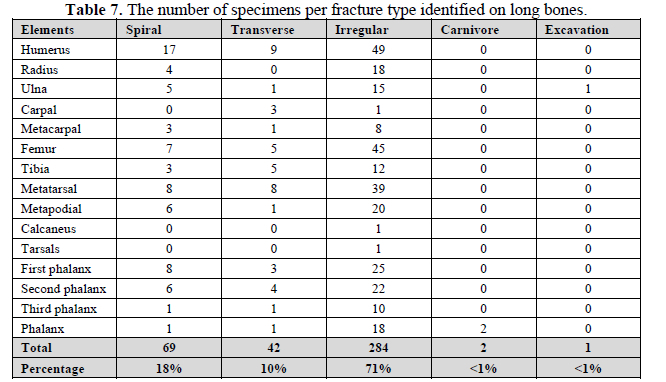
The breakage of identified long bones (humerus, radius, ulna, metacarpal, femur, tibia, metatarsal and metapodial) indicate that irregular fractures are most common, suggesting dry breaks. This is followed by spiral and transverse breaks (Table 7). Fractures caused by carnivores are uncommon, amounting to less than 1% of the long bones.
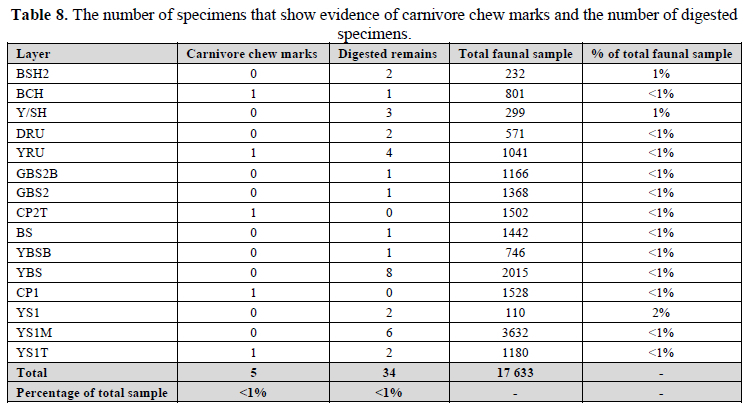
Carnivore chew marks were noted in many layers on the specimens (Table 8), indicating that carnivores were involved in accumulating some fauna. However, carnivore chew marks were found on less than 1% of the total faunal sample. The microscopic analysis of the 100 unidentified specimens did not yield any chew marks. Taxa with carnivore chew marks include Bovid III (n=1), medium mammal (n=2), penguin (n=1), as well as on an unidentified specimen (n=1). Digested remains are also not common and amount to less than 1% of the total faunal sample. Taxa that were digested include small rodent (n=1), rock hyrax (n=5), Cape fur seal (n=3), Cape grysbok/steenbok (n=4), Bovid I (n=2), Bovid II (n=2), small mammal (n=5), medium mammal (n=3), medium bird (n=2), fish (n=1), as well as unidentified specimens (n=6).
A total of seven specimens, amounting to less than 1% of the total sample, showed evidence of rodent gnaw marks. Evidence for rodent gnawing was found in layers BCH (n=1), BSH2 (n=1), YBSB (n=1), YBS (n=2) and YRU (n=2).
Skeletal part representation
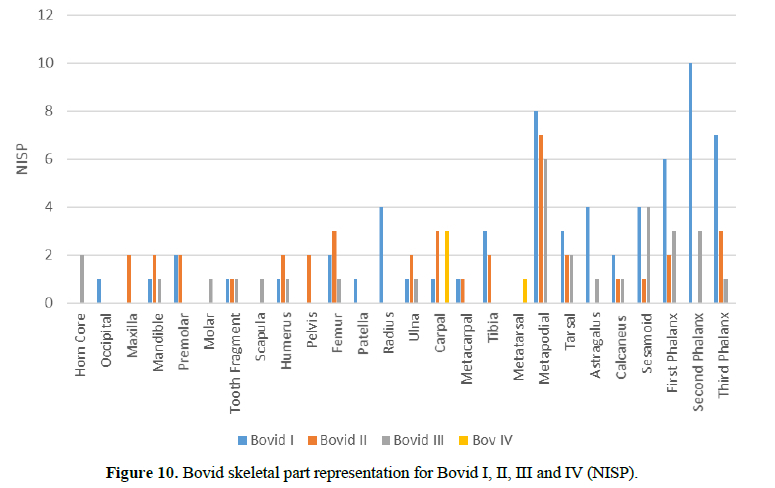
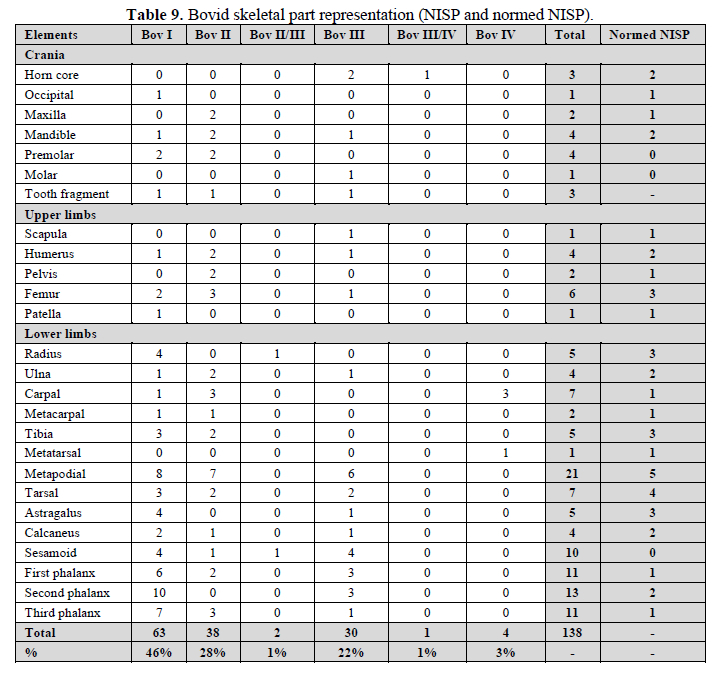
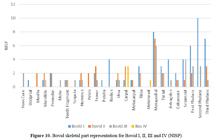
The bovid skeletal part representation indicates that Bovid I specimens are most common, followed by Bovid II, Bovid III and only a few Bovid IV elements (Table 9). Combined, most skeletal elements are present (Fig. 10). Lower limbs are particularly common, especially metacarpals, metatarsals, metapodia and tarsals, which are also dense elements that tend to preserve well (e.g., Brain 1981).
For rock hyraxes, the front (n=26) and hind limb (n=23) are nearly equally represented, but the crania (n=71, excluding teeth) outnumber the post-crania (n=50). The predominance of crania may suggest that some of the rock hyrax remains were accumulated by raptors such as black eagles, or by leopards (Cruz-Uribe & Klein 1998).
Aging
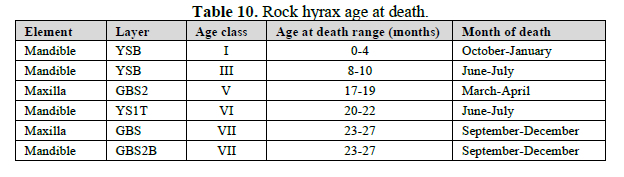
Most bovid specimens are from adult individuals (Ezeimo 2022). However, based on long bone fusion, some neonates are present for Bovid I (n=2), Bovid II (n=1) and Bovid III (n=1), as well as juveniles (Bovid I, n=11; Bovid II, n=5; Bovid III, n=3). For Cape fur seals, most specimens are from adult individuals (Ezeimo 2022), although some juveniles (n=11) and sub-adults (n=1) are present. Using October as the birth peak of rock hyraxes (Skinner & Chimimba 2005), those specimens that could be aged do not show a particular season of death (Table 10).
6. Discussion and conclusion
MSA faunal samples from southern Africa, including those from KRM, are usually heavily fragmented (e.g., Marean et al. 2000; Reynard et al. 2016b). For example, the MSA II/Mossel Bay fauna from the Witness Baulk at KRM Cave 1 excavated by Deacon yielded 43% identified specimens, although not all fragments may have been included in the count (Van Pletzen-Vos et al. 2019). From the fauna from squares C1 and B2 in Cave 1 from the Wurz excavation for older MSA II layers, only 6% could be identified (Lap 2020), which is similar to the level of fragmentation in this study. There are several possible reasons for the high level of fragmentation in the RS sample. The most likely causes include burning, butchery and post-depositional fragmentation (cf. Stiner et al. 1995). The sample size used in this study, consisting of a full range of vertebrates, is relatively large (Badenhorst et al. 2022b) indicating it is substantial enough to provide information about the agents of accumulation and subsistence patterns.
Several types of evidence indicate that hominins contributed faunal remains to the RS sub-sample, notably: a presence of cultural artefacts; shellfish remains (Thackeray 1988, 2019); the remains of tortoises, seals and other large mammals (cf. Van Pletzen-Vos et al. 2019; Reynard & Wurz 2020); butchery marks; burnt specimens; the lack of diversity of carnivore taxa compared to ungulates (as reflected in the very low carnivore-ungulate ratio); and a very low number of baboons (as reflected in the very low leopard index; Badenhorst et al. 2021). The values of these two ratios are similar to other MSA sites in the Eastern and Western Cape that were accumulated primarily by humans. Moreover, the sample lacks any beak marks or hyena coprolites. Taken together, the role of humans as an agent of accumulation of the RS sub-sample is beyond any doubt.
However, it is also very likely that other agents, notably carnivores, accumulated at least some of the fauna from the RS sample, especially some of the smaller taxa. This is based on the presence of carnivore chew marks and digested remains (although it is possible for humans to also inflict these types of modifications). Some of the digested remains include Cape grysbok/steenbok. These small bovids are common in both anthropogenic (Klein 1976; Henshilwood et al. 2001; Faith 2011; Badenhorst et al. 2016), hyena (Grine & Klein 1993) and leopard (Klein 1978; Faith 2013) accumulations in the Eastern and Western Cape. Baboon remains are frequently associated with leopard accumulations (see summary in Badenhorst 2022), but it is uncertain if the single baboon phalanx in the sample necessarily implies the involvement of this predator. This may well represent a natural death of a baboon. The skeletal part representation of rock hyraxes suggests the remains were accumulated by either leopards or raptors (Cruz-Uribe & Klein 1998). Brown hyenas often consume fish (Kuhn et al. 2008), and the presence of digested fish may suggest that these carnivores were responsible for their presence.
In addition to the involvement of carnivores in accumulating the RS sub-member, there is also potential evidence for raptor activities. The remains of raptors themselves in the RS faunal sample may represent natural deaths, as they often nest above rock shelters (Taylor 2003). However, the RS faunal sample lacks beak marks (Brain 1981) and some birds were likely accumulated by carnivores, as reflected in the digested remains. The rodent remains may either represent natural intrusions, or prey of raptors (Andrews 1990; Matthews et al. 2009, 2011; Nel & Henshilwood 2021) or carnivores.
The fauna from the RS sample is similar to what has previously been identified from the MSA I at KRM in Cave 1 (Klein 1976) and Cave 1/1A (Van Pletzen-Vos et al. 2019; Reynard & Wurz 2020). The range of larger ungulates from the MSA I at KRM suggest humans were capable hunters (Dusseldorp 2010; Thompson 2010; Thompson & Henshilwood 2011; Clark & Kandel 2013; Dusseldorp & Reynard 2021) using a variety of hunting techniques to acquire prey (Klein 1978; Milo 1998; Dusseldorp 2010; Clark & Kandel 2013). The Game Index, which measures the ratio of small to large game in samples (Badenhorst 2015; Badenhorst et al. 2022a), indicates a sample predominated by ungulates (value of 0.37, considering that the rock hyraxes were likely accumulated by a non-human agent). The Game Index value of the RS sub-sample is higher than other faunal samples from KRM, including Cave 1A MSA III (0.23), Cave 1A SAS Base (0.21), Cave 1A MSA II L (0.17), Cave 1A Upper (0.17), Cave 1A SAS Middle (0.11) and Cave 1A MSA II U (0.09; Badenhorst et al. 2022a). Nevertheless, the overall pattern, based on the Game Index, is that humans at KRM were focusing on hunting larger game animals, notably Cape grysbok/steenbok (although some of these bovids were possibly accumulated by carnivores). Interestingly, the Game Index values are lower for samples accumulated (exclusively or largely) by brown hyenas from the Eastern and Western Cape during the Middle to Late Pleistocene (Pinnacle Point Cave PP30, Sea Harvest, Swartklip, Duinefontein 2, Elandsfontein Bone Circle, and Hoedjiespunt), averaging 0.13 (range of 0.01-0.56; Badenhorst et al. 2022a). This indicates that brown hyenas feed infrequently on small animals such as hares and rock hyraxes.
The Cape fur seal would have been speared from a close distance or clubbed to death (Klein & Cruz-Uribe 1996). However, the presence of digested seal remains in the RS sub-sample suggest that carnivores such as brown hyenas, which frequently consume seals (Kuhn et al. 2008), also contributed specimens of this taxon to the sample. Tortoises, on the other hand, were obtained easily (Henshilwood et al. 2001; Thompson & Henshilwood 2014) and based on historical accounts, tortoises were often cooked whole in their shell (Speth & Tchernov 2002). It is uncertain if the single tortoise/turtle shell from the RS sample, with localised burning, reflects such a cooking method.
Grazing taxa are common during the MSA I at KRM (Van Pletzen-Vos et al. 2019; Reynard & Wurz 2020), suggesting an open environment in the vicinity (also see Reynard 2021). This is also supported by the presence of Cape and giant buffalo in samples from the RS sub-sample in Cave 1B. The open environment is also reflected in the Modified Degree of Vegetation Cover Index (MDVC; Greenacre & Vrba 1984; Thackeray 1990; Badenhorst et al. 2022a), which measures the ratio between kudu (Tragelaphus strepsiceros), bushbuck (Tragelaphus sylvaticus) and steenbok/grysbok to the total ungulates in a sample. Kudu, bushbuck and Cape grysbok/steenbok prefer closed habitats (Skinner & Chimimba 2005). While the first two ungulates are absent from the RS sub-sample, the MDVC value is relatively high (12). The MDVC values are slightly lower for other MSA samples from KRM, including Cave 1A SAS Base (7), Cave 1A MSA II L (6), Cave 1A SAS Middle (4), Cave 1A MSA II U (3), Cave 1A Upper (3) and Cave 1A MSA III (3; Badenhorst et al. 2022a). Overall, the MDVC values from KRM show that Cape grysbok/steenbok make up a large proportion of the ungulates during the MSA. Both the Cape grysbok and steenbok prefer open environments, provided there is dense cover (Skinner & Chimimba 2005).
MSA humans used rock shelters sporadically, often due to favourable environmental conditions and available resources (Jacobs et al. 2008). The neonate Bovid I specimens from the RS sub-member are most likely Cape grysbok/steenbok, the most common small ungulate in the sample. Cape grysbok give birth throughout the year, but peak between September and December (Novellie et al. 1984; Skinner & Chimimba 2005). The birthing peak of steenbok is also during November-December (Smithers 1971; Skinner & Chimimba 2005), thus suggesting an early summer accumulation for at least part of the RS sub-member. The presence of young Cape fur seals further support occupation during these months. In November, female Cape fur seals are present along the coastline to deliver their pups (Kirkman 2010), and mortality rates of juveniles are high during this time because of predation, trampling, starvation and drowning (De Villiers & Roux 1992).
The Klasies Pattern was heavily debated for several years (e.g., Klein 1976; Bartram & Marean 1999) because the pattern resulted from unidentifiable long bone shaft fragments that were discarded during the Singer-Wymer excavations (Turner 1989; Bartram & Marean 1999; Van Pletzen-Vos et al. 2019; Reynard & Wurz 2020). The Klasies Pattern is present for bovids when all the RS sample layers are combined. Most of the RS sub-sample consists of unidentified specimens. As a result, skeletal part representation usually only indicates patterns within a sub-sample of a faunal assemblage (Badenhorst & Plug 2011).
The fauna from the RS sub-member excavated from Cave 1B at KRM consists of mammals, birds, reptiles, amphibians and fish. Overall, there are convincing indications that humans accumulated a substantial portion of the fauna. MSA humans were able to hunt and obtain a variety of animals. However, there are also indications that some taxa, many of which are smaller in body size, were accumulated by agents such as carnivores and raptors. The fauna suggests the presence of open environments close to KRM during MIS5.
Acknowledgements
The support of the DSI-NRF Centre of Excellence in Palaeosciences (CoE-Pal) towards this research is hereby acknowledged. Opinions expressed and conclusions arrived at, are those of the author and are not necessarily to be attributed to the CoE. We thank staff from the Evolutionary Studies Institute at Wits and the Ditsong National Museum of Natural History for access to collections.
References
- Andrews, P. 1990. Owls, Caves and Fossils: Predation, Preservation and Accumulation of Small Mammal Bones in Caves, with an Analysis of the Pleistocene Cave Faunas from Westbury-sub-Mendip, Somerset, U.K. Chicago: University of Chicago Press.
- Armstrong, A. 2016. Small mammal utilization by Middle Stone Age humans at Die Kelders cave 1 and Pinnacle Point site 5-6, Western Cape Province, South Africa. Journal of Human Evolution, 101: 17-44.
- Avery, G. 1987. Coastal birds and prehistory in the Western Cape. In: Parkington, J. & Hall, M. (ed.) Papers in the Prehistory of the Western Cape, South Africa: 164-191. Oxford: British Archaeological Reports International Series.
- Avery, G., Halkett, D., Orton, J., et al. 2008. The Ysterfontein 1 Middle Stone Age Rock Shelter and the evolution of coastal foraging. South African Archaeological Society Goodwin Series, 10: 66-89.
- Badenhorst, S. 2015. Intensive hunting during the Iron Age of southern Africa. Environmental Archaeology, 20(1): 41-51.
- Badenhorst, S. 2022. Citizens of the savanna: An account of three million years of interaction between baboons and hominins in South Africa. In: Urbani, B., Youlatos, D. & Antczak, A.T. (eds) World Archaeoprimatology: Interconnections of Humans and Nonhuman Primates in the Past: 375-392. Cambridge: Cambridge University Press.
- Badenhorst, S. & Kimambo, J.S. 2020. The frequency of butchery marks on goat (Capra hircus) remains from pastoral Khoekhoe villages at Gobabeb, Namibia. Indago, 36: 1-12.
- Badenhorst, S., Ezeimo, J., Lebatla, L.T., et al. 2022a. Variability in hunting behaviour during the Middle Stone Age in the Eastern and Western Cape of South Africa. Journal of Archaeological Science: Reports, 44: 103527.
- Badenhorst, S., Ezeimo, J., Van Niekerk, K.L., et al. 2021. Differential accumulation of large mammal remains by carnivores and humans during the Middle Stone Age in the Eastern and Western Cape, South Africa. Journal of Archaeological Science: Reports, 35: 102752.
- Badenhorst, S., Mthombothi, N., Van Niekerk, K.L., et al. 2022b. An initial assessment of zooarchaeological assemblage sizes from South Africa. Revue de Paléobiologie, 41(1): 1-10.
- Badenhorst, S. & Plug, I. 2011. Unidentified specimens in zooarchaeology. Palaeontologica Africana, 46: 89-92.
- Badenhorst, S. & Plug, I. 2012. The faunal remains from the Middle Stone Age levels of Bushman Rock Shelter in South Africa. South African Archaeological Bulletin, 16: 16-31.
- Badenhorst, S., Van Niekerk, K.L. & Henshilwood, C.S. 2014. Rock hyraxes (Procavia capensis) from Middle Stone Age Levels at Blombos Cave, South Africa. African Archaeological Review, 31: 25-43.
- Badenhorst, S., Van Niekerk, K.L. & Henshilwood, C.S. 2016. Large mammal remains from the 100 ka Middle Stone Age layers of Blombos Cave, South Africa. South African Archaeological Bulletin, 71: 46-52.
- Bartram, J.L. & Marean, C.W. 1999. Explaining the "Klasies Pattern": Kua ethnoarchaeology, the Die Kelders Middle Stone Age archaeofauna, long bone fragmentation and carnivore ravaging. Journal of Archaeological Science, 26: 9-29.
- Bartram, L.E., Kroll, E.M. & Bunn, H.T. 1991. Variability in camp structure and bone food refuse patterning at Kua San hunter-gatherer camps. In: Kroll, E.M. & Price, T.D. (eds) The Interpretation of Archaeological Spatial Patterning: 77-148. New York: Plenum.
- Binford, L.R. 1984. Faunal Remains from Klasies River Mouth. New York: Academic Press.
- Blumenschine, R.J. 1988. An experimental model of the timing of hominid and carnivore influence on archaeological bone assemblages. Journal of Archaeological Science, 15: 483-502.
- Brain, C.K. 1967. Hottentot food remains and their bearing on the interpretation of fossil bone assemblages. Scientific Papers of the Namib Desert Research Station, 32: 1-7.
- Brain, C.K. 1974. Some suggested procedures in the analysis of bone accumulations from southern African Quaternary sites. Annals of the Transvaal Museum, 29: 1-8.
- Brain, C.K. 1981. The Hunters or the Hunted? An Introduction to African Cave Taphonomy. Chicago: University of Chicago Press.
- Brenner, M., Ryano, K. & Wurz, S. 2022. Coastal adaptation at Klasies River main site during MIS 5c/d (93-110 000 years ago) from a southern Cape Perspective. Journal of Island & Coastal Archaeology, 17(2): 218-245.
- Clark, J.L. 2019. The Still Bay and pre-Still Bay fauna from Sibudu Cave: Taphonomic and taxonomic analysis of the macromammal remains from the Wadley excavations. Journal of Paleolithic Archaeology, 2: 26-73.
- Clark, J.L. & Kandel, A.W. 2013. The evolutionary implications of variation in human hunting strategies and diet breadth during the Middle Stone Age of southern Africa. Current Anthropology, 54: 269-287.
- Clary, K.H. 1987. Coprolites from Pueblo Alto. In: Mathien, F.J. & Windes, T.C. (eds) Investigations at the Pueblo Alto Complex, Chaco Canyon, New Mexico, 1975-1979. Volume III, Part 2, Artifactual and Biological Analyses: 785-788. Santa Fe: National Park Service.
- Cruz-Uribe, K. 1991. Distinguishing hyena from hominid bone accumulations. Journal of Field Archaeology, 18(4): 467-486.
- Cruz-Uribe, K. & Klein, R.G. 1998. Hyrax and hare bones from modern South African eagle roosts and the detection of eagle involvement in fossil bone assemblages. Journal of Archaeological Science, 25: 135-147.
- De Villiers, D.J. & Roux, J.P. 1992. Mortality of newborn pups of the South African fur seal Arctocephalus pusillus pusillus in Namibia. South African Journal of Marine Science, 12: 881-889.
- Deacon, H.J. 1989. Late Pleistocene palaeoecology and archaeology in the southern Cape, South Africa. In: Mellars, P. & Stinger, C.B. (eds) The Human Revolution: 547-564. Edinburgh: Edinburgh University Press.
- Deacon, H.J. & Geleijnse, V.B. 1988. The stratigraphy and sedimentology of the main site sequence, Klasies River, South Africa. South African Archaeological Bulletin, 43: 5-14.
- Delaney-Rivera, C., Plummer, T.W., Hodgson, J.A., et al. 2009. Pits and pitfalls: Taxonomic variability and patterning in tooth mark dimensions. Journal of Archaeological Science, 36: 2597-2608.
- Dewar, G. & Jerardino, A. 2007. Micromammals: When humans are the hunters. Journal of Taphonomy, 5(1): 1-14.
- Driver, J.C. 2005. Manual for description of vertebrate remains. Unpublished manual compiled for the Crow Canyon Archaeological Center.
- Dusseldorp, G.L. 2010. Prey choice during the South African Middle Stone Age: Avoiding dangerous prey or maximising returns? African Archaeological Review, 27: 107-133.
- Dusseldorp, G.L. 2012. Studying prehistoric hunting proficiency: Applying Optimal Foraging Theory to the Middle Palaeolithic and Middle Stone Age. Quaternary International, 252: 3-15.
-
Dusseldorp, G. & Reynard, J. 2021. Faunal exploitation strategies during the Later Pleistocene in southern Africa. Oxford Research Encyclopaedia of Anthropology. Available from: https://doi.org/10.1093/acrefore/9780190854584.013.599 (Accessed: 2024).
» https://doi.org/10.1093/acrefore/9780190854584.013.599 - Ezeimo, J. 2022. Faunal exploitation and the palaeoenvironment during the Middle Stone Age at Klasies River Cave 1B. Masters Dissertation. Johannesburg: University of Witwatersrand.
- Faith, J.T. 2007. Sources of variation in carnivore tooth-mark frequencies in a modern spotted hyena (Crocuta crocuta) den assemblage, Amboseli Park, Kenya. Journal of Archaeological Science, 34(10): 1601-1609.
- Faith, J.T. 2008. Eland, buffalo, and wild pigs: Were Middle Stone Age humans ineffective hunters? Journal of Human Evolution, 55: 24-36.
- Faith, J.T. 2011. Late Quaternary dietary shifts of the Cape grysbok (Raphicerus melanotis) in southern Africa. Quaternary Research, 75: 159-165.
- Faith, J.T. 2013. Taphonomic and paleoecological change in the large mammal sequence from Boomplaas Cave, Western Cape, South Africa. Journal of Human Evolution, 65: 715-730.
- Feathers, J. 2002. Luminescence dating in less than ideal conditions: Case studies from Klasies River Main Site and Duinefontein, South Africa. Journal of Archaeological Science, 29: 177-194.
- Fourvel, J-B., Fosse, P. & Avery, G. 2015. Spotted, striped or brown? Taphonomic studies at dens of extant hyaenas in eastern and southern Africa. Quaternary International, 369: 38-50.
- Grayson, D.K. 1984. Quantitative Zooarchaeology. San Diego: Academic Press.
- Greenacre, M.J. & Vrba, E.S. 1984. Graphical display and interpretation of antelope census data in African wildlife areas, using correspondence analysis. Ecology, 65: 984-997.
- Grine, F.E. & Klein, R. 1993. Late Pleistocene human remains from the Sea Harvest Site, Saldanha Bay, South Africa. South African Journal of Science, 89: 145-152.
- Grine, F.E., Marean, C.W., Faith, J.T., et al. 2017. Further human fossils from the Middle Stone Age deposits of Die Kelders Cave 1, Western Cape Province, South Africa. Journal of Human Evolution, 109: 70-78.
- Grine, F.E., Mongle, C.S., Smith, S.L., et al. 2020. Human manual distal phalanges from the Middle Stone Age deposits of Klasies River Main Site, Western Cape Province, South Africa. Journal of Human Evolution, 146: 102849.
- Harako, R. 1981. The cultural ecology of hunting behavior among Mbuti Pygmies in the Ituri Forest, Zaire. In: Harding, R.S.O. & Teleki, G. (eds) Omnivorous Primates: 499-555. New York: Columbia University Press.
- Henshilwood, C.S., Sealy, J.C., Yates, R., et al. 2001. Blombos Cave, southern Cape, South Africa: Preliminary report on the 1992-1999 excavations of the Middle Stone Age levels. Journal of Archaeological Science, 28(4): 421-448.
- Jacobs, Z., Roberts, R.G., Galbraith, R.F., et al. 2008. Ages for the Middle Stone Age of southern Africa: Implications for human behavior and dispersal. Science, 322: 733-735.
- Jones, K.T. 1993. The archaeological structure of a short-term camp. In: Hudson, J. (ed.) From Bones to Behavior: Ethnoarchaeological and Experimental Contributions to the Interpretation of Faunal Remains, Center for Archaeological Investigations, Occasional Paper No. 21: 101-114. Carbondale: Southern Illinois University.
- Kirkman, S.P. 2010. The Cape fur seal: Monitoring and management in the Benguela Current ecosystem. Doctoral Thesis. Cape Town: University of Cape Town.
- Klein, R.G. 1975. Paleoanthropological implications of the non-archaeological bone assemblage from Swartklip 1, South-Western Cape Province, South Africa. Quaternary Research, 5: 275-288.
- Klein, R.G. 1976. The mammalian fauna of the Klasies River Mouth sites, southern Cape Province, South Africa. South African Archaeological Bulletin, 31: 75-98.
- Klein, R.G. 1978. A preliminary report on the larger mammals from the Boomplaas Stone Age cave site, Cango Valley, Oudtshoorn District, South Africa. South African Archaeological Bulletin, 33: 66-75.
- Klein, R.G. & Cruz-Uribe, K. 1996. Exploitation of large bovids and seals at Middle and Later Stone Age sites in South Africa. Journal of Human Evolution, 31: 315-334.
- Klein, R.G. & Cruz-Uribe, K. 2000. Middle and Later Stone Age large mammal and tortoise remains from Die Kelders Cave 1, Western Cape Province, South Africa. Journal of Human Evolution, 38: 169-195.
- Kuhn, B.F., Berger, L.R. & Skinner, J.D. 2010. Examining criteria for identifying and differentiating fossil faunal assemblages accumulated by hyenas and hominins using extant hyenid accumulations. International Journal of Osteoarchaeology, 20(1): 15-35.
- Kuhn, B.F, Wiesel, I. & Skinner, J.D. 2008. Diet of brown hyaenas (Parahyaena brunnea) on the Namibian coast. Transactions of the Royal Society of South Africa, 63(2): 150-159.
- Langejans, G.H., Dusseldorp, G.L. & Thackeray, J.F. 2017. Pleistocene molluscs from Klasies River (South Africa): Reconstructing the local coastal environment. Quaternary International, 427: 59-84.
- Lap, A. 2020. Bones for thought: A taphonomic study of the faunal remains from early MIS 5 at Klasies River main site. Masters Dissertation. Johannesburg: University of Witwatersrand.
- Lee, R.B. 1979. The !Kung San: Men, Women and Work in a Foraging Society. Cambridge: Cambridge University Press.
- Loftus, E., Lee-Thorp, J., Leng, M., et al. 2019. Seasonal scheduling of shellfish collection in the Middle and Later Stone Ages of southern Africa. Journal of Human Evolution, 128: 1-16.
- Lombard, M., Bradfield, J., Caruana, M.V., et al. 2022. The southern African Stone Age sequence updated (II). South African Archaeological Bulletin, 77(217): 172-212.
- Lyman, R.L. 2008. Quantitative Paleozoology. Cambridge: Cambridge University Press.
- Marean, C.W., Abe, Y., Frey, C.J., et al. 2000. Zooarchaeological and taphonomic analysis of the Die Kelders Cave 1 Layers 10 and 11 Middle Stone Age larger mammal fauna. Journal of Human Evolution, 38: 197-233.
- Matthews, T., Marean, C. & Nilssen, P. 2009. Micromammals from the Middle Stone Age (92-167 ka) at Cave PP13B, Pinnacle Point, south coast, South Africa. Palaeontologia Africana, 44: 112-120.
- Matthews, T., Rector, A., Jacobs, Z., et al. 2011. Environmental implications of micromammals accumulated close to the MIS 6 to MIS 5 transition at Pinnacle Point Cave 9 (Mossel Bay, Western Cape Province, South Africa). Palaeogeography, Palaeoclimatology, Palaeoecology, 302: 213-229.
- Milo, R.G. 1998. Evidence for hominid predation at Klasies River Mouth, South Africa, and its implications for the behaviour of early modern humans. Journal of Archaeological Science, 25: 99-133.
- Morrissey, P., Mentzer, S.M. & Wurz, S. 2023. The stratigraphy and formation of Middle Stone Age deposits in Cave 1B, Klasies River Main site, South Africa, with implications for the context, age, and cultural association of the KRM 41815/SAM-AP 6222 human mandible. Journal of Human Evolution, 183: 103414.
- Nel, T.H. & Henshilwood, C.S. 2021. The 100,000-77,000-year old Middle Stone Age micromammal sequence from Blombos Cave, South Africa: Local climatic stability or a tale of predator bias? African Archaeological Review, 38: 443-476.
- Nel, T.H., Wurz, S. & Henshilwood, C.S. 2018. Small mammals from Marine Isotope Stage 5 at Klasies River, South Africa - reconstructing the local palaeoenvironment. Quaternary International, 471: 6-20.
- Novellie, P.A., Manson, J. & Bigalke, R.E. 1984. Behavioural ecology and communication in the Cape grysbok. African Zoology, 19: 22-30.
- O'Connor, T. 2000. The Archaeology of Animal Bones. Gloucestershire: Sutton Publishing.
- Outram, A.K. 2001. The scapula representation could be the key: A further contribution to the 'Klasies Pattern' debate. Journal of Archaeological Science, 28: 1259-1263.
- Parsons, I. & Badenhorst, S. 2004. Analysis of lesions generated by replicated Middle Stone Age lithic points on selected skeletal elements. South African Journal of Science, 100: 384-387.
- Pickering, T.R. 2002. Reconsideration of criteria for differentiating faunal assemblages accumulated by hyenas and hominids. International Journal of Osteoarchaeology, 12: 127-141.
- Plug, C. & Plug, I. 1990. MNI counts as estimates of species abundance. South African Archaeological Bulletin, 45: 53-57.
- Pobiner, B. 2008. Paleoecological information in predator tooth marks. Journal of Taphonomy, 6(3-4): 373-397.
- Rector, A.L. & Reed, K.E. 2010. Middle and late Pleistocene faunas of Pinnacle Point and their paleoecological implications. Journal of Human Evolution, 59: 340-357.
- Reinhard, K.J., Ambler, J.R. & Szuter, C.R. 2007. Hunter-gatherer use of small animal food resources: Coprolite evidence. International Journal of Osteoarchaeology, 17: 416-428.
- Reynard, J.P. 2021. Paradise lost: Large mammal remains as a proxy for environmental change from MIS 6 to the Holocene in southern Africa. South African Journal of Geology, 124(4): 1055-1072.
- Reynard, J.P., Badenhorst, S. & Henshilwood, C.S. 2014. Inferring animal size from the unidentified long bone fragments from Middle Stone Age layers at Blombos Cave, South Africa. Annals of the Ditsong National Museum of Natural History, 4: 9-25.
- Reynard, J.P., Discamps, E., Badenhorst, S., et al. 2016a. Subsistence strategies in the southern Cape during the Howiesons Poort: Taphonomic and zooarchaeological analyses of Klipdrift Shelter, South Africa. Quaternary International, 404: 2-19.
- Reynard, J.P., Discamps, E., Wurz, S., et al. 2016b. Occupation intensity and environmental changes at Klipdrift Shelter, southern Cape, South Africa. Palaeogeography, Palaeoclimatology, Palaeoecology, 449: 349-364.
- Reynard, J.R. & Henshilwood, C.S. 2017. Subsistence strategies during the later Middle Stone Age in the southern Cape of South Africa: Comparing the Still Bay of Blombos Cave with the Howiesons Poort of Klipdrift Shelter. Journal of Human Evolution, 108: 110-130.
- Reynard, J.P. & Henshilwood, C.S. 2019. Environment versus behaviour: Zooarchaeological and taphonomic analyses of fauna from the Still Bay layers at Blombos Cave, South Africa. Quaternary International, 500: 159-171.
- Reynard, J.P. & Wurz, S. 2020. The palaeoecology of Klasies River, South Africa: An analysis of the large mammal remains from the 1984-1995 excavations of Cave 1 and 1A. Quaternary Science Reviews, 237: 1-17.
- Romero, A.J., Díez, J.C. & Saladié, P. 2016. Mammal bone surface alteration during human consumption: An experimental approach. Journal of Archaeological Science: Reports, 8: 82-89.
- Scott, L. & Klein, R.G. 1981. A hyena-accumulated bone assemblage from late Holocene deposits at Deelpan, Orange Free State. Annals of the South African Museum, 86(6): 217-227.
- Singer, R. & Wymer, J. 1982. The Middle Stone Age at Klasies River Mouth in South Africa. Chicago: Chicago University Press.
- Skinner, J. & Chimimba, C. 2005. The Mammals of the Southern African Subregion. Cambridge: Cambridge University Press.
- Smithers, R.H. 1971. The Mammals of Botswana. Salisbury: Trustees of the National Museums of Rhodesia.
- Speth, J.D. & Tchernov, E. 2002. Middle Paleolithic tortoise use at Kebara Cave (Israel). Journal of Archaeological Science, 29: 471-483.
- Steele, T.E. & Klein, R.G. 2013. The Middle and Later Stone Age faunal remains from Diepkloof Rock Shelter, Western Cape, South Africa. Journal of Archaeological Science, 40(9): 3453-3462.
- Steyn, D. & Hanks, J. 1983. Age determination and growth in the hyrax Procavia capensis (Mammalia: Procaviidae). Journal of Zoology, 201: 247-257.
- Stiner, M.C., Kuhn, S.L., Weiner, S., et al. 1995. Differential burning, recrystallization, and fragmentation of archaeological bone. Journal of Archaeological Science, 22: 223-237.
- Taylor, I. 2003. Barn Owls: Predator-Prey Relationships and Conservation. Cambridge: Cambridge University Press.
- Thackeray, J.F. 1979. An analysis of faunal remains from archaeological sites in southwestern South West Africa (Namibia). South African Archaeological Bulletin, 34(129): 18-33.
- Thackeray, J.F. 1988. Molluscan fauna from Klasies River, South Africa. South African Archaeological Bulletin, 43: 27-32.
- Thackeray, J.F. 1990. Carnivore activity at Klasies River Mouth: A response to Binford. Palaeontologica Africana, 27: 101-109.
- Thackeray, J.F. 2019. A 40-year reflection on Klasies River research projects (1977-2017). South African Archaeological Bulletin, 74: 86-90.
- Thompson, J.C. 2010. Taphonomic analysis of the Middle Stone Age faunal assemblage from Pinnacle Point Cave 13B, Western Cape, South Africa. Journal of Human Evolution, 59: 321-339.
- Thompson, J.C., Faith, J.T., Cleghorn, N., et al. 2017. Identifying the accumulator: Making the most of bone surface modification data. Journal of Archaeological Science, 85: 105-113.
- Thompson, J.C. & Henshilwood, C.S. 2011. Taphonomic analysis of the Middle Stone Age larger mammal faunal assemblage from Blombos Cave, southern Cape, South Africa. Journal of Human Evolution, 60: 746-767.
- Thompson, J.C. & Henshilwood, C.S. 2014. Tortoise taphonomy and tortoise butchery patterns at Blombos Cave, South Africa. Journal of Archaeological Science, 41: 214-229.
- Turner, A. 1989. Sample selection, schlepp effects and scavenging: The implications of partial recovery for interpretations of the terrestrial mammal assemblage from Klasies River Mouth. Journal of Archaeological Science, 16: 1-11.
- Val, A., Porraz, G., Texier, P-J., et al. 2020. Human exploitation of nocturnal felines at Diepkloof Rock Shelter provides further evidence for symbolic behaviours during the Middle Stone Age. Scientific Reports, 10:6424.
- Van Niekerk, K. 2011. Marine fish exploitation during the Middle and Later Stone Age of South Africa. Doctoral Thesis. Cape Town: University of Cape Town.
- Van Pletzen, L.V. 2000. The large mammal fauna from Klasies River. Doctoral Thesis. Stellenbosch: Stellenbosch University.
- Van Pletzen-Vos, L.V., Brink, J., Reynard, J.P., et al. 2019. Revisiting Klasies River: A report on the large mammal remains from the Deacon excavations of Klasies River Main site, South Africa. South African Archaeological Bulletin, 74: 127-137.
- Van Wijk, Y., Tusenius, M.L., Rust, R., et al. 2017. Modern vegetation at the Klasies River archaeological sites, Tsitsikamma coast, south-eastern Cape, South Africa: A reference collection. Plant Ecology and Evolution, 150: 13-34.
- Vogel, J.C. 2001. Radiometric dates for the Middle Stone Age in South Africa. In: Tobias, P.V, Raath, M.A., Moggi-Cecchi, J., et al. (eds) Humanity from African Naissance to Coming Millennia: 261-268. Firenze: Firenze University Press.
- von den Driesch, A. 2004. Middle Stone Age fish fauna from the Klasies River main site, South Africa. Anthropozoologica, 39: 33-59.
- Wadley, L. 2015. Those marvelous millennia: The Middle Stone Age of southern Africa. Azania: Archaeological Research in Africa, 50(2): 155-226.
- Weaver, T.D., Steele, T.E., Klein, R.G. 2011. The abundance of eland, buffalo, and wild pigs in Middle and Later Stone Age sites. Journal of Human Evolution, 60: 309-314.
- Wurz, S. 2002. Variability in the Middle Stone Age lithic sequence, 115,000-60,000 years ago at Klasies River, South Africa. Journal of Archaeological Science, 29: 1001-1015.
- Wurz, S. 2023. Klasies River main site. In: Wright, D., Wilkins, J., Bouzouggar, A., et al. (eds) Handbook of Pleistocene Archaeology of Africa: Hominin Behavior, Geography, and Chronology: 1531-1547. Cham: Springer.
-
Wurz, S. 2024. Southern African Middle Stone Age. Oxford Research Encyclopaedia of African History. Available from: https://doi.org/10.1093/acrefore/9780190277734.013.65 (Accessed: 2024).
» https://doi.org/10.1093/acrefore/9780190277734.013.65 - Wurz, S., Bentsen, S.E., Reynard, J., et al. 2018. Connections, culture and environments around 100 000 years ago at Klasies River main site. Quaternary International, 495: 102-115.
- Wurz, S., Pickering, R., Mentzer, S.M. 2022. U-Th dating, taphonomy, and taxonomy of shell middens at Klasies River main site indicate stable and systematic coastal exploitation by MIS 5c-d. Frontiers in Earth Sciences, 10: 1-25.
Revised June 2024
Published June 2024