The Andrew Phaswana Site: A new locality in the Swartkrans Cave paleoanthropological complex (South Africa)
Abstract
We announce a new palaeoanthropological locality, the Andrew Phaswana Site (APS), located near the main Swartkrans Cave in the UNESCO Cradle of Humankind World Heritage Site (hereafter 'The Cradle') of South Africa. Preliminary analyses of faunal and lithic assemblages from APS reveal its complex formational history, during which geologically older breccia bodies adhering to the roof and walls of the cave eroded and collapsed in large blocks, and were subsequently incorporated into the floor sediments. As such, the mammalian faunal assemblages are mixed temporally, including Pleistocene and Holocene species. On the other hand, cultural materials buried in the floor, such as lithics, ostrich eggshell fragments, ochre and quartz crystals, likely represent an intact assemblage we preliminarily assign to the Later Stone Age (LSA). LSA sites are rare in the Cradle region, and, along with lithic and faunal assemblages from Members 4 and 5, respectively, of the Swartkrans Formation (exposed at the main Swartkrans Cave), APS has the potential to provide perspective on later Pleistocene to Holocene human occupation in this area.
Swartkrans Cave; Later Stone Age; site formation; Cradle of Humankind; South Africa
1. Introduction
The Swartkrans Cave main site (SKM) is renowned for its rich, Early Pleistocene fossil and archaeological records, currently including a large and the geologically oldest sample of Paranthropus robustus remains (e.g., Brain 1981, 1993; Pickering et al. 2012, 2016, 2025; Kuman et al. 2018, 2021). Less well-known is Swartkrans II (SK II), a complex of breccia-bearing caves and fissures ~200 m northeast of SKM (Brain 1958, 1981). Brain (1958) initially noted a series of small, deroofed cave sites within SK II. It was not until 2017 that the paleoanthropological potential of a sheltered cave was fully appreciated through the survey efforts of Swartkrans Paleoanthropological Research Project (SPRP) member, Andrew Phaswana. Here we provide the formal announcement and initial description of this site, designated as the Andrew Phaswana Site (APS) (Fig. 1).
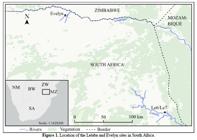
The floor of APS was recently excavated to explore its palaeontological, archaeological, taphonomic, and sedimentary contexts, which provide insight into a Later Stone Age (LSA) occupational episode, potentially associated with cut-marked bone. Our excavation of APS now extends the archaeological record of the Swartkrans Cave complex beyond the Middle Stone Age (MSA) of Member 4 (Sutton et al. 2009). LSA sites are rare in the surrounding Cradle region, and it is thus important to increase resolution on forager lifeways in an area occupied by human ancestors for ~3.5 million years (Granger et al. 2015). In this context, APS preserves an important record of Late Pleistocene to Holocene forager occupation, which may be compared chronologically with earlier archaeological assemblages from Member 1-4, and with nearby LSA sites in the Magaliesberg to better understand patterns of technological variation and mobility.
2. Background
After Andrew Phaswana identified fossils and stone tools on the floor of the APS entrance, the site was further inspected in 2018 by other members of the SPRP. At that time, fossiliferous masses of breccia adhering to the roof and walls were identified, and it was also recognised that the APS floor overlies an extensive underground cave network, which is currently being mapped and explored. However, particularly intriguing was the nature of the APS surface materials, including the predominance of Procaviidae (rock hyrax) fossils and stone tools that were remarkably fresh in appearance. These factors suggested to us an archaeological assemblage of relatively recent derivation, most likely representing a Late Pleistocene to Holocene occupational episode. Initial excavation of APS deposits was conducted from 2019 to 2020.
The Cradle is known for its Late Pliocene to Early Pleistocene palaeontological and archaeological records (e.g., Kuman 2007, 2023; Kuman & Field 2009), while younger sites that record more recent human activity are scarce and understudied (Caruana & Stratford 2019). Middle Stone Age (MSA) lithic assemblages have been recovered from Swartkrans Cave in the Member 4 infill (<110 000±1980; Sutton et al. 2009). Excavations of the post-Member 6 infill and Lincoln Cave (252 600±35 600-115 300±7700; Reynolds et al. 2003, 2007) at Sterkfontein also yielded MSA lithic assemblages. Although the assemblages are small and from disturbed sedimentary contexts (Kuman 1994; Ogola 2009), they are of particular interest for the site formation and disturbance information. Plovers Lake was also thought to contain MSA lithics, Pleistocene faunas, and human remains dating between 62.9±1.3-88.7±1.6 ka (de Ruiter et al. 2008; Brophy et al. 2014). However, subsequent genetic testing on human postcranial elements and bovid teeth, in combination with radiocarbon dating, from the supposed MSA unit at Plovers, revealed that this material in fact dated to the Iron Age period at ~500 years old (Lombard et al. 2019).
For the Later Stone Age (LSA), there are only a few rock shelters, including Jubilee (6490±200 and 3100±150 BP), Cave James (6130±110-3870±50 BP), and Cave Elizabeth, which are all situated in the Magaliesberg mountain range (Wadley 1986, 1989, 1996). These sites are interpreted as seasonal hunter-gatherer occupational localities related to periods of aggregation and dispersion, before and after contact with Bantu-speaking agropastoralists (Wadley 1996). In her exploration of Jubilee and Cave James, Wadley (1986, 1989, 1996) noted important differences in cultural markers of these penecontemporaneous localities. The LSA record at Jubilee contains an abundance of formal tool types (i.e., segments, backed bladelets, and scrapers) often made using raw material sources from 20 to 30 km distant, as well as bone points, bone spatulas, and ostrich (Struthio camelus) eggshell beads. In contrast, the lithic assemblage from Cave James is described as unstandardised and contains few retouched pieces (Wadley 1989, 1996). Wadley (1989: 42) further suggests that tools from this locality were generally "expediently produced" using local raw materials (i.e., quartz and quartzite), and unassociated with other cultural materials, such as bone tools or ostrich eggshell beads (cf. Wadley 1996). To interpret these differences, Wadley (1986, 1989, 1996) turned to the ethnographic record of the Kalahari San, noting that they establish seasonal camps based on periods of aggregation (i.e., when multiple bands come together to share resources) and dispersion (i.e., when individual bands separate to exploit local resources).
In contrast to these mountainous LSA sites, Swartkrans Hill (on which APS is positioned) is situated in the Highveld Grasslands to the south of the Magaliesberg. The Magaliesberg is an ecotone separating the grasslands to the south (occupying a large portion of the South African interior) and the savannahs to the north, which extend into eastern Africa (Carruthers 2014; Lombard et al. 2021, 2023). As such, occupation of the Magaliesberg range may have offered strategic advantages for hunting and gathering opportunities, due to the abundance of foodplants, water and the bottlenecking of migratory animal herds through the six poorts (erosional gaps along the mountain) (Mason 1957; Lombard et al. 2021, 2023).
Within this ecological setting, the LSA occupation at APS may provide insights into the habitation of the grassland biome, near to the strategic settings of the Magaliesberg ecotone. While complicated by complex site formation processes, investigating any potential causal links between the archaeological and palaeontological assemblages may provide perspective on technological and behavioural variability characterising the LSA record of the Cradle. Assessing the assemblages and context of APS allows us to further develop insights into chronological change in technology, via comparisons with lithic collections from Members 1-4, as well as any variation in cultural materials possibly related to ecological settings.
3. Methods
Excavation protocols
We used a Nikon Nivo 5.C total station to install and assign local grid coordinates (X: 200, Y: 100, Z: 50) to five permanent datums inside APS and then established a 2x3 m excavation grid in the middle of the cave floor. Given the lack of observable stratigraphy, we excavated squares in 50x50 cm quadrants and in arbitrary 5 cm spits. All artefacts, bones, and other materials measuring over 2 cm in length were piece-plotted and assigned coordinates with the total station and bagged separately with provenance labels. We used 5- and 2-mm sieves to capture any remaining archaeological materials. At the base of each 5 cm spit, surfaces were photographed for documentation, and sediments were described to help identify any stratigraphic change. Excavation efforts were subsequently limited after 2020, when the bridge to Swartkrans Hill over the Bloubank River was washed away, which restricted our access to APS. This restriction has considerably set back plans for further excavations and chronological analyses.
Site formation and stratigraphic analyses
Deposits exposed in the APS cavity were qualitatively described in terms of their basic structure, stratigraphy and geometry to establish distribution within the cavity, sequence position, filling direction and major sedimentary process. This is an initial step towards formal facies description and sedimentological analysis. Characteristics prioritised include clast lithology, size, sorting, shape and organisation within the deposits (including fabric). Matrix texture, structure, stratigraphy, degree of induration, were also assessed. Evidence of organic matter content and bioturbation were noted for unindurated sediments.
Macrofaunal analysis
The macrofaunal analysis focused on the larger, more readily identifiable piece-plotted remains. Specimens from sieve residue will be analysed in future studies. Aided by the comparative osteology reference collection housed in the Evolutionary Studies Institute (ESI) at the University of the Witwatersrand (Johannesburg, South Africa), all specimens were identified to the most precise taxonomic and skeletal element level possible. Several levels of taxonomic identifiability were utilised, ranging in precision from broad categories such as Mammalia or Aves down to family (e.g., Bovidae), tribe (e.g., Antilopini) or, when possible, genus and species. Many specimens, based on overall size and/or cortical bone thickness, could also be assigned to a mammal size group (Brain 1974; Klein 1976; Bunn 1982). The maximum length of all specimens was recorded to the nearest millimeter with a tape measure. Bone surfaces were examined closely with 10x hand lenses and a strong oblique light source to identify modifications such as cut marks, percussion marks, and tooth marks (Blumenschine et al. 1996). Bone breakage was characterised as green (fractures that occurred when the bone still retained moisture and/or soft tissue), dry (fractures that occurred when the bone no longer retained moisture and/or soft tissue), recent (fractures that occurred while or after the specimen was extracted from the sedimentary matrix), unknown, or some combination of these types (Villa & Mathieu 1991). Bone flakes and notches were also identified. The former are specimens with platforms and bulbs analogous to those produced through conchoidal lithic fracture, while the latter appear as arcuate indentations associated with negative flake scars on the medullary surface. Both are produced when humans and carnivores breach the marrow cavities of long bones with hammerstones or dentitions, respectively (Capaldo & Blumenschine 1994).
Micromammalian analysis
Microvertebrate (i.e., vertebrates of less than 300-500 g live weight) remains were recovered from the 2 mm screen residues. The analysis focused on identifying the various taxa constituting the micromammalian spectrum. Therefore, only the most diagnostic elements were selected for study: i.e., primarily cranio-dental remains and select postcranial bones with distinctive morphology, such as humeri of bats and golden moles. Identification was facilitated through comparative analysis with fossil specimens housed in the ESI collections and modern reference specimens from the Ditsong National Museum of Natural History (Pretoria, South Africa), as well as an identification key (Linchamps et al. 2023). Taxonomic determinations of rodents were carried out to the most discrete possible taxonomic unit, contingent upon the preservation state of the specimens and the presence of diagnostic characters. For shrews, golden moles and bats, a conservative identification at the order or family level was favoured, pending more detailed taxonomic assessment.
Lithic analysis
The assemblage was measured and described to characterise typo-technological trends using a combination of analytical approaches outlined in Inizan et al. (1999), Wurz (2002), Soriano et al. (2007), Porraz et al. (2013), Wilkins et al. (2017), and Shea (2020). The purpose of our analysis was to characterise lithic production strategies to facilitate comparisons with other LSA sites in the Cradle Region and beyond. Raw materials were identified and properties recorded, including colour, groundmass texture, grain size and sorting (Stout et al. 2005). Weathering patterns, including patination, as well as the presence of damage to tool edges and the degree of abrasion on both tool edges and flake scar ridges, were recorded to assess patterns of post-depositional disturbance (Wilkins et al. 2017).
Artefacts were initially sorted into typological classes, including cores, debitage (i.e., flakes and core management removals), retouched pieces (e.g., scrapers and denticulates), and debris (i.e., undiagnostic knapping waste >/<2 cm) (Wurz 2002; Porraz et al. 2013; Wilkins et al. 2017). All artefacts were subsequently measured (maximum length, width and thickness) using Mitutoyo digital calipers to the nearest 0.01 mm and weighed with a digital scale to the nearest 0.01 g, while debris were only measured for length and weight (Wilkins et al. 2017). The amount and location of cortical surfaces were inspected to characterise blank selection (i.e., clasts, pebbles, cobbles or boulders) (Wilkins et al. 2017). Tool blank types were assessed to understand selection processes within and between typological classes, as was the level of artefact completeness (i.e., complete, fragmented, split, etc.) (Wurz 2002; Porraz et al. 2013).
Cores are particularly important for understanding lithic production strategies, specifically in terms of platform and flake surface preparation, which demonstrates levels of planning depth and curation (Railey 2010; Shea 2020). Characterising reduction systems is thus important for regional comparisons that may help contextualise observed variation in tool types and interpretations regarding site function. Cores were first categorised into reduction systems according to the number of knapped faces, which included unifacial, bifacial and multifacial groups (Inizan et al. 1999; Diez-Martín et al. 2012). These systems were further differentiated by exploitation strategies, which assessed the orientation of flake scars (isolated, parallel, centripetal, convergent, orthogonal or divergent), their directionality (uni- or bidirectional, sub-radial or centripetal), as well as the angle of percussion (secant, perpendicular or parallel) (Diez-Martín et al. 2012). Bifacial cores were further differentiated according to the alternate, alternating and continuous rotation patterns of worked edges (Sánchez-Yustos et al. 2017). Alternate removal patterns do not reflect structure or patterning related to the sequence of core rotation throughout reduction sequences, whereas alternating patterns imply cores are rotated after each removal, thereby having two core faces that are knapped interchangeably. Continuous patterns denote that one surface was exploited first, then the core was rotated, and the opposing surface was then flaked (Sánchez-Yustos et al. 2017).
Debitage pieces were initially sorted by type (cortical, non-cortical, core management, or prepared) to understand their relationship with core reduction strategies, and then by the knapping method (i.e., freehand or bipolar) (Wurz 2002; Porraz et al. 2013; Wilkins et al. 2017). Dorsal scar counts and directionality (uni- or bidirectional, sub-radial or centripetal) were analysed to further assess core rotation patterns (Inizan et al. 1999; Wurz 2002; Wilkins et al. 2017). Platforms were measured (width, thickness and exterior angles) and characterised by types (cortical, plain, dihedral, faceted, focal or crushed) and morphologies (linear, curved, trapezoidal, ovular, triangular and punctiform) to assess flake detachment preparation (Inizan et al. 1999; Soriano et al. 2007). Termination types (feather, stepped, hinged, overshoot and plunging) were recorded to determine the success rates of flake detachments (Inizan et al. 1999; Wilkins et al. 2017). Complete flakes were recorded for shape in planview (expanding, parallel or convergent) and in profile (symmetrical, amorphous) to further investigate any intentional production of specific morphological types (Wilkins et al. 2017).
Retouched pieces were separated into scraper, notched and denticulate categories, and then distinguished by the number, angle and patterns of edge modifications (Inizan et al. 1999; Shea 2020). The longest retouched edges were measured in terms of their length, to the nearest 0.01 mm using Mitutoyo digital calipers, and angle using a goniometer (Wilkins et al. 2017). Retouch morphologies (stepped, scalar, notched, parallel and backing), initiation (ventral, dorsal or bifacial), extent (marginal or invasive), as well as distribution (continuous, discontinuous or clustered) patterns were analysed to characterise edge modification patterns (Inizan et al. 1999). The number and type of notches, including simple (a concavity formed through a single retouch scar) and complex (a concavity formed through two or more retouch scars), were also recorded to assess their frequency and production trends, as was the angle (degrees) of edges.
4. Results
Site formation & stratigraphy
Our excavation removed ~160 cm3 of sediment, reaching depths of 20 cm towards the north portion of the excavation and 30 cm towards the south. In general, the APS site occupies a secondary cavity, formed by the erosion and collapse of the proximal portion of a large, indurated primary talus deposit that filled a larger original cave chamber to its roof. The original cave is now mostly deroofed, with breccias (indurated clastic sediments) exposed on the landscape surface around the APS cavity. Weathered, fossiliferous breccias are exposed at the sides of the short, heavily vegetated, northern approach to the site. The cavity is accessed via a low entrance comprised of breccia that represents the southern limit of the site (Fig. 2). Inside APS cave, lithologically variable, fossiliferous breccias comprise the eastern, northern (Fig. 3) and southern walls, extending from the floor to the roof. The ceiling of the cavity is partially composed of breccias in the west, where they still adhere to the original chamber roof. In the central and eastern ceiling, steeply N- and NE-dipping dolomite is exposed, representing the primary cave chamber roof (Fig. 3). Weathered and eroded speleothem drapery and pockets of adhering breccia on the dolomite roof indicate the continuity of primary talus breccia across the volume that is now a cavity. Several geological and structural features exposed in the dolomite roof suggest multigenerational controls on the original chamber and primary talus formation, as well as subsequent hydrological processes that led to the decalcification, erosion and collapse of primary talus breccias, which formed the secondary APS cavity. A brief description of these controls is provided below, but further analysis is required to expand our understanding of the primary chamber and associated cave network, which extends both N and NE tens of meters below the APS floor.
The N-NE dipping dolomite is typical of the southern extents of the Malmani Subgroup dolomites that formed within the Transvaal Basin about 2.5 billion years ago (Eriksson et al. 2001; Martini et al. 2003) as part of the basin evolution process. The dip of the dolomite roof in the APS cavity is particularly steep and may represent localised, increased deformation. Two shale interbeds exposed in the roof may have been primary weaknesses that defined the shape and extent of the roof of the original chamber. The roof has, and continues to, weather at the contact of these beds releasing slab-shaped dolomite blocks and platy shale particles (slabs can be seen on the floor in Figure 3). Two fractures are also exposed in the dolomite roof. An ENE-WSW orientated fracture is filled with silica, calcite and, in the west, roots. The passage to the lower reaches of the APS chamber follows this fracture direction and descends initially at the contact between the talus and the roof for the first 5-6 m. The various fracture fillings suggest it has made long-term structural contributions to primary karst cave formation, as well as cave opening position, typical in southern Cradle caves like Sterkfontein (Martini et al. 2003; Stratford 2020). This fracture has reactivated numerous times and influenced the long-term local hydrological processes that have contributed to the shape of the original chamber, formation and induration of the primary talus, and more recent decalcification and erosion of the central proximal portion of the talus, which created the APS cavity. A more northern, unfilled fracture radiates from the central western roof in a NE-SW direction, indicating that recent subsidence of the cave roof and more modern, local hydrological activity influenced the APS cavity formation. Generally, primary talus sediments in the north and western wall are more decalcified than the south, suggesting the main pathway for modern fluid movement.
The indurated primary talus deposit, in which the APS cavity has formed, represents the southern, northern, and western walls and adheres to the roof in the western side of the cave. The N and NE-dipping clast fabric and exposure of the contact between the primary talus and original cave roof indicates the APS cavity formed in the proximal reaches of the deposit, close to its apex, below the original chamber entrance. The original entrance is likely to have been located at the southern boundary of the chamber, as suggested by the N and NE extending chamber below APS and a flowstone exposed in the southwest corner of the APS cavity, which thins rapidly in a N and NE direction. A small opening to the landscape surface is now present where erosion has truncated the original chamber roof. The fossiliferous, indurated primary talus is characterised by various clastic facies, including clast-supported chaotically organised deposits in the western and northern walls with boulder-sized clasts representing part of an entrance choke feature (Fig. 3), and weakly bedded matrix-supported sediments with interstratifying flowstones exposed along the southern wall (Fig. 2). Acknowledgement of variability in the lithology of the primary talus is important at APS because the constituent chemical and clastic components will have contributed significantly to the composition of the floor deposits being excavated in the following ways: (1) in situ sediments of the primary talus may be encountered as excavations descend onto un-collapsed parts of this deposit. Later, allogenic LSA-bearing sediments will have potentially contaminated these deposits; and (2) ex situ sediments from the primary talus adhering to the walls and roof will have accreted onto the floor of the shelter during the formation of the secondary cavity, potentially consistently accumulating with allogenic LSA-bearing sediments. This complex combination of sedimentation processes may significantly affect the faunal assemblage composition recovered through excavation.
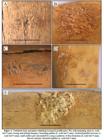
The APS cavity is relatively accessible and is currently inhabited by a range of animals, including porcupines (Hystrix africaeaustralis) and birds. Roots and geophytes, such as bulbs and tubers, descend from the western end of the roof, and modern water ingress has eroded and weathered primary talus sediments and flowstones close to the opening, and decalcified sediments in the western and northern walls. This dynamic space is prone to significant turbative processes; unsurprisingly, the shallow exposed profile of square 198/99 shows no internal stratification, but has extensive bioturbative features (Fig. 4), including fibrous root penetration and small burrows. The sediment exposed in the profile is a matrix-supported siliciclastic silty sand with interspersed variably sized, sub-angular to sub-rounded clasts of decayed dolomite and occasional modern (non-Pleistocene) organic particles (detrital and potentially artefactual), and lithic artefacts attributed to the LSA.
Macrofauna
The analysed APS macrofaunal assemblage consists of 1111 specimens (Table 1). Of this total, 216 (19.4%) are <2.5 cm in maximum dimension and the average specimen length is 3.5 cm. Preservation is generally good, although many bone surfaces are affected by manganese precipitates and some retain calcified sediment matrix. Table 1 summarises the taxonomic representation in terms of Number of Identified Specimens (NISP) and Minimum Number of Individuals (MNI). Over half (53.6%) of the assemblage is identifiable only as mammal. Bovidae is the most common taxonomic family; of those bovid specimens that could be identified to tribe, Alcelaphini and Antilopini are the most abundant. The single most common species is the rock hyrax, Procavia capensis, which, based on dentitions, is represented by a minimum of nine individuals. Suidae and Equidae remains are present but rare. A handful of carnivores are represented, including one Cape fox (Vulpes chama). Bird remains, including four ostrich eggshell fragments, are also present in the assemblage at a very low frequency.
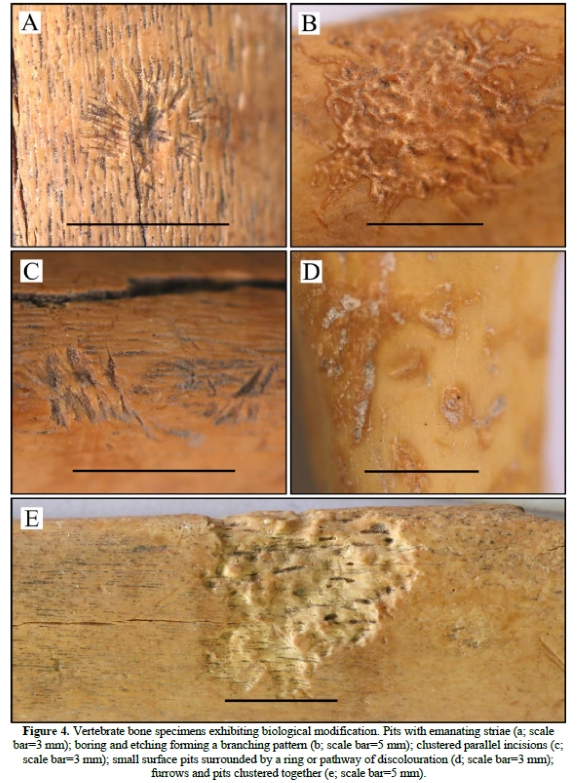
Cut marks from human butchery occur on 24 specimens (e.g., Fig. 5a; Table 2). Most of the cut-marked specimens (n=23) are ribs or long bones. Percussion marks appear on 13 specimens (e.g., Fig. 5b). Bone flakes (n=11) and specimens with notches (n=36) appear in the assemblage as well. Tooth marks were identified on 66 specimens, and all such marks are consistent with those produced by terrestrial carnivores (e.g., Fig. 5c), with many likely imparted by fox- or jackal-sized animals. Green fractures are common in the APS assemblage (Table 3). The next most common breakage type is recent. The bone assemblage includes specimens in various states of fossilisation, and one specimen even preserves desiccated soft tissue.
Micromammals
The APS fossil micromammal assemblage comprises a minimum of 91 individuals, based on 211 identifiable specimens (Table 4). Included are at least 22 taxa belonging to five orders: Afrosoricida (golden moles), Chiroptera (bats), Eulipotyphla (shrews), Macroscelidea (elephant-shrews), and Rodentia (rodents). Rodents represent the most abundant, taxonomically diverse group, with at least 16 identified genera belonging to four families: Bathyergidae (mole-rats, two genera), Gliridae (dormice, one genus), Muridae (mice, rats, and gerbils, eight genera), and Nesomyidae (climbing mice, fat mice, white-tailed rats, five genera). The micromammalian community is dominated numerically by shrews (16.5% of MNI) and the rodents Mystromys (15.4%) and Otomys (12.1%) (Fig. 6).
The micromammal assemblage also includes a mixture of extinct and extant species, exemplified by the simultaneous presence of both the fossil and modern forms of Mystromys - namely, the small-sized †M. hausleitneri and the larger extant M. albicaudatus. Other fossil species identified in the assemblage include †Proodontomys cookei, †Malacothrix makapani, and †Dasymys bolti. Additionally, one specimen of Rattus rattus, an invasive species recently introduced into South Africa, was recovered.
As with the macrofaunal remains, the micromammal fossils display varying degrees of fossilisation. The majority of specimens are fully mineralised, exhibiting a dark brown coloration and a thin manganese coating typical of most fossil micromammal assemblages from the Cradle area. In contrast, some specimens appear to have accumulated much more recently, likely originating from owl pellets that recently became incorporated into the sediment. Finally, a few specimens fall into an intermediate preservation state, mineralised but lacking surface encrustation and with a beige coloration.
Lithics and other cultural materials
Table 5 provides typological frequencies of the lithic assemblage (n=2820) excavated from APS, which is dominated by vein quartz (n=2480; 87.9%), followed by quartzite (n=213; 7.6%), chert (n=81; 2.9%), andesite (n=31; 1.1%), sandstone (n=13; 0.5%) and slate (n=2; 0.1%) lithologies. In terms of procurement strategies, the majority of these toolstone types are found locally (~100 m of APS) in the Bloubank River gravels (i.e., vein quartz, chert, sandstone and quartzite), while andesite and slate outcrops are located within a ~5 km radius. Weathering patterns show that most lithic elements are fresh (n=2594; 92%), while the remaining are either slightly abraded (n=195; 6.9%) or decayed (n=31; 1.1%), the latter category reflecting the natural degradation of andesite in the APS sediments.
The lithic assemblage is dominated by debris elements (n=1964; 69.6%), followed by smaller frequencies of debitage (n=722; 26%), cores (n=78; 2.8%), retouched pieces (n=14; 0.5%), manuports (n=31; 1.1%) and percussive tools (n=3; 0.1%) (Fig. 7). Core reduction was mostly carried out through unifacial strategies (n=18; 0.6%) averaging 3.2 flake removals, along with bipolar strategies (n=12; 0.4%) averaging 1.7 flake removals, which denotes an expedient reduction system. Complete flakes show unidirectional (n=125; 86.8%) and bidirectional (n=25; 13.2%) scar orientations, suggesting core rotation patterns were infrequent, which further corroborates expediency in blank production. The average dimensions of complete flakes are 41.04x28.91x10.33 mm (L, W and T, respectively) and weigh an average of 16.07 g. Retouched pieces (n=14; 0.5%) show a mix of steep scraper retouch (~67.8°) and complex notching (~63°), albeit are low in frequency. Other cultural materials include 27 pieces of ochre, two of which show faceting, along with 11 pieces of ostrich eggshell fragments, and two quartz crystals (Fig. 7h-j).
5. Discussion and Conclusion
The complex origin of APS provides an example of secondary cavity formation in which sediments from different periods of accumulation now comingle. It is important to note such complex site formation histories, as the slow decalcification of primary breccia bodies have resulted in clastic particles (ranging in size from individual grains to breccia aggregates and large clasts) detaching from the roof and walls, which mixed with sediments and artefacts that accumulated during the Holocene. Fossil components of these breccia bodies have also been incorporated into the floor deposits, and the mammalian fossil assemblages have mixed, now representing a conflation of taxa from different geological periods.
Despite this complex mixing, patterned trends in taxonomic representation and bone breakage exist. Taxonomically informative macrofauna are dominated by open habitat bovids such as Alcelaphini and Antilopini (see Table 1). Green bone breakage is extensive among the macrofaunal remains, which indicates that this assemblage holds the potential to inform about bone-accumulating biological agents (see Table 3). For example, evidence of human subsistence behaviour is preserved in the form of cut marks, percussion marks, and hammerstone breakage (see Table 2; Fig. 5). Similarly, tooth-marked specimens indicate that carnivores were also involved in the formation of the macrofaunal bone collection. Yet, temporal mixing is revealed by the wide range of fossilisation stages observed within the faunal assemblage.
The composition of the microvertebrate accumulation, including both extinct and extant taxa, also shows a mixture of faunas from different periods (see Table 4; Fig. 6). Specimens with advanced fossilisation display features typical of most Plio-Pleistocene assemblages from the Cradle area, including a predominance of Mystromys and Otomys and the presence of several extinct rodent species (e.g., Avery 2001; Linchamps et al. 2024). In contrast, remains that appear to have accumulated more recently exhibit characteristics of (sub)modern micromammalian communities, including the presence of the alien R. rattus and a high proportion of Mastomys (Linchamps et al. 2025). Careful consideration of the stratigraphic relationship and integrity of mammalian remains is necessary before any meaningful paleoenvironmental information can be formulated.
On the other hand, the state of preservation and composition of the lithic assemblage, along with ostrich eggshell fragments and ochre, suggests that the cultural remains represent a temporally constrained assemblage, likely associated with the LSA (see Table 1; Fig. 7). The stone tool assemblage at APS is macrolithic in nature, produced through expedient patterns of core reduction on locally available raw materials. Diagnostic Earlier Stone Age and MSA tools, such as handaxes or blades and points, are absent, and the fresh appearance of the assemblage in shallow depths supports a more recent depositional history. Furthermore, the typological profile of the APS assemblage is similar to that of Cave James (Wadley 1996), which is also dominated by flakes and cores, although the retouch component is slightly higher when compared to APS.
Wadley interpreted Cave James as a dispersion camp, albeit other cultural materials at APS, including ochre, ostrich eggshell and quartz crystals, demonstrate affinities to the Jubilee assemblage, representing an aggregation locality (Wadley 1986, 1989, 1996). Yet, the dynamics of site function should be cautioned at this point given the complex nature of sediment formation at APS, because we cannot exclude the possibility that cultural materials accumulated outside the cavity and were subsequently washed into the deposit. The incorporation of fossil materials derived from erosion of older breccia bodies that have mixed within the APS floor sediments appears similar to site formation conditions described for the Post Member 6 infill (Kuman & Clarke 2000; Ogola 2009) and the Lincoln Cave deposits (Reynolds et al. 2003, 2007), and both MSA deposits at Sterkfontein Caves. Such complex sedimentation dynamics at karst Cradle sites warrant caution in understanding the relationship between fossil and stone tool assemblages subject to mixing with decalcification and erosion of older breccias.
Nonetheless, the occupation of APS (or near its entrance) may relate more to the logistics of subsistence activities, rather than social traditions. The abundance of foodplants in the Cradle area differs dramatically when compared to the Magaliesberg ecotone. In fact, Lombard et al. (2023) compared the frequency of plant foods within the Magaliesberg to the Cradle using a three-tier foraging radius distance method (at 12.5 km, 35 km and 70 km), based on ethnographic accounts of daily southern African hunter-gatherer ranges. Although the foraging range of the Magaliesberg was likely restrictive due to its topography, 511 plant foods could be found within a 12.5 km radius, compared to 326 found in the Cradle grasslands at the same scale (Lombard et al. 2023). Therefore, the occupation of APS, within the grasslands, may represent a satellite camp, potentially based on the collection of cultural goods that could be transported, or occupied for hunting, or both. The causal link between expedient stone tools and cut-marked and percussed bones may reflect basic subsistence in short-term occupational episodes that accompanied the group's hunting and foraging activities.
Acknowledgements
All excavations were carried out under SAHRA permits 2598 and 3291. We are grateful to A. Phaswana for identifying the significance of APS and his overall contribution towards the Swartkrans Palaeoanthropological Research Project. General support for Swartkrans excavations came from grants awarded to TRP from the LSB Leakey Foundation and the Palaeontological Scientific Trust (PAST, South Africa); special thanks to Gordon Getty and Paddy Moore at the former organisation, and to Rob Blumenschine and the late Andrea Leenen at the latter. We thank Profs Marion Bamford and Bernhard Zipfel for their approval of access to Swartkrans, as well as Dr. Sifelani Jirah for managing curating of the APS finds. Assistance from the Sterkfontein technicians was funded by DS's grants from DSI-NRF African Origins Platform funding. CPE was supported by the College of Arts and Sciences International Travel Fund, Office of Research and Engagement, Global Engagement Office Kohler Fund, and the Department of Anthropology Kupferer-Outwin Endowment (all at UNCG). KK and RJC also thank PAST, GENUS and Oppenheimer Generations for grants that have supported both lab and fieldwork costs for Swartkrans, including the APS. We thank our reviewers, including Dr. Sara E. Rhodes, for their helpful comments. This is paper no. 11 in the Swartkrans Paleoanthropology Research Project publication series.
References
-
Avery, D.M. 2001. The Plio-Pleistocene vegetation and climate of Sterkfontein and Swartkrans, South Africa, based on micromammals. Journal of Human Evolution, 41(2): 113-132. https://doi.org/10.1006/jhev.2001.0483.
» https://doi.org/10.1006/jhev.2001.0483 -
Blumenschine, R.J., Marean, C.W. & Capaldo, S.D. 1996. Blind tests of inter-analyst correspondence and accuracy in the identification of cut marks, percussion marks, and carnivore tooth marks on bone surfaces. Journal of Archaeological Science, 23(4): 493-507. https://doi.org/10.1006/jasc.1996.0047.
» https://doi.org/10.1006/jasc.1996.0047 - Brain, C.K. 1958. The Transvaal Ape-Man-Bearing Cave Deposits. Pretoria: Transvaal Museum.
-
Brain, C.K. 1974. Some suggested procedures in the analysis of bone accumulations from southern African Quaternary sites. Annals of the Transvaal Museum, 29(1): 1-8. https://hdl.handle.net/10520/AJA00411752_213.
» https://hdl.handle.net/10520/AJA00411752_213 - Brain, C.K. 1981. The Hunters or the Hunted?: An Introduction to African Cave Taphonomy. Chicago: University of Chicago Press.
- Brain, C.K. 1993. Swartkrans: A Cave's Chronicle of Early Man. Pretoria: Transvaal Museum.
-
Brophy, J.K., de Ruiter, D.J., Athreya, S., et al. 2014. Quantitative morphological analysis of bovid teeth and implications for paleoenvironmental reconstruction of Plovers Lake, Gauteng Province, South Africa. Journal of Archaeological Science, 41: 376-388. https://doi.org/10.1016/j.jas.2013.08.005.
» https://doi.org/10.1016/j.jas.2013.08.005 - Bunn, H.T. 1982. Meat-eating and human evolution: Studies on the diet and subsistence patterns of Plio-Pleistocene hominids in East Africa. Doctoral Thesis. Berkeley: University of California.
-
Capaldo, S.D. & Blumenschine, R.J. 1994. A quantitative diagnosis of notches made by hammerstone percussion and carnivore gnawing on bovid long bones. American Antiquity, 59(4): 724-748. https://doi.org/10.2307/282345.
» https://doi.org/10.2307/282345 -
Caruana, M.V. & Stratford, D.J. 2019. Historical perspectives on the significance of archaeology in the Cradle of Humankind, South Africa. South African Archaeological Society Goodwin Series, 12: 44-55. https://search.informit.org/doi/10.3316/informit.479376156376298.
» https://search.informit.org/doi/10.3316/informit.479376156376298 - Carruthers, V. 2014. The Magaliesberg Biosphere. Third Edition. Pretoria: Protea Books.
-
de Ruiter, D.J., Brophy, J.K., Lewis, P.J., et al. 2008. Faunal assemblage composition and paleoenvironment of Plovers Lake, a Middle Stone Age locality in Gauteng Province, South Africa. Journal of Human Evolution, 55(6): 1102-1117. https://doi.org/10.1016/j.jhevol.2008.07.011.
» https://doi.org/10.1016/j.jhevol.2008.07.011 -
Diez-Martín, F., Cuartero, F., Sánchez-Yustos, P., et al. 2012. Testing cognitive skills in early Pleistocene hominins and concepts of hierarchization and predetermination. In: Domínguez-Rodrigo, M. (ed.) Stone Tools and Fossil Bones: 245-309. Cambridge: Cambridge University Press. https://doi.org/10.1017/CBO9781139149327.012.
» https://doi.org/10.1017/CBO9781139149327.012 -
Eriksson, P.G., Altermann, W., Catuneanu, O., et al. 2001. Major influences on the evolution of the 2.67-2.1 Ga Transvaal basin, Kaapvaal craton. Sedimentary Geology, 141: 205-231. https://doi.org/10.1016/S0037-0738(01)00075-6.
» https://doi.org/10.1016/S0037-0738(01)00075-6 -
Granger, D.E., Gibbon, R.J., Kuman, K., et al. 2015. New cosmogenic burial ages for Sterkfontein Member 2 Australopithecus and Member 5 Oldowan. Nature, 522(7554): 85-88. https://doi.org/10.1038/nature14268.
» https://doi.org/10.1038/nature14268 - Inizan, M.L., Reduron-Ballinger, M., Roche, H., et al. 1999. Technology and Terminology of Knapped Stone. Préhistoire de la Pierre Taillée 5. Paris: CREP.
-
Klein, R.G. 1976. The mammalian fauna of the Klasies River Mouth Sites, southern Cape province, South Africa. South African Archaeological Bulletin, 31: 75-98. https://doi.org/10.2307/3887730.
» https://doi.org/10.2307/3887730 -
Kuman, K. 1994. The archaeology of Sterkfontein - past and present. Journal of Human Evolution, 27: 471-495. https://doi.org/10.1006/jhev.1994.1065.
» https://doi.org/10.1006/jhev.1994.1065 - Kuman, K. 2007. The Earlier Stone Age in South Africa: Site context and the influence of cave studies. In: Pickering, T.R., Schick, K. & Toth, N. (eds) Breathing Life into Fossils: 181-198. Gosport, IN: Stone Age Institute Press.
-
Kuman, K. 2023. Cradle of Humankind, South Africa. In: Beyin, A., Wright, D.K., Wilkins, J., et al. (eds) Handbook of Pleistocene Archaeology of Africa: 1349-1365. Switzerland: Springer. https://doi.org/10.1007/978-3-031-20290-2_87.
» https://doi.org/10.1007/978-3-031-20290-2_87 -
Kuman, K. & Clarke, R.J. 2000. Stratigraphy, artefact industries and hominid associations for Sterkfontein, Member 5. Journal of Human Evolution, 38(6): 827-847. https://doi.org/10.1006/jhev.1999.0392.
» https://doi.org/10.1006/jhev.1999.0392 - Kuman, K. & Field, A.S. 2009. The Oldowan industry from Sterkfontein caves, South Africa. In: Schick, K. & Toth, N. (eds) The Cutting Edge: 151-170. Gosport, IN: Stone Age Institute Press.
-
Kuman, K., Sutton, M.B., Pickering, T.R., et al. 2018. The Oldowan industry from Swartkrans Cave, South Africa, and its relevance for the African Oldowan. Journal of Human Evolution, 123: 52-69. https://doi.org/10.1016/j.jhevol.2018.06.004.
» https://doi.org/10.1016/j.jhevol.2018.06.004 -
Kuman, K., Granger, D.E., Gibbon, R.J., et al. 2021. A new absolute date from Swartkrans Cave for the oldest occurrences of Paranthropus robustus and Oldowan stone tools in South Africa. Journal of Human Evolution, 156: 103000. https://doi.org/10.1016/j.jhevol.2021.103000.
» https://doi.org/10.1016/j.jhevol.2021.103000 -
Linchamps, P., Avery, D.M., Cornette, R., et al. 2023. Quaternary rodents of South Africa: A companion guide for cranio-dental identification. PLoS ONE, 18(11): e0289812. https://doi.org/10.1371/journal.pone.0289812.
» https://doi.org/10.1371/journal.pone.0289812 -
Linchamps, P., Stoetzel, E., Cornette, R., et al. 2024. Fossil micromammals and the palaeoenvironments of the Paranthropus robustus site of Cooper's Cave. Historical Biology, 36(5): 905-920. https://doi.org/10.1080/08912963.2023.2196677.
» https://doi.org/10.1080/08912963.2023.2196677 -
Linchamps, P., Stoetzel, E., Amberny, L., et al. 2025. New modern and Pleistocene fossil micromammal assemblages from Swartkrans, South Africa. Journal of Human Evolution, 200: 103636. https://doi.org/10.1016/j.jhevol.2024.103636.
» https://doi.org/10.1016/j.jhevol.2024.103636 -
Lombard, M., Lotter, M.G. & Caruana, M.V. 2021. Wonderboompoort, South Africa: A natural game funnel for meat harvesting during the later Acheulean. Journal of Archaeological Science: Reports, 39: 103193. https://doi.org/10.1016/j.jasrep.2021.103193.
» https://doi.org/10.1016/j.jasrep.2021.103193 -
Lombard, M., Lotter, M.G. & Caruana, M.V. 2023. The foodplant fitness landscape of Wonderboom and possible implications for Middle Pleistocene foragers of the Magaliesberg, South Africa. Archaeological and Anthropological Sciences, 15(10): 145. https://doi.org/10.1007/s12520-023-01836-y.
» https://doi.org/10.1007/s12520-023-01836-y -
Lombard, M., Malmström, H., Schlebusch, C., et al. 2019. Genetic data and radiocarbon dating question Plovers Lake as a Middle Stone Age hominin-bearing site. Journal of Human Evolution, 131: 203-209. https://doi.org/10.1016/j.jhevol.2019.03.014.
» https://doi.org/10.1016/j.jhevol.2019.03.014 -
Martini, J.E., Wipplinger, P.E., Moen, H.F., et al. 2003. Contribution to the speleology of Sterkfontein Cave, Gauteng Province, South Africa. International Journal of Speleology, 32(1): 43-69. http://dx.doi.org/10.5038/1827-806X.32.1.4.
» http://dx.doi.org/10.5038/1827-806X.32.1.4 -
Mason, R.J. 1957. Preliminary note on an earlier Stone Age site at Wonderboom South, Pretoria. South African Journal of Science, 53(17): 431-434. https://hdl.handle.net/10520/AJA00382353_2069.
» https://hdl.handle.net/10520/AJA00382353_2069 -
Ogola, C. 2009. The Sterkfontein western breccias: Stratigraphy, fauna and artefacts. Doctoral Thesis. Johannesburg: University of the Witwatersrand. http://hdl.handle.net/10539/7256.
» http://hdl.handle.net/10539/7256 -
Pickering, T.R., Heaton, J.L., Clarke, R.J., et al. 2012. New hominid fossils from Member 1 of the Swartkrans formation, South Africa. Journal of Human Evolution, 62(5): 618-628. https://doi.org/10.1016/j.jhevol.2012.02.003.
» https://doi.org/10.1016/j.jhevol.2012.02.003 -
Pickering, T.R., Heaton, J.L., Sutton, M.B., et al. 2016. New early Pleistocene hominin teeth from the Swartkrans formation, South Africa. Journal of Human Evolution, 100: 1-15. https://doi.org/10.1016/j.jhevol.2016.08.005.
» https://doi.org/10.1016/j.jhevol.2016.08.005 -
Pickering, T.R., Cazenave, M., Clarke, R.J., et al. 2025. First articulating os coxae, femur, and tibia of a small adult Paranthropus robustus from Member 1 of the Swartkrans Formation, South Africa. Journal of Human Evolution, 201: 103647. https://doi.org/10.1016/j.jhevol.2024.103647.
» https://doi.org/10.1016/j.jhevol.2024.103647 -
Porraz, G., Texier, P.J., Archer, W., et al. 2013. Technological successions in the Middle Stone Age sequence of Diepkloof rock shelter, Western Cape, South Africa. Journal of Archaeological Science, 40(9): 3376-3400. https://doi.org/10.1016/j.jas.2013.02.012.
» https://doi.org/10.1016/j.jas.2013.02.012 -
Railey, J.A. 2010. Reduced mobility or the bow and arrow? Another look at "expedient" technologies and sedentism. American Antiquity, 75(2): 259-286. https://doi.org/10.7183/0002-7316.75.2.259.
» https://doi.org/10.7183/0002-7316.75.2.259 -
Reynolds, S.C., Vogel, J.C., Clarke, R.J., et al. 2003. Preliminary results of excavations at Lincoln Cave, Sterkfontein, South Africa. South African Journal of Science, 99: 286-288. https://doi.org/10.10520/EJC97625.
» https://doi.org/10.10520/EJC97625 -
Reynolds, S.C., Clarke, R.J. & Kuman, K.A. 2007. The view from the Lincoln Cave: Mid- to late Pleistocene fossil deposits from Sterkfontein hominid site, South Africa. Journal of Human Evolution, 53(3): 260-271. https://doi.org/10.1016/j.jhevol.2007.02.004.
» https://doi.org/10.1016/j.jhevol.2007.02.004 -
Sánchez-Yustos, P., Diez-Martín, F., Domínguez-Rodrigo, M., et al. 2017. Diversity and significance of core preparation in the developed Oldowan technology. Boreas, 46(4): 874-893. https://doi.org/10.1111/bor.12237.
» https://doi.org/10.1111/bor.12237 -
Shea, J. 2020. Prehistoric Stone Tools of Eastern Africa. Cambridge: Cambridge University Press. https://doi.org/10.1017/9781108334969.
» https://doi.org/10.1017/9781108334969 -
Stratford, D. 2020. The geological setting, cave formation, and stratigraphy of the fossil-bearing deposits at Sterkfontein caves. In: Zipfel, B., Richmond, B.G. & Ward, C.V. (eds) Hominin Postcranial Remains from Sterkfontein: 8-20. Oxford: Oxford University Press. https://doi.org/10.1093/oso/9780197507667.003.0002.
» https://doi.org/10.1093/oso/9780197507667.003.0002 -
Stout, D., Quade, J., Semaw, S., et al. 2005. Raw material selectivity of the earliest stone toolmakers at Gona, Afar, Ethiopia. Journal of Human Evolution, 48(4): 365-380. https://doi.org/10.1016/j.jhevol.2004.10.006.
» https://doi.org/10.1016/j.jhevol.2004.10.006 -
Soriano, S., Villa, P. & Wadley, L. 2007. Blade technology and tool forms in the Middle Stone Age of South Africa. Journal of Archaeological Science, 34: 681-703. https://doi.org/10.1016/j.jas.2006.06.017.
» https://doi.org/10.1016/j.jas.2006.06.017 -
Sutton, M.B., Pickering, T.R., Pickering, R., et al. 2009. Newly discovered fossil- and artifact-bearing deposits at Swartkrans Cave, South Africa. Journal of Human Evolution, 57(6): 688-696. https://doi.org/10.1016/j.jhevol.2009.05.014.
» https://doi.org/10.1016/j.jhevol.2009.05.014 -
Villa, P. & Mahieu, E. 1991. Breakage patterns of human long bones. Journal of Human Evolution, 21(1): 27-48. https://doi.org/10.1016/0047-2484(91)90034-S.
» https://doi.org/10.1016/0047-2484(91)90034-S -
Wadley, L. 1986. Segments of time: A mid-Holocene Wilton site in the Transvaal. South African Archaeological Bulletin, 41: 54-62. https://doi.org/10.2307/3888190.
» https://doi.org/10.2307/3888190 -
Wadley, L. 1989. Legacies from the Later Stone Age. South African Archaeological Society Goodwin Series, 6: 42-53. https://doi.org/10.2307/3858131.
» https://doi.org/10.2307/3858131 -
Wadley, L. 1996. Changes in the social relations of precolonial hunter-gatherers after agropastoralist contact. Journal of Anthropological Archaeology, 15(2): 205-217. https://doi.org/10.1006/jaar.1996.0008.
» https://doi.org/10.1006/jaar.1996.0008 -
Wilkins, J., Brown, K.S., Oestmo, S., et al. 2017. Lithic technological responses to Late Pleistocene glacial cycling at Pinnacle Point Site 5-6, South Africa. PLoS ONE, 12(3): e0174051. https://doi.org/10.1371/journal.pone.0174051.
» https://doi.org/10.1371/journal.pone.0174051 -
Wurz, S. 2002. Variability in the Middle Stone Age lithic sequence at Klasies River, South Africa. Journal of Archaeological Science, 29(9): 1001-1015. https://doi.org/10.1006/jasc.2001.0799.
» https://doi.org/10.1006/jasc.2001.0799
Revised July 2026
Published September 2026