Ectodermal dysplasia
MAXILLOFACIAL RADIOLOGY
Ectodermal dysplasia
L MerboldI; Chané SmitII
IBChD, PGDipDent (Radiology), MSc (Maxillofacial Radiology), Department of Oral and Maxillofacial Pathology, School of Dentistry, Faculty of Health Sciences, University of Pretoria, South Africa. ORCID: 0000-0003-4041-127X
IIBChD, MSc (Maxillofacial Radiology), Department of Oral and Maxillofacial Pathology, School of Dentistry, Faculty of Health Sciences, University of Pretoria, South Africa. ORCID: 0000-0003-4047-6356
CASE
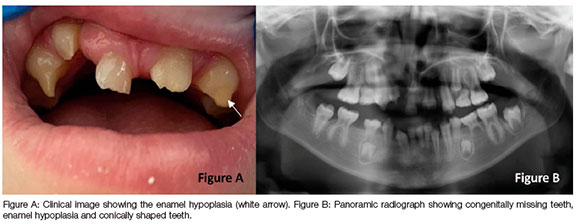
A 9-year-old female patient presented to the clinic with a main complaint of abnormally shaped and missing teeth. Upon clinical examination, the patient had a repaired cleft lip and palate and sparse hair of her eyebrows. Intraoral and radiological examination revealed generalised enamel hypoplasia, multiple conical-shaped teeth and multiple congenitally absent teeth.
INTERPRETATION
Ectodermal dysplasia (ED) characterises a group of disorders where two or more structures derived from the ectoderm exhibit developmental disturbances.122314
The head and neck manifestations of ED include the following:1-3
• Enamel hypoplasia
• Malformed teeth (teeth that are smaller and pointed)
• Anodontia or hypodontia
• Malocclusion or ectopically-positioned teeth
• Cleft lip and/or palate
• Reduction in salivary flow
• Thin or sparse hair
• Reduced density of eyebrow/eyelash hair
• Nail dystrophy
• Abnormal functioning of the sweat glands
• Frontal bossing
• Saddle nose
• Periocular skin wrinkling and pigmentation
Diagnosing ED requires a multidisciplinary approach. ED is usually diagnosed during early childhood but, due to the wide range of clinical symptoms, some individuals are only diagnosed in adulthood.45562
Treatment often depends on the case's complexity and the patient's age, with some treatments only commencing after growth is completed.277185
AUTHORS' DECLARATION
Funding
This research did not receive any specific grant from funding agencies in the public, commercial or not-for-profit sectors.
Conflict of interest
The authors declare that they have no conflict of interest.
Ethics approval
This study was approved by the University of Pretoria Ethics Committee (Reference no 360/2023). All procedures followed the ethical standards of the Helsinki Declaration of 1975, as revised in 2008.
Author's contribution
1. Lené Merbold (primary author) 70%
2. Chané Smit (secondary author) 30%
REFERENCES
- 1. Neville BW, Damm DD, Allen CM, Chi AC. (2016) Oral & Maxillofacial Pathology. 4th Edition, WB Saunders, Elsevier, Missouri, 741-743
-
2. Visinoni Átila F, Lisboa-Costa T, Pagnan NAB, Chautard-Freire-Maia EA. (2009). Ectodermal dysplasias: clinical and molecular review. American Journal of Medical Genetics Part A, 149a(9), 1980-2002. https://doi.org/10.1002/ajmg.a.32864
» https://doi.org/10.1002/ajmg.a.32864 - 3. Halai T, Stevens C. (2015). Ectodermal dysplasia: a clinical overview for the dental practitioner. Dental Update, 42(8), 779-80
-
4 Kariya R, Kadota T, Okawa R, Ochiai M, Okuda M, Nakano K. (2023). Two cases of ectodermal dysplasia diagnosed based on congenital absence of multiple teeth. Pediatric Dental Journal, 33(2), 147-151. https://doi.org/10.1016/j.pdj.2023.03.001
» https://doi.org/10.1016/j.pdj.2023.03.001 -
5. Cerezo-Cayuelas M, Pérez-Silva, A, Serna-Munoz C, Vicente A, Martínez-Beneyto Y Cabello-Malagón I, Ortiz-Ruiz AJ. (2022). Orthodontic and dentofacial orthopedic tteatm ents in patients with ectodermal dysplasia: a systematic review. Orphanet Journal of Rare Diseases, 17(1). https://doi.org/10.1186/s13023-022-02533-0
» https://doi.org/10.1186/s13023-022-02533-0 -
6. Bonndarets N, Jones RM, McDonald F. (2002). Analysis of facial growth in subjects with syndromic ectodermal dysplasia: a longitudinal analysis. Orthodontics & Craniofacial Research, 5(2), 71-84. https://doi.org/10.1034/j.1600-0544.2002.01159.x
» https://doi.org/10.1034/j.1600-0544.2002.01159.x -
7. Wimalarathna AAAK, Weerasekara WBMCRD, Herath EMUCK. (2020). Cart prehensive management of ectodermal dysplasia with interceptive orthodontics in a young boy who was bullied at school. Case Reports in Dentistry, 2020, 6691235-6691235. https://doi.org/10.1155/2020/6691235
» https://doi.org/10.1155/2020/6691235 -
8. D, Manente A, Grippaudo C, Cordaro M. (2018). Interceptive treatment in ectodermal dysplasia using an innovative orthodontic/prosthetic modular appliance. A case report with 10-year follow-up. European journal of paediatric dentistry, 19(4), 307-312. https://doi.org/10.23804/ejpd.2018.19.04.11
» https://doi.org/10.23804/ejpd.2018.19.04.11