Factors associated with delayed presentation among patients with oral cancer in Malawi
INTRODUCTION
Worldwide oral cancer is the sixth most common cancer, affecting important structures for respiration, feeding and vision and is the leading cause of illness and death.1,2 In developing countries such as India and Tanzania, many cancer patients visit healthcare facilities in the late stage of the disease. This results in delayed diagnosis, poor prognosis, and palliative care treatment. Comparatively in developed countries such as the United Kingdom (UK) where oral cancers are usually diagnosed early,1,3 there is less disfigurement, and a reduction in management costs of oral cancer patients. 4
Several factors associated with treatment delays have been identified, including gender, patient age, tumor site, lack of awareness, differences between rural and urban areas, fear of disfiguring surgery, and psycho-social factors.3
Among oral cancer patients in developing countries, one of the significant factors contributing to the severity of the disease is a lack of positive health-seeking behavior.5621
The delay can be stratified into three phases; first phase is patient delay, the time taken for the patient experiencing symptoms of a disease to visit the health care facility.714
In developing countries, an estimate of 20%-50% of patients will visit the health care worker in the range of 1-3 months after noticing the symptoms of oral cancer.1, 8 and about 5 out of every 10 oral cancer patients have advanced-stage disease when they are first diagnosed. 1, 8 the patient's delay accounts for most of the delay rather than health care worker delay. 98
A study in India 1010,11
According to studies in Sri Lanka 1110107,10,11 Agarwal et al 1155, 12
Malawi's population was approximately 17.4 million in 2017 with 64% under 15 years and life expectancy of 58 years was estimated for both genders12121212121212
The health-seeking delay adversely affects the management planning and the treatment outcome of the patient.88, 14 The delay in seeking care can eventually result in treatment that requires extensive ablative surgeries, a need for more expertise, a longer stay in the hospital, and possible significant morbidity because of structural and aesthetic defects in the patient. 8, 14
In Malawi contributing factors to delay in seeking care among cancer patient are limited knowledge of the initial symptoms of cancer and financial constraint. 15, 16 Because of this, women with cervical and breast cancer delay for screening, diagnosis and treatment.15,16 Other factors include long distance and unavailability of cancer screening facilities in the health centers.15, 16 Another factor was the prolonged use of antibiotics before referral of the patients and also consultation of traditional healers or herbalist 161616, 17
METHODOLOGY
This was a descriptive study conducted in all major referral hospitals in Malawi namely: Mzuzu, Kamuzu, Queen Elizabeth and Zomba Central Hospital from April to June 2023. This study population consisted of 68 patients, histologically diagnosed with oral cancer attending dental clinics during the study period. The inclusion criteria were all oral cancer patients who were willing to give consent. Excluding criteria was all the patients who did not consent, patients not able to provide any of the necessary details, patients with onset symptoms and patients less than 18 years. The sampling technique employed for this study was non-probability systematic sampling.
The independent variables were demographic variables; (age, sex, level of education), social economic status, level of education and organisational factors (long walking distance to the health facility. The dependent variables were oral cancer and the reason for delayed presentation. A closed ended structured questionnaire was used for data collection. The questionnaire translated from English to Chichewa was used to collect relevant information. A pilot study involving five patients in each central hospital was undertaken to adapt it to the local conditions.
The questionnaire was divided into social demographic information where age was categorised into distinct age ranges, using a grouping interval of 20 years. Marital status was divided into two groups: married individuals (including those who were married or cohabiting). While unmarried individuals consisted of singles, widows, widowers, and divorced individuals. The level of education was categorised based on different educational milestones or degrees achieved. The following categories were used: Illiterate (without formal education): Participants who had never attended primary school. Educated (formal education) Participants who had attended primary education, finished primary education, attended secondary school, finished secondary school, or obtained a college/university education.
Additionally, income level was categorised as follows: low income: Participants earning less than or equal to K 50,000 (equivalent to 1000 Rands). Medium income: Participants earning between K 50,000 and K 100,000 (equivalent to 1000-2000 Rands). High income: Participants earning more than K 100,000 (equivalent to more than 2000 Rands). When it comes to Health seeking behavior, the distance to the nearest health facility was categorised into two groups: less than 10 kilometers and more than 10 kilometers. The patient was considered to have been delayed for treatment if it took more than two weeks to report to the health care worker upon noticing the initial symptoms. The diagnosis was recorded from the Pathology Laboratories of the Kamuzu Central and Queen Elizabeth Central hospitals.
Permission was obtained from the heads of departments of the dental units for the study to be conducted within their departments. Data was entered into an Excel spreadsheet, cleaned, validated, and analysed using STATA version 17. Data was presented using frequency distributions, pie chart and histogram. The independent variables were examined statistically for associations and a p-value of =0.05 was taken as significant. Logistic regression was used to determine socio-economic factors associated with delayed presentation. Each participant gave their written informed consent after receiving ethical approval from the Wits University Human Research Ethical Committees and Kamuzu University of Health Science (COMREC). The Research committees' of all central hospitals approved this study. The Heads of Department in the dental units gave permission for the study to be conducted in their departments.
RESULTS
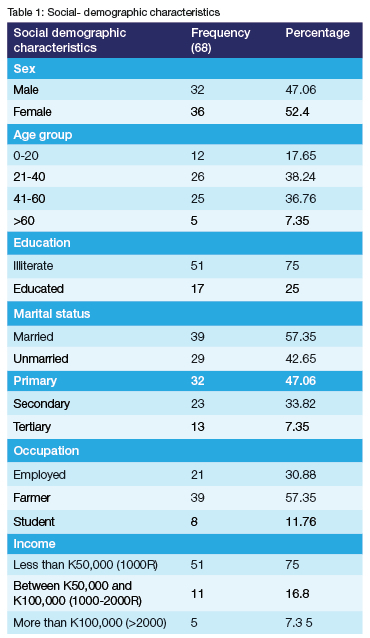
The total number of participants was 68 patients with oral cancer of which 36(52.4%) were females (and thirty two (n=47.06%) were males Twenty-six percent were between 21-40 years while five (7.35%) of the patients were above 60 years see (Table I).
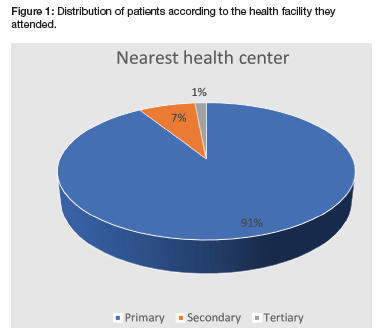
Most of the patients were farmers (n=39, 57.35%) and twenty-one (30.88%) of the patients were employed, while (n=51, 75.88%) were illiterate with a level of income of less than K50, 000 (1000R) a month (n=51, 75%). Fifty patients (73.53%) reported that the distance to the nearest health facility was more than 10 km. The nearest health facility for most of the patients (n=62, 91.18%) was a primary health care facility and only one (1.47%) of the patients was close to the central hospital [Figure 1].
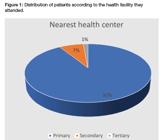
Most of the patients (n=45, 66.18%) reported unavailability of dental services at the nearest health facility. More than that, thirty-two patients (47.06%) were referred from primary healthcare facilities, followed by those who were referred from district hospitals (n=23, 33.82%). While a smaller proportion (n=13, 19.12%) directly arrived at the tertiary health centers without prior referral. Thirty-eight patients (55.88%) were able to inform their relatives when they are sick, and of which (n=22, 32.35%) informed their spouses. Thirty-six patients (52.94%) and (n=31, 45.59%) reported that the main reason for visiting the hospital was pain and increasing symptoms respectively.
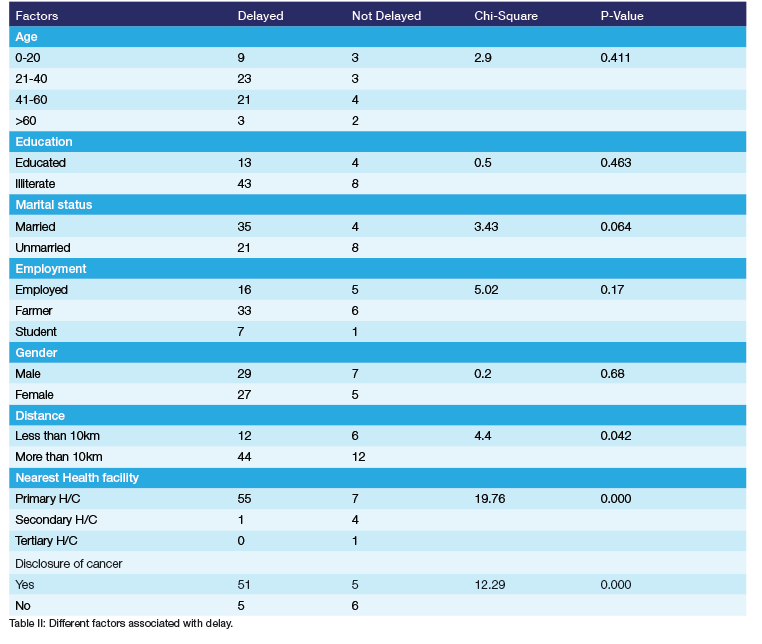
Most participants (n=55, 82.35%) experienced a delay in seeking healthcare after recognising the initial symptoms. Twelve patients (17.65%) sought care within one to two weeks, forty (58.82%) waited for more than three weeks to six months, and, sixteen (23.53%) reported waiting for over 12 months. There was no statistically significant between delayed visit to healthcare facilities after symptom recognition and various social demographic characteristics, including marital status (p = 0.064), age group (p = 0.411), occupation (p = 0.170) and educational level (p = 0.463). However, there was a statistically significant correlation (p = 0.042) was found between the delay in reporting to the nearest healthcare facility and the distance to that facility. There was significance (p = 0.000) between the delayed presentation and the nearest health care facility as well as disclosure of symptoms to a relative or a spouse [Table II].
The histology results were available to 47 patients, (69.12%) at one to two weeks and to 21 patients (30.88%) at more than three weeks. Seventeen patients (25%) reported to the health facility when oral cancer was at stage I and 41 patients (60.29%) reported to the health facility when oral cancer was at stage II.
Fifty (73.53%) of patients reported that they have never heard of oral cancer and all the patients were not afraid to see the doctor. Most participants (n=45, 66.18%) had already started taking medication prior to their visit to the health facility, with 45 (66.67%) of them self-prescribing the medication. Fifty nine of the participants (86.76%) stated that they had sufficient time to make a visit to a health facility.
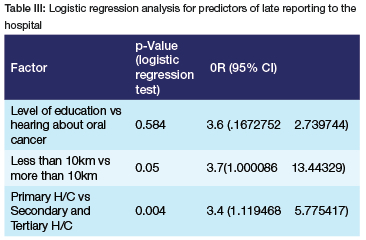
The logistic regression analysis results for factors predicting delayed hospital reporting are presented in Table 4. An odds ratio of 3.6 suggests that individuals who are more educated are 3.6 times more likely to have heard about oral cancer in relation to those with a lower level of education, with p value of 0.584 which is not statistically significant. Furthermore, individuals who are located more than 10km are 3.7 times more likely to have a delayed presentation for treatment compared to individuals who are located less than 10km; the association is statistically significant (p-value 0.05). More than that the odds ratio of 3.4 suggests that individuals close to primary healthcare (HCF) are 3.4 times are more likely to have delayed presentation in seeking treatment unlike individuals located close to secondary and tertiary healthcare, this difference with a p=0.004 was statistically significant.
DISCUSSION
This study was done in all central hospitals of Malawi which serve as the main referral centers in the country. In the Malawi healthcare system, patients with oral cancer are referred and treated through a similar process. Thus, patients initially seek care at primary healthcare facilities such as dispensaries or health centers, where a clinical diagnosis is made. 83, 8 These findings enhance the understanding of the delay in diagnosis and treatment-seeking among oral cancer patients, and the similarities have been noted in prior studies. 5, 8
Moreover, in this study women were more affected compared to men, the same findings were reported in Tanzania, which has a similar healthcare system as Malawi. 813, 18 According to the findings of this study, men tend to exhibit a higher tendency to delay seeking medical attention when experiencing oral cancer symptoms compared to women.1920, 21 But also, women rely on larger social networks for emotional support and advice which potentially reduces the delay. 19, 21
The delayed presentation of oral cancer patients especially men can be attributed to cultural factors.191918185, 8, 14
The results of the current study also align with those of research done in Malaysia, which found that patients' knowledge and education levels have an impact on how they interpret symptoms, use coping mechanisms, and engage in health-seeking behaviors' 241, 2,7 Several studies, concluded there is a significant association between patient delay and education level, with a p-value of 0.001 106,7,9,10
Most patients in this study reported farming as their occupation, which coincides with low-income levels. This higher occurrence of SCC especially among farmers might be attributed to continuous exposure to the sun and carcinogens present in the chemical composition of fertilisers, however the malignant lesions that are diagnosed at Stage I have a cure rate of more than 90%.22,23 Early detection and timely interventions are crucial in enabling individuals to accurately evaluate oral symptoms, thereby reducing the risk of misinterpretation, and associated harmful behaviors like prolonged self-medication.13, 23
This study, found that in the early stages of oral cancer, patients frequently disregard painless lesions similar to the conclusion reached by Azhar et al, 22, 9 and, the persistence of symptoms was perceived as a signal that something was wrong, prompting individuals to seek medical attention. The intensity of symptoms affects the time for an individual to seek medical care. 11
Ravi et al, 20202, 15, 20 have indicated that an increase in fear is related to a higher likelihood of delayed seeking help, although the underlying reasons remain unclear. 2, 19 But fear did not have any impact on delayed presentation in this study, similar to a study in Pakistani. 2319,20,23 Literature 2, 18, 21 has shown that, as oral cancer progresses in TNM staging there is persistent of symptoms, increasing concern and worry among patients. As there is deterioration of oral function affecting emotional well-being of individuals and overall quality of life, motivating patients to seek medical care. 22, 9
The SRM provides insights into the underlying reasons behind the delay. 2,9 The model proposes that participants have four types of coping mechanisms; self-remedy based on previous experience, self-medication such as pills and mouthwashes, and consulting traditional healers', which are cheap means and readily accessible and little time cost than consulting GPs.292,9.
Many researchers 4, 9, 21, 23 have discussed the factors that affect patients with malignant melanoma, oral cancer, and breast cancer to delay for treatment. Factors like the severity of symptoms, anxiety, and humiliation, can contribute to the delay for medical attention in patients with breast cancer.212121
There have been studies on the delayed presentation of patients with oral cancer in Tanzania, India, and London, though the length of the delay which was considered the time the first signs of oral cancer are noticed until the patient sees a health personnel varied.8, 14, 23 and it ranged from 31days to 2 years. 8, 14, 23 similarly, a 2-6-month delay was found in this study. But also, professional delay can also impact the treatment modalities for patients, even if they arrive at the hospital in time.5
The limitation of this study, the sample size was small, and the duration of data collection was short, diseases like oral cancer need a longer duration hence, it's difficult to generalize the findings must be generalized with caution. Another challenge encountered was measurements of patients' delay. The patients had to recall when they first noticed the symptom and presented it to the physician, this is prone to errors due to recall bias.
CONCLUSION AND RECOMMENDATIONS
Oral cancer was diagnosed among the young age group at central hospitals, and patients with stage I and II cancer reported delays in seeking treatment. Factors contributing to delay were living far from healthcare facilities, lack of dental staff at primary healthcare facilities, lack of knowledge about oral cancer, and the delay in receiving the previously investigated pathological results. Therefore, education and awareness campaigns should be used as a tool for guidance towards intervention programs to reduce patient delayed presentation at the primary health care level and to ensure proper diagnosis also continuing education must be offered to dental health personnel as well as health care workers at primary health care facilities. An additional measure can be the provision of Standard Operating Procedures for monitoring pre-cancerous lesions at any health Care facility. Hence conducting another study specifically targeting health care profession delays would provide valuable insights into this aspect of oral cancer management.
REFERENCES
- 1. Scott SE, Grunfeld EA, Auyeung V, McGurk M. Barriers and triggers to seeking help for potentially malignant oral symptoms: Implications for interventions. J Public Health Dent. 2009; 69(1):34-40.
- 2. Azhar N, Doss JG. Health-seeking behavior and delayed presentation of oral cancer patients in a developing country: A qualitative study based on the self-regulatory model. Asian Pacific Journal of Cancer Prevention. 2018 Oct 1; 19(10):2935-41.
- 3. Gilyoma JM, Rambau PF, Masalu N, Kayange NM, Chalya PL. Head and neck cancers: A clinico-pathological profile and management challenges in a resource-limited setting. BMC Res Notes. 2015; 8(1):1-9.
- 4. Scott SE, Grunfeld EA, Main J, McGurk M. Patient delay in oral cancer: A qualitative study of patients' experiences. Psychooncology. 2006 Jun; 15(6):474-85.
- 5. Rath H, Shah S, Sharma G, Mishra E. Exploring determinants of care-seeking behavior of oral cancer patients in India: A qualitative content analysis. Cancer Epidemiol. 2018; 53(January):141-8.
- 6. Akram M, Siddiqui SA, Karimi AM. Patient Related Factors Associated with Delayed Reporting in Oral Cavity and Oropharyngeal Cancer. Vol. 5, International Journal of Preventive Medicine. 2014; 5:9-15
- 7. Singh K, Msolla R, Nathaniel Simon E, Singh Sohal K, Stanslaus Owibingire S. Late reporting for health care among patients presenting with oral maxillofacial tumors or tumor-like lesions in Muhimbili National Hospital, Tanzania. Medical Journal of Zambia. Vol. 46 (2): 109 - 116 (2019)
- 8. Noonan B. Understanding the reasons why patients delay seeking treatment for oral cancer symptoms from a primary health care professional: An integrative literature review. European Journal of Oncology Nursing. 2014; 18(1):118-24.
- 9. Alahapperuma LS, Fernando EA. Patient-linked factors associated with delayed reporting of oral and pharyngeal carcinoma among patients attending national cancer institute, Maharagama, Sri Lanka. Asian Pacific Journal of Cancer Prevention. 2017; 18(2):321-5.
- 10. Joshi P, Nair S, Chaturvedi P, Nair D, Agarwal JP, D'Cruz A. Delay in seeking specialized care for oral cancers: Experience from a tertiary cancer center. In: Indian Journal of Cancer. Medknow Publications; 2014. p. 95-7.
- 11. Agarwal AK, Sethi A, Sareen D, Dhingra S. Treatment Delay in Oral and Oropharyngeal Cancer in Our Population: The Role of Socio-Economic Factors and Health-Seeking Behaviour. Indian Journal of Otolaryngology and Head and Neck Surgery. 2011 Apr;63(2):145-50.
- 12. Makwero, M (2018) "Delivery of primary health care in Malawi," African Journal of Primary Health Care & Family Medicine, pages 1-3.
- 13. Singh M, Misra S, Rathanaswamy S, Gupta S, Tewari B, Bhatt MB, et al. Clinical profile and epidemiological factors of oral cancer patients from North India. Natl J Maxillofac Surg. 2015;6(1):21.
- 14. Warnakulasuriya S. Global epidemiology of oral and oropharyngeal cancer. Oral Oncology. 2009;45(4-5):309-16.
- 15. Chadza E, Chirwa E, Maluwa A, Kazembe A, and Chimwaza A, (2012) Factors that contribute to delay in seeking cervical cancer diagnosis and treatment among women in Malawi, 4(11),pp.1015-22.
- 16. Ngwira, F, Zuo, B, Mkandawire, J. and Kondowe, W. (2020) Cancer Awareness in Malawi: A Comprehensive Analysis of News Coverage on Mass Media. Advances in Journalism and Communication, 8, pp,117-130.
- 17. Rudd P, Gorman D, Meja S, Mtonga P, Jere Y, Chidothe I, Msusa AT, Bates MJ, Brown E and Masamba L (2017) Cervical cancer in southern Malawi: A prospective analysis of presentation, management, and outcomes. Malawi Med J, 29(2) pp.124-129.
-
18. Nyasa Times (2013). Delays in Early Cancer Diagnosis Fuel Cancer Deaths in Malawi. Nyasa Times. http://www.nyasatimes.com/delays-in-early-cancerdiagnosis-fuel-cancer-deaths-in-malawi
» http://www.nyasatimes.com/delays-in-early-cancerdiagnosis-fuel-cancer-deaths-in-malawi - 19. Bassey GO, Osunde OD, Anyanechi CE. Maxillofacial tumors and tumor-like lesions in a Nigerian teaching hospital: An eleven-year retrospective analysis. Afr Health Sci. 2014;14(1):56-63.
- 20. Ravi M, Mamata S, Kishore GR, Manish S and Kapoor AK. (2005) Trends of prevalence and pathological spectrum of head and neck cancers in North India. Indian J Cancer. 2005 Apr-Jun;42(2):89-93.
- 21. Bhatia RK, Rayne S, Rate W, Bakwenabatsile L, Monare B, Anakwenze C, et al. Patient factors associated with delays in obtaining cancer care in Botswana. J Glob Oncol. 2018(4).
- 22. Gilyoma JM, Rambau PF, Masalu N, Kayange NM, Chalya PL. Head and neck cancers: A clinico-pathological profile and management challenges in a resource-limited setting. BMC Res Notes. 2015 Dec 12;8(1).
- 23. Basharat S, Shaikh BT, Rashid HU, Rashid M. Health seeking behavior, delayed presentation and its impact among oral cancer patients in Pakistan: A retrospective qualitative study. BMC Health Serv Res. 2019 Oct 21;19(1).
- 24. Llewellyn CD, Johnson NW, Warnakulasuriya S. Factors associated with delay in presentation among younger patients with oral cancer. Oral Surg Oral Med Oral Pathol Oral Radiol Endod. 2004 Jun;97(6):707-13.

Contribution ratios.
1. Mervyn Turto 30%
2. Nathan Lungu 30%
3. Mmathambo Sekhoto 20%
4. Russell Turto 20%