The capacity of the Oral Health Centre, University of Pretoria, to complete root canal treatments
Abstract
INTRODUCTION: The University of Pretoria Oral Health Centre (UPOHC) is inundated by patients presenting with toothache, many requiring emergency pulpectomies (EPs). To date, the outcome of these procedures performed at this academic/public health facility, remains unknown. Aims and objectives: To determine the completion rate of treatment of teeth that had received EPs at the UPOHC. STUDY DESIGN: A retrospective survey of data obtained from electronic and paper records of 498 randomly selected teeth from the 1050 that had undergone EPs between 1 July 2012 and 30 June 2013 at the UPOHC, followed to 30 June 2014. METHODS: The outcome of treatment was recorded as "no treatment after initial pulpectomy", "pulpectomy repeated", "tooth was removed" or "root canal treatment (RCT) was completed by student or dentist". RESULTS: Of the 498 teeth included, 224 (44.98%) were obturated, 35 (7.03%) were retreated, forty two (8.43%) teeth were referred for extraction and 197 (39.56%) remained untreated. After 16.56 (SD 6.19) months, treatment remained incomplete in 46.58% (n=232) of cases CONCLUSIONS: The UPOHC lacked capacity to complete all RCTs that were started. A primary health care approach focussed on prevention combined with an integrated resource plan for oral health in the region is recommended.
INTRODUCTION
The University of Pretoria Oral Health Centre (UPOHC) is a joint initiative between the School of Dentistry of the University of Pretoria and the Gauteng Department of Health. The institution trains dental and oral hygiene students and provides subsidised dental care to the public.
The bulk of South Africans who pursue treatment at government facilities, such as the UPOHC, are unable to pay private health fees.1
In under-resourced countries, extraction is often the only option for compromised teeth because of costs or lack of qualified personnel to perform specialised treament.2,3,4 The UPOHC offers an emergency pulpectomy (EP) (extirpation of the inflamed or necrotic pulp) as the preferred treatment to alleviate pain in patients who wish to retain the compromised tooth. Emergency procedures such as EPs are often squeezed in between treating other waiting patients. High patient numbers for root canal treatment (RCT) often means that a decision to retain or extract the tooth must be made quickly.56-8 The purpose of an EP is to decrease or eradicate infected tissue and bacterial count in root canal systems, in order to prevent apical spread.910113
Staff of the UPOHC render services in addition to their academic and research responsibilities and EPs are generally performed by dentists, rather than students. Patients are subsequently placed on a waiting list for the preparation and obturation of the affected root canals. The majority of RCTs are completed at the UPOHC by fourth and fifth-year dental students under the supervision of academic staff. Each student has to complete a minimum of five RCTs per annum. Fourth year students work on incisors, canines and premolars, while the fifth year students work on molars.12
There is no information on the outcome of EPs in South Africa. The only published study establishing the attendance for RCT completion following an emergency pulpectomy was from the UK.13et al at the University Dental School in Cork, Ireland, revealed that 39% of 574 patients returned for the obturation of the root canal.1313
Hence, it is important to measure the outcome of emergency procedures such as EPs provided in academic institutions such as the UPOHC. The aim of this study was therefore to measure the completion rate of EPs at the UPOHC and to suggest solutions for related inefficiencies in the service-rendering processes of the UPOHC.
METHODS
The University of Pretoria granted ethical approval. The manager of the UPOHC gave permission for a retrospective analysis of electronic and paper records to be conducted. The target population included patients who had undergone an EP during the period of 1 July 2012 until 30 June 2013.
The paper-based and electronic files, including radiographs on the Kodak® digital radiograph system, were accessed at the UPOHC in July 2014. Teeth that received EP during the study period were identified by procedure code: "8132" on the GoodX Dental Studio software®. These accounted for 1050 teeth of which 500 teeth were selected using computer generated randomization (Biostatistics Unit, Medical Research Council). Two of the records of the selected teeth were discarded. One record on the electronic system was a mock entry and the other was a duplicate record. The final number of teeth included for the analysis was 498.
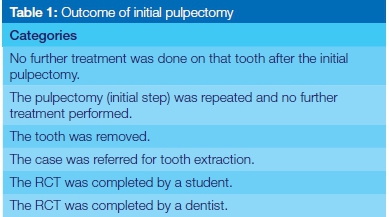
The outcome of the pulpectomy through to 30 June 2014 was determined by studying the files and was recorded by selecting one of the categories (indicated in Table 1):
•The tooth had no further treatment after the initial pulpectomy.
•The pulpectomy was repeated but no further treatment was performed.
•The tooth was removed.
•The case was referred for extraction.
•The RCT was completed by a student.
•The RCT was completed by a dentist.
The initial pulpectomy and final treatment dates were also indicated. Thus the period for final outcome was between 12 and 24 months (1 July 2012- 30 June 2014).
Descriptive statistics were used to describe the outcome of EPs at the UPOHC. The Kaplan-Meier analysis, which provides an estimate of survival in a given length of time, was employed to describe the passage of time before which the RCTs were completed.
RESULTS
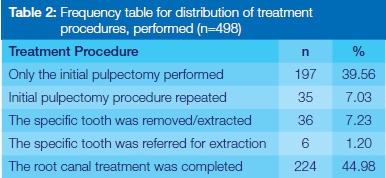
Table 2 displays the outcomes of the 498 pulpectomies which had been recorded in the sample of 498 case records examined.
In this sample, less than half (44.98%) of the teeth that were treated with EPs were completely obturated at the UPOHC (Table 2). It may be noted that of the 224 completed cases, 104 were completed by dentists, including part-time dentists appointed at the UPOHC.
Kaplan-Meier analysis revealed that 46.58% (n=232) of cases were still incomplete 16.56 months (SD 6.19) after the initial treatment.
DISCUSSION
This is the first study to report the outcome of EPs in the South African oral health care system. The resulting information provides valuable insight into capacity of the UPOHC to provide RCT to people who are dependent on Government services in the Tshwane District. These statistics are particularly relevant since the UPOHC is the sole government funded dental facility that provides RCT in the Tshwane District.
Demand versus capacity to treat - UPOHC
RCT is a very costly and time-consuming procedure in dentistry.1Table 2 attests to the protocol whereby the UPOHC provides EPs to non-scheduled, emergency, patients presenting with pain, without taking into account the time required for completion of the endodontic component.
The outcomes measured in this study are similar to those reported in Ireland by Lynch et al.13Table 2) of teeth that had received an emergency pulpectomy at the UPOHC. In the Irish study the completion rate was 39%.1313
It should be noted that the UPOHC appointed a number of part-time dentists to alleviate the backlog in August 2012. These dentists completed 104 out of the total of 224 cases during the study period shown in Table 2. These results may however not be a true reflection of the UPOHC's capacity to complete RCTs. The service of some of the dentists could not be sustained due to insufficient funds. Therefore, the actual percentage of completed RCT's could have been as low as 25% had these dentists not been employed.
The extended time interval between EP and obturation at the UPOHC, as illustrated in the current study, also suggests the EP might not have been the best treatment option13 in the context of what the local health care system can provide. At the time of the study it was standard procedure at the UPOHC to give the patient the choice of removal or EP and placement on the waiting list. The current study shows that 7.03% of cases returned as emergencies, probably because the patient had re-occurring pain, the tooth fractured or loss of the temporary restoration (Table 2). Moreover, 8.23% of teeth that underwent EPs were eventually extracted or were referred for an extraction. It is universally accepted in dentistry that a tooth with a vital pulp should be preserved without question.2930
Lynch et al suggested that one of the reasons for non-completion was that patients did not receive adequate pre-treatment counselling. The authors also suggested that teeth were poorly selected for RCT because in 10% of cases an extraction was eventually performed.13131331
Demand versus capacity to treat - Public Health Care System
The above-mentioned findings and the discovery that 46.58% (n=232) of cases were still incomplete 16.56 months (SD 6.19) after the initial treatment can probably be linked to the very high demand for subsidised dental care in South Africa. The deficit in human resources in South Africa clearly does not allow the dental needs of the South African population to be adequately met.14,15 New dispensations in Health in 1994 granted free dental services to many at government facilities (clinics), resulting in increased demand and placing a burden on the limited existing personnel.1617
The lack of capacity is further exacerbated by the escalating demands of a population beset by high unemployment rates and socio-economic inequalities. The unemployment rate in South Africa is high with nearly 13.5% of South Africans occupying informal settlements.17,18 The demand by patients of lower socioeconomic class for treatment at public facilities, certainly contributes to the problem of adequate delivery of oral health care in South Africa. This is particularly true of the more costly procedures such as RCT.4,19 In South Africa, as in other parts of the world, dentistry receives a small portion of the overall health budget and has a comparatively low ratio of 0.085 dentists per 1 000 population.20,21
A proposal by the South African government to reduce the number of dentists employed and to increase the numbers of dental therapists (which to date has not been implemented), was aimed at reducing the cost of basic dental care.2221
The South African Department of Health implemented a compulsory community service (CCS) year for dentists in 2001.2316,24 Holtshousen suggested that if the dental therapists were also compelled to complete a community service year, this would release the newly qualified dentists to focus on specialized dental procedures such as RCT and crown and bridge work, thereby also improving their skills.24
Thus far the discussion has considered only factors related to the health care system. It is however also conceivable that factors related to the patient may also have played a role in the current predicament. Patients receiving an emergency pulpectomy often present with neglected tooth decay that extends into the pulp.2526-28 The identification of these factors suggest a need for an integrated primary health care approach that would be able to identify and prevent tooth decay at an early stage, reducing the need for expensive RCT.
Limitations of the study
As with many retrospective studies, the quality of the data depends on the nature of the documented records.32
The quality of completed RCTs was not considered and should also be assessed during a follow-up study to obtain a broader sense of the success of RCT provided at the UPOHC.
CONCLUSION
The evidence in this study confirms that the UPOHC lacks the capacity to complete the RCT's. An integrated primary health care strategy with a strong preventative focus should be incorporated into the National Health Insurance plan to obviate the need for expensive treatments such as RCT. It is suggested that the Government consider the expansion of oral health services in urban areas such as Tshwane as the demand for service, population growth and socio-economic disparities clearly does not correlate with the capacity to provide service.
Finally, the UPOHC should consider improving their pre-counselling protocol before providing EPs to ensure that the prognosis of a tooth is properly determined before allocation to a waiting list for further complex treatment.
ACRONYMSCCS: Compulsory community service
EP: Emergency pulpectomy
RCT: Root canal treatment
UPOHC: University of Pretoria Oral Health Centre
References
- 1. Naidoo S, Chikte UM, Moola H, Steyn K. Perceptions of oral health: the South African Demographic and Health Survey of 1998. SADJ 2001; 56:505-10.
- 2. Asgary S, Eghbal MJ. The effect of pulpotomy using a calcium-enriched mixture cement versus one-visit root canal therapy on postoperative pain relief in irreversible pulpitis: a randomized clinical trial. Odontology 2010; 98:126-33.
- 3. Nyerere JW, Matee MI, Simon EMM. Emergency pulpotomy in relieving acute dental pain among Tanzanian patients. BMC Oral Health 2006; 6:1-4.
- 4. Bender IB. Reversible and irreversible painful pulpitides: diagnosis and treatment. Aust Endod J 2000; 26:10-4.Ch
- 5. Torabinejad M, Anderson P, Bader J. et al. Outcomes of root canal treatment and restoration, implant-supported single crowns, fixed partial dentures, and extraction without replacement: a systemic review. J Prosthet Dent 2007 Oct; 98:285-311.
- 6. McCartan B, Freeman L, Harrison A. Patterns of attendance and treatment at an emergency dental clinic. J Ir Dent Assoc 1996; 42:27-8.
- 7. Kells BE, Hussey DL. Audit of the casual patient attendance at the restorative clinic. J Ir Dent Assoc 1994; 40:94-7.
- 8. Gibson GB, Blasberg B, Hill SJ. A prospective survey of hospital ambulatory dental emergencies. Part 1: Patient and emergency characteristics. Spec Care Dentist 1993; 13:61-5.
- 9. Swarupa CH, Sajjan GS, Sashi Kanth YV. An in vitro stereomicroscopic comparative evaluation of a combination of apex locator and endodontic motor with an integrated endodontic motor. J Conserv Dent. 2013;16:458-61.
- 10. Kojima K, Inamoto K, Nagamatsu K, Hara A, Nakata K, Morita I, Nakagaki H, Nakamura H. Success rate of endodontic treatment of teeth with vital and nonvital pulps. A meta-analysis. Oral Surg Oral Med Oral Pathol Oral Radiol and Endod 2004 Jan; 97:95-9.
- 11. Nixdorf DR, Moana-Filho EJ, Law AS, McGuire LA, Hodges JS, John MT. Frequency of persistent tooth pain after root canal therapy: a systemic review and meta-analysis. J Endod 2010 February; 36:224-30
- 12. Department of Odontology, School of Dentistry, UPOHC, Faculty of Health Sciences' Study Guide. 2014.
- 13. Lynch CD, Burke FM, Ríordáin RN, Hannigan A. Endodontic treatment completion following emergency pulpectomy. Community Dent Health 2010; 27:114-7.
- 14. Essack SY. Models for increasing the health workforce. SAMJ 2012; 102:830-2.
- 15. Van Wyk PJ, Louw AJ, Du Plessis JB. Caries status and treatment needs in South Africa: report of the 1999-2002 national children's oral health survey. SADJ 2004; 59:238-42.
- 16. Bhayat A, Yengopal V, Rudolph MJ. Attitudes of South African dental therapy students towards compulsary Community Service. J Dent Edu 2008; 72:1134-41.
-
17. StatsSA. Quarterly Labour Force Survey statistical release PO211. 2013 Available from: https://www.statssa.gov.za/publications/P0211/P02111stQuarter2013.pdf (accessed 24 March 2014)
» https://www.statssa.gov.za/publications/P0211/P02111stQuarter2013.pdf - 18. Oldewage-Theron WH, Slabbert TJC. Impact of food and nutrition interventions on poverty in an informal settlement in the Vaal Region of South Africa. Proceedings of the Nutrition Society 2008 Feb; 67:91-7.
- 19. Rotstein DL, Alter DA. Where does the waiting begin? A short review of the dynamics and organization of modern waiting lists. Soc Sci Med 2006; 62:3157-60.
- 20. Unal GC, Kaya BU, Tac AG, Kececi AD. Survey of attitudes, materials and methods preferred in root canal therapy dental practice in Turkey: Part1. Ent J Dent 2012 Oct; 6:376-84.
- 21. Strachan B, Zabow T, van der Spuy ZM. More doctors and dentists are needed in South Africa: Original article. SAMJ 2011; 101:523-8.
- 22. Lalloo R. A national human resources plan for oral health: is it feasible? SADJ 2007; 62:360,362-4.
- 23. Reid S. J. Compulsory community service for doctors in South Africa-evaluation of the first year. S Afr Med J 2001; 91:329-35.
- 24. Holtshousen WSJ. Service rendering statistics of compulsory community service dentists in Gauteng. Presentation at the 2004 Meeting of the South African Chapter of the International Association for Dental Research, in Pretoria.
- 25. Athanassiadis B, Abbott PV, Walsh LJ. The use of calcium hydroxide, antibiotics and biocides as antimicrobial medicaments in endodontics. Aust Dent J 2007; 52:S64-S82.
- 26. Cohen SM, Fiske J, Newton JT. Behavioural dentistry: The impact of dental anxiety on daily living. Br Dent J 2000 Oct 14; 189:385-90.
- 27. Bedos C, Brodeur JM, Levine A, Richard L, Boucheron L, Mereus W. Perception of dental illness among persons receiving public assistance in Montreal. Am J Public Health 2005; 95:1340.
- 28. Anderson R, Thomas DW. 'Toothache stories': a qualitative investigation of why and how people seek emergency dental care. Community Dent Health 2003; 20:106-11.
- 29. Asgary S, Eghbal MJ, Ghoddusi J. Two-year results of vital pulp therapy in permanent molars with irreversible pulpitis: an ongoing multicentre randomized clinical trial. Clin Oral Investig 2014; 18:635-41.
- 30. Jones JA, Boehmer U, Berlowitz DR, Christiansen CL, Pitman A, Kressin NR. Tooth retention as an indicator of quality dental care: development of a risk adjustment model. Med Care 2003 August; 41:937-49.
- 31. Siciliani L, Hurst J. Tackling excessive waiting times for elective surgery: a comparative analysis of policies in 12 OECD countries. Health Policy 2005; 72:201-15.
- 32. Dugas NN, Lawrence HP, Teplitsky P, Friedman S. Quality of life and satisfaction outcomes of endodontic. J Endod 2002 28:819-27.
Vanessa C Mostert
Department of Dental Management Sciences, School of Dentistry, University of Pretoria
P.O. Box 1266,
Pretoria, 0001, South Africa.
Tel: +27 12 319 2370,
Cell: +27 84 2322,
Fax: +27 12 319 2146
E-mail: