Prevention of infective endocarditis associated with dental interventions
Abstract
Infective endocarditis (IE) is associated with significant morbidity and mortality. Prevention is therefore an important clinical entity. The maintenance of optimal oral health is likely to play the most important role in protecting those at risk for IE. Both patients and health care practitioners must be educated in this regard. Guidelines have recommended that antibiotic prophylaxis should be limited to individuals (undergoing certain high-risk dental procedures) with underlying cardiac conditions that are associated with the greatest risk of an adverse outcome from IE. These conditions include prosthetic valves, congenital heart disease and previous IE. In South Africa, and other developing countries, IE is often a disease of young patients with rheumatic heart disease (RHD) and carries a very poor prognosis. In contrast, IE in Europe/North America, where guidelines and indications for antibiotic prophylaxis have been reduced, has a different spectrum of factors. These patients are older with degenerative valve disease. IE may also occur as a result of invasive health care associated procedures or in the setting of prosthetic valves and implantable cardiac devices. Recently published international guidelines cannot be automatically applied to countries where RHD is common and oral hygiene is poor. We therefore recommend that patients with RHD should also receive antibiotic prophylaxis prior to the listed dental procedures. Antibiotic prophylaxis should be prescribed after stressing the role of good oral health and why the approach differs in South Africa. There should be close cooperation between the dental practitioner and clinician as to who should receive prophylaxis and who should not. SAHeart 2017;14:170-174.
INTRODUCTION
Infective endocarditis (IE) is a rare, but severe, disease and occurs when circulating microorganisms colonise cardiac valves (both natural and prosthetic), the endocardium, or intracardiac devices.11-3
The Stellenbosch University conducted a 3-year prospective epidemiological study of IE in the Western Cape. RHD was the major predisposing condition in 76.6% and 17% of the patients had prosthetic valves. Degenerative valve disease, intravenous drug use and HIV infection were not important risk factors. Outcome was extremely poor; 6-month mortality was 35.6% (much higher compared to reported international rates of 6% - 27%), while nearly half of the patients required subsequent valve replacement. Cardiac failure developed or worsened in just over 75%, which may partly be due to late referral and other inefficiencies in local health care services.34
RHD markedly elevates the risk of IE. In a case review from the northern territories of Australia, IE incidence in patients with native valve RHD was 290 per 100 000 person-years. This corresponded to a relative risk of 58 in comparison to those without native valve RHD.5 5-8 but is no longer seen in many higher income countries,5,9 where the prevalence of rheumatic fever has declined,5,10 and the use of intravenous recreational drugs is more common.5,11
It is obvious that the first step in the prevention of IE in developing countries would be to reduce the pool of patients who are susceptible to this infection. This would require effective programmes to prevent rheumatic fever (and recurrences) and, hence, RHD. Regrettably, this has not happened.2
The rationale for antibiotic prophylaxis is based on the assumption that bacteraemia subsequent to medical procedures may cause IE, particularly in those with predisposing cardiac disease. Prophylactic antibiotics might prevent IE by minimising bacteraemia, or by altering bacterial properties leading to reduced adherence to the endocardium.1,2,12 This concept led to the recommendation of antibiotic prophylaxis in a large number of patients with predisposing cardiac conditions, undergoing a wide range of procedures.
Antibiotic prophylaxis has been accepted for decades, even though the efficacy has not been confirmed in a prospective randomised controlled trial. It is also unlikely that such a study will ever be conducted. Assumptions are based on non-uniform expert opinion, findings from animal models, case reports and contradictory observational studies.1-3,12-22
In the majority of those who suffer IE, no potential index procedure can be identified beforehand. The estimated risk of IE following dental procedures is very low.12,13 Prophylaxis may therefore avoid only a small number of IE cases, as shown by estimations of , case of IE per ,50 000 dental procedures (in intermediate risk patients) with prophylaxis and , per 46 000 for procedures unprotected by antibiotics.13
Bacteria originating from the mouth account for a significant proportion of cases of IE. Transient bacteraemia occurs not only following dental (and other) procedures, but also after routine oral activities such as tooth brushing, flossing and chewing. The high incidence and cumulative effect of lowgrade daily episodes, especially in those with poor oral hygiene, is a more important risk factor than sporadic bacteraemia occurring with a single dental procedure. Patients with underlying heart conditions that predispose to bacterial colonisation are therefore exposed to a low, but continual, lifelong risk of developing IE. Eliminating gingivitis would reduce the incidence and degree of spontaneous bacteraemia and hence IE.1-3,12-22
Oral health in South Africa is generally quite poor and addressing this at policy level will have more impact on the prevalence of IE than antibiotic prophylaxis.222
All Expert Committees on IE prevention agree that the maintenance of optimal oral hygiene (by regular professional dental care and the appropriate use of manual, powered and ultrasonic toothbrushes, dental floss and other plaque-removal devices) is the most effective intervention for the prevention of IE of oral origin.1-3,12-22
It is recommended that patients with valvular heart disease be referred to a dentist/oral hygienist for ongoing treatment and advice. Patients and attending clinicians need to be educated in this regard. A medical history should be obtained from every patient before any dental treatment. A full oral examination, including dental radiography, should be performed. Further examinations at frequent and regular intervals will ensure maintenance of good oral hygiene, as well as early diagnosis and treatment of any oral infections. It is advisable to issue patients with a warning card to record their cardiac condition, drug therapy and suggested prophylactic measures to be taken before dental treatment.2,12,13
Patients should be informed about their valve disease and the possible development of what constitutional symptoms might be associated with IE. They should be advised to seek prompt medical care in the event of suspicious symptoms such as fever that is more than transient.
SA Heart is an affiliated member of the European Society of Cardiology (ESC) and hence adopts the practice guidelines of the ESC as its own.
INFECTIVE ENDOCARDITIS PREVENTIONIn 2009, the "Guidelines on the prevention, diagnosis and treatment of infective endocarditis" were endorsed by the European Society of Clinical Microbiology and Infectious Diseases, and by the International Society of Chemotherapy for Infection and Cancer.12 13
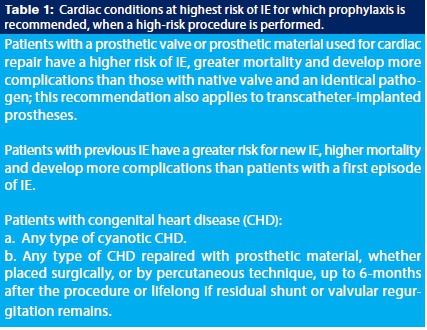
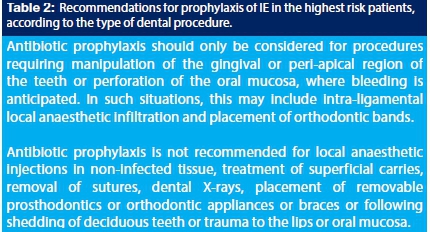
The ESC Guideline states that antibiotic prophylaxis should be limited to those with the highest risk of IE (Table 1), undergoing the highest risk dental procedure (Table II). High-risk is defined as those with underlying cardiac conditions associated with the greatest risk of adverse outcome from IE, and not necessarily those with an increased lifetime risk of endocarditis.B Prophylaxis was not recommended for any other form of native valve disease, with a small but increased life-time risk of IE, including the most commonly identified conditions, bicuspid aortic valve, mitral valve prolapse and calcific aortic stenosis.,2,B
Although the American Heart Association/American College of Cardiology recommend prophylaxis in cardiac transplant recipients who develop cardiac valvulopathy,19B
It is the opinion of SA Heart that recently published guidelines cannot be automatically applied in developing countries where RHD is common and oral hygiene is poor. We concede that the evidence in favour of prophylaxis is not robust; however, patients with RHD (undergoing dental procedures) represent a higher risk for IE (and poor outcome) and should thus receive antibiotic prophylaxis prior to the dental procedures listed below (Table II). This recommendation is made, given our prevailing circumstances and the absence of evidence of significant harm for a potentially effective intervention, oral amoxicillin. Antibiotic prophylaxis should be prescribed after stressing the role of good oral health and informing patients of the ESC guidelines and why the approach differs in South Africa.
Antibiotic prophylaxis should only be considered for procedures requiring manipulation of the gingival or peri-apical region of the teeth or perforation of the oral mucosa, where bleeding is anticipated. In such situations, this may include intra-ligamental local anaesthetic infiltration and placement of orthodontic bands. Guidelines from other countries with populations with similar high RHD prevalence, have also kept RHD on the list of conditions for prophylaxis. The Infective Endocarditis Prophylaxis Expert Group has recommended that indigenous Australian patients with RHD are a special population at high risk for IE (and for adverse outcomes) and should receive antibiotic prophylaxis.23552425
HIV infection is not associated with an increased risk of IE. A significant number of patients with IE may be coincidentally HIV infected, given the high prevalence of both HIV and RHD in Africa.263Table I), undergoing the procedures outlined in Table II.
The use of dental implants raises concerns with regard to potential risk due to foreign material at the interface between the buccal cavity and blood. Very few data are available. The opinion of the ESC task force is that there is no evidence to contraindicate implants in all patients who may be at risk. The indication should be discussed on a case-by-case basis. The patient should be informed of the uncertainties and the need for close follow-up.13
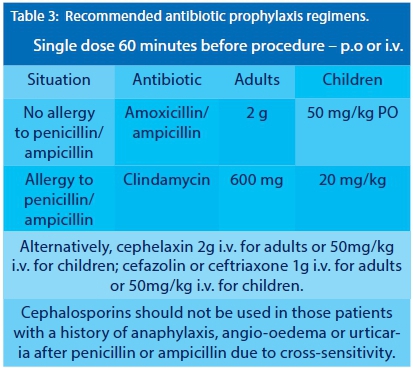
Antibiotic prophylaxis should only be considered for patients at highest-risk described in Table 1 (in addition to those with RHD) undergoing any of the at-risk procedures (Table II), and is not recommended in other situations. Oral streptococci are the main targets for prophylaxis. A single dose of antibiotic should be given before the procedure. There is no proven value to administering a follow-up dose 6 hours later. Table III summarises the main regimens of antibiotic prophylaxis recommended before dental procedures. Fluoroquinolones and glycopeptides are not recommended due to their unclear efficacy and the potential induction of resistance.13
Clindamycin is not always available in a suspension form in certain State clinics. It is therefore suggested that suitable alternatives are azithromycin or clarithromycin, 500mg for adults and 15mg/kg in children.19
Antibiotic administration carries a small risk of anaphylaxis, which may become more significant in the event of widespread use, however the risk of lethal anaphylaxis is extremely low when using oral amoxicillin. In fact, no fatal case has been reported (over at least a 35-year period) after oral administration for IE prophylaxis.12, 13,27,28
Curative antibiotics must be prescribed for any focus of bacterial infection.1313
In addition to antibiotic prophylaxis of IE, pre-procedural antiseptic mouth rinses (chlorhexidine or povidone-iodine) may reduce the incidence or magnitude of bacteraemia occurring during invasive dental procedures. The results of studies of "oral degerming" have however been variable, and there is no conclusive evidence for this approach.1,29 The ESC protocol makes no reference to the use of antiseptic prophylaxis before at-risk dental manipulation. (12,13) Further research is required to determine the effectiveness of pre-procedural mouth rinsing and to investigate new antiseptic protocols.2920
In 2008 the National Institute of Health and Clinical Excellence (NICE) radically recommended complete cessation of antibiotic prophylaxis, in any patient with valvular heart disease, whatever the risk.21313 www.nice.uk.org) has since found no need to change their existing guidance. They concluded that the longstanding increase in the incidence of IE is not well understood, and may be due to other factors.21
INFECTIVE ENDOCARDITIS PREVENTIONThe risk assessment suggests that it would be safer to recommend antibiotic prophylaxis (for those with high-risk cardiac disease), while waiting for a randomised controlled trial. It is likely that cumulative regular small bacteraemias from daily activities pose a significant threat to patients at risk of IE; this does not mean that occasional large bacteraemias from invasive dental procedures do not. Our aim should be to minimise all causes of bacteraemia in susceptible individuals.3231,32 and at least for those without a history of penicillin allergy, oral amoxicillin prophylaxis is safe, with a low likelihood of anaphylaxis.28,29,32
SA Heart recommends antibiotic prophylaxis to individuals with the greatest risk of an adverse outcome with IE (outlined in Table 1, in addition to those with RHD, undergoing the procedures described in Table II). We again emphasise the maintenance of optimal oral health, which is likely to play the most important role in protecting those at risk of IE, in addition to the education of patients in this regard. There should be close cooperation between the dental practitioner/physician/paediatrician/cardiologist/cardiac surgeon as to who should receive prophylaxis and who should not.
Conflict of Interest: The authors declare no conflict of interest and all authors have approved the final manuscript submitted.
References
- 1. Durack DT. Prophylaxis of Infective Endocarditis. In Mandell, Douglas, and Bennett's principles and practice of infectious diseases. 2015. 8th edition. Bennett JE, Dolin R, Blaser MJ editors; 1057.
- 2. Maharaj B, Parrish A. Prevention of infective endocarditis in developing countries. Cardiovasc J Afr. 2012:23;303.
- 3. Koegelenberg CFN, Doubell AF, Orth H, et al. Infective endocarditis in the Western Cape Province of South Africa: A three-year prospective study. QJM. 2003:96;217.
- 4. Meel R, Peters F, Essop MR. Tricuspid valve endocarditis associated with intravenous Nyoape use: A report of 3 cases. South African Medical Journal. 2014;104:853.
- 5. Baskerville CA, Hanrahan BB, Burke AJ, et al. Infective endocarditis and rheumatic heart disease in the north of Australia. Heart Lung Circ. 2012:21;36.
- 6. Choudhury R, Grover A, Varma J, et al. Active infective endocarditis observed in an Indian hospital 1981 - 1991. Am J Cardiol. 1992:70;1453.
- 7. Garg N, Kandpal B, Tewari S, et al. Characteristics of infective endocarditis in a developing country-clinical profile and outcome in 192 Indian patients, 1992 - 2001. Int J Cardiol. 2005:98;253.
- 8. Jalal S, Khan KA, Alai MS, et al. Clinical spectrum of infective endocarditis: Fifteen years experience. Indian Heart J. 1998:50:516.
- 9. Tleyjeh IM, Steckelberg JM, Murad HS, et al. Temporal trends in infective endocarditis: A population-based study in Olmsted County, Minnesota. JAMA. 2005:293;3022.
- 10. Quinn RW. Comprehensive review of morbidity and mortality trends for rheumatic fever, streptococcal disease, and scarlet fever: The decline of rheumatic fever. Rev Infect Dis. 1989:11;928.
- ,
- 11. Heiro M, Helenius H, Makila S, et al. Infective endocarditis in a Finnish teaching hospital: A study on 326 episodes treated during 1980 - 2004. Heart. 2006:92;1457.
- 12. Habib G, Hoen B, Tornos P, et al. ESC Committee for Practice Guidelines. Guidelines on the prevention, diagnosis, and treatment of infective endocarditis (new version 2009): The task force on the prevention, diagnosis, and treatment of infective endocarditis of the European Society of Cardiology (ESC). Eur Heart J. 2009:30;2369.
-
13. Habib B, Lancellotti P, Antunes MJ, et al. 2015 ESC Guidelines for the management of infective endocarditis. The task force for the management of infective endocarditis of the European Society of Cardiology (ESC). 2015; http://dx.doi.org/10.1093/eurheartj/ehv319ehv319. Published online: 29 August 2015.
» http://dx.doi.org/10.1093/eurheartj/ehv319ehv319 - 14. Andrade J, Stadnick E, Mohamed A. Infective endocarditis prophylaxis: An update for clinical practice. BC Medical Journal. 2008:50;451.
- 15. Parrish A, Maharaj B. Prevention of infective endocarditis in developing countries - justifiable caution? S Afr Med J 2012;102;652.
- 16. Bobhate P, Pinto RJ. Summary of the new guidelines for prevention of Infective Endocarditis: Implications for the developing countries. Ann Pediatr Card. 2008:1;56.
- 17. Nishimura, Otto CM, Bonow RO, et al. 2014 AHA/ACC Valvular Heart Disease Guideline. JACC. 2014:63;e57.
- 18. Shanson D. New British and American guidelines for the antibiotic prophylaxis of infective endocarditis: Do the changes make sense? A critical review. Curr Opin Infect Dis. 2008:21;191.
- 19. Nishimura RA, Carabello BA, Faxon DP, et al. ACC/AHA 2008 Guideline update on valvular heart disease: focused update on infective endocarditis. A report of the American College of Cardiology/American Heart Association task force on practice guidelines. Circulation. 2008:118:887.
-
21. NICE short clinical guidelines technical team. Prophylaxis against infective endocarditis: antimicrobial prophylaxis against infective endocarditis in adults and children undergoing interventional procedures. National Institute for health and clinical excellence clinical guideline 64. 2008. Published online http://www.nice.org.uk/CG064.
» http://www.nice.org.uk/CG064 - 22. Maharaj B, Vayej AC. Oral health of patients with severe rheumatic heart disease. Cardiovasc J Afr. 2012:23;336.
- 23. Moulds RFW, Jeyasingham MS, for the Infective Endocarditis Prophylaxis Expert Group, Therapeutic Guidelines Ltd. Antibiotic prophylaxis against infective endocarditis: Time to rethink. Med J Australia. 2008:189;301.
-
24. National Heart Foundation of New Zealand Advisory Group. New Zealand guideline for prevention of infective endocarditis associated with dental and other medical interventions. Auckland: National Heart Foundation of New Zealand; 2008. Published online http://www.heartfoundation.org.nz.
» http://www.heartfoundation.org.nz - 25. Fernandes JRC, Max Grinberg M. Prophylaxis of Infective Endocarditis: A different Brazilian reality? Arq Bras Cardiol. 2013:101;e37.
- 26. Ntsekhe M, Hakim J. Impact of Human Immunodeficiency Virus Infection on Cardiovascular Disease in Africa. Circulation. 2005:112;3602.
- 27. Thornhill MH, Dayer MJ, Prendergast B, et al. Incidence and nature of adverse reactions to antibiotics used as endocarditis prophylaxis. J Antimicrob Chemother. 2015:70;2382.
- 28. Lee P, Shanson D. Results of a UK survey of fatal anaphylaxis after oral amoxicillin. J Antimicrob Chemother. 2007;60:117.
- 29. Tomás I, Álvarez-Fernández M. History of antimicrobial prophylaxis protocols for infective endocarditis secondary to dental procedures. In recent advances in infective endocarditis. 2013. Kerrigan SW editor; 53. Published online http://dx.doi.org/10.5772/56118.
- 30. Dayer MJ, Jones S, Prendergast B, et al. Incidence of infective endocarditis in England, 2000 - 2013: A secular trend, interrupted time-series analysis. Lancet. 2015:385;1219.
- 31. Thornhill MH, Lockhart PB, Prendergast B, et al. NICE and antibiotic prophylaxis to prevent endocarditis. British Dental Journal. 2015:218;619.
- 32. Van der Bijl (jr) P, van der Bijl P. Infective endocarditis and antibiotic prophylaxis: An update for South African dental practitioners SADJ. 2014:69;118.