Continuous education in sedation 2: Protecting the airway during sedation
INTRODUCTION
Protecting the airway is a critical aspect of safe sedation practice. Sedation practitioners must be able to identify the patient at risk for airway obstruction. We will discuss key aspects of airway evaluation, sedation monitoring, and practical points to prevent compromising the airway during sedation.
DISCUSSION
According to the 2015 SASA Sedation Guidelines for surgical procedures, no patient should be considered for sedation without having undergone a focused airway assessment.12
Features that are commonly linked with difficult intubation are also associated with upper airway obstruction during sleep.34
There are particular conditions which preclude surgery-based sedation: for instance patients with severe obstructive sleep apnoea(OSA), poorly controlled respiratory disease (asthma or COPD) or patients with active respiratory tract infections. They may not be ASA 1 or 11 patients who would qualify for sedation outside the operating theatre. Tonsillar hypertrophy and excessive lymphoid tissue in the pharynx are predisposing factors to OSA in children.4
Pre-operative fasting remains a controversial issue. In a sedation technique where dissociative and non-dissociative intravenous techniques are used we suggest that sedation practitioners follow the SASA Guidelines.1
Standards of monitoring differ slightly according to the level of sedation provided. Minimal sedation can be monitored with clinical monitoring, deep sedation with the same electronic and clinical monitoring as with general anaesthesia. However, it is important for the sedation practitioner to understand that sedation is a continuum. The more drugs we give the deeper the level of sedation may be. The sedation practitioner must be prepared to rescue any patient that inadvertently slips into a deeper level of sedation.
Moderate sedation levels require continuous monitoring that includes pulse oximetry, heart rate, respiratory rate and breathing pattern, and blood pressure recording. Capnography is said to be the gold standard for monitoring of effective breathing as it is more sensitive than pulse oximetry. It is not mandatory for moderate sedation but highly recommended in patients with respiratory disease, the obese, and where deep sedation is utilized.1
Patients with a tendency to upper airway obstruction during sleep are more vulnerable for airway problems during sedation.44
Certain drugs are known to decrease the muscle tone in the upper airway. Propofol and Midazolam are commonly used in sedation practice and are well known for their effects in inhibiting upper airway activity, resulting in airway compromise. Ketamine is probably a better drug if we want to prevent airway compromise. Titration still remains the best option when we administer drugs for sedation.
Opioids and sedation drugs are synergistic and may enhance the respiratory depression caused by opioids. Ketamine seems to protect against hypoventilation when combined with Propofol (Ketofol). Similarly, during the post-operative period, the depression on breathing may be further exacerbated by residual effects of sedative pre-medications as well as any sedation drugs used.5
When administering opioids, according to the SASA sedation guidelines, the specific antagonist, Naloxone, must always be immediately available.12
Various maneuvers can be used when the airway is threatened: Firstly, placing the head in the "sniffing the morning air" (extension of the neck) position decreases the upper airway collapsibility.
Secondly, when displacing the mandible forwards, the tongue will be pulled forwards too and increase the diameter of the retro-lingual and retro-palatal airway. Simply lifting the chin with mouth closure can also assist in increasing pharyngeal dimensions.4
The sedation practitioner and the whole team are responsible to check the presence and working condition of all resuscitation equipment, emergency airway adjuncts and emergency pharmacological agents. Displaying protocols on the management of anaphylaxis and cardiac arrest is strongly advised.61
The review of emergency procedures and protocols are fundamental to all sedation practitioners and members of the sedation team through practical and theoretical training. This highlights the importance of continuous education and training.
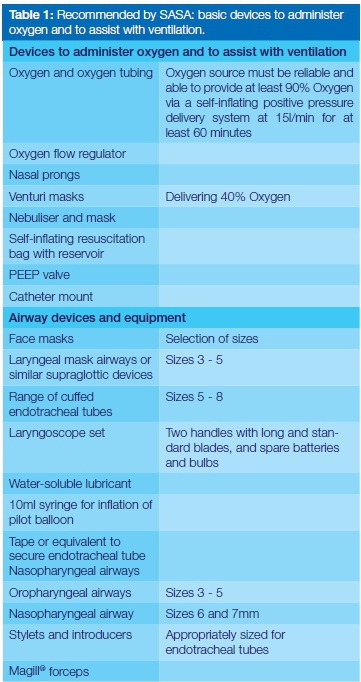
Table 1 is a recommendation from the SASA sedation guidelines of 2015 regarding the basic devices that should be present to administer oxygen and to assist with ventilation during any sedation in any procedure room.1
CONCLUSION
Adverse events in sedation can generally be prevented by careful preoperative assessment as well as attentive intraoperative monitoring and support.74
Our next articles will focus on obesity and sedation, and the management of anaphylaxis.
ACRONYMs
ASA: American Society of Anaesthesiologists
COPD: Chronic Obstructive Pulmonary disease
OSA: Obstructive Sleep Apnoea
SASA: South African Society of Anaesthesiologists
References
- 1. South African Society of Anaesthesiologists Sedation Guidelines 2015. Guidelines for the safe use of procedural sedation and analgesia for diagnostic and. 2015;21(2):1-38.
- 2. Becker DE, Haas DA. Recognition and management of complications during moderate and deep sedation. Part 1: Respiratory considerations. Anesth Prog [Internet].
- 2011;58(2):82-92. Available from: http://www.pubmedcentral.nih.gov/articlerender.fcgi?artid=3198131&tool =pmcentrez&rendertype=abstract\ nhttp://www.pubmedcentral.nih.gov/articlerender. fcgi?artid=3167157&tool=pmcentrez&rendertype=abstract
- 3. Hiremath AS, Hillman DR, James AL, Noffsinger WJ, Platt PR, Singer SL. Relationship between difficult tracheal intubation and obstructive sleep apnoea. Br J Anaesth. 1998;80(5):606-11.
- 5. Pattinson KTS. Opioids and the control of respiration. Br J Anaesth. 2008;100(6):747-58.
- 6. Mikhael MS, Wray S, Robb ND. Intravenous conscious sedation in children for outpatient dentistry. Br Dent J. 2007;203(6):323-31.
- 7. Becker DE, Haas DA. Recognition and management of complications during moderate and deep sedation. Part 2: Cardiovascular considerations. Anesth Prog. 2011;58(3):126-38.
James A Roelofse
Private Bag X1, Tygerberg 7505.
Tel: 021 937 3085, C
ell: 083 458 2427.
E-mail: