Bond strength of metal orthodontic brackets to all ceramic crowns
Abstract
INTRODUCTION: The demand for orthodontic treatment in adult patients has increased considerably, in many cases requiring orthodontists to place attachments onto ceramic restorations. AIM: This study evaluated, in-vitro, the shear bond strength (SBS) of metal orthodontic brackets to all- ceramic crowns. METHOD: 40 IPS eMax crowns and 40 porcelain-veneered zirconia crowns were manufactured. Group 1: n=20 crowns and Group 2: n=20 crowns were thermocycled. Groups 3 and 4: n=40 crowns, were not exposed to thermal changes. The facial surfaces of all crowns (n=80) were etched by the application of 35 % ortho-phosphoric acid liquid for 2 minutes, followed by the application of a thin layer of a ceramic primer. After bonding, all samples were stored in distilled water for 24 hours before debonding. Data were analysed using side by side Box-and-Whisker plots, the Kruskal-Wallis test (p < 0.05) and the Bonferroni Test. RESULTS: Group 3: mean SBS 5.1 MPa (45.5 Newtons) to 5.8 MPa (51.9 Newtons). Group 4: mean SBS 6.4 MPa (57.3 Newtons) to 8.1 MPa (72.7 Newtons). ARI values further highlighted the negative influence of thermocycling. CONCLUSION: There was no significant difference in the shear bond strengths of RelyXTM Unicem 2 and TransbondTM XT bonded to all-ceramic crowns.
INTRODUCTION
There has been an increasing interest and demand for the use of all-ceramic materials to restore severely damaged teeth or to replace lost teeth, particularly in adult patients. In the anterior region, the most commonly fabricated silica based ceramic crown is the IPS eMax crown and the most commonly fabricated high strength ceramic crown is the feldspathic porcelain veneered zirconia based crown. Although the veneered porcelain reduces the f lexural strength of the zirconia based ceramic, translucency is greatly improved making it more aesthetically pleasing in the anterior regions.1
The demand for orthodontic treatment in adult patients has been increased considerably, together with an increase in patients' knowledge and the changes in modern lifestyle. As a result, orthodontists are frequently required to attach orthodontic attachments or fixed retainers to teeth which may have been previously restored with ceramic restorations such as crowns or veneers.
Ceramic is an inert material and does not adhere chemically to any of the currently available bonding resins. Therefore, in orthodontics, ceramic surface preparation is an essential step prior to bonding. However, mechanical alteration (sandblasting and using diamond burs) to roughen the surface of porcelain can cause irreversible damage and compromise the integrity of the porcelain crown.22,6
The overall time required to place an appliance is an important factor in the cost of the treatment.27
On the one hand, optimum bond strength is required for minimizing bond failures during the treatment phase, and on the other hand, the porcelain on the restored tooth should ideally return to its initial state of appearance, without any damage to its surface after the brackets are removed.8
Although there are innumerable protocols for bonding orthodontic brackets to porcelain, there is still no scientific consensus about which of the techniques would be the ideal standard protocol for the purpose of overcoming the two contrasting requirements mentioned above.9
Hence, the purpose of the present study was to test and compare the shear bond strength and the resultant failure pattern of two types of resin adhesive cements (RelyXTM Unicem 2, a self-adhesive resin cement and TransbondTM XT, a two step bonding resin cement) to etched and silane treated all- ceramic crowns. Additionally, a further aim of this study was to examine an alternative to etching with hydrofluoric acid, which is noxious and harmful. Instead, etching with 35% ortho-phosphoric acid and silane coupling application as pre-treatment preparation of the all ceramic crown surfaces before bonding was investigated. Furthermore, the study tested the effect of thermocycling, included to simulate the oral environment on the shear bond strengths. Many studies have not considered this aspect.
AIMThis study was conducted in-vitro to evaluate the shear bond strength (SBS) and the resultant failure pattern after debonding, of metal orthodontic brackets bonded with TransbondTM XT and RelyXTM Unicem 2 self-adhesive resin cement to pre-treated (35% ortho-phosphoric acid and silane coupling agent application) IPS eMax and porcelain veneered zirconia crowns.
MATERIALS AND METHODOLOGY
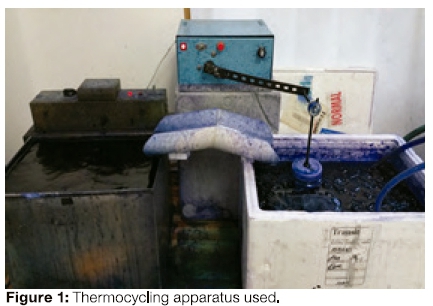
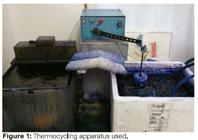
A typodont maxillary lateral incisor was used and prepared in a conventional manner to receive a full ceramic crown. A CAD (computer aided design)/ CAM (computer aided manufacturing) machine was used to scan the prepared tooth and to manufacture 40 IPS eMax crowns. A skilled technician prepared an additional 40 porcelain veneered zirconia crowns. Half the number of IPS eMax crown specimens (n=20) and half the number of porcelain veneered zirconia crown specimens (n=20) were thermocycled (i.e. to mimic thermal changes which occur in the mouth), from 5° to 55° for 500 cycles as recommended by the International Organization for Standardization (ISO 6872, 2008) (Figure 1).
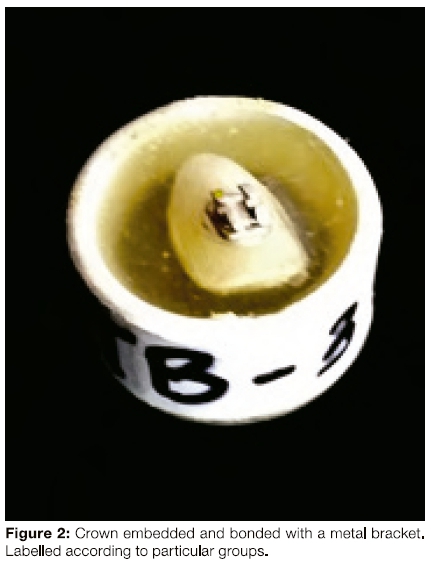
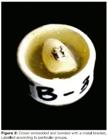
The remaining 20 IPS eMax crown specimens and 20 porcelain veneered zirconia crown specimens remained pristine and unexposed to thermal changes. The facial surfaces of all the thermocycled and non-thermocycled crown specimens were then etched. Etching of all the ceramic bonding surfaces was performed by the application of 35 per cent ortho-phosphoric acid liquid for two minutes, followed by a thin layer of a ceramic primer. The crowns were separated into four groups, Groups 1 and 2 each comprising 10 thermocycled etched and silane treated IPS eMax and 10 thermocycled and etched and silane treated porcelain veneered zirconia crown specimens, Groups 3 and 4 comprising the non-thermocycled combinations. A lateral incisor metal bracket with a bracket base area of 9mm2Figure 2).
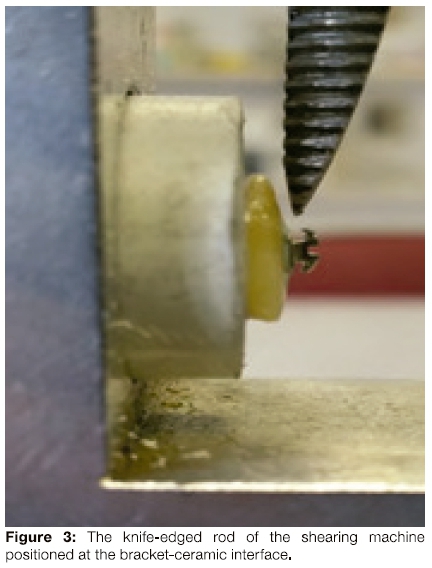
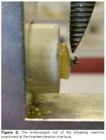
After bonding all samples were stored in distilled water for 24 hours before being submitted to the shear bond strength test (Figure 3). Debonding forces in Newtons (Ν) were determined by using a shear testing machine and the values converted into Mega Pascals (MPa).
After debonding, the surfaces of crown and resin were examined to determine the mean Adhesive Remnant Index (ARI) values and the Porcelain Fracture Index.8
RESULTS
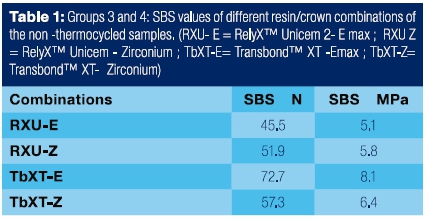
Table 1 shows the SBS values in Newtons (Ν) and Mega Pascals (MPa) of the different resin/crown combinations of Groups 3 and 4.
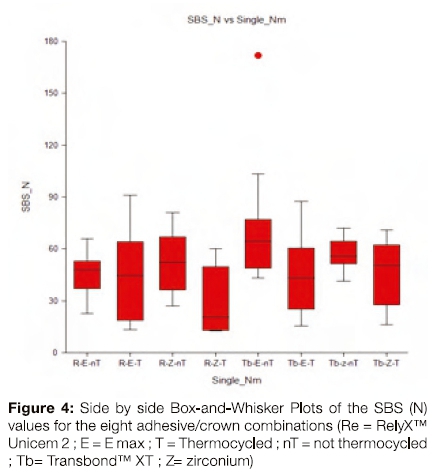
Figure 4 shows the side by side Box-and-Whisker plots of the shear bond strengths demonstrating wide and overlapping dispersions of the resin/crown combinations which consequently lessens the probability of significant differences occurring between the data of the resin/crown combinations in all four groups.
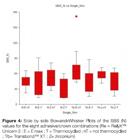
According to the Kruskal-Wallis test (p < 0.05), and the Bonferroni Test the data of the non-thermocycled resin/crown combinations did not differ significantly.
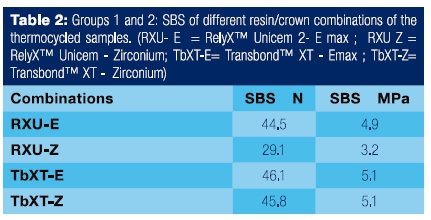
Table 2 shows the SBS values in Newtons (Ν) and Mega Pascals (MPa) of the different resin/crown combinations of Groups 1 and 2.
The results of the thermocycled groups (Group 1 and Group 2) show the TransbondTM XT/non-thermocycled IPS eMax crown combination yielded the highest overall mean shear bond strength of 8.1 MPa (72.7 Newtons) (Table 1) but dropped to a mean shear bond strength of 5.1 MPa (46.1 Newtons) (36.4% drop in shear bond strength) when the crowns had been thermocycled prior to bonding (Table 2). The TransbondTM XT/non-thermocycled porcelain veneered zirconia crown combination yielded the second highest overall mean shear bond strength of 6.4 MPa (57.3 Newtons), which also dropped, to a mean shear bond strength of 5.1 MPa (45.8 Newtons) (19.3% drop in shear bond strength) when the thermocycled crowns were used. The RelyXTM Unicem 2/non-thermocycled porcelain veneered zirconia crown combination yielded the third highest overall mean shear bond strength of 5.8 MPa (51.9 Newtons), The adhesive strength recorded on the thermocycled crowns was a significant 43.8% lower at a mean shear bond strength of 3.2 MPa (29.1 Newtons). Lastly, the RelyXTM Unicem 2/non-thermocycled IPS eMax crown combination yielded the fourth highest mean shear bond strength of 5.1 MPa (45.5 Newtons) but dropped to a mean shear bond strength of 4.9 MPa (44.5 Newtons) (a drop in shear bond strength of only 3%) when the crowns had been thermocyled prior to bonding.
The non-thermocycled resin/crown combinations showed mean ARI values of between 1.3 and 2.1 indicating cohesive fractures within the composite resin and efficient bonding of the adhesive material to the porcelain surface. However, all the thermocycled resin/crown combinations showed mean ARI values of between 0 and 0.8, indicating a bond failure between adhesive and porcelain and highlighting the negative influence of thermocycling on the bond strength of both adhesive resin cements. No cohesive fractures of the porcelain crowns were noted.
DISCUSSION
Optimal bracket adhesion to the bonding surface of porcelain crowns is always of concern to orthodontists because the forces applied during treatment should not result in bond failure. Glazed porcelain is not an appropriate surface for resin penetration and orthodontic bonding.10115,12 Etching of porcelain surfaces with phosphoric acid alone does not provide shear bond strength sufficient to resist the forces applied during orthodontic treatment.132,6 Phosphoric acid does not etch porcelain, and it does not produce physical or topographical changes in the porcelain surface. Instead, phosphoric acid has the effect of neutralising the alkalinity of the adsorbed water layer, which is present on all porcelain restorations in the oral cavity. This enhances the chemical activity of the silane coupling agents which are subsequently applied.14-16 Silane coupling agents have been reported to enhance bond strength to porcelain surfaces.11,17-21 The silane reacts with the silica within the porcelain and the organic groups of the bonding resin, thus forming a bridge between the two materials.20
There are a few scientifically-based recommendations in the literature for minimum orthodontic bracket shear bond strength. A tensile force of 60kg/cm2220222
The Adhesive Remnant Index and the Porcelain Fracture Index were also examined to establish which regime produced adequate strength for orthodontic bracket attachment to all-ceramic crowns, with the least porcelain surface damage following bracket removal. As this appears to be the first shear bond strength study on IPS eMax and porcelain-veneered zirconia crowns conditioned with 35% phosphoric acid and a silane coupling agent, there are no published values with which to compare. Shear bond strength values were compared with results from bonding orthodontic brackets to ceramic crowns conditioned with Hydrofluoric acid (HFA) and a silane coupling agent. Jivanescu and Bratu23 24,25 who had treated the porcelain surfaces with 9.6% HFA and a silane primer. However, Turk et al.26627
CONCLUSION
Within the limitations of this study, it can be concluded that:
1. There was no significant difference in the shear bond strengths of metal orthodontic brackets bonded with RelyXTM Unicem 2 self-adhesive resin cement and metal orthodontic brackets bonded with TransbondTM XT adhesive resin cement to IPS eMax and porcelain-veneered zirconia crowns which were conditioned with 35 % phosphoric acid and a silane coupling agent.
2. Conditioning the porcelain surface with 35% phosphoric acid and a silane coupling agent (which is safer to use than Hydrofluoric acid) provides a substrate which enables the satisfactory bonding of metal orthodontic brackets to all ceramic crowns, and should make it simpler for clinicians to remove the remaining adhesive from the porcelain surface after debonding.
ACRONYMSARI: Adhesive Remnant Index
HFA: Hydrofluoric acid
SBS : shear bond strength
References
- 1. Fradaeni M. Presentation: Aesthetic Challenges on Natural Dentition. SADA Dental Congress, Cape Town, South Africa, November 2012.
- 2. Ajlouni R, Bishara SE, Oonsombat C, Solimán Μ, Laffoon J. The effects of porcelain surface conditioning on bonding orthodontic brackets. Angle Orthod 2005; 75: 858-64.
- 3. Nebbe Β, Stein Ε. Orthodontic brackets bonded to glazed and deglazed porcelain surfaces. Am J Orthod Dentofacial Orthop 1996; 09: 431-6.
- 4. Schmage P, Nergiz I, Herrman W, Ozcan M. Influence of various surface-conditioning methods on the bond strength of metal brackets to ceramic surfaces. Am J Orthod Dentofacial Orthop 2003; 123: 5406.
- 5. Lamour CJ, Bateman G, Stirrups DR. An investigation into the bonding of orthodontic attachments to porcelain. Eur J Orthod 2006; 28(1): 747.
- 6. Abu Alhaija ES, Al-Wahadani AMS. Shear bond strength of orthodontic brackets bonded to different ceramic surfaces. Eur J Orthod 2007; 29: 386-9.
- 7. Hayakawa T, Horie K, Aida M, Kanaya H, Koboyashi T et al. The influence of surface conditions and silane agents on the bond of resin to dental porcelain. Den Mat 1992; 8: 238-40.
- 8. Mattos AM, Capelli JM. Porcelain surface evaluation after debonding of orthodontic brackets. Rev Dent Press Orthodon Orthopedi Facial 2006; 11: 151-58.
- 9. Herion DT, Ferracane JL, Covel DA. Porcelain surface interactions and refinishing after use of two orthodontic bonding materials. Angle Orthod 2010; 80:167-74.
- 10. Smith GA, Mclnnes-Ledoux P, Ledoux WR, Weinberg R. Orthodontic bonding to porcelain- bond strength and refinishing. Am J Orthod Dentofacial Orthop 1988; 119: 245-52.
- 11. Kocadereli I, Canay S, Akea K. Tensile bond strength of ceramic orthodontic brackets bonded to porcelain surfaces. Am J Orthod Dentofacial Orthop 2001; 119: 617-20.
- 12. Zachrisson YO, Zachrisson BU, Buyukyilmas S. Surface preparation of orthodontic bonding to porcelain. Am J Orthod Dentofacial Orthop 1996; 109: 420-30.
- 13. Guimaraes MB, Lenz HF, Bueno RS, Blaya MBG, Hlrakata LM. Orthodontie bonding to porcelain surfaces:in vitro shear bond strength. Rev Odonto Cienc 2012; 27: 47-51.
- 14. Wolf DM, Powers JM, O'Keefe KL. Bond strength of composite to etched and sandblasted porcelain. Am J Dent 1993; 6: 155-8.
- 15. Samruajbenjakul B, Kukiattrakoon B. Shear bond strength of ceramic brackets with different base designs to feldspathic porcelain. Angle Orthod 2009; 79: 571-6.
- 16. Purmal K, Alam MK, Sukumaran P. Shear bond strength of orthodontic buccal tubes to porcelain. Dent Res J 2013; 10: 81-6.
- 17. Wood DP, Jordan RE, Way DC, Galil KA. Bonding to porcelain and gold. Am J Orthod 1986; 89:194-205.
- 18. Kao EC, Bolz KC, Johnson WM. Direct bonding of orthodontic brackets to porcelain veneer laminates. Am J Orthod Dentofacial Orthop 1988; 94: 458-68.
- 19. Winchester L, Orth M. Direct orthodontic bonding to porcelain. Br J Orthod 1991; 18: 299-308.
- 20. Newman GV. Epoxy adhesives for orthodontic attachments: Progress report. Am J Orthod Dentofacial Orthop 1994; 106: 358-64.
- 21. Bourke BM, Rock WP. Factors affecting the shear bond strength of orthodontic brackets to porcelain. Br J Orthod 1999; 26: 285-90.
- 22. Whitlock BO, Erick JD, Ackerman RJ, Glaros AG, Chappell RP. Shear strength of ceramic brackets bonded to porcelain. Am J Orthod Dentofacial Orthop 1994; 106: 358-64.
- 23. Jivanescu A, Bratu CD. 2014. Tensile bond strength evaluation of two adhesive cements used for bonding orthodontic metal brackets to porcelain-fused-to-metal crowns. Mat Plastice 2014; 51: 465-7.
- 24. Bilgic F, Alkis H, Gungor AY, et al. Shear bond strength of ceramic brackets bonded to three different porcelain surfaces. Eur J Orthod 2013; 1: 17-20.
- 25. Elham S. Abu Alhaija J, AL-Wahadni AM. Shear bond strength of orthodontic brackets to different ceramic surfaces. Eur J Orthod 2007; 29: 386-9.
- 26. TurkT, Sarac D, Sarac Y, Elekdag-Turk S. Effects of surface conditioning on bond strength of metal brackets to all-ceramic surfaces. Eur J Orthod 2006; 28: 450-6.
- 27. Alhuwalia KS, Gupta A, Gaurav I, Jain N, et al. Shear bond strength of self-ligating orthodontic brackets on different types of porcelain crowns. J Orofacial Sc
Prof A. Shaikh
Department of Orthodontics, Oral Health Centre
Tygerberg Hospital Complex, Parow.
Email: