The attitudes and perceptions towards the Covid-19 vaccine among dental staff at the University of the Western Cape, South Africa
Abstract
INTRODUCTION: Despite the well-known increased risk of exposure to the Covid-19 virus in a dental setting, vaccination rates among staff members are low. This information, as well as the possible associations to demographic profiles, may be useful for authorities to adequately address specific concerns and uncertainties Aims and Objectives: To determmine the attitudes and perceptions towards the COVID-19 vaccine among dental staff at the UWC Oral Health Centers. DESIGN: A cross-sectional design was used METHODS: An anonymous, online, validated questionnaire was used to collect the data RESULTS: Majority (91.4%) of the participants had received the Covid-19 vaccine while just over 12% stated that they would not take the booster vaccination. Significant associations between the level of education and the attitudes and perceptions of staff were found CONCLUSIONS: While the majority had a positive attitude towards the Covid-19 vaccine, specific concerns and uncertainties were identified and will need to be addressed in order to improve vaccination rates among staff members
"Covid-19 vaccine"; "vaccine hesitancy"; "cross-sectional study"; "South Africa"; "Dental Staff"
INTRODUCTION
COVID-19 is a communicable disease that is also known as severe acute respiratory syndrome coronavirus 2 (SARS-COV 2) and was announced a pandemic on the 11th of March 20201,2. The Covid-19 virus's most common route of spread is through tiny droplets propelled during coughing or speech from individuals infected with the virus, within a space of 6 feet1
According to the National Institute for Communicable Diseases, the first COVID-19 case in South Africa was identified and recorded on the 5th of March 2020 in KwaZulu-Natal345
Global efforts were made to develop an effective and safe vaccine against this COVID-19 virus. The following vaccines were developed with different approaches: Oxford Univ-AstraZeneca, Gamaleya Sputnik V and Johnson & Johnson (vital vector, genetically modified virus); Pfizer-BioNtech, Moderna, Curevac and Curevac (RNA, nucleic acid, incorporating part of the virus genetic code); Sinopharm and Sinovac (Inactivated or attnuated virus); Inovio (DNA, sunthetic DNA fragments) and EpiVAcCorona and Novavax (Protein subunit) 678
Although the Johnson & Johnson vaccine program may not eliminate COVID-19, it provides the best protection against severe COVID-19 cases that result in hospitalization and death 91011th January 2022, 28.3 million doses have been administered against the COVID-19 across South Africa 121313
Dentists and dental staff face daily risks of cross infection due to exposure to high levels of microorganisms found not only in the patient's oral cavity, but also in the aerosols generated by dental instrumentation 14,15. Ultrasonic generated aerosols and the use of highspeed rotary instruments create a large amount of infectious aerosol droplets that can remain suspended in the air for extended periods of time after a dental procedure 16,17. The University of the Western Cape (UWC) in Cape Town, South-Africa, has two oral health centres that serve the Tygerberg and Mitchell's Plain communities. The University of the Western Cape was designated a World Health Organization (WHO) Collaborating Centre for Oral Health and is at the forefront of oral health developments while serving underprivileged communities. The oral health centres consist of a combination of academic, administrative and support staff for both teaching and clinical care. All staff members working in the oral health centres, regardless of their role, are in one way or another, exposed to the high-risk dental environment.
Despite the availability of the Covid-19 vaccine free of charge to all staff members, many opted not to accept the vaccine. The ideal would be for all staff members to be vaccinated against the Covid-19 virus, thereby limiting cross-infection and contributing to the safety of staff, students and the patients at the two oral health centres. It is therefore important to identify and address specific concerns and uncertainties and thus improve vaccination rates.
The aim of the present study was to determine the attitudes and perceptions towards the COVID-19 vaccine among dental staff at the UWC Oral Health Centers. A secondary aim was to determine if there were any associations between the demographics (age, sex, staff type and level of education) and the staff's attitudes and perceptions.
MATERIALS AND METHODS
A cross-sectional study was conducted by means of an anonymized online survey. The study was approved by and ethical clearance obtained from the UWC Biomedical Research Ethics Committee (ref no. BM21/5/3). A human resources representative shared the link to the online survey with all the staff members. Participation was also voluntary and no incentive was set for participants, other than the new UWC specific data that would be gained. The included population consisted of the staff compliment included all professions actively working in the oral health centers (clinical, administrative, academic and support staff) for the Dental Faculty at the University of the Western Cape. Participation in the study was voluntary and participants could withdraw from the study at any stage. Using a 50% prevalence for attitudes, a sample size of 184 participants was necessary for a 5% precision and a 95% condfidence interval for a limited sample of 368 staff members at the Dental Faculty.
The questionnaire was based on a validated questionnaire18
Microsoft Excel was used for data cleaning, editing, sorting, and coding. The excel file was then imported into STATA software (StataCorp. 2019. Stata Statistical Software: Release 16. College Station, TX: StataCorp LLC.). Confounders such as age, sex, level of education and staff type were also recorded. Descriptive statistics (i.e., frequencies, percentages, means, standard deviations) and first-order analysis (i.e., chi-square tests, Fisher's exact test) were performed. Likewise, t-tests or one-way ANOVA or Kruskal Wallis tests were performed to determine significant relations of the mean attitudes scores with sociodemographic information. A Pearson's correlation was used to determine correlations between attitudes and perceptions. Finally, factors that significantly differed in terms of perception scores, were included into multivariate linear regression analysis with perceptions, as the dependent variables. All tests were deemed statistically significant at p < 0.05.
RESULTS
There was a 28.5% (n = 105) response rate out of 368 potential participants. This response rate is close to the expected response rate for internal surveys and above the expected response rate of external surveys.19
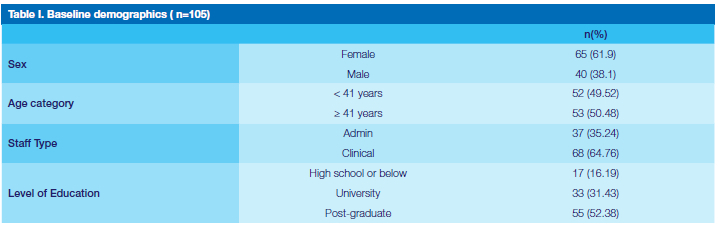
The majority (n = 96) of the participants had already received either the Johnson & Johnson (90.63%) or Pfizer (9.38%) Covid-19 vaccine. Table 1 indicates the demographics of the participants in this study, with a majority being female (61.9%), clinical staff (64.76%) with postgraduate qualifications (52.38%).
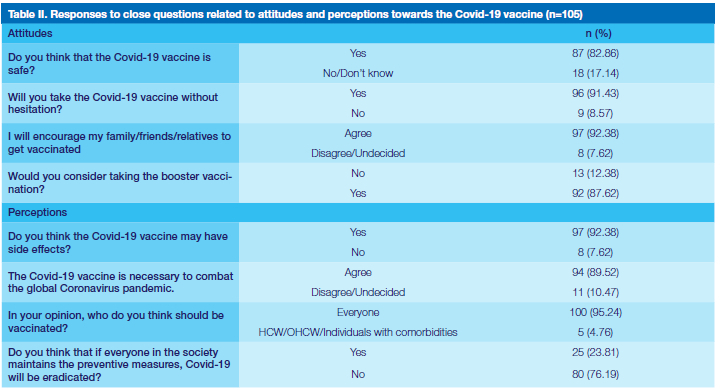
More than 80% felt that the vaccine was safe and 96% felt that they would take the vaccine without hesitation (Table II).
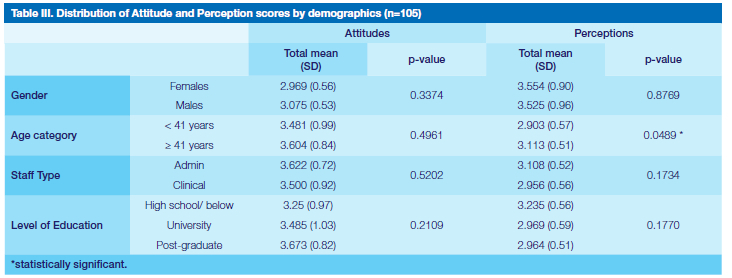
The distribution of attitude and perception scores by demographic profiles are reported in Table III.
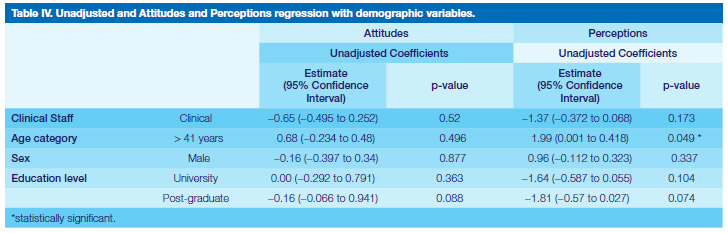
Higher scores are indicative of positive attitudes and perceptions with regards to the COVID-19 vaccine. None of the adjusted models using forward or backward elimination had an impact on attitudes or perceptions. Therefore, only simple (unadjusted) regression models were presented for attitudes and perception scores. Although not statistically significant, males had a better attitidue towards the COVID-19 vaccine compared to females, but this was not the case for the perception scores.
There was a statistically significant, moderately positive correlation between attitude and perception, p = 0.0043. In other words, participants with a better attitude also had a better perception towards the COVID-19 vaccine.
In Table IV, it is evident that older individuals were more likely to have higher (positive) perceptions scores compared to the younger participants. In fact, older participants had an increased perception score of 1.99 units greater than their younger counterparts. However, attitude scores did not differ by age group. Attitudes and perception scores did not differ between administrative or clinical staff. There was no statistically significant difference in attitude or perception scores for different levels of education.
DISCUSSION
The aim of the present study was to determine the attitudes and perception towards the COVID-19 vaccine among dental staff at the UWC Oral Health Centers.
The results of the present study show that overall, age did not impact the attitudes (p = 0.4961) of participants, but that perception scores were statistically significantly higher (more positive) in older participants (p = 0.0489) towards the Covid-19 vaccine. Al-Zalfawi et al.20et al. 18
Al-Zalfawi et al.2018Table I), however, the present study did not have an equal number of male and female participants which may have skewed this comparison.
Neary all the participants (95.24 %) reported that everyone should be vaccinated against COVID-19 and this finding was higher than the findings in a study by Haque et al. 2122Table IV). This finding agrees with Rzymski et al., 2313
CONCLUSIONS
The present study revealed that majority of the staff at the UWC oral health centres, have positive attitudes and perceptions towards the COVID-19 vaccine. Attitudes and perception scores were statistically significantly lower for participants without post-graduate training. The findings suggest that policy makers should provide specific information regarding the mechanism of action of the vaccine, possible side effects and the necessity of booster shots, to improve the and strengthen the attitudes and perceptions among dental staff towards the Covid-19 vaccine, especially among staff with lower levels of education. Focused informative interventions will help alleviate uncertainties, reduce vaccine hesitancy and improve the success rate of the vaccine roll out.
Limitations
There was a very low response rate, as only 28.5% of the staff population responded to the survey, however, a response rate of 33% is generally accepted 22
Author Contributions
The following statements should be used "Conceptualization, F.K.D. and N.P.; methodology, F.K.D.; software, F.K.D.; validation, F.K.D and L.R..; formal analysis, F.K.D.; investigation, F.K.D. and N.P.; resources, F.K.D.; data curation, L.R., D.P., I.P., C.P., S.L.R., S.R. C.R.; writing - original draft preparation, L.R., D.P., I.P., C.P., S.L.R., S.R. C.R.; writing - review and editing, F.K.D., N.P., S.N.; visualization, F.K.D.; supervision, S.N.; project administration, F.K.D. and N.P.; funding acquisition, S.N. All authors have read and agreed to the published version of the manuscript."
Declaration of Funding: This research received no external funding
Ethics:The study was conducted in accordance with the Declaration of Helsinki, and approved by the Institutional Review Board (BMREC) of University of the Western Cape (protocol code BM21/5/3 and date of approval: 29 June 2021). Participation in this study was voluntary and informed consent was obtained from all subjects involved in the study.
Data Availability Statement: The data can be found at this link, https://zenodo.org/record/5776161
Acknowledgments: The authors would like to thank the participants for partaking in this study
Conflicts of Interest: The authors declare no conflict of interest.
REFERENCES
-
1. Cennimo DJ, Bergman SJ, Olsen KM, Windle ML, Bronze MS, Miller MM. Coronavirus disease 2019. Manhattan: Medscape; 2021. Available from: https://emedicine.medscape.com/article/2500114-overview#a1 Accessed on 06 January 2022.
» https://emedicine.medscape.com/article/2500114-overview#a1 -
2. McArthur, R. The four types of COVID-19 vaccine - a snapshot. South Africa: Healthcare IT News; 2021. Available from: https://www.healthcareitnews.com/news/emea/four-types-covid-19-vaccine-snapshot Accessed on 06 January 2022.
» https://www.healthcareitnews.com/news/emea/four-types-covid-19-vaccine-snapshot -
3. Mkhize, Z. First case of COVID-19 coronavirus reported in SA. South Africa: National Institute for Communicable Diseases; 2020. Available from: https://www.nicd.ac.za/first-case-of-covid-19-coronavirus-reported-in-sa/#:~:text=FIRST%20CASE%20OF%20COVID-19%20CORONAVIRUS%20REPORTED%20IN%20SA Accessed on 06 January 2022.
» https://www.nicd.ac.za/first-case-of-covid-19-coronavirus-reported-in-sa/#:~:text=FIRST%20CASE%20OF%20COVID-19%20CORONAVIRUS%20REPORTED%20IN%20SA -
4. Western Cape Government. First case of COVID-19 confirmed in the Western Cape [Internet]. Western Cape: Western Cape Government; 2020. Available from: https://www.westerncape.gov.za/news/first-case-covid-19-confirmed-western-cape Accessed on 06 January 2022.
» https://www.westerncape.gov.za/news/first-case-covid-19-confirmed-western-cape -
5. National Institute for Communicable Diseases. Latest confirmed cases of covid-19 in South Africa (5 January 2022). Western Cape: Western Cape Government; 2021. Available from: https://www.nicd.ac.za/latest-confirmed-cases-of-covid-19-in-south-africa-5-january-2022 Accessed on 07 January 2022.
» https://www.nicd.ac.za/latest-confirmed-cases-of-covid-19-in-south-africa-5-january-2022 -
6. The InterAcademlc Partneshlp. The Different types of COVID-19 vaccines. 2021. Available from: https://www.lnteracademles.org/publlcatlon/dlfferent-types-covid-19-vacclnes. Accessed on 07 July 2022.
» https://www.lnteracademles.org/publlcatlon/dlfferent-types-covid-19-vacclnes -
7. Zheng C, Shao W, Chen X, Zhang B, Wang G, Zhang W. Real-world effectlveness of COVID-19 vacclnes: a llterature revlew and meta-analysls. Int J Infect Dls. 2022;114:252-260. doi: 10.1016/j.ljld.2021.11.009. Epub 2021 Nov 17. PMID: 34800687; PMCID: PMC8595975.
» https://doi.org/10.1016/j.ljld.2021.11.009 -
8. Hasan, I. Covld 19 vacclne rollout ln South Afrlca 'successful'. Anatoly Agency; 2021. Avallable from: https://www.aa.com.tr/en/afrlca/covld-19-vaccine-rollout-ln-south-afrlca-successful/2158634 Accessed on 06 January 2022.
» https://www.aa.com.tr/en/afrlca/covld-19-vaccine-rollout-ln-south-afrlca-successful/2158634 -
9. Bal, N. How Effectlve Is the Johnson & Johnson COVID-19 Vacclne? Here's What You Should Know. Callfornla: UCSF; 2021. Avallable from: https://www.ucsf.edu/news/2021/03/420071/how-effectlve-johnson-johnson-covld-19-vacclne-heres-what-you-should-know Accessed on 06 January 2022
» https://www.ucsf.edu/news/2021/03/420071/how-effectlve-johnson-johnson-covld-19-vacclne-heres-what-you-should-know -
10. Self WH, Tenforde MW, Rhoads JP, Gaglanl M, Glnde AA, Douln DJ, et al. Comparatlve Effectlveness of Moderna, Pfizer-BloNTech, and Janssen (Johnson & Johnson) Vacclnes ln Preventlng COVID-19 Hospltallzatlons Among Adults Without Immunocompromlslng Condltlons - Unlted States, March-August 2021. MMWR Morb Mortal Wkly Rep. 2021 Sep 24;70(38):1337-1343. dol: 10.15585/mmwr.mm7038e1. PMID: 34555004; PMCID: PMC8459899.
» https://doi.org/10.15585/mmwr.mm7038e1 -
11. Statlstlcs and Research. Coronavlrus (COVID-19) Vacclnatlons. [Internet]. https://ourworldlndata.org/covid-vaccinations?country=OWID_WRL Accessed on 07 January 2022
» https://ourworldlndata.org/covid-vaccinations?country=OWID_WRL -
12. COVID-19 South Afrlcan Online Portal. COVID-19 South Afrlcan coronavlrus news and lnformatlon [Internet]. South Africa: Department of Health; 2021. Avallable from: https://sacoronavlrus.co.za/latest-vaccine-statlstlcs/ Accessed on 07 January 2022.
» https://sacoronavlrus.co.za/latest-vaccine-statlstlcs/ -
13. Slmnanl FZ, Slngh D, Kaur R. COVID-19 phase 4 vaccine candldates, effectiveness on SARS-CoV-2 variants, neutrallzing antibody, rare side effects, traditional and nano-based vaccine platforms: a review. 3 Biotech. 2022;12(1):15. doi: 10.1007/s13205-021-03076-0. Epub 2021 Dec 12. PMID: 34926119; PMCID: PMC8665991.
» https://doi.org/10.1007/s13205-021-03076-0 - 14. Yan J, Grantham M, Pantellc J, De Mesqulta PJB, Albert B, Liu F, Ehrman S, Milton DK, Consortium EMIT. Infectlous virus ln exhaled breath of symptomatic seasonal lnfluenza cases from a college community. Proc Natl Acad Sci. 2018; 115:1081-1086.
- 15. Stadnytskyl V, Bax CE, Bax A, Anfinrud, P. The alrborne lifetime of small speech droplets and thelr potential lmportance ln SARS-CoV-2 transmission. Proc Natl Acad Sci. 2020;117:11875-11877.
-
16. Grenler, D. Quantltatlve analysls of bacterlal aerosols in two dlfferent dental cllnlc envlronments. Appl Environ Microbiol. 1995;61:3165-3168. https://doi.org/10.1128/AEM.61.8.3165-3168.1995.
» https://doi.org/10.1128/AEM.61.8.3165-3168.1995 -
17. Jones RM, Brosseau LM. Aerosol transmission of lnfectious dlsease. J Occup. Environ. Med. 2015, 57, 501-508. https://doi.org/10.1097/JOM.0000000000000448.
» https://doi.org/10.1097/JOM.0000000000000448 -
18. Islam MS, Slddlque AB, Akter R, Tasnim R, Sujan SH, Ward PR, Sikder, T. Knowledge, attitude and perceptions towards COVID-19 vaccinations: A cross-sectional community survey in Bangladesh. medRxiv 2021. Available from: https://doi.org/10.1101/2021.02.16.21251802 , Preprint.
» https://doi.org/10.1101/2021.02.16.21251802 -
19. Cleave P. What is a good survey response rate? Smart Survey. December 2020. Available from: https://www.smartsurvey.co.uk/blog/what-is-a-good-survey-response-rate#:~:text=It's%20also%20important%20to%20note,surveys%20at%2010%2D15%25 Accessed on 09 July 2021.
» https://www.smartsurvey.co.uk/blog/what-is-a-good-survey-response-rate#:~:text=It's%20also%20important%20to%20note,surveys%20at%2010%2D15%25 - 20. Al-Zalfawi, S.M., Rabbani, S.I., Asdaq, S.M.B., Alamri, A.S., Alsanie, W.F., Alhomrani, M., Mohzari, Y., Alrashed, A.A., AlRifdah, A.H. and Almagrabe, T. Public Knowledge, Attitude, and Perception towards COVID-19 Vaccination in Saudi Arabia. Int J Environ Res Public Health, 2021; 18:10081.
- 21. Haque, M.M.A., Rahman, M.L., Hossian, M., Matin, K.F., Nabi, M.H., Saha, S., Hasan, M., Manna, R.M., Barsha, S.Y., Hasan, S.R. and Siddiquea, S.R. Acceptance of COVID-19 vaccine and its determinants: Evidence from a large sample study in Bangladesh. Heliyon, 2021; 7:e07376.
- 22. Alam, A.M., Azim Majumder, M.A., Haque, M., Ashraf, F., Khondoker, M.U., Mashreky, S.R., Wahab, A., Siddiqui, T.H., Uddin, A., Joarder, T. and Ahmed, S.M. Disproportionate COVID-19 vaccine acceptance rate among healthcare professionals on the eve of nationwide vaccine distribution in Bangladesh. Expert review of Vaccines, 2021; 20:1167-1175.
- 23. Rzymski, P., Poniedziatek, B. and Fal, A. Willingness to Receive the Booster COVID-19 Vaccine Dose in Poland. Vaccines, 2021; 9:1286.
Faheema Kimmie-Dhansay
Department of Community Oral Health, Faculty of Dentistry, University of the Western Cape
South Africa
E-mail:

Author contributions:
Faheema Kimmie-Dhansay: 16%
Nicoline Potgieter: 16%
Lida Roodt: 9%
Dhinita Parumaul: 9%
Irene Pretorius: 9%
Carlien Prins: 9%
Samuel Lebea Ramaphoko: 9%
Sisipho Rhini: 9%
Corrine Ruiters: 9%
Sudeshni Naidoo: 5%