Dental Students' Perceptions of Sugar Tax and Consumption of Sugar-Sweetened Beverages
INTRODUCTION
Sugar remains a common risk factor that is associated with an increased risk of type 2 diabetes, obesity, heart disease, and dental caries.13456
The Sugar Sweetened Beverage (SSB) tax has been implemented in over 40 countries around the world with the aim of reducing purchasing and consumption of sugar sweetened beverages, incentivising product reformulation by industry, and generating revenue that would be directed to health-promoting programs.7889
A cross-sectional study examining tax awareness and perceived cost of sugar-sweetened beverages in four countries namely Australia, the United States, the United Kingdom and Mexico between 2017 and 2019 assessed three following factors: Perceived cost of SSBs over time, awareness of SSB taxes in years where taxes were present and self-reported changes in beverage purchases in response to SSB taxes in years where taxes were present. This study found that the perceived cost of SSBs relative to non-SSBs was higher in Mexico in all three years. Tax awareness was higher in the U.K., and Mexicans were reported to be buying "less" taxed beverages. Furthermore, respondents with lower socioeconomic status were less likely to be aware of an SSB tax.7
Another research paper aimed at evaluating the impact of the sugar tax on sugar-sweetened beverage consumption among school children in Saudi Arabia reported that, after the implementation of the SSB tax, energy drink consumption declined and soft drink consumption increased slightly among school children aged 12-14. The proportion of soft drink consumption before tax was 92.5% and increased by 2% after tax to 94.6%. On the other hand, when it came to energy drink consumption before tax, the proportion was 46.1%, and after tax, it reduced to 38.4%, coming down to a reduction of 8%.10
In South Africa, a qualitative study was conducted in Soweto assessing the attitudes and perceptions that contribute to sugar-sweetened beverage (SSB) intake after the introduction of the sugar tax. Out of 85 participants recruited, only 57 were willing to participate, all of whom were adults over 18.66
Oral health professionals generally express support for sugar taxation policies, given their awareness of the detrimental effects of excessive sugar consumption on dental health and broader systemic outcomes.11125, 13 The tax has since been adopted over 7 years ago in South Africa; However, limited evidence exists regarding the influence of such regulatory interventions on sugarsweetened beverage consumption among oral health professionals and students following their implementation. Therefore, this study aims to investigate perceptions of the SSB tax and patterns of SSB consumption among dental students at the University of the Witwatersrand after the tax was introduced.
METHODOLOGY
A quantitative study, using a cross-sectional study design was employed. All 147 undergraduate Wits dental students, across years 1-5, in 2023 were invited to participate on a voluntary basis. The study questionnaire was adopted from a validated questionnaire by Wrottesley et al, 2020.14
The data was collected and transferred onto a Microsoft Excel spreadsheet which was imported on to STATA version 14 for data analysis. The data was analysed using descriptive analysis. Chi-squared analysis was then used to assess the association between demographic variables and SSB consumption. All analysis was set to a 95% confidence interval.
Results
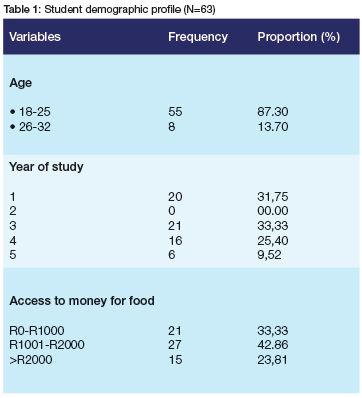
Sixty-three out of 147 dental students participated in the study, giving a 42% response rate. Table 1 shows the demographics of the participants, in terms of age, 87.3% of them were between 18-25 years. They were largely in their 1st year of study (31.7%), and most (42.8%) had access to 1000-2000 Rands pocket money a month. The second-year students were not available during the data collection phase.
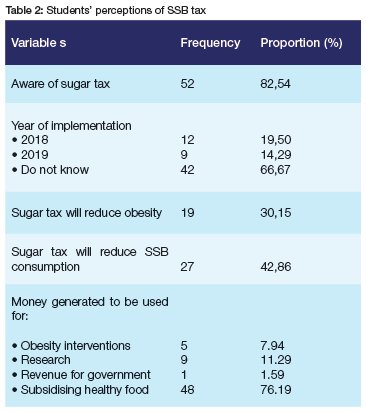
In terms of perceptions, Table 2 shows that 82.5% of the students were aware of the implementation of sugar tax, however 66.6% did not know when it was introduced. They believed (42.8%) that a sugar tax would reduce the consumption of SSBs, and 76.1% of them felt that the money generated should be used to subsidise healthy foods.
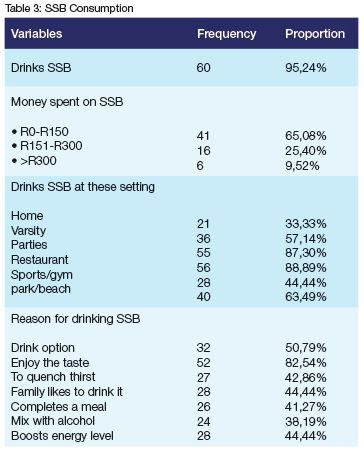
Most (95.2%) of the students continue to consume SSB, see Table 3. The majority of them spend close to R150 rands per month on SSB's. Particularly when they are at restaurants or parties (88,8%; 87,3%). The majority (82,5%) report that the reason they drink SSB's is largely for the enjoyment of the taste.
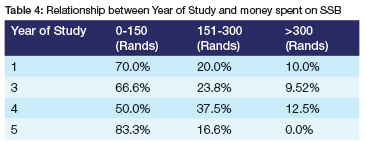
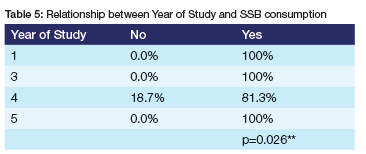
No association was found between demographic variables and SSB consumption. However, there was an association between the year of study and money spent on SSB's and SSB consumption. The fourth-year students proportionally spent more than R300 on SSB's (p=0.048), Table 4. In addition, only 18.7% of fourth-year students reported not consuming SSBs, compared with the other classes (p=0.026). See Table 5.
DISCUSSION
Our findings indicated that among the n=63 students participating in the study, 82.5% of them were aware of the implementation of sugar tax, although more than 50% (66.6%) did not know when it was introduced. They had positive perceptions on the benefits of the tax and believed that it could reduce SSB consumption and that the money generated should be utilised for subsidising healthy foods. Despite these perceptions, most (95.2%) reported consuming SSBs. Although most students spent no more than R150 on SSB, our results showed that 4th-year students spent significantly more (>R300) on SSBs (p=0.048). In addition, there was an association between the year of study and SSB consumption which revealed that although the fourth year students spent more on SSB's, they were the only group that had 18.7% of participants not consuming SSB's. No association was found between demographic variables and SSB consumption variables.
Our study revealed that as much as the majority of the students were aware of the sugar tax and understood the benefits of such a regulation in reducing obesity, consumption and money being directed to health-promoting initiatives (76.1%), their awareness and positive perceptions were not adequate to influence SSB consumption. This finding aligns with the results of Mosenogi et al. (2024), who examined the influence of multiple regulatory interventions on SSB consumption among South African adults and concluded that taxation alone was insufficient to alter consumer behavior meaningfully.1516
Our results interestingly revealed that although the fourth-year students spent more money on SSB's, they were the only group where 18.7% reported not to consume SSB. Concerning access to money and SSB consumption, a systematic review of 21 studies examining association between socio-economic status and SSB consumption, found that those who had a high socio-economic status or more access to money were 48% less likely to consume SSB's.16p=0.026). Miller et al (2020) further explore other drivers of sugar consumption among young adults. Their qualitative study found that participants drank SSBs to address their low energy levels, as shown by 44.4% of our participants. Miller et al.'s participants also considered frequent consumption acceptable when taken in moderation, even though they could not clearly define "moderation". Finally, many young adults relied on packaging and labeling, which are often unreliable.15
Regarding determinants of SSB consumption behaviour, the literature suggests that taxation alone is not sufficient to bring about behaviour change. Product formulation and promotion regulations are found as key in influencing positive change.15191820
LIMITATIONSThis study had some limitations. The relatively small sample size restricted the depth of the statistical analyses that could be performed, including the inability to conduct regression modelling. Nevertheless, the findings offer valuable preliminary insights into dental students' perceptions of the sugar-sweetened beverage (SSB) tax and their consumption habits after its implementation. Future research could expand the scope of the study by including a broader range of oral health students, such as oral hygiene and dental therapy students. In addition, although the questionnaire provided a practical, low-burden method for estimating habitual dietary intake, participants' reports of their SSB consumption may have been affected by recall bias. However, we had data on perceptions, which provided useful baseline data that can be valuable for building on future research.
CONCLUSION
This study demonstrated that although dental students were generally aware of the sugar-sweetened beverage (SSB) tax and held favorable perceptions of its intended benefits, this awareness alone did not translate into reduced SSB consumption. Given that positive perceptions alone were insufficient to influence consumption behaviour, the existing literature suggests that taxation should be complemented by additional regulatory strategies, such as product formulation and promotion regulations, to bring about a more positive behavioural change.
ACKNOWLEDGEMENT
This is to acknowledge the following past students, Relebohile Baleni, Ntokozo Mzizi, Refilwe Nziyane, and Tevin Nemudzivhadi, for their participation in the conceptualisation of the research and data collection.
REFERENCES
- 1. Barrington G, Khan S, Kent K, Brennan DS, Crocombe LA, Bettiol S. Obesity, dietary sugar and dental caries in Australian adults. International dental journal. 2019;69(5):383-91.
- 2. Gómez EJ. Government response to ultra-processed and sugar beverages industries in developing nations: The need to build coalitions across policy sectors. 2023.
- 3. Rosier B, Van Loveren C, Zaura E, Loos B, Keijser B, Crielaard W, et al. Caries incidence in a healthy young adult population in relation to diet. JDR Clinical & Translational Research. 2017;2(2):142-50.
- 4. Åkesson M-L, Wärnberg Gerdin E, Söderström U, Lindahl B, Johansson I. Health-related quality of life and prospective caries development. BMC oral health. 2016;16:1-9.
- 5. Madiba TK, Bhayat A, Nkambule NR. Self-reported knowledge, attitude and consumption of sugar-sweetened beverages among undergraduate oral health students at a university in South Africa. Journal of International Society of Preventive and Community Dentistry. 2017;7(Suppl 3):S137-S42.
- 6. Bosire EN, Stacey N, Mukoma G, Tugendhaft A, Hofman K, Norris SA. Attitudes and perceptions among urban South Africans towards sugar-sweetened beverages and taxation. Public health nutrition. 2020;23(2):374-83.
- 7. Acton RB, Vanderlee L, Adams J, Kirkpatrick SI, Pedraza LS, Sacks G, et al. Tax awareness and perceived cost of sugar-sweetened beverages in four countries between 2017 and 2019: findings from the international food policy study. International Journal of Behavioral Nutrition and Physical Activity. 2022;19(1):38.
-
8. National Treasury, RSA. Taxation of Sugar Sweetened Beverages. 2016; Accessed in https://www.gov.za/sites/default/files/gcis_document/201608/policy-paper-and-proposal-taxation-sugar-sweetened-beverages.pdf, on 15/03/26.
» https://www.gov.za/sites/default/files/gcis_document/201608/policy-paper-and-proposal-taxation-sugar-sweetened-beverages.pdf - 9. Hajishafiee M, Kapellas K, Listl S, Pattamatta M, Gkekas A, Moynihan P. Effect of sugar-sweetened beverage taxation on sugars intake and dental caries: an umbrella review of a global perspective. BMC Public Health. 2023;23(1):986.
- 10. Alhareky M, Goodson JM, Tavares M, Hartman M-L. Beverage consumption and obesity in Kuwaiti school children. Frontiers in Endocrinology. 2024;14:1174299.
- 11. Kearns C, Urata J, Chaffee B. California Dentists' Engagement in Media Advocacy for Sugar Restriction Policies. JDR Clinical & Translational Research. 2022;7(2):205-14.
- 12. Sowa PM, Keller E, Stormon N, Lalloo R, Ford PJ. The impact of a sugar-sweetened beverages tax on oral health and costs of dental care in Australia. European Journal of Public Health. 2019;29(1):173-7.
- 13. Vos MB, Kaar JL, Welsh JA, Van Horn LV, Feig DI, Anderson CA, et al. Added sugars and cardiovascular disease risk in children: a scientific statement from the American Heart Association. Circulation. 2017;135(19):e1017-e34.
- 14. Wrottesley SV, Stacey N, Mukoma G, Hofman KJ, Norris SA. Assessing sugar-sweetened beverage intakes, added sugar intakes and BMI before and after the implementation of a sugar-sweetened beverage tax in South Africa. Public Health Nutrition. 2021;24(10):2900-10.
- 15. Mosenogi K. The Influence of Regulatory Interventions on Consumption Behaviour of Sugar-Sweetened Beverages in South Africa: University of the Witwatersrand, Johannesburg (South Africa); 2024.
- 16. Fadupin G, Ogunkunle M, Gabriel O. Knowledge, attitude and consumption pattern of alcoholic and sugar sweetened beverages among undergraduates in a Nigerian institution. African Journal of Biomedical Research. 2014;17(2):75-82.
- 17. Purohit BM, Dawar A, Bansal K, Nilima, Malhotra S, Mathur VP, et al. Sugar-sweetened beverage consumption and socioeconomic status: a systematic review and meta-analysis. Nutrition and Health. 2023;29(3):465-77.
- 18. Miller C, Braunack-Mayer A, Wakefield M, Roder D, O'Dea K, Dono J, et al. "When we were young, it really was a treat; now sugar is just the norm every day"-A qualitative study of parents' and young adults' perceptions and consumption of sugary drinks. Health Promotion Journal of Australia. 2020;31(1):47-57.
- 19. Alvarado M, Penney TL, Unwin N, Murphy MM, Adams J. Evidence of a health risk 'signalling effect'following the introduction of a sugar-sweetened beverage tax. Food Policy. 2021;102:102104.
- 20. Essman M, Zimmer C, Carpentier FD, Swart EC, Taillie LS. Are intentions to change, policy awareness, or health knowledge related to changes in dietary intake following a sugar-sweetened beverage tax in South Africa? A before-and-after study. International Journal of Behavioral Nutrition and Physical Activity. 2022;19(1):136.

Authors contributions
1. Ntshovela Mabasa - 50%, conceptualization, data collection, writing
2. Mpho M Matlakale - 50%, conceptualization, analysis, writing, editing