Immune-mediated response of bone in osteomyelitis - fundamental concepts
Abstract
Advancement of knowledge on the role of the immune system in bone metabolism has uncovered a dynamic interdisciplinary research field labelled "osteoimmunology". The immune system provides stem cells for bone remodelling and elaborates cytokines under both physiological- and pathological circumstances which map the local response of bone cells and alter the phenotypic expression of bone. This manuscript provides an overview of the interaction between the immune system and bone in the different stages of osteomyelitis and correlates the inductive patterns with the radiologic appearances.
osteoimmunology; immune regulatory mediators; bone remodelling; osteomyelitis
INTRODUCTION
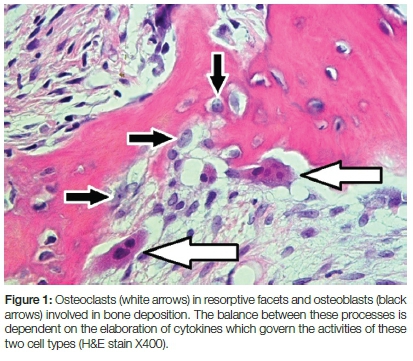
Bone formation is a complex and precisely regulated process initiated with the differentiation of mesenchymal cells into osteoblasts that are responsible for secretion of the organic bone matrix and the mineralization thereof. Upon completion of bone formation, a continuous process of bone remodelling is responsible for preserving bone mass, repair of fractures and maintaining calcium and phosphorous homeostasis. The seemingly inert skeleton displays an impressive restructuring capacity, with approximately 10% of the mass of the adult skeleton being replaced every year.122Figure 1).
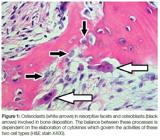
The importance of the immune system in bone metabolism is illustrated by the rapidly expanding interdisciplinary field of osteoimmunology. During physiological bone remodelling the immune system not only provides stem cells, but also elaborate cytokines that regulate the activities of osteoclasts and osteoblasts through binding to specific receptors on the cell surfaces.3
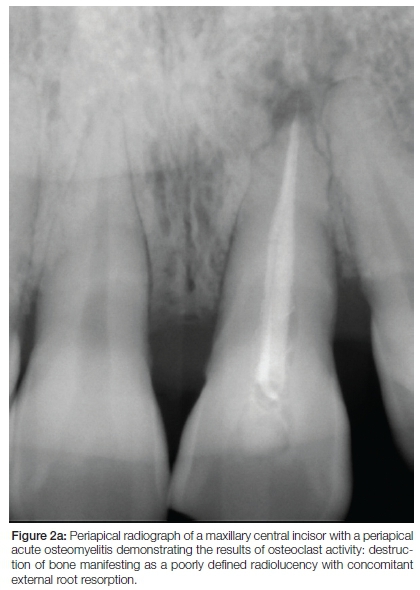
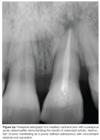
BONE REACTION IN ACUTE OSTEOMYELITISAcute osteomyelitis is characterised radiographically as an area of poorly demarcated bone loss at the site of inflammation. The resorptive process is initiated by the attraction of neutrophils and monocytes, the mainstay of the innate immune response, to the site of inflammation. Osteoclasts which are responsible for bone resorption differentiate from a pool of predestined osteoclast precursors which circulate in the blood as monocytes and are attracted to bone by a complex interaction of cytokines, the details of which fall outside the scope of this paper.11
Osteoclasts are retained within bone by a chemokine known as stromal-derived factor-1 (SDF-1).45
During normal bone remodelling, macrophage-colony-stimulating factor (M-CSF) promotes the expression of receptor activator of nuclear factor κ β (RANK) receptors on dedicated monocytes67-9 This finely tuned control of bone resorption by osteoblasts is important for calcium and phosphate homeostasis whilst maintaining the integrity of the skeleton.
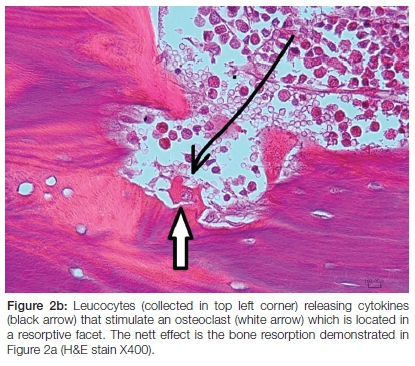
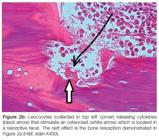
The attraction of leukocytes and macrophages to a site of osteomyelitis and subsequent elaboration of several osteoclastogenic cytokines by the inflammatory cells, amongst others RANKL produced by activated macrophages, several interleukins (IL's) released by leukocytes10111213Figures 2a and 2b).
BONE REACTION IN CHRONIC OSTEOMYELITIS
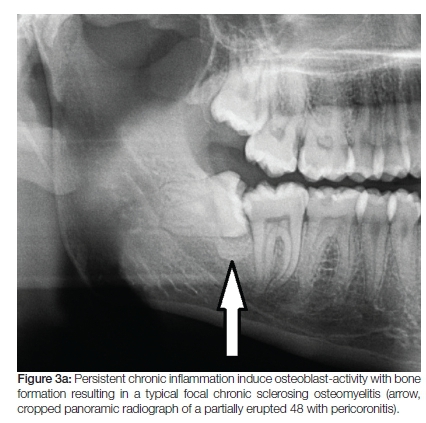
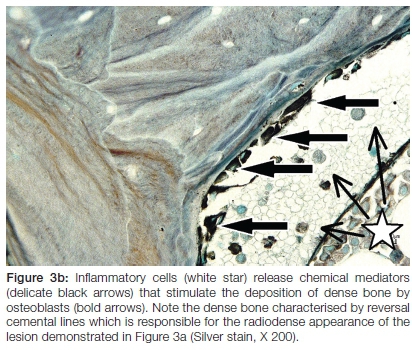
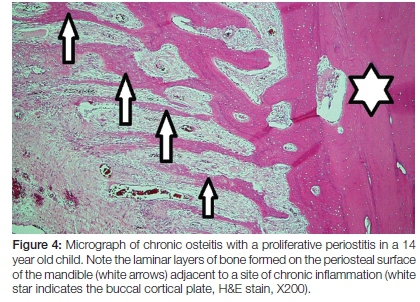
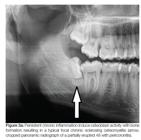
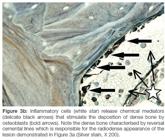
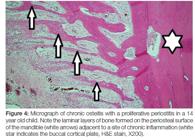
After neutralization of most of the antigens by the innate immune response and the short life span of neutrophils, the nature of the inflammatory reaction in osteomyelitis changes and cells of the adaptive immune response (lymphocytes and plasma cells) appear. Osteoclasts are active for approximately three weeks1415161718Figures 3a and 3b). In children, the elaboration of bone inductive cytokines at a site of chronic inflammation and in the presence of anabolic hormones such as human growth hormone (HGH) and insulin-like-growth-factor-1 (IGF-1)19Figure 4). This reactive process manifests with an "onion-skin appearance" radiologically and is designated as chronic osteitis with proliferative periostitis.
CONCLUSION
Mapping of the cytokines released during the course of osteomyelitis provides an explanation for the reaction of bone and the subsequent radiologic changes of the disease. The characterization of cell receptors governing the inflammatory induced bone changes provide lucrative commercial opportunities for the manufacturing of patented drugs and auto antibodies which can either limit bone resorption or stimulate bone formation, thereby facilitating an enhanced clinical outcome for patients with osteomyelitis. Injectable biodegradable microspheres coated by osteoinductive cytokines have already been shown to decrease post infection healing time of bone.20,21 Further advances in this rapidly developing field of manipulating bone health is certain to impact in the near future on the management of osteomyelitis of the jaw bones.
References
- 1. Murthy MB. Osteoimmunology- Unleasing the concepts. J Indian Soc Periodontol 2011; 15:190-8.
- 2. Corral DA, Amling M, Priemel M, et al. Dissociation between bone resorption and bone formation in osteopenic transgenic mice. Proc Natl Acad Sci USA. 1998; 95 (23):12835-13840.
- 3. Lorenzo J, Horowitz M, Choi Y. Osteoimmunology: interactions of the bone and immune system. Endocr Rev, 2008: 29(4): 403-40.
- 4. Boyce BF. Advances in the regulation of osteoclasts and osteoclast functions. J Dent Res 2013: 92(10): 860-7.
- 5. Tetti A, Rucci N. The unexpected links between bone and the immune system. Medicograph 2010 (32)4:341-8.
- 6. Boyce BF, Zuscik MJ, Xing L. Biology of bone and cartilage. In: Genetics of Bone Biology and Skeletal Disease. London, UK: Elsevier, pp3-24.
-
7. Abu-Amer Y: NFKB signalling and bone resorption. Osteoporos Int 2013;24: DOI:10.1007/s00198-013-2313-x.
» https://doi.org/10.1007/s00198-013-2313-x - 8. Glass DA, Bialek P, Ahn JD. Cananonical Wnt signalling in differentiated osteoblasts controls osteoclast differentiation. Dev Cell 2005;8:751-64.
- 9. Lacey DL, Timms E, Tan HL. Osteoprotegerin ligand is a cytokine that regulates osteoclast differentiation and activation. Cell 1998;93:165-76.
- 10. Walsh MC, Kim N, Kadono Y. Osteoimmunology: interplay between the immune system and bone metabolism Ann Rev Immunol 2006;24:33-63.
- 11. Jurisic V, Colic S, Jurisic M. The inflammatory radicular cysts have a higher concentration of TNF alpha in comparison to odontogenic keratocysts (odontogenic tumour). Acta Medica (Hradec Kralove) 2007;50:233-8.
- 12. Boyce BF. Advances in the regulation of osteoclasts and osteoclast functions. J Dent Res 2013; 92(10): 860-7.
- 13. Hayman AR. Tartrate-resistant acid phosphatase (TRAP) and the osteoclast/immune cell dichotomy. Autoimmun 2008;41:218-23.
-
14. Sims NA, Martin TJ. Coupling the activities of bone formation and resorption: a multitude of signals within the basic multicellular unit. BoneKey Rep 2014; doi:10.1038/bonekey.2013.215.
» https://doi.org/10.1038/bonekey.2013.215 - 15. Street J, Bao M, deGusman L. Vascular endothelial growth factor stimulated bone repair by promoting angiogenesis and bone turnover. Proc Natl Acad Sci USA 2002;99:9656-9661.
- 16. Sacchetti B, Funari A, Michienzi S. Self-renewing osteoprogenitors in bone marrow sinusoids can organize a hematopoietic microenvironment. Cell 2007;131:324-6.
- 17. Komori T. Regulation of osteoblast differentiation by transforming factors. J Cell Biochem 2006;99:1233-9.
- 18. Graham S, Gamie Z, Polyzois I. Prostaglandin EP2 and EP4 receptor agonists in bone formation and bone healing: In vivo and in vitro evidence. Expert Opin Investig Drugs 2009;18:746-66.
- 19. Olney RC. Regulation of bone mass by growth hormone. Med Pediatr Oncol 2003;41:228-34.
- 20. Jennisen HP. Accelerated and improved osseointegration of implants biocoated with bone morphogenetic protein 2 (BMP-2). Ann NY Acad Sci 2002;961:139-42.
- 21. Tiffany NV, Kasper FK, Mikos AG. Strategies for controlled delivery of growth factors and cells for bone regeneration. Adv Drug Deliv Rev 2012;64:1292-1309.
Hilde D Miniggio
P.O. Medunsa 0204, Pretoria
Tel: 012 521 4882
Fax: 012 521 4274
Cell: 072 869 4045
E-mail: