HIV-associated salivary gland enlargement: a clinical review
Abstract
Salivary gland disease is well established as an important HIV associated oral lesion. It manifests as salivary gland swelling involving one or both parotid glands with or without xerostomia. In the context of HIV, the swelling may be due to a wide spectrum of pathological conditions that include reactive or inflammatory disorders, acute and chronic infections, and neoplasms. This paper reviews the epidemiology, pathogenesis, clinical presentation, aspects of diagnosis and management of HIV associated salivary gland enlargement, in particular parotid gland enlargement, due to benign lymphoepithelial cysts (BLEC). Parotid gland enlargement is typically an early manifestation in the HIV-positive patient and should alert healthcare professionals to the likelihood of HIV infection. FNAC of the parotid gland is required to confirm the diagnosis and instituting HAART forms an important part of the management. There is a shift away from surgery in the treatment of this essentially ‘benign’ condition.
HIV; salivary gland disease; parotid enlargement; benign lymphoepithelial cysts
INTRODUCTION
Salivary gland disease is well established as an important Human Immunodeficiency Virus (HIV) associated oral lesion12et al as salivary gland swelling involving one or both parotid glands with or without xerostomia.31,4 In the context of HIV, the swelling may be due to a wide spectrum of pathological conditions that include reactive or inflammatory disorders, acute and chronic infections, and neoplasms.2
ACRONYMSBLEC: benign lymphoepithelial cysts
BLEL: benign lymphoepithelial lesions
CT: computed tomography scanning
CMV: Cytomegalovirus
DILS: Diffuse infiltrative CD8 lymphocytosis syndrome
ELISA: Enzyme linked immunoassay
EBV: Epstein Barr Virus
FNAC: fine needle aspiration cytology
HAART: highly active antiretroviral therapy
KS: Kaposi's sarcoma
MRI: Magnetic resonance imaging
NHL: Non-Hodgkin's lymphoma
EPIDEMIOLOGY OF HIV ASSOCIATED SALIVARY GLAND DISEASE AND ENLARGEMENTHead and neck lesions associated with HIV arise in over 50% of HIV- positive patients and occur in nearly 80% of all patients with AIDS.4,5 The average prevalence of HIV associated salivary gland disease in Africa was estimated to be 19%,6 7684,9 In a recent South African study, 23.3% of patients were diagnosed with BLEC.10611 11
PATHOGENESISParotid gland enlargement is commonly due to the development of BLEC within the parotid gland. To date, the precise aetiology of these lesions is unknown,1244,12,13
In a subgroup of HIV-positive patients, a disease process known as "Diffuse infiltrative CD8 lymphocytosis syndrome" has been observed. This entity is characterized by a CD8 lymphocytosis, bilateral parotid swelling, a diffuse visceral CD8 lymphocytic infiltration (usually involving the lung), and cervical lymphaden-opathy.1415
There is considerable debate as to the terminology used to describe these lesions. The terms include benign lymphoepithelial cysts (BLEC), benign lymphoepithelial lesions (BLEL), cystic BLEL, AIDS-related lymphadenopathy, diffuse infiltrative CD8 lymphocytosis syndrome (DILS), cystic lymphoid hyperplasia and HIV associated salivary gland disease.4
CLINICAL PRESENTATIONAmong the salivary glands that may be affected by HIV infection, the parotid is most widely involved. Exceptionally, the submandibular gland may be affected.16101741819 20,21
The clinical assessment of patients with HIV and parotid swelling involves taking a thorough history related to the time of onset and rate of growth as well as symptoms associated with the mass such as pain and discomfort. Constitutional symptoms such as fever, loss of weight and night sweats should alert the practitioner to the possibility of TB or lymphoma; a sudden increase in gland size should arouse suspicion of possible lymphomatous transformation. On physical examination, both parotid glands must be investigated for masses and the neck for lymphadenopathy. Features of malignant transformation such as induration, pain, fixation and facial nerve pathology should also be noted.22
The differential diagnosis of BLEC includes branchial cysts, salivary duct cysts, reactive lymphadenopathy, traumatic sialocoeles, Sjogren's syndrome, lymphangiomas, tuberculous abscesses, cystic tumours, malignancies (for example cystadenocarcinoma), as well as those due to Non-Hodgkin's lymphoma (NHL) and Kaposi's sarcoma (KS).10,19 These conditions are important to consider and exclude using the diagnostic methods described below.
ASPECTS OF DIAGNOSISThe diagnosis of BLEC is very specific to HIV infection. Thus, if confirmed in a patient with an unknown HIV status, it is mandatory to perform an HIV test as part of the diagnostic work- up.23
Diagnostic modalities may be non-invasive and invasive. Non-invasive diagnostic evaluation consists of an ultrasound scan of the parotid gland, computed tomography scanning (CT) and/or magnetic resonance imaging (MRI) in cases of diagnostic ambiguity. Ultrasonography is ideal for evaluating "superficially located anatomic soft tissue entities" such as the parotid gland.99et al (2010), four distinctive ultrasound patterns in the parotid glands of HIV-positive patients were described. These include: lymphocytic aggregations, lymphoepithelial cysts (prominent round hypo-echoic areas with well circumscribed margins and internal septa), fatty infiltration (in patients on protease inhibitor therapy) and lymphadenopathy.2413
Invasive procedures include fine needle aspiration cytology (FNAC) of the parotid gland, which is a safe and suitable diagnostic modality and is recommended to exclude the lesions that may be considered in the differential diagnosis.232510,22
The diagnostic criteria for DILS comprises HIV seropositivity as confirmed on enzyme linked immunoassay (ELISA) and Western Blot testing, bilateral salivary gland enlargement, or xerostomia persistent for more than six months and histologic confirmation of a salivary or lacrimal gland granulomatous inflammation or a neoplastic involvement.2622 2728
The aetiology of BLEC remains obscure. The role of epidermotropic viruses such as Epstein Barr Virus (EBV) and Cytomegalovirus (CMV) has been suggested. However conflicting reports exist in the literature as to the main causative organism.2929
In summary, the main diagnostic modalities for BLEC include ultrasonography and FNAC of the parotid gland. The key diagnostic features for HIV-associated BLEC described by Meyer et al,30
MANAGEMENT OF HIV- ASSOCIATED PAROTID GLAND ENLARGEMENT
The management of parotid gland BLEC is controversial with different opinions as regards the best treatment option.4 4
For minimally symptomatic lesions without significant cosmetic deformity, monitoring is a viable option and should be at six-monthly intervals, with radiographic and histopathologic analysis undertaken where necessary to exclude malignancy. BLEC are slowly progressive lesions and any sudden increases in gland size requires prompt investigation due to the risk of lymphomatous transformation.413
Aspiration affords rapid relief, but cysts tend to recur within weeks to months and continue to enlarge.41241930 4
HAART has been shown to reduce the incidence of BLEC and DILS.4,22,31 Paradoxically, some studies show an overall increase in the prevalence of salivary gland pathology in the HAART era.32,33 Likely reasons to explain this phenomenon include the size of pre-existing lesions, duration of therapy, different HAART regimens34351,18 In contrast, significantly lower prevalence rates of DILS in the post-HAART era are reported, signifying that DILS is an antigen (viral)-driven response with the key treatment being antiretroviral therapy.36123737 14
Promising results have also been reported with the use of low-dose external beam radiotherapy (24Gy in 1.5Gy daily fractions).1222
Surgery for BLEC is challenging. For benign parotid pathology such as pleomorphic adenoma, either the superficial or deep lobe is removed; in BLEC, the entire parotid gland is affected, necessitating a total parotidectomy. The vascularity of the parotid gland, underlying sialadenitis and cystic changes that are part of the pathological process leads to distorted tissue planes, with displacement of the facial nerve, making dissection extremely hazardous. Thus, facial nerve injury, bleeding and seroma formation may occur.1212
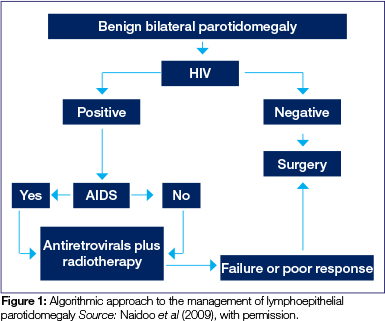
A useful management algorithm has been proposed by Naidoo et al (Figure 1).12
CONCLUSION
Oral lesions are important clinical Indicators of HIV Infection and may also point toward disease progression to AIDS.38 2,6 In a proportion of patients, HIV-associated salivary gland enlargement may be the initial manifestation of HIV infection, Thus, surgeons, together with other health care professionals, are uniquely placed in their current practices to make a significant impact on this disease entity, through timeous patient screening and referral for appropriate clinical care including HAART.39,40,41
There is a paucity of literature describing aspects of HIV-associated parotid gland enlargement especially from developing countries, including South Africa, In these areas, where HIV infection is rampant, and healthcare resources are limited, epidemiological studies and research on feasible diagnostic and management modalities are critical to reduce further morbidity.11
Conflict of Interest:
The authors declare no commercial or other association that might pose a conflict of interest with regard to this study.
Declaration:
No financial aid was sought or received to support this work.
This study was part of a thesis submission by Sumayyah Ebrahim (July, 2012) to the University of KwaZulu-Natal (UKZN) for the degree of Master of Medicine (Surgery).
References
- 1. Jeffers L, Webster-Cyriaque J. Viruses and Salivary Gland Disease (SGD) Lessons from HIV SGD. Advances in Dental Research. 2011;23(1):79-83.
- 2. Leao JC, Ribeiro C, Carvalho AAT, Frezzini C, Porter S. Oral complications of HIV disease. Clinics. 2009;64(5):459-70.
- 3. Schi0dt M, Dodd CL, Greenspan D, Daniels TE, Chernoff D, Hollander H, et al. Natural history of HIV-associated salivary gland disease. Oral surgery, Oral Medicine, Oral Pathology. 1992;74(3):326-31.
- 4. Shanti RM, Aziz SR. HIV-associated Salivary Gland Disease. Oral and Maxillofacial Surgery Clinics of North America. 2009;21(3):339-43.
- 5. Yengopal V, Naidoo S. Do oral lesions associated with HIV affect quality of life? Oral Surgery, Oral Medicine, Oral Pathology, Oral Radiology, and Endodontics. 2008 7;106(1):66-73.
- 6. Ranganathan K, Hemalatha R. Oral lesions in HIV infection in developing countries: an overview. Advances in Dental Research. 2006;19(1):63-8.
- 7. Matee M, Scheutz F, Moshy J. Occurrence of oral lesions in relation to clinical and immunological status among HIV-infected adult Tanzanians. Oral Diseases. 2000;6(2):106-11.
- 8. Frezzini C, Leao JC, Porter S. Current trends of HIV disease of the mouth. Journal of Oral Pathology & Medicine. 2005;34(9):513-31.
- 9. Mandel L. Ultrasound findings in HIV-positive patients with parotid gland swellings. Journal of Oral and Maxillofacial Surgery. 2001;59(3):283-6.
- 10. Michelow P, Dezube BJ, Pantanowitz L. Fine needle aspiration of salivary gland masses in HIV-infected patients. Diagnostic cytopathology. 2012;40(8):684-90.
- 11. Holmes HK, Stephen LXG. Oral lesions of HIV infection in developing countries. Oral Diseases. 2002;8:40-3.
- 12. Naidoo M, Singh B, Ramdial P, Moodley J, Allopi L, Lester B. Lymphoepithelial lesions of the parotid gland in the HIV era-a South African experience. South African Journal of Surgery. 2009;45(4):136-41.
- 13. Mandel L, Surattanont F. Bilateral parotid swelling: a review. Oral Surgery, Oral Medicine, Oral Pathology, Oral Radiology, and Endodontics. 2002;93(3):221-37.
- 14. Mandel L. Salivary Gland Disorders. Dental Clinics of North America. 2011;55(1):121-40.
- 15. Mandel L, Surattanont F. Regression of HIV parotid swellings after antiviral therapy: Case reports with computed tomographic scan evidence. Oral Surgery, Oral Medicine, Oral Pathology, Oral Radiology and Endodontics. 2002;94(4):454-9.
- 16. Mulligan R, Navazesh M, Komaroff E, Greenspan D, Redford M, Alves M, et al. Salivary gland disease in human immunodeficiency virus-positive women from the WIHS study. Oral Surgery, Oral Medicine, Oral Pathology, Oral Radiology, and Endodontics. 2000;89(6):702-9.
- 17. Casiglia JW, Woo S-B. Oral manifestations of HIV infection. Clinics in Dermatology.18(5):541-51.
- 18. Islam NM, Bhattacharyya I, Cohen DM. Salivary gland pathology in HIV patients. Diagnostic Histopathology. 2012;18(9):366-72.
- 19. Monama GM, Tshifularo MI. Intralesional bleomycin injections in the treatment of benign lymphoepithelial cysts of the parotid gland in HIV-positive patients: Case reports. The Laryngoscope. 2010;120(2):243-6.
- 20. Favia G, Capodiferro S, Scivetti M, Lacaita MG, Filosa A, Muzio LL. Multiple parotid lymphoepithelial cysts in patients with HIV-infection: report of two cases. Oral Diseases. 2004;10(3):151-4.
- 21. Carlson ER. Diagnosis and Management of Salivary Gland Infections. Oral and Maxillofacial Surgery Clinics of North America. 2009;21(3):293-312.
- 22. Kim TB PS, Goldberg AN. Head and Neck Manifestations in the Immunocompromised Host. In: Flint PW, editor. Cummings Otolaryngology: Head & Neck Surgery. General Otolaryngology. 1. Fifth Edition ed. Philadelphia: Mosby; 2005. p. 209- 29.
- 23. Gurney TA, Murr AH. Otolaryngologic manifestations of human immunodeficiency virus infection. Otolaryngologic Clinics of North America. 2003;36(4):607-24.
- 24. Kabenge C, Ng S, Muyinda Z, Ameda F. Diagnostic ultrasound patterns of parotid glands in human immunodeficiency viruspositive patients in Mulago, Uganda. Dentomaxillofac Radiol. 2010;39(7):389-99. PubMed PMID: WOS:000281761200001. English.
- 25. Madani G, Beale T. Inflammatory conditions of the salivary glands. Seminars in Ultrasound, CT, and MRI. 2006;27(6):440-51.
- 26. Williams FM, Cohen PR, Jumshyd J, Reveille JD. Prevalence of the diffuse infiltrative lymphocytosis syndrome among human immunodeficiency virus type 1 positive outpatients. Arthritis & Rheumatism. 1998;41(5):863-8.
- 27. Itescu S, Brancato LJ, Buxbaum J, Gregersen PK, Rizk CC, Croxson TS, et al. A diffuse infiltrative CD8 lymphocytosis syndrome in human immunodeficiency virus (HIV) infection: a host immune response associated with HLA-DR5. Annals of Internal Medicine. 1990;112(1):3-10.
- 28. Rubinstein A, Morecki R, Silverman B, Charytan M, Krieger BZ, Andiman W, et al. Pulmonary disease in children with acquired immune deficiency syndrome and AIDS-related complex. The Journal of Pediatrics. 1986;108(4):498-503.
- 29. Yen TL, Murr AH, Rabin J, Mhatre AN, Lalwani AK. Role of Cytomegalovirus, Epstein Barr Virus, and Human Herpes Virus 8 in Benign Lymphoepithelial Cysts of the Parotid Gland. The Laryngoscope. 2004;114(8):1500-5.
- 30. Meyer E, Lubbe DE, Fagan JJ. Alcohol sclerotherapy of human immunodeficiency virus-related parotid lymphoepithelial cysts. The Journal of Laryngology & Otology. 2009;123(04):422-5.
- 31. Syebele K, Bütow K-W. Comparative study of the effect of antiretroviral therapy on benign lymphoepithelial cyst of parotid glands and ranulas in HIV-positive patients. Oral Surgery, Oral Medicine, Oral Pathology, Oral Radiology, and Endodontics. 2011;111(2):205-10.
- 32. Smith JA. HIV and AIDS in the adolescent and adult: An update for the Oral and Maxillofacial Surgeon. Oral and Maxillofacial Surgery Clinics of North America. 2008;20(4):535-65.
- 33. Patton LL, McKaig R, Strauss R, Rogers D, Eron Jr JJ. Changing prevalence of oral manifestations of human immuno-deficiency virus in the era of protease inhibitor therapy. Oral Surgery, Oral Medicine, Oral Pathology, Oral Radiology, and Endodontics. 2000;89(3):299-304.
-
34. Taiwo O, Hassan Z. The impact of Highly Active Antiretroviral Therapy (HAART) on the clinical features of HIV - related oral lesions in Nigeria. AIDS Research and Therapy. 2010;7(1):19. PubMed PMID: doi:10.1186/1742-6405-7-19.
» https://doi.org/10.1186/1742-6405-7-19 - 35. Hegarty AM, Chaudhry SI, Hodgson TA. Oral healthcare for HIV-infected patients: an international perspective. Expert Opinion on Pharmacotherapy. 2008;9(3):387-404.
- 36. Basu D, Williams FM, Ahn CW, Reveille JD. Changing spectrum of the diffuse infiltrative lymphocytosis syndrome. Arthritis Care & Research. 2006;55(3):466-72.
- 37. Mandel L, Vakkas J. Parotid enlargement in patient with HIV. The New York State Dental Journal. 2005;71(1):44-6.
- 38. Patton LL, van der Horst C. Oral infections and other manifestations of HIV disease. Infectious Disease Clinics of North America. 1999;13(4):879-900.
- 39. Cunningham CM. Human immunodeficiency virus/acquired immune deficiency syndrome: the forgotten crisis and implications for the general surgery practice. The American Journal of Surgery. 2011;201(5):705-6.
- 40. Saltzman DJ, Williams RA, Gelfand DV, Wilson SE. The surgeon and AIDS: twenty years later. Archives of Surgery. 2005;140(10):961-7.
- 41. Martinson NA, Omar T, Gray GE, Vermaak JS, Badicel M, Degiannis E, et al. High rates of HIV in surgical patients in Soweto, South Africa: impact on resource utilisation and recommendations for HIV testing. Transactions of the Royal Society of Tropical Medicine and Hygiene. 2007;101(2):176-82.
S Ebrahim
Departments of Surgery,
Nelson R. Mandela School of Medicine
University of KwaZulu-Natal
Private Bag 7
Congella
South Africa 4013
Cell: 082 485 8344, Fax: 086 593 0999
E-mail: