Reciprocating instruments in Endodontics: a review of the literature
INTRODUCTION
When conventional nickel titanium (Ni-Ti) instruments are rotated in root canals, they are subjected to structural fatigue that, if continued, will eventually lead to fracture.1,2 Torsion and fatigue through flexure are the two main reasons for this failure.3 4,5 The amount of bending stress imposed on an instrument depends on the anatomy of the root canal and is obviously greater in curved root canals.6
The first study experimenting with an alternating movement was that of Yared in 2008, which used the ProTaper F2 instrument (Dentsply/Maillefer) in a reciprocating movement.78,9 The study showed great promise for the reduction in the number of instruments required in the cleaning and shaping sequence; in minimising possible contamination; and alleviating operator anxiety of the possibility of instrument failure.7810
Alternating (reciprocation) of Ni-Ti instruments have the following advantages over continuous rotation:
• Binding of the instruments into the root canal dentine walls is less frequent, reducing torsional stress.11
• The reduction of the number of cycles within the root canal during preparation results in less flexural stress on the instrument.5
• There is decreased risk of instrument fracture.7,11
ACRONYMSCW: clockwise
CCW: counter clockwise
SAF: Self-Adjusting File
The WaveOne NiTi File System (Dentsply/Maillefer) was introduced to the dental market in 2010. It is a pre-packaged, pre-sterilised, single-use system that is designed to shape root canal systems to a continuously tapering morphology.12,13
In the majority of cases a single file can be used to complete root canal preparation in single- or multiple root canal systems. Instead of a rotary motion, the files work in a reverse "balanced force" cutting motion112
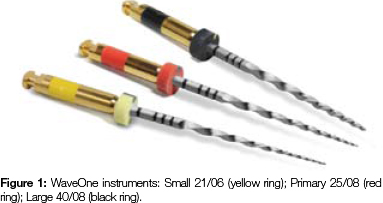
The WaveOne single-file reciprocating system (Dentsply/ Maillefer) (Figure 1) is available in three different file sizes in lengths of 21mm, 25mm, and 31mm:
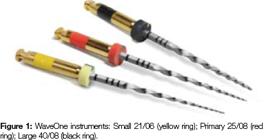
1. WaveOne Small File - Tip of the file is size ISO 21 and the shaft has a continuous taper of 6%.
2. WaveOne Primary File - Tip of the file is size ISO 25 and the shaft has a continuously decreasing taper of 8% from its tip to its shaft (0.8, 0.65, 0.6, 0.55).
3. WaveOne Large File - Tip of the file is ISO 40 and the shaft has a continuously decreasing taper of 8% from its tip to its shaft (0.8, 0.65, 0.6, 0.55).
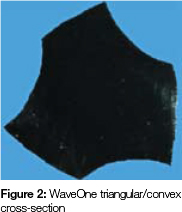
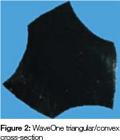
The three WaveOne instruments are also characterised by different cross-sectional designs over the entire length of the working part of the instruments. In the tip region the cross-section presents radial lands while in the middle part and near the shaft the cross-sectional diameter changes from a modified triangular/convex cross-section with radial lands to a neutral rake angle with a triangular/convex cross-section (Figure 2).14
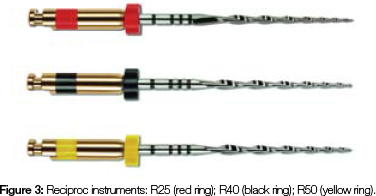
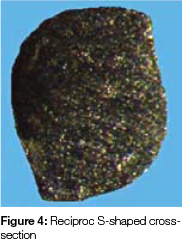
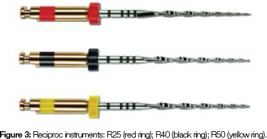
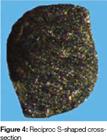
The Reciproc system also includes three instruments (R25, R40 and R50) (Figure 3) and is driven by the VDW Silver Reciproc Motor (VDW) or the X-Smart Plus motor (Dentsply/ Maillefer). The instruments have an S-shaped cross section and demonstrate a progressive taper (Figure 4).1515
As mentioned, the reciprocating instruments are single use. This provides the clinician with the following advantages:
• A general decrease in instrument fracture associated with the reduction of instrument fatigue.7
• Elimination of possible cross contamination that is associated with the inability to adequately clean and sterilise previously used instruments;7,12
•No need to disinfect, clean, sterilise and organise because the instruments are disposed of after each use.
Both systems, WaveOne and Reciproc, are manufactured from M-Wire technology to improve the fracture resistance of the instruments. M-Wire is a new Ni-Ti alloy that is prepared by a special thermal process, claimed to increase flexibility and resistance to cyclic fatigue.16,17 It is reported that instruments made from M-Wire with a ProFile (Dentsply/Maillefer) design exhibit nearly 400% more resistance to cyclic fatigue than do super-elastic wire instruments of the same size.18
LITERATURE REVIEW ON RECIPROCATING INSTRUMENTS
a. Cyclic fatigue
De Deus et al. (2010) evaluated the cyclic fatigue resistance of ProTaper F2 instruments in reciprocating motion compared with continuous rotation.19
The influence of different angles of reciprocation on the cyclic fatigue of different Ni-Ti instruments was investigated by Gambharini et al. in 2012.20
Gavini et al. (2012) evaluated the resistance to flexural fatigue of the Reciproc R25 files under either continuous rotation or reciprocation, using simulated root canals of tempered steel.21
Plotino et al. (2012) evaluated the cyclic fatigue resistance of Reciproc and WaveOne in simulated root canals.2223,24,25,26 Kim et al. (2012) evaluated the cyclic fatigue and torsional resistance of Reciproc, WaveOne and ProTaper. These authors concluded that the WaveOne system had a higher torsional resistance whilst Reciproc showed a higher number of cycles before fracture, compared with the other instruments. Both reciprocating instruments demonstrated significantly higher cyclic fatigue resistance and torsional resistance than did ProTaper.27et al. (2013).28
In a study conducted by Castelló-Escrivá et al. (2012) the researchers compared the cyclic fatigue resistances of ProTaper Universal (F2, 25/08), WaveOne (Primary, 25/08) and Twisted Files (25/08)(Sybron Endo).29
b. Debris removal
A study by Bürklein et al. (2012) compared the efficacy of instruments functioning in a conventional rotating action with instruments functioning in reciprocating motion.30
A further study by Dietrich, Kirkpatrick and Yaccino (2012) compared the canal and isthmus debris removal of the Self-Adjusting File (SAF) (Reodent, Nova), K3 (Sybron Endo) and WaveOne files in the mesial roots of human mandibular mo-lars.31
Factors that could also have influenced the data in this study could include the fact that no glide paths were prepared before canal preparation and also the manner in which the instruments were used. The authors state that prior to instrumentation the curved canals had a diameter that was compatible with an ISO size 15. The manufacturers of ProTaper Universal and WaveOne instruments recommend using PathFiles (Dentsply/Maillefer) before canal preparation. The PathFile system enlarges the glide path to an ISO size 19, which will possibly result in less stress on the instrument and less debris compaction. Secondly, the WaveOne instrument was used with in-and-out pecking motions instead of brushing motions as recommended by several authors.12,13 A pecking motion could lead to debris compaction while a brushing motion leads to debris removal.
A very recent study reported that the reciprocating root canal technique induces greater debris accumulation than continuous rotary techniques when assessed by three-Dimensional Micro-computed Tomography.32
According to our personal clinical experience, it takes at least three or more cutting cycles to prepare a mesial root canal on a mandibular molar with WaveOne instruments. Another factor that could have led to more debris accumulation is the fact that the canals were irrigated with 2ml of sodium hypochlorite after each usage of the primary WaveOne file between the two cutting cycles. According to our clinical experience it is essential to perform a recapitulation step with a hand instrument after irrigation and then to re-irrigate in order to remove cutting debris from the root canal before the next cutting cycle. The fact that only two cutting cycles were done (and no mention is made of recapitulation being done between cutting cycles) could have led to more debris accumulation in the root canals, as indeed was found in the study under review.
c.
Debris extrusionThe extrusion of dentinal chips, micro-organisms, pulp tissue and other materials can cause post-operative complications such as flare-ups.33et al. (2010) found that when the ProTaper Universal file F2 was used in a reciprocating motion, no significant difference was found between the full sequence of ProTaper Universal and the single ProTaper file F2,34
Bürklein et al. (2012) compared the debris extrusion associated with the larger reciprocating files of WaveOne (40/08) and Reciproc (40/06 black) to that recorded in the full sequences of ProTaper Universal and Mtwo.10in vitro study are applied to a clinical situation. Similar observations were made by Xavier et al. (2014) when they conducted a study using mandibular premolars in comparing the apical extrusion of debris associated with the action of Reciproc (40/06) and of WaveOne (40/08) instruments. Their findings also concluded that filing with Reciproc showed more apical debris extrusion compared with that seen with WaveOne.3536
Again, it should be noted that the reciprocating instruments (WaveOne and Reciproc) were used in a pecking motion instead of a brushing motion as suggested previously, and that no mention is made of any recapitulation after each cutting cycle to loosen up debris in the root canal. Another factor that might have influenced the results of this study is the use of water for irrigation instead of sodium hypochlorite.
d.Bacterial reduction
According to Kakehashi et al. (1965) the presence of bacteria is the main cause of the development of periodontal infection and apical periodontitis.3738394041
A recent study compared the influence of the reciprocating single-file technique with conventional rotary instrumentation on the bacterial reduction in infected root canals.42et al. in 2014.43
e. Maintenance of root canal antomy
Originally, the use of a reciprocating motion with hand instruments was proposed to increase canal centring ability, minimise torsional and flexural stresses, reduce the taper lock within the number of instrument cycles within the root canal, and to reduce the risk of producing root canal deformity.44,45,46 Berutti et al. (2012) compared canal shaping efficacy between WaveOne primary reciprocating files and the ProTaper Universal system.47
Another recent study by Berutti et al. (2012) assessed how effective the primary WaveOne reciprocating instrument was in preserving root canal anatomy in acrylic simulators, with or without a glide path preparation with PathFiles. The authors concluded that canal modifications seem to be significantly reduced when a previous glide path is performed prior to canal preparation with the primary WaveOne instrument.48
Two reciprocating systems (WaveOne, Primary R25/08 and Reciproc, Primary 25) were compared by Yoo and Cho (2012) with ProTaper Universal and Profile instruments operating in full rotation.49
Lim and co-workers evaluated the shaping ability of WaveOne and Reciproc instruments in terms of maintaining the original canal configurations and curvatures, with and without a glide path.50
A recent study evaluated and compared several parameters of root canal preparation, namely: changes in canal curvature, transportation, and volume of removed dentine produced by two different Ni-Ti systems (Twisted Files, a continuous rotation full sequence system, and WaveOne, a reciprocating single file system). Extracted human teeth were used and the root canals were examined by cone-beam computed tomography (CBCT).32et al. (2014) where the effect of the reciprocating cutting action of the WaveOne system was compared with that of the ProTaper Universal system used in full rotation.514941
f.
Dentinal defects/cracksIn the modern era, various Ni-Ti instruments have been introduced with different designs but, unfortunately, most systems cause dentinal defects and even vertical root fractures.52,53,54,55 A recent study compared the incidence of dentinal defects after root canal preparation with reciprocating (WaveOne 40/08 and Reciproc R40) and with rotary instrumentation (Mtwo and ProTaper Universal) on extracted human central lower incisors.56
These observations are in agreement with those from an earlier study by Adorno et al. (2011) which demonstrated that instrumentation with larger files could potentially cause more cracks.57et al. (2014) in which single canal mandibular premolars were used. The authors used the primary WaveOne instruments (25/08) as part of the experiment and found these to produce fewer dentinal cracks compared with the incidence when ProTaper F2 files were used in either full rotary or reciprocating motion.58
g.
Effect of preparation with reciprocating instruments on canal lengthStudies demonstrate a minimal decrease in working distance in canals that are prepared with rotary Ni-Ti instruments.59,60 In the study by Yoo and Cho (2012), where the shaping abilities of reciprocating instruments in simulated curved canals were compared, the authors were unable to notice a statistically significant loss in working length.49
In a study by Berutti et al. (2011) the opposite was found with the use of the primary WaveOne reciprocating instrument.61
h.
Clinical efficiencyA recent study by Park et al. (2013) compared the efficiency of reciprocating instruments (Reciproc and WaveOne) by measuring the working time required to complete canal shaping.62et al. (2014) found that the cutting efficiency of Reciproc files was superior to that of the WaveOne system. Once again, both designs were tested on a modified in vitro device which is not a true representative of root canal anatomy and the prescribed techniques were not followed during the experiment.63
The total canal preparation time also increased for both systems, as the working length and curvature of the canal increased. As the number of files used increased, the efficiency decreased. Only a few or no micro-cracks were detected after reusing files for five canals. The authors concluded that reciprocating files might be able to be re-used up to five times with no critical changes in the metallurgical properties of the instruments.
i.
Removal of filling material during retreatmentEndodontic retreatment is indicated when the initial procedure has failed. Ruddle (2004) suggested that retreatment could improve root canal disinfection and debridement before a new homogenous root canal obturation is placed.64 65et al (2014).66
CONCLUSIONS
The clinical technique in which reciprocating instruments like WaveOne and Reciproc are used can play a vital role in the successful outcome of the cleaning and preparation phase of endodontic treatment. Most studies agree that the reciprocating movement can reduce torsional (binding to dentine is reduced) and flexural stresses (number of rotation cycles are reduced) on endodontic instruments. These instruments also maintain the original canal anatomy and demonstrate reduced time for canal preparation compared with full rotary systems. However, there are conflicting results in the literature regarding the efficacy of debris removal and bacterial reduction and there remains the possibility of debris extrusion and dentinal crack formation during root canal preparation with reciprocating instruments.
Conflict of interest: none declared
References
- 1. Sotokawa T. An analysis of clinical breakage of root canal instruments. J Endod 1998; 14: 75-82.
- 2. Pruett JP, Clement DJ, Carnes DL Jr. Cyclic fatigue testing of nickel-titanium endodontic instruments. J Endod 1997; 23: 77-85.
- 3. Serene TP, Adams JD, Saxena A. Nickel-titanium instruments: application in endodontics. J Endod 1995; 2: 92-4.
- 4. Gabel WP, Hoen M, Steiman HR, Pink FE, Dietz R. Effect of rotational speed on nickel-titanium file distortion. J Endod 1999; 25: 752-4.
- 5. Sattapan B, Palmara JE, Messer HH. Torque during canal instrumentation using rotary nickel-titanium files. J Endod 2000; 26: 156-60.
- 6. Pruett JP, Clement DJ, Carnes DL Jr. Cyclic fatigue testing of nickel-titanium endodontic instruments. J Endod 1997; 23: 77-85.
- 7. Yared G. Canal preparation using only one Ni-Ti rotary instrument: preliminary observations. Int Endod J 2008; 41: 339-44.
- 8. You SY, Bae KS, Baek SH, Kum KY, Shon WJ, Lee W. Lifespan of one nickel-titanium rotary file with reciprocating motion in curved root canals. J Endod 2010; 36: 1991-4.
- 9. Varelo-Patino P, Ibanez-Párraga A, Rivas-Mundiña B, Cantatore G, Otero XL, Martin-Biedma B. Alternating versus continuous rotation: a comparative study of the effect on instrument life. J Endod 2010; 36: 157-9.
- 10. Bürklein S, Schäfer E. Apically extruded debris with reciprocating single-file and full-sequence rotary instrumentation systems. J Endod 2012; 38: 850-2.
- 11. Varela-Patiño P, Martin Biedma B, Rodriguez N, Cantatore G, Malentaca A, Ruiz-Pinon M. Fracture rate of nickel-titanium instruments using continuous versus alternating rotation. Endodontic Practice Today 2008; 2: 193-7.
- 12. Webber J, Machtou P, Pertot W, Kuttler S, Ruddle C, West J. The WaveOne single-file reciprocating system. Roots 2011; 1: 28-33.
- 13. Van der Vyver PJ. WaveOne Instruments: Clinical application guidelines. Endodontic Practice, Nov 2011: 45-54.
- 14. Bürklein S, Hinschitza K, Dammaschke T, Schäfer E. Shaping ability and cleaning effectiveness of two single-file systems in severely curved root canals of extracted teeth: Reciproc and WaveOne versus Mtwo and ProTaper. Int Endod J 2012; 45: 449-61.
- 15. Yared G. Canal preparation using one reciprocating instrument without prior hand filing: A new concept. Int Dent SA - African Edition, 2: 78-87.
- 16. Gambarini G, Grande NM, Plotino G, Somma F, Garala M, De Luca M, Testarelli M. Fatigue resistance of engine-driven rotary nickel-titanium instruments produced by new manufacturing methods. J Endod 2008; 34: 1406-9.
- 17.Shen Y, Zhou MH, Zheng YF, Peng B, Haapasalo M. Current challenges and concepts of the thermomechanical treatment of nickel-titanium instruments. J Endod 2013; 39: 163-72.
- 18. Johnson E, Lloyd A, Kuttler S, Namerow K. Comparison between a novel nickel-titanium alloy and 508 nitinol on the cyclic fatigue life of profile 25/04 rotary instruments. J Endod 2008; 34: 1406-9.
- 19. De-Deus G, Moreira EJ, Lopes HP, Elias CN. Extended cyclic fatigue life of F2 ProTaper instruments used in reciprocating movement. Int Endod J 2010; 43: 1063-8.
- 20. Gambarini G, Rubini A, Al Sudani D, Gergi R, Culla A, De Angelis F, Di Carlo S, Pompa G, Osta N, Testarelli L. Influence of different angles of reciprocation on the cyclic fatigue of nickel-titanium endodontic instruments. J Endod 2012; 38: 1408-11.
- 21. Gavini G, Caldeira C, Akisue E, Candeiro G, Kawakami D. Resistance to flexural fatigue of Reciproc R25 files under continuous rotation and reciprocating movement. J Endod 2012; 38: 1-4.
- 22. Plotino G, Grande NM, Testarelli l, Gambarini G. Cyclic fatigue of Reciproc and WaveOne reciprocating instruments. Int Endod J 2012; 45: 614-8.
- 23. Melo MCC, Bahia MGA, Buono VTL. Fatigue resistance of engine-driven rotary nickel-titanium endodontic instruments. J Endod 2002; 28: 765-9.
- 24. Tripi TR, Bonaccorso A, Condorelli GG. Cyclic fatigue of different nickel-titanium endodontic rotary instruments. Oral Surg Oral Pathol Oral Radiol Endod 2006; 102: e106-14.
- 25. Ray JJ, Kirkpatrick TC, Rutledge RE. Cyclic fatigue of Endosequence and K3 rotary files in a dynamic model. J Endod 2007; 33:1469-72.
- 26. Cheung GSP, Darvell BW. Low cycle fatigue of NiTi rotary instruments of various cross-sectional shape. Int Endod J 2007, 40: 626-32.
- 27. Kim H, Kwak S, Cheung G, Ko D, Chung S, Lee W. Cyclic fatigue and torsional resistance of two new nickel-titanium instruments used in reciprocation motion: Reciproc versus WaveOne. J Endod 2012; 38: 541-4.
- 28. Pedullà E, Grande N, Plotino G, Gambarini G, Rapisarda G. Influence of continuous or reciprocating motion on cyclic fatigue resistance of four different nickel-titanium rotary instruments. J Endod 2013; 39: 258-61.
- 29. Castelló-Escrivá R, Alegre-Domingo T, Faus-Matoses V, Román-Richon S, Faus-Llácer VJ. In vitro comparison of cyclic fatigue resistance of ProTaper, WaveOne and Twisted files. J Endod 2012; 38: 1521-4.
- 30. Bürklein S, Hinschitza K, Dammaschke T, Schäfer E. Shaping ability and cleaning effectiveness of two single-file systems in severely curved root canals of extracted teeth: Reciproc and WaveOne versus Mtwo and ProTaper. Int Endod J 2012: 45: 449-61.
- 31. Dietrich M, Kirkpatrick T, Yaccino J. In vitro canal and isthmus debris removal of the Self-Adjusting File, K3, and WaveOne files in the mesial root of human mandibular molars. J Endod 2012; 38: 1140-4.
- 32. Marzouk AM, Ghoneim AG. Computed tomographic evaluation of canal shape instrumented by different kinematics rotary nickel-titanium systems. J Endod 2013; 39: 906-9.
- 33. Seltzer S, Naidorf IJ. Flare-ups in endodontics: I. Etiological factors. J Endod 1985; 11: 472-8.
- 34. De-Deus G, Brandão M, Barino B, Di Giorgi K, Fidel R, Luna A. Assessment of apically extruded debris produced by the single file ProTaper F2 technique under reciprocating movement. Oral Surg Oral Med Oral Pathol Oral Radiol Endod 2010; 110: 390-4.
- 35. Xavier F, Nevares G, Romeiro MK, Gonçalves K, Gomihno L, Albuquerque D. Apical extrusion of debris from root canals using reciprocating files associated with two irrigation systems. Int Endod J 2014; 47: 1-5.
- 36. Myers GL, Montgomery S. A comparison of weights of debris extruded apically by conventional filling and canal master techniques. J Endod 1991; 17: 275-9.
- 37. Kakehashi S, Stanley HR, Fitzgerald RJ. The effects of surgical exposures of dental pulps in germ-free and conventional laboratory rats. Oral Surg Oral Med Oral Pathol 1965; 20: 340-9.
- 38. Aydin C, Tunca YM, Senses Z, Baysallar M, Kayaoglu G, Ostravik D. Bacterial reduction by extensive versus conservative root canal instrumentation in vitro. Acta Odontologica Scandinavica 2007; 65: 167-70.
- 39. Berutti E, Castellucci A. Cleaning and shaping of root canal system In: Castellucci A editor. Endodontics: Volume II. Italy: Edizioni Odontoiatriche II Tridente S.r.l. 2005.
- 40. Yang G, Yuan G, Yun X, Zhou X, Liu B, Wu H. Effects of two nickel-titanium instruments systems. Mtwo versus ProTaper Universal, on root canal geometry assessed by micro-computed tomography. J Endod 2011; 37: 1412-6.
- 41. Machado MEL, Sapia LAB, Cai S, Martins GHR, Nabeshima CK. Comparison of two rotary systems in root canal preparation regarding disinfection. J Endod 2010; 36: 1238-40.
- 42. Machado MEL, Nabeshima CK, Leonardo MFP, Reis FAS, Britto MLB, Cai S. Influence of reciprocating single-file and rotary instrumention on bacterial reduction on infected root canals. Int Endod J 2013; 46: 1083-87.
- 43. Nabeshima CK, Caballero-Flores H, Cai S, Aranguren J, Britto MLB, de Lima Machado. Bacterial removal promoted by 2 single-file systems: WaveOne and One Shape. J Endod 2014: (In Press).
- 44. Roane JB, Sabala C, Duncanson MG Jr. The "balanced-forced" concept for instrumentation of curved canals. J Endod 1985; 11: 303-11.
- 45. Roane JB, Sabala C. Clockwise or counter clockwise? J Endod 1984; 10: 349-53.
- 46. Southward DW, Oswald RJ, Nattkin E. Instrumentation of curved molar root canals with the Roane technique. J Endod 1987; 13: 479-89.
- 47. Berutti E, Chianddussi G, Paolino DV, Scotti N, Cantatore G, Castellucci A. Canal shaping with WaveOne primary reciprocating files and ProTaper system. A comparative study. J Endod 2012, 38: 505-9.
- 48. Berutti E, Paolino D, Chiandussi G, Alovisi M, Cantatore G, Castelucci A, Pasqualini D. Root canal anatomy preservation of WaveOne reciprocating files with or without glide path. J Endod 2012; 38: 101-4.
- 49. Yoo Y, Cho Y. A comparison of the shaping ability of reciprocating Ni-Ti instruments in simulated curved canals. Rest Dent Endod 2012; 37: 220-7.
- 50. Lim YJ, Park SJ, HC Kim, Min KS. Comparison of the centering ability of WaveOne and reciproc nickel titanium instruments in simulated curved canals. Rest Dent Endod 2013; 38: 21-5.
- 51. Giuliani V, Di Nasso L, Pace R, Pagavino G. Shaping ability of WaveOne primary reciprocating files and ProTaper system used in continuous and reciprocating motion. J Endod 2014; 40: 1468-71.
- 52. Onnink P, Davis R, Wayman B. An in vitro comparison of incomplete root fractures associated with three obturation techniques. J Endod 1994; 20: 32-7.
- 53. Sathorn C, Palamara J, Messer H. A comparison of the effects of two canal preparation techniques on root fracture susceptibility and fracture pattern. J Endod 2005; 31: 283-7.
- 54. Bier C, Shemesh H, Tanomaru-Filho M, Wesselink P, Wu M. The ability of different nickel-titanium rotary instruments to induce dentinal damage during canal preparation. J Endod 2009; 35: 236-8.
- 55. Shemesh H, Bier C, Wu M, Tanomaru-Filho M, Wesselink R. The effects of canal preparation and filling on the incidence of dentinal defects. Int Endod J 2009; 42: 208-13.
- 56. Bürklein S, Tsotsis P, Schäfer E. Incidence of dentinal defects after root canal preparation: reciprocation versus rotary instrumentation. J Endod 2013; 39: 501-4.
- 57. Adorno CG, Yoshioka T, Suda H. Crack initiation on the apical root surface caused by three different nickel-titanium rotary files at different working lengths. J Endod 2011; 37: 522-5.
- 58. Abou El Nasr HM, Abd El Kader KG. Dentinal damage and fracture resistance of oval roots prepared with single-file systems using different kinematics. J Endod 2014; 40: 849-51.
- 59. Thomson SA, Dummer, PM. Shaping ability of Profile0.4 taper series 29 rotary nickel-titanium instruments in simulated root canals. Part 1. Int Endod J 1997; 30: 1-7.
- 60. Schäfer E, Vlassis, M. Comparative investigation of two rotary nickel-titanium instruments: ProTaper versus RACE. Part 1. Shaping ability in simulated curved canals. Int Endo J 2004; 37: 229-38.
- 61. Berutti E, Chiandussi G, Paolino D, Scotti N, Cantatore G, Castellucci A, Pasqualini D. Effect of canal length and curvature on working length alteration with WaveOne reciprocating files. J Endod 2011; 37: 1687-90.
- 62. Park SK, Kim JY, Shon WJ, You, SY, Moon YM, Kim HC, Lee WC. Clinical efficiency and reusability of the reciprocating nickeltitanium instruments to the root canal anatomy. Scanning 2013; 9999:1-6.
- 63. Plotino G, Rubini AG, Grande NM. Cutting efficiency of Reciproc and WaveOne reciprocating instruments. J Endod 2014; 40: 1228-30.
- 64. Ruddle CJ. Nonsurgical re-treatment. J Endod 2004; 30: 827-45.
- 65. Zuolo AS, Mello JE, Cunha RS, Zuolo ML, Bueno CES. Efficacy of reciprocating and rotary techniques for removing filling material during root canal treatment. Int Endod J 2013; 46: 942-5.
- 66. Helvacioglu-Yigit D, Yilmaz A, Kiziltas-Sendur G, Aslan OS, Abbott PV. Efficacy of reciprocating and rotary systems for removing root filling material: A micro-computed tomography study. Scanning 2014; 9999: 1-6.
PJ van der Vyver
PO Box 2609
Cresta, 2118
Tel: 011 781 1020, Cell: 082 4104 293
Email: