The association between feedback delivery and student self-regulation
Abstract
PURPOSE: This paper examined the association between the mode of feedback delivery and the student's ability to self-regulate learning. METHODS: A Prisma 2020 scoping review was conducted by entering "Ethics" and "Feedback" as the only two key words in the Medline (Web of Science), Pubmed and PsycINFO databases. No limitations were placed on the search to maximise the identification of ethical considerations that influence feedback. Duplicates, non-sensical publications and non-English articles were systematically removed. The remaining publication titles were screened for appropriateness and relevance. The search strategy required there to be some form of connotation to 1) feedback delivery 2) ethical considerations and 3) the impact on students' self-regulation in any teaching context. Articles were qualitatively analysed. Apposite quotations were recorded, and emerging themes were grouped under teacher and student-related factors. RESULTS: "Ethical" feedback delivery was linked to academic success and promoted the development of self-regulation amongst learners. Conversely an "unethical" mode of feedback delivery was linked to poor performance and a lack of growth. Respect, being autonomy supportive and the maintenance of confidentiality during feedback delivery could be linked to psychological safety, which encourages learning. The opposite behaviour created fear which is not conducive to learning, particularly amongst students with low self-esteem and self-regulating capabilities. CONCLUSION: The associations drawn in this study may serve a s a conceptual model for staff development to provide constructive feedback with an ethical basis to induce self-regulation amongst students.
Ethics; feedback; self-regulation; psychological safety
INTRODUCTION
The provision of feedback is critical to close learning gaps in dental education. Feedback is effective when given correctly.1 2
Feedback on the self is, in particular, discouraged as it negatively affects self-efficacy belief, motivation and learning.1 3 It can hence be argued that feedback on the self is unethical as it harms the student's self-esteem and may be counter productive in the learning process.
Undergraduate dental education can be a challenging endeavour for learners, with one of their main stressors being their interaction with teachers.415 3
Feedback is often that interface between the teacher and the student and can either enrich or be detrimental to learning, depending on the mode of delivery.1367
A need therefore exists to explore the relationship of ethics and feedback in education. This paper aimed to investigate the factors that inform on the ethical basis of clinical teaching. Understanding their relationship and how feedback delivery impacts on learning, may allow for improvements in the approach to feedback delivery in the clinical training environment. The establishment of a model may also systematically inform staff training through the conception of a standard against which staff can be evaluated.
MATERIALS AND METHODS
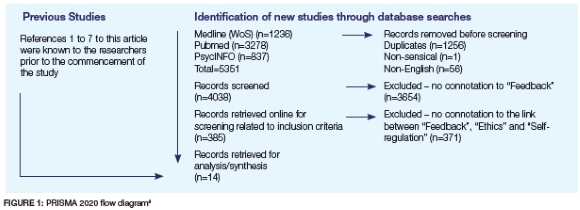
A PRISMA 2020 scoping review8
The remaining publication titles were screened for appropriateness by the primary researcher (TCP) and later verified by the co-author (LMS). The only inclusion criterion at this stage was a clear connection to feedback delivery. The elimination process continued after reading the abstracts of the initially included titles. At this point the search strategy required a connotation to 1) feedback delivery 2) ethical considerations and 3) the impact on students' self-regulation in any teaching context.
The remaining articles were qualitatively analysed and focal ethical principles and considerations were identified and thematically grouped.96
Emerging themes were used to synthesise a proposed model that demonstrates how the ethical basis of clinical teaching, combined with student characteristics could affect learning outcomes.
RESULTS
A total of 5351 documents were identified of which 1236 were from Medline (WoS), 3278 from Pubmed and 837 from PsycINFO (dated 3 June 2023). This was followed by the removal of one non-sensical document, 1256 duplicates and the remaining 56 non-English articles (Figure 1).
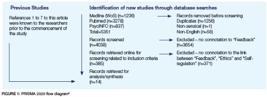
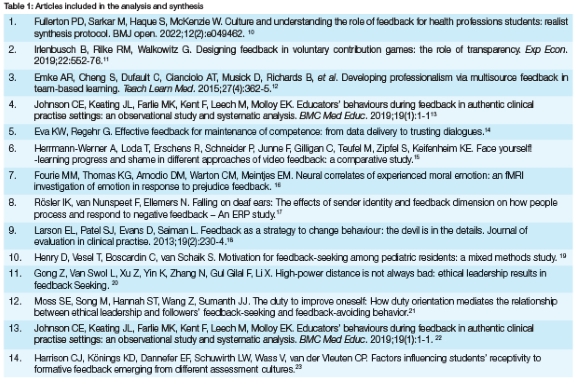
The number of remaining titles with a connotation to feedback delivery and self-regulation totalled 385 of which 14 were kept (Table 1) for analysis after reading the abstracts and the articles.
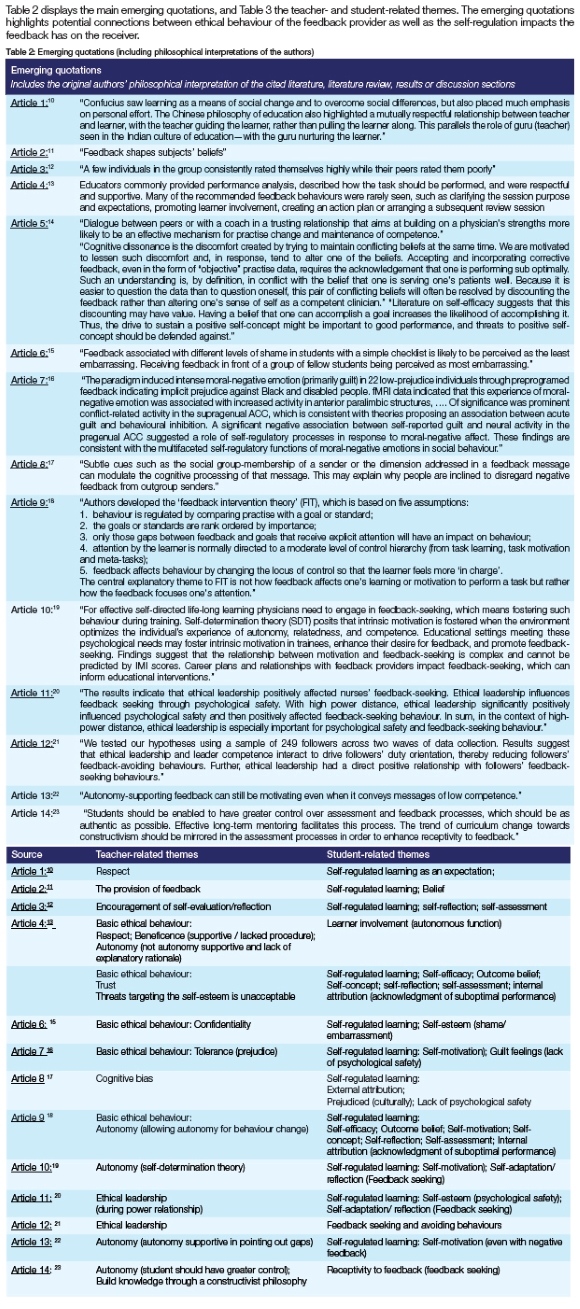
Table 2 displays the main emerging quotations, and Table 3 the teacher- and student-related themes. The emerging quotations highlights potential connections between ethical behaviour of the feedback provider as well as the self-regulation impacts the feedback has on the receiver.
DISCUSSION
This study examined the relationship between the ethical behaviour of teachers and the self-regulation ability of students using qualitative data obtained from the scoping review.
The learner's duty
Learners have a moral obligation regulate their own learning Article 1, Table 1).10
The teachers' duty
Building trust and respect: Teachers in turn should guide and nurture the student through a respectful relationship (Article 1).101112131415 1617
Be autonomy supportive: Allowing students autonomy has a connection with self-regulated learning concepts such as self-efficacy belief, outcome expectation, self-motivation self-concept, self-reflection, self-assessment, internal attribution (acknowledgment of suboptimal performance) (Article 9).18 1920212223
Proposed conceptual model
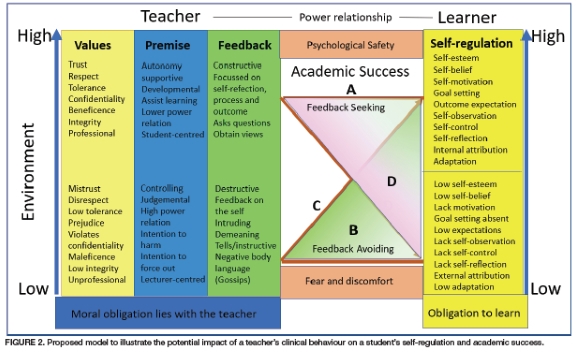
The above-mentioned were used together with the literature known to the authors to synsthesize a model to illustrate the potential impact of a teacher's clinical behaviour on a student's self-regulation and academic success.
Figure 2 contains a synthesised model of these relationships.
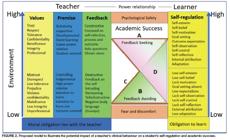
On the left side is the teachers who have an obligation to teach. At the same time, they have a moral duty to do so in a manner that will create an environment of psychological safety for the students.241010-23
The lines A and B in the middle demonstrates the general relationships described in the literature. In scenario A there is a combination of ethical teachers who behave with professionalism and are student-centred in their approach. They deliver feedback with the aim of doing good by focussing on the gaps in understanding, allowing the students time and opportunity to self-reflect, and respecting their views whilst giving truthful feedback in a respectful way.10
In scenario B the teachers mistrust the student and show little compassion for the fact that they are still new to the study material and will have skills and knowledge gaps. They are often judgmental and prejudicial even before the learning contact starts. They may shame the student in front of others people. This type of behaviour is even more morally reprehensible if they do so when interacting with students who they know have low self-regulation abilities or poor self-esteem. Such students will not perform well academically and avoid feedback because it affects their self-esteem negatively. They thus not only deprive themselves of the much-needed tuition, but may even become depressed and anxious, which further hinders their progress.
In scenario C, the upwards arrow indicates the situation where the teacher behaves as described in scenario B, but the student has high self-regulation ability and ignores the comments of the teacher or puts in more effort to prove them wrong. The student now enters the "Bermuda Triangle". This is risky as it's a large space (illustrated by the pink triangle) and there is no way of telling where they may end up within this triangle. Some may rise up the C arrow and achieve academic success, while others end up anywhere in between the top and bottom limits, achieving varying levels of clinical and academic success.
In scenario D, the downwards arrow represents the situation where the teacher behaves as described in scenario A but the student has low self-regulation and does not perform academically. Once again, few will directly follow the straight line, while most will fall within the green triangle of unknown outcomes.
CONCLUSION
Staff competence should be developed in the field of ethical feedback delivery to enhance student self-regulation and promote learning. Assessment of their skills in feedback delivery could even be used as a measure of their performance as educators. The above-mentioned model may serve as a framework for such development.
DISCLOSURENothing to disclose
ACKNOWLEDGEMENTS
None
REFERENCES
- 1. Hattie J, Timperley H. The power of feedback. Rev Educ Res. 2007;77(1):81-112.
- 2. Bellhäuser H, Dignath C, Theobald M. Daily automated feedback enhances selfregulated learning: a longitudinal randomized field experiment. Front Psychol. 2023;18;14:1125873.
- 3. Eva KW, Regehr G. Effective feedback for maintenance of competence: from data delivery to trusting dialogues. CMAJ. 2013;185(6):463-4.
- 4. Hashemipour MA, Hosseini V, Kamyabi H. Stressors in Dental Students During the Transition from Theory to Practice: A Qualitative Research. SADJ. 2022;77( ):386-93.
- 5. Hardie P, O'Donovan R, Jarvis S, Redmond C. Key tips to providing a psychologically safe learning environment in the clinical setting. BMC Med Educ. 2022;22(1):1-1.
- 6. Zimmerman BJ. Investigating self-regulation and motivation: historical background, methodological developments, and future prospects. Am Educ Res J. 2008;45(1):166-83.
- 7. Cox DJ. Descriptive and normative ethical behavior appear to be functionally distinct. J Appl Behav Anal. 2021;54(1):168-91.
- 8. Page MJ, McKenzie JE, Bossuyt PM, Boutron I, Hoffmann TC, Mulrow CD, et al. The PRISMA 2020 statement: an updated guideline for reporting systematic reviews. Int Surg J. 202;88:105906.
- 9. Braun V, Clarke V. Using thematic analysis in psychology. Qual Res Psychol. 2006;1;3(2):77-101.
- 10. Fullerton PD, Sarkar M, Haque S, McKenzie W. Culture and understanding the role of feedback for health professions students: realist synthesis protocol. BMJ open. 2022;12(2):e049462.
- 11. Irlenbusch B, Rilke RM, Walkowitz G. Designing feedback in voluntary contribution games: the role of transparency. Exp Econ. 2019;22:552-76.
- 12. Emke AR, Cheng S, Dufault C, Cianciolo AT, Musick D, Richards B, et al. Developing professionalism via multisource feedback in team-based learning. Teach Learn Med. 2015;27(4):362-5.
- 13. Johnson CE, Keating JL, Farlie MK, Kent F, Leech M, Molloy EK. Educators' behaviours during feedback in authentic clinical practise settings: an observational study and systematic analysis. BMC Med Educ. 2019;19(1):1-1.
- 14. Eva KW, Regehr G. Effective feedback for maintenance of competence: from data delivery to trusting dialogues. CMAJ. 2013;185(6):463-4.
- 15. Herrmann-Werner A, Loda T, Erschens R, Schneider P, Junne F, Gilligan C, Teufel M, Zipfel S, Keifenheim KE. Face yourself! -learning progress and shame in different approaches of video feedback: a comparative study. BMC Med Educ. 2019;19(1):1-8.
- 16. Fourie MM, Thomas KG, Amodio DM, Warton CM, Meintjes EM. Neural correlates of experienced moral emotion: an fMRI investigation of emotion in response to prejudice feedback. Soc Neurosci. 2014;9(2):203-18.
- 17. Rösler IK, van Nunspeet F, Ellemers N. Falling on deaf ears: The effects of sender identity and feedback dimension on how people process and respond to negative feedback - An ERP study. J Exp Soc Psychol. 2023;104:104419.
- 18. Larson EL, Patel SJ, Evans D, Saiman L. Feedback as a strategy to change behaviour: the devil is in the details. J Eval Clin Pract. 2013;19(2):230-4.
- 19. Henry D, Vesel T, Boscardin C, van Schaik S. Motivation for feedback-seeking among pediatric residents: a mixed methods study. BMC Med Educ. 2018;18:1-7.
- 20. Gong Z, Van Swol L, Xu Z, Yin K, Zhang N, Gul Gilal F, et al. High-power distance is not always bad: ethical leadership results in feedback Seeking. Front Psychol. 2019;27;10:2137.
- 21. Moss SE, Song M, Hannah ST, Wang Z, Sumanth JJ. The duty to improve oneself: How duty orientation mediates the relationship between ethical leadership and followers' feedback-seeking and feedback-avoiding behavior. J Bus Ethics. 2020;165:615-31.
- 22. Mouratidis A, Lens W, Vansteenkiste M. How you provide corrective feedback makes a difference: The motivating role of communicating in an autonomy-supporting way. J Sport Exerc Psychol. 2010;32(5):619-37.
- 23. Harrison CJ, Könings KD, Dannefer EF, Schuwirth LW, Wass V, van der Vleuten CP. Factors influencing students' receptivity to formative feedback emerging from different assessment cultures. Perspect Med Educ. 2016;5:276-84.
- 24. Martin JG. Teaching without fear. The Learning Professional. 2020;41(2):36-8.
Name: Leanne M. Sykes
Address: Corner of Steve Biko and Dr Savage Rd Pretoria, Prinshof Campus, School of Dentistry, University of Pretoria
Email: