Local anaesthetics in dentistry - Part 3: Vasoconstrictors in local anaesthetics
INTRODUCTION
Vasoconstrictors like adrenaline in local anaesthetics are associated with more drug interactions than any other drug in Dentistry12
Local anaesthetics are vasodilators, hence the addition of a vasoconstrictor like adrenaline provides the following advantages: improves the anaesthetic onset and duration, reduces bleeding, and decreases the systemic absorption rate of local anaesthetics by reducing the plasma concentration.2,3 However, adrenaline is unstable and therefore an antioxidant is added to prevent it oxidizing. Sodium bisulphite is the preservative most commonly added to local anaesthetics. Of course, patients allergic to sulphites will now react to a local anaesthetic containing sodium bisulphites.
DOSAGECalculating the dose of vasoconstrictor is different from ascertaining the local anaesthetic dosage in that vasoconstrictors are expressed as a dilution ratio and are not weight-dependent. In local anaesthetics, the adrenaline in dilution ratios of 1:80000 (Xylotox E80A, Adcock Ingram; Xylestesin, 3M), 1:100 000 (Ubistesin forte, 3M; Septocaine, Septodont) and 1:200000 (Ubistesin 3M; Septocaine, Septodont) are generally the most commonly used concentrations in dentistry. Adrenaline concentrations are generally expressed as 1:1000 which is 1mg/ml. Therefore, a local anaesthetic with 1:100000 adrenaline concentration will translate to 0.01mg/ml resulting in a 1.8ml local anaesthetic cartridge containing 0.018mg adrenaline. A 1:200000 will therefore contain a concentration of 0.005mg/ml translating to approximately 0.01mg per cartridge of local anaesthetic. The maximum dose of adrenaline in healthy patients is 0.2mg per appointment (approximately 10 cartridges of 1:100000 local anaesthetic). However, in medically compromised patients, such as those having cardiac risk, the recommended maximum dosage of adrenaline is 0.04 mg i.e. two cartridges of 1:1000000 local anaesthetic. The American Heart Association and the American Dental Association have stated "the typical concentrations of vasoconstrictors contained in local anaesthetics are not contraindicated in cardiovascular disease so long as preliminary aspiration is practiced, the agent is injected slowly, and the smallest effective dose is administered".4 567-9 In fact, 1:200000 solutions should be the preferred choice of adrenaline concentration in the absence of significant differences in performance with the 1:100000 solution.1011
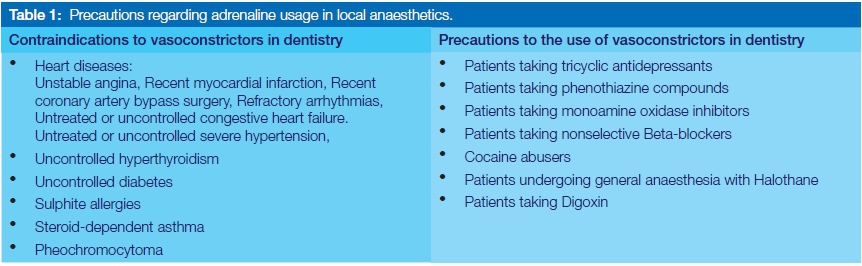
ADRENALINE AND DRUG INTERACTIONAnother problem associated with adrenaline is that it can interact with some of the drugs that the patient may be taking. In this instance the most commonly affected drugs are the non-selective beta blockers, some antidepressants and "street drugs" (Table 1).
NON-SELECTIVE BETA BLOCKERS
Non-selective beta blockers like propranolol (Inderal) and nadolol (Corgard) are used as anti-hypertensive drugs or to control migraines. Vasoconstrictors administered to patients on non-selective beta blockers can result in uncompensated peripheral vasoconstriction as a result of unopposed stimulation of alpha 1 receptors, leading to increase in blood pressure, bradycardia and headaches.4,12,13
Cases have been recorded in both the dental and medical literature where the magnitude of the blood pressure increased was alarming and potentially life threatening.13
TRICYCLIC ANTIDEPRESSANTSTricyclic antidepressants like imipramine and amitriptyline inhibit the uptake of adrenaline at the neuronal level, resulting in increased concentrations of the catecholamines at the sympathetic neuronal junction.14151
The interactions of vasoconstrictors with general anaesthetics like halothane, thiopental and barbiturates can increase the dysrhythmic effects of dental vasoconstrictors. The clinician needs to inform the anaesthetist before administering a local anaesthetic with vasoconstrictor, and to restrict the dose to the limit recommended for the vasoconstrictor according to general anaesthetic procedures: halothane (2.2µgkg for halothane, 3.5µg/kg for enflurane and 5.5µg/kg for isoflurane).1,15 A reported death under halothane anaesthesia caused by adrenaline in gingival retraction cord reinforces the need to adhere to recommended doses of adrenaline under general anaesthesia.
"STREET DRUGS"
Methamphetamines and cocaine have sympathomimetic effects and can interact with adrenaline in local anaesthetics. Vasoconstrictors in combination with cocaine or methamphetamines increase the risk of hypertensive crises, stroke and myocardial infarction.43
ADRENALINE AND THE MEDICALLY COMPLEX PATIENTAdrenaline is both a hormone and a neurotransmitter belonging to sympathomimetic drugs that can mimic sympathetic nervous system mediators.6Table 1). A joint statement of the American Dental Association and American Heart Foundation on vasoconstrictors provides the following advice: "Vasoconstrictors should be used with extreme care to avoid intravascular injection. The minimum possible amount of vasoconstrictor should be used".6
CARDIOVASCULAR DISEASESIn the presence of ischaemic heart disease, elective dental treatment is contraindicated in the following situations: patients with unstable angina, recent myocardial infarction (less than six months), recent coronary artery bypass surgery (less than three months).16
If emergency dental treatment is necessary, medical consultation is required and adrenaline dosages should be limited to one to two cartridges of 1:100000 solution (0.018 to 0.036 mg of adrenaline).16,17 Similarly, in patients with stable angina, vasoconstrictors should be limited to one to two cartridges.161016,17
STROKEUse of adrenaline should be deferred for patients who have suffered a cerebrovascular accident, or stroke within the last six months. After that time, doses of adrenaline should be limited to less than 0.036 mg, equivalent to two cartridges of local anaesthetic with 1:100000 adrenaline concentration.16,17
HYPERTHYROIDISMThe use of adrenaline in local anaesthetics should be avoided, or at least minimized to one to two cartridges, in the untreated or poorly controlled hyperthyroid patient.1810
CORTICOSTEROID-DEPENDENT ASTHMA
Administration of local anaesthetic with vasoconstrictors in cortico-dependent asthma patients may result in a higher risk of sulphite allergy. An anaesthetic without vasoconstrictor, and thus without bisulphite, is indicated.4,10,17
PHEOCHROMOCYTOMAA tumour of the adrenaline medulla, characterized by the presence of catecholamine-producing tissue, constitutes an absolute contraindication to the administration of vasoconstrictors.10
BONE IRRADIATIONIt is desirable to avoid the use vasoconstrictors with a local anaesthetic when a patient is receiving irradiation of bone.10
CONCLUSION
A thorough understanding of the pharmacologic interactions between adrenaline and vasoconstrictors is important to avoid untoward reactions in patients.
A lower concentration like 1:200000 provides similar vasoconstriction and may be preferred especially for medically compromised patient.
References
- 1. Yagiela JA. Adverse drug interactions in dental practice: interactions associated with vasoconstrictors. Part V of a series. J Am Dent Assoc. 1999;130(5):701-9.
- 2. Kaufman E, Garfunkel A, Findler M, Elad S, Zusman SP, Malamed SF, et al. Emergencies evolving from local anesthesia. Refu'at hapeh veha-shinayim. 2002 Jan;19(1):13-8, 98.
- 3. Balakrishnan R, Ebenezer V. Contraindications of vasoconstrictors in Dentistry. Vol. 6, Biomedical and Pharmacology Journal. 2013. p. 409-14.
- 4. Bassett K, DiMarco A, Naughton D. Local Anesthesia for Dental Professionals. 2nd ed. DiMarco Arthur NDBK, editor. New Jersey: Pearson Education Inc; 2015. 1-418 p.
- 5. Daubländer M, Müller R, Lipp MD. The incidence of complications associated with local anesthesia in dentistry. Anesth Prog. 1997;44(4):132-41.
- 6. Malamed SF. Handbook of Local Anesthesia. 6th ed. Malamed SF, editor. Vol. 33, Elsevier. St. Louis: Elsevier Mosby; 2013. 25-38 p.
- 7. Mcentire M, Nusstein J, Drum M, Reader A, Beck M. Anesthetic efficacy of 4% articaine with 1:100,000 epinephrine versus 4% articaine with 1:200,000 epinephrine as a primary buccal infiltration in the mandibular first molar. J Endod. 2011;37(4):450-4.
- 8. Santos CF, Modena KCS, Giglio FPM, Sakai VT, Calvo AM, Colombini BL, et al. Epinephrine concentration (1:100,000 or 1:200,000) does not affect the clinical efficacy of 4% articaine for lower third molar removal: a double-blind, randomized, crossover study. J Oral Maxillofac Surg. 2007;
- 9. Wahl MJ, Ilvento TW, Schmitt MM, Wahl JA, Ganjavian S. Articaine with 1:100000 epinephrine versus articaine 1;200000 epinephrine. e-Journal Dent. 2013;3(2):371-5.
- 10. Carlos M, Bruno C, Ronneau M. Recommendations to use vasoconstrictors in Dentistry and Oral Surgery. Médecine buccale Chir buccale. 2003;9(2):1-30.
- 11. Moore P, Doll B, Delie R, Hersh E, Korostoff J, Johnson S, et al. Hemostatic and anesthetic efficacy of 4% articaine HCl with 1:200,000 epinephrine and 4% articaine HCl with 1:100,000 epinephrine when administered intraorally for periodontal surgery. J Periodontol. 2007;78(2):247-53.
- 12. Hersh E V, Moore PA. Three serious drug interactions that every dentist should know about. Compend Contin Educ Dent. 2015;36(6):408-13.
- 13. Hersh E V, Giannakopoulos H. Beta-adrenergic blocking agents and dental vasoconstrictors. Dent Clin North Am. 2010;54(4):687-96.
- 14. Sisk AL. Vasoconstrictors in local anesthesia for Dentistry. Anesth Prog. 1992;39:187-93.
- 15. Gómez-Moreno G, Guardia J, Cutando A, Calvo-Guirado JL. Pharmacological interactions of vasoconstrictors. Med Oral Patol Oral Cir Bucal Med Oral Patol Oral Cir Bucal Jan Med Oral S L CIF B. 2009;141414(11):20-7.
- 16. Domingo D, Canaan T. Local anesthetics (Part III): use in medically complex patients. Clin Updat. 2002;24(11):22-4.
- 17. Budenz AW. Local anesthetics and medically complex patients. J Calif Dent Assoc. 2000;28:611-9.
- 18. Perusse R, Goulet JP, Turcotte JY. Contraindications to vasoconstrictors in Dentistry: Part II. Hyperthyroidism, diabetes, sulphite sensitivity, cortico-dependent asthma, and pheochromocytoma. Oral Surgery, Oral Med Oral Pathol. 1992;74(5):687-91.