Job satisfaction among dental technologists working in the public health sector in Nigeria: A phenomenological study
Abstract
BACKGROUND: Job satisfaction is critical in healthcare professions, including dental technologists - influencing individual wellbeing, service delivery quality and workforce retention. This study explored factors influencing job satisfaction among dental technologists working in public health sectors in Nigeria METHODS: This qualitative study employed a phenomenological research design to capture the lived experiences of 18 dental technologists (10 males, 8 females) working in Lagos's federal and state government healthcare facilities. Data were collected through semi-structured interviews and thematic content analysis was used RESULTS: The study found that job satisfaction among dental technologists in the public health sector is affected by several interconnected factors. Key themes included the workplace environment, compensation, opportunities for professional development and interpersonal relationships. Participants noted that inadequate resources, limited career advancement opportunities and unsatisfactory pay were significant challenges that impacted their job satisfaction CONCLUSION: Addressing job satisfaction challenges necessitates a holistic approach, including reforms for fair pay and placement, enhanced educational access, respectful interprofessional relationships and improved infrastructure. Such initiatives would enhance job satisfaction among dental technologists and strengthen their contributions to the healthcare system overall
Job satisfaction; dental technologists; public health sector; qualitative research; Nigeria
BACKGROUND
Job satisfaction among healthcare professionals is a critical issue affecting workforce retention and quality of care. Studies across multiple countries reveal generally low levels of job satisfaction among healthcare providers.1-3 Factors influencing job satisfaction include working conditions, autonomy, supervision, recognition and interpersonal relationships.2,4,5 Furthermore, job satisfaction is associated with factors such as poor remuneration, large workload, lack of equipment, limited workplace socialisation, low autonomy and lack of training opportunities.6
Job satisfaction, particularly in the healthcare industry, is pivotal in ensuring the efficient functioning of healthcare organisations, employee retention and improved patient outcomes.7,8 Job satisfaction impacts workplace behaviours such as absenteeism, productivity and organisational commitment.7-10 Job satisfaction varies across healthcare professions, with pharmacy professionals reporting higher satisfaction than other specialities.1112
In dental professionals, studies have shown that the overall job satisfaction.13-15 The following factors were reported to play a significant role in job satisfaction among the dental workforce: work environment productivity; the level of stress and burnout; low remuneration; long working hours; the perceived quality of staff relationships; and lack of opportunities for speciality training.15-19
Although there were studies conducted about job satisfaction among dental professionals, there is, however, a paucity of studies in Africa. Thus, this study explores the factors influencing job satisfaction among dental technologists working in public health sectors in Nigeria.
METHODOLOGY
Research design
This study utilised a phenomenoiogicai research design, ideal for investigating individuals' lived experiences and perceptions of specific phenomena. The research focused on job satisfaction among dental technologists in public health sectors in Lagos, Nigeria.
Study participants
Participants were selected through purposive sampling, a non-probability technique that targets individuals with pertinent knowledge and experience relevant to the research question. This approach ensured the inclusion of dental technologists who were able to provide valuable insights into job satisfaction. Specifically, the study focused on dental technologists employed in federal and state government health institutions in Lagos, Nigeria, chosen for their unique challenges, such as variability in employment conditions, access to resources and opportunities for professional growth, differing from private practice or NGO environments. The final sample comprised 18 participants (10 males, 8 females) to capture diverse perspectives and account for potential gender-related differences in workplace experiences.
Data collection methods
Data were collected through semi-structured interviews, balancing the flexibility of open-ended questions with the consistency of a structured interview guide. This approach allowed for an in-depth exploration of themes related to job satisfaction while permitting participants to share their experiences freely. Interview questions were designed to align with the study's objectives, covering work environment, remuneration, professional development and workplace relationships. A pilot test with five dental technologists was conducted to refine questions for clarity and relevance. Interviews lasted 30 to 60 minutes and were conducted in comfortable settings, primarily face-to-face, to promote open and honest communication. All interviews were audio-recorded with participants' consent, and field notes were taken to capture non-verbal cues and contextual details.
Data analysis
Thematic content analysis was employed as a qualitative method for identifying, analysing and reporting patterns within the data. The following steps were undertaken to ensure the rigour and reliability of the analysis: transcription, familiarisation, initial coding, generating themes, reviewing themes, defining and naming themes and final analysis.
Ethical considerations
Ethical principles were maintained throughout the study. Written informed consent was obtained from all participants, with confidentiality ensured via anonymisation of responses. The study received ethical approval from the Institutional Research Ethics Committee (IREC) at Durban University of Technology under certificate reference number REC-147/15.
RESULTS
Demographics of participants
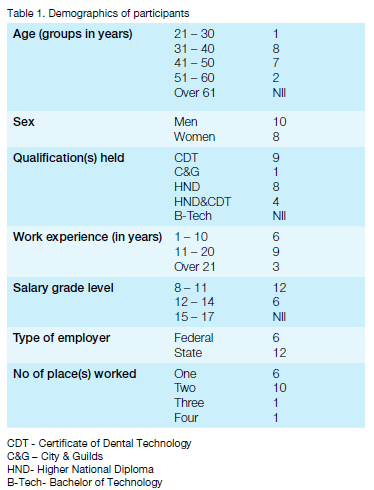
Table 1 illustrates the research participants' demographics, including age groups, sex, qualifications, work experience, salary grade level, type of employer and number of places where the participants previously worked.
Factors associated with job satisfaction among dental technologists
Several factors affecting job satisfaction among dental technologists were identified and included: entry level placement, remuneration, promotion opportunities, interprofessional relationships, education and training advancement and working conditions.
Entry level placement
Entry-level placement has emerged as a critical determinant of job satisfaction among dental technologists within the context of this study. Numerous participants articulated feelings of frustration and discontent regarding their placement at lower salary grades in comparison to other health professionals possessing equivalent qualifications and training. This disparity not only adversely affects their immediate financial compensation but also significantly impedes their long-term career advancement and overall professional morale. One participant elucidated the concern by asserting: "The entry level where we are placed Is lower than other health professionals who are at a similar level In terms of training and practice."
Another participant expounded: "Being on SGL 08 instead of SGL 10 means that I am losing my salary for two SGLs."
This discrepancy engenders a perception of inequity and dissatisfaction, particularly given that dental technologists often require several years to attain comparable standing to their counterparts in other health professions. The study further underscored that low entry-level placement exerts a cascading effect on various dimensions of job satisfaction, including remuneration. A participant correlated these elements by stating: "The impact of poor remuneration can intricately be linked to low entry level, because low entry level is the resultant effect of low remuneration."
Moreover, the inequity associated with entry-ievei placement was identified as a systemic issue entrenched in policy and structural deficiencies, resulting in many professionals experiencing a sense of being undervalued within their occupational roles.
Remuneration
Remuneration has been recognised as a pivotal element affecting job satisfaction among dental technologists. The results disclosed a prevalent sense of dissatisfaction regarding salaries, which numerous participants believed were not aligned with their qualifications, efforts or the intricacy of their responsibilities. This discontent was frequently associated with systemic challenges, such as low entry-level positions and inconsistencies in salary frameworks compared to other health professionals. Many participants pointed out the insufficiency of their earnings. One participant commented: "Considering the nature of my job and my monthly output, my income does not reflect my contributions."
This feeling was shared by another participant, who stated: "Since the entry-level salary is quite low, it ultimately influences the monthly salary I receive."
These remarks highlight how compensation not only impacts their immediate financial security but also undermines their sense of professional value and drive. The results also uncovered notable salary inequalities between dental technologists and other healthcare professionals within the same organisations. One participant conveyed their frustration, saying: "We collaborate closely with other health professionals, yet the salary difference is substantial. It's disheartening, particularly when you recognise the importance of your role in patient care."
This disparity intensifies dissatisfaction, as dental technologists feel unappreciated despite their vital contributions to healthcare services. In addition to inadequate base salaries, participants mentioned the withholding or non-receipt of certain allowances as an additional source of discontent. For instance, one respondent remarked: "Certain allowances, such as call duty allowances, are not provided to dental technologists in my workplace."
These overlooked financial benefits further intensified feelings of inequity and diminished job satisfaction.
Promotion opportunities
Promotion opportunities profoundly affect job satisfaction among dental technologists, serving as both a source of motivation and frustration, depending on the individual's educational background and career path. For numerous participants, promotions were regarded as a beneficial element of their jobs, acknowledging their contributions and chances for career advancement. Nevertheless, the study also identified the challenges faced by those without degrees, who encounter obstacles that restrict their professional development. Several participants conveyed their contentment with the promotion procedures within their organisations, especially those who fulfilled the necessary qualifications. One participant noted: "I received my promotions as scheduled, in my workplace. I've consistently been promoted because you take exams."
This recognition of a systematic and reliable promotion framework positively influenced their job satisfaction.
Conversely, for individuals without degrees, the situation was quite different. Many believed that their educational qualifications created a barrier to their careers, preventing them from progressing beyond certain grade levels. One participant shared: "If you lack a degree, your career is stalled. You can't climb the ladder, and it feels like there's no opportunity for growth."
This restriction meant that non-degree holders frequently found themselves unable to advance beyond Standard Grade Level (SGL) 14, whereas degree holders could move up to higher tiers such as SGL 17. This discrepancy fostered a sense of frustration and inequality among non-degree holders, as it limited their professional aspirations and left them feeling stuck in their positions. One participant commented: "Technologists reach the end of their career at level 14; once you hit SGL 14, you remain there until retirement, especially those with the HND, while those with a BSc can surpass that threshold."
Education and training advancement
Education and training play crucial roles in shaping job satisfaction among dental technologists, largely because of their influence on professional development, career progression and skill enhancement. The research underscored notable obstacles in obtaining additional education and specialised training, leading to frustration and stagnation among the participants. Numerous dental technologists voiced their discontent with the scant opportunities for further education and specialisation. One participant commented: "There are hardly any chances for further education or specialisation. We're left to figure it out ourselves, but even then, the opportunities are just not there."
This deficiency in access to advanced educational offerings, like postgraduate degrees in dental technology, obstructed their ability to gain specialised skills, progress in their careers and maintain competitiveness in the industry. The lack of organised opportunities for continuing professional development (CPD) was another major issue. Participants indicated that training programmes were either non-existent or required personal funding, which created both financial and logistical obstacles. One participant expressed: "There are no funding opportunities for continuing professional education. I have had to fund myself to attend training, and even then, it's not always easy."
The absence of employer-supported CPD initiatives restricted their capacity to keep abreast of advancements in dental technology, further fuelling their dissatisfaction. Furthermore, the study highlighted the detrimental effect of these educational deficiencies on professional self-esteem. One participant articulated: "Lack of educational structure is one of the factors that reduces one's professional esteem. It reduces it to the core because you're not bold enough to say, Ί am an HND [Higher National Diploma] holder.' It demoralises you, makes you feel inferior."
This erosion of confidence, stemming from inadequate educational opportunities, diminished their sense of professional pride and overall satisfaction. Additionally, the limited access to specialised training in fields such as ceramics, orthodontics and maxillofacial technology further hampered career progression. One participant observed: "The lack of opportunity for specialty training also can be linked to limited career advancement. If there were good educational structures, one would be able to further specialise in one area of dental technology."
The unavailability of such opportunities left many individuals feeling confined to their current positions, unable to explore and cultivate new skills.
Interprofessional relationships
Interprofessional dynamics play a crucial role in determining job satisfaction among dental technologists, with numerous participants voicing their discontent regarding strained relations with other healthcare providers, especially dentists. The difficulties within these interactions arise from perceived disparities, a lack of mutual respect and restricted professional autonomy, each of which adversely affects workplace morale and overall satisfaction. A prevalent observation identified was the perception of a "master-servant" relationship between dentists and dental technologists. Several participants conveyed feelings of being undervalued and disrespected by their dental peers. One participant articulated: "My observation is that there is this master-servant relationship from the dentists. They see other interprofessional colleagues as servants; however, it is now left to me as a dental technologist to let them know that I am not their servant."
This underlying dynamic breeds resentment and diminishes the sense of professional camaraderie that is essential for a constructive work atmosphere. Participants also highlighted the absence of collaborative decision-making and autonomy in their responsibilities. One participant noted: "In the procurement procedures, technologists are not allowed to test-run the machines/equipment to certify them, we are not involved."
This exclusion from vital elements of their work undermines their expertise and lessens their sense of contribution to the healthcare team. Furthermore, the hierarchical structure of the dental team was a significant source of dissatisfaction for many participants. They perceived dentists as the predominant leaders of the team, which left scant room for acknowledging the contributions of dental technologists. One participant remarked: "The issue with this profession that I don't like is the fact that dentists are believed to be the head of the dental team Dental technology should be a standalone profession; we should not be receiving direct instructions from dentists administratively."
Such feelings reflect a yearning for greater professional autonomy and acknowledgement. Nevertheless, not all participants recounted negative experiences. A select few reported positive interprofessional relationships characterised by mutual respect and teamwork. One participant stated: "There is a mutual relationship with professional colleagues, including the dentists."
Although these positive experiences were less frequent, they underscore the potential for enhanced collaboration to improve job satisfaction.
Working conditions
Working conditions significantly influenced job satisfaction among dental technologists, with numerous participants pointing out deficiencies in their work environments as a primary source of frustration and discontent. These issues primarily revolved around inadequately equipped laboratories, a shortage of essential materials and outdated facilities, which together impede their ability to carry out their responsibilities effectively. Participants often highlighted the inadequate condition of laboratory equipment and the insufficient supply of consumables necessary for high-quality service delivery. One participant commented: "Our labs are inadequately equipped, and it impacts the quality of work we can provide. How can you feel fulfilled when you lack the proper tools for the task?"
Such shortcomings not only reduce the quality of care provided to patients but also diminish the professional satisfaction of dental technologists, who find themselves unable to fully leverage their skills due to the limitations of their work environment. Moreover, insufficient maintenance of vital amenities emerged as another persistent concern. Participants recounted experiences where malfunctioning electrical fittings, ineffective air conditioning and delays in acquiring urgently needed supplies caused unnecessary stress. One participant expressed: "When essential amenities like air conditioners or electrical fittings are out of order, and the body language suggests that there is nothing that can be done about it, it is extremely frustrating."
These obstacles rendered the work environment less supportive, contributing to feelings of neglect and diminished motivation. Government policies also influenced working conditions, particularly through restrictive regulations and disparities in resource distribution. Participants observed that policies frequently favoured other healthcare professions, leaving dental technologists with fewer resources and opportunities. One participant remarked: "Policy matters are closely linked with both entry-level and retirement positions . other health professionals start at salary entry grade level 10 (CONHESS 9), while we begin at a much lower level."
DISCUSSION
This study explored the factors influencing job satisfaction among dental technologists in the public health sector in Lagos, Nigeria. Several factors affecting job satisfaction among dental technologists were identified and included: entry level placement, remuneration, promotion opportunities, interprofessional relationships, education and training advancement and working conditions. Similarly, a growing body of research underscores that factors such as remuneration, career progression, and workplace conditions are fundamental in shaping job satisfaction among healthcare professionals.19,20. A study by Teng, Wu and Lee21212119
In this study, poor remuneration emerged as a significant concern. Similarly, Kumar and Mohammadnezhad1922
The issue of limited career progression and professional growth emerged as a significant barrier to job satisfaction. Kumar and Mohammadnezhad191923,24 A study conducted in Pakistan showed a concern between dentists and dental technicians and their impact on prosthesis manufacturing.2525
Poor working conditions were also pivotal in our findings. Participants highlighted issues such as outdated equipment and inadequate supplies of dental laboratory consumables, which hindered their ability to perform and contributed to feelings of professional frustration. Similarly, Kumar and Mohammadnezhad19
Strengths, limitations and recommendations
The strength of the study resides in its comprehensive analysis of the factors influencing job satisfaction among dental technologists in Africa, with a specific focus on Nigeria. Furthermore, a notable advantage of this research is its phenomenological approach, which prioritises the understanding of participants' lived experiences. This methodology facilitates the capture of authentic and nuanced insights into the challenges and perceptions faced by dental technologists.
The study reveals several limitations. The findings are specific to a certain group of dental technologists, restricting generalisability to other populations. Self-reported data may introduce biases due to social desirability or recall issues. The study mainly focuses on public health challenges, overlooking private employment experiences. Systemic issues were noted but not explored in depth, resulting in gaps in actionable insights. The cross-sectional design captures only a moment in time, failing to account for the evolution of experiences across career stages.
In response to these findings, several recommendations have been made. Policy reforms should ensure equitable pay and career advancement for dental technologists in line with their qualifications. Access to education and training must be improved through degree-awarding institutions and CPD initiatives. Promotion policies should be revised to eliminate barriers for non-degree holders. Employers must enhance laboratory conditions by upgrading facilities and maintaining infrastructure. Cultivating positive interprofessional relationships is essential for collaboration and respect between dental technologists and dentists. Advocacy from dental technologist associations is vital to address systemic inequities in career progression and recognition. Further research, including longitudinal studies, is necessary to understand job satisfaction across the profession comprehensively.
CONCLUSION
This research identified factors influencing job satisfaction among dental technologists and revealed significant challenges that negatively impact their professional experiences. Identified issues include inequitable entry-level placements affecting compensation, limited promotional pathways for non-degree holders, insufficient educational frameworks for career progression and poor interprofessional dynamics, particularly with dentists, alongside suboptimal working conditions that hinder effective practice.
Addressing these challenges requires a comprehensive approach with far-reaching implications. Establishing fair placement and remuneration policies would promote equity and financial stability, while accessible educational pathways and advanced training opportunities could empower technologists and facilitate career progression. Building respectful interprofessional relationships would enhance workplace morale, and upgrading workplace infrastructure would improve efficiency and job satisfaction. By tackling these interconnected issues, dental technologists would be better positioned to thrive in their roles and make stronger contributions to the healthcare system.
Conflict of interest
The authors declare no conflict of interest.
Acknowledgement
This study received funding from the Research and Postgraduate Support Directorate at the Durban University of Technology. The authors extend their heartfelt gratitude to Angela Skea for her valuable contributions and guidance throughout this study.
REFERENCES
- 1. Mathevula H, Dhliwayo S. A comparison of job satisfaction levels among South African public healthcare professionals. Academic Journal of Interdisciplinary Studies. 2022
-
2. Geta A, Biks GA, Dellie E, Yazachew L. Job Satisfaction and Associated Factors among Health Professionals Working at Public and Private Hospitals in Bahir Dar City, Northwest Ethiopia: A Comparative Cross-Sectional Study. BioMed Research International. 2021;2021:1-13. https://doi.org/10.1155/2021/6632585
» https://doi.org/10.1155/2021/6632585 -
3. Mere RA, Simbeni TV, Mathibe M, Mogale M, Ntuli ST. Job satisfaction among health professionals in a District of North West province, South Africa. Health SA Gesondheid. 2023;28:1-7. https://doi.org/10.4102/hsag.v28i0.2234
» https://doi.org/10.4102/hsag.v28i0.2234 -
4. Erdoğan V, Yıldırım A. The Relationship between Exposure to Mobbing and Job Satisfaction among Healthcare Professionals in Northern Cyprus. Revista De Cercetare Si Interventie Sociala. 2019;67:154-168. https://doi.org/10.33788/rcis.67.10
» https://doi.org/10.33788/rcis.67.10 -
5. Gustavsson K, van Diepen C, Fors A, Axelsson M, Bertilsson M, Hensing G. Healthcare professionals' experiences of job satisfaction when providing personcentred care: a systematic review of qualitative studies. BMJ Open. 2023;13:1-10. http://dx.doi.org/10.1136/bmjopen-2022-071178
» http://dx.doi.org/10.1136/bmjopen-2022-071178 -
6. Lombardo C, Mento C, De Stefano R, et al. Job satisfaction in the health professions: The role of affective temperaments. Work. 2023;75(3):1001-1007. https://doi.org/10.3233/WOR-220164
» https://doi.org/10.3233/WOR-220164 -
7. Hoxha G, Simeli I, Theocharis D, Vasileiou A, Tsekouropoulos G. Sustainable healthcare quality and job satisfaction through organizational culture: Approaches and outcomes. Sustainability. 2024;16(9):3603. https://doi.org/10.3390/su16093603
» https://doi.org/10.3390/su16093603 -
8. El Mouaddib H, Sebbani M, Mansouri A, Adarmouch L, Amine M. Job satisfaction of primary healthcare professionals (public sector): A cross-sectional study in Morocco. Heliyon. 2023;9(9)https://doi.org/10.1016/j.heliyon.2023.e20357
» https://doi.org/10.1016/j.heliyon.2023.e20357 -
9. Lu H, Zhao Y, While A. Job satisfaction among hospital nurses: A literature review. International Journal of Nursing Studies. 2019;94:21-31. https://doi.org/10.1016/j.ijnurstu.2019.01.011
» https://doi.org/10.1016/j.ijnurstu.2019.01.011 -
10. De Simone S, Planta A, Cicotto G. The role of job satisfaction, work engagement, self-efficacy and agentic capacities on nurses' turnover intention and patient satisfaction. Applied Nursing Research. 2018;39:130-140. https://doi.org/10.1016/j.apnr.2017.11.004
» https://doi.org/10.1016/j.apnr.2017.11.004 -
11. Tenaw Z, Siyoum M, Tsegaye B, Werba TB, Bitew ZW. Health professionals job satisfaction and associated factors in Ethiopia: A systematic review and metaanalysis. Health Services Research and Managerial Epidemiology. 2021;8:1-12. https://doi.org/10.1177/23333928211046484
» https://doi.org/10.1177/23333928211046484 -
12. Alqarni T, Alghamdi A, Alzahrani AJ, Abumelha K, Alqurashi Z, Alsaleh A. Prevalence of stress, burnout, and job satisfaction among mental healthcare professionals in Jeddah, Saudi Arabia. Plos One 2022;17:1-9. https://doi.org/10.1371/journal.pone.0267578
» https://doi.org/10.1371/journal.pone.0267578 -
13. Al-Buainain FS, Alzarouni AA, Alshamsi HA, Arab AH, Bader F, Awad MA. Job satisfaction of U.A.E. dental practitioners. European Journal of Dentistry. 2019;13:354-360. https://doi.org/10.1055/s-0039-1700186
» https://doi.org/10.1055/s-0039-1700186 -
14. Le VNT, Dang MH, Kim JG, Yang YM, Lee DW. Dentist job satisfaction: A systematic review and meta-analysis. Int Dent J. 2021;71(5):369-377. https://doi.org/10.1016/j.identj.2020.12.018
» https://doi.org/10.1016/j.identj.2020.12.018 - 15. Anzar W, Qureshi A, Afaq A, et al. Analysis of occupational stress, burnout, and job satisfaction among dental practitioners. Work. 2022
-
16. Hamasha AA-H, Alturki A, Alghofaili N, et al. Predictors and level of job satisfaction among the dental workforce in national guard health affairs. Journal of International Society of Preventive and Community Dentistry. 2019;9(1):89-93. http://dx.doi.org/10.4103/jispcd.JISPCD_418_18
» http://dx.doi.org/10.4103/jispcd.JISPCD_418_18 -
17. Singh PK. Job satisfaction among dental therapists in South Africa. Journal of Public Health Dentistry. 2014;74(1):28-33. https://doi.org/10.1111/j.1752-7325.2012.00363.x
» https://doi.org/10.1111/j.1752-7325.2012.00363.x - 18. Al Jazairy YH, Halawany HS, Al Hussainan N, Al Maflehi N, Abraham NB, Jacob V. Factors affecting job satisfaction and their correlation with educational standards among dental assistants. Industrial Health. 2014;52(4):324-333
-
19. Kumar S, Mohammadnezhad M. Perceptions of dental health professionals (DHPs) on job satisfaction in Fiji: A qualitative study. BMC Health Services Research. 2022;22(1):1261. https://doi.org/10.1186/s12913-022-08620-z
» https://doi.org/10.1186/s12913-022-08620-z - 20. Mohase N, Khumalo J. Job satisfaction in the healthcare services in South Africa: Case of MPH. Mediterranean Journal of Social Sciences. 2014;5(3):94-102
-
21. Teng T-Y, Wu J-H, Lee C-Y. Acceptance and experience of digital dental technology, burnout, job satisfaction, and turnover intention for Taiwanese dental technicians. BMC Oral Health. 2022;22(1):342. https://doi.org/10.1186/s12903-022-02359-z
» https://doi.org/10.1186/s12903-022-02359-z -
22. Korac S, Saliterer I, Weigand B. Factors affecting the preference for public sector employment at the pre-entry level: A systematic review. International Public Management Journal. 2019;22(5):797-840. https://doi.org/10.1080/10967494.2018.1430086
» https://doi.org/10.1080/10967494.2018.1430086 -
23. Kaki L, Kc S, Gallagher JE. Health and Wellbeing of Clinical Dental Care Professionals: A Systematic Review. Primary Dental Journal. 2022;11(2):40-50. 10.1177/20501684221101663
» https://doi.org/10.1177/20501684221101663 -
24. Curtis S, Gurveer J, Gallagher JE. Clinical dental technicians in the United Kingdom: A qualitative understanding of the experiences, of practices and challenges of communication for dental professionals. Gerodontology. 2019;36(4):405-416. https://doi.org/10.1111/ger.12413
» https://doi.org/10.1111/ger.12413 -
25. Afzal H, Ahmed N, Lal A, et al. Assessment of communication quality through work authorization between dentists and dental technicians in fixed and removable prosthodontics. Applied Sciences. 2022;12(12):6263. https://doi.org/10.3390/app12126263
» https://doi.org/10.3390/app12126263

Author's contribution
1. Conceptualisation and design: Michael Chijioke Ndubuisi (50%) and Julian David Pillay (50%)
2. Analysis and interpretation of data: Michael Chijioke Ndubuisi (33.3%), Alexis Harerimana (33.3%) and Julian David Pillay (33.3%)
3. Preparation and submission of the final manuscript: Michael Chijioke Ndubuisi (33.3%), Alexis Harerimana (33.3%) and Julian David Pillay (33.3%)
4. Acquisition and recording of data: Michael Chijioke Ndubuisi (100%)