Patients' Understanding of Information Provided During Consent Process for Fixed Prosthodontic Treatment: A Mixed Methods Study at Dental Facilities in Kampala
Abstract
INTRODUCTION: Obtaining valid informed consent requires that patients understand treatment information. This is crucial for irreversible procedures, like fixed prosthodontic treatment, where dentists are required to communicate highly technical information to patients with different literacy levels and treatment expectations. Failure of patients to understand some aspects of the treatment may result in dissatisfaction and complaints. There is limited data about dental patients' understanding of treatment information in Uganda AIM AND OBJECTIVES: This study explored patients' understanding of information provided for fixed prosthodontic treatment at two dental care facilities in Kampala, Uganda DESIGN: Parallel-convergent mixed methods METHODS: A survey was carried out on 216 patients and 19 in-depth interviews at two dental facilities. The patients had received information from their dentists about the fixed prosthodontic treatment they were to undergo. Quantitative data were collected using a pretested semi-structured interviewer-administered questionnaire. The questionnaire consisted of 5 items on a 4-point Likert scale and a checklist of 19 items to collect data on patients' subjective and objective understanding of the information provided, respectively. An interview guide facilitated the interviews. Quantitative data were analysed using descriptive statistics and Chi-square statistics. Total scores were computed for the assessment of objective understanding and categorized as adequate, moderate, or inadequate understanding, on attaining 80100%, 50-79% or less than 50% of the maximum possible score. Qualitative data were analysed using thematic analysis RESULTS: Over three quarters (> 85.0%) of the patients reported to have received the information during a verbal discussion with their dentist at prior appointment. Several participants reported that they were not informed about the possible risks (48.4%) or alternative treatments (22.2%). More than two-thirds felt that they had understood well (subjective understanding) many aspects of the treatment information, but only 13.4% of them had an adequate objective understanding. Treatment procedures and alternative treatment options were the most difficult to understand. There was no significant association between subjective and objective understanding CONCLUSIONS: Most participants did not adequately understand the information. Results indicate the need to develop interventions to enhance patient understanding of information provided during the consent process and measures for objective assessment of' understanding
fixed prosthodontic treatment; informed consent; information; understanding
INTRODUCTION
Informed consent obtained from patients undergoing clinical procedures is important not only for ethical and legal reasons but also for the quality of care.12-5 This is particularly important for irreversible procedures such as fixed prosthodontics. In addition, patients often have high or unrealistic expectations of the outcomes, and failure to understand the treatment as well as the limitations may result in dissatisfaction.2 22, 6
The importance of ensuring that patients understand the information provided has been emphasized in various ethical codes.7, 89
While it is critical for patients to understand the information provided during the informed consent process, available literature from medical specialties reports several shortcomings in practice, including difficulties in patient recall, poor understanding or knowledge, and misconceptions of treatment information.5,10-12 However, there is limited data on patients' understanding of the information provided during consent for dental care, and the scenario is the same in Uganda. This is particularly of concern for complex procedures such as fixed prosthodontic treatment (FPT), in which dentists must communicate highly technical and specialised information to patients with varying literacy levels and socio-cultural backgrounds.2
Therefore, this study aimed to explore patients' understanding of the information provided during the informed consent process for FPT among patients attending two dental care facilities within Kampala. It was hypothesized that, despite patients receiving information, they did not adequately understand the treatment information provided during the consent process.
MATERIAL AND METHODS
Study design and approach
The study employed a parallel, convergent mixed-methods design that included a survey and in-depth interviews. Both quantitative and qualitative methods were used to gain in-depth knowledge of how well patients understood the information provided during the consent process. The qualitative approaches clarified areas of inadequate understanding in the collected interviews and enabled understanding of the complex issues related to the communication of information, and patient's understanding. The study was approved by the Makerere University School of Medicine Research Ethics Committee (Mak-SOMREC-2022-418) and the Uganda National Council of Science and Technology (HS2914ES). Written informed consent was obtained from all participants before enrolment. The ethical considerations followed the guidelines of the Declaration of Helsinki.
Study setting
This study was conducted at two dental care facilities in Kampala, Uganda, between September 2023 and March 2024. The two hospitals were the Mulago and Makerere University Dental Hospitals (MUK-DH). Mulago is a national referral hospital (MNRH) that registers approximately 30 patients for fixed prosthodontics monthly. MUK-DH is a teaching and oral health service delivery facility for Makerere University that registers approximately 40 patients for fixed prosthodontic treatment monthly
Study population, sample size determination, and sampling procedure
The study was conducted among patients aged > 18 years who had treatment plans involving FPT, had received information concerning their treatment from their dentists, and agreed to participate. Patients with a background in dental education, those on treatment for mental health issues, or those unable to speak English or Luganda were excluded.
The sample size was calculated using a statistical formula with a finite population correction:13
 where n = sample size; no = (Z2PQ)/d2; N is population size; Z is 1.96, P is the proportion (considering an arbitrary value of 50% as no previous study in Africa); Q = 1 - P, d = 5%. Given that approximately 420 (N) patients sought FPT at the two hospitals over six months, the estimated sample size was 200, which was increased by 10% to 220 to account for missing data.
Proportional allocation was used to ensure adequate representation of each facility. Consecutive sampling was used to select participants at the dental facilities. For qualitative data, nineteen participants were purposively selected based on data saturation.
Data collection and quality control
Four research assistants (dentists) collected quantitative data using an interviewer-administered questionnaire (Supplementary file 1) in either English or Luganda. The questionnaire comprised three parts. Part I solicited socio-demographic information and service-related factors. Part II comprised five items on the subjective understanding of the information on a four-point Likert scale assessing patients' understanding of dental problems, proposed treatment procedures, benefits, probable risks, and alternative treatments. The Likert scale had the following alternatives: (1) "patient did not understand the item at all," (2) "somewhat understood," (3) "understood well," and (4) "understood very well." If participants believed they were not informed about a certain item, they were prompted to select not informed = 0. Part III contained a checklist of 19 items for the assessment of objective understanding of the information, including 5 items for the procedure, 6 regarded benefits, 6 probable risks, and 2 items concerning alternative treatments. The responses were "Disagree" (1), "Unsure/ I do not know" (2), and "Agree" (3). The questionnaire was developed based on the validated Quality of Informed Consent Tool for assessment of both subjective and objective understanding in research settings.14
In-depth interviews (iDis) were conducted by the principal investigator and a trained research assistant among 19 patients. The IDIs were conducted in either English or Luganda, using an interview guide (Supplementary file 2), and lasted 15-25 minutes. The interview guide included items to explore patients' views about: the information provided and their understanding of the information provided, decision-making, and suggestions to improve patients' understanding. The interviews were audio-recorded and supplemented with notes.
The study teams were trained before data collection, and daily checks were conducted to ensure the accuracy and completeness of the data. The trustworthiness of qualitative findings was demonstrated through the concepts of credibility, transferability, dependability, and confirmability. Credibility was enhanced through data triangulation, while the dependability of findings is illustrated through the well-documented methods. Study findings are derived from the data.
Data analysis
Quantitative data were analysed using STATA version 14.0 and summarized using descriptive statistics. Responses for the assessment of objective understanding were recorded as follows: correct=2, unsure/I do not know=1, and incorrect=0. Total scores were computed for each
domain and categorized as: "adequate understanding" if 80-100% of the maximum possible score was attained, "moderate understanding" for 50-79%, and "inadequate understanding" for less than 50%. This categorization of scores was adapted from a systematic review of the comprehension of informed consent for surgery and clinical research.152P < 0.05.
For qualitative data, audio recordings were transcribed verbatim. Three transcripts were translated from Luganda into English and verified for their accuracy. Thematic analysis was conducted using both inductive and deductive approaches using NVivo version 12. The PI and a social scientist with expertise in qualitative methods analysed the data following the six steps for thematic analysis.
RESULTS
Results for the quantitative data
Socio-demographic characteristics of the study participants
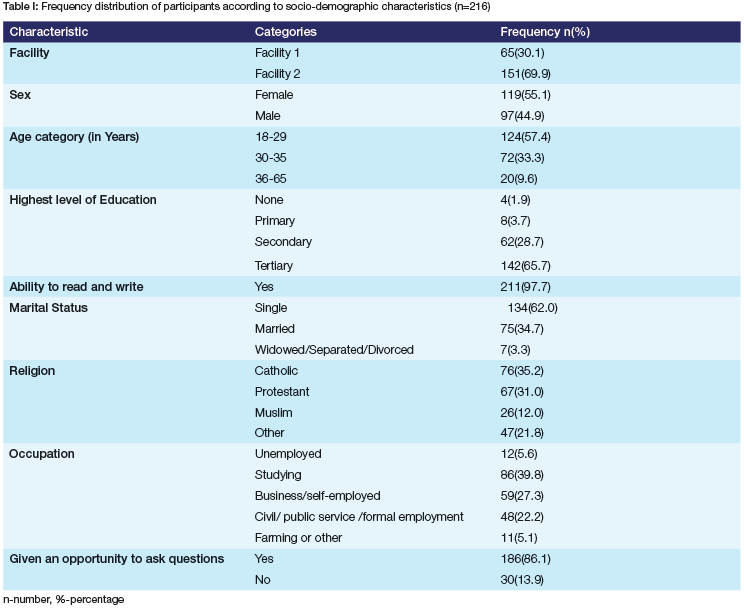
More than half (55.4%) were female, and the median age (interquartile range) was 27 (23, 36) years. Almost all (94.4%) were literate and had completed secondary education (Table I).
Service-related factors
More than three-quarters (>83.0%) of the patients needed a crown, and this was their first time to have such treatment. Majority (85.2%) noted that information had been provided by the dentist who would be treating, while for the rest it was from another dentist in the same practice. Almost all (96.3%) patients reported to have received the information at a prior appointment or before the start of the procedure, while for 3.7% of them, information was provided as the procedure was being conducted. All patients reported having received information in an verbal discussion, and videos or dental models were utilised among 4.6 % and 9.3% of them, respectively.
Information provided and assessment of patient's subjective (perceived) understanding of information provided
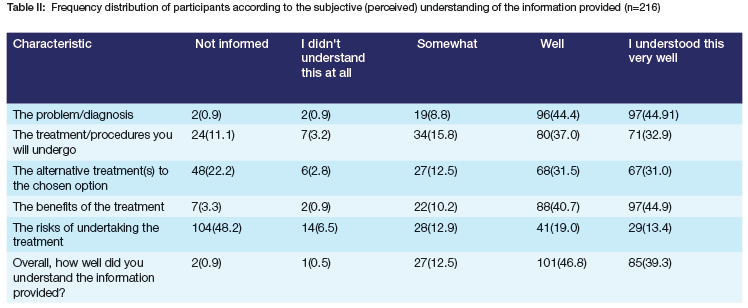
Almost half (48.4%) reported that they had not received information about risks. More than two-thirds reported to have understood either well or very well the information regarding their dental problem, the proposed treatment procedure, and its benefits, whereas less than a third (31.4%) felt they understood information regarding the possible risks. Notably, about 15 to 20% of them felt they did not understand or somewhat understood the information provided regarding procedures, alternative treatment, or risks (Table II).
Objective understanding of the information provided
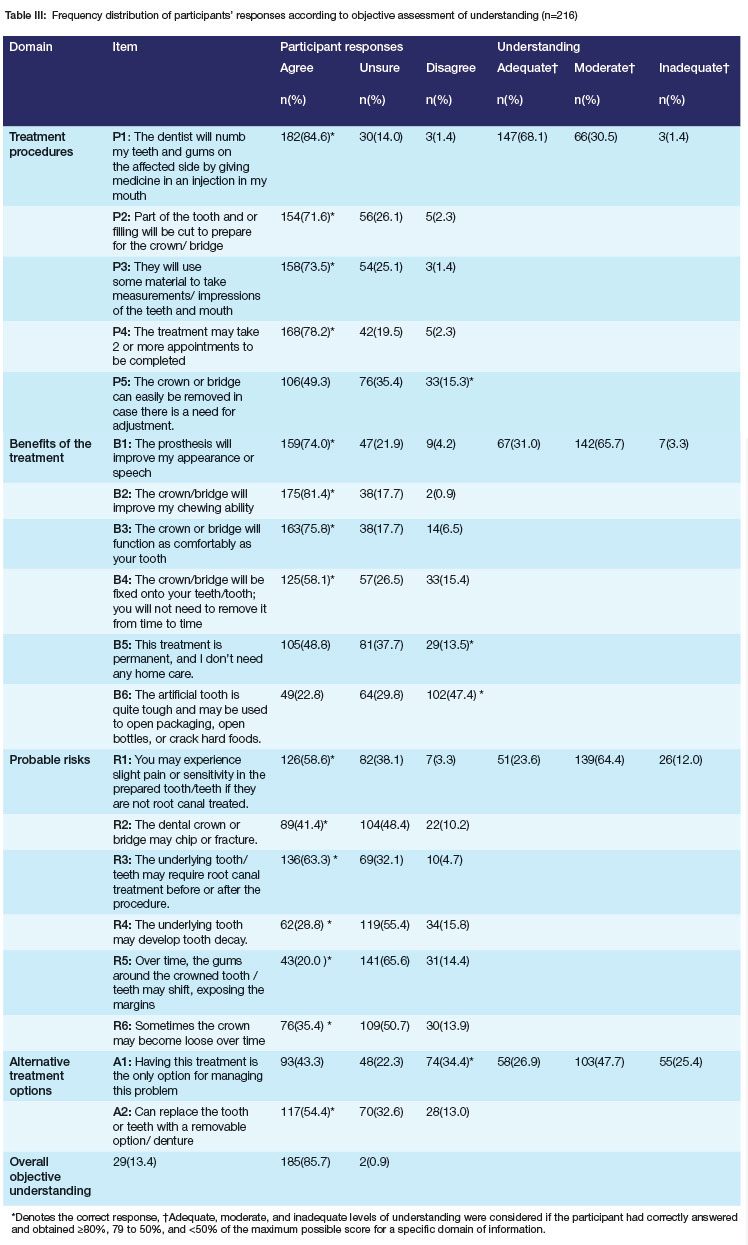
Overall, approximately 13.4% of the participants had an adequate objective understanding of the information provided regarding FPT (Table III). Most items assessing participants' understanding of treatment procedures (P1, P2, P3, P4) were answered correctly, with more than two-thirds (68.1%) having an adequate understanding. Conversely, less than one-third of the participants had an adequate understanding of the risks, alternative treatment options, and benefits, 23.6%, 26.8%, and 31.0%, respectively (Table III).
Association of subjective and objective understanding of information among participants
There was no significant association between the different levels of subjective understanding and overall objective understanding among the participants (P=0.064, x2
Qualitative Results
The participants had a mean age (SD) of 30.3(11.9) years. Most (17/19) participants had attained formal education up to secondary school. Six had formal jobs or personal businesses, two were farmers, and 11 were students (nine pursuing a diploma or bachelor's degree, one a postgraduate degree, and one secondary school education).
Three key themes emerged from the qualitative data: 1) patients' perceptions of the information received, 2) patient awareness of the treatments, and 3) suggestions on how to improve patients' understanding of information.
Theme 1: Patient perceptions of the information received
The majority (n=16, 84%) of the participants reported that they felt they had received adequate information about their management to make informed decisions. However, two university students felt that they needed more information and searched on the internet, as one participant stated:
'Yes, I did. I went back and saw some videos [..]. I did some search and I went to Google, I read about it. I saw the different types [fixed prostheses]; I saw the metallic and their disadvantages.' (IDI 7)
However, on exploring the information received for each specific domain, less than half (n=9, 47.4%) indicated that they had no recollection of being told about the details of the procedures or possible risks. A few participants (n=3, 15.7%) reported knowing only one benefit of the treatment, which directly resolved their chief complaints. For Instance, patients who wanted to restore or replace a missing anterior tooth to enhance their appearance claimed that the only benefits of the bridge or crown they knew of were to improve their esthetics.
Participants felt that the main importance of the information provided was to educate and guide them to make informed treatment decisions about their treatment, as well as to allay their worries arising from certain misconceptions, as expressed by the quotes.
'It [information] is important because it helps to make a rational decision [...]. People fear these procedures. They say, how do you go for a root canal treatment? It is very risky, a challenge can come, and you can get an accident [...], so when you are given all the information, it helps you make a rational decision.' (IDI 7)
'It is important because first of all I make a choice that is informed, that suits me because the dentist might do something that is general, but I have my [personal] fears, so if I am given a variety of options, I go with something that I am comfortable with and that suits me'. (IDI 17)
Theme 2: Participants' awareness about the fixed prosthodontic treatment they were to undergo.
Most participants (n=13, 68.4 %) indicated that the information provided was easy to understand according to them. However, some participants reported that they did not understand some of the information and had to trust the dentist to make correct decisions. A female with a tertiary education level indicated that she could not understand the information but trusted the dentist to do the right thing.
Information that was difficult to understand included treatment procedures and alternative treatments, especially when technical terms were used in the discussion, as expressed in the participant quote below.
'The treatment type and procedure need to be explained in detail because some of the medical terms are not friendly [...]. The other two treatments were not clear because they told me three treatments, but I didn't understand well the other two'. (ID114)
Overall, the majority (n=16, 84%) described explicitly their problem and knew at least one reason for the treatment and benefits of the FPT. Only one participant was aware of two or more of the possible risks. Several participants had no information on the details of the procedure or risks.
'No, I am not sure of what exactly will be done. I am neither sure of what I will go through nor the number of appointments'. (IDI- 1)
It is worth noting that one participant did not know the reason for the treatment they had agreed to undergo.
'I don't even know the reason why I need a crown. I haven't got the information why they are putting a crown [...]. Although I agreed, but I don't know why the tooth needs a crown'. (IDI 8)
Theme 3: Suggestions for improving communication and patients' understanding
More than a third (n=7, 37%) suggested that the use of visual aids may improve patients' understanding of the information.
Visual aids such as videos, pictures, or models should be used during discussions or shared on social media to improve the patients' understanding. Other suggestions included the use of simplified language during the discussion, allowing the patient sufficient time to make decisions that may involve another appointment, providing information at several appointments, encouraging patients to ask questions, using local languages, and providing a more detailed explanation of the treatments.
'I think in clinics, having visual aids will be one of the easiest ways to communicate to patients. For the pamphlets, people don't read them'. (IDI 17)
'I think in this era of communication, online and social media are the best ways of communication. With a particular patient, you can share pictures, for example, Dr. X shared with me. Or send a link of a procedure, and the person sees what is going to happen to them. Well, if they haven't understood the verbal information, they can see the video of the process, so that they know how it's going to be'. (IDI 7)
'Maybe by simplifying some of the terms and the language used. Simplify the way they communicate to make it understandable to everyone'. (IDI 9)
DISCUSSION
The study findings indicated that the majority of patients did not have an adequate understanding of the FPT they were to undergo on the objective assessment. These findings are consistent with those from several studies conducted in clinical settings, which showed that most patients did not have an adequate understanding of information.5, 15-17 For example, a systematic review of articles on understanding informed consent for surgery found that 6 out of the 21 (29%) studies reported that participants had inadequate understanding of the information provided during the consent process.151818
The study's findings, that few participants had an adequate understanding, raise various concerns; about the effectiveness of methods used for communication of treatment information, whether patients in the present study were in a position to make informed decisions, and provide valid informed consent, as the four criteria of information disclosure, competence, understanding, and voluntariness must be met. As suggested by several authors, it is proposed to incorporate the use of adjunct educational materials, either delivered in written form or visual tools, for improvements in patients' understanding of consent information and the delivery of standardised information.5, 10
Furthermore, the qualitative results revealed that difficulties in understanding information were partly due to the use of medical terms. Goltileb et al observed similar findings and noted that the use of medical phrases during doctor-patient discussions may lead to confusion among patients.2522, 27, 28
In addition, several participants in both study arms noted that they had not received any information about the risks or treatment procedures. The results are comparable to findings by Brezis et al., who observed that half and two-thirds of the patients who underwent invasive procedures did not recall receiving explanations about risks or alternative treatment options, respectively.294, 8, 921 41
Furthermore, the study findings revealed no significant association between subjective and objective understanding, which may imply that participants who thought they had understood the information actually did not. This discrepancy between patients' subjective perception of understanding and their actual comprehension indicates possible biases in self-reports by patients and the need to provide comprehensive treatment information. This also indicates a challenge to practitioners, as they may proceed with treatment on the assumption that whenever patients answer affirmatively to a general question on whether they have understood such information, then they have indeed understood. Since obtaining valid informed consent is a stringent moral and legal obligation of practitioners, and the burden of proof of understanding usually lies on practitioners,4
The findings revealed that the overall objective understanding of information was as low as 13% in a predominantly literate study sample. Thus, it could be worse among semi-literate and illiterate patients as several studies have noted that information recall and patient understanding are affected by literacy level.28, 3022-24 to improve patients' understanding of the information provided during the informed consent process for dental care. In addition, there is a need to develop innovative methods for objective assessment.
Limitations of the study include: 1) the study findings may not be generalized to all patients in Uganda as participants were recruited from two dental facilities in urban area, and 2) the lack of documentation concerning what was discussed during the informed consent process for the participants and relying on patients' recall as a reporting tool could have influenced the responses with recall bias. (3) There may have been variability in the information provided during the consent process.
CONCLUSION
Most patients who received FPT at the two dental care facilities did not adequately understand the treatment they were to undertake. Based on the data, it is suggested to devise measures for the objective assessment of patient understanding before obtaining consent or starting treatment. In addition, to develop interventions such as visual tools or consent forms to improve patient understanding of information deemed difficult to understand. To improve the generalizability of study findings, similar studies should be conducted with larger sample sizes and across multiple regions, including rural and urban areas.
Conflicts of interest
The authors have no conflicts of interest to declare.
REFERENCES
- 1. Jameson LM, Al-Tarawneh SK. Informed consent from a historical, societal, ethical, legal, and practical perspective. J Prosthodont. 2022; 31(6): 464-71.
- 2. Nassani MZ. Aspects of malpractice in prosthodontics. J Prosthodont. 2017; 26(8): 672-81.
- 3. Reid KI. Informed consent in dentistry. J Law Med Ethics. 2017; 45(1): 77-94.
- 4. Kakar H, Gambhir RS, Singh S, Kaur A, Nanda T. Informed consent: cornerstone in ethical medical and dental practice. J Family Med Prim Care. 2014; 3(1): 68-71.
- 5. Glaser J, Nouri S, Fernandez A et al. Interventions to improve patient comprehension in informed consent for medical and surgical procedures: an updated systematic review. Med Decis Making. 2020; 40(2): 119-43.
- 6. Sharma A, Chhabra A, Sharma A, Bopiah C. Patient consent in dentistry: are we legally safe. Journal of Oral Health and Community Dentistry. 2011; 5(2): 68-72.
- 7. Beauchamp TL, Childress JF. The Principles of Biomedical Ethics, 7th ed. Oxford: Oxford University Press, 2013.
- 8. Uganda Medical and Dental Practitioners Council. Code of Professional Ethics. Kampala, 2013: 1-19.
- 9. Ministry of Health Uganda. Patients Rights and Responsibilities Charter. Kampala, 2019: 1-18.
- 10. Sherlock A, Brownie S. Patients' recollection and understanding of informed consent: a literature review. ANZ Journal of Surgery. 2014; 84(4): 207-10.
- 11. Basukala S, Shrestha O, Thapa N et al. How informed is informed consent?- Evaluating the quality of informed consent among surgical patients in a tertiary care hospital in Nepal. PLoS One. 2023; 18(7): e0288074.
- 12. Pietrzykowski T, Smilowska K. The reality of informed consent: empirical studies on patient comprehension-systematic review. Trials. 2021; 22(1): 1-8.
- 13. Smith S. Determining Sample Size: How to Ensure You Get the Correct Sample Size. Qualtrics Online Sample, 2013.
- 14. Atal S, Dunne F. Assessment of the understanding of informed consent including participants' experiences, and generation of a supplemental consent decision aid for gestational diabetes mellitus (GDM) research. HRB Open Research. 2018; 1: 12.
- 15. Falagas ME, Korbila IP, Giannopoulou KP, Kondilis BK, Peppas G. Informed consent: how much and what do patients understand? Am J Surg. 2009; 198(3): 420-35.
- 16. Taiwo OO, Kass N. Post-consent assessment of dental subjects' understanding of informed consent in oral health research in Nigeria. BMC Med Ethics. 2009; 10: 1-7.
- 17. Sherman KA, Kilby CJ, Pehlivan M, Smith B. Adequacy of measures of informed consent in medical practice: A systematic review. PLoS One. 2021; 16(5): e0251485.
- 18. Sahai A, Kucheria R, Challacombe B, Dasgupta P. Video consent: a pilot study of informed consent in laparoscopic urology and its impact on patient satisfaction. Journal of the Society of Laparoendoscopic Surgeons. 2006; 10(1): 21-25.
- 19. Richardson V. Patient comprehension of informed consent. Journal of Perioperative Practice. 2013; 23(1-2): 26-30.
- 20. Abolfotouh MA, Adlan AA. Quality of informed consent for invasive procedures in central Saudi Arabia. International Journal of General Medicine. 2012; 5: 269-75.
- 21. Sudeshni Naidoo. Obtaining informed consent for surgery. Current Allergy and Clinical Immunology 2014; 27( 2): 184-86.
- 22. Ho JCY, Chai HH, Lo ECM, Huang MZ, Chu CH. Strategies for Effective Dentist-Patient Communication: A Literature Review. Patient Prefer Adherence. 2024; Jul 1(18): 1385-94.
- 23. Rector TS. How should we communicate the likelihood of risks to inform decisions about consent? IRB: Ethics & Human Research. 2008; 30(4): 15-18.
- 24. Horner R, Rimmer C. Consent: assessing and communicating risk. Surgery. 2019; 37(8): 431-34.
- 25. Gotlieb R, Praska C, Hendrickson MA et al. Accuracy in patient understanding of common medical phrases. JAMA Network Open. 2022; 5(11): e2242972.
- 26. Waylen A. The importance of communication in dentistry. Dental update. 2017; 44(8): 774-80.
- 27. Thompson CL, Pledger LM. Doctor-patient communication: is patient knowledge of medical terminology improving? Health Communication. 1993; 5(2): 89-97.
- 28. Wittink H, Oosterhaven J. Patient education and health literacy. Musculoskelet Sci Pract. 2018; 38: 120-27.
- 29. Brezis M, Israel S, Weinstein-Birenshtock A et al. Quality of informed consent for invasive procedures. Int J Qual Health Care. 2008; 20(5): 352-57
- 30. McCarthy DM, Waite KR, Curtis LM et al. What did the doctor say? Health literacy and recall of medical instructions. Medical Care. 2012; 50(4): 277-82.

Authors' contribution
1. Barbara Ndagire: conceptualisation, design of the work, analysis of data, draft preparation, review and editing (52%)
2. Sudeshni Naidoo: design of the work, review and editing (12%)
3. John Barugahare: conceptualization, review and editing (12%)
4. Jovan Mugerwa: design of the work, analysis of data, review and editing (12%)
5. Charles Mugisha Rwenyonyi: design of the work, review and editing (12%)