In vitro efficacy of different solutions in the disinfection of silicone pacifiers
Abstract
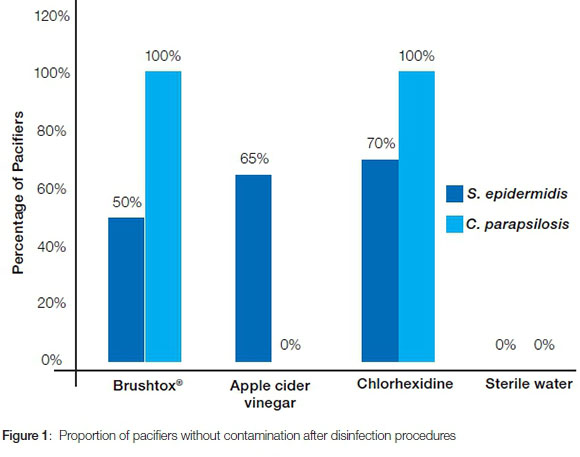
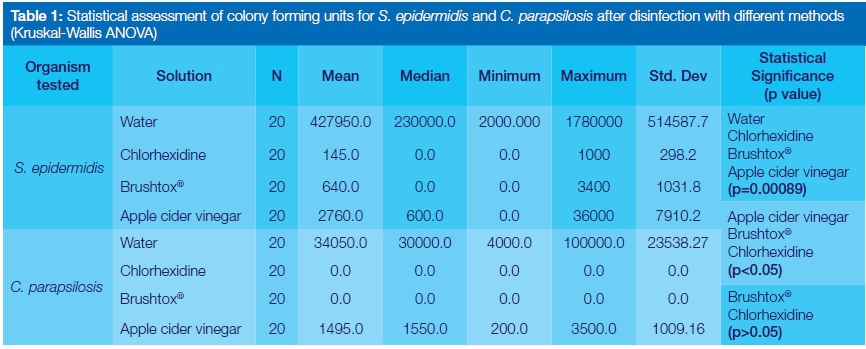
INTRODUCTION: Pacifiers used by toddlers and young children are susceptible to contamination by microorganisms. Effective methods of disinfection are required to prevent oral infections. There are limited studies on pacifier disinfection in South Africa. AIM: To investigate the efficacy of four pacifier disinfecting agents. METHODS: Two groups of 80 pacifiers each were contaminated with a standardized suspension of either Staphylococcus epidermidis or Candida parapsilosis. Each group was subdivided into four sub-groups, and severally disinfected with 0.12% GUM® Paroex™ Chlorhexidine Gluconate Oral Rinse (chlorhexidine), Brushtox®, apple cider vinegar and sterile distilled water (control), followed by microbiological analysis. Data were analyzed using the Kruskal Wallis Anova test. RESULTS: Chlorhexidine and Brushtox® were statistically similar in eliminating the fungi from pacifiers (p>0.05). Statistically significant differences were noted between the effects of chlorhexidine and Brushtox® compared with that of apple cider vinegar for both test organisms (p=0.0001). Statistically significant differences were observed in the efficacies of disinfection between chlorhexidine, Brushtox®, apple cider vinegar and sterile distilled water (p=0.00089). CONCLUSION: Chlorhexidine and Brushtox® were equally effective in eliminating both S. epidermidis and C. parapsilosis from silicone pacifiers. Apple cider vinegar was the least effective disinfecting solution.
Pacifier; Candida parapsilosis; Staphylococcus epidermidis; 0.12% GUM® Paroex™ Chlorhexidine Gluconate Oral Rinse; Brushtox®; Apple cider vinegar
 Thumbnail