Relationship between Wits appraisal and ANB angle in a South African orthodontic patient sample
Abstract
INTRODUCTION: Both earlier and recent studies have relied exclusively on the ANB angle to quantify malocclusion. Since the ANB angle is measured at the nasion, variations of the relative position of the nasion between populations may influence the reliability of ANB angle for malocclusion classifications. The Wits appraisal offers an alternative that excludes variability from skeletal differences beyond the jaws. However, few studies have examined the Wits appraisal relationship with ANB angle, and none in South Africa, leaving the interpretation of ANB measurements in local populations uncertain. AIMS AND OBJECTIVES: This study aimed to assess the efficacy of the ANB angle for skeletal malocclusion by correlating it with the Wits appraisal. DESIGN: A cross-sectional quantitative approach. METHODS: A total of 114 lateral cephalograms were sampled and measured using ImageJ software. Spearman's correlations were performed between ANB angles and Wits appraisal using PAST statistical software. RESULTS: All correlations were statistically significant. The ANB angle and Wits appraisal showed a moderate correlation in the entire sample, but stronger in the negative category and weak in the positive category. CONCLUSION: The ANB angle was not considered consistently reliable to distinguish between malocclusion classes because of the considerable lack of agreement with the Wits appraisal measures.
ANB angle; cephalometrics; malocclusion; Wits appraisal
INTRODUCTION
Malocclusion is one of the most prevalent oral health issues and is a primary reason why patients seek orthodontic treatment often driven by their own perceptions of what constitutes aesthetic dentition. Normative and objective evaluation by orthodontists entail cephalometric analyses that determine skeletal class and informs treatment objectives.1,2
The anteroposterior skeletal relationship between the maxilla and mandible, which is a key determinant of malocclusion type, is often quantified by ANB angles, incorporating the subspinale (A-point), nasion (N) and supramentale (B-point). Skeletal class I (associated with normal occlusion or mild malocclusion) is represented by an ANB angle of between 2° to 4°, class II (associated with maxilla positioned anterior to the mandible) by an angle greater than 4° and class III by an angle less than 2° (associated with mandible positioned anterior to the maxilla).3,4 This classification of malocclusion using ANB angles has, however, been criticised in earlier studies5,6 and more recently78
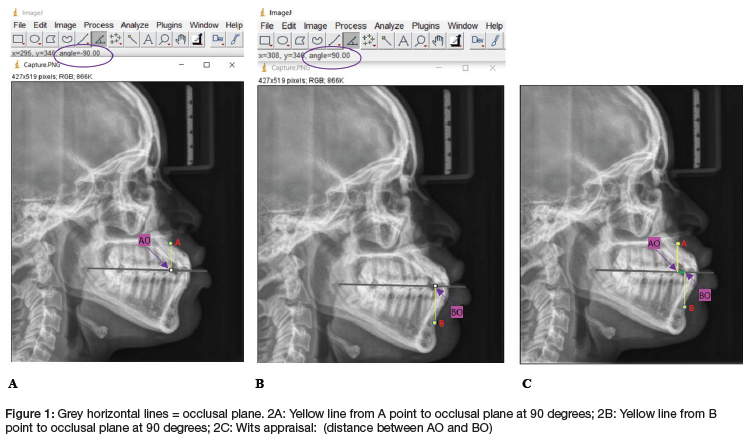
The Wits appraisal, on the other hand, measures the anteroposterior jaw relationships96,9,10 When BO is anterior to AO, Wits appraisal indicates negative readings and is associated with class III. Positive Wits appraisal readings are indicated by an AO that is anterior to BO and is associated with class II malocclusion.9
The Wits appraisal has been used as a reference for evaluating the reliability of the ANB angle in the classification of malocclusion. Despite the correlation between the two parameters (Wits and ANB) being absent, weak, or moderate but seldom strong,11,12,13 recent studies continue to categorise malocclusion based solely on the ANB angles.3,14,15 This study aimed to explore the relationship between the ANB angle and Wits appraisal in a South African Black sample, thereby assessing the efficacy of the ANB angle for skeletal malocclusion in this specific population.
MATERIALS AND METHODS
This study was conducted on lateral cephalograms of 114 Black South African patients from an academic oral health centre, before any orthodontic treatment. Population group was assigned based on patients' records. The sample was selected by means of a convenience sampling strategy due to the accessibility and availability of data at the oral health centre. Sample distribution comprised 51 males and 63 females aged between 18 and 58 years who were generally referred for the assessment of malocclusion or for skeletal examination. Cephalograms that indicated bone trauma or any modifications to the areas investigated were excluded from the study.
Measurements were obtained using ImageJ software16Figures 1 and 2 respectively. Statistical analyses were performed using Paleontological Statistics (PAST).1718s) tests were applied.1920

Intraobserver reliability was performed using the intraclass correlation coefficients (ICC)21
RESULTS
The intra-observer error indicated excellent measurement agreement, where ICC values were 0.93 and 0.96 for the ANB angle and Wits appraisal respectively. The 95% confidence intervals for both parameters were good to excellent, where lower and upper bounds were 0.76 and 0.98 for ANB respectively, and those of Wits appraisal were 0.85 and 0.97 respectively.
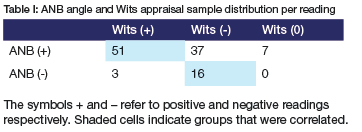
Only 19 out of 114 cephalograms had a negative ANB. Of these 19 individuals with a negative ANB reading, 16 had negative Wits appraisal readings, while 3 had a positive Wits appraisal. Correlations for negative groups were thus performed on 16 individuals (Table I).
The remaining 95 cephalograms had positive ANB readings, where 51 of these individuals with a positive ANB exhibited a positive Wits appraisal, 37 had a negative Wits appraisal and 7 presented with zero Wits appraisal (Table I). Correlations for positive groups were therefore performed on 51 individuals.
Variables in all three groups (entire sample, negative and positive categories) were not normally distributed. Spearman's coefficient of correlation (rs) tests were thus applied. All correlations were highly statistically significant (p ≤ 0.01). The ANB and Wits appraisal correlations for the entire sample (N = 114) were moderate (rs = 0.51), while strong in the negative category (rs = 0.77) and weak in the positive category (rs = 0.37).
DISCUSSION
While discrepancies associated with the use of the ANB angle as a measure of malocclusion have been reported in historical literature,5,6 recent studies continue to use ANB angles to classify malocclusion.3,14,15,22 To assess the value of using the ANB angle for skeletal malocclusion classifications in the Black South African population, the relationships between the ANB angle and the Wits appraisal were explored in this study. Although all correlations were statistically significant, positive categories (N = 51) resulted in weak correlations, suggesting that Wits appraisal findings associated with class II malocclusion could not solely be explained by the ANB angle in this category despite the larger samples size than those of the negative categories. The strong correlations in the negative groups indicate that ANB angle could to a certain extent be reliable when grouping skeletal class III only.
The ANB angle and Wits appraisal correlation for the overall sample was moderate, which was similarly moderate in a Chinese sample,23132313s = 0.77) and in their study (r = 0.75).
Other factors, such the vertical development of the face or the position of the nasion,11,12 could have influenced the readings of the ANB angle. A relatively shortened anterior cranial base resulting in a varying angle position at the nasion to the subspinale and supramentale have been implicated in another Black population.8
Although the ANB angle showed statistically significant differences between Wits appraisal categories and correlated to some extend with the Wits appraisal especially in the negative categories, it did not prove consistently reliable for distinguishing between categories because of the substantial overlap in angle values in especially the positive categories. There were 37 of the 95 individuals with a positive ANB angle that presented with a negative Wits appraisal and 3 of the 19 individuals presenting with a negative ANB angle that had a positive Wits appraisal.
CONCLUSION
Skeletal malocclusion classes categorised solely by ANB angles should be interpreted with caution in South African Black populations. Clinicians should consider using the Wits appraisal to quantify malocclusion as it is a linear measure expected to present with less variability than angular methods and minimises the interpopulational differences that are introduced when using ANB angles.
ETHICAL CONSIDERATIONSApproval to conduct the study was granted by Sefako Makgatho Health Sciences University (SMUREC/M/274/2023:PG). Details of patients were only obtained for sample categorisation purposes. Information of patients will not be publicised in relations to this study.
Dr Charlotte Theye for assisting with ImageJ software training.
Funding
This research was funded by the NRF.
Conflicts of interest
None.
Acknowledgements
Mrs Bukeka Mxamle for helping with retrieval of lateral cephalograms.
REFERENCES
- 1. Iranzo-Cortés JE, Montiel-Company JM, Bellot-Arcis C, Almerich-Torres T, Acevedo Atala C, Ortolá-Siscar JC, Almerich-Silla JM. Factors related to the psychological impact of malocclusion in adolescents. Scientific Reports. 2020 Aug 10;10(1):13471.
- 2. Zhou Z, Liu F, Shen S, Shang L, Shang L, Wang X. Prevalence of and factors affecting malocclusion in primary dentition among children in Xi'an, China. BMC Oral Health. 2016 Sep 2;16(1):91.
- 3. Panainte I, Suciu V, Mártha KI. Correlation between cranial base morphology and various types of skeletal anomalies. J Interdiscip Med. 2017;2(51):57-61.
- 4. Plaza SP, Reimpell A, Silva J, Montoya D. Relationship between skeletal Class II and Class III malocclusions with vertical skeletal pattern. Dental press journal of orthodontics. 2019 Sep 5;24(04):63-72.
- 5. Taylor CM. Changes in the relationship of nasion, point A, and point B and the effect upon ANB. American journal of orthodontics. 1969 Aug 1;56(2):143-63.
- 6. Jacobson A. Update on the Wits appraisal. The Angle Orthodontist. 1988 Jul 1;58(3):205-19.
- 7. Alassiry AM. Accuracy of different cephalometric analyses in the diagnosis of class III malocclusion in Saudi and Yemeni population. Journal of Orthodontic Science. 2020 Jan 1;9(1):14.
- 8. Oliveira TC, Copello FD, Silva IM, Nojima LI, Nojima MD. Dentofacial and skeletal pattern in African descendants from southeastern Brazil: clinical prospective study. Dental press journal of orthodontics. 2021 Jun 30;26:e2119288.
- 9. Jacobson A. The "Wits" appraisal of jaw disharmony. American journal of orthodontics. 1975 Feb 1;67(2):125-38.
- 10. Martinez P, Bellot-Arcís C, Llamas JM, Cibrian R, Gandia JL, Paredes-Gallardo V. Orthodontic camouflage versus orthognathic surgery for class III deformity: comparative cephalometric analysis. International journal of oral and maxillofacial surgery. 2017 Apr 1;46(4):490-5.
- 11. Rotberg S, Fried N, Kane J, Shapiro E. Predicting the "Wits" appraisal from the ANB angle. American journal of orthodontics. 1980 Jun 1;77(6):636-42.
- 12. Bishara SE, Fahl JA, Peterson LC. Longitudinal changes in the ANB angle and Wits appraisal: clinical implications. American journal of orthodontics. 1983 Aug 1;84(2):133-9.
- 13. Al-Jabaa AH, Aldrees AM. ANB, Wits and Molar Relationship, Do they correlate in Orthodontic Patients?. Dentistry. 2014 Jan 1;4(6):1.
- 14. Ardani IG, Willyanti I, Narmada IB. Correlation between vertical components and skeletal Class II malocclusion in ethnic Javanese. Clinical, Cosmetic and Investigational Dentistry. 2018 Dec 19:297-302.
- 15. Khan SH, Ahmed N, Tahsin T, Sultana N, Rubby MG. Skeletal Pattern of Bangladeshi Patients with Class II Malocclusion Attending in a Selected Private Setting. Update Dental College Journal. 2023 Oct 9;13(2):34-7.
- 16. Ferriera T, Rasband R. ImageJ user guide. National Institutes of Health, Bethesda, MD. 2012
- 17. Hammer Ø, Harper DA. Past: paleontological statistics software package for educaton and data anlysis. Palaeontologia electronica. 2001;4(1):1.
- 18. Neideen T, Brasel K. Understanding statistical tests. Journal of surgical education. 2007 Mar 1;64(2):93-6.
- 19. Mukaka MM. A guide to appropriate use of correlation coefficient in medical research. Malawi medical journal. 2012;24(3):69-71.
- 20. Schober P, Boer C, Schwarte LA. Correlation coefficients: appropriate use and interpretation. Anesthesia & analgesia. 2018 May 1;126(5):1763-8.
- 21. Koo TK, Li MY. A guideline of selecting and reporting intraclass correlation coefficients for reliability research. Journal of chiropractic medicine. 2016 Jun 1;15(2):155-63.
- 22. Al Zain T, Ferguson DJ. Cephalometric characterization of an adult Emirati sample with Class I malocclusion. Journal of orthodontic science. 2012 Jan 1;1(1):11-5.
- 23. Zhou L, Mok CW, Hägg U, McGrath C, Bendeus M, Wu J. Anteroposterior dental arch and jaw-base relationships in a population sample. The Angle Orthodontist. 2008 Nov 1;78(6):1023-9.
Authors contributions
1. Ms Ruth Kobedi. Role: principal researcher, manuscript development and write-up 60%
2. Dr Sandeepa Rajbaran Singh. Role: conception and manuscript editing: 15%
3. Dr Helene Franci Swanepoel.Role: manuscript editing: 5%
4. Prof Anna Catherina Oettlé. Role: conception, data analysis, manuscript development and editing 20%