Comparison of efficiency of ozone and chlorhexidine subgingival irrigation in orthodontic patients for controlling gingival inflammation
Abstract
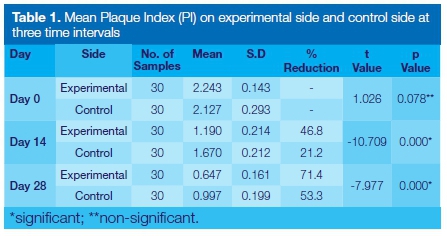
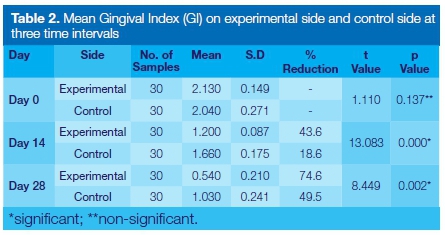
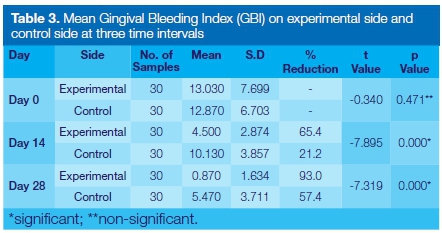
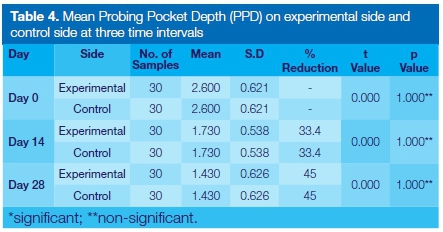
AIM: To compare the clinical effects of subgingival irrigation with ozonated water to the effects of chlorhexidine solution on gingivitis in orthodontic patients and to correlate the clinical effects with the MCP-1 activity in gingival crevicular fluid (GCF OBJECTIVE: Correlate the inflammatory marker monocyte chemoat-tractant protein (MCP-1) in GCF with clinical parameters viz. gingival index (GI), plaque index (PI), gingival bleeding index (GBI), probing pocket depth (PPD MATERIALS AND METHOD: A double-blind clinical study of subgingival irrigation was conducted in a split-mouth design on 30 subjects for 28 days. Clinical parameters (plaque index, gingival index, gingival bleeding index, probing pocket depth) and MCP-1 enzyme activity were measured at baseline followed by subgingival irrigation with 0.01 mg/l of ozonated water on right maxillary quadrants and 0.02% of chlorhexidine solution on left maxillary quadrants. These parameters were again assessed on 14th and 28th day. RESULTS: Significant (P<0.01) reduction of all the clinical parameters and GCF MCP-1 activity after subgingival irrigation with both solutions. Ozonated water showed a highly significant reduction of clinical parameters and MCP-1 activity CONCLUSION: Subgingival ozone irrigation can be an effective method to reduce gingival inflammation in orthodontic patients
Gingival inflammation; Ozonated water; Chlorhexidine solution; MCP-1