Epithelial cell rests of Malassez: From quiescent remnants to front-runners in periodontal homeostasis and regeneration. A brief review
Abstract
In recent years, research has been directed towards elucidating the physiological role played by the epithelial cell rests of Malassez within the periodontal ligament and surrounding alveolar bone. These unique structures were, for many years, considered to be quiescent remnants of development, but are now emerging as key role-players in the maintenance of periodontal health and are also implicated in bone resorption through secretion of bone resorption mediators. Reviews on this topic are infrequent in the dental literature and the notable advances regarding the cytokine profile of the epithelial cell rests of Malassez and their autocrine and paracrine roles in the periodontal tissues make it opportune to review their physiological roles in maintaining periodontal health. Furthermore, experiments have established that epithelial cell rests of Malassez contain stem cells that can undergo epithelial-mesenchymal transitions, placing these cells at the centre of periodontal regeneration.
epithelial cell rests of Malassez; epidermal growth factor; periodontal homeostasis; periodontal regeneration; paracrine signaling; bone remodeling
INTRODUCTION
A thorough understanding of the biological basis of maintenance of periodontal health is indispensable to many aspects of clinical dentistry in order that adequate dental treatment may be provided. Epithelial cell rests of Malassez (ERM) are integrated in the periodontal ligament and have been found to secrete several growth factors, cytokines, chemokines, adhesion molecules and associated proteins.1
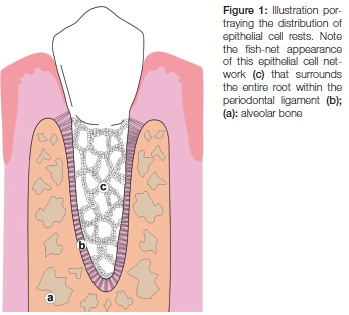
Epithelial cell rests of Malassez were first described by Augustin Serres in 1817.234Figures 1 and 2).

Epithelial cell rests of Malassez originate from the degeneration of Hertwig's epithelial root sheath to form quiescent cell rests that persist as the sole epithelial cells in the periodontium.561
Characterization of the cytokine profile of ERM have brought to light important bone resorbing factors, growth factors, chemokines and related proteins which are directly implicated in the process of bone remodelling.1,4 Furthermore, adhesion molecules such as osteopontin and bone sialoproteins which regulate mineralization, are secreted by ERM in the root regions of mature and developing teeth.51
Bone is a metabolically active specialized form of connective tissue that undergoes continuous remodelling through a tightly regulated interaction between two equivalent and opposing events, specifically, bone resorption of pre-existing bone by osteoclasts, followed by new bone formation by osteoblasts.778-10 The successive bone-degradation and bone-formation sequence and the observation that under physiological conditions bone mass is kept constant, has led to the postulate that the two opposing processes regulate each other.89-11
RANKL/RANK EXPRESSION IN OSTEOCLASTS AND OSTEOBLASTS
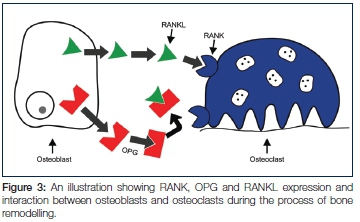
Macrophage-colony stimulating factor (M-CSF) and several transcription factors are required for the final transformation of haematopoietic stem cells to osteoclasts.9 8,11,12 Receptor activator of nuclear factor kappa-B (RANK) is the cell bound receptor for RANKL found on the surface of preosteoclasts.999Figure 3).
ERM AND BONE REMODELLING
Epithelial cell rests of Malassez have the ability to maintain their structure within the periodontal ligament through the constant release of a polypeptide known as epidermal growth factor (EGF).13,17 Epidermal growth factor was identified by Stanley Cohen in 1962 and has been associated with odontogenesis and tooth eruption.141416,17 Epithelial cell rests of Malassez are able to proliferate and to sustain their structure through autocrine signalling by the constant release of EGF that is responsible for their growth and integrity.13
Epidermal growth factor released by the ERM is directly implicated in osteoclastogenesis and hence bone resorp-tion through the inhibition of osteoprotegerin (OPG), a well-established decoy receptor for RANKL.12,13,15 Con-comitantly EGF enhances the expression of monocyte chemoattractant protein-1 (MCP1) due to the proximity of ERM to surrounding alveolar bone and the continuous secretion of EGF which will have a resorptive effect on the adjacent alveolar bone with the net effect of alveolar bone remodelling in order to maintain the periodontal ligament space at a constant, that is approximately 0,25 mm.12,18
The connective tissue that separates ERM from adjacent bone cells is believed to provide the essential dilution site for EGF, preventing this polypeptide from reaching the EGF receptors on bone cells in high concentrations thereby avoiding excessive bone resorption.121212121212
Epithelial cell rests of Malassez have also been shown to proliferate when stimulated by induced tooth movements.8,18-21 The proliferation of ERM increases the amount of secreted mediators, particularly EGF that induces bone resorption as well as the renewal and reorganization of the cells within the periodontal ligament including cementogenesis on the resorptive tooth surface.819,21 Experiments have demonstrated that Hertwig's epithelial root sheath, under the influence of transforming growth factor beta (TGF-β), is capable of undergoing epithelial-mesen-chymal transition.22222223,24
In the absence of EGF release, ERM would lose their ability to self-stimulate and maintain their structure within the periodontal ligament. In addition, paracrine signalling through the secretion of mediators of bone resorption would not take place, impacting on the process of bone remodelling around the tooth and leading to the tooth assuming the traits of ankylosis. Therefore, the persistence of ERM in the periodontal ligament is essential to the maintenance of periodontal homeostasis.
CONCLUSION
Epithelial cell rests of Malassez are functional components of the periodontium that fulfil key physiological and regenerative functions to ensure periodontal integrity. These include:
- Maintenance of a constant periodontal ligament space by indirect stimulation of osteoclast differentiation though decreasing the decoy receptor OPG and increasing MCP1;
- Prevention of the formation of alveolodental ankylosis by constantly secreting bone resorptive mediators thereby preventing mineralisation of the periodontal ligament;
- Participation in the process of periodontal regeneration by providing a stem cell supply which can migrate to sites of resorption and injury and stimulate cementogenesis;
- Participation in tooth movement by increasing EGF production in periodontal tissues and helping to repair root resorption areas while stimulating cementogenesis.
Due to the numerous physiological and regenerative functions that ERM perform within the periodontal ligament, the authors suggest that the current nomenclature of epithelial cell "rests" should be replaced by the term epithelial "network" in order to emphasize the central role that these cells play in the homeostasis of the tooth supporting apparatus.
Acknowledgement
The authors would like to acknowledge Nicolette Jordaan from Medical Illustration & Audio-Visual Services, SMU, for her assistance with the illustrations in this article.
References
- 1. Ohshima M, Yamaguchi Y, Micke P, Abiko Y, Otsuka K. In vitro characterization of the cytokine profile of the epithelial cell rests of Malassez. J Periodontol 2008; 79 (5): 912-9.
- 2. Serres A. Essai sur Lanatomie et la physiologie des dents ou nouvelle théorie de la dentition. Mequignon-Marvis, Paris. 1817: 28.
- 3. Malassez L. Sur l'existence damas epitheliaux autour de la racine des dents chez l'homme adulte et a l'etat normal (debris epitheliaux paradentaires). Arch Physiol 1885; 5: 129-48.
- 4. Rincon JC, Young WG, Barltold PM. The epithelial cell rests of Malassez: a role in periodontal regeneration? J Period Res 2006; 41 (4) 245-52.
- 5. Wang Y, Linlin Lv, Yu X, et al. The characteristics of epithelial cell rests of Malassez during tooth eruption of development mice. J Mol Hist 2014; 45: 1-10.
- 6. Nanci A. Ten Cate's Oral Histology: Development, Structure and Function, 8th edition Edition: Elsevier, 2013.
- 7. Ross MH, Pawlina W. Histology, A Text and Atlas. 2006. Lip-pincott Williams & Wilkins, 5th Ed.
- 8. Corral DA, Amling M, Priemel M, et al. Dissociation between bone resorption and bone formation in osteopenic transgenic mice. Proc Natl Acad Sci USA 1998; 95(23): 12835-13840.
- 9. Boyce BF. Advances in the regulation of osteoclasts and os-teoclast functions. J Dent Res 2013; 92(10): 860-7.
- 10. Soysa NS, Alles N, Aoki K, Ohya K. Osteoclast formation and differentiation: An overview. J Med Dent Sci 2012; 59(3): 65-74.
-
11. Weitzmann, MN. The role of inflammatory cytokines, the RANKL/OPG axis, and the immunoskeletal interface in physiological bone turnover and osteoporosis. Scient 2013; doi:10.1155/2013/125705.
» https://doi.org/10.1155/2013/125705 - 12. Consolaro A, Consolaro MF. ERM functions, EGF and orthodontic movement. Dental Press J Orthodont 2010; 15 (2)-24-32.
- 13. Raisz LG, Simmons HA, Sandburg AL, Canalis E. Direct stimulation of bone resorption by epidermal growth factor. Endocrinol 1980; 107(1): 270-3.
- 14. Cohen S. 1962. Isolation of a mouse submaxillary gland protein accelerating incisor eruption and eyelid opening in the new-born animal. J Biol Chem 1982; 237: 1555-62.
- 15. Zhang X, Tamasi J, Lu X, et al. Epidermal growth factor receptor plays an anabolic role in bone metabolism in vivo. J Bone and Min Res 2011; 26(5): 1022-34.
- 16. Carpenter G. Receptors for epidermal growth factor and other polypeptide mitogens. Ann Rev Biochem 1987; 56: 881-914.
- 17. Carpenter G. Epidermal growth factor: biology and receptor metabolism. J Cell Sci Suppl 1985; 3:1-9.
- 18. Schneider MR, Sibilia M, Erben RG. The EGFR network in bone biology and pathology. Trends in Endocrinol and Met 20(10): 517-524.
- 19. Walker GC, Dangaria S, Ito Y, Luan X, Diekwisch TGH. Oste-opontin is required for unloading-induced osteoclast recruitment and modulation of RANKL expression during tooth drift associated bone remodelling but not for super-eruption. Bone 2010; 47: 1020-9.
- 20. Saddi KR, Alves GD, Paulino TP, Ciancaglini P, Alves GB. Epidermal growth factor in liposomes may enhance osteoclast recruitment during tooth movement in rats. Angle Orthodont 2008; 78(4): 604-9.
- 21. Alves JB, Ferreira CL, Martins AF, et al. Local delivery of EGF-liposome mediated bone modelling in orthodontic tooth movement by increasing RANKL expression. Life Sci 2009; 85(19-20):693-9.
- 22. Xiong J, Mrozik K, Gronthos S, Barltold PM. Epithelial cell rests of Malassez contain unique stem cell populations capable of undergoing epithelial-mesenchymal transition. Stem Cell and Dev 2012; 21(11): 2012-25.
- 23. Seo BM, Miura M, Gronthos S, et al. Investigation of multipo-tent postnatal stem cells from human periodontal ligament. Lancet 2004; 364: 149-55.
- 24. Battula VL, Evans KW, Hollier BG, et al. Epithelial-mesenchy-mal transition-derived cells exhibit multi-lineage differentiation potential similar to mesenchymal stem cells. Stem Cells 2010; 28: 1435-45.
Hilde Doris Miniggio
P.o. Box 0204, medunsa, Pretoria
Tel: 012 521 4882, Fax: 012 521 4274, Cell: 072 869 4045
E-mail: