Evaluation of handwashing practices among dental care providers in a tertiary hospital in South West Nigeria: A cross sectional study
Abstract
BACKGROUND: Handwashing prevents cross-transmission of microorganisms, thus preventing hospital acquired infections. The aim was to evaluate hand washing knowledge, attitude and practices among dental care providers in a hospital set up for infection control. MATERIALS AND METHODS: A descriptive cross-sectional study was carried out in a tertiary hospital in South West Nigeria. A self-administered questionnaire was administered among 110 dental care providers in the hospital. Data obtained were analysed using SPSS. Association between variables was carried out using a Chi-square test. RESULTS: The majority (52; 47.2%) of the respondents were dentists. The respondents had good overall level of knowledge (71.8%), attitude (84.5%) and practice (93.6%) of handwashing. However, only 35.5% stated they have heard about Ayliffe's technique of handwashing, in which 97.4% of them could not correctly state the right order of the technique. There was statistically significance association between the knowledge of handwashing and occupational status of the respondents (p=0.014). There was statistically significance association between the practice of handwashing and occupational status of the respondents (p=0.013). CONCLUSIONS: The knowledge and practice of handwashing were good, and there was positive attitude of handwashing among the dental care providers in our hospital. However, the actualisation of handwashing technique and appropriate sequence were poor.
Handwashing practice; dental care provider; tertiary hospital; Infection control
INTRODUCTION
Handwashing refers to the process of physical removal of dirt, blood, body fluids and transient microorganisms from the hands whereas the destruction of microorganisms is referred to as hand antisepsis.123
Antiseptic hand rubs involve rubbing hands with alcohol-based solutions. These germicidal solutions could be augmented with antiseptics such as chlorhexidine, octenidine, triclosan or quaternary ammonium for persistent activity.4
Independent studies by Ignaz Seemmelweiss in 1847 and Oliver Wendell Holmes in 1843 in Boston established a link between the hands of health care workers and the spread of hospital-acquired diseases.5,6
Some of the diseases that can be contracted from non-handwashing are "Superbugs" which are multidrug resistant organisms781011
Some studies12,13 have shown knowledge gaps in the recommended methods of handwashing and inadequate practices of hand washing among dental care providers. The interventions for improving knowledge can be through regular workshops and continuing education131112,14-18 in some parts of the world and Africa that evaluated the effectiveness of handwashing in the control of infection, while few studies19
Handwashing with respect to dental practice in Nigeria has not been well documented in literature. Therefore, the reason for this study is to evaluate handwashing knowledge, attitude and practices among dental care providers which would help in infection control.
Materials and methods
The descriptive cross-sectional study was carried out in Lagos State University Teaching Hospital, a tertiary hospital in South West Nigeria. Ethical approval was obtained from the Health Research and Ethics Committee of Lagos State University Teaching Hospital (LREC/06/10/2304). A self-administered questionnaire was distributed to 110 dental care providers in the hospital. The questionnaire was in four sections. The first section comprised sociodemographic information of the respondents, the second section comprised their knowledge of specific areas related to handwashing and disease. The third section included their attitude towards handwashing in respect to health and safety and the fourth section comprised how they practice handwashing at the dental clinic/laboratory.
Data obtained were analysed using Statistical Package for Social Sciences (SPSS, IBM) version 25.0. Data presentation was done using frequency distribution and tables. Association between variables was carried out using Chi-square test; p-value <0.05 was assumed to be statistically significant at 95% CI.
RESULTS
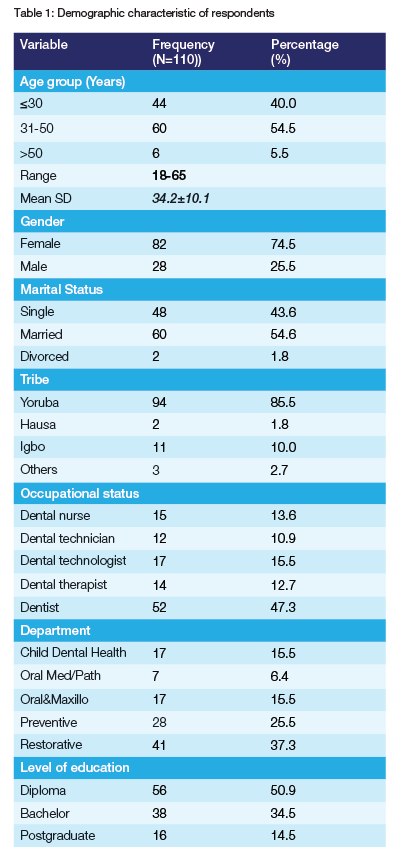
A total of one hundred and ten (110) respondents were recruited in this study. The majority (60; 54.5%) of the respondents was within the age group of 31-50 years, with a mean age of 34.2±10.1 and a range of 18-65 years. There were more females (82; 74.5%) than males (28; 25.5%). The majority (52; 47.2%) of the respondents were dentists, while most of the respondents had a diploma as their highest level of education (Table 1).
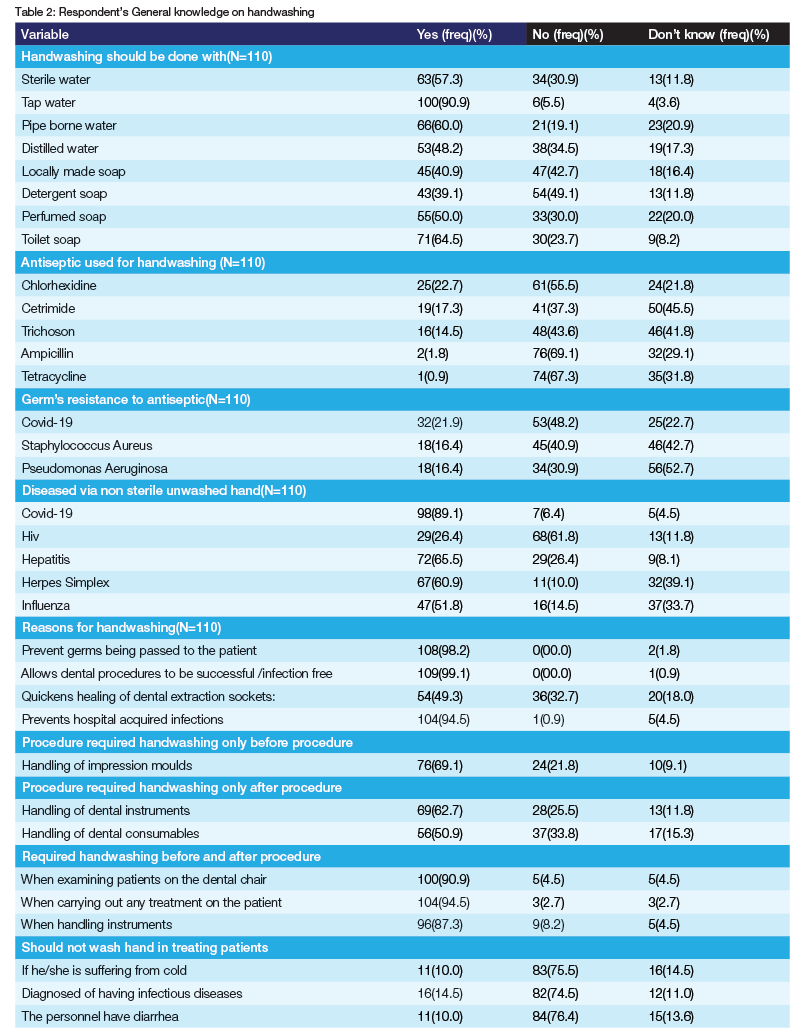
Table 2 shows respondents' general level of knowledge on handwashing. The majority (63; 57.3%) incorrectly noted that handwashing should be done using sterile water. Less than half of the respondents (45; 40.9%) correctly stated that locally made soap should be used for handwashing. Only (25; 22.7%) rightly noted that Chlorhexidine is used for handwashing. More than half the respondents (56; 52.7%) did not know if Pseudomonas Aeruginosa is resistant to antiseptics used in handwashing. The majority (69; 62.7%) believed it is not necessary to wash hands before handling sterile dental instruments.
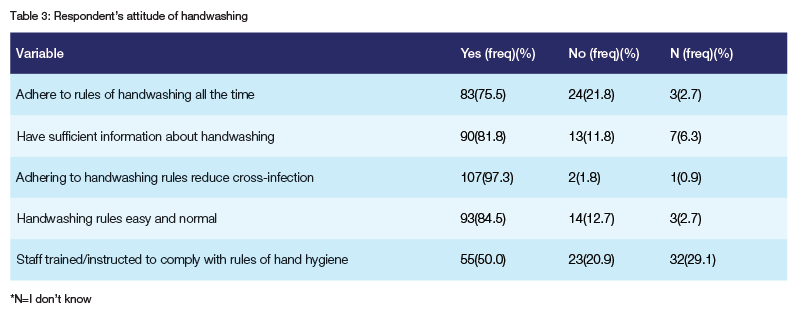
Table 3 represents the attitude of the respondents to handwashing. Most of the respondents (83; 75.5%) and 107 (97.3%) reported that they adhere to rules of handwashing all the time and have sufficient information about handwashing respectively, whereas 55 (50.0%) of the respondents noted that the new members of staff are trained/instructed to comply with rules of hand hygiene.
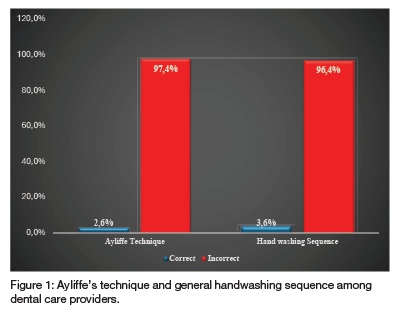
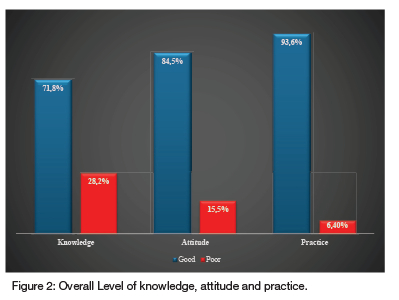
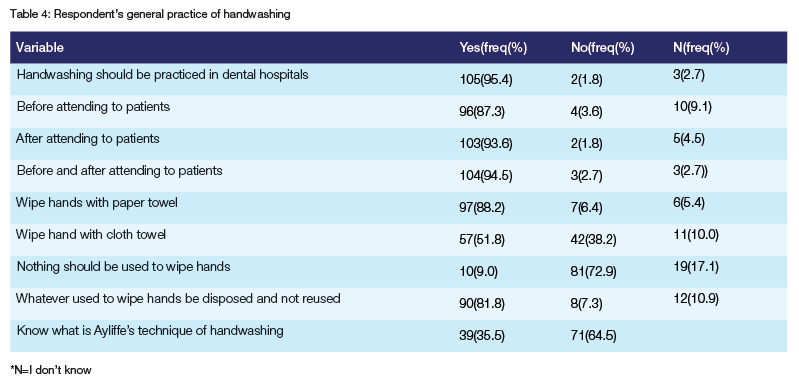
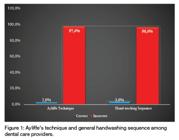
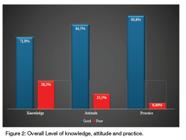
Table 4 displays the practice of handwashing among the respondents in which the majority (105; 95.4%) rightly noted that handwashing should be practiced in dental hospitals. However, only 35.5% stated they have heard about Ayliffe's technique of hand washing, in which 97.4% of them could not correctly state the right order of this technique (Figure 1). In addition, the majority (104; 96.4%) could not state the general sequence of hand washing (Figure 1). The respondents had good overall level of knowledge (71.8%), attitude (84.5%) and practice (93.6%) of handwashing (Figure 2).
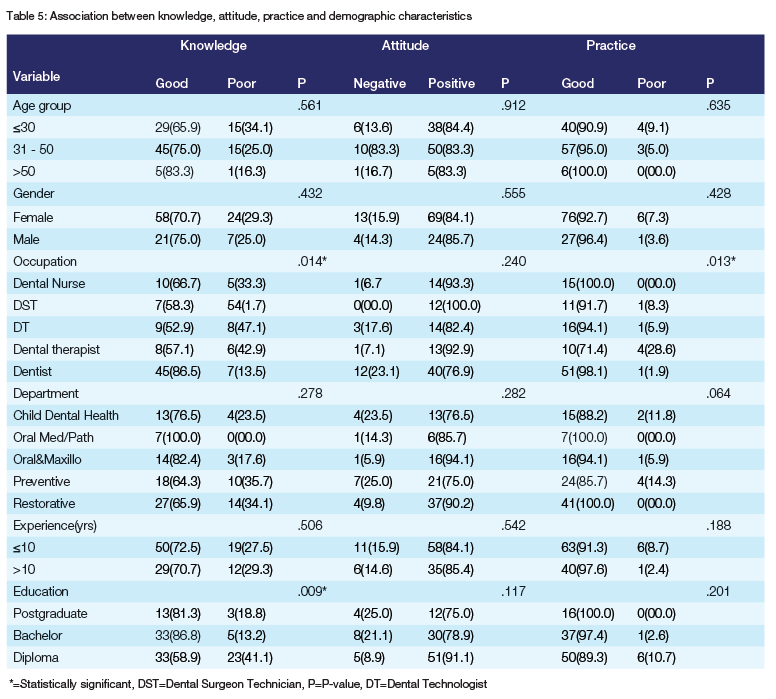
Among the dental care providers, dentists were the highest respondent that had good knowledge (45; 86.5%) and practice (51; 98.1%) of handwashing. There was statistically significant association between the knowledge of handwashing and occupational status of the respondents (p=0.014) (Table 5). There was statistically significant association between the practice of handwashing and occupational status of the respondents (p=0.013). There was statistically significance association between the knowledge of handwashing and educational level of the respondents (p=0.009) (Table 5).
DISCUSSION
Handwashing is an essential practice in the control of cross-infections. This study evaluated the attitude, knowledge and practice of handwashing among the dentists, dental nurses, dental surgery technicians, dental therapists, and dental technologists in Lagos State University Teaching Hospital, Ikeja, Lagos State. Most of the respondents in this study were aged between 31-50 years (54.5%), with more females (74.5%). The majority of the respondents (52; 47.3%) were dentists.
Seventy-nine (71.8%) respondents had good knowledge of handwashing, similar to a study132021
Majority of the respondents (71.8%) had a positive attitude towards handwashing. Of these attitudes, 97.3% of respondents believed that adhering to handwashing reduces cross-infection; this result was similar to a study by Bello et al22et al19
Moreover, it's a known fact that the oral cavity is an environment rich in various types of microorganisms.23249et al25
Adherence to the proper rules of handwashing all the time was noted in 77.5% of respondents and 84.5% claimed that adhering to rules of handwashing were easy and normal. This might be due to availability of wash basins, adequate running water, antiseptic soaps and disposable towels in the various clinics. In addition, overrating their personal compliance might not be overemphasised. However, Bello et al2219
Most of the respondents (93.6%) had good practice of handwashing in terms of when to practice it and what to use when practicing handwashing. Nevertheless, only 35.5% knew the Ayliffe's technique of handwashing in which 97.6% could not rightly state the order of the technique and 3.6% of the respondents were able to state the handwashing sequence correctly. This showed that the respondents had not been practicing the right way of handwashing. In a similar study by El Dokky et al26, the respondents (100%) had correct answers about handwashing practice, but only 40% of them could demonstrate the proper method of washing of hands. Improper handwashing could be attributed to lack of continuous monitoring and evaluation.2619
Since most of the participants in the present study did not know the Ayliffe's technique or the correct sequence of handwashing, seminars should be advocated for in the training of the dental care providers in the institution. Moreover, visual guide and tips can be pasted in the various clinics as a reminder until mastering it becomes part of the dental care provider. The Ayliffe's technique (1978)27
Among the dental care providers, dentists were the highest respondents (86.5%) who had good knowledge of handwashing and 98.1% had good practice; there was statistically significant association in this finding. This can be attributed to the constant continuing medical education (CME) to which the dentists are exposed; this CME is a prerequisite for renewal of an annual practicing licence. Regarding the level of education, respondents with a Bachelor's degree had the highest good knowledge of handwashing (86.8%), even higher than postgraduates. Respondents with a Bachelor's degree in the tertiary institution might be exposed to more information because they tend to study more and attend various seminars, academic updates and conferences, while respondents with postgraduate qualification might have the feeling that they have attained their ultimate achievements. Therefore, seminars on handwashing guidelines should involve every dental care provider irrespective of their level of education.
CONCLUSION
The knowledge and practice of handwashing were good, and there was a positive attitude to handwashing among the dental care providers in our hospital. However, the actualisation of handwashing technique and appropriate sequence were poor, which may not be adequate to prevent infection transmission. Regular seminars on handwashing guidelines in relation to infection control should be embraced quarterly among dental care providers. New staff should be subjected to training of handwashing as soon as they are employed in the hospital. Visual guides and tips should be placed in strategic locations to improve the adherence to handwashing practice.
REFERENCES
- 1. Infection Control Services LTD (Home infection Manual Dentistry Personal Protection). Hand Hygiene. Page updated 9 October 2006
- 2. Rotter M. Hand washing and hand disinfection [chapter 87]. In: Mayhall CG ed. Hospital epidemiology and infection control. 2nd ed. Philadepia: Lippincott Williams & Wilkins; 1999
- 3. Labarraque AG. Instructions and observations regarding the use of chlorides of soda and lime. Porter J, ed. [French] New Haven, Conn: Baldwin and Treadway; 1829
- 4. Roe G. eHow Contributor. Hand washing techniques in a Dental office. Copright 1998-2011 antibioticprophylaxis.com
- 5. Centres for Diseases Control and Prevention (CDC). Guideline for hand hygiene in health-care settings: Recommendedations of the Health-care Infection Control Practices Advisory Committee and the HIC PAAC/SHEA/APIC/IDSA Hand Hygiene Task Force, MMWR 2002; 51(RR-16): 1-46
- 6. Semmelweis I. Etiology, concept and prophylaxis of childhood fever. Carter KC, ed. 1st ed, Madison; Wins.: The University of Wisconsin Press; 1983
- 7. Scarlett MI. Handwashing: the best defence against superbugs. Insid Dent Assist. 2009;5(10)
- 8. DePaola LG, Fried JI. Handwahing: The most effective way to prevent the spread of disease. 2007
- 9. WORLD HEALTH ORGANIZATION, WHO Director-General's opening remarks at the media briefing on Covid-19. 2020
- 10. UNICEF, Everything you need to know about washing your hands to protect against coronavirus (Covid-19). 2020
- 11. Subbalakshimi E, Abirami P, Subramanian V, Victor HK. Awareness of hand hygiene in hospital set-up for infection control: Knowledge-based questionnaire for health care workers in a teaching hospital. Biomed Pharmacol J. 2020;13(4):1773-9
- 12. Elhassan DK. Knowledge, Attitudes and Practices of Oral Health Care Workers towards Infection Control in Khartoum Dental Teaching Hospital, Sudan. 2023.
- 13. Marei NM, Salama MT, Habibullah MA. Knowledge, attitude and practice of hand hygiene among dentists as a prevention method from Covid-19 in Al Qassim region, kingdom of Saudi Arabia: a cross-sectional study. Int J Med Diagnosis Res. 2020;4(9):11-8.
- 14. Hassan H, Zahid F, Malik MI, Shakoor A, Yaasir Z, Zeeshan M. Hand Hygiene and Cross Infection Control among Dental Auxiliaries working in Private and Public Dental Institutes of Punjab. Pakistan J Med Heal Sci. 2022;16(10):711-4
- 15. Hassan H, Khalid S, Rafique A, Zahid F, Khurram M, Khalid R. Hand hygiene awareness, attitude and compliance among house officers in public-sector dental institutes - A questionnaire-based study. Pakistan J Med Heal Sci. 2022;16(05):961-4
- 16. Cheng HC, Peng B y, Lin ML, Chen SL. Hand hygiene compliance and accuracy in a university dental teaching hospital. J Int Med Res. 2019;47(3):1195-201
- 17. Ait-ou-amar S, Berrazzouk S, Ennibi O. Handwashing revisited in dental practice during the COVID-19 outbreak. Dent Med Probl. 2021;58(2):243-52
- 18. Majid M, Zulfiqar A, Chaudhary MA, Sultan S, Rizwan G, Rizwan Z. Knowledge, attitude and practice of dentists towards Covid-19 in twin cities of Pakistan : a cross sectional study. J Khyber Coll Dent. 2021;11(2):50-8
- 19. Omogbai JJ, Azodo CC, Ehizele AO, Umoh A. Hand hygiene amongst dental professionals in a tertiary dental clinic. African J Clin Exp Microbiol. 2011;12(1):9-14
- 20. Naik S, Khanagar S, Kumar A, Vadavadagi S, Neelakantappa HM, Ramachandra S. Knowledge, attitude, and practice of hand hygiene among dentists practicing in Bangalore city - a cross-sectional survey. J Int Soc of Prevent Community Dent. 2014;4(3):159-63
- 21. Klymenko I, Kampf G. Systemic mistakes in hand hygiene practice in Ukraine: detection, consequences and ways of elimination. GMS Hyg Infect Control. 2015;10
- 22. Bello S, Effa EE, Okokon EE, Oduwole OA. Handwashing practice among healthcare providers in a teaching hospital in Southern Nigeria. Int J Infect Control. 2013;17:9(4)
- 23. Mutters NT, Hägele U, Hagenfeld D, Hellwig E, Frank U. Compliance with infection control practices in a university hospital dental clinic. GMS Hyg Infect Control. 2014;9(3)
- 24. Yüzbasioglu E, Saraç D, Canbaz S, Saraç Y Cengiz S. A survey of cross-infection control procedures: knowledge and attitudes of Turkish dentists. J Appl Oral Sci. 2009;17(6):565-9
- 25. Sofola OO, Folayan MO, Denloye OO, Okeigbemen SA. Occupational exposure to bloodborne pathogens and management of exposure incidents in Nigerian dental schools. J Dent Educ. 2007;71(6):832-7
- 26. El Dokky N, Moheb D. Evaluation of infection control knowledge attitude and practices among a group of Egyptian postgraduate dental students. Egyptian Dent J. 2021;67(3):1819-26
- 27. Ayliffe GA, Babb J, Quoraishi AH. A test for "hygienic" hand disinfection. J Clin Pathol. 1978;31(10):923-8
Dr Adenike.O. Awotile
Address: Department of Restorative Dentistry, Faculty of Dentistry, Lagos State University College of Medicine, PMB 21266, Ikeja Lagos State Nigeria
Contact Number: +2349082124877
E.mail: