Non-maleficence - a disremembered moral obligation
INTRODUCTION
Moral and ethical values of health professionals come under intense scrutiny. Justly, the conduct of health professionals in recent times has merited rigorous and intense appraisal and resultant disapproval, especially in the wake of atrocities such as South African Life Healthcare Esidimeni.1
Notwithstanding substantial methodological challenges to the understanding of harm, this paper aims to provide a conceptual discussion of non-maleficence and its application and implication in the dental practice. Further elucidation will be provided on how and where harm and injury is likely to occur in dentistry.
-
DEFINITION OF HARM
The understanding of non-maleficence is rooted in the moral intent of an agent to abstain from harming or imposing risk of harm or to prevent injuries to others. The concept of harm is broad and is highly contested in literature.2-5 The plethora of definitions of harm encapsulate "trivial" notions of harm such as to annoy, humiliate, offend, and or cause discomfort.2,5,6 More serious views of harm include interfering with one's liberties, privacy, reputation, property etcetera.2,5,6 Despite these contestations, it is generally accepted that harm implies that one has been injured, violated, or treated unjustly by another. Beauchamp and Childress conceptualise harm as the "thwarting, defeating, or setting back of some party's interest."4harmed but not wronged. The dismissal of a negligent clinician is not wrong, though harmful, as his interests, financial security and reputation would be thwarted. Therefore, for health professionals, it can be argued that non-maleficence has been entrenched as a prima facie principle that requires the justification of harmful actions.5
Simply put, a clinician's harmful actions may not be deemed morally or legally wrong provided they are aligned with specific rules of non-maleficence or are not superseded by other moral principles. Causing some harm in order to benefit the patient may be desirable, necessary and justifiable. Clinicians often face serious moral and ethical dilemmas in which they have to determine whether the harm they may cause is justified in terms of any associated possible benefits to the patient. According to the Catholic doctrine of the rule of "double effects",77
Frankena6
One ought not to inflict evil or harm
One ought to prevent evil or harm
One ought to remove evil or harm
One ought to do or promote good.
Frankena's exposition of non-maleficence as expressed in the first rule of non-maleficence corresponds with the maxim primum non nocere.6prima facie precedence over the obligation for beneficence. However and as argued by Gillion et al.89
We restrict, in this article, the notion of non-maleficence to physical and psychological harm. Furthermore and included are the associated outcomes such as pain, handicap, disability, suffering, loss or death. For oral health professionals, the notion of non-maleficence includes prevention, avoidance and removal of harm or mitigation of the risk of harm to dental patients. Dental patients may experience harm or increased risk of injury due to commission or omission or because of a deliberate or unintentional action by an attending professional or their staff within the clinical setting.
CONTEXT OF HARM IN CLINICAL PRACTICENon-maleficence includes the obligation not to cause harm or to inflict the risk of harm. This undertaking is implicitly espoused in the Hippocratic Oath and pledges undertaken by health professionals to honour the inviolability of the patient. The obligation of clinicians to non-maleficence in caring for patients, assumes the commitment to exercise "due care".1011 12
Underpinned by the principle of non-maleficence, dentists ought to maintain the highest level of conduct and competence commensurate with their professional norms and standards. It is foremost critical for dental education to meet stringent standards and quality that would enable dental professionals to manage dental patients satisfactorily. This quality assurance mandate is effected by training institutions, with the oversight of the regulator (HPCSA). The need for quality education extends beyond formal university learning to include acquisition of CPDs (Continuing Professional Development). This form of lifelong learning is meant to sustain the desired levels of clinical, cognitive and affective competencies. These skills are critical in this era of rapid technological revolution and increased demands by patients alike. It is hence morally indefensible for dental practitioners to fail to adopt beneficial health care developments, more so if the developments seek to reduce harm but continue to benefit patients. Understandably, health-governing bodies (such as the HPCSA) introduced a compulsory CPD programme as a requisite for practitioners to maintain their registration and licence to continue to practice their trade. This practice is part of the legal obligation of the regulator and moral obligation by the clinician to ensure beneficence and non-maleficence towards the patient.
The principle of non-maleficence obliges dentists to safeguard the welfare of patients by procuring the special skills of colleagues with advanced knowledge and competencies. It is hence imperative for practitioners to understand their limits in terms of knowledge and clinical skills and to refer appropriately. Failure to refer patients when it is necessary could result in serious harm to the patients. Referrals between the dentist and specialist should be undertaken in a collegial manner in order to avoid further harm to the patient and to professionals. Similarly, when a patient is referred for second opinion, such opinions should be provided in accordance to professional norms and codes of conduct. Dental professionals must guard against touting and supersession in such instances. In group practices, the dentists in charge are ultimately responsible for the care provided by the auxiliary staff in their employ. The principal clinician is obliged to prescribe, oversee and assure that the desired quality of care provided is by these personnel, and that no harm or injury occurs.
Dental practitioners who are impaired in some way or are unable to practice to full extent, should limit their practice to levels commensurate with their current skills and competence. Failure to recognise these clinical limitations could harm or increase the risk of harm to the patients. The impairment could be permanent due to disease, or intermittent due to the abuse of substances. In all these cases, it is also obligatory for colleagues to report such concerns to authorities to protect patients and in support of the practitioners. Dentists exposed to infectious conditions should inform patients about that status and seek consent for treatment, according to acceptable clinical protocols. Intra-operatively the dentist may not terminate the treatment without informing the patients appropriately. It is proper professional conduct to allow the patient ample time to And care from another professional. When another dentist provides such care, no case of supersession can be lodged. Ultimately, the patient has absolute right to decide who their practitioner should be.
EVALUATING MR MISHAK'S CASE
By not acting or failing to act as expected, Mishak and Magnificent Dental placed the patients at risk of harm. This level of commission and omission contravenes the obligation of non-maleficence as espoused in the Hippocratic Oath (and other ethical rules - HPCSA). Jointly, Mishak and Magnificent Dental failed to appreciate and manage the factors that caused or increased the risk of harm to the patients.
First, the failure to comply with CPD requirements meant that Mishak did not stay up to date with current developments in clinical care. Consequently, he may not have been able to provide the best available patient care and improved clinical outcomes. Therefore, Mishak's conduct increased the risk of harm, and minimised possible benefits.
Secondly, by missing appointments of patients, Mishak delayed the provision of needed and or scheduled dental care. As a results the prognosis worsened, resulting in unhealthier and unhappier patients. Third, the organization abdicated its responsibility of ensuring that all employees are healthy, physically, mentally and psychologically, thereby increasing the risk of harm to patients by clinicians such as Mishak.
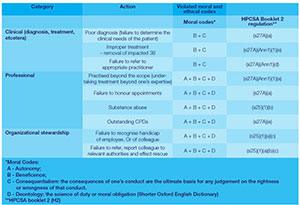
The Table below provides a synopsis of actions, inactions, and related ethical principles and moral rules that have been violated or disregarded.
CONCLUSION
This case highlighted the nuances of non-maleficence, including the failure by clinicians to recognise the intricacies of their conduct as possible causes of harm to patient. As discussed in this article, any form of omission or abdication of professional rules, renunciation of moral rules, and disregard of codes of practice, is tantamount to a commission of maleficence. Similarly, failure to act according to the scope of practice, or to discharge clinical responsibilities with necessary care is maleficent.
At the very least practitioners should remember the maxim primum non nocere or at the very least do no harm. This might be challenging as most clinicians have a limited understanding of the concept of harm.
References
- 1. Dhai A. The Life Esidimeni tragedy: constitutional oath betrayed. South African Journal of Bioethics and Law 2017; 10: 40-1.
- 2. Al-Bar MA and Chamsi-Pasha H. Non-maleficence. Contemporary Bioethics. Springer, 2015, p. 119-28.
- 3. Andersson GB, Chapman JR, Dekutoski MB, et al. Do no harm: the balance of "beneficence" and "non-maleficence". LWW, 2010.
- 4. Beauchamp TL and Childress JF. Principles of Biomedical Ethics. Oxford University Press, USA, 2001.
- 5. Paranhos FRL, Garrafa V and Melo RL. Critical analysis of the principle of benefit and harm. Revista Bioética 2015; 23: 12-9.
- 6. Frankena WK. Ethics: Foundations of Philosophy Series. 1973: 16-7.
-
7. Walen AD. Choosing your reasons for an action: Moral permissibility, willful action, and the doctrine of double effect. 2011. Available at SSRN : http://ssrn.com/abstract=1447042.
» http://ssrn.com/abstract=1447042 - 8. Gillon R. "Primum non nocere" and the principle of non-maleficence. British Medical Journal (Clinical Research ed) 1985; 291: 130.
- 9. Gillon R. Medical ethics: four principles plus attention to scope. British Medical Journal 1994; 309: 184.
- 10. Young A. The legal duty of care for nurses and other health professionals. Journal of Clinical Nursing 2009; 18: 3071-8.
- 11. Fullbrook S. The duty of care, 1: compliance with directives and protocols. British Journal of Nursing 2007; 16: 574-5.
- 12. Hunter D and Salzman J. Negligence in the air: the duty of care in climate change litigation. U Pa L Rev. 2006; 155: 1741.
Pagollang D Motloba
Chief Specialist, Head of Department, Community Dentistry
School of Oral Health Sciences - Sefako Makgatho Health Science University
Tel: +27 12 521 4848
Email: